
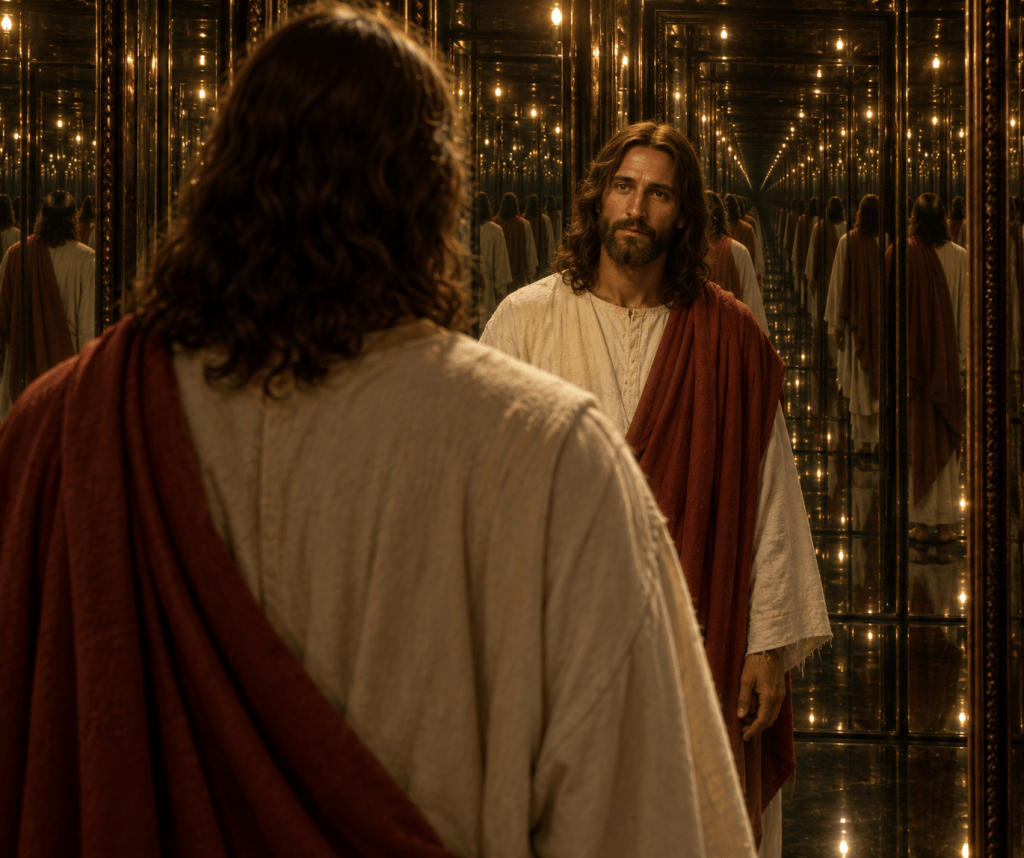
Our saint for today is Hildegard of Bingen, born in 1098. Hildegard was a great teacher and advisor to everyone from the average person on the street to kings, queens, and Popes. Many of her letters are preserved, and today I would like to share one she wrote to Elisabeth of Schoenau, who led the double monastery in Schoenau, Germany. Hildegard writes,
“I, a poor little form and earthen vessel, speak these things not from myself but from the serene light: Man is a vessel which God fashioned for himself, which he imbued with his spirit, so that he might accomplish his works in him.”
Hildegard then speaks of God’s creation and leading up to the fall. She cries out, “Oh woe!” She continues, “Then all the elements enfolded themselves in the alternation of light and shadows as man did in transgressing God’s commands. God, however, strengthened/irrigated certain men, lest man be completely despised. Abel was good, but Cain a suicide. And many saw the mysteries of God in the light, but others committed many sins, until that time came in which the word of God was manifest as it is said: Beautiful in form beyond the sons of men. Then the sun of justice appeared and illuminated men with good works in faith and in act, just as the dawn comes first, and the other hours of the day follow, until night arrives. Thus, o daughter Elisabeth, is the world changed. For the world is already weary in all the greenness of virtues, that is at dawn, prime, ters, and in the strongest hour of the day, at sext. But in this time it is necessary for God to strengthen/irrigate some men, lest his instruments be idle. Hear, o anxious daughter, that the ambitious suggestions of the ancient serpent are worrying somewhat those men whom the inspiration of God has so imbued. For when that same serpent sees an elegant gem, he roars, saying: “What is this?” And he worries it with many miseries of the burning mind, desirous of flying over the clouds, as if they were Gods, just as he did. Now hear again: Who desire to accomplish the works of God, let them always consider that they are earthen vessels, since they are men, and let them always reflect on what they are and what they will be, and leave heavenly things to [him] who is of heaven, since they are exiles, not knowing heavenly things, but only reciting the mysteries of God, just as a trumpet only makes sounds, but does not cause them; someone blows in it in order to make the sound. But the mild put on the [armor] of faith, being gentle, poor, and unfortunate, having the simple habits of children, just as he whose trumpet sounds they are was a Lamb, since God always scourges those who sing in his trumpet, taking care lest their earthen vessel perish, except as it pleases Him. O daughter, let God make you a mirror of life. But I too lie in the [timidity] of my mind, fatigued much by fear, sounding a little, at times, like the small sound of a trumpet from the living light. Whence God help me, that I may remain in his ministry.”
I was struck by the line, “O daughter, let God make you a mirror of life.”
Do you remember Clare of Assisi and her letter to Blessed Agnes of Prague? In it, Clare implored Agnes to “Look more deeply into the mirror and meditate on” the characteristics of Jesus. Clare asks Agnes to gaze into Christ as into a mirror, contemplating him so deeply that her own life is conformed to what she sees. I see “O daughter, let God make you a mirror of life” as an extension of this teaching: Clare tells us to look into a mirror and see Jesus, and Hildegard tells us to be a mirror and reflect Jesus into the world.
Imagine the infinite mirror effect. There is a mirror in front of you and a mirror behind. You stand between them, but instead of seeing yourself, you see Jesus, and that reflection continues into eternity.
Jesus said, “Those who do what is true come to the light, so that it may be clearly seen that their deeds have been done in God.” Perhaps this is the life Clare and Hildegard are calling us to live: a life between the mirrors—beholding Christ until, by grace, we begin to reflect the Christ we behold.
Question: What are you reflecting?
 Candle in a Cave