Pip: If you have ever wondered whether a snowplow could double as a theological argument, Fr. John has an answer for you — and it leads somewhere genuinely worth going.
Mara: This episode follows one extended sermon from Candle in a Cave, working through the question of whose image we carry — and what happens when the world starts stamping its own version over it.
Pip: Caesar's coin, a damaged statue in Santiago, and a bird that cannot take off without wind. Let's start with the coin.
Whose Image Do You Actually Wear
Mara: The sermon opens with the familiar trap question put to Jesus — pay taxes to Rome, yes or no — and the answer that sidesteps the snare entirely. The real weight, though, lands on the second half of Jesus's reply, the half he leaves implied.
Pip: The setup for that implication is a direct citation from Genesis, and it lands like a key turning in a lock. Here it is: "So God created man in his own image, in the image of God he created him; male and female he created them."
Mara: So the upshot is this — the coin belongs to Caesar because it bears Caesar's image; you belong to God because you bear God's image. The logic is clean, and St. Hilary of Poitiers makes it explicit: "give therefore your money to Caesar, but preserve a conscience void of offense for God."
Pip: But here is the complication the sermon presses on. When a Roman emperor died, the mint started stamping new coins with the new face. The image changed. And the same drift, the sermon argues, happens to us — not that God's image leaves, but that the world layers its own stamp over it.
Mara: The illustration that makes this concrete is a damaged statue in the church of San Fiz of Solovio in Santiago, Spain — a figure that might be the Apostle John, but whose left hand is missing and whose identifying object is gone. A hundred percent positive identification was not possible.
Pip: Which is a quietly devastating image for what the sermon is actually asking: can the people around you still read whose you are?
Mara: And the sermon's answer to distortion is not the lecture everyone expects — more confession, more prayer, more Bible reading. Instead it reaches for St. Francis de Sales and a bird Aristotle called the apode, a creature with legs too weak to launch itself back into the air. The wind has to do it.
Pip: Grace as weather. You do not manufacture the lift; you open your wings.
Mara: The closing line the sermon returns to is from First John: "We love because he first loved us." The image of God may blur, the sermon says, but God's recognition of us does not fail — which is the exact reversal of the opening joke, where God genuinely could not pick Shirley out of a lineup.
Pip: Shirley worked very hard to become unrecognizable. The sermon's invitation runs the other direction entirely.
Mara: Not to make ourselves worthy before approaching, but to bring the distorted image — scars, world-stamps, and all — and open to the grace that has not stopped moving.
Mara: The coin, the statue, the apode — three images for the same question: what does it take to stay recognizable to the one who made you?
Pip: Apparently less effort than Shirley put in, and more willingness to let the wind do the work. More next time.
A woman named Shirley had a heart attack and was taken to the hospital.
While on the operating table, she had a near-death experience. She saw God and asked, “Is this it?” God said, “No, you have another 30 to 40 years to live.”
Upon her recovery, she decided to stay in the hospital and have collagen shots, cheek implants, a facelift, liposuction, and a bit of augmentation. After getting out, she dyed her hair and got a tattoo. She figured that since she had another 30 to 40 years, she might as well make the most of it.
Walking out of the gym where she was whipping the rest of herself into shape, she was hit by a snowplow and died.
Arriving before God, she said, “I thought you said I had another 30 to 40 years?”
God replied, “Shirley! I’m sorry, but I didn’t recognize you!”
The Pharisees and Herodians didn’t typically associate with one another, but in today’s gospel reading we see them team up to trap Jesus.
They first gush out some false praise, then ask their question: “Tell us, then, what you think. Is it lawful to pay taxes to the emperor, or not?”
Jesus, knowing their hearts, recognizes the question as a trick. If he answers, “Yes, it is lawful to pay taxes to the emperor,” he will appear to side with the occupying government. If he says, “No,” then they can turn him over to the Romans for sedition. So he asked for a coin that would have been used to pay the tax, but instead of answering their question, he asked, “Whose head is this, and whose title?” They answered, “The emperor’s.” In response, Jesus says, “Give therefore to the emperor the things that are the emperor’s, and to God the things that are God’s.”
It is a brilliant response. Give the government what is legally the government’s; give God what is legally God’s. The first part is clear—the coin bears Caesar’s image and represents Caesar’s authority; therefore, give Caesar what is properly owed him. The second part is implied.
Jesus does not specifically cite Genesis, but it is there. Genesis (1:26-27) states,
“Then God said, ‘Let us make man in our image, after our likeness. And let them have dominion over the fish of the sea and over the birds of the heavens and over the livestock and over all the earth and over every creeping thing that creeps on the earth.’
So God created man in his own image, in the image of God he created him; male and female he created them.”
As the coin, stamped with the Emperor’s image, is under the emperor’s authority, so you, made in the image of God, are under God’s authority. St. Hilary of Poitiers writes, “It behooves us also to render unto God the things that are His, namely, body, soul, and will. For Caesar’s coin is in the gold, in which His image was portrayed, that is, God’s coin, on which the Divine image is stamped; give therefore your money to Caesar, but preserve a conscience void of offense for God.”
We understand this and try to be obedient to this calling, but along the way, something happens.
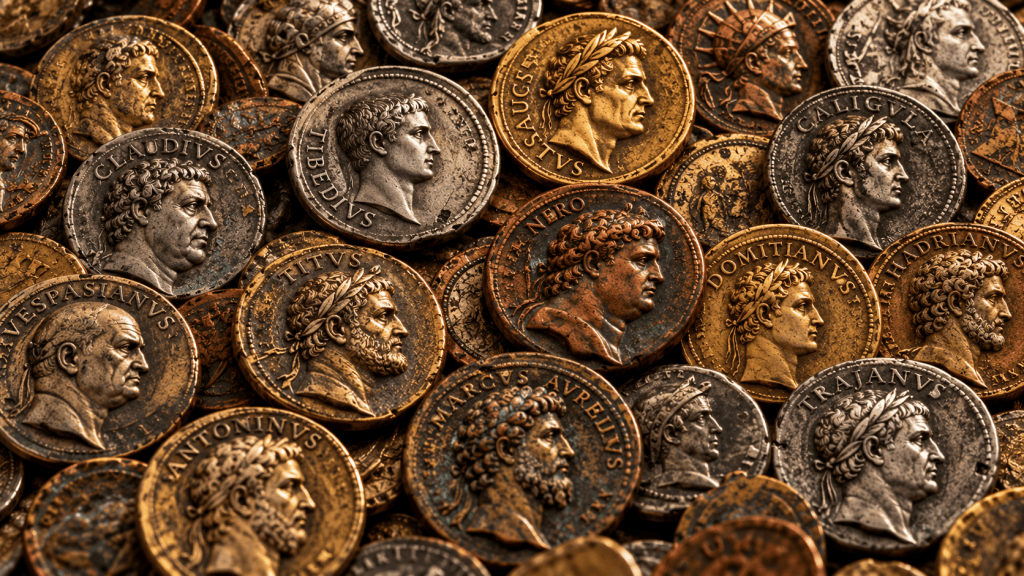
When the question is asked about the coin, “Whose head is this and whose title?” Another answer could have been given: “Well, it depends on the day.” Why? Because when an emperor died, the empire began minting coins with the new emperor’s image. So, although the coin remains the emperor’s, it is stamped to represent the current political regime, and the same thing can happen to us.
The image of God we were created in never leaves us, but it can become distorted and reminted by the world around us. Like the Emperor’s coin, it can depend on the day, or even the time of day.
Come Sunday morning, the image we present may reflect forgiveness and kindness, but come Sunday night, with Monday looming, that image may show uncharitable ambition or pride. In the mornings, when we are with family and children, we may show joy and patience, but as soon as we get behind the wheel of the car, we bring on anger and impatience. What image do you present? Well, it depends on the day. Over time, the image of God remains, but it can become distorted beneath everything else that the world stamps upon it.
Over the last couple of weeks, I had the opportunity to serve in the church of San Fiz of Solovio in Santiago, Spain. It is a church that has been built, destroyed, built again, destroyed again, and so on. The altars, retables, statues, and most everything about it has been replaced, moved, or simply lost. So, to pass the time, I set out to track down who some of the Saints represented were. The Virgin Mary is fairly straightforward, but others are much harder to identify.
To properly identify a statue, you need to discover the symbols it is adorned with, the color of its garments, and even its placement in the church. For example, a statue of the Apostle John was easy to identify: youthful, with red hair, holding a book, and a pulpit shaped like an eagle, which always symbolizes John. However, there was a much older statue of a youthful person with what could have possibly been red hair, but his left hand was missing, and although the right hand was present, the object he held was missing. The colors of its garments match those of many other statues of the Apostle John, but in the end, a 100% positive identification of the image was not possible.
I am made in the image of God. You are made in the image of God. Question: Like the Emperor’s coin, is that image still recognizable, or has the world stamped you with its own image, distorting God’s image? Like an old statue in a much older church, have parts of the image of God been lost behind this world’s concerns and other life events?
If we are honest with ourselves, we will all say the image of God within us has become distorted or blurred. We may even think that parts have gone missing—broken off and lost forever. But honestly, that is just the devil whispering despair in your ear, for that image of God is still present, although distorted.
So how do we clear away the distortions and reveal those parts that appear to be missing?
Everybody says, “Now here’s where Father John gives us a great lecture. He will proceed to tell us why we should go to confession, pray more earnestly, and read our Bibles more devoutly.” Well, sure you could do those things and you probably should, but that’s not the answer.
I’ve been working my way through St. Francis de Sales’ Treatise on the Love of God, and in one chapter he refers to a certain bird Aristotle calls apodes: “because having extremely short legs, and feeble feet, they use them no more than if they had none.” People believed that if an apode ever landed on the ground, it could not take flight again and would die unless the wind blew. Then it could stretch out its wings and be lifted into the air again.
Using this example, Francis tells us that God’s grace, His love, is like the wind, a wind that is constantly blowing, and that we are like those apodes, unable to take flight on our own. To take flight, to enter into God’s grace, we must stretch out our wings; that is, we must participate in God’s grace and be open to Him.
When the image of God becomes distorted, we believe we must “whip ourselves into shape” so that God will love us, but that is backward. What did St. John tell us? “We love because he first loved us.” (1 John 4:19) When the image of God is distorted, we must open to God—the wind of grace is already blowing. God is not waiting for you to get your act together before his grace works in your life. No. God’s grace is already reaching toward you. He invites you to open your wings, to open yourself to the love that has been there all along.
Our reflection of God’s image may become clouded, but God’s love for us does not diminish. We may fail to recognize God’s presence within ourselves and others, but God never fails to recognize us.
Jesus asked them to bring him a coin, to look upon its image, and to recognize whose it was. Perhaps He invites us to bring our lives before Him as well.
Not because we have already made ourselves worthy. Not because we have successfully removed every imperfection. Not because we have finally become the people we ought to be. But simply because we belong to Him.
We come with our failings, our fears, our scars, and all the ways the world has tried to stamp its image on us.
And we open ourselves to the grace that God has never stopped offering.
The Christian life is not about making ourselves into someone God might someday love. It is about allowing God’s love to reveal more fully the image He placed within us from the beginning.
“We love because He first loved us.”
Let us pray: Pour forth, we beseech Thee, O Lord, Thy grace into our hearts; that we, to whom the incarnation of Christ, Thy Son, was made known by the message of an angel, may by His Passion and Cross be brought to the glory of His Resurrection, through the same Christ Our Lord. Amen.
Pip: There's a sermon on this week's feed that opens with a joke about Joan of Arc — and somehow lands in the middle of the Sinai desert without losing anyone. Fr. John has been busy.
Mara: This episode covers one sermon — but it moves through a lot of territory: wilderness thirst, reasonable expectations, a parable about a vineyard, and what the Church is actually for. Let's start with the desert.
Sermon: Proper 21 RCL A1 — Massah and Meribah
Pip: The sermon opens with a question the Israelites asked at Rephidim — "Is the Lord among us or not?" — and it's framed not as ancient faithlessness but as something recognizable. The tension is between reasonable expectation and a wasteland where nothing arrives.
Mara: The setup matters here. The Israelites weren't wandering blindly — they were traveling oasis to oasis, as commanded. The sermon notes, "The whole congregation of the Israelites journeyed by stages, as the Lord commanded." They did what they were told, and they arrived somewhere dry.
Pip: Which is the real sting of the story. This wasn't recklessness punished — it was faithfulness that hit a wall. You followed the route, and the oasis was empty.
Mara: And the sermon is careful not to let the congregation feel superior to the Israelites. It points out that these are the same people who witnessed the ten plagues, the parting of the sea, the cloud by day and fire by night — and roughly forty-five days later, they're questioning whether God is present at all. The place gets renamed: Massah and Meribah, testing and quarreling.
Pip: Right — and the sermon doesn't leave it as a cautionary tale about ancient ingratitude. It pivots to something harder.
Mara: Much harder. It asks whether each listener has a place in their own life that started as Rephidim — a legitimate destination — and became Massah and Meribah. The sermon lists it plainly: "The prayer isn't answered, the relationship cracks, the sickness persists… there is no water."
Pip: That's where the parable of the two sons comes in, and it's doing more work than it might seem.
Mara: The sermon focuses on the first son — the one who says no and then goes anyway. Nothing changes externally; there's still no water. What changes is the son. And the sermon offers two reasons he goes back: obedience, and relationship. It calls obedience "a very distant second."
Pip: The primary reason is that the son knows the father has always been faithful — so he trusts the father has reasons, even when the vineyard is brutal and the water hasn't come.
Mara: The sermon closes with something specific about what the Church can and cannot do. It doesn't promise a timeline. It says, "I can sit with you in Rephidim. When you cannot remember what God has done, I can remember it for you. When you cannot pray, I can pray for you." The community itself becomes the evidence that God is present.
Pip: Which is a quieter answer than most people want — but probably the only honest one available.
Mara: The through-line here is expectation — what we're owed, what we trust, and what we do when the oasis is dry.
Pip: Next time, bring water. Or at least someone who remembers where the last spring was.
After five years of therapy, a psychiatrist told his patient, “We don’t often use the word cured, but I’m pleased to tell you that I believe you’re completely cured.”
To his surprise, the woman looked deeply disappointed.
He said, “What’s wrong? I thought you’d be thrilled.”
She said, “Doctor, look at it from my point of view. Five years ago I was Joan of Arc. Now I’m nobody.”
Expectations are funny things. They don’t just affect how we feel about what happens. They also shape how we interpret it.
Some expectations are fanciful: when I was about eight, I wanted a pair of leather pants because I expected to grow up and be a cowboy, and of course I couldn’t be a cowboy without them. Other expectations are more reasonable: you purchase a plane ticket from point A to point B, and you can pretty much expect to land at about the correct time at point B.
Today in our reading from Exodus, we hear of a reasonable expectation followed by disappointment.
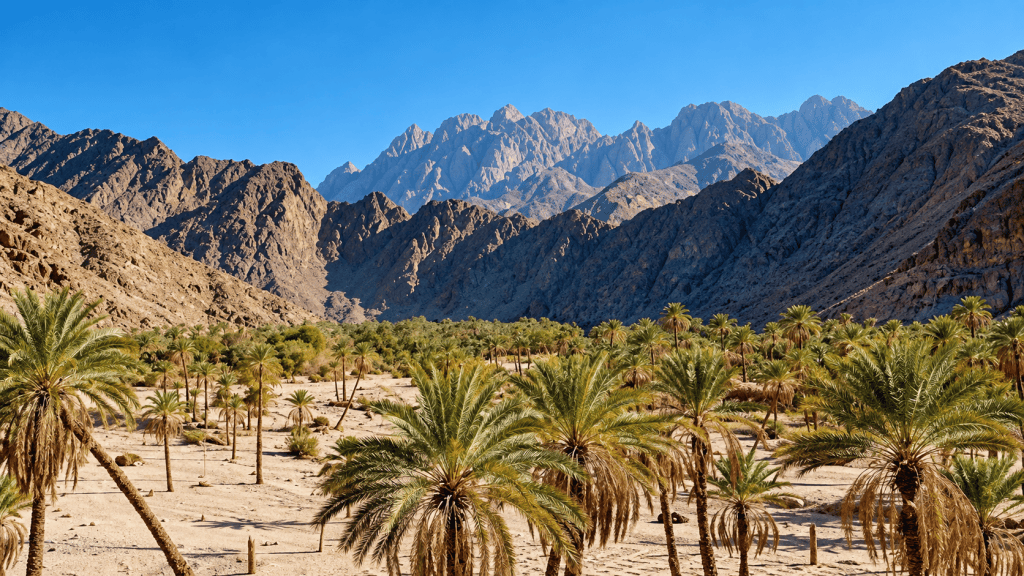
The Israelites are a desert people; they know you can never travel too far from a water source. So, to get somewhere, you don’t necessarily travel in a straight line. Instead, you travel from one oasis to the next. This is what the Israelites did because it was smart if you wanted to live, and because God told them to: “The whole congregation of the Israelites journeyed by stages, as the Lord commanded.” By doing this, they came to Rephidim. The picture on the front of your bulletin shows the traditional site. It is an oasis. Why did they go there? The text is not explicit, but it is safe to say they had a reasonable expectation that there would be water.
Being in the desert without water is death, so the people quarreled with Moses: “Why did you bring us out of Egypt, to kill us and our children and livestock with thirst?” Then they asked a hard question: “Is the Lord among us or not?”
We read the words of the Psalmist: Hear my teaching, O my people; incline your ears to the words of my mouth. He worked marvels in the sight of their forefathers, in the land of Egypt, in the field of Zoan. He split open the sea and let them pass through; he made the waters stand up like walls. He led them with a cloud by day, and all the night through with a glow of fire.
The people at Rephidim who asked, “Is the Lord among us or not,” are the same people who have experienced these praiseworthy deeds and witnessed the power of the Lord. Yet about 45 days later, when their expectations were not immediately met, they quarreled over whether God was with them.
Despite their complaints against God, the miracle came, and water flowed from the rock at Horeb. The miracle is remembered, but so is the complaining. Moses called the place Rephidim Massah and Meribah, meaning testing and quarreling. Years later, the Psalmist will instruct the people,
Today, if you hear his voice, do not harden your hearts, as at Meribah, as on the day at Massah in the wilderness, when your fathers put me to the test and put me to the proof, though they had seen my work. (Psalm 95:8-9)
Sitting here in our nice air-conditioned church, it is easy to be critical of the Israelites: “You had firsthand knowledge of all God can do, and now you’re complaining. What’s a little water when you’ve lived through the ten plagues of Egypt and seen the sea parted?” However, I suspect there is a place in each of our lives that was once Rephidim but has become a place of Massah and Meribah—a place where we grumble because, even though we’ve done all God asked in the way He asked, there is no water.
You’ve gone to church, you’ve confessed your sins, you’ve prayed, you’ve knocked because you believe Jesus’ words, and you’ve been faithful; therefore, you have a reasonable expectation that God will act in a certain way. Yet there is no water. The prayer isn’t answered, the relationship cracks, the sickness persists… there is no water.
Like the Israelites, whether spiritually or physically, you need water to live. There is a possibility the Lord will provide a rock at Horeb—water—but there is also the possibility that Riphidim remains a barren and dry place, a place of Massah and Meribah—testing and quarreling. And in that place you may ask, “Is God with me or not?”
As a deer pants for flowing streams, so pants my soul for you, O God. My soul thirsts for God, for the living God. When shall I come and appear before God? My tears have been my food day and night, while they say to me all the day long, “Where is your God?” (Psalm 42:1-3)
In your thirst, what are you to do?
Today, Jesus tells us the parable of the father with the vineyard and two sons: “A man had two sons; he went to the first and said, ‘Son, go and work in the vineyard today.’ He answered, ‘I will not’; but later he changed his mind and went. The father went to the second and said the same; and he answered, ‘I go, sir’; but he did not go.”
Now, imagine you are that first son. You’ve been going to work in that vineyard day after hot, sweaty day, but on this day you’ve had enough. Your father asks you, and without giving any reason, you say no. Notice, the father does not offer you an increase in your allowance or any other reward, but neither does he beg or threaten. The father simply asks. You say no, but after a time you have a change of heart—nothing has changed; there is still no water—nothing has changed except you. Why did you go into the vineyard to work?
I would suggest two possible reasons. First, there is obedience. You have been asked by your father, one who is in authority over you, to carry out a task. You can obey or not. So, you may have had a change of heart because you recognize the father’s authority. However, in this case, I think obedience is a very distant second to the main reason behind your change of heart.
The main reason is the relationship between the father and the son. The son knows that the father has always cared for him, provided for his needs, and been faithful in all things. The son knows that his father loves him. Therefore, in response to the father’s love, the son goes and works in the vineyard. Nothing has changed; there is still no water, but because of the father’s loving faithfulness, you know he has his reasons. It may not look like what you wanted. It may not be what you think you need. Yet God is with you. He has always been with you and loved you.
You are faithful. To the best of your ability, you do what our heavenly Father asks, so you have a reasonable expectation that when you ask for water—peace, healing, renewal, consolation, answers—God will provide. Yet when you get to Rephidim, it is a wasteland. It hurts and is disappointing, but that doesn’t mean God is absent. We remember the Father’s loving kindness and trust that he is with us.
You say, “That’s all well and good, Father John, but I’m dying of thirst out here.” You say with David,
O God, you are my God; earnestly I seek you; my soul thirsts for you; my flesh faints for you, as in a dry and weary land where there is no water. (Psalm 63:1)
Yet when we say these things, the Lord replies as he did to the Prophet Isaiah:
When the poor and needy seek water, and there is none, and their tongue is parched with thirst, I the Lord will answer them; I the God of Israel will not forsake them. I will open rivers on the bare heights, and fountains in the midst of the valleys. I will make the wilderness a pool of water, and the dry land springs of water. (Isaiah 41:17-18)
“Yes, yes, yes,” you say. “God will do those things, but when? I’m thirsty now.”
I know.
And I wish I could tell you where your rock of Horeb is. I wish I could tell you when the water will come, but I can’t. Still, there are things I can do. I can sit with you in Rephidim. When you cannot remember what God has done, I can remember it for you. When you cannot pray, I can pray for you. When you ask, “Is the Lord among us or not?” I will stay with you as we wait. You see, that is what the Church does. We don’t pretend there is water when there isn’t. We don’t tell thirsty people they simply haven’t prayed hard enough. We don’t explain away the wilderness. Instead, we sit together, just as we are doing today. And perhaps that is how we know the Lord is among us. Because we can reach out and touch Him in the person next to us.
Let us pray: O Lord our God, grant us to trust in your overshadowing wings. Protect us beneath them and bear us up. You will carry us as little children; even to our grey-headed age, you will carry us still. When you are our strong security, that is strength indeed. Amen.
The Apostle Paul planned to visit Iconium in central Turkey. When he arrived, the people wrote a description of him: “At length they saw a man coming (namely Paul), of a small stature with meeting eyebrows, bald [or shaved] head, bow-legged, strongly built, hollow-eyed, with a large crooked nose; he was full of grace, for sometimes he appeared as a man, sometimes he had the countenance of an angel.” (Source) That description appears in a second-century text: The Acts of Paul and Thecla. An early commentator described it as “religious romance,” not a romance between a man and a woman as we understand it, but a shared romance of sharing the Gospel.
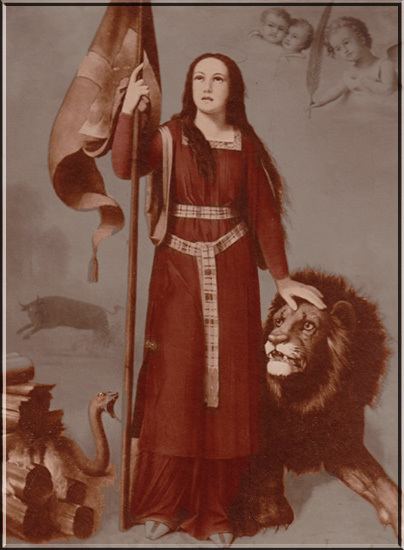
While Paul was visiting Iconium, Thecla sat on her windowsill for three days without eating or drinking and listened to Paul teach on chastity and purity. Following that teaching, she swore off marriage, ended her engagement, and pledged to follow Paul as a helper. Her fiancé, not at all pleased with this decision, brought charges against her. She had agreed to marry, and getting married and having children was what women were for. Not only was her choice to remain unmarried against the will of her fiancé and family, but it was also against the will of the state: you can’t have women going off with these funny ideas of not producing children. Her sentence: to be burned at the stake. She was tied up, the fire was set, and… there was a great flood of rain. She escaped her death sentence and went to Antioch with Paul.
I’m guessing she was more attractive than he was. Once there, she caught the attention of a city official who desired her, but she rebuffed him as well, which sent him into a fit and prompted him to call for her death. This time, she was set in the arena with wild beasts—twice. The first time, the lioness sent in to kill her only licked her feet. The second time, the lioness protected Thecla by killing another lion and a bear, then lay down at Thecla’s feet. In the end, the text reports that the Apostle Paul sent Thecla back to Iconium to do two things: preach and baptize. This may be why the Acts of Paul and Thecla do not appear in the canon of scripture or even in the apocrypha, and why it was condemned by Tertullian, who, writing on baptism and Paul, stated, “For how credible would it seem, that he who has not permitted a woman even to learn with over-boldness, should give a female [Thecla] the power of teaching and of baptizing!”
The Psalmist writes,
Because you have made the Lord your refuge, *
and the Most High your habitation,
There shall no evil happen to you, *
neither shall any plague come near your dwelling.
For he shall give his angels charge over you, *
to keep you in all your ways.
They shall bear you in their hands, *
lest you dash your foot against a stone.
As I read Thecla’s story, I considered that Psalm and remembered the words Joshua said to the people, “It is the Lord your God who fights for you, just as he promised you.”
So often, when we come up against an adversary, whether it be someone or something in the world, our own inner ‘demons,’ or events such as sickness or hardships, we can believe we are in it alone. But if we remember Thecla, we remember that our God douses the flames and turns back the wild beast. The Lord our God is one who gives his angels charge over us, so that our souls and eternal lives will always be saved.
The next time you face trouble, remember Thecla, who even in the face of death stood and did battle and, through the Lord, overcame her adversary.
Pip: Fire-breathing dragons, a martyrdom at the altar, and a painter who hid himself in the scene running away — Fr. John has been busy.
Mara: This episode follows a single sermon preached on the Feast of St. Matthew, tracing the saint's legend from Jerusalem to Ethiopia, and ending with a question about what it means to keep looking back at the Gospel even as we walk away from it.
Pip: Let's start with the legend itself, and what it asks of us.
Matthew, Ethiopia, and the Man Running Away
Mara: The sermon opens in apocryphal territory — not the canonical Gospels but the Acts of the Holy Apostle Thomas, where the apostles divide up the known world before scattering to evangelize it.
Pip: The verbatim passage sets the scene directly: "we the apostles were all in Jerusalem — Simon called Peter, and Andrew his brother; James the son of Zebedee, and John his brother; Philip and Bartholomew; Thomas, and Matthew the tax-gatherer… and we portioned out the regions of the world, in order that each one of us might go into the region that fell to him."
Mara: Matthew's region, according to Jacobus de Voragine's Golden Legend, is Ethiopia — where he settles with the very eunuch Philip had baptized on the road to Gaza, and spends thirty-three years converting the country.
Pip: Dragons lay down at his feet. A king's son rises from the dead. The king announces, quote, "Come and see God in the likeness of a man" — and Matthew redirects all the gold toward building a church. Quite the ministry.
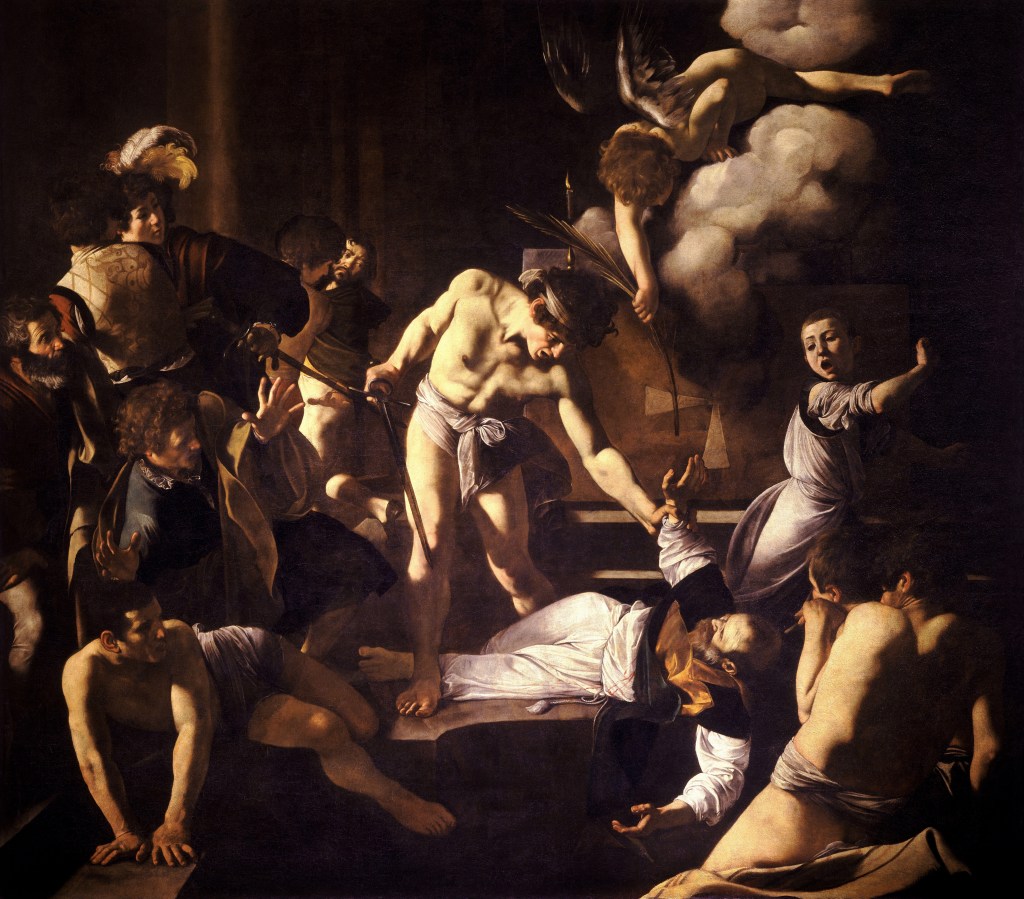
Mara: The sermon doesn't stop at the legend. It moves to Caravaggio's Martyrdom of Saint Matthew in Rome, where the saint lies on the altar steps, hand raised — not to ward off the executioner's blow, but to receive a palm branch from an angel above.
Pip: And then the sermon finds its real subject: a second face in the painting. Just behind the executioner's shoulder, Caravaggio painted himself — watching the scene and walking away from it.
Mara: The sermon asks what that figure means for the rest of us. The words are plain: "We hear the Gospel. We know what Christ asks of us… And sometimes we do. But sometimes we turn away. Sometimes the demands of the Gospel are more than we want to bear."
Pip: But the man is still looking back. That's the hinge the whole sermon turns on.
Mara: Right — and the sermon holds that tension without resolving it cheaply. The question it leaves is not whether we'd have the courage to die as Matthew did, but whether we have the courage to turn around while we're still alive.
Pip: The palm branch is waiting. The painting says the journey isn't over yet.
Mara: A saint's legend, a Caravaggio self-portrait, and a question about where we place ourselves in the scene.
Pip: Still looking back. Which, apparently, is where grace begins.
The canonical books of Holy Scripture run from Genesis through Revelation, and the Episcopal Church also recognizes the Apocrypha—Bel and the Dragon, the Book of Wisdom, and others—but does not use them to establish doctrine, rather as suitable “for example of life and instruction of manners.” (BCP 868) However, these are not all. Many other books have been passed down that are hard to classify and are known as the New Testament Apocrypha and Pseudepigrapha, such as the Infancy Gospel, the Ascent of Isaiah, and the Apocalypse of Peter, to name a few. The one where our story begins today is the Acts of the Holy Apostle Thomas.
It is primarily the story of Thomas and how he evangelized India, but it begins in Jerusalem. “At that time we the apostles were all in Jerusalem — Simon called Peter, and Andrew his brother; James the son of Zebedee, and John his brother; Philip and Bartholomew; Thomas, and Matthew the tax-gatherer; James of Alphæus and Simon the Cananæan; and Judas of James; — and we portioned out the regions of the world, in order that each one of us might go into the region that fell to him, and to the nation to which the Lord sent him.”
If this is to be trusted, our Patron Saint Matthew was in attendance, but from there the legends and traditions take many different directions. Today, I’m using Jacobus de Voragine’s Golden Legend because that legend is linked to the painting on the cover of your bulletin.
In Acts of the Apostles, an angel instructed Philip to go to Gaza. There, he met “an Ethiopian, a eunuch, a court official of Candace, queen of the Ethiopians.” The Ethiopian was trying to understand a passage from the Book of the Prophet Isaiah. Philip explained it, and the Ethiopian was converted.
Years later, according to the Golden Legend, after the meeting in Jerusalem when they divided up the known world, we are told that Matthew went down to Ethiopia, where he “stayed with the eunuch of Candace the Queen, whom Philip had baptized.”
Using the Eunuch’s home as his base, Matthew went out and began evangelizing. Along the way, he had some rather interesting encounters with magicians. On one occasion, “a man came to them and reported that the magicians had arrived with two dragons, which breathed fire and sulfur from their mouths and nostrils and killed everyone they encountered.” Matthew, armed with the sign of the cross, went out to meet these magicians and their dragons. As soon as they saw Matthew, the two dragons approached him, lay down at his feet, and went to sleep.
A verbal confrontation with the magicians follows, ending with Matthew waking the dragons and sending them away. Is that a true story? Let me ask you, when was the last time you saw a fire-and-sulfur-breathing dragon?
Later, the king’s son died, and Matthew raised him to life. The king declared far and wide, “Come and see God in the likeness of a man.” The people came, bringing gold and wanting to make sacrifices to Matthew, but he said to them, “What are you doing? I am not God. I am the servant of our Lord.” He commanded that the gold and silver be taken and used to build a magnificent church, completed in thirty days. From this church, Matthew ministered the Gospel for thirty-three years, converting all of Ethiopia.
During that time, Matthew established a convent where some two hundred virgins lived and prayed. One of them, Ephigenia, caught the eye of the new king, Hirtacus, who ascended the throne after the king whose son Matthew had raised died.
Hirtacus greatly desired Ephigenia and pleaded with Matthew to release her and persuade her to come and be his bride. In response, Matthew told the king to do as his predecessor had done and come to church on Sunday. The king was happy, thinking Matthew would do as he commanded.
In concluding his sermon, Matthew said that marriage is good when it is faithfully preserved in a good covenant. But then he said: “You who are gathered here know well that if a servant were to take the wife of a king, he would not only offend the king but would deserve death—not simply because he wished to marry her, but because in taking his lord’s bride he would violate the marriage that already joined them.”
“And you, O king, know that Ephigenia has become the bride of the everlasting King [Jesus] and has been consecrated to him by the holy veil. How, then, can you take the wife of a mightier King and join her to yourself in marriage?”
As you can imagine, the king was not pleased and flew into a rage. The Golden Legend tells us, “After the solemn celebration of the Mass, the king sent an executioner, who killed Matthew from behind with a sword as he stood beside the altar with his hands raised toward heaven.”
In the Church of San Luigi dei Francesi in Rome, three paintings by the great Italian painter Caravaggio hang in a small chapel near the high altar: The Calling of Saint Matthew, The Inspiration of Saint Matthew, and The Martyrdom of Saint Matthew. I would wager you would recognize them if you saw them, and The Martyrdom of Saint Matthew is the one on the cover of your bulletin.
Matthew lies on the altar steps, and his executioner holds Matthew’s wrist. It appears as though Matthew is holding up his hand, as if trying to ward off another blow, but he is instead reaching out to take the palm branch the angel above the altar is handing him.
The Book of Revelation describes the vision St. John had. At one point, John sees “a great multitude that no one could number… clothed in white robes, with palm branches in their hands.” (Revelation 7:9) When John asks who these people are, he is told, “These are the ones coming out of the great tribulation. They have washed their robes and made them white in the blood of the Lamb.” (Revelation 7:14)
Matthew reaches for the palm branch, the sign of his martyrdom.
Is the whole story true? I’ll let you be the judge, but I suspect that behind the dragons’ wings, there is a good bit of truth about our Patron Saint.
Some may say, “That’s a nice story, Father John, but what’s it got to do with us, with me?” The answer, I see, is not in the story but in the painting.
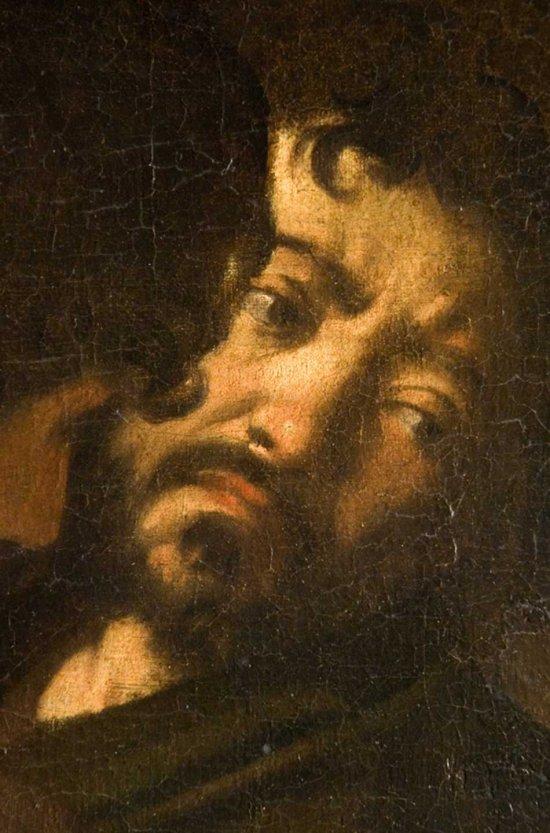
If you were at our Wednesday night study, you may recognize a face in the painting. On Wednesday, we looked at Caravaggio’s painting of David and Goliath. David holds up Goliath’s head, and Goliath’s face is Caravaggio’s self-portrait. Caravaggio also includes a self-portrait in The Martyrdom of St. Matthew.
The executioner is in the center. There is a face just to the left of the executioner’s left shoulder. It is believed to be Caravaggio. He has painted himself looking on this horrific scene while running away.
Now, I don’t know what Caravaggio intended by placing himself in this painting, and I’m not going to pretend that I do. But I wonder what we might learn from this man who is running away while looking back.
He sees the violence. He sees Matthew lying on the steps. He sees the executioner standing over him. And he is leaving.
But he is still looking back.
I wonder how often that is us.
We hear the Gospel. We know what Christ asks of us. We know we are to love God with all our heart, soul, and mind, and our neighbor as ourselves. We know we are to forgive, to show mercy, to care for those in need, and to take up our cross and follow him.
And sometimes we do.
But sometimes we turn away. Sometimes the demands of the Gospel are more than we want to bear. Sometimes the world offers us something that seems a good bit easier than following Christ.
And we walk away.
But we keep looking back.
I wonder if Caravaggio’s self-portrait might tell us something about the grace of God. For even as this man is leaving the scene, he has not entirely turned his back on what is happening. Something still holds his attention.
And perhaps that is where the work of grace begins.
Look again at Matthew. He is reaching toward the palm branch, the promise of victory and eternal life. His earthly journey is coming to an end.
But Caravaggio’s journey is not over.
He is still alive. He still has time to turn around.
And so do we.
I don’t know where you would place yourself in this painting. Perhaps you would be among those fleeing. Perhaps you would be standing helplessly, watching what is happening. Perhaps you would like to imagine yourself beside Matthew, ready to share in his martyrdom.
I know where I would like to place myself.
But I also know that there have been times when I have walked away from what Christ was asking of me.
And yet, I keep looking back.
Maybe that’s the question we should take away from this painting today. Not whether we would have the courage to die as Matthew did, but whether we have the courage to turn around and follow Christ while we are still alive.
Because the man in the painting still has time.
And so do we.
Let us pray:
O blessed Saint Matthew, once a tax collector, now a beloved apostle of Jesus, pray for us. You were called from a worldly life to follow the Lord, and your example inspires us to leave behind our sins and embrace a life of faith.
Intercede for us that we may be open to God’s call in our lives. Help us to recognize His presence in the ordinary moments of our days. Grant us the courage to follow Him wherever He leads.
We ask for your intercession, that we may be faithful stewards of our talents and resources, using them for the glory of God and the good of others.
Our saint for today is Hildegard of Bingen, born in 1098. Hildegard was a great teacher and advisor to everyone from the average person on the street to kings, queens, and Popes. Many of her letters are preserved, and today I would like to share one she wrote to Elisabeth of Schoenau, who led the double monastery in Schoenau, Germany. Hildegard writes,
“I, a poor little form and earthen vessel, speak these things not from myself but from the serene light: Man is a vessel which God fashioned for himself, which he imbued with his spirit, so that he might accomplish his works in him.”
Hildegard then speaks of God’s creation and leading up to the fall. She cries out, “Oh woe!” She continues, “Then all the elements enfolded themselves in the alternation of light and shadows as man did in transgressing God’s commands. God, however, strengthened/irrigated certain men, lest man be completely despised. Abel was good, but Cain a suicide. And many saw the mysteries of God in the light, but others committed many sins, until that time came in which the word of God was manifest as it is said: Beautiful in form beyond the sons of men. Then the sun of justice appeared and illuminated men with good works in faith and in act, just as the dawn comes first, and the other hours of the day follow, until night arrives. Thus, o daughter Elisabeth, is the world changed. For the world is already weary in all the greenness of virtues, that is at dawn, prime, ters, and in the strongest hour of the day, at sext. But in this time it is necessary for God to strengthen/irrigate some men, lest his instruments be idle. Hear, o anxious daughter, that the ambitious suggestions of the ancient serpent are worrying somewhat those men whom the inspiration of God has so imbued. For when that same serpent sees an elegant gem, he roars, saying: “What is this?” And he worries it with many miseries of the burning mind, desirous of flying over the clouds, as if they were Gods, just as he did. Now hear again: Who desire to accomplish the works of God, let them always consider that they are earthen vessels, since they are men, and let them always reflect on what they are and what they will be, and leave heavenly things to [him] who is of heaven, since they are exiles, not knowing heavenly things, but only reciting the mysteries of God, just as a trumpet only makes sounds, but does not cause them; someone blows in it in order to make the sound. But the mild put on the [armor] of faith, being gentle, poor, and unfortunate, having the simple habits of children, just as he whose trumpet sounds they are was a Lamb, since God always scourges those who sing in his trumpet, taking care lest their earthen vessel perish, except as it pleases Him. O daughter, let God make you a mirror of life. But I too lie in the [timidity] of my mind, fatigued much by fear, sounding a little, at times, like the small sound of a trumpet from the living light. Whence God help me, that I may remain in his ministry.”
I was struck by the line, “O daughter, let God make you a mirror of life.”
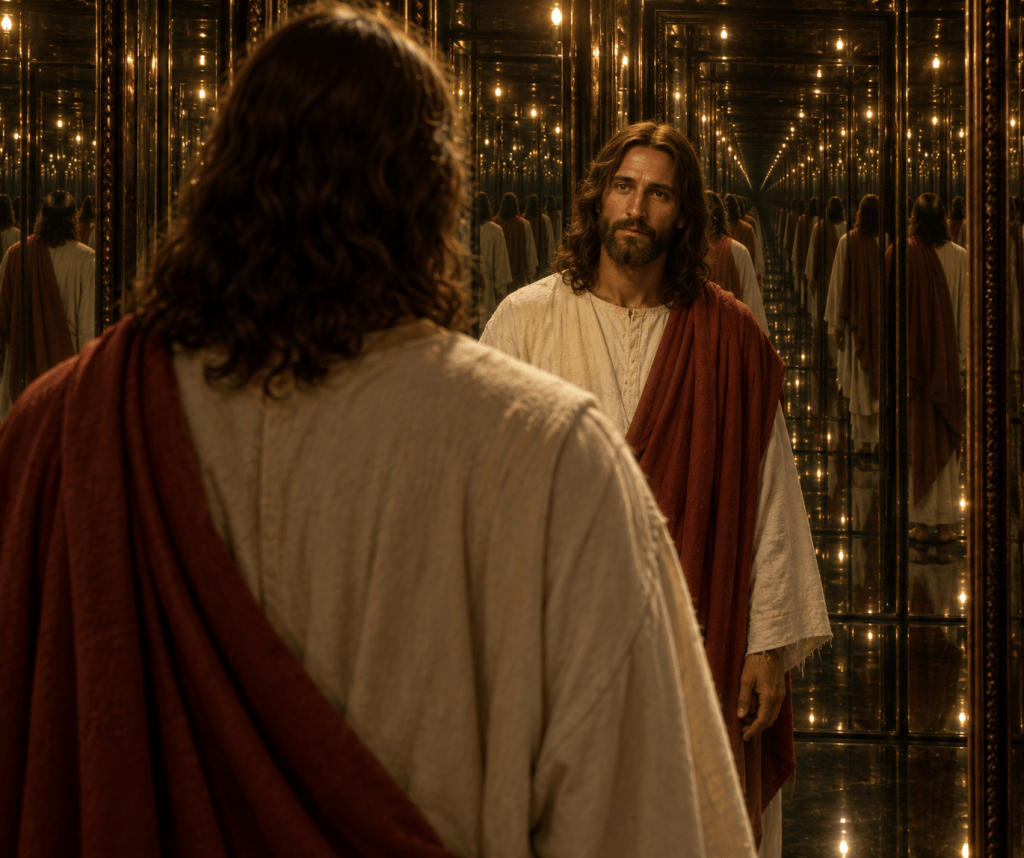
Do you remember Clare of Assisi and her letter to Blessed Agnes of Prague? In it, Clare implored Agnes to “Look more deeply into the mirror and meditate on” the characteristics of Jesus. Clare asks Agnes to gaze into Christ as into a mirror, contemplating him so deeply that her own life is conformed to what she sees. I see “O daughter, let God make you a mirror of life” as an extension of this teaching: Clare tells us to look into a mirror and see Jesus, and Hildegard tells us to be a mirror and reflect Jesus into the world.
Imagine the infinite mirror effect. There is a mirror in front of you and a mirror behind. You stand between them, but instead of seeing yourself, you see Jesus, and that reflection continues into eternity.
Jesus said, “Those who do what is true come to the light, so that it may be clearly seen that their deeds have been done in God.” Perhaps this is the life Clare and Hildegard are calling us to live: a life between the mirrors—beholding Christ until, by grace, we begin to reflect the Christ we behold.
Pip: Star Wars, Pharaoh, a donkey with delusions of grandeur — Fr. John is covering a lot of ground this week at Candle in a Cave.
Mara: The sermon for Proper 19 pulls together the Exodus story, the parable of the unforgiving servant, and a question that runs through all of it: what are you actually building with what God has given you?
Pip: Let's get into it.
"What Are You Building?" — Gifts, Empires, and the Kingdom
Mara: The sermon opens with a sweep through history — every great empire, from the British to the Mongol to the Babylonian, eventually collapses. That pattern sets up the Exodus reading, where Pharaoh insists the Nile is his own making.
Pip: And the sermon lands the line that becomes the sermon's spine. After the Israelites cross the Red Sea and receive Egyptian gold as a parting gift from God, they melt it into a golden calf — and the sermon reads that act as Pharaoh's logic recycled: "My Nile is my own; I made it for myself."
Mara: That phrase does the heavy lifting. The Israelites were liberated, given a gift, and then used the gift to rebuild the very thing they escaped — their own version of Egypt, their own small empire.
Pip: Which is where the parable of the unforgiving servant walks in and makes the same point at human scale. The king forgives an impossible debt — the sea parts, the servant walks through free — and then the servant immediately shakes down a colleague for pocket change.
Mara: The sermon draws the parallel directly: "The servant took the gift of mercy and, in his arrogance, began building his own little empire." Liberation received, liberation refused to others.
Pip: And then there is the donkey. Decorated with garlands to carry a sacred icon, he stops mid-procession and brays at the crowd, convinced the adoration is for him. The man leading him swats him and says, "The honor is not meant for you but for the image you are carrying."
Mara: That fable lands the sermon's practical point. The gifts — wealth, education, position, talent — are not the problem. The sermon is clear: "The gold was never the problem. Possessing the gold was never the problem. The question was what they built with it."
Pip: Wealth can build an empire or serve the Kingdom. Same gold, entirely different structure.
Mara: Saint James frames it as the law of liberty — freedom from sin that teaches liberated people how to live, and Saint Peter adds: "use it to serve one another, as good stewards of God's varied grace… in order that in everything God may be glorified through Jesus Christ."
Pip: Every empire falls. The sermon closes on that contrast — every empire we build eventually collapses, and God's Kingdom endures forever — and asks why anyone would choose the perishable project.
Mara: The closing prayer puts it plainly: serve without counting the cost, labor without seeking rest, spend yourself for glory that belongs to someone else entirely.
Pip: Pharaoh, a servant, and a self-important donkey — same story, different costumes.
Mara: The question underneath all of it stays simple: the gift is in your hands. What are you building with it?