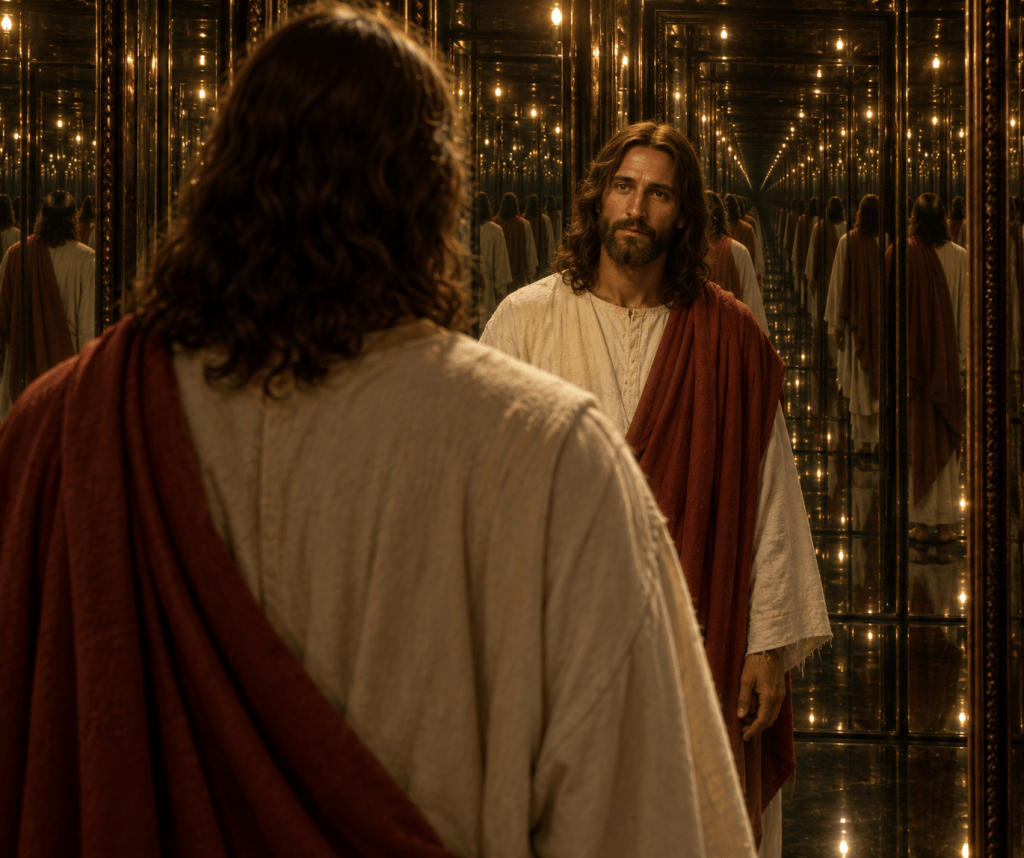
Our saint for today is Hildegard of Bingen, born in 1098. Hildegard was a great teacher and advisor to everyone from the average person on the street to kings, queens, and Popes. Many of her letters are preserved, and today I would like to share one she wrote to Elisabeth of Schoenau, who led the double monastery in Schoenau, Germany. Hildegard writes,
“I, a poor little form and earthen vessel, speak these things not from myself but from the serene light: Man is a vessel which God fashioned for himself, which he imbued with his spirit, so that he might accomplish his works in him.”
Hildegard then speaks of God’s creation and leading up to the fall. She cries out, “Oh woe!” She continues, “Then all the elements enfolded themselves in the alternation of light and shadows as man did in transgressing God’s commands. God, however, strengthened/irrigated certain men, lest man be completely despised. Abel was good, but Cain a suicide. And many saw the mysteries of God in the light, but others committed many sins, until that time came in which the word of God was manifest as it is said: Beautiful in form beyond the sons of men. Then the sun of justice appeared and illuminated men with good works in faith and in act, just as the dawn comes first, and the other hours of the day follow, until night arrives. Thus, o daughter Elisabeth, is the world changed. For the world is already weary in all the greenness of virtues, that is at dawn, prime, ters, and in the strongest hour of the day, at sext. But in this time it is necessary for God to strengthen/irrigate some men, lest his instruments be idle. Hear, o anxious daughter, that the ambitious suggestions of the ancient serpent are worrying somewhat those men whom the inspiration of God has so imbued. For when that same serpent sees an elegant gem, he roars, saying: “What is this?” And he worries it with many miseries of the burning mind, desirous of flying over the clouds, as if they were Gods, just as he did. Now hear again: Who desire to accomplish the works of God, let them always consider that they are earthen vessels, since they are men, and let them always reflect on what they are and what they will be, and leave heavenly things to [him] who is of heaven, since they are exiles, not knowing heavenly things, but only reciting the mysteries of God, just as a trumpet only makes sounds, but does not cause them; someone blows in it in order to make the sound. But the mild put on the [armor] of faith, being gentle, poor, and unfortunate, having the simple habits of children, just as he whose trumpet sounds they are was a Lamb, since God always scourges those who sing in his trumpet, taking care lest their earthen vessel perish, except as it pleases Him. O daughter, let God make you a mirror of life. But I too lie in the [timidity] of my mind, fatigued much by fear, sounding a little, at times, like the small sound of a trumpet from the living light. Whence God help me, that I may remain in his ministry.”
I was struck by the line, “O daughter, let God make you a mirror of life.”
Do you remember Clare of Assisi and her letter to Blessed Agnes of Prague? In it, Clare implored Agnes to “Look more deeply into the mirror and meditate on” the characteristics of Jesus. Clare asks Agnes to gaze into Christ as into a mirror, contemplating him so deeply that her own life is conformed to what she sees. I see “O daughter, let God make you a mirror of life” as an extension of this teaching: Clare tells us to look into a mirror and see Jesus, and Hildegard tells us to be a mirror and reflect Jesus into the world.
Imagine the infinite mirror effect. There is a mirror in front of you and a mirror behind. You stand between them, but instead of seeing yourself, you see Jesus, and that reflection continues into eternity.
Jesus said, “Those who do what is true come to the light, so that it may be clearly seen that their deeds have been done in God.” Perhaps this is the life Clare and Hildegard are calling us to live: a life between the mirrors—beholding Christ until, by grace, we begin to reflect the Christ we behold.
When I travel, especially by myself, I don’t always have a set agenda. There are places I want to see, but I’m not rushing from one to the next just to tick them off a list, and I don’t try to fill every moment. For me, that makes things more relaxing and leaves time to fit in the unexpected. I learned about one unexpected place while taking a cab from the airport in Luxembourg to my hotel (I quickly learn to use public transportation because it’s much less expensive, but when I’m schlepping bags, it’s just easier to take the cab).
When the cab driver learned I was an American, he said, “You know, your General Patton is buried here.” I didn’t know that, so I added it to my list of possibilities. A few days later, when one of the places I wanted to visit was closed, I decided to take the trip out to the Luxembourg American Cemetery. General Patton is there, set apart from the others, but he is only one of many, and his grave marker is the same as all the others.
What I never expect when entering places like this is the emotional response. Even before you walk through the main gates, it starts to hit you, so I was intentional about not looking up until my heart was ready… and then I did.
There is General Patton’s cross, and then there are 4,958 other crosses for known individuals, 371 crosses for the unknown, and 119 Stars of David. Of those buried there, you will also find 22 sets of brothers. It is a sea of white markers for those who died near that place.
At one point, I was the only person in the entire cemetery. As I slowly passed among the markers, I read the names, but I was specifically looking for anyone from Oklahoma. I found Roy W Roe, Private First Class, 319th Infantry, 80th Division. He died on March 15, 1945. Based on what I’ve learned so far, he was twenty-four years old and married to Marion.
As I stood looking at his marker, I said to him, “Today, I see you.” For me, that meant, “I see you as a person, as a young man who had a life ahead of him but died so far from home, and as someone so very young. I see you, not as a memory or a marker, but as a person.”
As I continued to walk among them, I read their names and told each of them, “I see you.” I don’t know if that makes sense to anyone, but it did to me. It was the only way I had to honor them and the sacrifice they made.
In truth, all of us like to be seen, maybe not in the spotlight, but acknowledged. Being seen validates who we are as human beings and affirms that our existence counts for something, even if only to a very few. However, knowing that we will be seen raises an important question: When someone sees us, who or what do they see? There, I saw brave men and one woman who gave so much, but what do others see when they see me? What do others see when they see you?
A lot of time and money goes into appearance—clothes, hair, fitness, etc.—but that is like the cover of a book. You can look like a million bucks and still be a Cruella De Vil. Yet when we are truly seen, who or what do people see? This is a question that relates to one of the many lessons in today’s Gospel reading.
Philip said to Jesus, “Lord, show us the Father, and we will be satisfied.” You can hear the exasperation in Jesus’ voice as he responds, “Have I been with you all this time, Philip, and you still do not know me? Whoever has seen me has seen the Father. How can you say, ‘Show us the Father’? Do you not believe that I am in the Father and the Father is in me?”
Jesus’ answer provides part of the foundation for our understanding of the Holy Trinity—Father, Son, and Holy Spirit. If you see Jesus, you see the Father. If you witness the works of the Holy Spirit, you witness the works of God, and so on.
In part of Jesus’ great priestly prayer on the night before He was crucified, He prays, “As you, Father, are in me, and I in you” (John 17:21). There are the Father, the Son, and the Holy Spirit, and although separate, they are one. See one, and you see the others. So, what about us? What about you? If I pass you on the street and say to you, “I see you,” who or what do I see? Who or what do you want me to see?
St. Paul says to us in his letter to the Galatians, “I have been crucified with Christ. It is no longer I who live, but Christ who lives in me” (Galatians 2:20). If we are alive to Christ, we have died to ourselves; therefore, when I say, “I see you,” I should see Jesus. Question: Do I?
At the east end of the Sistine Chapel, on the altar wall, is Michelangelo’s great painting of the Last Judgment. At the top is the figure of Christ. With His right hand, He is calling the righteous up to the Kingdom of God, while with His left He is casting out the wicked. The righteous are escorted by angels, and the wicked are greeted by demons.
Since the painting’s unveiling in 1541, there has been high demand for copies and similar works. One of those who created a similar work was Raphaël Coxie (COKE-see). In his painting, the figures are near life size, so the painting is large, approximately ten feet by twelve feet. It hangs in the museum in Ghent, Belgium. However, as with many similar paintings of judgment, it originally hung in a courtroom as a reminder to the criminally inclined of the consequences should they continue down such a path.
Given the size and subject matter, it really caught my attention, but it was so large that it was difficult to focus on one thing. Still, after studying it, my eye fell on the figure on the cover of your bulletin. She is located at the bottom center of the painting—the woman with her jeweled tiara. Yet it wasn’t so much her as what she is holding. I looked at it for a good long while, then realized she was holding up a mirror and that there is a face in the mirror. However, unlike the other images in the painting, the image in the mirror is vague. It was then that I thought I understood. Coxie kept the image in the mirror vague because he wanted us to see ourselves.
Imagine you are on trial and you see this painting. You are reminded that some are called to Heaven while others are cast down into hell, and here is this woman, saying to you with her eyes, her expression, and her gesture, “Look in the mirror and judge yourself. Which one will you be? Called up or cast down?”
If we are alive in Christ, we have died to ourselves. When people see us, they should see Jesus. Do they? Well, answer this: When you look in Coxie’s mirror, who or what do you see? Do you see Jesus? Do you see someone being called up or someone being cast down?
Philip said to Jesus, “Show us the Father,” and Jesus replied, “If you have seen me, you have seen the Father.” If someone said to you, “Show us Jesus,” would you even in the smallest way be able to say, “If you have seen me, you have seen something of Jesus”? The scary part is that we should be able to say that. If that is not true, why did Jesus go on to say to Philip, “Very truly, I tell you, the one who believes in me will also do the works that I do and, in fact, will do greater works than these, because I am going to the Father”? If we are to do the same work Jesus did, we should look like Him. Right? When we look in Coxie’s mirror, we should see something of the Imago Dei, the Image of God. It won’t be perfect; only One was perfect, but Jesus should be recognizable in each of us.
When we look in a regular mirror, we look for all sorts of things—do I have something caught in my teeth, is my hair combed, am I getting old, etc.? I would challenge you to look in Coxie’s mirror and ask, “Do I look like Jesus? Will I be called up or will I be cast down?”
In seeing Jesus, we can see the Father. In seeing you, others should be able to see Jesus. Perhaps it is only as one sees in a mirror dimly, but there should be something of Jesus that is visible.
You are seen by others. Who or what do they see?
Let us pray: God, our Father, You redeemed us and made us Your children in Christ. Through Him, You have saved us from death and given us Your Divine life of grace. By becoming more like Jesus on earth, may we come to share His glory in Heaven. Give us the peace of Your kingdom, which this world does not give. By Your loving care, protect the good You have given us. Open our eyes to the wonders of Your Love that we may serve You with a willing heart. Amen.