
A woman named Shirley had a heart attack and was taken to the hospital.
While on the operating table, she had a near-death experience. She saw God and asked, “Is this it?” God said, “No, you have another 30 to 40 years to live.”
Upon her recovery, she decided to stay in the hospital and have collagen shots, cheek implants, a facelift, liposuction, and a bit of augmentation. After getting out, she dyed her hair and got a tattoo. She figured that since she had another 30 to 40 years, she might as well make the most of it.
Walking out of the gym where she was whipping the rest of herself into shape, she was hit by a snowplow and died.
Arriving before God, she said, “I thought you said I had another 30 to 40 years?”
God replied, “Shirley! I’m sorry, but I didn’t recognize you!”
The Pharisees and Herodians didn’t typically associate with one another, but in today’s gospel reading we see them team up to trap Jesus.
They first gush out some false praise, then ask their question: “Tell us, then, what you think. Is it lawful to pay taxes to the emperor, or not?”
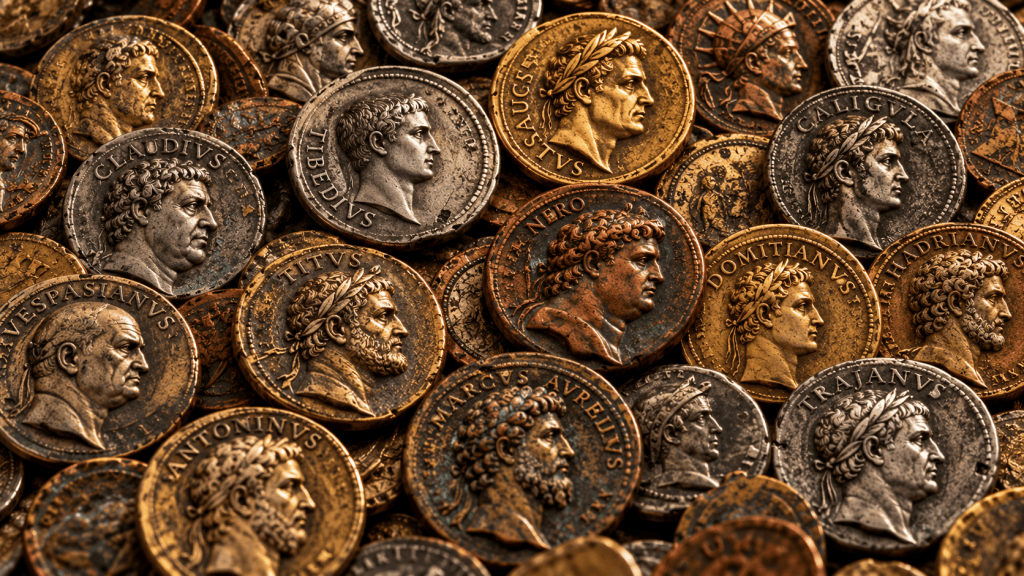
Jesus, knowing their hearts, recognizes the question as a trick. If he answers, “Yes, it is lawful to pay taxes to the emperor,” he will appear to side with the occupying government. If he says, “No,” then they can turn him over to the Romans for sedition. So he asked for a coin that would have been used to pay the tax, but instead of answering their question, he asked, “Whose head is this, and whose title?” They answered, “The emperor’s.” In response, Jesus says, “Give therefore to the emperor the things that are the emperor’s, and to God the things that are God’s.”
It is a brilliant response. Give the government what is legally the government’s; give God what is legally God’s. The first part is clear—the coin bears Caesar’s image and represents Caesar’s authority; therefore, give Caesar what is properly owed him. The second part is implied.
Jesus does not specifically cite Genesis, but it is there. Genesis (1:26-27) states,
“Then God said, ‘Let us make man in our image, after our likeness. And let them have dominion over the fish of the sea and over the birds of the heavens and over the livestock and over all the earth and over every creeping thing that creeps on the earth.’
So God created man in his own image,
in the image of God he created him;
male and female he created them.”
As the coin, stamped with the Emperor’s image, is under the emperor’s authority, so you, made in the image of God, are under God’s authority. St. Hilary of Poitiers writes, “It behooves us also to render unto God the things that are His, namely, body, soul, and will. For Caesar’s coin is in the gold, in which His image was portrayed, that is, God’s coin, on which the Divine image is stamped; give therefore your money to Caesar, but preserve a conscience void of offense for God.”
We understand this and try to be obedient to this calling, but along the way, something happens.
When the question is asked about the coin, “Whose head is this and whose title?” Another answer could have been given: “Well, it depends on the day.” Why? Because when an emperor died, the empire began minting coins with the new emperor’s image. So, although the coin remains the emperor’s, it is stamped to represent the current political regime, and the same thing can happen to us.
The image of God we were created in never leaves us, but it can become distorted and reminted by the world around us. Like the Emperor’s coin, it can depend on the day, or even the time of day.
Come Sunday morning, the image we present may reflect forgiveness and kindness, but come Sunday night, with Monday looming, that image may show uncharitable ambition or pride. In the mornings, when we are with family and children, we may show joy and patience, but as soon as we get behind the wheel of the car, we bring on anger and impatience. What image do you present? Well, it depends on the day. Over time, the image of God remains, but it can become distorted beneath everything else that the world stamps upon it.
Over the last couple of weeks, I had the opportunity to serve in the church of San Fiz of Solovio in Santiago, Spain. It is a church that has been built, destroyed, built again, destroyed again, and so on. The altars, retables, statues, and most everything about it has been replaced, moved, or simply lost. So, to pass the time, I set out to track down who some of the Saints represented were. The Virgin Mary is fairly straightforward, but others are much harder to identify.
To properly identify a statue, you need to discover the symbols it is adorned with, the color of its garments, and even its placement in the church. For example, a statue of the Apostle John was easy to identify: youthful, with red hair, holding a book, and a pulpit shaped like an eagle, which always symbolizes John. However, there was a much older statue of a youthful person with what could have possibly been red hair, but his left hand was missing, and although the right hand was present, the object he held was missing. The colors of its garments match those of many other statues of the Apostle John, but in the end, a 100% positive identification of the image was not possible.
I am made in the image of God. You are made in the image of God. Question: Like the Emperor’s coin, is that image still recognizable, or has the world stamped you with its own image, distorting God’s image? Like an old statue in a much older church, have parts of the image of God been lost behind this world’s concerns and other life events?
If we are honest with ourselves, we will all say the image of God within us has become distorted or blurred. We may even think that parts have gone missing—broken off and lost forever. But honestly, that is just the devil whispering despair in your ear, for that image of God is still present, although distorted.
So how do we clear away the distortions and reveal those parts that appear to be missing?
Everybody says, “Now here’s where Father John gives us a great lecture. He will proceed to tell us why we should go to confession, pray more earnestly, and read our Bibles more devoutly.” Well, sure you could do those things and you probably should, but that’s not the answer.
I’ve been working my way through St. Francis de Sales’ Treatise on the Love of God, and in one chapter he refers to a certain bird Aristotle calls apodes: “because having extremely short legs, and feeble feet, they use them no more than if they had none.” People believed that if an apode ever landed on the ground, it could not take flight again and would die unless the wind blew. Then it could stretch out its wings and be lifted into the air again.
Using this example, Francis tells us that God’s grace, His love, is like the wind, a wind that is constantly blowing, and that we are like those apodes, unable to take flight on our own. To take flight, to enter into God’s grace, we must stretch out our wings; that is, we must participate in God’s grace and be open to Him.
When the image of God becomes distorted, we believe we must “whip ourselves into shape” so that God will love us, but that is backward. What did St. John tell us? “We love because he first loved us.” (1 John 4:19) When the image of God is distorted, we must open to God—the wind of grace is already blowing. God is not waiting for you to get your act together before his grace works in your life. No. God’s grace is already reaching toward you. He invites you to open your wings, to open yourself to the love that has been there all along.
Our reflection of God’s image may become clouded, but God’s love for us does not diminish. We may fail to recognize God’s presence within ourselves and others, but God never fails to recognize us.
Jesus asked them to bring him a coin, to look upon its image, and to recognize whose it was. Perhaps He invites us to bring our lives before Him as well.
Not because we have already made ourselves worthy. Not because we have successfully removed every imperfection. Not because we have finally become the people we ought to be. But simply because we belong to Him.
We come with our failings, our fears, our scars, and all the ways the world has tried to stamp its image on us.
And we open ourselves to the grace that God has never stopped offering.
The Christian life is not about making ourselves into someone God might someday love. It is about allowing God’s love to reveal more fully the image He placed within us from the beginning.
“We love because He first loved us.”
Let us pray: Pour forth, we beseech Thee, O Lord, Thy grace into our hearts; that we, to whom the incarnation of Christ, Thy Son, was made known by the message of an angel, may by His Passion and Cross be brought to the glory of His Resurrection, through the same Christ Our Lord. Amen.

