
“A long time ago in a galaxy far, far away … It is a period of civil war. Rebel spaceships, striking from a hidden base, have won their first victory against the evil Galactic Empire.”
Can you see those words scrolling up the screen as the music swells? I was stunned to learn this week that next year will mark the 50th anniversary of the original Star Wars movie. But I have been a faithful follower of those movies and even survived Jar Jar Binx.
As big and powerful as the Galactic Empire was, it went the way of all the real empires we know of. The British Empire of the 1920s was the largest, and it eventually collapsed, as did the Mongol, Russian, and Spanish Empires, among others.
If the empires of history were represented by colors, we would see one color constantly superseding another. Beautiful and chaotic.
The empires we hear about in scripture—Egyptian, Assyrian, Babylonian—dominate Israel’s history, and in today’s reading, the Egyptians take center stage.
Moses came to Pharaoh and delivered the Lord’s message: “Let my people go.” Pharaoh responded, “Who is the Lord, that I should obey his voice and let Israel go? I do not know the Lord.” (Exodus 5:2) Years later, another Pharaoh would say essentially the same thing: “My Nile is my own; I made it for myself.” (Ezekiel 29:3) In their arrogance, they believed they had built the empires they ruled. God has a funny way of humbling such fool-heartedness.
The sea parted, the Israelites crossed on dry land, and the Egyptians followed. In the song of Miriam that we read, Pharaoh said, “I will pursue, I will overtake, I will divide the spoil, my desire shall have its fill of them. I will draw my sword, my hand shall destroy them.” The Lord said, “I don’t think so,” and the waters came crashing down. The Israelites were liberated. What do they do with this newfound freedom?
As you will recall, just before the Israelites left Egypt, Moses told the people to ask the Egyptians for silver and gold, and the Lord disposed the Egyptians to comply.
Today, they passed through the Red Sea, but only a couple of months later, “All the people took off the rings of gold that were in their ears and brought them to Aaron. And he received the gold from their hand and fashioned it with a graving tool and made a golden calf. And they said, ‘These are your gods, O Israel, who brought you up out of the land of Egypt!’” (Exodus 32:3-4) The Egyptian gold they received as a blessing from God was used, with their own hands, to make the Golden Calf, a false god, to replace the one true God who had liberated them. By their actions, they speak in the same spirit as Pharaoh, “My Nile is my own; I made it for myself.” In essence, the Israelites are building their own version of Egypt. They are beginning to build their own empire. How it all plays out is a story for another day, but see the pattern: captivity to liberation, yet instead of living into God’s freedom, they turn from God to self. “My Nile is my own; I made it for myself.” And in that turning from God and in their arrogance, they began building their own empire. When they did, we should not be surprised that God came along and smacked them, as he has done to so many others.
What we must keep in mind is that this applies not only to world empires; it also applies to the individual. Consider it the parable Jesus told today.
The king is settling his accounts and has a servant who owes more than he can ever repay. Because the servant was unable to pay, the king ordered that the servant and the members of his family—wife and children—be sold into slavery to pay the debt. The servant went to the king and pleaded for the king’s patience: “‘Have patience with me, and I will pay you everything.’ And out of pity for him, the lord of that slave released him and forgave him the debt.”
The servant is like the Israelites in Egypt. He is in captivity to his debt. Yet, like the Egyptians’ gift of gold, the king gives the servant a gift—mercy. In doing so, the sea parts for the servant, allowing him safe passage through the debt, and then the sea closes behind him, bringing him into safety. The servant has been liberated.
“But that same slave, as he went out, came upon one of his fellow slaves who owed him a hundred denarii; and seizing him by the throat, he said, ‘Pay what you owe.’ Then his fellow slave fell down and pleaded with him, ‘Have patience with me, and I will pay you.’ But he refused; then he went and threw him into prison until he would pay the debt.” The servant took the gift of mercy and, in his arrogance, began building his own little empire. “My Nile is my own; I made it for myself.” The king, hearing of this, recalled that servant and smacked him about the head and neck.
The Israelites were liberated, and the servant was liberated. In both cases, a gift followed. But the gift never became a way of life. Israel received the gold but forgot the Giver. The servant received mercy but refused to become merciful.
In his epistle, Saint James speaks of the law of liberty. It means that, through Christ, we have been liberated from the empire of sin and death. However, the liberty we received does not mean we are free to do whatever we please or to treat those around us in a sinful manner. Instead, the law of liberty teaches us how liberated people live, using the gifts He has bestowed on us for the good of His kingdom. Why? Because the gift is not about us—me—the gift is about God and His glory. Saint Peter writes, “As each has received a gift, use it to serve one another, as good stewards of God’s varied grace… in order that in everything God may be glorified through Jesus Christ. To him belong glory and dominion forever and ever.” (1 Peter 4:10-11)
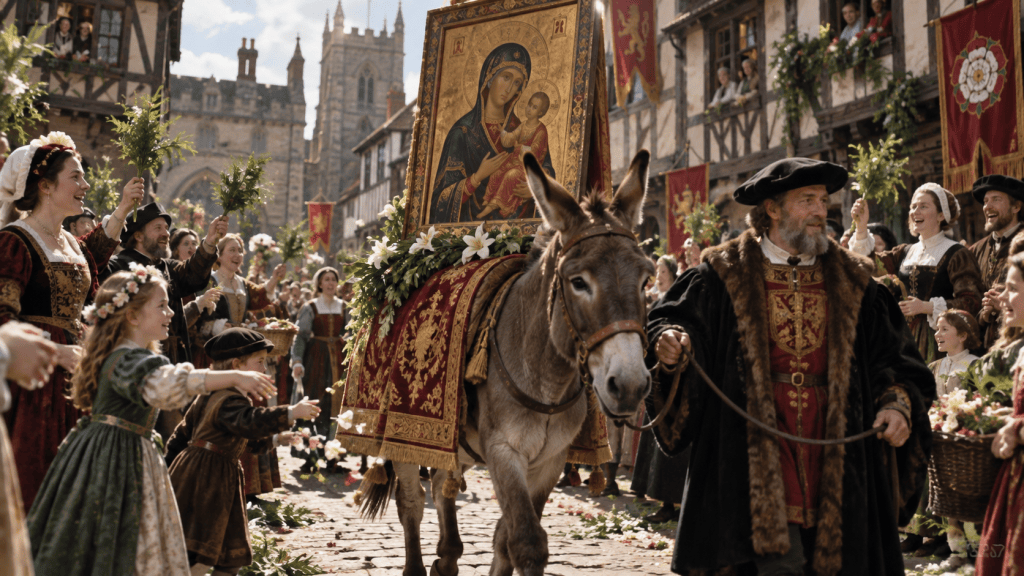
Aesop wrote a fable that has evolved over the years but remains essentially the same: A sacred icon of the Madonna and Child was being transported from one church to another. To carry the icon, they decorated a donkey with garlands and ribbons and placed the icon on its back so that, as it passed, all could see it.
As the procession went along, the people came out, adoring the image, singing songs, and casting flowers before it. However, the donkey got it in his pointy little head that all the adoration was for him. In his foolishness and arrogance, he stopped and began to bray loudly, basking in all the praise. Understanding what was happening, the man leading the donkey swatted him on the backside with a stick and said, “Get along with you, you stupid Ass. The honor is not meant for you but for the image you are carrying.”
God has liberated us from sin and death and has given each of us gifts. Some have received wealth, education, position, status, and many other gifts. These are wonderful gifts and great blessings, but like the Egyptian gold or the servant’s mercy, they can be profaned. We can begin thinking like the donkey or Pharaoh: “My Nile is my own; I made it for myself.” In doing so, there’s a very good chance God will come along and swat us with a stick and say, “Get along, you stupid little… yeah.” Why? Because when God liberated us and blessed us with such wonderful gifts, He did so that we might enjoy them to the fullest, but more importantly, He did so that we might bring Him glory.
Remember how they collected gold to build the Golden Calf? Later, they collected gold again, this time to build the Tabernacle and its sacred furnishings, including the Ark of the Covenant. The gold was never the problem. Possessing the gold was never the problem. The question was what they built with it.
Wealth can build an empire or serve the Kingdom. Education can elevate the self or serve the Kingdom. Authority can dominate or serve the Kingdom. Position, reputation, intelligence, talent—all of it. The question is what you build with what God has put in your hands.
The Psalmist says of the Lord,
Your kingdom is an everlasting kingdom,
and your dominion endures throughout all generations.
(Psalm 145:13)
Every empire we build eventually falls. God’s Kingdom endures forever.
Question: Why would we ever want to work on our own little perishable empires when we can work to bring glory to the only Kingdom that is imperishable and eternal?
God has parted the Red Sea for you. You are free. He has placed gifts in your hands. Don’t use them to rebuild Egypt. Don’t use them to build yourself a little empire. Build his Kingdom. And whatever he has placed on your back—carry it well. Just remember who gets the glory.
Let us pray: O Dearly beloved Word of God, teach us to be generous, to serve You as You deserve, to give without counting the cost, to fight without fretting at our wounds, to labor without seeking rest, to spend ourselves without looking for any reward other than to bring You glory, knowing that we do Your holy will. Amen.
 Candle in a Cave
Not sure what you’re doing, but you’re sermons have been on fire and on point lately!
Very good sermon John. Very Good.