Sermon: Proper 19 RCL A1 – “What are You Building?”


“A long time ago in a galaxy far, far away … It is a period of civil war. Rebel spaceships, striking from a hidden base, have won their first victory against the evil Galactic Empire.”

Can you see those words scrolling up the screen as the music swells? I was stunned to learn this week that next year will mark the 50th anniversary of the original Star Wars movie. But I have been a faithful follower of those movies and even survived Jar Jar Binx. 

As big and powerful as the Galactic Empire was, it went the way of all the real empires we know of. The British Empire of the 1920s was the largest, and it eventually collapsed, as did the Mongol, Russian, and Spanish Empires, among others.

If the empires of history were represented by colors, we would see one color constantly superseding another. Beautiful and chaotic.

The empires we hear about in scripture—Egyptian, Assyrian, Babylonian—dominate Israel’s history, and in today’s reading, the Egyptians take center stage.

Moses came to Pharaoh and delivered the Lord’s message: “Let my people go.” Pharaoh responded, “Who is the Lord, that I should obey his voice and let Israel go? I do not know the Lord.” (Exodus 5:2) Years later, another Pharaoh would say essentially the same thing: “My Nile is my own; I made it for myself.” (Ezekiel 29:3) In their arrogance, they believed they had built the empires they ruled. God has a funny way of humbling such fool-heartedness.

The sea parted, the Israelites crossed on dry land, and the Egyptians followed. In the song of Miriam that we read, Pharaoh said, “I will pursue, I will overtake, I will divide the spoil, my desire shall have its fill of them. I will draw my sword, my hand shall destroy them.” The Lord said, “I don’t think so,” and the waters came crashing down. The Israelites were liberated. What do they do with this newfound freedom?

As you will recall, just before the Israelites left Egypt, Moses told the people to ask the Egyptians for silver and gold, and the Lord disposed the Egyptians to comply.

Today, they passed through the Red Sea, but only a couple of months later, “All the people took off the rings of gold that were in their ears and brought them to Aaron. And he received the gold from their hand and fashioned it with a graving tool and made a golden calf. And they said, ‘These are your gods, O Israel, who brought you up out of the land of Egypt!’” (Exodus 32:3-4) The Egyptian gold they received as a blessing from God was used, with their own hands, to make the Golden Calf, a false god, to replace the one true God who had liberated them. By their actions, they speak in the same spirit as Pharaoh, “My Nile is my own; I made it for myself.” In essence, the Israelites are building their own version of Egypt. They are beginning to build their own empire. How it all plays out is a story for another day, but see the pattern: captivity to liberation, yet instead of living into God’s freedom, they turn from God to self. “My Nile is my own; I made it for myself.” And in that turning from God and in their arrogance, they began building their own empire. When they did, we should not be surprised that God came along and smacked them, as he has done to so many others.

What we must keep in mind is that this applies not only to world empires; it also applies to the individual. Consider it the parable Jesus told today.

The king is settling his accounts and has a servant who owes more than he can ever repay. Because the servant was unable to pay, the king ordered that the servant and the members of his family—wife and children—be sold into slavery to pay the debt. The servant went to the king and pleaded for the king’s patience: “‘Have patience with me, and I will pay you everything.’ And out of pity for him, the lord of that slave released him and forgave him the debt.”

The servant is like the Israelites in Egypt. He is in captivity to his debt. Yet, like the Egyptians’ gift of gold, the king gives the servant a gift—mercy. In doing so, the sea parts for the servant, allowing him safe passage through the debt, and then the sea closes behind him, bringing him into safety. The servant has been liberated.

“But that same slave, as he went out, came upon one of his fellow slaves who owed him a hundred denarii; and seizing him by the throat, he said, ‘Pay what you owe.’ Then his fellow slave fell down and pleaded with him, ‘Have patience with me, and I will pay you.’ But he refused; then he went and threw him into prison until he would pay the debt.” The servant took the gift of mercy and, in his arrogance, began building his own little empire. “My Nile is my own; I made it for myself.” The king, hearing of this, recalled that servant and smacked him about the head and neck.

The Israelites were liberated, and the servant was liberated. In both cases, a gift followed. But the gift never became a way of life. Israel received the gold but forgot the Giver. The servant received mercy but refused to become merciful.

In his epistle, Saint James speaks of the law of liberty. It means that, through Christ, we have been liberated from the empire of sin and death. However, the liberty we received does not mean we are free to do whatever we please or to treat those around us in a sinful manner. Instead, the law of liberty teaches us how liberated people live, using the gifts He has bestowed on us for the good of His kingdom. Why? Because the gift is not about us—me—the gift is about God and His glory. Saint Peter writes, “As each has received a gift, use it to serve one another, as good stewards of God’s varied grace… in order that in everything God may be glorified through Jesus Christ. To him belong glory and dominion forever and ever.” (1 Peter 4:10-11)

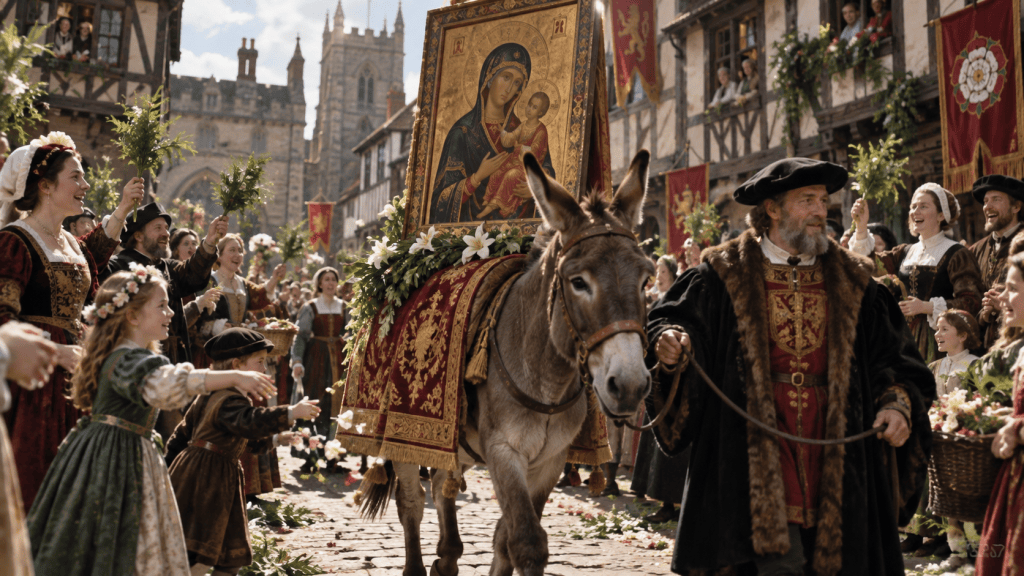
Aesop wrote a fable that has evolved over the years but remains essentially the same: A sacred icon of the Madonna and Child was being transported from one church to another. To carry the icon, they decorated a donkey with garlands and ribbons and placed the icon on its back so that, as it passed, all could see it.

As the procession went along, the people came out, adoring the image, singing songs, and casting flowers before it. However, the donkey got it in his pointy little head that all the adoration was for him. In his foolishness and arrogance, he stopped and began to bray loudly, basking in all the praise. Understanding what was happening, the man leading the donkey swatted him on the backside with a stick and said, “Get along with you, you stupid Ass. The honor is not meant for you but for the image you are carrying.”

God has liberated us from sin and death and has given each of us gifts. Some have received wealth, education, position, status, and many other gifts. These are wonderful gifts and great blessings, but like the Egyptian gold or the servant’s mercy, they can be profaned. We can begin thinking like the donkey or Pharaoh: “My Nile is my own; I made it for myself.” In doing so, there’s a very good chance God will come along and swat us with a stick and say, “Get along, you stupid little… yeah.” Why? Because when God liberated us and blessed us with such wonderful gifts, He did so that we might enjoy them to the fullest, but more importantly, He did so that we might bring Him glory.

Remember how they collected gold to build the Golden Calf? Later, they collected gold again, this time to build the Tabernacle and its sacred furnishings, including the Ark of the Covenant. The gold was never the problem. Possessing the gold was never the problem. The question was what they built with it.

Wealth can build an empire or serve the Kingdom. Education can elevate the self or serve the Kingdom. Authority can dominate or serve the Kingdom. Position, reputation, intelligence, talent—all of it. The question is what you build with what God has put in your hands.

The Psalmist says of the Lord,

Your kingdom is an everlasting kingdom,
    and your dominion endures throughout all generations.

(Psalm 145:13)

Every empire we build eventually falls. God’s Kingdom endures forever.

Question: Why would we ever want to work on our own little perishable empires when we can work to bring glory to the only Kingdom that is imperishable and eternal?

God has parted the Red Sea for you. You are free. He has placed gifts in your hands. Don’t use them to rebuild Egypt. Don’t use them to build yourself a little empire. Build his Kingdom. And whatever he has placed on your back—carry it well. Just remember who gets the glory.

Let us pray: O Dearly beloved Word of God, teach us to be generous, to serve You as You deserve, to give without counting the cost, to fight without fretting at our wounds, to labor without seeking rest, to spend ourselves without looking for any reward other than to bring You glory, knowing that we do Your holy will. Amen.

Sermon: Proper 16 RCL A1 – “Holy Purposes”


Many are familiar with the story of Adolf Hitler being rejected from the Academy of Fine Arts Vienna twice. There is no way to know, and many other factors were involved, but might world history have been different if he had been accepted?

One small action, and the result affected everyone on the planet. There are many such stories.

At the Paris Peace Conference in 1919, President Woodrow Wilson received a petition and letter from someone who worked at the Ritz Hotel in France, asking that France withdraw from Vietnam. Another hugely complicated issue, however, it is believed by many that the hotel employee was a young Vietnamese man named Ho Chi Minh. One little thing might have changed much.

Little actions, leading to tremendous results.

Our story from the Old Testament is the beginning of the Exodus and traces the transformation that unfolded in Egypt over many years. When Joseph’s brother came to him, Joseph was held in very high esteem by Pharaoh; however, over time that relationship was forgotten, and the Israelites had become so numerous that Pharaoh and the Egyptians feared them. To weaken the Israelites, they were ruthlessly oppressed.

To further decrease their numbers, two midwives, Shiphrah and Puah, were summoned by Pharaoh. Why them? Scripture does not say. Perhaps they were the ones in charge of others. Whatever the case, they were instructed to kill all male children of the Israelites as soon as they were born.

Unlike Prissy from Gone with the Wind, who didn’t know nothin’ ‘bout birthin’ no babies, these two were professionals. They, like all other midwives, were important members of the community and would have worked day and night, caring for mothers and babies. However, when Pharaoh commanded them to kill the male babies, there was one thing he failed to factor in—these two women feared God more than they feared him. Therefore, they found a way to disregard Pharaoh’s orders. Whether by deception or flat-out lying, they allowed the male children to live. When his covert plan to deal with the Israelites failed, Pharaoh simply demonstrated his own ruthlessness and ordered all male Israelite babies to be thrown into the Nile River—to be murdered.

As the story proceeds, a woman becomes pregnant. We don’t learn her name here, but it is Jochebed. (Exodus 6:20) Jochebed is a woman who is living in very harsh conditions. She is a slave and greatly oppressed. Her child is born, and it’s a boy. Knowing that Pharaoh decreed that all male children be killed, she hides her child for three months. When it becomes apparent that she can no longer hide him, she comes up with a plan.

In English, we read that she made a basket and covered it in pitch. In Hebrew, she made a tevah. The word tevah is used only once elsewhere in Scripture. It is what Noah was told to build—an ark. Jochebed makes an ark for her baby, places the child in it, seals it with pitch, and, in a way, following the command of Pharaoh, casts the ark into the waters of the Nile.

The baby’s sister is also not named here, but we learn it later. She is called Miriam. If Jochebed’s life was hard, Miriam’s was even more so. In the story, she watches to see what happens, as any loving big sister would. She watches the course of her brother’s ark.

The ark and the baby float down the Nile and are seen by Pharaoh’s daughter. We never learn her name, but among all the women in Egypt, she is at the highest point of society. Unlike the midwives, Jochebed, and Miriam, she has everything. She is daddy’s little girl. When she sees the baby in the ark, she immediately knows he is a Hebrew child, but unlike Daddy, she does not see a nemesis or someone to be feared. She sees a child, one to be pitied. Even knowing that Pharaoh has commanded all male Hebrew babies be killed, she finds a way to save this child. Seeing this, Miriam runs over and says she can find someone to nurse the child. Pharaoh’s daughter agrees, and the baby is returned to where he began—in the arms of his mother, Jochebed.

Who was the baby? Moses.

So often, when we read the story of the Exodus, we become so focused on the central characters, God and Moses, that we fail to see the part everyone else played. However, in this part of the story, Moses does only four things: he rides in a basket, he eats, he sleeps, and he poops. That’s it. However, if it hadn’t been for the work of the others, the story would have ended very quickly, and Moses would have drowned in the Nile River.

You are familiar with Saint Paul’s teaching to the Romans that we read today. He says, “As in one body we have many members, and not all the members have the same function, so we, who are many, are one body in Christ, and individually we are members one of another.” He will later expand on this idea, but here he continues by saying, “We have gifts that differ according to the grace given to us: prophecy, in proportion to faith; ministry, in ministering; the teacher, in teaching; the exhorter, in exhortation; the giver, in generosity; the leader, in diligence; the compassionate, in cheerfulness.”

The list is short, but the categories are very broad. It could have easily included midwives—those who care for the poor and the innocent. Those who are willing to stand up against injustice. Those who give of themselves so others might have life.

The list could’ve included the Jochebeds of the world. Those who faithfully fulfill their calling as a mother, father, or guardian, and who, after doing all that is required of them, entrust the work to God.

Paul’s list could also include those like Miriam, who watch and discern. Who know when to speak and what to say. Who know how to put the pieces together so that God’s work moves forward.

The list can include individuals like Pharaoh’s daughter. Those who can use their position and resources to save and care for the less fortunate. Those who can see not a problem to be dealt with, but a child of God made in His image—a human being who deserves the opportunity to survive and to thrive.

The story of Exodus is not just the story of Moses. Instead, it is the story of God and the individuals He endowed with specific gifts so that His will might be accomplished in their lives and in the world. And that is not only the story of the Exodus; it is also the story of the Church.

Each person seated here today has been endowed with a particular grace, a specific gift that can be used in the church and in the fulfillment of God’s purposes. As Paul said, we do not all serve the same function, but together as the body, we serve God.

The gospel reading today is known as the Confession of Saint Peter. Jesus first asks, “Who do the people say that the Son of Man is?” The disciples answer, “Some say this, others say that.” Jesus then makes the question personal: “But who do you say that I am?” Peter answers with his confession, “You are the Messiah, the Son of the living God.” Jesus responds, “Peter, you get the gold star,” but then Jesus does something interesting—He tells Peter who he is: “I tell you, you are Peter, and on this rock I will build my church, and the gates of Hades will not prevail against it.”

Paul tells us that we each have a part to play in God’s kingdom, but sometimes we may not know what that part is. One way to find out is to turn Jesus’ question back to Him. Jesus asks, “Who do you say that I am?” So ask Him the same question. “Lord, who do you say that I am?” Like Peter, you may hear Him come straight up and tell you, or, like Moses, you may encounter a burning bush. However, it is more likely He will say to you, “Open your eyes and look around. What do you see?”

When you do, like Jochebed, you might see those who are vulnerable and in need of nurturing so they can be prepared to go out into the world. Like the midwives, you might see a specific need that must be met for God’s work to continue. Like Miriam, you may be one who has the gift of discernment, organizing others to accomplish the work. Like Pharaoh’s daughter, you may have the resources and compassion to help those less fortunate.

God is funny like that. He’s not going to look at you and say, “You’re a mighty fine brain surgeon, so I’m going to make you a carpenter.” No. God says, as He did with Peter, “You’re a mighty good fisherman, so I’m going to change what you’re fishing for. Instead of fish, it will be people.” If we allow it, God will take our natural gifts and give us opportunities to use them for holy purposes. When we do this, it is called ministry, where a little action can have tremendous results. You may only see one small part. You may not be able to see the wider scope of what is taking place. However, you may see that one piece, that one little thing, that completes the greater work.

Pray, “Lord, who do you say that I am?” Then open your eyes. He will show you. When He shows you, don’t just sit on it. Pick up your call and fulfill your purpose.

Let us pray: Lord Jesus, You call all your people to be your Church, and you give each of us gifts to share. Look with love upon those who serve as lay ministers in your house. May their work build up your kingdom on earth and bring your light to the world. Keep them close to you in daily prayer, and let their lives reflect your great love. We ask this in your holy name. Amen.

Sermon: Christmas 2 RCL C (Matthew 2:13-15, 19-23) – “Squirrels”


He had semi-cameo roles in Monsters, Inc., and Ratatouille and won the coveted Palm Dog Award at the Cannes Film Festival, but he is best known for his role in the movie Up. Of course, we are talking about the one and only Dug (aka: Dug the talking dog.) 

Dug is a Golden Retriever who can talk via a unique collar created by his master, Charles Muntz. The collar can read Dug’s thoughts and then translate them into English. Famous Dug lines:

“My name is Dug. I have just met you, and I love you.”

“My master is good and smart.”

And, “I do not like the cone of shame.” 

However, Dug’s most famous line is, “Squirrel!”

For those who do not know the meaning, it occurs when you are on task and getting things done, and something irrelevant to the task and often inconsequential catches your attention. (For the record, we like letting squirrels loose in vestry meetings because they frequently generate some of the best ideas.) So, some squirrels are good, while others affect us negatively. 

A study was conducted on office workers and screen time to track attention spans. The researchers would watch and time how long someone stayed on a particular task. For example, you pull up a document and begin reading/writing. How long do you continue doing this before switching to something like viewing email? In 2004, workers averaged two-and-a-half minutes. I don’t know if that is good or bad, but by 2012, the time had been reduced to seventy-five seconds. These same researchers say that today, the average attention span is forty-seven seconds.

That’s office workers; however, in the real world, the average attention span of a human is 8.25 seconds, which means you’ve dropped in and out of this sermon multiple times, and I’m just getting started. 8.25 seconds sounds pretty sad, but what makes it even more pathetic is the fact that a goldfish has an attention span of 9 seconds. Bottom line: we have a lot of squirrels running loose in our heads. I suppose that’s not so bad if we are watching TV or scrolling social media, but it does become problematic when we are trying to do things like driving or studying.

The squirrels will lead us straight into a ditch if we are not careful.

In our Gospel reading, we read about the Holy Family’s flight to Egypt. Joseph had a dream that Herod would try and kill Baby Jesus, so he quickly fled Israel with Mary and Jesus and went to Egypt, where they lived for a few years. Then, another dream tells Joseph it is safe to return to their homeland, so leaving Egypt, they eventually settle in Nazareth. In telling this story, Matthew reminds his readers of something the Prophet Hosea had said, “Out of Egypt I have called my son.” (Hosea 11:1) However, Hosea wasn’t thinking of Jesus when he said this. Instead, Hosea is referring to the Israelites’ escape from 400 years of enslavement in Egypt. The “son” Hosea is speaking of is all the people. The Lord has brought all His people out of Egypt and out of slavery.

Following their escape, the Israelites passed safely through the Red Sea, and their enemy was destroyed when the waters crashed back down. They wandered in the desert for all those years but eventually came to the Jordan River. With the Ark of God going before them, they made the miraculous crossing of the Jordan River—the river was caused to be stopped up, and they crossed on dry land. They entered the Promised Land and began the fulfillment of God’s plan. 

Some might say that God’s plan for the Israelites was to conquer the land they had been given and have a home of their own. This is true to an extent, but that was not their primary purpose. We read of it in the Book of the Prophet Isaiah what this was.

“Thus says God, the Lord,
    who created the heavens and stretched them out,
    who spread out the earth and what comes from it,
who gives breath to the people on it
    and spirit to those who walk in it:

‘I am the Lord; I have called you in righteousness;
    I will take you by the hand and keep you;
I will give you as a covenant for the people,
    a light for the nations,

    to open the eyes that are blind,
to bring out the prisoners from the dungeon,
    from the prison those who sit in darkness.’”

(Isaiah 42:5-7)

The Israelites were to be the Light of the Nations, but… “Squirrel!” They lost their focus. Their attention was drawn away from God. “Wow. That’s a pretty girl. Kinda looks like Scarlett Johansson. Who cares if she is a Gentile, and who cares if God said we weren’t to marry Gentiles? She’s the goil for me.” “Our crops failed this year, but all the Gentiles’ crops did great. It must be the gods they worship that did the trick. We’ll worship Yahweh on the Sabbath, but we’ll worship these other gods the rest of the week.” “Ever heard the expression, ‘When in Rome?’ Well, we aren’t in Rome, but if we want to get along with all our new neighbors, we better start acting like them.” “But God said we can’t.” “Yeah, well, God forgot to mention their goils look like Scarlett Johansson!” 

They were called out of Egypt to be the bearers of God’s light, but all these squirrels kept drawing their attention away from God. This led to their disobedience, and they ended up looking like everybody else, wandering around in darkness. 

So, out of Egypt, God called another Son. But this One is His True Son—Jesus. As we read today, like the Israelites, Jesus was called out of Egypt. Like the Israelites, Jesus passed through the waters of the Jordan River at His baptism. Like the Israelites, Jesus was to be a light to the nations. Unlike the Israelites, Jesus accomplished this great work of the Father. Jesus is the light that shines in the darkness, and the darkness… the squirrels did not overcome Him.

On Christmas Eve, we talked about baptism and understood that Jesus did not need to be baptized by John the Baptist because He was without sin. However, Jesus humbled Himself and submitted to the baptism of John so that He might show us the way to become sons and daughters of God.

Jesus was “called out of Egypt,” and in a spiritual sense, to be “called out of Egypt” is to be called out of slavery to sin. Jesus was “called out of Egypt,” not because He was a slave to sin but, like His baptism, He was called out of Egypt so He could go before us, lead us, and again show us the way out of Egypt where we were enslaved. 

Now, through the work of the Cross, we have been delivered through the waters of the Jordan River at our baptism and placed in the Promised Land. We are to be this light to the nations, calling all of creation out of Egypt so they, too, might participate in God’s Kingdom. However, we can only accomplish this great work if we don’t lose our focus. We can’t allow our attention to be drawn away from God by all the silly squirrels that bounce around us.

St. Paul teaches us, “Seek the things that are above, where Christ is, seated at the right hand of God. Set your minds on things that are above, not on things that are on earth.” (Colossians 3:1-2) 

There are all sorts of squirrels that can be fun to chase around and see where they lead. However, when it comes to our relationship with God, we must let them go. We can’t be drawn away from God’s righteousness, but we must keep our eyes on the narrow path that leads to Him. 

Let us pray:
Father in Heaven,
You made us Your children
and called us to walk in the Light of Christ.
Free us from darkness
and keep us in the Light of Your Truth.
The Light of Jesus has scattered
the darkness of hatred and sin.
Called to that Light,
we ask for Your guidance.
Form our lives in Your Truth,
our hearts in Your Love.
Through the Holy Eucharist,
give us the power of Your Grace
that we may walk in the Light of Jesus
and serve Him faithfully.
Amen.