
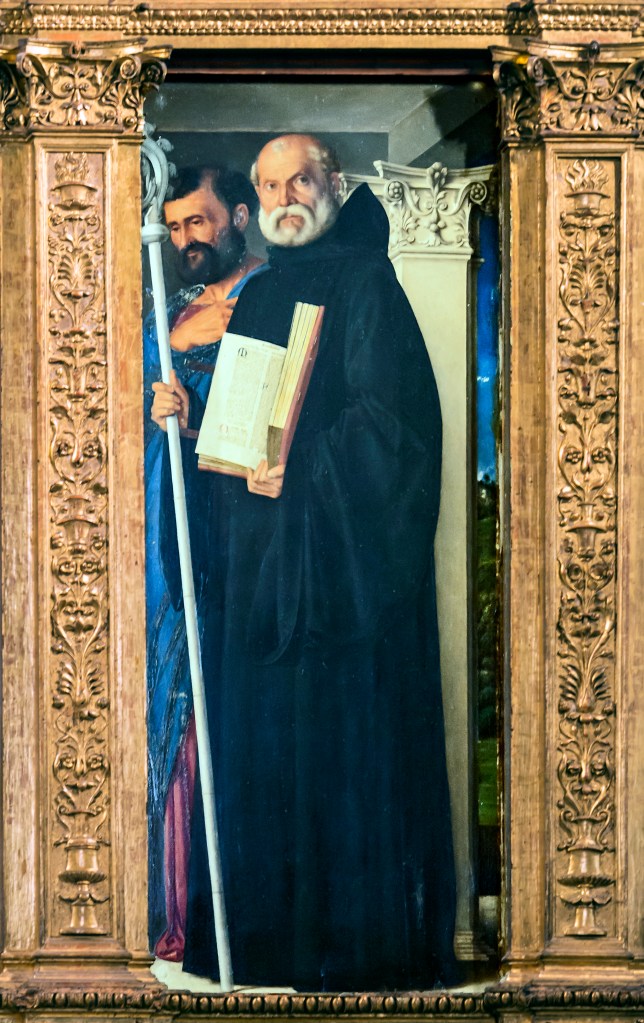
In our reading to the Philippians, Paul said, “Work out your own salvation with fear and trembling; for it is God who is at work in you, enabling you both to will and to work for his good pleasure.” So, if I were to ask you, how would you say you are working out your salvation?
Some may have a good plan, while others take the Hail Mary approach. Not the Hail Mary prayer, but the Hail Mary play in football, when you are at the end of the game and behind, so you make one last play and hope you come down with a score. I suspect most fall somewhere in between, but Benedict of Nursia worked out his salvation with a particular Rule. You know it as the Rule of St. Benedict, written around the year 530 A.D.
The Rule has five significant dimensions: silence, prayer, humility, manual labor, and obedience. These can all be studied in depth, but since our time is limited, I would like to focus on humility. In chapter seven of the Rule, Benedict outlines twelve degrees of true humility. He presents them as a ladder, referencing the ladder Jacob saw in a dream, on which the angels of heaven ascended and descended. Each degree, each rung of the ladder, brings you closer to heaven. He begins:
“The first degree of humility, then, is that a person keep the fear of God before his eyes and beware of ever forgetting it. Let him be ever mindful of all that God has commanded; let his thoughts constantly recur to the hell-fire which will burn for their sins those who despise God, and to the life everlasting which is prepared for those who fear him.”
The following eleven degrees read similarly. Briefly, they are:
- Doing the will of the Father over our own.
- Complete obedience in submitting to superiors.
- Remain patient, even in the face of injustice.
- Confession of every sin and every evil thought to the Abbott of the monastery.
- Be content under even the worst of circumstances.
- Consider yourself to be the lowest of all.
- Follow the Rule.
- Keep silent unless questioned by a superior.
- Do not be quick to laugh.
- When you speak, do so quietly with as few words as necessary.
- To be humble not only in heart but in appearance.
Having climbed this ladder and passed through these levels, Benedict states that the monk will no longer fear Hell but will instead experience total love for Christ.
Returning to your own rule of life, have you begun to climb such a ladder? Perhaps not as prescribed by Benedict, but have you set before yourself an intentional path that will help you develop a deeper relationship with God and lead you into greater holiness, so that you may grow in His image? If yes, good. Keep it up. If not, I can commend the Rule of St. Benedict, even if you only generally seek to incorporate those five significant dimensions – silence, prayer, humility, manual labor, and obedience – into your daily life.
In Book 1, Chapter 19 of The Imitation of Christ, Thomas à Kempis writes, “Not everyone can have the same devotion. One exactly suits this person, another that. Likewise, different exercises are suitable for different times, some for feast days and others again for weekdays. In times of temptation, we need certain devotions. For days of rest and peace, we need others. Some are suitable when we are sad, others when we are joyful in the Lord.”
The Rule of St. Benedict may not be for you, but it points to our need for an intentional, daily encounter with God so that we may work out our salvation. Therefore, I encourage you to develop one for your own life so that you may grow in the Lord’s wisdom, knowledge, and love.

