
Last week, I shared with you a verse from the Epistle to the Hebrews: “Faith is the assurance of things hoped for, the conviction of things not seen” (Hebrews 11:1). In our study of the Heavenly Virtues, including the three Theological Virtues, we understand that faith is a gift from God, but that faith is not something like a commodity we can acquire more of it on an as-needed basis. Instead, faith is a relationship with the Father through Christ Jesus. Faith is resting in the shadow of His wings, regardless of circumstances or outcome. However, the passage from Hebrews introduced the second of the Theological Virtues—hope.
Within philosophy, hope has mainly been seen as negative, though sometimes as positive. It is considered negative because it was seen as frivolous optimism, and positive because, in the right measure, it can provide encouragement.
In psychology, hope is considered part of positivity and positive thinking. Hope is “the perceived capability to derive pathways to desired goals, and motivate oneself via agency thinking—willpower or drive—to use those pathways.” (Source) A psychology professor at the University of Oklahoma explains, “We often use the word ‘hope’ in place of wishing, like you hope it rains today or you hope someone’s well… but wishing is passive toward a goal, and hope is about taking action toward it.” (Ibid.) From this view, hope combines positive thinking with action to achieve a specific goal.
Both of these approaches—philosophy and psychology—bump up against our understanding of the Virtue of Christian Hope, but neither completely captures it, and they differ in two main ways.
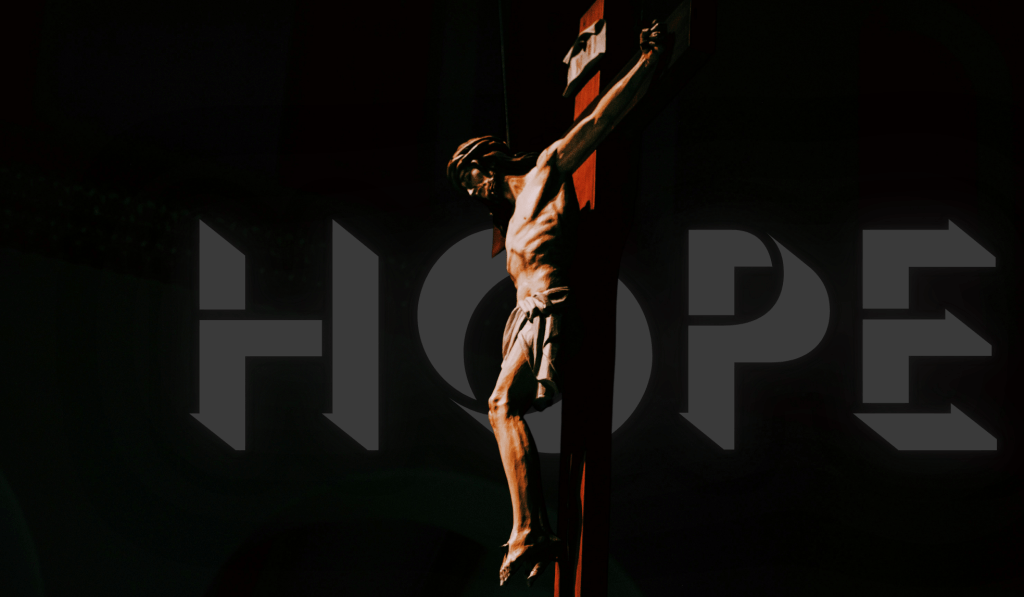
First, Christian hope is not about an action or outcome we expect to be fulfilled in the future. Instead, Christian hope concerns an outcome that has already been accomplished. Our hope is the salvation that was achieved at Golgotha on the Cross. St. Alphonsus Liguori writes, “What sinner would ever have been able to hope for pardon if Jesus had not, by his blood and by his death, made satisfaction to the divine justice for us?” (The Love of Jesus Crucified, p.117) Without salvation, there would be no hope; without it, life is just a series of days strung together that lead to nothingness. Instead, “How great is the hope of salvation which the death of Jesus Christ imparts to us.” (Ibid. p.122)
Writing to the Romans, St. Paul said, “He who did not spare his own Son but gave him up for us all, how will he not also with him graciously give us all things?Who shall bring any charge against God’s elect? It is God who justifies.Who is to condemn?” (Romans 8:32-34) Ligouri, expanding on this, wrote, “How should that Lord condemn thee, who died in order not to condemn thee? How should he drive thee away when thou returnest to his feet, he who came from heaven to seek thee when thou wert fleeing from him? ‘What art thou afraid of, sinner? How shall he condemn thee penitent, who dies that thou mayst not be condemned? How shall he cast thee off returning, who came from heaven seeking thee?’” (Love, p.122) In other words, for you, Jesus endured the horrors of the Cross, why—if you call on His name, if you have faith in Him and, through that faith, enter into a relationship with Him, and if you love Him—why would He turn from you and condemn you? Christian hope speaks to our souls and assures us that He would never do that. This also highlights the second main difference between Christian hope and the hope of philosophy or psychology: Although Christian hope helps us in this life, its main focus is eternal life.
Our hope lies in our salvation, which has already been secured. While we begin to experience the joy of that salvation in this life, it is our eternal life that Jesus cares most about. Jesus said, “I am the resurrection and the life. Whoever believes in me, though he die, yet shall he live, and everyone who lives and believes in me shall never die” (John 11:25-26). Our hope is eternal life, made possible through salvation gained through the Cross. That in turn gives us the hope we have in daily living. Through the hope of eternal life, made possible by the resurrection of the dead, regardless of the trials we endure, in the words of St. Teresa of Avila: “All shall be well, and all shall be well, and all manner of thing shall be well.” That fun line from The Best Exotic Marigold Hotel puts it: “Everything will be okay in the end, and if it is not okay, it is not the end.”
Faith is the loving and protective relationship we have with the Father. Our hope informs our souls to know that not only do we have this relationship, but that it is eternal. This leaves us with the last of the Theological and Heavenly Virtues, and it is greater than all these—love.
Let us pray (from St. Alphonsus Ligouri). I invite you to make this prayer your own: My Jesus, my hope, Thou, in order not to lose me, hast been willing to lose Thy life; I will not lose Thee, O infinite good. If, in time past, I have lost Thee, I repent of it; I wish, for the future, never to lose Thee more. It is for Thee to aid me, that I may not lose Thee again. O Lord, I love Thee, and I will love Thee always. Mary, thou, next after Jesus, art my hope; tell thy Son that thou dost protect me, and I shall be safe. Amen. So may it be. (Love, p.130)
 Candle in a Cave