
On a Sunday afternoon, an elderly man sat on the back porch of the parsonage, talking to the young priest, and said, “Father, I’ve got something to tell you. I’ve never told this to a soul; it’s extremely difficult to tell you now, but my wife and I have had a fight almost every day for the past 30 years of our marriage.”
The priest was surprised and looked away. He nervously sipped his coffee, unsure of what to say. The young priest asked, “Every day?” “Yes, just about every day.” “Did you fight today before coming to church?” “Yes.” “How did it end?” “She came crawling to me on her hands and knees.” “My goodness, what did she say?” “Come out from under that bed, you coward, and fight like a man!”
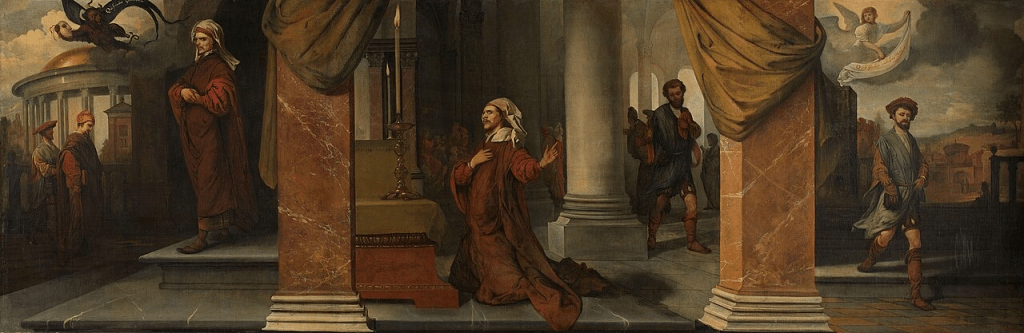
Jesus tells a parable about two men who “went up to the temple to pray, one a Pharisee and the other a tax collector.” The Pharisee was very knowledgeable about God’s teachings. The tax collector, not so much. Plus, the tax collector was generally seen as a plague on society. So, after their prayer, you might think the Pharisee would be the one justified before God, but that’s not the case. When he prays, he believes he knows the mind of God, how things work—he’s not just on the team, he’s the star quarterback, so he is all puffed up. When he prays, he says to God, “You know me and I know you. We’re tight, and thank heaven I’m not like that poor schmuck over there. You and me, we’re good.” He sees himself as a righteous dude because he thinks God views him as a righteous dude.
On the other hand, the tax collector could not even look up toward heaven when he prayed. In the temple, he stayed as far away as possible, keeping his head bowed. He didn’t consider himself worthy, so he prayed, “God, be merciful to me, a sinner!” And Jesus said, “I tell you, this man went down to his home justified rather than the other; for all who exalt themselves will be humbled, but all who humble themselves will be exalted.”
What was the key difference between the two? If I had to pick one word, I would say truthfulness — not with the world around them or even with God, but truthfulness with themselves.
In The Brothers Karamazov, Fyodor Dostoevsky writes, “And, above all—don’t lie… Above all, don’t lie to yourself. The man who lies to himself and listens to his own lie comes to such a pass that he cannot distinguish the truth within him, or around him, and so loses all respect for himself and for others.”
The tax collector, despite feeling miserable about himself and his sins, was at least honest with himself. He had no illusions about being a good man, so instead of trying to justify himself before God, he cast his soul on God’s mercy. He prayed, “God, be merciful to me, a sinner.”
As for the Pharisee, he couldn’t see past his own self-deception to repent for any wrongdoing. He stood before God, having lied to himself so completely that, in Dostoevsky’s words, he could not “distinguish the truth within him, or around him.”
Unfortunately, I believe that more people are like the Pharisee than the tax collector. They deceive themselves into thinking they are justified and righteous before God. Why? Several reasons come to mind.
First, looking inward and facing the truth about ourselves can sometimes be quite painful. For example, if you have a long work history, jumping from one job to another, it’s easy to blame others. “Well, the boss didn’t like me.” “At this job, they didn’t appreciate me.” “There, the employees were always after me.” Each of those statements could be true and reason enough to leave, but if you are honest with yourself and those circumstances, you might ask, “What is the common denominator? What do each of those positions have in common?” The answer: you. That doesn’t mean you were the problem, but it’s a question you need to ask. If, in asking that question honestly and realizing it was you, well, that can be a painful revelation, and we don’t like pain—whether physical, emotional, or spiritual—which leads to another reason for self-deception: fear of change.
In those jobs you held, you were honest with yourself, you discovered that you were the one who was the issue, and even though it was a painful revelation, you still must make a choice. Will you remain the same, or will you work to change and improve yourself? Everyone talks about how change is a good thing, and I believe that it is, right up to the point where I’m the one who has to do the changing; then change is very, very bad.
If we choose to overcome the pain and change, we must also face another part of being honest with ourselves—letting others see and understand who we truly are and that we were wrong. Oh, the humanity! Pride is a harmful trait.
In the end, if we overcome these and other fears of being truthful with ourselves and with God, I believe there is one more reason why we will continue to deceive ourselves: we don’t believe we have the capacity or the tools to do anything about it. We say, “I am who I am, and there’s nothing to be done about it in Heaven or on Earth.” O woe is me, but that is just another lie we tell ourselves so we don’t have to do the work.
The Psalms we read on Sundays are usually very pleasant and easily consumed. From the Psalm today, praising the Lord.
“Happy are they who dwell in your house! they will always be praising you.”
However, if you explore the Psalms beyond our Sunday readings, you will notice there is quite a focus on enemies. Take Psalm 63, for example. When we read it, we see verses one through eight. It begins,
“O God, you are my God; earnestly I seek you;
my soul thirsts for you;
my flesh faints for you,
as in a dry and weary land where there is no water.”
Nice and comforting, but when we only read verses one through eight, we never get to verses nine and ten.
“But those who seek to destroy my life
shall go down into the depths of the earth;
they shall be given over to the power of the sword;
they shall be a portion for jackals.”
Hoorah! But who are these enemies that seek my life? Who is it that will be put down by the sword and fed to jackals?
Some may have a person or group they consider an “enemy” (I would suggest you rethink that), but what if, instead of a person or group, we interpret the enemies in Psalms as the self-deceptions and sins within us? What if we see the enemies as those parts of our lives that we need to rid ourselves of, to fight so that we can conquer, in order that we might change and be transformed into the image of God? What if we say we must defeat the pain and fear of change and put the pride under our feet? Think about these ideas and consider them in the context of a portion of Psalm 118.
For who is God, but the Lord?…
He trains my hands for war,
so that my arms can bend a bow of bronze.
You have given me the shield of your salvation,
and your right hand supported me,
and your gentleness made me great.
You gave a wide place for my steps under me,
and my feet did not slip.
I pursued my enemies
—I pursued my sin and self-deception—
and overtook them,
and did not turn back till they were consumed.
I am running a few minutes late; my previous meeting is running over.
I thrust them through, so that they were not able to rise;
they fell under my feet.
For you equipped me with strength for the battle;
you made those who rise against me
—those enemies within—
sink under me.
You made my enemies turn their backs to me,
and those who hated me I destroyed.
They cried for help, but there was none to save;
they cried to the Lord, but he did not answer them.
I beat them fine as dust before the wind;
I cast them out like the mire of the streets.
What if, like the Psalmist, when our enemies come against us, we don’t crawl under the bed, but instead say, “Bring it!”—trusting completely in the words of the Lord, “No weapon that is fashioned against you shall succeed” (Isaiah 54:17a).
If we will, then we know that we can and must stand against the enemies and self-deception, so that when we come before the Lord, we don’t pretend as though nothing is wrong. We don’t stand there like a Pharisee saying, “Oh, look how perfect I am,” but instead, we are in a place where we can humbly pray, “God, be merciful to me, a sinner!” And in doing so, like the tax collector, be justified, be made right before the Lord. Jesus said, “All who exalt themselves will be humbled, but all who humble themselves will be exalted.
In his first epistle, the Apostle John wrote, “If we say we have no sin, we deceive ourselves, and the truth is not in us. If we confess our sins, he is faithful and just to forgive us our sins and to cleanse us from all unrighteousness (1 John 1:8-9).” If we will humble ourselves by being truthful with ourselves and with God, then we will be justified in God’s eyes.
Let us pray: God, the author of peace and lover of concord, to know you is eternal life and to serve you is perfect freedom: Defend us, your humble servants, in all assaults of our enemies; that we, surely trusting in your defense, may not fear the power of any adversaries; through the might of Jesus Christ our Lord. Amen.
 Candle in a Cave