Pip: A three-year-old invoking the name of Jesus to score twenty-three boxes of chocolate chip cookies — honestly, that is the most theologically efficient prayer in recorded history.
Mara: That story opens a sermon by Fr. John, and it turns out to be the perfect door into something much larger: what prayer actually does when God already has a plan.
Pip: Right — and that tension between providence and petition is exactly where this episode lives. Let's get into it.
Providence, Prayer, and a Busted Hip
Mara: The central question here is one that anyone who has prayed and waited and heard nothing will recognize: if God has a wise, loving plan already in motion, what is the point of asking?
Pip: The sermon lands its answer through Jacob — a man who wrestled God at the Jabbok River and refused to let go. Here is the line that frames everything: "Jacob prayed, 'Bless me,' and the Lord replied, 'What you are asking is good, but it is too small.'"
Mara: That reframe is the hinge of the whole argument. Jacob got his blessing — but it arrived as a dislocated hip, a new name, and a lineage that eventually produced Jesus of Nazareth. The prayer was answered; it just expanded far beyond what Jacob could have conceived.
Pip: So the sermon is not really arguing that God ignores us. It is arguing that our requests are structurally too small for what God is doing.
Mara: Exactly, and three reasons for prayer follow from that. The first two are fairly direct: Jesus commands it, and prayer enlarges the soul to receive more of God — the sermon uses the image of a teaspoon versus a five-gallon bucket both dipped in the ocean. Neither empties the ocean; one simply holds more.
Pip: The third reason is the one with some weight to it.
Mara: It is. The sermon draws on Paul's letter to the Corinthians: "We are God's fellow workers. You are God's field, God's building." The claim is that prayer is not just petition — it is participation. God wants us asking so we can be woven into the work itself.
Pip: Which reframes the unanswered prayer entirely. You are not being ignored; you are being incorporated.
Mara: And when we do not know what to ask for, Paul's words from Romans carry the load: "The Spirit himself intercedes for us with groanings too deep for words." Our feeble attempts, the sermon says, are taken and perfected.
Pip: Twenty-three boxes of cookies, or a busted hip — either way, you are not praying into a void.
Mara: The through-line is that providence and prayer are not in competition — prayer is how we become part of the story rather than just recipients of it.
Pip: Jacob limped away from that riverbank with everything he asked for and more than he bargained for. That seems about right. More next time.
A story is told about a 3-year-old boy who went to the grocery store with his mother. Before they entered the store, she told him, “Now you’re not going to get any chocolate chip cookies, so don’t even ask.” She put him in the cart, and he sat in the little child’s seat while she wheeled down the aisles. He was doing just fine until they came to the cookie section. He saw the chocolate chip cookies, stood up in the seat, and said, “Mom, can I have some chocolate chip cookies?” She said, “I told you not even to ask. You’re not going to get any at all.” So he sat back down. They continued down the aisles, but in their search for certain items, they ended up back in the cookie aisle. “Mom, can I please have some chocolate chip cookies?” She said, “I told you that you can’t have any. Now sit down and be quiet.” Finally, they were approaching the checkout lane. The little boy sensed that this might be his last chance. So just before they got to the line, he stood up on the seat of the cart and shouted in his loudest voice, “In the name of Jesus, may I have some chocolate chip cookies?” And everybody round about just laughed. Some even applauded. Due to the generosity of the other shoppers, the little boy and his mother left with twenty-three boxes of chocolate chip cookies.
Ever wondered what your life would be like if God answered your prayers exactly as you prayed them? There have been times when I wish He would: “Lord, please let me win the lottery so I can prove to you that it won’t spoil me.” But there have also been so many other prayers that would have ended miserably if they had been answered. However, I suppose it is a moot point, because it seems to me that God doesn’t answer too many of our prayers, and when He does, it certainly isn’t in the way we asked. Consider Jacob, whom we read about this morning.
Jacob wronged his brother Esau. Not only did Jacob purchase Esau’s birthright with a cup of stew, but he also tricked his father and stole Esau’s blessing. In his anger, Esau said, “The days of mourning for my father are near; then I will kill my brother Jacob.” (Genesis 27:42) To resolve the issue, Jacob ran away. He was gone for twenty years, and today we read about his return home with his two wives and all his possessions.
They camped on the Jabbok River, and that night, when he was alone, Jacob spoke with and wrestled with a heavenly being. Whether it was an angel or God, we do not learn here, but the Prophet Hosea wrote, “He struggled with the angel and overcame him; he wept and begged for his favor.” (Hosea 12:4a)
The Church, looking at the event in light of Hosea’s statement, has long understood Jacob’s wrestling with God as an image of persevering prayer, for Jacob struggled with God and would not let him go until he received God’s blessing. However, what should be noted is that Jacob did receive the blessing, but not before God gave him a busted hip and a new name—Israel. Jacob had his prayer answered, but not in the way he asked for. Jacob prayed for something very specific and personal, and God answered the prayer, but not just for Jacob. God answered Jacob’s prayer for everyone, us included. How?
The Lord blessed Jacob/Israel and also gave him twelve sons, one of whom was Judah. Several generations later in Israel’s lineage, there was a king, David. Many more generations and years later, there was a man named Joseph, whom another angel of the Lord spoke to: “Joseph son of David, do not be afraid to take Mary home as your wife, because what is conceived in her is from the Holy Spirit. She will give birth to a son, and you are to give him the name Jesus, because he will save his people from their sins.” (Matthew 1:20b-21)
Jacob prayed, “Bless me,” and the Lord replied, “What you are asking is good, but it is too small. I will bless you, but it’s not going to look like anything you could have ever imagined. Oh, and I’m also going to give you a busted hip so that you remember it.”
Last week we talked about God’s providence; we concluded that we do not believe things come about by luck or chance, nor do we believe the ways of the world have been set on a path of fate from which nothing deviates.
We are a people who believe in God’s providence, defined as God’s wise, loving, and continual governance of all creation, by which He sustains the universe and directs history toward His good purposes while respecting our free will. God takes the good, the bad, and the ugly and uses them for His purposes.
During this past week, I’ve continued to reflect on that, and I’ve been wondering how our prayers work within God’s providence. My question was, if God has this big, beautiful plan worked out in His providence, then what good are my prayers? Why pray?
The easy answer is that Jesus tells us we should pray, and He sets the example for us. But in addition, prayer enlarges our souls so that we might be able to receive more of God.
Imagine you have a teaspoon and a five-gallon bucket. You take them both to the beach and fill them in the ocean. Neither the teaspoon nor the five-gallon bucket diminishes the ocean; however, the five-gallon bucket can receive more. Now, think of God as the ocean. Through our connection and immersion in God, and even through our desires, our souls are enlarged, and we are able to receive more.
We pray because we are told we should, and we pray because it allows us to receive more of God. Those two reasons are fairly straightforward; however, the third reason is more complicated but also more exciting.
When we pray, we are most often looking for a particular result. “Lord, I need ____.” Even when prayed rightly, we focus on the outcome, but what if our prayer were more about communion with God than the result? What if God is saying, “I want you to pray, I want you to pray so that you can receive more of me, but I also want you to pray so that you can be a part of this great work”? This is what St. Paul means when he writes, “We are God’s fellow workers. You are God’s field, God’s building.” (1 Corinthians 3:9) God says, “I want you to pray, asking for anything, and like with Jacob who wanted to be blessed, I’m going to take your prayer, your work, and incorporate it into something greater than you could ever ask for or imagine.”
Do our prayers matter? Are they answered? Yes. It’s just that we don’t know how to pray properly. St. Paul teaches us, “The Spirit helps us in our weakness. For we do not know what to pray for as we ought, but the Spirit himself intercedes for us with groanings too deep for words. And he who searches hearts knows what is the mind of the Spirit, because the Spirit intercedes for the saints according to the will of God.” (Romans 8:26-27) Our prayers matter, but we don’t know how to pray properly, so the Lord, in His loving care, takes our feeble attempts and perfects them. What does that look like?
I pray to win the lottery, and God says, “No, but through your prayers and your work in My kingdom, I will store up treasures for you in heaven, where neither moth nor rust destroys and where thieves do not break in and steal” (Matthew 6:20b). You pray for healing, and God says, “Yes, but too small; I’ll take your prayer and weave it into Providence. I won’t just heal you and fix you up for a few more years, but I’ll prepare you for the resurrection and eternal life, and even more, I’ll give eternal life to all those who believe in me.” We pray, “Lord, relieve me of my suffering,” and God says, “I can do that, but My greater purpose is to teach you about My Son.” We say, “But Lord, it hurts.” And just when we begin to think He’s not going to answer, we discover that He is sitting with us in that deep darkness, speaking comfort, perhaps not to our physical bodies but to our souls.
We offer up our prayers; they matter, and God hears. God says, “I will take your prayer and perfect it. Along the way, you may get twenty-three boxes of chocolate chip cookies, or, like Jacob, you may get a busted hip or worse. Also like Jacob, you may see your prayer answered today, or tomorrow, or in fifty years, or never, but you and I will be in communion with one another. You and I will be working together, and in the end, you and I will be together, for that too is part of My providence and is, in fact, the ultimate goal.”
The Psalmist writes,
The Lord frustrates the designs of the nations, he defeats the plans of the peoples. His own designs shall stand for ever, the plans of his heart from age to age.
They are happy, whose God is the Lord, the people he has chosen as his own. From the heavens the Lord looks forth, he sees all the children of men.
From the place where he dwells he gazes on all the dwellers on the earth, he who shapes the hearts of them all and considers all their deeds.
(Psalm 33:10-15)
Let us pray (a prayer of St. Ignatius): Take, Lord, receive all our liberties, our memories, our understandings, our whole will, all that we have and all that we possess. You gave it all to us, Lord; we give it all back to you. Do with it as you will, according to your good pleasure. Give us your love and your grace; for with this we have all that we need. Amen.
Groucho Marx said, “If you find it hard to laugh at yourself, I would be happy to do it for you.” And the Tunisian Prime Minister, Habib Bourguiba, wrote, “Happy is the person who can laugh at himself. He will never cease to be amused.” We know that laughing at ourselves, or self-deprecating humor, can have a healthy side, but it can also become detrimental. We say something about ourselves that makes others laugh, but on the inside, we actually believe it. Example: “My romantic strategy is simple: I just wait for someone to make a terrible mistake and fall in love with me.” In addition, most of the time, we don’t need to laugh at ourselves, because the world can pour it on just fine. That is not only true of who we are, but also of our faith. In fact, the world has been great at ridiculing and laughing at those who act in faith.
There’s Noah. He’s an easy one. Can you imagine the grief they must have put him through? According to Scripture, it took him 50-100 years to build the Ark. All the while, everyone was watching, and I’m certain they were laughing. When he started gathering the animals, think of the ridicule. How stupid could a person be?
Then there was Abram, who became Abraham, whom we read about today. Can you imagine: Abram starts packing up his house. The neighbors stop by and ask, “Hey, Abe, what are you doing?” His response, “The Lord spoke to me and said, ‘Go from your country and your kindred and your father’s house to the land that I will show you. I will make of you a great nation, and I will bless you, and make your name great, so that you will be a blessing.’” Can you imagine the ridicule and laughter? “You can’t even pack your camel correctly, and the Lord is going to make a nation out of you? Please.”
When David was just a boy, he went up against the giant Goliath. His brother saw him coming and berated him. The King, Saul, said, “You’re just a boy. You’ve got no chance” (cf. 1 Samuel 17:33). Then, Goliath laughed and sneered. “Am I a dog, that you come to me with sticks?… Come to me, and I will give your flesh to the birds of the air and to the beasts of the field.” (1 Samuel 17:43) All of them rebuked him and, I’m certain, laughed at him, not only the Philistines but his own people. “You’re nothing but a child. Go home to mama.” But what St. Paul would later write to the Corinthians was just as applicable to these: “God chose what is foolish in the world to shame the wise; God chose what is weak in the world to shame the strong; God chose what is low and despised in the world, even things that are not, to bring to nothing things that are, so that no human being might boast in the presence of God.” (1 Corinthians 1:27–29)
Noah, his family, and the animals were saved from the flood, while the world perished around them. Abraham walked the earth 4,000 years ago, and we are part of the great nation established through him, which continues to grow and expand. David struck down Goliath with a single small stone and became the greatest King Israel has ever known, and his lineage produced Jesus. God chose the weak, the despised, the lowly, and the ridiculed to accomplish His work, so that it was clear to all that the victory was God’s alone.
If these three were the only examples in Scripture, we could say, “Everybody gets lucky on occasion,” but in truth, it is the way of God. And the pattern continues. Gideon’s 300 defeated an army. Esther saved her people. A young girl named Mary said yes to God and bore the Savior of the world.”
Again and again, God works through the foolish, the weak, and the ridiculed, overturning the expectations of the powerful.
In our Gospel reading, we find two more examples. First is the calling of Matthew. Jesus said, “Follow me,” and Matthew did. That evening, Jesus had dinner at Matthew’s house, and many other sinners were present. Seeing this, the Pharisees said, “Why does your teacher eat with tax collectors and sinners?” They ridiculed Jesus and, I imagine, laughed at his foolishness. I suspect their comments were like those of the Pharisee who invited Jesus to dinner. You’ll recall that the “sinful woman” came and washed Jesus’ feet with her tears, dried them with her hair, and then anointed them. The Pharisee thought, “If this man were a prophet, he would have known who and what sort of woman this is who is touching him, for she is a sinner.” (Luke 7:39) I can hear them saying the same thing about Matthew and his companions.
The second incident in the Gospel involves Jesus. The little girl has died, yet through her, Jesus intends to demonstrate the power of God. He says to the crowd, “‘Go away; for the girl is not dead but sleeping.’ And they laughed at him.” They believed that only God has power over life and death, and, in their understanding, Jesus was merely a man.
Remember how Jesus’ hometown ridiculed him? They said, “Where did this man get this wisdom and these mighty works? Is not this the carpenter’s son? Is not his mother called Mary? And are not his brothers James and Joseph and Simon and Judas? And are not all his sisters with us? Where then did this man get all these things?” (Matthew 13:54-56) “We know this kid. Who does he think he is? He’s Joe’s boy. He’s nothing.”
When Jesus said to those gathered around the dead little girl that she was only sleeping, they laughed at Him. They knew she was dead and that only God could raise the dead. They were saying, “Who do you think you are? You’re nothing.”
However, you would think that after witnessing all the miracles the people would have believed, but even then there was still ridicule and disbelief. “‘He is possessed by Beelzebul,’ and ‘by the prince of demons he casts out the demons.’” (Mark 3:22)
Writing in the second century, the philosopher Celsus spoke sarcastically about Christianity and those who followed Jesus. He described Christians as “the most uneducated and vulgar persons” and “like a swarm of bats–or ants creeping out of their nests–or frogs holding a symposium round a swamp–or worms in a conventicle in a corner of mud.” Not what I would call high praise, but it is what many thought of Christianity and Christians. 2,000 years later, not much has changed. Should we be surprised? No. Jesus said, “A disciple is not above his teacher, nor a servant above his master…. If they have called the master of the house Beelzebul, how much more will they malign those of his household.” (Matthew 10:24-25)
Throughout history, God’s people have been ridiculed and laughed at for their faith. Yet no word or sneer from the outside has stopped us from moving forward. Yet, there is ridicule and laughter that can and does bring everything to a halt—when we attack ourselves. When we laugh or sneer at the faith that is in us. What does that look like?
“I’m not good enough. My sins are too great for God to hear me.” “God is too busy to be bothered with the likes of me and my little problems.” “What I want to say or ask just isn’t all that important, so I shouldn’t bother God with it.” “I’m too weak. I’m too foolish. I’m laughable in my relationship with God.” These and all the other “reasons” we come up with are simply ways of degrading and ridiculing who we are in God and in our faith. We’re laughing at ourselves, but not in a healthy way, and it is detrimental to our life with God.
Jesus says, “If you abide in me, and my words abide in you, ask whatever you wish, and it will be done for you.” (John 15:7) There are no qualifiers in that statement like, “Ask whatever you want, as long as you’re as holy as me, and it better be important.” Jesus says, “Fear not, little flock, for it is your Father’s good pleasure to give you the kingdom.” (Luke 12:32) It is the Father’s pleasure to hear from us and to fulfill those things in accordance with His ways.
St. Paul says it so clearly: “Since then we have a great high priest who has passed through the heavens, Jesus, the Son of God, let us hold fast our confession… Let us then with confidence—let us boldly—draw near to the throne of grace, that we may receive mercy and find grace to help in time of need.” (Hebrews 4:12, 16)
There are plenty in the world who will gladly ridicule and laugh at your faith. And you know… so what. They’ve been doing it since the beginning. Wish them a nice day and keep moving. As St. Josemaria Escriva says, “Don’t waste your time and your energy — which belong to God — throwing stones at the dogs that bark at you on your way. Ignore them.” (The Way) But also don’t do their job for them. Don’t undermine your own faith through self-condemnation and self-abuse. Instead, come before God’s throne of grace with boldness and confidence, come as His beloved children, and lay your heart before Him. It is His good pleasure to hear you.
Let us pray: “Loving and Merciful Father, we come before You knowing that You are ever present and attentive to the voice of our prayers. In the quiet of our hearts, we trust that You hear every petition, joy, and sorrow we lay before You. We place our anxieties and needs into Your compassionate hands, confident that Your steadfast love endures forever. Strengthen our faith, Lord, and grant us the grace to always accept Your holy will. Amen.”
Hearken to my voice, O Lord, when I call; have mercy on me and answer me. You speak in my heart and say, “Seek my face.” Your face, Lord, will I seek.
I love to read, but I’ll occasionally go through a phase when I don’t even want to pick up a book, so I’ll end up binge-watching something on TV for a few weeks. Then I’ll get tired of that and go back to reading. It’ll happen with other things as well, but… the Psalmist said, “You speak in my heart and say, ‘Seek my face.’ Your face, Lord, will I seek.” Have you ever gone through a phase when you just didn’t feel like seeking His face? I’m not going to ask you to raise your hand if you have, because that is not the kind of thing good Christian folk like to confess, but do you occasionally find yourself a bit tired of seeking Him, wondering about His will, and all that? As I said, I won’t ask you to confess, but if you say you’ve never experienced those feelings, I would say you need to go to confession for fibbing. It is something we all experience at times, and in those moments, our faith is truly demonstrated.
A mature Christian will continue in their faith and practices, knowing that these are times of wilderness rather than abandonment by God. However, others will begin to drift away, and perhaps one of the first things to go is prayer. When it seems we’re filling the air with words that are unheard and accomplish nothing, why bother? But it is the prayers in the wilderness that will see us through, because it is through them that we maintain the relationship with the Father.
Julian of Norwich, whom we celebrate today, spoke about this in the second part of her fourteenth revelation, contained in her Revelations of Divine Love. “Our Lord is very glad and happy that we should pray, and he expects it and wants it… for this is what [the Lord] says, ‘Pray earnestly even though you do not feel like praying, for it is helping you even if you do not feel it doing you any good, even if you see nothing, yes, even if you think you cannot pray; for in dryness and in barrenness, in sickness and weakness, then your prayers give me great pleasure, even if you feel that they are hardly pleasing to you at all. And it is so in my sight with all your trustful prayers.’” Julian says, “God accepts the good intentions and the effort of those who serve him, whatever we are feeling.” (p.100)
To us, it may seem fruitless, but in a time of barrenness, when we feel the absence of God, stopping prayer is to break off from the relationship. So, regardless of how we feel, we must stay engaged because it is through our faithfulness and this engagement that we will once again feel the presence of God.
If you say, “I just don’t feel like praying. I don’t have anything to say,” then take the good advice of Archbishop Michael Ramsey, “Pray that you could pray,” but don’t stop praying.
On a Sunday afternoon, an elderly man sat on the back porch of the parsonage, talking to the young priest, and said, “Father, I’ve got something to tell you. I’ve never told this to a soul; it’s extremely difficult to tell you now, but my wife and I have had a fight almost every day for the past 30 years of our marriage.”
The priest was surprised and looked away. He nervously sipped his coffee, unsure of what to say. The young priest asked, “Every day?” “Yes, just about every day.” “Did you fight today before coming to church?” “Yes.” “How did it end?” “She came crawling to me on her hands and knees.” “My goodness, what did she say?” “Come out from under that bed, you coward, and fight like a man!”
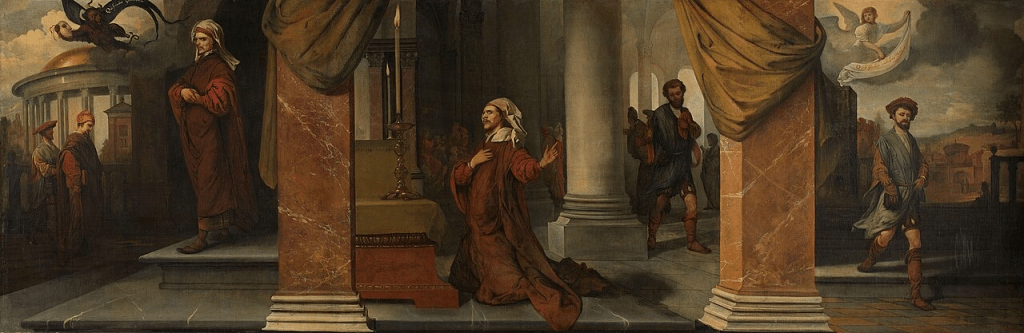
Jesus tells a parable about two men who “went up to the temple to pray, one a Pharisee and the other a tax collector.” The Pharisee was very knowledgeable about God’s teachings. The tax collector, not so much. Plus, the tax collector was generally seen as a plague on society. So, after their prayer, you might think the Pharisee would be the one justified before God, but that’s not the case. When he prays, he believes he knows the mind of God, how things work—he’s not just on the team, he’s the star quarterback, so he is all puffed up. When he prays, he says to God, “You know me and I know you. We’re tight, and thank heaven I’m not like that poor schmuck over there. You and me, we’re good.” He sees himself as a righteous dude because he thinks God views him as a righteous dude.
On the other hand, the tax collector could not even look up toward heaven when he prayed. In the temple, he stayed as far away as possible, keeping his head bowed. He didn’t consider himself worthy, so he prayed, “God, be merciful to me, a sinner!” And Jesus said, “I tell you, this man went down to his home justified rather than the other; for all who exalt themselves will be humbled, but all who humble themselves will be exalted.”
What was the key difference between the two? If I had to pick one word, I would say truthfulness — not with the world around them or even with God, but truthfulness with themselves.
In The Brothers Karamazov, Fyodor Dostoevsky writes, “And, above all—don’t lie… Above all, don’t lie to yourself. The man who lies to himself and listens to his own lie comes to such a pass that he cannot distinguish the truth within him, or around him, and so loses all respect for himself and for others.”
The tax collector, despite feeling miserable about himself and his sins, was at least honest with himself. He had no illusions about being a good man, so instead of trying to justify himself before God, he cast his soul on God’s mercy. He prayed, “God, be merciful to me, a sinner.”
As for the Pharisee, he couldn’t see past his own self-deception to repent for any wrongdoing. He stood before God, having lied to himself so completely that, in Dostoevsky’s words, he could not “distinguish the truth within him, or around him.”
Unfortunately, I believe that more people are like the Pharisee than the tax collector. They deceive themselves into thinking they are justified and righteous before God. Why? Several reasons come to mind.
First, looking inward and facing the truth about ourselves can sometimes be quite painful. For example, if you have a long work history, jumping from one job to another, it’s easy to blame others. “Well, the boss didn’t like me.” “At this job, they didn’t appreciate me.” “There, the employees were always after me.” Each of those statements could be true and reason enough to leave, but if you are honest with yourself and those circumstances, you might ask, “What is the common denominator? What do each of those positions have in common?” The answer: you. That doesn’t mean you were the problem, but it’s a question you need to ask. If, in asking that question honestly and realizing it was you, well, that can be a painful revelation, and we don’t like pain—whether physical, emotional, or spiritual—which leads to another reason for self-deception: fear of change.
In those jobs you held, you were honest with yourself, you discovered that you were the one who was the issue, and even though it was a painful revelation, you still must make a choice. Will you remain the same, or will you work to change and improve yourself? Everyone talks about how change is a good thing, and I believe that it is, right up to the point where I’m the one who has to do the changing; then change is very, very bad.
If we choose to overcome the pain and change, we must also face another part of being honest with ourselves—letting others see and understand who we truly are and that we were wrong. Oh, the humanity! Pride is a harmful trait.
In the end, if we overcome these and other fears of being truthful with ourselves and with God, I believe there is one more reason why we will continue to deceive ourselves: we don’t believe we have the capacity or the tools to do anything about it. We say, “I am who I am, and there’s nothing to be done about it in Heaven or on Earth.” O woe is me, but that is just another lie we tell ourselves so we don’t have to do the work.
The Psalms we read on Sundays are usually very pleasant and easily consumed. From the Psalm today, praising the Lord.
“Happy are they who dwell in your house! they will always be praising you.”
However, if you explore the Psalms beyond our Sunday readings, you will notice there is quite a focus on enemies. Take Psalm 63, for example. When we read it, we see verses one through eight. It begins,
“O God, you are my God; earnestly I seek you; my soul thirsts for you; my flesh faints for you, as in a dry and weary land where there is no water.”
Nice and comforting, but when we only read verses one through eight, we never get to verses nine and ten.
“But those who seek to destroy my life shall go down into the depths of the earth; they shall be given over to the power of the sword; they shall be a portion for jackals.”
Hoorah! But who are these enemies that seek my life? Who is it that will be put down by the sword and fed to jackals?
Some may have a person or group they consider an “enemy” (I would suggest you rethink that), but what if, instead of a person or group, we interpret the enemies in Psalms as the self-deceptions and sins within us? What if we see the enemies as those parts of our lives that we need to rid ourselves of, to fight so that we can conquer, in order that we might change and be transformed into the image of God? What if we say we must defeat the pain and fear of change and put the pride under our feet? Think about these ideas and consider them in the context of a portion of Psalm 118.
For who is God, but the Lord?… He trains my hands for war, so that my arms can bend a bow of bronze. You have given me the shield of your salvation, and your right hand supported me, and your gentleness made me great. You gave a wide place for my steps under me, and my feet did not slip. I pursued my enemies —I pursued my sin and self-deception— and overtook them, and did not turn back till they were consumed. I am running a few minutes late; my previous meeting is running over. I thrust them through, so that they were not able to rise; they fell under my feet. For you equipped me with strength for the battle; you made those who rise against me —those enemies within— sink under me. You made my enemies turn their backs to me, and those who hated me I destroyed. They cried for help, but there was none to save; they cried to the Lord, but he did not answer them. I beat them fine as dust before the wind; I cast them out like the mire of the streets.
What if, like the Psalmist, when our enemies come against us, we don’t crawl under the bed, but instead say, “Bring it!”—trusting completely in the words of the Lord, “No weapon that is fashioned against you shall succeed” (Isaiah 54:17a).
If we will, then we know that we can and must stand against the enemies and self-deception, so that when we come before the Lord, we don’t pretend as though nothing is wrong. We don’t stand there like a Pharisee saying, “Oh, look how perfect I am,” but instead, we are in a place where we can humbly pray, “God, be merciful to me, a sinner!” And in doing so, like the tax collector, be justified, be made right before the Lord. Jesus said, “All who exalt themselves will be humbled, but all who humble themselves will be exalted.
In his first epistle, the Apostle John wrote, “If we say we have no sin, we deceive ourselves, and the truth is not in us. If we confess our sins, he is faithful and just to forgive us our sins and to cleanse us from all unrighteousness (1 John 1:8-9).” If we will humble ourselves by being truthful with ourselves and with God, then we will be justified in God’s eyes.
Let us pray: God, the author of peace and lover of concord, to know you is eternal life and to serve you is perfect freedom: Defend us, your humble servants, in all assaults of our enemies; that we, surely trusting in your defense, may not fear the power of any adversaries; through the might of Jesus Christ our Lord. Amen.
The Western Wall, also known as the Wailing Wall, is a part of the wall that surrounded the Temple in Jerusalem. It is the holiest site in Judaism, and this section of the wall is especially significant because it was closest to the Temple itself.
A young woman journalist assigned to the Jerusalem bureau has an apartment overlooking the Wailing Wall. At certain times every day, when she looks out her window, she sees an old bearded Jewish man praying solemnly, his lips moving and his eyes closed. Certainly, he would be a good interview subject, so the journalist walks down to the Wall and introduces herself to the old man after his prayers.
She asks, “You come every day to the Wall; how long have you been doing this, and what are you praying for?”
The old man replies, “I have come here to pray every day for 25 years. In the morning, I pray for my family and the brotherhood of man. I go home, have lunch, and in the afternoon, I come back and pray for the broader concerns of the world.”
The journalist is moved to silence, so humbled is she by the sincerity of this old man. Then she remembers her training and asks her second question.
“So,” she asks, “how does it feel to come here every day for 25 years and pray for these wonderful things? What’s it like?”
The old man shrugs his shoulders and replies, “Like talking to a wall.”
Our Gospel today tells about the unjust judge, who is described as a man with no concern except for himself. He cares nothing for God or the people. Also, in the parable, there is the widow, who has been wronged in some way and has come to the judge seeking justice. The judge refuses to rule on the case, but this does not stop the widow from repeatedly coming and pleading her case. Eventually, the judge says to himself, “If I don’t do what this widow is asking, she’s going to drive me up the wall with all her nagging.” So, he is forced to make a ruling because of the constant pressure she was applying.
Through the parable, Jesus is saying, “If this widow could change the mind of the unjust judge simply by coming to him repeatedly, how much more will our Father in Heaven, who loves us, hear the prayers of His people? Jesus says, “Will He delay long in helping them? I tell you, He will quickly grant justice to them.”
As I studied this lesson, I kept returning to that sentence: “God will quickly grant justice and answer our prayers.” Does He? I don’t know if you’ve ever experienced this, but have you ever prayed and not received an answer, or what you were seeking? I’m not talking about praying to win the lottery or get a date with Scarlett Johansson, nothing like that. I’m talking about praying for something that was truly on your heart—someone was sick, a relationship was faltering, a job was needed, or becoming unbearable? You earnestly prayed but were met with only silence. Night after night, day after day, you wrestle with God, but end up with no results. Everybody, nod your head.
Jesus makes some interesting statements about prayer. “Which of you, if your son asks for bread, will give him a stone? Or if he asks for a fish, will give him a snake? If you, then, though you are evil, know how to give good gifts to your children, how much more will your Father in heaven give good gifts to those who ask him!” “Truly I tell you that if two of you on earth agree about anything they ask for, it will be done for them by my Father in heaven.” “I will do whatever you ask in my name, so that the Father may be glorified in the Son. You may ask me for anything in my name, and I will do it.” I can possibly understand why I wouldn’t get the date with Scarlett, but what about a mother with a sick child? What about a mother who gave birth to a beautiful little girl only to discover that the child was born with cancer? Cancer running all through the child’s body. And what if that mother prayed with all her heart for that child to be healed, but before the little girl reached her first birthday, she died? Jesus said, “Ask for anything and I will do it,” so why didn’t he heal the little girl? What are we to conclude? Did Jesus not mean what he said? Let’s take a closer look at this mom and her daughter.
Did I mention that the mom got pregnant outside of marriage? The child was “conceived in sin,” so shouldn’t we really expect the child to be sick? Is there any reason why God should listen to the mom’s prayers? After all, she is a sinner. There’s one possible reason the baby wasn’t healed.
You know, Jesus says, “If you have faith as small as a mustard seed, you can say to this mountain, ‘Move from here to there,’ and it will move. Nothing will be impossible for you.” So, maybe the mother just didn’t have enough faith, and that’s why the baby died.
Possibly the mom didn’t add “in Jesus’ name” at the end of her prayers, so of course, we can’t expect God to answer that prayer.
Or did you notice that the baby’s skin was much darker than her mother’s, a clear sign that the father was of a different race? Well, we all know that can only end in sickness.
Now, you might be looking at me with disgust and thinking that no one would ever say such things and that I’m a monster for even considering them. But what if I told you that these are comments I’ve actually heard in very similar situations? I believe they are all disgusting, completely erroneous, unfounded, and unbiblical. So, if I’m right and these explanations to the question are wrong, then why does it seem like God does not answer prayers the way He says He will?
I’m not smart enough to come up with an answer, so I did my research to find someone who could answer the question. I can either double the length of this sermon and dive into the research with you or just share my findings. I’ll go with sharing my findings. Why does it seem that God doesn’t answer prayers as He promises? Answer: I don’t know, and I don’t think anyone else does. But I will tell you what I do know.
I know that it happened to King David when he prayed for his son’s life—the child died. (2 Samuel 12:15-19) I know it happened to St. Paul regarding the “thorn” in his flesh—“‘Three times I pleaded with the Lord about this, that it should leave me. But he said to me, ‘My grace is sufficient for you, for my power is made perfect in weakness.’” (2 Corinthians 12:8-9) Paul prayed for relief, and the Lord essentially told him, “Deal with it. The suffering is good for you.” I also know it happened to God’s own Son. On the night before he was crucified, Jesus prayed, “My Father, if it is possible may this cup be taken from me.” We know the result.
In each of these situations, it appears as though evil wins, but we know better. While preaching on Holy Saturday, the day between Good Friday and Easter Sunday, Pope Francis said, “The prayer that Jesus addresses to the Father in Gethsemane also seems to go unheard. “My Father, if it be possible, let this cup pass from me.” It seems that the Father does not listen to Him. The Son must drink fully from the chalice of the Passion. But Holy Saturday is not the final chapter because, on the third day, Sunday, is the Resurrection. Evil is lord of the penultimate day. Remember this well. Evil is never the lord of the last day.”
“Remember this well. Evil is never the lord of the last day.” In our unanswered prayers, we believe evil has won, but it is not the last day. On the last day, the Lord our “God will wipe away every tear from [our] eyes, and death shall be no more, neither shall there be mourning, nor crying, nor pain anymore, for the former things have passed away.” (Revelation 21:4) “Behold,” the Lord says, “I am making all things new.” (Revelation 21:5)
When you pray, it may sometimes feel like you’re talking to a wall, and you might want to scream at God. Be faithful. Keep praying. Do not lose heart. When you pray, the thorn in your side might stay, or you might have to drink fully from the chalice set before you. Be faithful. Keep praying. Do not lose heart. When you pray, remember that “Evil is never lord of the last day.” Be faithful. Keep praying. Do not lose heart. God will grant justice to those who call on Him.
Let us pray: Lord, we pray for the grace and the strength to remain faithful to Your teachings and to the sacramental life of the Church. Help us to persevere in the commitments and promises we have made to You and to one another, and help us to persevere in prayer and confidence in You so that we may live our lives in accord with Your will. In Jesus’ name we pray. Amen.
A father reports that he used to have trouble getting his son to clean his room. The father would insist that he, “Do it now,” and the son would always agree to do so, but then he wouldn’t follow through—at least not right away. After high school, the son joined the Marine Corps. When he came home for leave after basic training, his father asked him what he had learned.
“Dad,” he said, “I learned what ‘now’ means.”
For me, when it comes to cleaning house, “Now” generally means the day or a few hours before I expect company; otherwise, there’s a good chance that there will be dirty dishes in the sink, dirty socks on the floor, a pile of clean laundry waiting to be folded on the dining room table, and if the cat got sick on my desk, it would be in better shape than it is now. I guess I agree with Phyllis Diller and Erma Bombeck when it comes to housework. Phyllis says, “Housework won’t kill you, but then again, why take the chance?” And Erma writes, “My theory on housework is, if the item doesn’t multiply, smell, catch fire, or block the refrigerator door, let it be. No one else cares. Why should you?”
I’m guessing they weren’t real keen on the word “Now” when it comes to housework, either.
The Bureau of Labor Statistics reports that, on average, we spend 2.01 hours per day on household chores, and yes, women spend more time than men—1.67 hours for men and 2.34 for women. (Source) Clearly, they’ve never been to my house. I eventually get everything nice and clean, but it doesn’t last. Give it a few days, and the dishes will start to stack up again, and the dirty socks will be on the floor. Before you know it, the whole place needs a solid napalm strike to clear it all up.
In our Gospel reading, Jesus talks about the servants in a house who remain awake and alert, and the owner of the house who guards against the thief. The servants fulfill their duties for the Master—taking care of his needs and property—and the owner protects against the thief who wishes to break in and steal. In both cases, we understand that the home Jesus is speaking about is our soul—the dwelling place for the Holy Spirit of God. As God’s children, we are to take care of our souls, keeping them pure and free of sin, and we need to guard them so that the devil cannot come in and destroy them. But for me, sometimes the inside of my soul looks a bit like my house—a little messy.
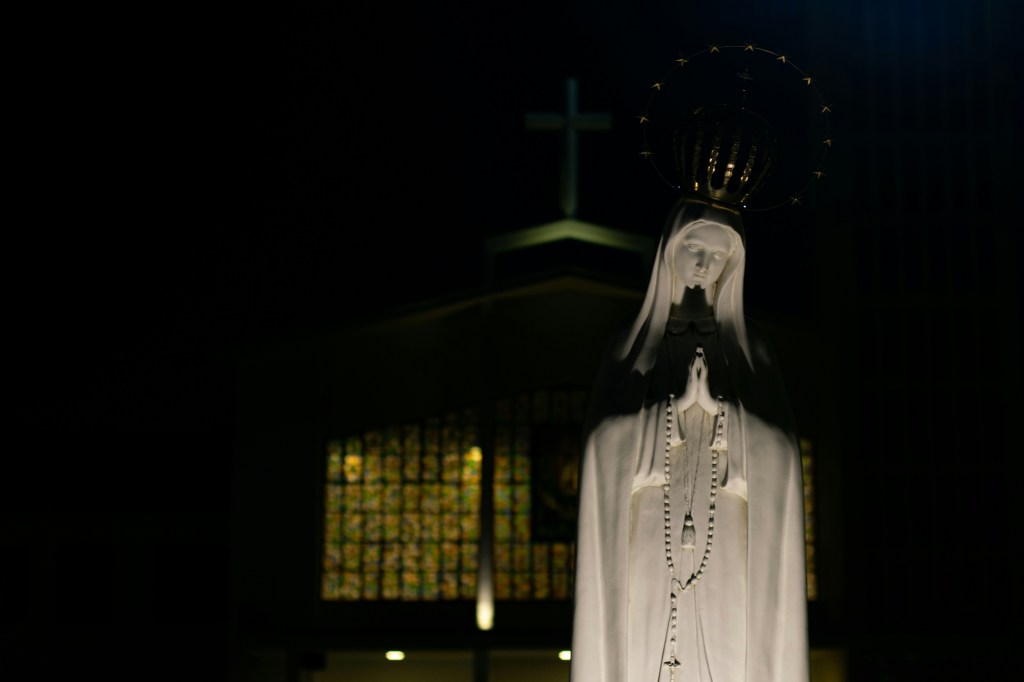
On July 13, 1917, Our Lady of Fatima appeared for the third time to the three children—Lucia dos Santos, Jacinta Marto, and Francisco Marto. During the visitation, she gave them a brief but terrifying vision of hell. Lucia wrote, “She opened Her hands once more, as She had done in the two previous months. The rays of light seemed to penetrate the earth, and we saw as it were a sea of fire. Plunged in this fire were demons and souls in human form.” She then goes on to describe what they saw.
It was so terrifying, she later wrote, “How can we ever be grateful enough to our kind Heavenly Mother, who had already prepared us by promising, in the first Apparition, to take us to Heaven. Otherwise, I think we would have died of fear and terror.”
During this same visitation, the Virgin Mary gave the children a prayer that we now know as the Fatima Prayer or O My Jesus.
“O my Jesus, forgive us our sins, save us from the fires of hell; lead all souls to heaven, especially those most in need of thy mercy.”
Mary asked that the children share with the world her desire for this prayer to be said at the end of each decade of the Rosary. It is also prayed just before starting the first decade—the Our Father and the first ten Hail Marys.
When I pray my Rosary, it is during those opening prayers that I begin—or at least try—to gain some sort of focus, and on one particular day, it was the same. I recited the Creed, prayed the Our Father, the first three Hail Marys, and the Gloria Patri, and then began the Fatima Prayer, “O my Jesus…” I stopped. The next word, “forgive,” simply would not come out. I tried again. “O my Jesus…” I couldn’t go any further. Why?
There was a story circulating when I was in seminary. It told of a young man who had a vision of himself entering a room. Inside the room were all these small files—row after row of them. The drawers seemed to be large enough to hold a piece of paper no bigger than a note card. As he got closer, he saw that each of the file drawers had labels. These included such things as “Books I Have Read” and “Television Programs I Have Watched.” There were others—“Lies I Have Told” and “Comfort I Have Given.” There was one that read “Things Done in Anger” and one right next to it, “Things I Have Said in Anger.”
He pulled that one out just to see what was inside, and to his horror, he found that written on each card was something he had said in anger. Then he realized he was standing in the record room of his life. Every single event, from the very best to the most sinful, had been recorded and filed.
As he examined more of the file drawer labels, he became absolutely convinced that no one—not anyone!—should be allowed to see what was written here. But, of course, there was One who would see, and that One, Jesus, was suddenly present, standing before the man.
Without a word spoken, and instinctively, Jesus went to the drawer that held the cards depicting the most horrible of sins, pulled it out, and began to read each card. The man was horrified and heartbroken. He collapsed in shame, but as he watched, he witnessed the most remarkable thing: on each of the cards, Jesus wrote His Name, covering the sin.
There I was, trying to pray my Rosary, “O my Jesus…,” but unable to ask for forgiveness. Why? Well, it’s a bit like my house. When my house gets messy, it’s nothing new. It’s always the same mess. Dirty dishes, dirty socks, a messy desk, etc. My soul ends up the same way. When Jesus has to come in and go through the files of my life, it’s not like He pulls out a card and says, “Wow, didn’t see that coming,” or “Hey, that’s original.” No. It’s the same thing each and every time. Entire file drawers dedicated to my life with the same thing written time and time again, and Jesus signing over it again and again… O my Jesus. I found myself—not out of disobedience, but out of shame and frustration—simply unwilling to ask Him once more to forgive me for the same damn thing I asked Him to forgive me for the day or week before. O my Jesus.
I could imagine Him standing there, pen in hand, poised and ready to sign, and there I was… O my Jesus.
In our Gospel reading, Jesus said, “Be dressed for action and have your lamps lit; be like those who are waiting for their master to return from the wedding banquet, so that they may open the door for him as soon as he comes and knocks.” Yet, I’m sitting there in the middle of a very dirty house, knowing I must do something but unable to act.
Joshua said, “Choose you this day whom you will serve.”
Quoting what the Lord said to the Prophet Isaiah, Paul wrote, “In a favorable time I listened to you, and in a day of salvation I have helped you.” Then Paul added, “Behold, now is the favorable time; behold, now is the day of salvation.” (2 Corinthians 6:2)
“Son, what did the Marines teach you?”
“Dad, I learned what ‘now’ means.”
And I prayed, “O my Jesus, forgive us our sins, save us from the fires of hell; lead all souls to heaven, especially those most in need of thy mercy.”
I’ll share something you might find hard to accept, but it’s true: no matter how much effort you put in, your soul will get dirty. You can’t keep it clean; once it becomes dirty, you won’t be able to clean it with your own strength and power. So, when the Master comes back—when Jesus returns—He will walk into the house of your soul and He will see the mess. Your only recourse is to say to Him today—right now—“O my Jesus, forgive.” And John tells us, “If we confess our sins, he is faithful and just to forgive us our sins and to cleanse us from all unrighteousness.” (1 John 1:9) If we confess our sins, Jesus will sign His name on the card and cover our sins.
The Psalmist writes, “For you, O Lord, are good and forgiving, abounding in steadfast love to all who call upon you.” Jesus stands ready to forgive all those who call on Him. Whatever reasons or excuses you may have—pride, shame, ignorance, stubbornness, or anything else—set it aside and humbly come before your God and King.
Let us pray… would you repeat after me: O my Jesus, forgive us our sins, save us from the fires of hell; lead all souls to heaven, especially those most in need of thy mercy. Amen.
If you were in church a few Sundays back, you’ll recall we discussed the many facets of this story of Mary and Martha. Well, this is a look at one of them, and it begins with a poem by Virginia Brasier written in 1949—Time of the Mad Atom.
This is the age Of the half-read page. And the quick hash And the mad dash.
The bright night With the nerves tight. The plane hop With the brief stop.
The lamp tan In a short span. The Big Shot In a good spot.
And the brain strain The heart pain. And the cat naps Till the spring snaps
—And the fun’s done!
Time. It consists of moments, minutes, hours, days, decades, and stretches into eternity. There are many wonderful quotes about time. How does it pass? The Wisdom of Solomon states that “our time is like a passing shadow.” How do we spend it? Susan Ertz wrote, “Millions long for immortality who do not know what to do with themselves on a rainy Sunday afternoon.” Do we want more? Queen Elizabeth I’s dying words were, “All my possessions for a moment of time.”
Without humankind, there really is no such thing as time, for as one Jewish commentary wrote, “Without man, time is meaningless.” So what is it then? What is time? For me, it is Henry Longfellow who has the best answer. He writes, “The shadow on the dial, the striking of the clock, the running of the sand, day and night, summer and winter, months, years, centuries — these are but arbitrary and outward signs, the measure of Time, not Time itself. Time,” he says, “is the Life of the soul.” Time is the life of the Soul.
If we were to compile a list of everything we need to accomplish with our time today, I suspect it would be quite long: jobs, caring for children or others, volunteering, studying, leisure, family time, and so on. A lengthy list. Many of these activities can be seen as serving God because we are helping others as He has commanded. However, we can become so caught up in our service to God that we neglect our relationship with Him. Even as a priest, I can get so busy writing sermons, preparing newsletters, attending meetings—everything for the Church—that I forget to make time for God and the life of the soul. Mary and Martha help us see this trap more clearly.
Jesus is visiting their home. Martha is busy running around to take care of everyone, while her sister, Mary, is sitting and listening to Jesus. Finally, frustrated, Martha says to Jesus, Don’t you care that I’m doing all this work and my sister is just sitting there like a bump on a log? While not condemning Martha for her work, Jesus responds, ”Martha, Martha, you are worried and distracted by many things; there is need of only one thing. Mary has chosen the better part, which will not be taken away from her.” Mary has chosen the better part. Martha’s work is good, but Mary has chosen the better part; she is tending to the life of her soul by engaging with her Lord.
This is indeed the time of “the quick hash and the mad dash.” Therefore, we must learn to serve as Martha served, but we also need to take time like Mary to tend to the life of our souls by stepping back from our busy service and by engaging in our relationship with God. After all, it is God who is the center that holds everything else together. “Seek first the Kingdom of Heaven.” Seek first those opportunities to sit at the feet of Jesus, as Mary did, then go forth in the Name of Christ to serve Him with gladness and singleness of heart.
President Jimmy Carter once told a joke during a speech in Japan that made the audience burst into laughter. Impressed, he asked how the interpreter managed to get such a big reaction. The interpreter admitted to saying, “President Carter told a funny story. Everyone must laugh.”
Translating from one language to another isn’t always easy. When I travel, I’ve learned to use Google Translate, but I’ve also learned that the other person doesn’t always receive the same message you’re seeing because of translation issues. Some companies might have learned this lesson when entering new markets.
Kentucky Fried Chicken: You know it and you love it. It is “Finger-licking good,” except in China, where it translates to “Eat your fingers off.”
Clairol: Some of you ladies may know of the curling iron named “Mist Stick.” All is well and good in the USA, but in Germany, it translates as “Manure Stick.” Also known as, How to End the Date Early.
Coors Beer: In the 1970s and 80s, they had an ad campaign with the slogan, “Turn it loose.” Sounds like fun, unless you’re in Spain, because it translates to “Suffer from Diarrhea.”
Translating isn’t always an exact science, especially considering the complexity and nuances of the English language, so it’s best to consult those who might know a bit more than even Google Translate.
True for marketing campaigns and also for the Bible.
Today, in our Gospel, we read the Lord’s Prayer:
Father, hallowed be your name. Your kingdom come. Give us each day our daily bread. And forgive us our sins, for we ourselves forgive everyone indebted to us. And do not bring us to the time of trial.
Question: When you heard that, how many of you thought, “That’s not the Lord’s Prayer I know. Seems they missed a few words.” What about “Your will be done on earth as it is in Heaven” or “deliver us from evil”? Those are pretty important bits to just leave out.
I thought the same thing, and it got me to thinking about how the Gospels came through history to us. This is one of those technical lessons, so if you start to glaze over, I’ll try and wrap it up quickly.
First, how many Gospels are there? Four? Nope. There are actually over thirty books or parts of books that claim to be Gospels. There’s the Gospel of Thomas, the Gospel of Mary Magdalene, The Gospel of Truth, and even one called the Gospel of Judas. But over time, the Church studied these closely and decided only four could be called true Gospels—Matthew, Mark, Luke, and John. Since Matthew, Mark, and Luke are so similar, they’re called the Synoptic Gospels, meaning they can be viewed together.
The Church has always believed that John was written independently of the others; however, it’s generally thought that the authors of the synoptic Gospels copied parts of each other’s and then added their own original material. How does that work?
Initially, it was believed that Matthew was written first. This is known as the Primacy of Matthew. This view states that both Mark and Luke used Matthew as a guide for writing their Gospels. However, most scholars now believe this isn’t correct and agree on the Primacy of Mark.
This is known as the Four-Source Hypothesis—a hypothesis, it is, and it’ll help if you have the diagram on the insert—says that Mark was written first, and Matthew and Luke used it as a guide. There’s a lot of reasoning behind it, which can cause you to glaze over, but Luke had a copy of Mark, then added some of his own material, which is known as “L.” Matthew also had a copy of Mark, and added his own material, known as “M.” Matthew and Luke were written independently of each other, but both contain similar sayings of Jesus (that are not included in Mark), which introduces a truly hypothetical document know as “Q,” which stands for the German word Quelle, meaning source. Q is said not to contain many of the stories of Jesus, but is primarily a collection of his sayings.
Putting all that together: if you take the Gospel of Mark, add L material, and then add Q, you end up with the Gospel of Luke. Clear as mud? It gets a lot more complicated, but we won’t go there today.
As I said, hypothetical Q is said to contain the sayings of Jesus. These sayings would include—the Beatitudes, Love Your Enemies, the temptation in the desert, and—you guessed it—the Lord’s Prayer. The Lord’s Prayer is only found in Luke’s and Matthew’s Gospels, not in Mark or John. The version of the Lord’s Prayer we read today is from the Gospel of Luke. What we are most familiar with is the version from the Gospel of Matthew. In other words, using the hypothesis we put forth, Luke may have only used Q material, but Matthew would have used Q plus some of his own M material to write his version. Why would they be different? Another theory here: Matthew was with Jesus, while Luke was not. Luke only had access to Q, but Matthew had access to Jesus—he had been with Jesus. Perhaps Matthew heard the expanded version and included it in his Gospel. Ultimately, we don’t really know.
What makes this even more confusing is that if you look at an older version of the Bible, such as the King James Version, you’ll discover that the Lord’s Prayer in Matthew and Luke is exactly the same. Why? A little thing called harmonization. At some point, someone decided they should be the same, and so, presto, they made it so.
Do you really need all this theory to pray the Lord’s Prayer? Nope, but since the Bible contains so much of what we know and understand about God, it’s important to have some knowledge of how it all works. More importantly, though, is knowing how to apply it to our lives. N.T. Wright provides us with a brief guide. He says, “Jesus intended this sequence of thought—that is, the Lord’s Prayer—to act more like the scaffolding than the whole building, though of course the prayer is used as it stands by countless Christians every day.” (Matthew for Everyone, Part One, p.58)
If the Lord’s Prayer is like scaffolding, then it’s truly the place where the work can take place. If I look up at the cross beams of this church building, I know they aren’t the roof, but the means by which the roof can stand. The same is true with the Lord’s Prayer. It’s an excellent prayer on its own, but it’s also just the beginning of prayer. We need look no further than the very first word—Our—to realize that this is much bigger than a personal petition. It’s not just about me. In fact, nothing in the prayer is spoken in the singular; it’s always in the plural. That one word—Our—tells us that when we pray, we are praying in the company of all God’s children, both the living and the dead, and those to come—the Church. Our gathers my prayers and your prayers together and brings them all into the very throne room of God, so that those prayers may be offered before the One who loves us and made us for Himself. Our binds us together as members of the very Body of Christ. Our is so much more, and it’s only the first word. It’s one piece of the scaffolding, and from it, we build our prayer.
I once heard it said that if we pray the Lord’s Prayer rightly, then it should take us all day. It’s easy to see how true that is when we consider it as the scaffolding from which all our prayers flow.
Dietrich Bonhoeffer dedicates a chapter of his book, The Cost of Discipleship, to the Lord’s Prayer, breaking down each line and explaining its significance. He also provides a summary of the prayer. “Jesus told his disciples not only how to pray, but also what to pray. The Lord’s Prayer is not merely the pattern prayer, it is the way Christians must pray. If they pray this prayer, God will certainly hear them. The Lord’s Prayer is the quintessence of prayer. A disciple’s prayer is founded on and circumscribed by it. Once again Jesus does not leave his disciples in ignorance; he teaches them the Lord’s Prayer and so leads them to a clear understanding of prayer.” (Macmillan, 1979, p.184)
It can be a fun exercise to explore the more technical aspects of Scripture, but that might not be for everyone. However, learning to hear God’s voice through them and further understanding how to apply those words is a lifelong practice for us all. When you pray the Lord’s Prayer, take time to meditate on the individual words and petitions, and enter into a richer prayer life.
Let us pray:
Our Father, who art in heaven, hallowed be thy name; thy kingdom come; thy will be done; on earth as it is in heaven. Give us this day our daily bread. And forgive us our trespasses, as we forgive those who trespass against us. And lead us not into temptation; but deliver us from evil. For thine is the kingdom, the power and the glory, for ever and ever. Amen.