
The human body is a fantastic creation, yet most of us don’t give it a second thought until something breaks. It’s a bit like what Jerry Seinfeld said, “The human body is like a condominium. The thing that keeps you from really enjoying it is the maintenance.” Outside of the maintenance, when we do think of it, we are primarily concerned with the outward appearance. Am I fit? How’s my hair? Do I have blemishes? “Honey, does this dress make me look fat?” That sort of thing. However, as interesting as all that can be, what goes on below the surface of the flesh is mindblowing—a few examples.
Did you know that when you listen to music, your heartbeat changes and attempts to mimic the beat? It is why soothing jazz slows you down, and that old-time rock-n-roll gets your blood moving.
The fastest-moving muscle in your body is the one that controls the contractions in your eye, helping you to focus. It does its job in 1/100th of a second.
Every second, you produce 25 million new cells.
If you live to 70, your heart will beat about 2.5 billion times; it is the only muscle that never gets tired.
The one fact that seems beyond belief is the circulatory system. A newborn’s circulatory system—all the arteries and veins—if stretched end to end, is 60,000 miles long. When you are an adult, it reaches 100,000 miles.
All this and more is happening, but when we look at another person, we see none of it.
If you’ve seen any of my travel pictures, you probably picked up on the fact that I haunt churches. The churches are the number one places to see when I visit a new city. I don’t know much about architecture or art, but I love the feel of them—how you can sit quietly and be surrounded by the centuries of prayers, sense the individuals who walked through and learn of the great history that took place in and around those walls. And most of all, to simply be there. Inside, you experience the awe and reverence that spills from your soul as the church’s grandness speaks of the greatness of God.
When I’m visiting one, I never think about everything that is going on behind the scenes. I don’t think about the choirmaster toiling away in a back office seeking the perfect hymn to fit with the upcoming services or the organist, who spends hours practicing so that the music is perfect. I don’t think about the individuals who polish the floors or pay the bills. When I see an ornate pulpit, I don’t necessarily think of the priest—I say to myself, “Man, I sure would like to preach from there.” It never crosses my mind that they may have a new refrigerator that makes a weird banging sound, but they can’t get anyone out to look at it, so they must call repeatedly. I can’t imagine someone there spending a couple of hours researching how to get the oxidation off the big red doors so that they aren’t the big pink doors. I don’t think about any of those things and so many other details. I am allowed to experience the greatness of God and His majesty and to worship when I am there. Why? Because I may not be thinking about or doing all those things, but someone is.
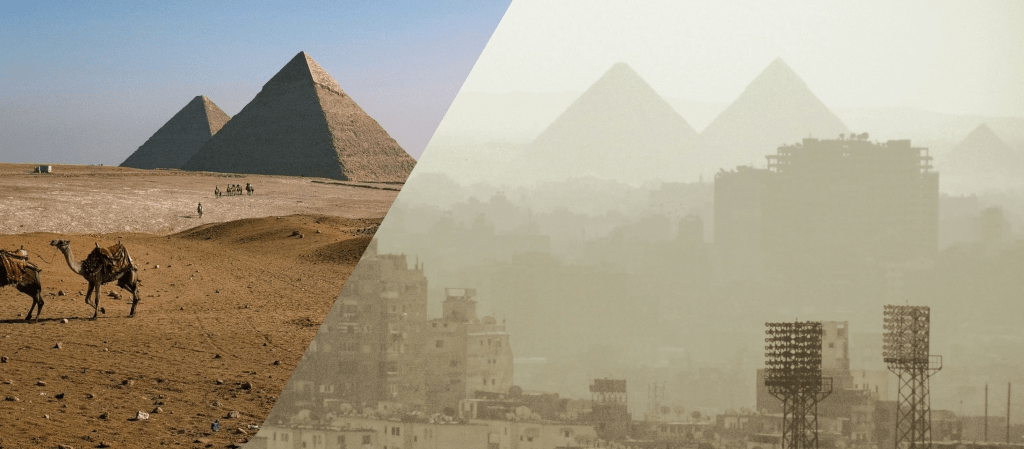
The pictures of the pyramids are on the front of your bulletin. I was looking at something and came across the one on the right. The pyramids are in the distance, with the city at the forefront. I wondered where that was. As it turns out, it is the exact same location as the picture on the left. That image on the left is how I always thought of the pyramids—isolated from the world, surrounded by the beautiful sands of the desert, the clear blue sky, and the remarkable symmetry of the structures, but it is only the angle from which you are looking. I had no idea. If we were there, facing the pyramids from the angle of the picture on the left, that is what we would see. If we turn 180°, the city is right there in all its chaos!
Walking into this church, I have the benefit of being able to see it from many angles. This—looking out at you—is my favorite view. It is like seeing the pyramids in all their glory—beautiful sand, blue sky, perfectly ordered—but if I change the angle and “look behind me,” it can be wild. Everything that had to take place and get done so that we could be here at this very moment, experiencing God together. However, what is even more fascinating is all that occurred in the past so that we could be here in the first place.
There’s a great film, Lucy, with… hubba hubba, you guessed it… Scarlett Johansson. In one scene, she sits in an office chair in Times Square in New York. Then, she swipes her hand and begins a rapid rewind of time. She stops the rewind; it is still Times Square, but it is being built. She swipes again; the city is gone, and she is seated in front of several Native Americans. Again, she swipes and continues to go further and further back. Through the process, she sees all that had to take place for her to be in that present moment. What if we could do the same with St. Matthew’s? What would we see? Not just what took place in the past week for us to be here but what took place over the centuries for us to be here. We would see the Bishops and the clergy and the people and would see the Land Run. Further back, we would see the establishment of the Anglican Church in the New World, and further and further until we see Jesus standing in front of a tax collector, saying to him, “Follow me.”
During all that 2,000-year history, you will discover many great women and men who made it possible for us to be here today. They are the ones we celebrate on this All Saints Day, but as I was thinking about them, I thought again about sitting in Scarlett’s chair and not swiping back, but instead swiping forward—into the future. If we did, what would we see in this place?
James Lloyd Breck is one of the saints of our Church. He was a great missionary and, in 1842, founded Nashotah House, the seminary I attended. He died in 1897, and on a gray autumn day in October, the people gathered at Nashotah House to lay him to rest. In attendance were Bishop Daniel Sylvester Tuttle, the first missionary Bishop of Montana, and Bishop Francis Key Brooke, the first Missionary Bishop of Oklahoma. Bishop Tuttle spoke at the graveside.
“There was a Grecian race in which the runners were charged to care not for themselves, nor indeed for each other, but for the torch they bore. As one and another, wearied and overcome, fell by the way, he held aloft his torch, handing it to a comrade who seized it quickly and sped on. So, with the torch borne by the Christian man. It has a triple flame: God’s truth, Christ’s love, men’s good. We are to hold it up and pass it on. One or another of us is soon to fall in the hard-trodden, dusty path. But never mind us, it is dust to dust, though it may be sacred dust that falls, and God will take care of it. Do not mind us; seize the torch, we pray you, and push on to the blessed goal.”
Those who went before us, all the Saints and that Great Cloud of Witnesses, carried that torch, and when they fell, someone else picked it up. And so, it is now our turn. We must pick up the torch with its triple flame, “God’s truth, Christ’s love, men’s good,” and carry it into the future so that when we fall back into dust, there will be someone new to pick it up and carry on.
It is a gift to be able to gather in this place, to be concerned with nothing other than the worship of the One True God, and to have fellowship with one another. It is a gift, but we must all turn and understand what makes this gift possible.
Like the saints that have gone before us, we have the responsibility to pick up that torch with its triple flame and carry it so that when the next generation picks it up, it is burning all the brighter.
How are we able to carry it? We carry it through our service to one another and the church—our attendance and participation in corporate worship, volunteering, helping in the various ministries, going out into the community and proclaiming the Gospel through word and deed, and financially supporting the Church as we are able.
We celebrate All Saints Day to honor those who have gone before us and to remind ourselves of who we are to become.
So, if you sit in Scarlett’s chair and fast forward into St. Matthew’s future, what do you want to see? When you see a vision of that future, ask yourself, “How can I help create that?” Then, in faithfulness and obedience, commit yourself to God, pick up that torch, and carry on.
Let us pray: Almighty ever-living God, by whose gift we venerate in one celebration the merits of all the Saints, bestow on us, we pray, through the prayers of so many intercessors, an abundance of the reconciliation with you for which we earnestly long. Through our Lord Jesus Christ, your Son, who lives and reigns with you in the unity of the Holy Spirit, God, for ever and ever. Amen

 Candle in a Cave
👍👍Sent from my iPhone