
Once, there was an elder in the lower parts of Egypt, and he was a very famous hermit who lived alone in a desert. Two young men knew of the old hermit’s pious life, and they often scoffed and ridiculed him. Knowing this, Satan brought it about that a woman of easy virtue came to the two young men and said, “What will you give me if I can cause the hermit to stumble and sin?” The young men loved the idea, so they agreed on a certain sum of money they would give her. Going out the following evening, the woman came to the hermit’s cell, pretending to have lost her way. She knocked at his door, and he came out. Seeing her, he was disturbed and said. “How did you get out here?” She pretended to weep and said, “I have lost my way.” So, being moved to pity, he let her into the front room of his cell, and for his part, he went on to the inner room and locked the door. But the unfortunate woman cried out, “Father, the wild animals will eat me out here.” Once again, the hermit was disturbed, thought of the Judgment of God, and said, “How did this dreadful thing ever happen to me?” But opening his door, he let her in. It was then that the devil began to shoot flaming arrows of lust into his heart. But he said within his soul, “The ways of the enemy are darkness, and the Son of God is light.” So he lit a lantern, but the temptation continued, and he said, “Well, let’s see if you will be able to bear the flames of hell if you stumble and fall into sin by this temptation.” So he put a finger into the lantern’s flame, but though the flame burned him, he did not feel it because the fire of lust burned so brightly in him.” It went on like this all night until morning. He had burned all his fingers. The unfortunate woman, watching what he was doing, was so struck with terror that she almost turned into stone. In the morning, the two young men came to the hermit and said, “Did a woman come here last night?” “Yes,” said the hermit. “She is over there asleep.” Seeing her, they said, “Father, she is dead!” Then the hermit, throwing back the cloak he was wearing, showed them his hands and said, “Look what she did to me, that child of Satan! She has cost me all my fingers.” (Naturally, it was the woman’s fault that the hermit lusted after her.) However, having told them all that had taken place, he said, “It is written, ‘Thou shalt not render evil for evil.’” So he said a prayer and the young woman was revived, converted, and lived chastely for the rest of her life.
The hermit had done all he knew to do to live an ascetic life—a life free of outside influence and stimulus—so that he might dedicate himself to a life of solitude and prayer. This might seem odd to us today, but it is, in fact, a very noble and holy calling. He believed he was doing everything necessary to please God, but then the woman appeared. For him, she was a temptation, a stumbling block in his walk with God. He overcame the temptation, but the price of his obedience was his fingers—a very high price, indeed.
In our gospel reading, we are told that a young man came to Jesus and asked, “Good Teacher, what must I do to receive eternal life?” Jesus answered, “You know the commandments: ‘You shall not murder; You shall not commit adultery; You shall not steal; You shall not bear false witness; You shall not defraud; Honor your father and mother.’” Excitedly, the young man replies, “I’ve done all this since I was a child.” In love, Jesus responds, “You lack one thing; go, sell what you own, and give the money to the poor, and you will have treasure in heaven; then come, follow me.”
Like the hermit, the young man believed he was doing everything right. He was following the Law to the letter and walking the path of righteousness, but it wasn’t enough for his salvation. Jesus knew that this young man was wealthy and had many possessions, so Jesus said, “Give it all away and follow me.” The young man went away sad. For him, the price of his obedience might as well have been all his fingers. But even then, it would not have been enough for his salvation.
Jesus is asking the young man, “Do you want to try and save yourself through your actions, your abilities, and possessions, or are you willing to set all that aside and walk by faith?”
In this incident, the young man represents the people of Israel. All their lives, they have believed they could bring about their salvation by adhering to the Law of Moses. That is, by their works (the idea that doing good deeds or following the Law allows you to earn your salvation), but now, Jesus says it is not enough. They must have faith, follow him, and accept God’s grace that is being offered.
In his letter to the Romans, St. Paul provides a fascinating discussion on salvation by works, which he compares to salvation by faith. Paul writes, the “Gentiles who did not pursue righteousness have attained it, that is, a righteousness that is by faith; but that Israel who pursued a law that would lead to righteousness did not succeed in reaching that law. Why? Because they did not pursue it by faith, but as if it were based on works. They have stumbled over the stumbling stone, as it is written, ‘Behold, I am laying in Zion a stone of stumbling, and a rock of offense; and whoever believes in him will not be put to shame.’” (Romans 9:30-33)
The people said to themselves, “If we burn all our fingers, we will be saved. If we follow the Law of Moses, we will be saved. If we do this, that, or the other, we will be saved. Through our works—the things we do—we can earn our salvation.” This belief was their stumbling block. And they so stubbornly believed in their ability to save themselves that they did not recognize the salvation Jesus was offering—a salvation that was far more costly than anything they could earn through their works.
In a day and age when we are so concerned with the stock market, inflation, wars, monkeypox, or whatever, I don’t know that the issue of our salvation and eternal life ever enters our minds, except, perhaps, when we gather here. However, when we do gather, we are the hermit in his cell, and we are the rich young man kneeling before Jesus, and like them, we ask, “What must I do to receive eternal life?” Like with the young man, Jesus may answer our question with a question. “What are you doing to receive eternal life?” We respond, “Well, I go to church, I say my prayers, I give to the poor, I read my Bible, I confess my sins, I receive communion, and more.” Jesus looks at us lovingly and responds, “You lack one thing. You must die to yourself. You must give me your life, then come, follow me.”
Jesus has just laid a large stumbling block in our path. The price is too high. It is too much.
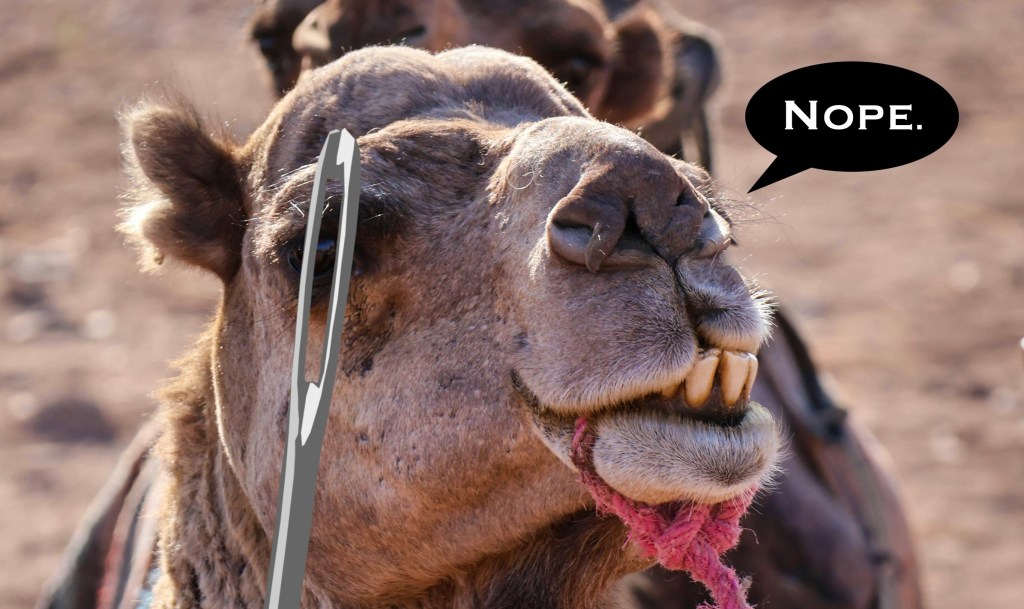
I always get a little tickled when I think of the second part of our Gospel reading. I get this cartoon image of a camel, and he has this big ol’ bug eyes as he stares through the eye of a needle, trying to figure out how he will get through it. A thought balloon pops up over his head. “Nope,” he thinks. “Not a snowball’s chance in the Sahara!” That is us. The price is too high. We simply cannot do it. The stumbling block placed before us plants us face down in the dirt, with no chance of recovering.
The disciples thought the same thing and asked, “Then who can be saved?” Can you see Jesus smiling when He answers? “For mortals, it is impossible, but not for God; for God, all things are possible.” Once, the apostle Paul was ranting against himself because of the stumbling block in his life, so he said in his despair, “Wretched man that I am! Who will deliver me from this body of death?” In the confession of his failing, he discovered the answer. “Thanks be to God through Jesus Christ our Lord!” (Romans 7:24-25a)
With all my talking about sin these last several weeks, you may have thought it was the Season of Lent. We talked about confessing our sins, walking in the Light of Jesus, drawing near to God, and being true friends by holding each other accountable. However, even with our very best efforts, we are the camel staring through the eye of the needle, and we respond in despair, “Nope. Not going to happen.” Not because we don’t want to but because we don’t have it within us.
We are to make our very best efforts to follow the commandments of God, but in the end, for our salvation and eternal life, it is too expensive for us; therefore, we need another way. We need God to forgive us our sins. We need mercy. We need grace.
“I lift up my eyes to the hills.
From where does my help come?
My help comes from the Lord,
who made heaven and earth.”
(Psalm 121:1-2)
“Thanks be to God through Jesus Christ our Lord!” Thanks be to God, for through Jesus, the camel can pass through the eye of the needle.
Let us pray:
Father of Mercy,
forgive our failings,
keep us in Your Grace,
and lead us in the way of salvation.
Give us strength in serving You
as followers of Christ.
May the Eucharist bring us Your Forgiveness
and give us freedom to serve You all our lives.
May it help us to remain faithful
and give us the grace we need in Your service.
May it teach us the way to eternal life.
Amen.
 Candle in a Cave