I came across a poem that I thought Mary Alice would like, but also one that feels as though she lived it. It is often attributed to St. Augustine, but it is much more contemporary than that. It was written in the early 20th century by German musician and teacher Georg Goetsch. The title: I Praise the Dance.
I praise the dance, for it frees people from the heaviness of matter and binds the solitary to community. I praise the dance, which demands everything: health and a clear spirit, a poised soul and a shining body. The dance transforms the soul into a dwelling of light.
O human, learn to dance, for otherwise the angels in heaven will not know what to do with you.
The dance is wholly from the beginning. It is the movement of creation itself, the becoming of all things, their passing and their re-becoming. The dance turns the deepest, holiest things into visible and living form.
Dance, because the whole of creation dances: the sun, the stars, the earth— they all move in rhythm and harmony. So too should you move in rhythm with God.
The author told us,
O human, learn to dance, for otherwise the angels in heaven will not know what to do with you.
I can assure you, you do not want to see me dance. It’s not pretty, but I do understand the deeper meaning of the author’s message.
He is telling us that in this life, we are meant to find joy. We should learn not only to experience God through prayer and study but also to encounter Him in the people we meet. We are called to seek out ways in this lifetime to love, show compassion, practice our faith, and give of ourselves. Living this way allows those around us to experience glimpses of heaven—the eternal life to come. From what I’ve learned, Mary Alice was just such a person. She was one who learned how to dance in her soul and showed others how to do the same.
You might think that someone who has lived such a life would face no troubles, but we know that’s not true. I recall the time St. Teresa of Avila was crossing a stream in winter. She lost her footing and fell into the icy water, then complained to the Lord about all her suffering. Jesus said to her, “Don’t complain, my daughter, this is how I treat My friends.” To which Teresa responded, “If this is how you treat your friends, it’s no wonder you have so few!”
Mary Alice, also a friend of Jesus, had every reason to complain just as St. Teresa did, but like St. Teresa, Mary Alice did not lose her faith. She heard those words of Jesus we read in our Gospel and lived them—“Do not let your hearts be troubled. Believe in God, believe also in me.” Despite her suffering, she held onto her belief, her faith in Jesus, so that on this day, we can confidently say that she is dancing with the angels in God’s Eternal Kingdom.
Those of us gathered here today are saddened by our loss, but we can also rejoice in knowing that Mary Alice, through the power of the resurrection, is now truly home. We can also rejoice in the knowledge that a place has been prepared for us, and on the day of the Lord’s choosing, he will gather us to Himself, where we will all be reunited in the very presence of His glory. As the Psalmist declares, “This is the Lord’s doing, and it is marvelous in our eyes.”
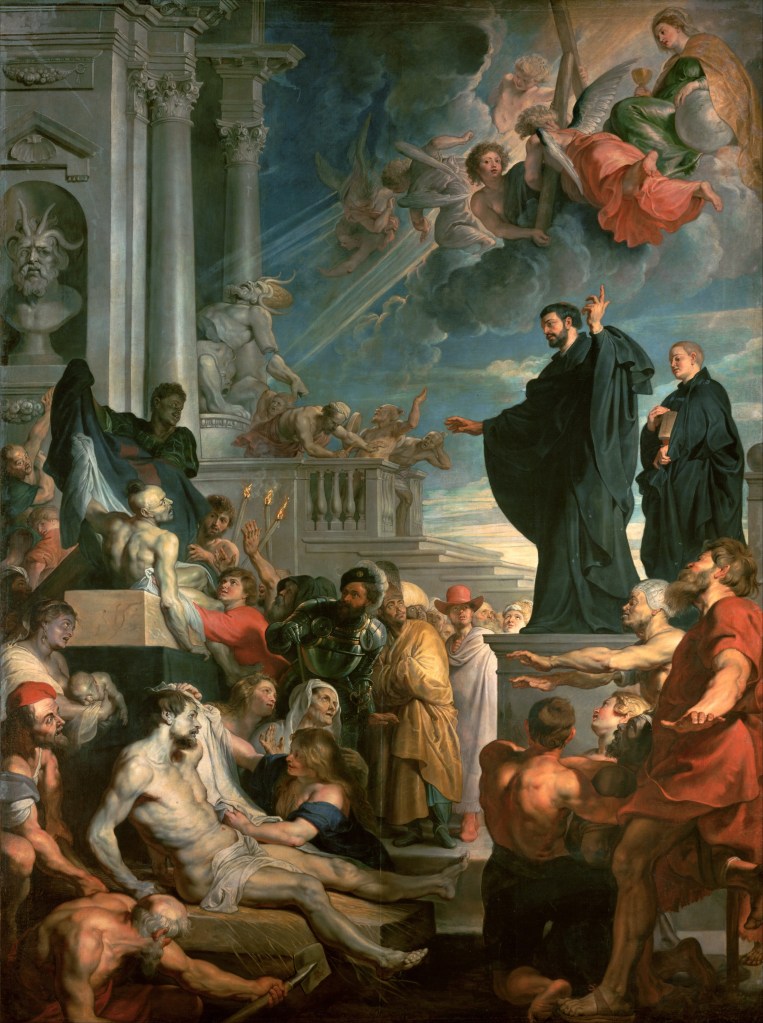
Peter Paul Rubens – The Miracles of St. Francis Xavier
Francis Xavier was born in Navarre, Spain, in 1507. He later moved to Paris, where he studied for the priesthood and there he met St. Ignatius of Loyola. Together, along with four others, they formed the Society of Jesus—The Jesuits—and became renowned missionaries.
Francis would live out this missionary zeal. In 1537, he moved to Lisbon, Portugal, and then traveled on to India. In one of his early letters to Ignatius from India, Francis shared the following:
“We have visited the villages of the new converts who accepted the Christian religion a few years ago. No Portuguese live here—the country is so utterly barren and poor. The native Christians have no priests. They know only that they are Christians. There is nobody to say Mass for them; nobody to teach them the Creed, the Our Father, the Hail Mary and the Commandments of God’s Law.
“I have not stopped since the day I arrived. I conscientiously made the rounds of the villages. I bathed in the sacred waters all the children who had not yet been baptized. This means that I have purified a very large number of children so young that, as the saying goes, they could not tell their right hand from their left. The older children would not let me say my Office or eat or sleep until I taught them one prayer or another. Then I began to understand: “The kingdom of heaven belongs to such as these.”
“I could not refuse so devout a request without failing in devotion myself. I taught them, first the confession of faith in the Father, the Son and the Holy Spirit, then the Apostles’ Creed, the Our Father and Hail Mary. I noticed among them persons of great intelligence. If only someone could educate them in the Christian way of life, I have no doubt that they would make excellent Christians.
“Many, many people hereabouts are not becoming Christians for one reason only: there is nobody to make them Christians. Again and again I have thought of going round the universities of Europe, especially Paris, and everywhere crying out like a madman, riveting the attention of those with more learning than charity: “What a tragedy: how many souls are being shut out of heaven and falling into hell, thanks to you!”
“I wish they would work as hard at this as they do at their books, and so settle their account with God for their learning and the talents entrusted to them.
“This thought would certainly stir most of them to meditate on spiritual realities, to listen actively to what God is saying to them. They would forget their own desires, their human affairs, and give themselves over entirely to God’s will and his choice. They would cry out with all their heart: Lord, I am here! What do you want me to do? Send me anywhere you like—even to India.”
He saw all those priests hanging around Paris just twiddling their thumbs, and thought, if they could see what I see, if they had any passion for souls, “They would cry out with all their heart: Lord, I am here! What do you want me to do? Send me anywhere you like—even to India.”
Even the Apostle Paul teaches us that not all are called to be preachers and teachers, so not all are called to be missionaries; however, each and every Christian can pray the first part of that statement: “Lord, I am here! What do you want me to do?”
It’s a little scary to do this because you never know what God will say or ask, but whatever it is, it is His desire for your life. Pray the prayer—“Lord, I am here! What do you want me to do?”—then, when you hear Him calling, respond like the Prophet Samuel did when the Lord called to him: “Speak, Lord, for your servant is listening.” (1 Samuel 3:9)
Dietrich Bonhoeffer writes, “If we want to be part of these events, Advent and Christmas, we cannot just sit there like a theatre audience and enjoy all the lovely pictures. Instead, we ourselves will be caught up in this action, this reversal of all things; we must become actors on this stage. For this is a play in which each spectator has a part to play, and we cannot hold back. What will our role be? Worshipful shepherds bending the knee, or kings bringing gifts? What is being enacted when Mary becomes the mother of God, when God enters the world in a lowly manger?”
What is taking place when God–Jesus–enters the world? It was just a few weeks ago that our Gospel lesson was quite similar to today’s, focusing on Jesus’ prophecies about the end of days. The problem with such readings is that we can become so caught up in the “what ifs” and “looking for signs” of the events themselves that we overlook the most important part.
So, if we look behind the curtain of all these events, what is really happening? From Bonhoeffer: “What is being enacted when Mary becomes the mother of God, when God enters the world in a lowly manger?”
Since this is the first Sunday of Advent, the start of the Church year, it helps us understand because Advent should inspire a deep sense of anticipation — an expectation of something new.
We talk of “wars and rumors of wars,” about one person being taken and another left behind, and about staying awake— yes, we are to do these things: watch, pray, remain alert as we seek Jesus coming again—but there is much more to it than this.
Almost everyone knows at least rumors of the Book of Revelation with all its wormwood, four horsemen of the apocalypse, and bowls of God’s wrath. Most are aware of the Second Coming of Christ. St. John reports, “I saw heaven opened, and behold, a white horse. And He who sat on him was called Faithful and True, and in righteousness He judges and makes war. His eyes were like a flame of fire, and on His head were many crowns.” John continues, “He was clothed with a robe dipped in blood, and His name is called The Word of God. And the armies in heaven followed Him. Out of His mouth goes a sharp sword, that with it He should strike the nations. And He has on His robe and on His thigh a name written: KING OF KINGS AND LORD OF LORDS.”
As Christians, we hear those words and feel like the home team just won the big game at the last second, but what is it all really about? What is the purpose? The Book of Revelation has twenty-two chapters. Most of it focuses on the end of the world—apocalyptic writing. However, at the start of chapter 21, John writes, “Now I saw a new heaven and a new earth, for the first heaven and the first earth had passed away. Also, there was no more sea. Then I, John, saw the holy city, New Jerusalem, coming down out of heaven from God, prepared as a bride adorned for her husband. And I heard a loud voice from heaven saying, ‘Behold, the tabernacle of God is with men, and He will dwell with them, and they shall be His people. God Himself will be with them and be their God. And God will wipe away every tear from their eyes; there shall be no more death, nor sorrow, nor crying. There shall be no more pain, for the former things have passed away.’ Then He who sat on the throne said, ‘Behold, I make all things new. It is done! I am the Alpha and the Omega, the Beginning and the End.’”
God says, I do all these things so that I may make all things new. At that, our excitement that the home team won is slightly diminished. It is like what we were talking about a few weeks ago—waiting! We have to keep waiting for the Lord’s return, but now we also have to keep waiting for things to be made new.
Well, that’s just great! When the Lord returns, I will start to experience this new life. In the meantime, it’s the same ol’ same ol.’” Thanks for playing. Please try again. St. Paul helps us understand that this “New” is not only in the future but also something we can experience today. Paul writes, “if anyone is in Christ, he is a new creation. The old has passed away; behold, the new has come.” (2 Corinthians 5:17) Yes, the Kingdom of God is a future event, but it is also a present reality.
However, we still can’t get all excited because we look around at the state of the world today and say, “Well, Father John, if this is the new Kingdom of God, then I’ll take what’s behind door number three.” And there is the rub. Today, we only see in a mirror dimly, for although we are made new in Christ Jesus, the world has not yet been made new. Paul says in his letter to the Romans, “For we know that the whole creation has been groaning together in the pains of childbirth until now. And not only the creation, but we ourselves, who have the firstfruits of the Spirit, groan inwardly as we wait eagerly for adoption as sons, the redemption of our bodies.” (Romans 8:22-23)
Creation suffers, and so do we, but we are a new creation. No longer subject to eternal death, but only a short sleep before the Great Day of the Lord’s return, when all is made new.
We live in this in-between time—the now and the not yet—so we wait. As frustrating as that may seem, this waiting is what Advent is all about. Bonhoeffer writes, “Celebrating Advent means being able to wait.” However, he goes on to say, “Waiting is an art our impatient age has forgotten. It wants to break open the ripe fruit when it has hardly finished planting the shoot… Whoever does not know the austere blessedness of waiting—that is, of hopefully doing without—will never experience the full blessedness of fulfillment. For the greatest, most profound, tenderest things in the world, we must wait. It happens not in a storm but according to the divine laws of sprouting, growing, and becoming.” Yes. We will watch, pray, and remain alert, and we will also wait.
Yet, in the midst of this waiting and becoming, God offers us glimpses of future blessings through the gifts of one another and the sacraments of the Church. Therefore, today, after Confession and before the Peace, we will offer the laying on of hands and anointing with oil. Through this sacrament of Unction—of healing—I pray you will see and perhaps experience the new life God is offering you, and that it will give you the courage and strength to wait with perseverance for the newness to come.
Let us pray: God of Love, Your son, Jesus, is your greatest gift to us. He is a sign of your love. Help us walk in that love during the weeks of Advent, As we wait and prepare for his coming. We pray in the name of Jesus, our Savior.
Before 2011, beer was considered a soft drink in Russia.
It is impossible to hum while holding your nose. (As you will all be curious about that one, and not hear the sermon until you try, go ahead.)
A group of cats can be called a clowder, or a cluster, or a glaring, or a nuisance, or a pounce, or a clutter.
More than half of the world’s population is under 30 years old.
The plastic tip on the end of a shoelace is called an “aglet”.
The Caesar salad was created in Tijuana, Mexico, by an Italian immigrant named Caesar Cardini.
It’s always good to be teachable and to learn new things. I never even thought about holding my nose while trying to hum until I read that (and tried). I would like to say that as I prepare sermons and teachings, I already know and understand it all, but each week I learn something new or gain a deeper understanding. This week was no different, even though it was something I already knew, I saw it with more clarity and fullness.
Today is the last Sunday of the Church Year: Christ the King Sunday—the day we celebrate the Kingship of our Savior, Jesus. When I reflect on this and the Kingdom of God, I’ve always viewed it as a Kingdom outside of myself. A Kingdom that I can walk through and work in. A Kingdom that I, if it is God’s will, can help move forward. But this week, I heard Jesus’ words in a different way. Which words were those? “The kingdom of God is not coming in ways that can be observed, nor will they say, ‘Look, here it is!’ or ‘There!’ for behold, the kingdom of God is within you.”
For me, Christ is the King I come before, kneel before, and desire to serve to the best of my abilities. I try to do His bidding as a faithful servant in His Kingdom, which is around me. However, what happens when I say, “Not only do I live and work in the Kingdom of God, but the Kingdom of God lives and works within me?” I understand God’s Holy Spirit working in me, just as I understand accepting Jesus into my heart, but what does it mean to have God’s Kingdom working within me?
What prompted me to meditate on this were the words in the notebook On Prayer by Origen of Alexandria, a second-century priest. He writes, “The kingdom of God, in the words of our Lord and Savior, does not come for all to see… Thus it is clear that he who prays for the coming of God’s kingdom prays rightly to have it within himself, that there it may grow and bear fruit and become perfect…. The Father is present in the perfect soul, and with him Christ reigns, according to the words: We shall come to him and make our home with him.” And a little further, Origen says, “There should be in us a kind of spiritual paradise where God may walk and be our sole ruler with his Christ. In us the Lord will sit at the right hand of that spiritual power which we wish to receive. And he will sit there until all his enemies who are within us become his footstool, and every principality [and power] in us is cast out.”
Listen to these words:
“God is the King of all the earth!” (Psalm 47:7)
“The Lord reigns; let the peoples tremble!” (Psalm 99:1)
“Who would not fear you, O King of the nations?” (Jeremiah 10:7)
“King of kings and Lord of lords.” (Revelation 19:16)
“The LORD is king forever and ever.” (Psalm 10:16)
What if we said that Jesus is Lord, Jesus is King, out there, but also in here? What if we understood that this King of all the earth can and will conquer His enemies in this world, but can also conquer the enemies within our souls? What would happen if you let the King of kings and Lord of lords reign within you to rule not only over your external life but also over your internal one? St. Paul tells us that “our God is a consuming fire.” (Hebrews 12:29) What if we allowed that consuming fire to burn within? Allowed is the right word because, so often, we hold God in check.
Do you remember the story of Charlemagne, the Holy Roman Emperor? He wanted to conquer the world for Christianity and insisted that all his soldiers be baptized. They did. All but one hand was submerged, and in that hand they held a sword. It was a statement that declared there bodies belonged to God, but that hand and that sword belonged to Charlemagne. When we say we want the consuming fire of the King of kings to reign within us, like those soldiers, we sometimes tuck away a few things in a fireproof room, because we’re willing to let God rule most of our lives but keep a few exceptions. Those few exceptions are the problem. Those few exceptions are what prevent us from fully submitting to the Kingship of Christ, which then causes a ripple effect, impacting not only the Kingdom of God within us but also the Kingdom of God in this world.
All I know about her is that her name is Amy and she is on the internet. (I promise this is not some weird story about me falling in love with the operating system on my computer.) Amy is someone who posts content online, and I’ve seen two of her posts. Anyway, she tells the story of going to the grocery store. At the checkout, standing in line in front of her is a man in his 70s. As they wait, one of the cashiers approaches and says, “Sorry, this line is closed, you’ll have to go to that one.” Amy does so, but the older man looks a bit confused, so he continues to stand there. After a minute, the cashier returns to him and repeats herself, and he understands. He moves toward the line she is in, but since she’s shifted, four more people are now behind her. Amy steps forward.
“You were in line in front of me,” she says. “You can go ahead of me.”
“Are you sure?” he asks. “Are you sure I was in front of you?” Amy assures him that he was, and he says, “Thank you for your honesty. It doesn’t happen very often anymore, and I really appreciate you being honest.” She tells him it’s no problem, but he continues, “It is such an odd world that we live in now, and I don’t know what to think of it anymore.”
She says, “Yeah, it is an odd ball world. I agree with you. It’s odd. Things are not going well for society right now.”
He responds, “Sometimes I’m happy that my life is almost over so that I don’t have to live in this world anymore.”
Amy later asked herself, “What if letting someone get in front of you in the line at the grocery store is a massive gesture of kindness? We have to do better as a society.”
If letting someone in front of us in line at the grocery store is the greatest act of kindness we can perform, then there’s not only something wrong with society, but also something deeply wrong with us. If someone is happy that they are nearing the end of their life because of how they are treated in the world, then the One who said, “Love one another as I have loved you,” is not the King of our lives. What is the solution?
Today in our Gospel reading, we heard about Jesus’ crucifixion. After those standing around and one of the others who had been crucified with Him finished taunting Him, the good thief said, “Jesus, remember me when you come into your kingdom.” He had no hope of reaching Heaven for himself, but he at least wanted to be remembered. However, Jesus said to him, “Truly I tell you, today you will be with me in Paradise.”
In this context, we see paradise as something to come; however, what did Origen say? “There should be in us a kind of spiritual paradise where God may walk and be our sole ruler with his Christ.” We are to create within ourselves a paradise where the King of Heaven and the “King of all the earth” can be the King within so that He might rule every aspect of our lives, and that, my friends, is a scary thing. St. Paul said in his letter to the Hebrews, “It is a fearful thing to fall into the hands of the living God.” (Hebrews 10:31) It is a fearful thing to fall into God’s hands to be ruled, but I will guarantee you this: it will be a far more fearful thing to fall into His hands to be judged.
Within, many choose to establish their own kingdom and sit on a throne they’ve created for themselves so they might rule over their own lives. However, a wise person will realize that within they can create a paradise for the very Kingdom of God, and within that Kingdom, there can be a throne where the King of Glory is permitted to take His rightful seat. Your soul and this world need the Kingdom of God.
Allow yourself to be consumed by the fire of God so that He may reign in your life as the Righteous King.
Let us pray: May the light of Christ, the King of all, shine brighter in our hearts, that with all the saints in light, we may shine forth as lights in the world. Amen.
A priest waited in line to get his car filled with gas just before a long holiday weekend. The attendant worked quickly, but there were many cars ahead of him at the service station. Finally, the attendant motioned him toward a vacant pump. “Father,” said the young man, “sorry about the delay. It seems as if everyone waits until the last minute to get ready for a long trip.”
The priest chuckled, “I know what you mean. It’s the same in my business.”
Don’t you just love waiting in a good, long line? I know I do. Have you ever gone up to the checkout lines in the grocery store and checked each line to see which shopper has the fewest items, just to avoid waiting those extra few minutes? Usually, just as I’ve figured it all out, someone else steps in, and I end up behind the person with two baskets. Oh, yes, I love to wait.
Our first lesson this morning from Malachi was from chapter 4:1-2. However, by stopping at verse 2, I feel like we get a bit shortchanged. I want to share with you through verse 6, which is the end of the chapter, because these are the very last words of the Old Testament.
“For behold, the day is coming, burning like an oven, when all the arrogant and all evildoers will be stubble. The day that is coming shall set them ablaze, says the Lord of hosts, so that it will leave them neither root nor branch. But for you who fear my name, the sun of righteousness shall rise with healing in its wings. You shall go out leaping like calves from the stall. And you shall tread down the wicked, for they will be ashes under the soles of your feet, on the day when I act, says the Lord of hosts.
“Remember the law of my servant Moses, the statutes and rules that I commanded him at Horeb for all Israel.
“Behold, I will send you Elijah the prophet before the great and awesome day of the Lord comes. And he will turn the hearts of fathers to their children and the hearts of children to their fathers, lest I come and strike the land with a decree of utter destruction.”
Following these words, there is a 400-year period of silence until the birth of Christ. For thousands of years before these verses were written, people waited for the coming of the savior, the Messiah. Now they are told they will wait some more, and so they do. Finally, after that 400-year wait, “The angel Gabriel was sent from God to a city of Galilee named Nazareth, to a virgin betrothed to a man whose name was Joseph, of the house of David. And the virgin’s name was Mary.” And the child was given the name Jesus.
Jesus teaches, gives hope, heals, and raises the dead. He tells us, “The kingdom of God is in the midst of you.” (Luke 17:21b) However, after only three years of ministry, he begins saying things like “The time will come” and “When I come again.” He speaks of trials and endurance, and in doing so, it starts to sound like the kingdom of God on earth is not yet here.
If I were a believer back then, my response to these statements would have been, “What are you saying, Jesus? You mean we have to wait some more?” And Jesus would say, “Haven’t you been listening? Of course, you will have to wait for the Kingdom of God to come to its fullness.” After we get over our disappointment, we must then ask, “How do we, as followers of Jesus, wait?” As has been proven over the last 2,000 years, it is not easy.
Pastor and author Warren Wiersbe observes, “The ability to calm your soul and wait before God is one of the most difficult things in the Christian life. Our old nature is restless…the world around us is frantically in a hurry. But a restless heart usually leads to a reckless life.”
Oftentimes, we get in a hurry, and then we become reckless, even in our faith. God isn’t acting quickly enough for us, so we tend to strike out on our own. Think about the Israelites after the Exodus from Egypt.
They have arrived at Mount Horeb, and Moses has gone up to meet with the Lord, but this meeting lasts longer than the people expected. At this point, “When the people saw that Moses delayed to come down from the mountain, the people gathered themselves together to Aaron and said to him, “Up, make us gods who shall go before us. As for this Moses, the man who brought us up out of the land of Egypt, we do not know what has become of him.’” So Aaron told the people to bring all their gold jewelry, and he made a golden calf from it. When the people saw it, they said, “These are your gods, O Israel, who brought you up out of the land of Egypt!”
They grew tired of waiting for the one true God, so they created a god for themselves. They made sacrifices to it, worshipped it, then held a feast, got drunk, and danced the hoochie coochie before it. They committed all kinds of wickedness. This serves as a warning for us today: if we become weary of waiting on God, lower our guard, and start following other gods, we risk falling into the same sinful behaviors.
As Christian people, acknowledging upfront that what Wiersbe said—waiting on God is “one of the most difficult things in the Christian life”—then how can we wait without falling into sin? The list is longer, but there seem to be three main components.
Henri Nouwen describes the first in his book Sabbatical Journeys by sharing the story of two friends who were trapeze artists—the Flying Roudellas.
They told him that there exists a special relationship between the flyer and the catcher. As they swing through the air, the flyer is the one who lets go, and the catcher is the one who catches. As the flyer swings high above the crowd on the trapeze, the moment comes when he must let go. He arcs out into the air. His job is to remain as still as possible and wait for the strong hands of the catcher to catch him.
One of them told Nouwen, “The flyer must never try to catch the catcher.” The flyer must wait in absolute trust. The catcher will catch him, so he must wait.
While waiting on the Lord, we must have patient trust. We must wait and trust that the Lord will do exactly as He has promised, but it will be in His own time. We are not to go grabbing at other things, but hold fast to the promise.
The second requirement is confident humility. We must trust that God can do what He promises and be humble enough to recognize that we cannot do it without Him. This kind of confident humility brings a peaceful sense of holiness into our lives, knowing that the chaos around us is not from God. Remember when the disciples were out on the sea and a great storm arose? They were terrified and thought they would die. Chaos was all around them. Where was Jesus? He was asleep in the bow of the boat. When the disciples woke Him and cried out, He rebuked the storm. Jesus spoke into the chaos, and peace was restored.
Confident humility affirms that God can speak into any chaos in our lives at any moment and bring peace.
Finally, while waiting on the Lord, we must learn to recognize God’s voice. In our Gospel lesson, Jesus said some will say, “I am he,” and others will say, “The time is near.” To such claims, Jesus instructed them to “not go after them.” Don’t follow every half-baked idea, and lead a reckless life. Instead, we must listen for His voice, the voice of the Good Shepherd. Jesus says, “My sheep hear my voice, and I know them, and they follow me. I give them eternal life, and they will never perish, and no one will snatch them out of my hand.” (John 10:27-28) Yet, if we do not take the time to learn and hear that voice through study and prayer, then we risk being led astray. We must practice listening to His voice so that when He does speak, we can know with certainty that it is Him.
Patient trust, confident humility, and knowing the voice of God—this is not all that is required to properly wait on God, but they are solid building blocks. The Prophet Isaiah writes,
“My way is hidden from the Lord, and my right is disregarded by my God”? Have you not known? Have you not heard? The Lord is the everlasting God, the Creator of the ends of the earth. He does not faint or grow weary; his understanding is unsearchable. He gives power to the faint, and to him who has no might he increases strength. Even youths shall faint and be weary, and young men shall fall exhausted; but they who wait for the Lord shall renew their strength; they shall mount up with wings like eagles; they shall run and not be weary; they shall walk and not faint.” (Isaiah 40:27-31)
Patient trust, confident humility, and knowing the voice of God. Let us renew our own strength and wait patiently on the Lord, so that when the day comes, we too may soar on wings like eagles.
Let us pray (from St. Thomas Aquinas): Grant us, O Lord our God, minds to know you, hearts to seek you, wisdom to find you, conduct pleasing to you, faithful perseverance in waiting for you, and a hope of finally embracing you. Amen.
Years ago, a young pastor found the roads blocked one Sunday morning and was forced to skate on the river to get to church, which he did. When he arrived, the elders of the church were horrified that their preacher had skated on the Lord’s day. After the service, they held a meeting where the pastor explained that it was either skate to church or not go at all. Finally, one elder asked, “Did you enjoy it?” When the preacher answered, “No,” the board decided it was all right!
The album, The Stranger, by Billy Joel was released in 1977. I must have been in junior high at the time, but I did have a copy and probably wore it out. I could probably still sing along to all of the songs (not that you would want me to).
One of the songs I remember is Only the Good Die Young. At the time, I had no idea what it was all about, but I eventually sorted it out. And even more so when I was introduced to John Keating, the English professor that Robin Williams played in the Dead Poets Society. He told students, all young men, that “Language was invented for one reason, boys – to woo women – and, in that endeavor, laziness will not do.” The song Only the Good Die Young was just such an attempt.
“You got a nice white dress and a party on your confirmation You got a brand new soul Mmm, and a cross of gold But, Virginia, they didn’t give you quite enough information You didn’t count on me When you were counting on your rosary
“And they say there’s a heaven for those who will wait Some say it’s better, but I say it ain’t I’d rather laugh with the sinners than cry with the saints The sinners are much more fun You know that only the good die young”
“The sinners are much more fun;” therefore, all fun must be declared sinful and stamped out at all costs. How do we stamp out fun? We make laws. How do we force people to follow the laws? We threaten them with all sorts of punishments. And, finally, who is best suited to write and enforce these laws? The Church! Can I get an “Amen”? Actually, religious leaders of every make and model, even before Jesus, have been doing this. During Jesus’ time, and with Judaism, there were two major parties of religious leaders and several minor ones.
The minor groups included the Essenes, Zealots, and Scribes, each with their own agenda. The two main parties we hear most about are the Pharisees and the Sadducees. Who were they?
Between the two groups, the Pharisees were more popular with the people and the common man. Although they were associated with the Temple through their faith, they were not the priests serving there. Instead, they focused on the Mosaic Law found in the Torah and other Old Testament writings. They would interpret the Law further and then interpret their interpretations, all aimed at leading to personal righteousness before God. The problem, and what Jesus criticized most, was that they got so far down in the weeds with their interpretation and application of the Law that they forgot about the souls of the people.
In His criticism of the Pharisees, Jesus said, “They tie up heavy burdens, hard to bear, and lay them on people’s shoulders, but they themselves are not willing to move them with their finger. They do all their deeds to be seen by others.” (Matthew 23:4-5) And again He says of them, “You are like whitewashed tombs, which outwardly appear beautiful, but within are full of dead people’s bones and all uncleanness.” (Matthew 23:27)
They did, however, believe in the resurrection, but it was earned through works, not by faith. Favor was granted through obedience. To gain eternal life, one had to follow the Law to the letter. The Lord, speaking through the Prophet Daniel, said, “Many of those who sleep in the dust of the earth shall awake, some to everlasting life, and some to shame and everlasting contempt.” (Daniel 12:2) The side of the bed you woke up on depended on whether or not you kept the Law. Nonetheless, this led to their understanding of the resurrection, which was one of the differences between the Pharisees and the Sadducees.
The Sadducees were the priests who controlled everything related to the Temple and the sacrificial system. They strictly followed the Mosaic Law, but their understanding was limited to the Law as written in the Torah—the first five books of the Old Testament. They did not recognize the authority of the other books—the Writings and the Prophets.
The Sadducees were the elites of society and in close relationship with the Romans. If your main concern is Temple worship, then you focus on keeping the peace and the status quo so that sacrifices can continue. They also prioritized their Jewish identity. As we read today, they did not believe in the resurrection. Instead, they believed that when you die, well, you’re dead—nothing more.
With such a belief, you might ask, “What’s the point?” Why go through all these rituals, follow the Law, make sacrifices, and maintain the Temple if, in the end… poof? The answer goes back to their identity. They did what they did for honor, for the nation of Israel, and for future generations. Perhaps the heretical teachings of the prosperity gospel today are the best way to understand the Sadducees—if you follow God and do what He tells you, then you get the big house on the hill. So, the best you can hope for after you die is to be remembered and leave a nice inheritance. Why didn’t they believe in the resurrection? Remember, they only followed what was written in the first five books of the Bible, the Torah, and they did not believe the Torah taught resurrection, so for them, it did not exist.
After the Temple was destroyed in 70 A.D., the Sadducees disappeared because, without the Temple, the sacrificial system could not continue, and there was no need for priests. So, the “brand” of Judaism that continues, even today descended from the Pharisees, with their emphasis on adhering to the Law and its interpretation.
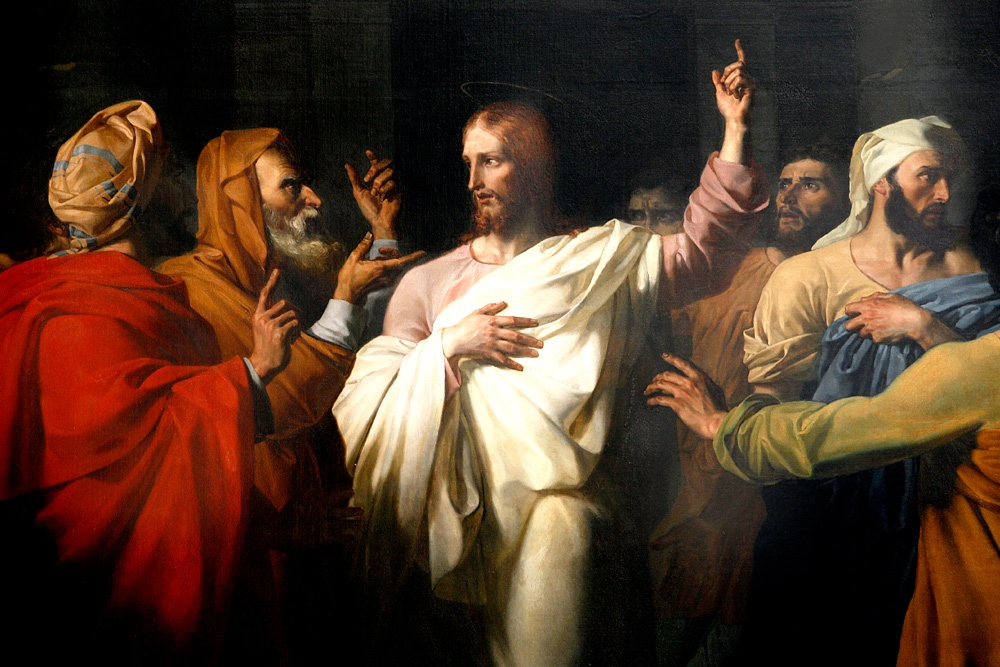
Today in our Gospel reading, Jesus encounters some Sadducees who propose a question which is the equivalent of “If Peter Piper Picked a Peck of Pickle Peppers.” On other occasions, Jesus will have similar encounters with the scribes and Pharisees. In almost all of these encounters, the religious leaders come to Jesus in an attempt to trip Him up over the Law. If they succeed, they can use their influence and power to denounce Him. But in each case, He turns it around on them and eventually silences them, at which point they resort to lying. At the trial the night before He was crucified, “The chief priests and the whole council were seeking false testimony against Jesus that they might put him to death, but they found none, though many false witnesses came forward.” (Matthew 26:59-60)
Through Christ and His sacrifice on the Cross, we are no longer under the Mosaic Law, but under grace. St. Paul states this clearly in his letter to the Romans: “You are not under law but under grace,” (Romans 6:15), but he quickly adds that sin still exists. How? We are no longer governed by the Mosaic Law, but we are under the law of the Spirit. Paul writes, “We are released from the [Mosaic] law, having died to that which held us captive, so that we serve in the new way of the Spirit and not in the old way of the written code.” (Romans 7:6) And what is the heart of this law of the Spirit? Paul tells us, “For the whole law is fulfilled in one word: “You shall love your neighbor as yourself,” (Romans 5:14) which includes the love of God because you cannot love your neighbor if you do not first love God.
Our society is quick to impose specific laws on itself and others, whether to maintain order or uphold moral standards. Some individuals ignore these laws altogether and live a lawless life—that’s a different topic. However, most follow these laws, and for the most part, they do so out of fear of punishment, a similar approach to that of the Sadducees and Pharisees. Follow the law to receive a reward. Break the law and face punishment. But the law of the Spirit is beyond any codified system. Why? Because it concerns the heart. It is about love.
We do what God asks of us not because it’s written in a book, but because it’s written on our hearts. We follow His commands not out of fear of being thumped on the head, but because we love Him and want to please Him. We don’t need a law telling us to feed the hungry; we do it because we love our neighbor. We don’t need a law that says, “Don’t drive drunk,” because we should love those who travel with us and those around us enough that we take responsibility for their safety and ours through our actions.
Are you following the law of the Spirit, or are you breaking it? Answer the question: Am I loving my neighbor?
As followers of Jesus, the things we do or don’t do should not be motivated by fear of punishment or reward. Instead, they should be guided by the answer to that one question. Additionally, I would add, err on the side of grace. You can love too little, but you can never love too much.
Let us pray: Breathe into me, Holy Spirit, that my thoughts may all be holy. Move in me, Holy Spirit, that my work, too, may be holy. Attract my heart, Holy Spirit, that I may love only what is holy. Strengthen me, Holy Spirit, that I may defend all that is holy. Protect me, Holy Spirit, that I may always be holy. Amen.
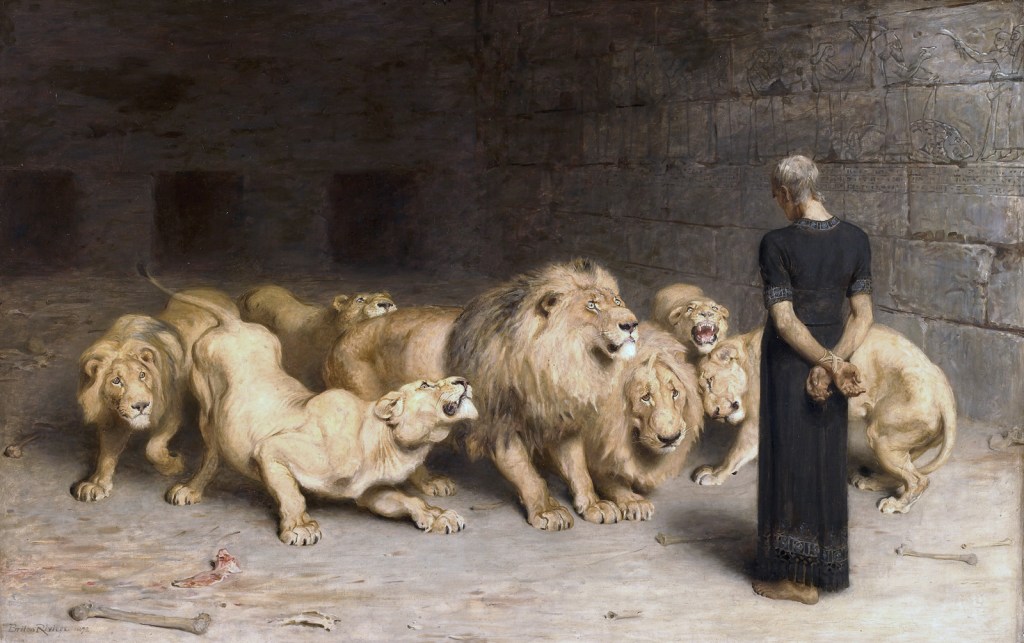
The story of Daniel in the Lion’s Den is a good one. Daniel’s only crime is that he refused to worship the king as a god and instead remained faithful to the one true God. Those around him are jealous, so they devise the plan to trap him so they can get him out of the way. The plan is simple: have the king issue an edict that, for one month, it’s illegal—punishable by death—to pray to any other god except himself. Daniel doesn’t make a fuss about it, but he disobeys the edict. Scripture tells us that he went to his room, shut the door, and there prayed to the one true God. However, those who want to get rid of him burst in while he is praying and report it to the king, who, because of the edict, has no choice but to throw Daniel into the lions’ den, and he does.
Today, in our Gospel reading, we hear Jesus say, “Blessed are you,” followed by the poor, the hungry, those who weep, and those who are hated. Then, he says, “Woe to you who” are rich, full, laughing, and spoken well of. Those who are blessed and those who are cursed seem to be upside down. “Excuse me, Jesus, but it is the fat and happy that are blessed.” But, no, it is the other way around. Hearing the story of Daniel, we might think,
“Woe to you who are cast to the lions, for you will experience weeping and gnashing of teeth!”
But instead, in the upside-down version, it is
“Blessed are you who are cast to the lions, for you shall be protected by God.”
So, if that is the case, what does it mean to be “blessed?”
It is very common for someone with a good life—nice car, house, white picket fence, fat checking account, etc.—to say, “I am so blessed.” However, it’s quite rare to hear someone who has just been diagnosed with cancer say, “I am so blessed.” Why? Because we most often understand being blessed as those things outside ourselves. But, those visible, tangible things are actually only signs of being blessed. Everyone knows that if you are rich, God has blessed you, and if you are poor, well, you’d best be getting straight with God. Right? Wrong. So, if being blessed isn’t about external signs, then what is it?
Moses and the Israelites wandered in the desert. God finally called them and sent them to the Holy Land, but Moses was afraid of the enemies they would face and other trials. So the Lord said to Moses, “My presence will go with you, and I will give you rest.” Moses, wanting to be sure, responded, “If your presence will not go with me, do not bring us up from here.” Unless you truly mean it, don’t send us, because without you, we are doomed. “And the Lord said to Moses, ‘This very thing that you have spoken I will do, for you have found favor in my sight, and I know you by name.’”
“My presence will go with you.” There are many external signs of what it means to be blessed by God, but the greatest blessing is the very presence of God. God did not tell Moses that it would be easy. God told Moses that he would be with him and the Israelites. God did not tell Daniel that being in exile, living among and serving a foreign people, and being thrown into the lions’ den would be easy, but Daniel trusted in God’s promise—Daniel trusted that God would be present.
With this understanding, even on the darkest days, you can say, “I am blessed,” because regardless of the circumstances, God is with you. The Lord told Joshua, “Be strong and courageous. Do not be afraid; do not be discouraged, for the Lord your God will be with you wherever you go.” (Joshua 1:9) If you need more proof, simply remember His name: “The virgin will conceive and give birth to a son, and they will call him Immanuel” (which means “God with us”). (Matthew 1:23)
In the first Freshman English class of the semester, the teacher stated, “Let us establish some examples about opposites. Timothy, what is the opposite of joy?”
“Sadness,” said the student.
“Fine.
And the opposite of depression, Rachel?”
“Elation,” she replied with a smile.
“Very good.
And you, Johnny, what is the opposite of woe?”
“I believe that would be ‘giddy up’”
Scripturally speaking, the opposite of “woe” is “blessed,” and we heard those beautiful words, “Blessed are you,” but as beautiful as those words are, today is our celebration of All Saints, so instead of focusing on the words, we focus on those who heard the words and followed the one who spoke them. We focus on the ones who were blessed.
There are approximately 8.1 billion people living today out of the roughly 117 billion people who have ever been born. Of those 117 billion, only about 10,000 are recognized by the church as capital “S” saints: St. Mary, St. Matthew, St. Julian, and others. That’s roughly one Saint for every 11,700,000 people born. So, the question for you today is: what are the chances of you becoming a saint?
For me, I go along with what Brennan Manning said in The Ragamuffin Gospel: “When I get honest, I admit I am a bundle of paradoxes. I believe and I doubt, I hope and get discouraged, I love and I hate, I feel bad about feeling good, I feel guilty about not feeling guilty. I am trusting and suspicious. I am honest and I still play games. Aristotle said I am a rational animal; I say I am an angel with an incredible capacity for beer.” I prefer Scotch, but you get the point. I consider the odds 1/11,700,000 and think it could happen, but if we’re being honest… honesty is overrated. My one consolation is that I know I have a much better shot at it than you lot.
Perhaps, instead of asking “Who will become a Saint?” we should ask, “Who should strive to become a Saint?” It might seem a bit bold to us, but many of the great saints intentionally described themselves as working to become saints, and some went as far as to predict that they would. St. Joseph Cafasso writes, “I would be the happiest of men if I could become a saint soon and a big one.” Blessed Mary Fortunata Viti says, “I am fortunate to be given this opportunity to become a saint. I want to become a saint,” and St. Margaret of Cortona says, “A time will come when you will call me a saint, and you will go on a pilgrimage to my tomb with the staff and wallet of a pilgrim.” This might seem to negate the whole idea of humility we see in the saints, but instead it points to the fact that they took seriously Christ’s command to “be perfect as your heavenly Father is perfect,” and, in doing so, they are blessed.
Thomas Merton, in his autobiography The Seven Storey Mountain, describes a notable conversation he had with his friend Robert Lax. Apparently, they were arguing as they walked when Robert suddenly stopped and, turning to Merton, asked, “What do you want to be, anyway?” Merton had a few poor answers in his mind but finally said, “I don’t know; I guess what I want is to be a good Catholic.” Robert responded, “What do you mean you want to be a good Catholic? What you should say… what you should say is that you want to be a saint.” “How do you expect me to become a saint?” Robert replied. “By wanting to.” Merton said, “I can’t be a saint.”
Remembering the mood of this conversation, years later, Merton wrote, “My mind darkened with a confusion of realities and unrealities: the knowledge of my own sins, and the false humility which makes men say that they cannot do the things that they must do, cannot reach the level that they must reach: the cowardice that says: ‘I am satisfied to save my soul, to keep out of mortal sin,’ but which means, by those words: ‘I do not want to give up my sins and my attachments.’” In their conversation, his friend Robert continued, “All that is necessary to be a saint is to want to be one. Don’t you believe that God will make you what He created you to be, if you will consent to let Him do it? All you have to do is desire it.” The next day, looking for a way out, Merton told another friend, “[Robert] is going around saying that all a man needs to be a saint is to want to be one.” His friend’s response, “Of course.” Of course! All you have to do to become a saint is to want to be one.
God’s love pulls us out of the places of sin where He finds us. He pulls us out because He wants more for us, and in pulling us out of those places, he calls us into another place—one where we can strive to become that one person in 11,700,000. And before you say, “I can’t,” consider the words of Thomas Merton when he said he couldn’t. You see, when we say we can’t, it’s because we become painfully aware of our sins. We are confronted with aspects of our lives that we’re often unwilling to change in order to be more saint-like. Remember St. Augustine’s words, “Lord, make me chaste—but not yet!”
Become a saint! I can’t. Why? Because of pride, gluttony, and anger? Then learn humility, moderation, and forgiveness. If you did those things, would you then be a saint? Probably not, but you might be a step closer.
Consider a monk who lived on Mount Athos with Elder Paisos. The monk drank excessively, smoked two packs of cigarettes a day, and cursed like a sailor. One day, after the monk’s death, a few pilgrims approached Elder Paisos, who spoke of the monk so affectionately and regarded him as a saint afterward. The pilgrims were distraught; they discussed all the issues the monk had in his life and scolded Elder Paisos for failing to notice those faults. Elder Paisos understood their concerns but then told them that the monk had cut his twenty glasses of wine down to three and reduced his smoking from two packs to just one cigarette a day. Elder Paisos was certain that God saw a fighter, while the world saw a sinner.
Is this an easy task? Of course not—there are many reasons, but one of the main challenges is the need to turn our critical eye toward ourselves. This battle isn’t fought out there but within us, because “For our struggle is not against flesh and blood, but against the rulers, against the authorities, against the powers of this dark world and against the spiritual forces of evil in the heavenly realms.” Becoming a saint is difficult because many of the battles are unseen. They occur in a place where our greatest weapon is our faith. At times that faith may not seem like much; however, behind that faith stands the One True God who loves us. St. Paul reminds us, “Since then we have a great high priest who has passed through the heavens, Jesus, the Son of God, let us hold fast our confession. For we do not have a high priest who is unable to sympathize with our weaknesses, but one who in every respect has been tempted as we are, yet without sin. Let us then with confidence draw near to the throne of grace, that we may receive mercy and find grace to help in time of need.” (Ephesians 4:14-16)
You may never attain sainthood in this life, and you might never receive the title “Saint,” with a capital “S,” but that shouldn’t stop you from consistently and faithfully striving for it. St. John Vianney wrote, “We must never lose sight of the fact that we are either Saints or outcasts, that we must love for Heaven or for Hell; there is no middle path in this.” Don’t be satisfied with merely escaping to heaven “as one escaping through the flames”; instead, put up a good fight and strive to hear those words, “Well done, good and faithful servant!” Strive to become one among 11,700,000. Strive to be blessed.
Let us pray: (This prayer is called The Anima Christi, The Soul of Christ.)
Soul of Christ, sanctify me; Body of Christ, save me; Blood of Christ, inebriate me; Water from the side of Christ, wash me; Passion of Christ, strengthen me; O good Jesus hear me; Within your wounds hide me; separated from you, let me never be; From the evil one protect me; At the hour of my death, call me; And close to you bid me; That with your saints, I may be praising you forever and ever. Amen.
On a Sunday afternoon, an elderly man sat on the back porch of the parsonage, talking to the young priest, and said, “Father, I’ve got something to tell you. I’ve never told this to a soul; it’s extremely difficult to tell you now, but my wife and I have had a fight almost every day for the past 30 years of our marriage.”
The priest was surprised and looked away. He nervously sipped his coffee, unsure of what to say. The young priest asked, “Every day?” “Yes, just about every day.” “Did you fight today before coming to church?” “Yes.” “How did it end?” “She came crawling to me on her hands and knees.” “My goodness, what did she say?” “Come out from under that bed, you coward, and fight like a man!”
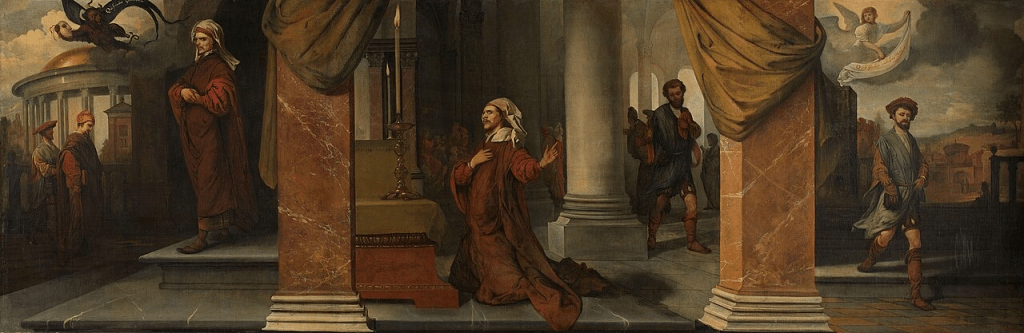
Jesus tells a parable about two men who “went up to the temple to pray, one a Pharisee and the other a tax collector.” The Pharisee was very knowledgeable about God’s teachings. The tax collector, not so much. Plus, the tax collector was generally seen as a plague on society. So, after their prayer, you might think the Pharisee would be the one justified before God, but that’s not the case. When he prays, he believes he knows the mind of God, how things work—he’s not just on the team, he’s the star quarterback, so he is all puffed up. When he prays, he says to God, “You know me and I know you. We’re tight, and thank heaven I’m not like that poor schmuck over there. You and me, we’re good.” He sees himself as a righteous dude because he thinks God views him as a righteous dude.
On the other hand, the tax collector could not even look up toward heaven when he prayed. In the temple, he stayed as far away as possible, keeping his head bowed. He didn’t consider himself worthy, so he prayed, “God, be merciful to me, a sinner!” And Jesus said, “I tell you, this man went down to his home justified rather than the other; for all who exalt themselves will be humbled, but all who humble themselves will be exalted.”
What was the key difference between the two? If I had to pick one word, I would say truthfulness — not with the world around them or even with God, but truthfulness with themselves.
In The Brothers Karamazov, Fyodor Dostoevsky writes, “And, above all—don’t lie… Above all, don’t lie to yourself. The man who lies to himself and listens to his own lie comes to such a pass that he cannot distinguish the truth within him, or around him, and so loses all respect for himself and for others.”
The tax collector, despite feeling miserable about himself and his sins, was at least honest with himself. He had no illusions about being a good man, so instead of trying to justify himself before God, he cast his soul on God’s mercy. He prayed, “God, be merciful to me, a sinner.”
As for the Pharisee, he couldn’t see past his own self-deception to repent for any wrongdoing. He stood before God, having lied to himself so completely that, in Dostoevsky’s words, he could not “distinguish the truth within him, or around him.”
Unfortunately, I believe that more people are like the Pharisee than the tax collector. They deceive themselves into thinking they are justified and righteous before God. Why? Several reasons come to mind.
First, looking inward and facing the truth about ourselves can sometimes be quite painful. For example, if you have a long work history, jumping from one job to another, it’s easy to blame others. “Well, the boss didn’t like me.” “At this job, they didn’t appreciate me.” “There, the employees were always after me.” Each of those statements could be true and reason enough to leave, but if you are honest with yourself and those circumstances, you might ask, “What is the common denominator? What do each of those positions have in common?” The answer: you. That doesn’t mean you were the problem, but it’s a question you need to ask. If, in asking that question honestly and realizing it was you, well, that can be a painful revelation, and we don’t like pain—whether physical, emotional, or spiritual—which leads to another reason for self-deception: fear of change.
In those jobs you held, you were honest with yourself, you discovered that you were the one who was the issue, and even though it was a painful revelation, you still must make a choice. Will you remain the same, or will you work to change and improve yourself? Everyone talks about how change is a good thing, and I believe that it is, right up to the point where I’m the one who has to do the changing; then change is very, very bad.
If we choose to overcome the pain and change, we must also face another part of being honest with ourselves—letting others see and understand who we truly are and that we were wrong. Oh, the humanity! Pride is a harmful trait.
In the end, if we overcome these and other fears of being truthful with ourselves and with God, I believe there is one more reason why we will continue to deceive ourselves: we don’t believe we have the capacity or the tools to do anything about it. We say, “I am who I am, and there’s nothing to be done about it in Heaven or on Earth.” O woe is me, but that is just another lie we tell ourselves so we don’t have to do the work.
The Psalms we read on Sundays are usually very pleasant and easily consumed. From the Psalm today, praising the Lord.
“Happy are they who dwell in your house! they will always be praising you.”
However, if you explore the Psalms beyond our Sunday readings, you will notice there is quite a focus on enemies. Take Psalm 63, for example. When we read it, we see verses one through eight. It begins,
“O God, you are my God; earnestly I seek you; my soul thirsts for you; my flesh faints for you, as in a dry and weary land where there is no water.”
Nice and comforting, but when we only read verses one through eight, we never get to verses nine and ten.
“But those who seek to destroy my life shall go down into the depths of the earth; they shall be given over to the power of the sword; they shall be a portion for jackals.”
Hoorah! But who are these enemies that seek my life? Who is it that will be put down by the sword and fed to jackals?
Some may have a person or group they consider an “enemy” (I would suggest you rethink that), but what if, instead of a person or group, we interpret the enemies in Psalms as the self-deceptions and sins within us? What if we see the enemies as those parts of our lives that we need to rid ourselves of, to fight so that we can conquer, in order that we might change and be transformed into the image of God? What if we say we must defeat the pain and fear of change and put the pride under our feet? Think about these ideas and consider them in the context of a portion of Psalm 118.
For who is God, but the Lord?… He trains my hands for war, so that my arms can bend a bow of bronze. You have given me the shield of your salvation, and your right hand supported me, and your gentleness made me great. You gave a wide place for my steps under me, and my feet did not slip. I pursued my enemies —I pursued my sin and self-deception— and overtook them, and did not turn back till they were consumed. I am running a few minutes late; my previous meeting is running over. I thrust them through, so that they were not able to rise; they fell under my feet. For you equipped me with strength for the battle; you made those who rise against me —those enemies within— sink under me. You made my enemies turn their backs to me, and those who hated me I destroyed. They cried for help, but there was none to save; they cried to the Lord, but he did not answer them. I beat them fine as dust before the wind; I cast them out like the mire of the streets.
What if, like the Psalmist, when our enemies come against us, we don’t crawl under the bed, but instead say, “Bring it!”—trusting completely in the words of the Lord, “No weapon that is fashioned against you shall succeed” (Isaiah 54:17a).
If we will, then we know that we can and must stand against the enemies and self-deception, so that when we come before the Lord, we don’t pretend as though nothing is wrong. We don’t stand there like a Pharisee saying, “Oh, look how perfect I am,” but instead, we are in a place where we can humbly pray, “God, be merciful to me, a sinner!” And in doing so, like the tax collector, be justified, be made right before the Lord. Jesus said, “All who exalt themselves will be humbled, but all who humble themselves will be exalted.
In his first epistle, the Apostle John wrote, “If we say we have no sin, we deceive ourselves, and the truth is not in us. If we confess our sins, he is faithful and just to forgive us our sins and to cleanse us from all unrighteousness (1 John 1:8-9).” If we will humble ourselves by being truthful with ourselves and with God, then we will be justified in God’s eyes.
Let us pray: God, the author of peace and lover of concord, to know you is eternal life and to serve you is perfect freedom: Defend us, your humble servants, in all assaults of our enemies; that we, surely trusting in your defense, may not fear the power of any adversaries; through the might of Jesus Christ our Lord. Amen.





 Candle in a Cave