Sermon: Proper 27 / Pentecost 24 RCL B – “Selfless”

There was a boat way out in the Pacific ocean that encountered a horrendous storm in the middle of the night and the boat ended up being capsized. Near by was an island and when day break came there were two men lying on the beach – the only survivors. As they pulled themselves together they discussed what they should do and concluded that they should pray – go figure.

However, the first man got the idea that perhaps one of them might be more righteous than the other and that God might hear the prayers of one over the other, but maybe not both if they stayed together, so the first man devised the plan where they would split the island and each was to stay on his side without coming on the others. The second man calmly agreed, they shook hands, and went their separate ways.

On the first night, the first man prayed for something to eat. The following morning he came into the most remarkable grove of fruit trees imaginable, everything a person needed to keep alive. Not only that, a small cove on his side of the island provided an abundance of fish that he easily caught with his bare hands. For the second man there was nothing. He did find an old piece of nearly rotten fruit on the beach that he managed to choke down, but it was hardly enough to keep him alive.

Several weeks later the first man decided that he did not want to be alone on the island, so he prayed that the Lord would send him a wife. That night there was another shipwreck and the lone survivor was a beautiful woman that washed up on the shore. They were perfect companions and got along famously. For the second man, again nothing. He couldn’t even find a volleyball that he could name Wilson. Perfectly dreadful were his conditions.

The months went by and the first man and his wife decided they might try and pray to be rescued and wouldn’t you know it, the following morning a boat floated up in the cove. It was all gassed up and ready to go, so they swam out to it, fired it up, and headed off. Suddenly there was a voice from heaven, “Are you going to leave the other man behind?” “Sure,” said the first man, “Look at him. He is obviously some heathen. Here I have prayed and received everything I asked for and he has received nothing. He must be some great sinner to be in such rotten shape. I see no need to save him.” “On the contrary, he has also had everyone of his prayers answered, even though he prays the same thing everyday, and if it weren’t for his prayers – none of yours would have been answered.” “Oh,” says the first man, “what was his prayer?” “He prayed that all your prayers would be answered.”

These days, with regard to self, we hear many terms. There is of course the selfie, but there are things like self-care, self-esteem, and self-love, but a “self” word that I heard while growing up seems to have fallen out of favor, because it means taking any of these “self” concepts too far, and these days much seems to be about doing just that. The word is “selfish.” It occurs when self, I, becomes the most important object of our affections and actions. There is nothing wrong with loving self – “Love your neighbor as you love yourself” – but it seems we can sometimes forget that first part of loving our neighbor and become selfish, where we always place our own needs, not only ahead of those of others, but instead of the needs of others.

Today, we read the end of the Book of Ruth, when Ruth takes Boaz as her husband and by doing so cares – yes, for herself – but also for Naomi, her mother-in-law. Yet the story does not have a happy beginning.

Due to a famine in the land, Naomi, her husband, and two sons moved from Israel to Moab. The sons married Moabite (gentile) women, Orpah and Ruth. Yet, Naomi’s husband and two sons died, leaving the women with no real way to care for themselves. So Naomi told her daughter-in-laws to return to their people where they could find new husbands and be cared for. (Sorry, ladies, at the time, a woman needed a husband in order to care for her.) Orpah returned, but Ruth said to Naomi, “Do not urge me to leave you or to return from following you. For where you go I will go, and where you lodge I will lodge. Your people shall be my people, and your God my God.  Where you die I will die, and there will I be buried. May the Lord do so to me and more also if anything but death parts me from you.”

Those are words that you may sometimes hear at a wedding, but here Ruth is vowing herself to Naomi and is looking outside of her own needs to those of another. Orpah was not being selfish by returning to her people, but Ruth was being selfless, by considering how her actions would effect Naomi.
Through her selfless actions and love of Naomi, Ruth was able to gain a husband, Boaz, and provide for the needs of them both.

In Matthew’s Gospel, we are provided with the genealogy of Jesus, and there are very few women mentioned, but Ruth is one of them, as she is the great-grandmother of King David, whom Jesus descended from. Ruth is memorialized and plays a part in the salvation of us all because of her selfless act.

Today in our Gospel, Jesus is witness to another selfless act, as the widow places all she has in the temple treasury. Jesus said of her, “Truly I tell you, this poor widow has put in more than all those who are contributing to the treasury. For all of them have contributed out of their abundance; but she out of her poverty has put in everything she had, all she had to live on.”

At the time in the Temple complex, there were thirteen jars used for collecting various offerings. Some were for the upkeep of the temple, others were to pay for sacrifices, and still others were used for alms, money used for the care of others. The context of our Gospel seems to imply that the woman gave not for herself, but for others. Not only did she give, but she gave selflessly everything she had. Although not named like Ruth, the widow with her two copper pennies is also memorialized for her selfless act.

A young brother and sister both have a very rare blood type. It is determined that the sister will need an operation and will likely need a transfusion. Because of the rare blood type, they turn to the young boy and ask him if he would be willing to give blood for his sister. He thinks about it for only a moment and agrees. As the procedure begins the young boy is nervous, but brave. Because of his age the doctors keep a close eye on him and notice that he is quietly crying. When asked if he is in pain, he says, “No.” But then asked, “How soon before I die.”

Jesus said, “This is my commandment, that you love one another as I have loved you.  Greater love has no one than this, that someone lay down his life for his friends.  You are my friends if you do what I command you.”

There are many ways to “lay down ones life,” but all of them require that we first lay ourselves down to lay down and set aside our own needs for the needs of others and to allow the Word of God to work through us. In The Imitation of Christ, Thomas à Kempis writes, “He does much who loves much. He does much who does a thing well. He does well who serves the common good rather than his own interests.”

As we seek to serve Christ, let us learn to be selfless in our giving and look to the common good. St. Francis of Assisi writes, “Above all the grace and the gifts that Christ gives to his beloved is that of overcoming self.” Ask for this gift, this grace, so that you may love, not just self, but all.

Let us pray: O Dearly beloved Word of God, teach us to be generous, to serve You as You deserve, to give without counting the cost, to fight without fretting at our wounds, to labor without seeking rest, to spend ourselves without looking for any reward other than that of knowing that we do Your holy will. In Jesus Name we pray. Amen.

Sermon: Proper 19 / Pentecost 16 RCL B – “Cross Bearing”

Communications has one major problem: language. Not surprising when you consider words can have multiple definitions (“set” has 464 and “run” has 395) Then there are the words we use or misuse or just the occasional typo. It would seem that church bulletins provide endless examples of all these problems. Actual church announcements:

The outreach committee has enlisted 25 visitors to make calls on people who are not afflicted with any church.

Low Self-Esteem Support Group will meet Thursday at 7 p.m. Please use the back door.

At the evening service tonight, the sermon topic will be “What is hell?” Come early and listen to our choir practice.

The sermon this morning: Jesus Walks on the Water. The sermon tonight: Searching for Jesus.

The church will host an evening of fine dining, superb entertainment, and gracious hostility.

During the absence of our pastor, we enjoyed the rare privilege of hearing a good sermon when J. F. Stubbs supplied our pulpit.

Misinterpretation of the words we use can also lead to problems in communication. There is a legend regarding J. Edgar Hoover who ran the FBI. Apparently he insisted that all correspondence to him have wide borders around the text so that he could write notes in the margins. In an effort to cut some costs and impress his boss, a supply clerk reduced the size of the office memo paper. One of the new memo sheets soon ended up on Hoover’s desk. Hoover took one look at it, determined he didn’t like the size because it limited the margin width, so scribbled the note, “Watch the borders!” The memo was passed on through the office. Legend has it that for the next six weeks, it was extremely difficult to enter the United States by road from either Mexico or Canada.

In the words of Cool Hand Luke, “What we got here is a failure to communicate.”

Now, if we have this much trouble getting bulletin announcements right or expressing our dislike for the width of the border on a page, is it any wonder that we have such difficulty and so many differences of opinion when it comes to interpreting Holy Scripture?

Paul wrote in his letter to the Corinthians, “For by grace you have been saved through faith, and this is not your own doing; it is the gift of God— not the result of works, so that no one may boast.” Yet last week in James’ Epistle we read, “So faith by itself, if it has no works, is dead.” Which is it? Is one right and the other wrong or are they both right, and if so how? Bring them up in a room full of theologians and watch the fun begin.

Here is another you hear all the time: “God will not place more on you than you can bear.” Most are surprised to learn that this particular statement is no where in Scripture. The closest we have is speaking about sin and temptation from 1 Corinthians, which says, “God is faithful, and he will not let you be tested beyond your strength, but with the testing he will also provide the way out so that you may be able to endure it.” But we’ve taken this verse to mean God won’t overburden us in all areas of our lives. Truthfully, I don’t believe that God will, but I know for a fact that the devil is more than happy to pour it on so thick that you can’t even breathe. So if you’re having a really bad day and someone says, “God won’t give you more than you can handle,” then smack ‘em one and see how well they handle that. No, no, no! Just politely tell them they’re misinterpreting the Scriptures.

Why all this talk on language and miscommunication? Because today we have another perfect example. Not only on the part of Peter, but also for us, because what we often think is being said, is not really the case.

Jesus and his disciples have been traveling near the coast, but now have made a turn inland. As they are traveling, near Caesarea Philippi, Jesus asked his disciples, “Who do people say that I am?” They answered him, “John the Baptist; and others, Elijah; and still others, one of the prophets.” The answers were across the board. People didn’t really know who he was. Go out on the streets of Enid and ask the same question, “Who is Jesus?” and you’ll encounter a similar result. Jesus is God. Prophet. King. Hoax. Madman. Lie. Everything from a figment of of the Gospel writers’ imaginations to the Creator of the Heavens and Earth. Too bad Gallop surveys weren’t around in the time of Jesus, we could have narrowed it down to percentages of each, yet even if we could, unlike the world today, Jesus would not have altered himself or his message in order to gain a higher approval rating. The same yesterday, today, and tomorrow. That type of information is irrelevant to him and his next question to his disciples proves that: “But who do you say that I am?” I don’t care what the people or the surveys say, I want to know who you think that I am. The message of salvation is not dependent upon what is popular, instead it is dependent upon each individual response. Peter answered, “You are the Messiah.” Peter got a gold star for his answer, but here is the first language issue. Peter interpreted “Messiah” as one who would be like King David and save them from their temporal / earthly enemies. Jesus, as we know, was concerned about the soul and saving us from our eternal enemy death, the result of sin. So when Jesus began talking about dying, Peter misunderstood. “Whoa there JC! This can’t happen and I’ll be danged if I’m going to let it, because if you die, then we have no King. We’re back where we started from.” Jesus rebukes him for the reason stated, “… you are setting your mind not on divine / eternal things but on human / temporal things.”

Jesus then turns from his disciples and speaks to the crowd that is gathered around him, “If any want to become my followers, let them deny themselves and take up their cross and follow me.” Perhaps in the time of Jesus they understood what he was talking about, but it seems that many times we misinterpret this saying of Jesus.

Someone has a difficult burden to bear. A job, an illness, a task. Something that weighs on them heavily and requires great strength and perseverance to accomplish. Another person comments on how difficult it must be. The response, “No, it’s not easy, but it’s my cross to bear.”

Another has a person in their life that through choice or relation presents various longterm difficulties. “You are such a saint for giving so much of yourself for them.” And in either true or false humility the response, “We all have our cross to bear.”

The difficult circumstances and burdens in our lives are not the cross we have to bear. These are the things in our lives that we call on Jesus to assist us with. These are the things that we as a Christian people help one another with. Those persons in our lives that present difficulties are not our crosses either. These are the ones we are called to love as we love ourselves.

The cross that Jesus calls us to take up has a very specific purpose, which has nothing to do with the circumstances of our lives or other people. You see, the cross we take up is for us, so that we – in the words of Paul – might be “crucified with Christ.” Paul writes, “We know that our old self was crucified with him so that the sinful body might be destroyed, and we might no longer be enslaved to sin.  For he who has died is freed from sin.  But if we have died with Christ, we believe that we shall also live with him.”

Reflecting on this verse in the Cost of Discipleship, Dietrich Bonhoeffer wrote, “When Christ calls a man, he bids him come and die.”

The language of the Bible can at times be confusing and difficult to understand. By responding to the trials and tribulations in our lives by saying, “This is my cross to bear,” is one of the ways we can confuse what Jesus said. “This is my cross to bear,” is in effect saying, “I will define my cross. I will assign what it is, how much it will weigh, and how far I am prepared to carry it,” instead of allowing God to use that cross for the purpose it was designed. When Jesus says, “If any want to become my followers, let them deny themselves and take up their cross and follow me,” he is asking us to take up our cross and follow him to that hill outside of Jerusalem to be crucified with him, so that we may die to self and live for God. By doing so, your life does not end. It begins. There is no confusion in Jesus’ message on this point, for he says plainly, “I came that they may have life, and have it abundantly.”

Let us pray: Most gracious and ever loving Father, we pray that you give us the strength, courage, wisdom, and will to follow where you have led the way. Through the inspiration of the Holy Spirit, direct our steps that we may be lights in this world to guide and direct others to your most loving Son, in whose Name we pray. Amen.

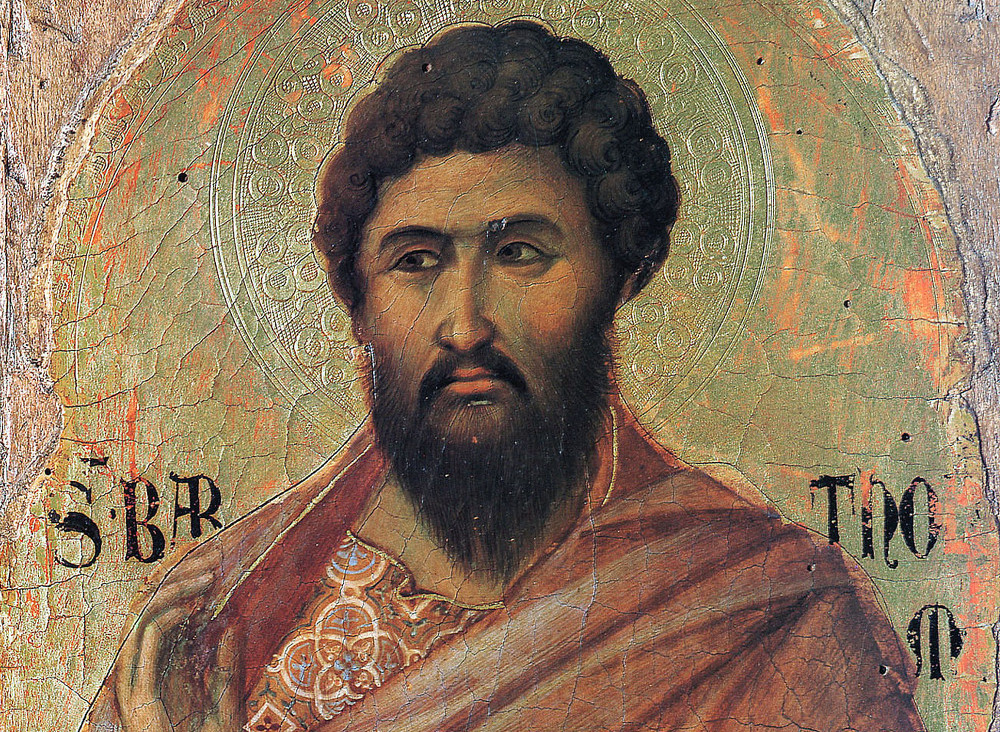
Sermon: Bartholomew

From Paul’s first letter to the church at Corinth:

I think that God has exhibited us apostles as last of all, as though sentenced to death, because we have become a spectacle to the world, to angels and to mortals. We are fools for the sake of Christ, but you are wise in Christ. We are weak, but you are strong. You are held in honor, but we in disrepute. To the present hour we are hungry and thirsty, we are poorly clothed and beaten and homeless, and we grow weary from the work of our own hands. When reviled, we bless; when persecuted, we endure; when slandered, we speak kindly. We have become like the rubbish of the world, the dregs of all things, to this very day.

I don’t know many who can name the twelve apostles who went out into the world after Jesus died – I don’t know that I could do it – but what they have accomplished is nothing less than a miracle. We are here today worshiping in this Chapel because of what they began 2,000 years ago. Yet, in their time, they were not highly thought of by the masses and were most certainly not treated well. Paul’s description from above is very accurate.

Their lives ended violently. With the exception of perhaps John, they were all put to death for the faith. “How” they were put to death reads something like a Stephen King novel – spears, swords, boiling oil, crucifixions – on and on. In the icons of Bartholomew, he is often seen holding a knife, because it is believed that he was flayed alive, but not before he had accomplished the work that Christ had commissioned him to do.

Certain sources indicate that there is a lost Gospel of Bartholomew. In addition, the Roman historian Eusebius reports that when others visited India, between 150 and 200, they “found there ‘the Gospel according to Matthew’ in Hebrew, which had been left behind by ‘Bartholomew, one of the Apostles.’”

Jesus said in our Gospel reading today, “The kings of the Gentiles lord it over them; and those in authority over them are called benefactors. But not so with you; rather the greatest among you must become like the youngest, and the leader like one who serves. For who is greater, the one who is at the table or the one who serves? Is it not the one at the table? But I am among you as one who serves.”

Bartholomew and the other Apostles were not looking to gain fame and fortune. There sole intent was to be among us as ones who serve. Ones who through passion and sacrifice served the Gospel.

Also in his letter to the Corinthians, Paul writes, “Now you are the body of Christ, and each one of you is a part of it.  And God has placed in the church first of all apostles, second prophets, third teachers, then miracles, then gifts of healing, of helping, of guidance, and of different kinds of tongues.  Are all apostles? Are all prophets? Are all teachers? Do all work miracles?  Do all have gifts of healing? Do all speak in tongues? Do all interpret?”

Then and now, the answer to Paul’s questions is “No.” Not all of us are Apostles or prophets. Not all of us are Bartholomew’s who go to India to preach the Gospel, but we all have God given gifts. Gifts that have been given to us by God to serve the Gospel. Gifts that should be used as passionately and sacrificially as Bartholomew and the others used theirs.

What gift is God calling  you to use for the sake of the Gospel?

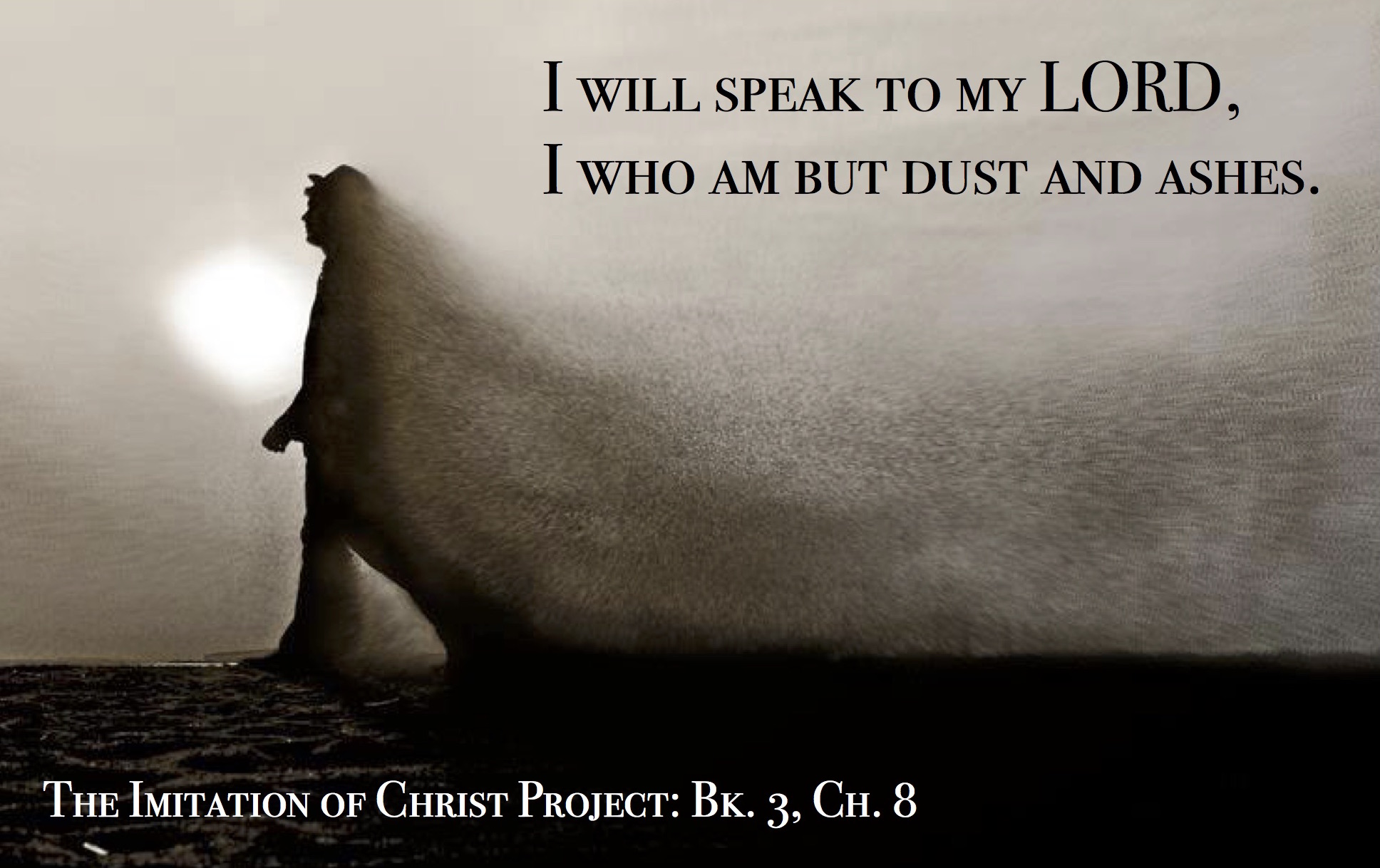
The Imitation of Christ Project: Bk. 3, Ch. 8

IOC 3.8

SELF-ABASEMENT IN THE SIGHT OF GOD –

THE DISCIPLE

I WILL speak to my Lord, I who am but dust and ashes. If I consider myself anything more than this, behold You stand against me, and my sins bear witness to the truth which I cannot contradict. If I abase myself, however, if I humble myself to nothingness, if I shrink from all self-esteem and account myself as the dust which I am, Your grace will favor me, Your light will enshroud my heart, and all self-esteem, no matter how little, will sink in the depths of my nothingness to perish forever.

It is there You show me to myself — what I am, what I have been, and what I am coming to; for I am nothing and I did not know it. Left to myself, I am nothing but total weakness. But if You look upon me for an instant, I am at once made strong and filled with new joy. Great wonder it is that I, who of my own weight always sink to the depths, am so suddenly lifted up, and so graciously embraced by You.

It is Your love that does this, graciously upholding me, supporting me in so many necessities, guarding me from so many grave dangers, and snatching me, as I may truly say, from evils without number. Indeed, by loving myself badly I lost myself; by seeking only You and by truly loving You I have found both myself and You, and by that love I have reduced myself more profoundly to nothing. For You, O sweetest Lord, deal with me above all my merits and above all that I dare to hope or ask.

May You be blessed, my God, for although I am unworthy of any benefits, yet Your nobility and infinite goodness never cease to do good even for those who are ungrateful and far from You. Convert us to You, that we may be thankful, humble, and devout, for You are our salvation, our courage, and our strength.

Sermon: Alcuin of Tours

For this Season of Easter, the opening sentence of any Eucharistic service has been, “Alleluia. Christ is Risen.” Following Pentecost, we’ll go back to, “Blessed be God: Father, Son, and Holy Spirit.” However, what follows, no matter the season of the church year, is always the same: “Almighty God, to you all hearts are open, all desires known, and from you no secrets are hid:  Cleanse the thoughts of our hearts by the inspiration of the Holy Spirit, that we may perfectly love you, and worthily magnify your holy Name; through Christ our Lord.” It is known as the Collect for Purity.

It is a prayer that started off as one of the many private prayers for clergy that was to be said before the Mass, yet it was deemed too meaningful to be locked away in the sacristy and was eventually introduced into the public prayers of corporate worship.

What does that have to do with today? We are celebrating Blessed Alcuin of Tours, born in the year 730, and it was he who preserved and incorporated that prayer into our worship. Just because we worship with the 1979 Book of Common Prayers does not mean that it is all of modern invention. Over the centuries, many like Alcuin have contributed to that wonderful little red book that automatically falls open to page 355.

Alcuin was one of the great scholars, in fact, at the time he was considered “The most learned man anywhere to be found.” Fr. John Julian says that “Alcuin’s work was seldom highly original, but his own commitment was rather to the protection, compilation, and promulgation of the words of others.” Through these efforts he “was chiefly responsible for the preservation of the classical heritage of western civilization.” And if that weren’t enough, he is also responsible for giving the world the punctus interrogativus. Is that true? Did he really? What could that possibly be? Why, the question mark.

It is this preservation of the ancient writings and presenting them to the church that makes our Gospel reading so relevant for Alcuin. Jesus said, “… every scribe who has been trained for the kingdom of heaven is like the master of a household who brings out of his treasure what is new and what is old.” There is a theological interpretation to this passage, as well as a practical, and it is the practical we understand to apply to Alcuin. The “scribe,” according to Sirach, is one who “will seek out the wisdom of all the ancients.” Think of it in terms of the George Santayana quote, “Those who cannot remember the past are condemned to repeat it.” Alcuin was one who not only sought out the wisdom of the ancients, but as Jesus taught, believed that the teachings of our fathers were worth preserving, not only for their historical value, but for our collective benefit.

He died in the year 804 and a portion of his epitaph reads, “Dust, worms, and ashes now… Alcuin my name, wisdom I always loved, Pray, reader, for my soul.”

When we think on the lives of the Saints, we often think of those like the apostles, martyrs, or evangelist. So, in the midst of them all, did you ever think you would come across a librarian? Don’t get me wrong! In the acknowledgements of my doctoral thesis, I named my local librarians! I think the world of the roles they fill, but a Saint? Absolutely.

Paul writes, “We have gifts that differ according to the grace given to us.” We can hear that and think it means that some are better than others, but that is a worldly perspective. Instead, we see it as God giving us each specific graces – gifts – that when exercised with zeal, benefit the whole. Again, Paul says, “God has appointed in the church first apostles, second prophets, third teachers” and so on. But Paul’s list is not exhaustive, it also implies that God has also appointed doctors, businesspeople, housekeepers, homemakers, and – Yes! – librarians.

Alcuin’s life says to us, “It’s not about the specific gift that God has graced you with. It’s about how you employ that gift.”

God has graced you with many gifts. Don’t squander them or leave them unutilized. Like Alcuin of Tours, practice them to your greatest ability in the work of God’s Kingdom.

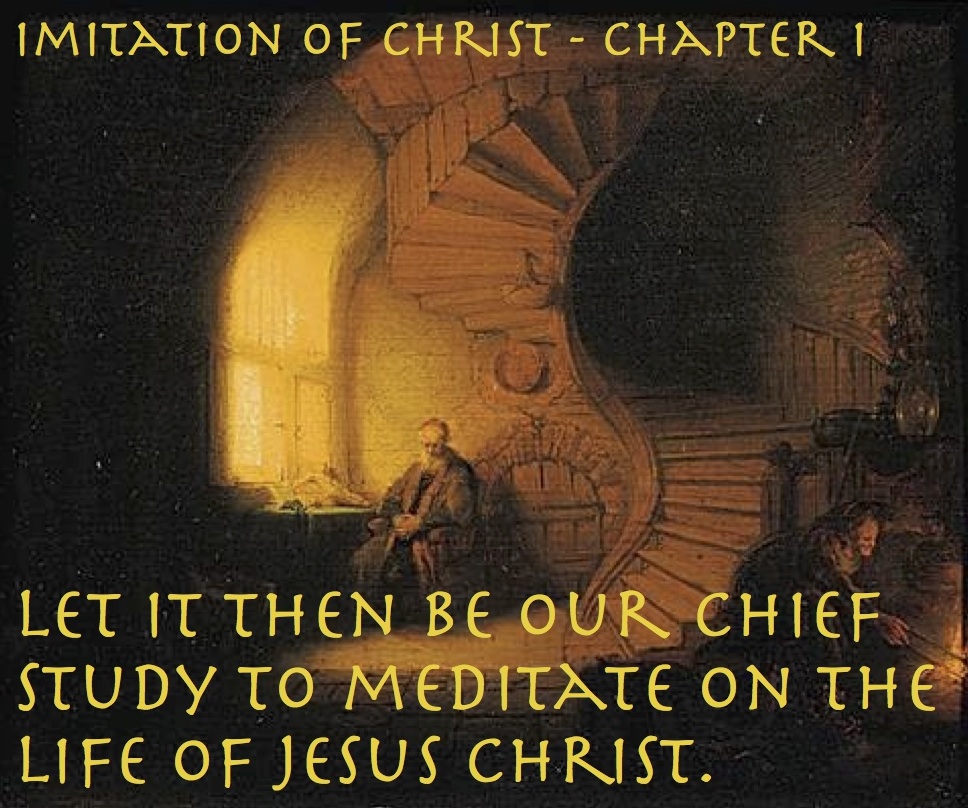
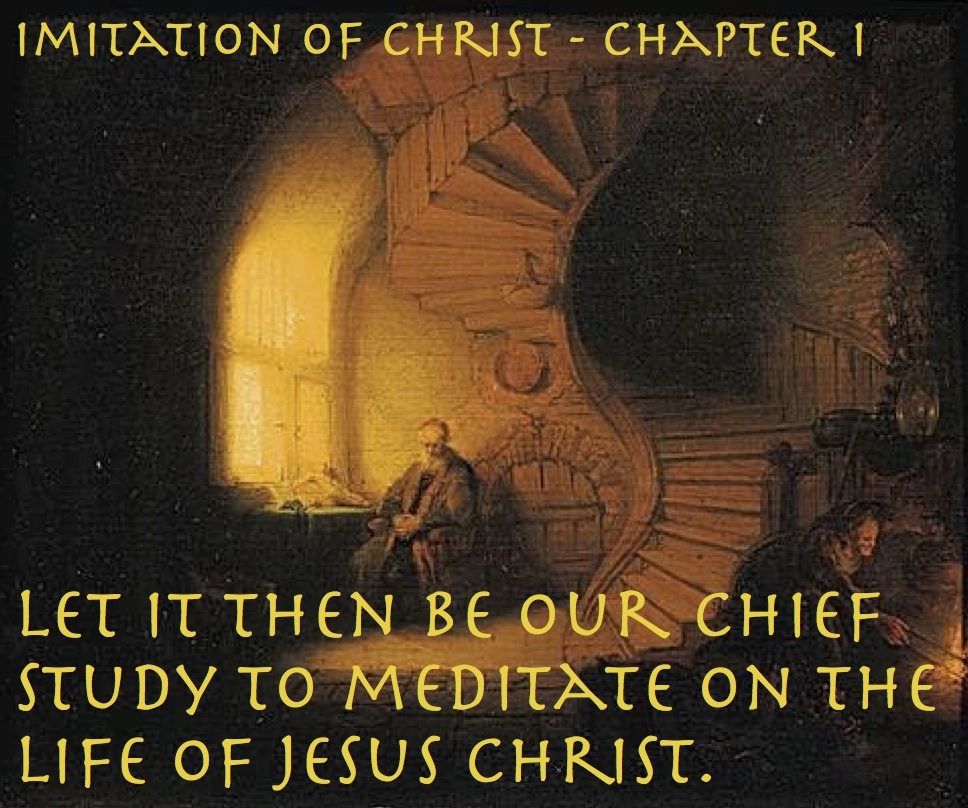
Imitation of Christ Project – Bk. 1, Ch. 1

IOC Ch1
“The Philosopher in Meditation” by Rembrandt Harmenszoon van Rijn

IMITATING CHRIST AND DESPISING ALL VANITIES ON EARTH

“He who follows Me, walks not in darkness,” says the Lord. By these words of Christ we are advised to imitate His life and habits, if we wish to be truly enlightened and free from all blindness of heart. Let our chief effort, therefore, be to study the life of Jesus Christ.

The teaching of Christ is more excellent than all the advice of the saints, and he who has His spirit will find in it a hidden manna. Now, there are many who hear the Gospel often but care little for it because they have not the spirit of Christ. Yet whoever wishes to understand fully the words of Christ must try to pattern his whole life on that of Christ.

What good does it do to speak learnedly about the Trinity if, lacking humility, you displease the Trinity? Indeed it is not learning that makes a man holy and just, but a virtuous life makes him pleasing to God. I would rather feel contrition than know how to define it. For what would it profit us to know the whole Bible by heart and the principles of all the philosophers if we live without grace and the love of God? Vanity of vanities and all is vanity, except to love God and serve Him alone.

This is the greatest wisdom — to seek the kingdom of heaven through contempt of the world. It is vanity, therefore, to seek and trust in riches that perish. It is vanity also to court honor and to be puffed up with pride. It is vanity to follow the lusts of the body and to desire things for which severe punishment later must come. It is vanity to wish for long life and to care little about a well-spent life. It is vanity to be concerned with the present only and not to make provision for things to come. It is vanity to love what passes quickly and not to look ahead where eternal joy abides.

Often recall the proverb: “The eye is not satisfied with seeing nor the ear filled with hearing.” Try, moreover, to turn your heart from the love of things visible and bring yourself to things invisible. For they who follow their own evil passions stain their consciences and lose the grace of God.

Sermon: Great Vigil of Easter RCL A – “Ghost!”

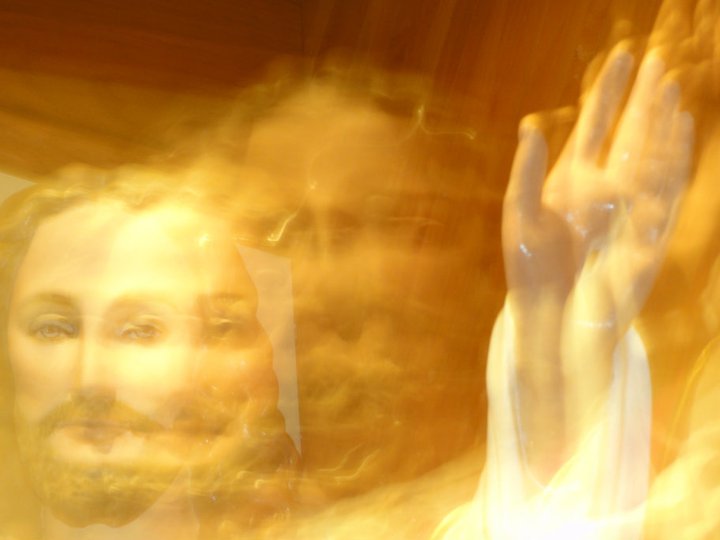
Jesus blurI like for my television programming to be intellectually stimulating. I like to constantly be stretching and growing my mind, so I stay away from things on the History Channel or the Learning Channel and go straight for the meat and potatoes: America’s Funniest Home Videos with an occasional episode or two of Friends. I do watch other things as well that are equally as stimulating. For a while I was on Mythbusters then I moved over to Miami Ink – especially when Kat Von D was on for a while, followed by Deadliest Catch. However, I’ve found one show that I’ve been absolutely hooked on for a while: Ghost Adventures, with my buddies Zak, Nick, and Aaron. Zak is the front man with the weird hair, Nick is the serious one, and Aaron is the one who acts a bit like Shaggy in Scooby Doo.

They’ve got all this really great equipment too for detecting ghosts: digital recorders to capture EVPs – that’s Electronic Voice Phenomenon for you non-ghost believers – night vision cameras, infrared imaging, the works. What is so tragic is that so often the ghosts drain the energy of their cameras, so just when they are about to capture something good like a full body apparition on tape – the camera dies! So they just have to tell you about it instead of showing it to you – I’m so disappointed for them.

The reason I mention this is because of our Gospel reading tonight. Jesus has been dead and in his tomb for three days, yet now he is appearing to the living. Is he a ghost? Is this the full body apparition that Zak, Nick, and Aaron are always talking about, or is it something all together different? The gospel writers are very careful about helping us to understand that what these women are seeing in tonight’s gospel – and for that matter at all the appearances of Jesus following his resurrection – is not a ghost.

For example our Gospel from today said, “Suddenly Jesus met them and said, ‘Greetings!’ And they came to him, took hold of his feet, and worshiped him.” “They took hold of his feet.” All ghost adventuring aside, even the folks in the time of Jesus knew that you could not touch a ghost. In later appearances we are told that others touched him, some walked down the road with him and broke bread with him, and there is the time when he will meet with the disciples on the shore of the sea and have breakfast with them. All of these things occurred after his death and resurrection; and the Gospel writers use these examples to help the reader understand that the Risen Jesus is not a ghost. He is alive.

Following his resurrection we know that he ascended into heaven so that we can no longer see him as he was and for many their response to that event is, “Well isn’t that convenient.” A bit like the Ghost Adventurers’ cameras going dead just as the ghost shows up, leaving only someone’s word that something actually took place. I think the lawyers would say that its all circumstantial evidence.

Perhaps more folks would believe that Jesus is in fact the risen Lord if they could take hold of his feet or have breakfast with him on the shore of the sea. We read in our Gospel tonight, Jesus told Mary, “Tell my brothers to go to Galilee; there they will see me.” Many today would ask, “Where is my Galilee that I might see Him?” You know how I respond to that? Open your eyes. He is all around you. As St. Patrick wrote:

Christ beside me, Christ before me;
Christ behind me, Christ within me;
Christ beneath me, Christ above me;
Christ to right of me, Christ to left of me;
Christ in my lying, my sitting, my rising;
Christ in heart of all who know me,
Christ on tongue of all who meet me,
Christ in eye of all who see me,
Christ in ear of all who hear me.

Open your eyes. You won’t see a ghost. You’ll see the Risen Lord. You’ll see Jesus.