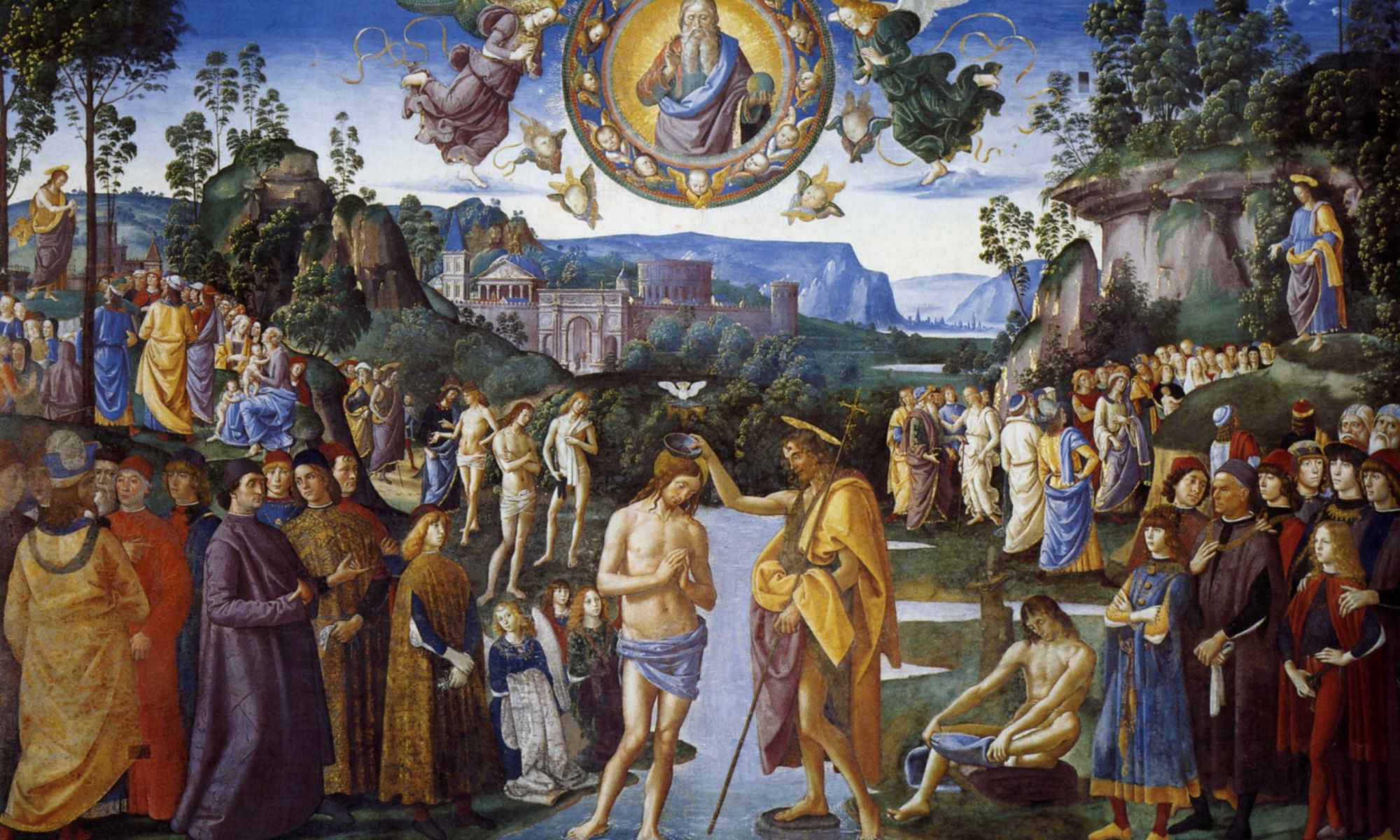
Sermon: Baptism of Our Lord

This 85 year old couple, having been married almost 60 years, had died in a car accident. They had been in good health the last ten years mainly due to her interest in health food, and exercise. When they reached the pearly gates, St. Peter took them to their mansion which was decked out with a beautiful kitchen and master bath suite and Jacuzzi. As they “oohed and aahed” the old man asked Peter how much all this was going to cost. “It’s free,” Peter replied, “this is Heaven.” Next they went out back to survey the championship golf course that the home backed up to. They would have golfing privileges everyday and each week the course changed to a new one representing the great golf courses on earth. The old man asked, “What are the green fees?” Peter’s reply, “This is heaven, you play for free.” Next they went to the club house and saw the lavish buffet lunch with the cuisines of the world laid out. “How much to eat?” asked the old man. “Don’t you understand yet? This is heaven, it is free,” Peter replied with some exasperation. “Well, where are the low fat and low cholesterol tables?” the old man asked timidly. Peter lectured, “That’s the best part, you can eat as much as you like of whatever you like and you never get fat and you never get sick. This is Heaven.” With that the old man went into a fit of anger, throwing down his hat and stomping on it, and shrieking wildly. Peter and his wife both tried to calm him down, asking him what was wrong. The old man looked at his wife and said, “This is all your fault. If it weren’t for your blasted bran muffins and uncountable laps around the mall, I could have been here ten years ago!”

So, how are all those New Year’s resolutions working out for you? Mine seems to be getting more difficult, because instead of losing weight, I’ve already gained an extra few pounds!

Of the top five resolutions, you will almost always find: eating healthier, quit smoking, and getting healthier. I suppose we all want to look better and live healthier, but I would also suggest to you that behind all of these efforts is one single fear. The fear of death. But I’ve got news for you, you can run a hundred miles a day, but you will not outrun death. It will catch you. (Thank you Fr. John for depressing us all this morning! Not my intent, though.)

In the opening chapters of Charlotte Brontë’s Jane Eyre, Mr. Brocklehurst comes to collect Jane from her aunt and uncle’s home and take her to a school for girls. Jane’s aunt, Mrs. Reed, has described Jane to Mr. Brocklehurst as a child with a “tendency for deceit.”

Mr. Brocklehurst, a rather unpleasant man says to Jane, “No sight so sad as that of a naughty child, especially a naughty little girl. Do you know where the wicked go after death?”

“They go to hell,” was Jane’s ready and orthodox answer.

“And what is hell? Can you tell me that?”

“A pit full of fire.”

“And should you like to fall into that pit, and to be burning there for ever?”

“No, sir.”

“What must you do to avoid it?”

Jane deliberated a moment: her answer, when it did come was objectionable: “I must keep in good health and not die.”

I must keep in good health and not die. Even though it is inevitable, like jane, we would like to avoid it, but what Benjamin Franklin said is true, “In this world nothing can be said to be certain, except death and taxes.” Therefore, somewhere in our minds, we accept the inevitability of death and then begin to console ourselves by saying things like, “Dying is just a part of living” and “Death is natural.” But what if I told you that these are just lies? What if I told you that you were not created to die?

Paul wrote in his letter to the Romans, “Just as sin entered the world through one man, and death through sin, and in this way death came to all people, because all sinned.” God did not create death. You were not created to die. It was through our sin that death came into the world. We say with Jane Eyre, “I must keep in good health and not die,” and then make our resolutions to lose weight, quit smoking and all the rest in an attempt to avoid death, because death is not natural. Dying is the most un-natural thing we will ever do, so we fight against it. We may accept it and be reconciled to the fact that it will happen, but every cell of our bodies will reject death’s claim over our lives. And fortunately for us, so does God. God has rejected death’s claim over you and through Christ has restored what was taken through sin.

Again, to the Romans, Paul wrote, “Don’t you know that all of us who were baptized into Christ Jesus were baptized into his death?  We were therefore buried with him through baptism into death in order that, just as Christ was raised from the dead through the glory of the Father, we too may live a new life.”

That ancient serpent holds out his sinful fruit to each of us, and just as Adam and Eve took and ate, so do we. The moment that fateful fruit touches our lips we are dead, but God in His infinite goodness extends to us the one thing that can overcome this sting of death. He extends to us His Son, and through our baptism we are united to Jesus in His death and into His resurrection. Therefore, for us, death is not an end or a destination, it is only something we pass through.

Hear again the words we read earlier that the Lord spoke through the Prophet Isaiah:
Do not fear, for I have redeemed you;
I have called you by name, you are mine.
When you pass through the waters, I will be with you;
and through the rivers, they shall not overwhelm you;
when you walk through fire you shall not be burned,
and the flame shall not consume you.

Jesus’ baptism shows us how we might follow him, and his death provides a way for us to pass through the waters and the fire without being overwhelmed or consumed. One of the great theologians, Hans Urs von Balthasar wrote, “The Church does not dispense the sacrament of baptism in order to acquire for herself an increase in membership but in order to consecrate a human being to God and to communicate to that person the divine gift of birth from God.”

Luke wrote in our Gospel, Now when all the people were baptized, and when Jesus also had been baptized and was praying, the heaven was opened, and the Holy Spirit descended upon him in bodily form like a dove. And a voice came from heaven, “You are my Son, the Beloved; with you I am well pleased.” As we rise from the waters of our own baptism, the voice of God is also heard: “You are my son, my daughter, my beloved; with you I am well pleased.”

Your only real death occurs here—in the waters of baptism—but you do not remain, for through the One born in a manger, the One who was worshipped by shepherds and kings, the one who conquered death once and for all, raises you to new life, consecrating you as sons and daughters of God Most High.

Let us pray: Father in Heaven, when the Spirit came down upon Jesus at His Baptism in the Jordan, You revealed Him as Your own Beloved Son. Keep us, Your children, born of water and the Spirit, faithful to our calling. May we, who share in Your Life as Your children through Baptism, follow in Christ’s path of service to all people. Let us become one in His Sacrifice and hear His Word with faith. May we live as Your children, following the example of Jesus. Amen.

Sermon: Thomas Becket

Thomas Becket and King Henry II were close friends. Even though a deacon in the church, Becket enjoyed a rather worldly life, often going out carousing with the young king. Given there close relationship, Henry believed that he could take a firm grip on the church by appointing his friend as Archbishop of Canterbury; therefore, on June, 2, 1162, Thomas was ordained a priest, in the morning on June 3 he was consecrated a bishop, and that afternoon he was installed as the Archbishop of Canterbury.

However, it was soon clear that Becket’s loyalties had shifted away from Henry to the church and the relationship between the two became strained. This became most evident in an incident where a priest had been accused of murder. At the time, clergy were tried by the church, but Henry wanted such authority under the crown. When the priest was acquitted under the church, Henry was furious and changed the law. From there things deteriorated much more, leading Becket to flee to France in fear for his life.

Eventually Thomas and the king would be somewhat reconciled; however, while Thomas was in exile in France he had excommunicated two bishops in England for giving into the king’s demands, but when he returned to England he refused to lift the excommunication order, which once again infuriated the king. Henry is then reported to have said to four of his knights, “What sluggards, what cowards have I brought up in my court, who care nothing for their allegiance to their lord. Who will rid me of this meddlesome priest.”

The four took these words as a command to go and execute Thomas. They found him at Canterbury Cathedral where they confronted him at the altar of the church. A witness to the events, a monk, Edward Grim wrote, ”The murderers followed him; ‘Absolve’, they cried, ‘and restore to communion those whom you have excommunicated, and restore their powers to those whom you have suspended.’

“He answered, ‘There has been no satisfaction, and I will not absolve them.’

‘Then you shall die,’ they cried, ‘and receive what you deserve.’

‘I am ready,’ he replied, ‘to die for my Lord, that in my blood the Church may obtain liberty and peace. But in the name of Almighty God, I forbid you to hurt my people whether clerk or lay.’

“Then they lay sacrilegious hands on him, pulling and dragging him that they may kill him outside the church, or carry him away a prisoner, as they afterwards confessed. But when he could not be forced away from the pillar, one of them pressed on him and clung to him more closely. Him he pushed off calling him ‘pander’, and saying, ‘Touch me not, Reginald; you owe me fealty and subjection; you and your accomplices act like madmen.’

“The knight, fired with a terrible rage at this severe repulse, waved his sword over the sacred head. ‘No faith’, he cried, ‘nor subjection do I owe you against my fealty to my lord the King.’

And there, inside Canterbury Cathedral, they murdered Thomas. His final words, ‘For the Name of Jesus and the protection of the Church I am ready to embrace death.’

Jesus said, “All men will hate you because of me, but he who stands firm to the end will be saved.”

Albus Dumbledore, Headmaster of Hogwarts School of Witchcraft and Wizardry (Harry Potter character for you muggles) said, “There are all kinds of courage. It takes a great deal of bravery to stand up to our enemies, but a great deal more to stand up to our friends.”

There will be times when we must make a decision between the demands of the world and the demands of God. Thomas Becket shows us how to stand even when the demands of the world are made by our friends. It will not be easy, but through Christ Jesus, we can hold to the faith that is within us and stand firm.

Sermon: Apostolic

Boudreaux and Thibodeaux went hunting and got lost in the woods. When Boudreaux began lamenting their fate, Thibodeaux said, “You know, I heard that the best thing to do if you get lost is to fire three shots in the air.” So they did that, and waited a while. When no rescue party showed up, they fired three more shots. Finally, when there was still no response, Thibodeaux said, “Well, I guess we better fire three more shots.” “OK, if you say so,” said Boudreaux. “But somebody better come soon—we’re about out of arrows!”

One holy catholic and apostolic. We’ve reached the final and fourth mark of the church as described in the Nicene Creed: apostolic.

The apostolic mark of the Church speaks of continuity. It is not a line that goes backward like in a children’s connect the dots puzzle, but a bond, an uninterrupted progression from Jesus and the apostles to us today, made possible through the bishops and the work of all God’s people. It began at the manger in Bethlehem and continues through the witness of every Christian today. However, where one holy and catholic primarily speak about who we are, apostolic speaks mainly about what we do, our work as the Church.

Our work as the Church is summarized nicely in the form of questions that we ask in the Baptismal Covenant: Will you continue in the apostles’ teachings? Will you persevere? Will you seek and serve Christ? Will you strive for justice? As the Church, I believe we do a brilliant job of these things, both individually and corporately. However, although we can always improve, there is one area of our work that we really need to improve. You see, as Episcopalians, we have selective hearing when it comes to the question, “Will you proclaim by word and example the Good News of God in Christ?” As Episcopalians we hear, “Will you proclaim by {mumble mumble} example the Good News in Christ?” It is good to proclaim Christ through our work, but in some cases, it is the equivalent of shooting up arrows and hoping someone will hear you.

An apostolic church is one that has continuity with the past, but it is also one that continues into the future. For that to happen, we must be like those first apostles and proclaim Christ’s message with our deeds, but there are also times when we must speak plainly about our faith.

During this Advent season, we hear God’s word as it speaks about the first and second coming of Jesus. Some will remember our minor prophet’s study when we discussed Joel and how he talked about “the day of the Lord.” Speaking of this day, the Lord said, “I will show portents in the heavens and on the earth, blood and fire and columns of smoke.  The sun shall be turned to darkness, and the moon to blood, before the great and terrible day of the Lord comes.” Yet in the midst of that message of judgment, there was the message of hope, for the Lord adds, “Then everyone who calls on the name of the Lord shall be saved.”

It is the Apostle Paul who quoted this line in his letter to the Romans, “Everyone who calls on the name of the Lord shall be saved.” Paul then adds, “But how are they to call on one in whom they have not believed? And how are they to believe in one of whom they have never heard? And how are they to hear without someone to proclaim him?  And how are they to proclaim him unless they are sent? As it is written, “How beautiful are the feet of those who bring good news!” And, following his resurrection, Jesus said to his apostles, “As the Father has sent me, I am sending you.”

In the movie Gravity, Sandra Bullock plays Dr. Ryan Stone who is aboard the space shuttle when it encounters catastrophic failures (hopefully, I won’t spoil it too much for you if you haven’t seen it). Towards the end, she finds herself alone, with limited oxygen and no way home. She is unable to communicate with mission control on earth, but as she turns the dial, she picks up through the static the voice of a man, Aningang. He can’t hear her, but through her tears she speaks to him: “I’m going to die, Aningang. I mean, we’re all going to die. Everyone knows that. But I’m going to die today… Funny that. To know. And you know what Aningang… I don’t care. I don’t care if I die. I don’t have anything… not anymore. But the thing is… I’m still scared. I’m really scared… No one will mourn me. No one will pray for my soul. Will you mourn me, Aningang? Is it too late to say a prayer? I’d say one for myself, but I have never prayed in my life… no one ever taught me how… No one ever taught me how.”

How would it be to die and to not know how to pray? How would it be to die and not know that there is a God of infinite love? How would it be to die and not know that the God of infinite love, loves you?

Our new Presiding Bishop, Michael Curry, recalls the words of the angel at the empty tomb of Jesus, “This Jesus of Nazareth whom you seek, he is not here, he has been raised as he said he would be and he has now gone ahead of you to Galilee.  There you will see him.  It is in Galilee that the Risen Lord will be found and seen for he has gone ahead of us.”

Bishop Curry goes on to say,

“Galilee.  Which is a way of talking about the world.

Galilee.

In the streets of the city.

Galilee.

In our rural communities.

Galilee in our hospitals.

Galilee in our office places.

Galilee where God’s children live and dwell there.

In Galilee you will meet the living Christ for He has already gone ahead of you.

The church can no longer wait for its congregation to come to it, the church must go where the congregation is.

Now is our time to go.  To go into the world to share the good news of God and Jesus Christ.  To go into the world and help to be agents and instruments of God’s reconciliation.  To go into the world, let the world know that there is a God who loves us, a God who will not let us go, and that that love can set us all free.

Bishop Curry concludes, “This is the Jesus Movement, and we are The Episcopal Church, the Episcopal branch of Jesus’ movement in this world.”

We are one holy catholic and apostolic church. As the Church, we stand at the foot of the cross, made complete in one flesh with Jesus, bound together in love, and made holy by means of grace, and our continuing mission has been firmly established.

Jesus said, “As the Father has sent me, I am sending you.” He sends us all to proclaim by word and example the Good News of God in Christ. You are the Episcopal branch of Jesus’ movement in Enid. Go! Go and make disciples, baptizing them in the name of the Father and of the Son and of the Holy Spirit, and teaching them to obey everything that Jesus has commanded us. And remember, He is with us always, to the very end of the age.

Let us pray—Everliving God, whose will it is that all should come to you through your Son Jesus Christ: Inspire our witness to him, that all may know the power of his forgiveness and the hope of his resurrection; who lives and reigns with you and the Holy Spirit, one God, now and for ever. Amen.

Follow this link to see Bishop Curry’s full message.

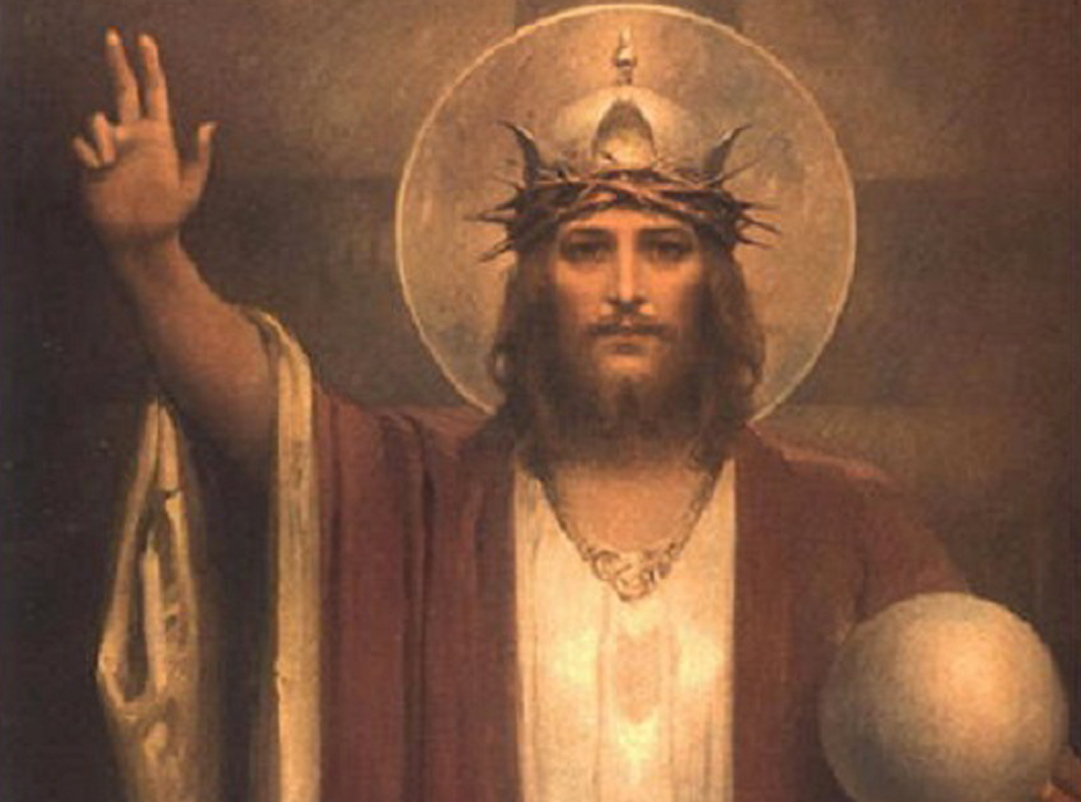
Sermon: Christ the King

A medieval astrologer prophesied to a king that his favorite mistress would soon die. Sure enough, the woman died a short time later. The king was outraged at the astrologer, certain that his prophecy had brought about the woman’s death.

He summoned the astrologer and commanded him: “Prophecy, tell me when you will die!”

The astrologer realized that the king was planning to kill him immediately, no matter what answer he gave. “I do not know when I will die,” he answered finally. “I only know that whenever I die, the king will die three days later.”

Henry Randall said that Henry VIII was a “lying, greedy and idiotic king, an beetle and a pile of dung, the spawn of a snake, a chicken, a lying toad mixed all together by Satan’s spawn.” He may have said it, but I would wager a lifetimes salary that he would never have said it to Henry’s face. Whether king or queen, history tells us that the monarchs have always gotten what they wanted. Disappointing the monarch could cost you everything. Angering the monarch could cost you your life.

Jesus is correct when he says, “The kings of the Gentiles lord it over them; and those who exercise authority over them call themselves Benefactors.”

The monarchs of this earth – with a few exceptions – have mostly proven to be scoundrels and if it were not for their bloodlines that allowed them to ascend the throne – or dare I say, their ability to win an election – we would likely want nothing to do with them.

Today, however, we celebrate our King. His titles are numerous: King of Kings, Lord of Lords, Alpha and Omega, The Light of the World, The Word of God, The Bright Morning Star, The Great I Am. The list goes on, but simply, our King is the Messiah, the Christ – Jesus, and today we celebrate his Reign and Kingship.

In our Gospel, “Pilate asked him, ‘So you are a king?’ Jesus answered, ‘You say that I am a king. For this I was born, and for this I came into the world, to testify to the truth.’” Jesus confirms that he is a King, but also states, “My kingdom is not from this world. If my kingdom were from this world, my followers would be fighting to keep me from being handed over to the Jews. But as it is, my kingdom is not from here.” Following this exchange, Pilate finds no basis for a charge against Jesus and seeks to release him, but as we know, Jesus will eventually be turned over to be crucified.

So we have Jesus confirming the fact that he is a King and in our hearts, by following him, we confirm that he is our King, our Lord and Master. As his followers, we declare ourselves his disciples, but to be a disciple of Jesus is more than a declaration – “I will follow you!” – anyone can do that. It is also more than just learning what He teaches, because even the devil has accomplished that. To declare ourselves disciples of Jesus, we must be like him every respect. We must have his Spirit within us, we must have his flesh as our flesh, guiding our every step and thought. That might seem easy at first glance. He’s a king and it is good to be king. Yet, as the Lord spoke through the Prophet Isaiah:

“For My thoughts are not your thoughts,
Nor are your ways My ways,” says the Lord.
“For as the heavens are higher than the earth,
So are My ways higher than your ways,
And My thoughts than your thoughts.”

And Jesus confirms this, for as he states, “The kings of the Gentiles lord it over them… But… but you are not to be like that. Instead, the greatest among you should be like the youngest, and the one who rules like the one who serves. For who is greater, the one who is at the table or the one who serves? Is it not the one who is at the table? But I am among you as one who serves.”

The passage “one who serves” is from the Greek διάκονος, where we get the word “deacon.” We often think of “one who serves” as one who waits on another person, but a broader understanding is to say, “one who ministers.” One who attends to the needs of others, and the “need” that Jesus was attending to by serving us was the need for the salvation of our souls. That serving, as we know, led to the cross on Calvary and our Kings’ death. And as His true disciples, we are to be like him every respect.

The life and death Jesus calls us to is not for weaklings. It’s not just about the exterior – “I didn’t kill anyone today, so I must be in good shape.” It is not about a list of do’s and don’ts. It is not just about looking the part, for anyone can do that.

A priest tells the story of the time during the 70’s that he was living in a monastery in New York. It seems that while living there he had numerous millionaire friends who enjoyed his company and would invite him out. He recalls on one occasion being invited to a swank restaurant and a Broadway play. During the intermission, he and his friends went out for some fresh air and engaged in a rather highbrow conversation regarding the play.

As he was going about trying to impress his friends with his intellectual savvy he noticed someone walking toward him who was “not one of the beautiful people.” Her clothes were a bit tattered, her shoes worn, and her nylons had holes. As she approached he also noticed that she was peddling the Variety magazine for $0.75, so in a gesture of extreme generosity he handed her a dollar and casually waved her away, eager to wow his friends a bit more.

And then she said, “Father?” The priest writes, “In those days, I knew I couldn’t distinguish myself by my virtues, so I distinguished myself by my clothing; I always wore the collar, ‘Father, could I talk to you a minute?’ I snapped, ‘What? Can’t you see I’m busy? Do you make a habit of interrupting people in the middle of a conversation? Wait over there and I’ll speak to you when I’m done.’ She whispered, ‘Jesus wouldn’t talk to Mary Magdalene like that.’ And then she was gone.”

Later, he wondered what this young woman would have thought if she had wandered into his church the following Sunday to hear him preach on the love of God. He asked, “How could she believe in the love of a God she can’t see when she couldn’t find even a trace of love in the eyes of a brother wearing a clerical collar whom she could see?” He noted, “A shriveled humanity has a shrunken capacity for receiving the rays of God’s love.” (From The Furious Longing of God, Brennan Manning)

There are many who come up to us everyday and ask, “Could I talk to you a minute?” They ask it verbally and nonverbally. They ask it with their lips and they ask it with their tears. And when they ask, they are not asking us to tell them to do this and to not do that. When they ask, they are asking us to see them as one made in God’s image, and perhaps for only a few moments, to love them.

As his disciples, Jesus calls us to serve as he served and to minister as he ministered. It is a call to live the life of a king. The King of Kings. St. Josemaría Escrivá writes, “How little a life is to offer to God!” Offer your life to the King and enter his courts, for the words the Psalmist spoke of the Lord are true:

A day in your courts is better
than a thousand elsewhere.
I would rather be a doorkeeper in the house of my God
than live in the tents of wickedness.
For the Lord God is a sun and shield;
he bestows favor and honor.
No good thing does the Lord withhold
from those who walk uprightly.
O Lord of hosts,
happy is everyone who trusts in you.

Serve the King as the King served you, and walk in His eternal courts.

“To him who loves us and freed us from our sins by his blood, and made us to be a kingdom, priests serving his God and Father, to him be glory and dominion forever and ever. Amen.”

The Imitation of Christ Project: Bk. 3, Ch. 11

Screen Shot 2015-11-18 at 11.35.40 AM

THE LONGINGS OF OUR HEARTS MUST BE EXAMINED AND MODERATED –

THE VOICE OF CHRIST

MY CHILD, it is necessary for you to learn many things which you have not yet learned well.

THE DISCIPLE

What are they, Lord?

THE VOICE OF CHRIST

That you conform your desires entirely according to My good pleasure, and be not a lover of self but an earnest doer of My will. Desires very often inflame you and drive you madly on, but consider whether you act for My honor, or for your own advantage. If I am the cause, you will be well content with whatever I ordain. If, on the other hand, any self-seeking lurk in you, it troubles you and weighs you down. Take care, then, that you do not rely too much on preconceived desire that has no reference to Me, lest you repent later on and be displeased with what at first pleased you and which you desired as being for the best. Not every desire which seems good should be followed immediately, nor, on the other hand, should every contrary affection be at once rejected.

It is sometimes well to use a little restraint even in good desires and inclinations, lest through too much eagerness you bring upon yourself distraction of mind; lest through your lack of discipline you create scandal for others; or lest you be suddenly upset and fall because of resistance from others. Sometimes, however, you must use violence and resist your sensual appetite bravely. You must pay no attention to what the flesh does or does not desire, taking pains that it be subjected, even by force, to the spirit. And it should be chastised and forced to remain in subjection until it is prepared for anything and is taught to be satisfied with little, to take pleasure in simple things, and not to murmur against inconveniences.

Sermon: Proper 27 / Pentecost 24 RCL B – “Selfless”

There was a boat way out in the Pacific ocean that encountered a horrendous storm in the middle of the night and the boat ended up being capsized. Near by was an island and when day break came there were two men lying on the beach – the only survivors. As they pulled themselves together they discussed what they should do and concluded that they should pray – go figure.

However, the first man got the idea that perhaps one of them might be more righteous than the other and that God might hear the prayers of one over the other, but maybe not both if they stayed together, so the first man devised the plan where they would split the island and each was to stay on his side without coming on the others. The second man calmly agreed, they shook hands, and went their separate ways.

On the first night, the first man prayed for something to eat. The following morning he came into the most remarkable grove of fruit trees imaginable, everything a person needed to keep alive. Not only that, a small cove on his side of the island provided an abundance of fish that he easily caught with his bare hands. For the second man there was nothing. He did find an old piece of nearly rotten fruit on the beach that he managed to choke down, but it was hardly enough to keep him alive.

Several weeks later the first man decided that he did not want to be alone on the island, so he prayed that the Lord would send him a wife. That night there was another shipwreck and the lone survivor was a beautiful woman that washed up on the shore. They were perfect companions and got along famously. For the second man, again nothing. He couldn’t even find a volleyball that he could name Wilson. Perfectly dreadful were his conditions.

The months went by and the first man and his wife decided they might try and pray to be rescued and wouldn’t you know it, the following morning a boat floated up in the cove. It was all gassed up and ready to go, so they swam out to it, fired it up, and headed off. Suddenly there was a voice from heaven, “Are you going to leave the other man behind?” “Sure,” said the first man, “Look at him. He is obviously some heathen. Here I have prayed and received everything I asked for and he has received nothing. He must be some great sinner to be in such rotten shape. I see no need to save him.” “On the contrary, he has also had everyone of his prayers answered, even though he prays the same thing everyday, and if it weren’t for his prayers – none of yours would have been answered.” “Oh,” says the first man, “what was his prayer?” “He prayed that all your prayers would be answered.”

These days, with regard to self, we hear many terms. There is of course the selfie, but there are things like self-care, self-esteem, and self-love, but a “self” word that I heard while growing up seems to have fallen out of favor, because it means taking any of these “self” concepts too far, and these days much seems to be about doing just that. The word is “selfish.” It occurs when self, I, becomes the most important object of our affections and actions. There is nothing wrong with loving self – “Love your neighbor as you love yourself” – but it seems we can sometimes forget that first part of loving our neighbor and become selfish, where we always place our own needs, not only ahead of those of others, but instead of the needs of others.

Today, we read the end of the Book of Ruth, when Ruth takes Boaz as her husband and by doing so cares – yes, for herself – but also for Naomi, her mother-in-law. Yet the story does not have a happy beginning.

Due to a famine in the land, Naomi, her husband, and two sons moved from Israel to Moab. The sons married Moabite (gentile) women, Orpah and Ruth. Yet, Naomi’s husband and two sons died, leaving the women with no real way to care for themselves. So Naomi told her daughter-in-laws to return to their people where they could find new husbands and be cared for. (Sorry, ladies, at the time, a woman needed a husband in order to care for her.) Orpah returned, but Ruth said to Naomi, “Do not urge me to leave you or to return from following you. For where you go I will go, and where you lodge I will lodge. Your people shall be my people, and your God my God.  Where you die I will die, and there will I be buried. May the Lord do so to me and more also if anything but death parts me from you.”

Those are words that you may sometimes hear at a wedding, but here Ruth is vowing herself to Naomi and is looking outside of her own needs to those of another. Orpah was not being selfish by returning to her people, but Ruth was being selfless, by considering how her actions would effect Naomi.
Through her selfless actions and love of Naomi, Ruth was able to gain a husband, Boaz, and provide for the needs of them both.

In Matthew’s Gospel, we are provided with the genealogy of Jesus, and there are very few women mentioned, but Ruth is one of them, as she is the great-grandmother of King David, whom Jesus descended from. Ruth is memorialized and plays a part in the salvation of us all because of her selfless act.

Today in our Gospel, Jesus is witness to another selfless act, as the widow places all she has in the temple treasury. Jesus said of her, “Truly I tell you, this poor widow has put in more than all those who are contributing to the treasury. For all of them have contributed out of their abundance; but she out of her poverty has put in everything she had, all she had to live on.”

At the time in the Temple complex, there were thirteen jars used for collecting various offerings. Some were for the upkeep of the temple, others were to pay for sacrifices, and still others were used for alms, money used for the care of others. The context of our Gospel seems to imply that the woman gave not for herself, but for others. Not only did she give, but she gave selflessly everything she had. Although not named like Ruth, the widow with her two copper pennies is also memorialized for her selfless act.

A young brother and sister both have a very rare blood type. It is determined that the sister will need an operation and will likely need a transfusion. Because of the rare blood type, they turn to the young boy and ask him if he would be willing to give blood for his sister. He thinks about it for only a moment and agrees. As the procedure begins the young boy is nervous, but brave. Because of his age the doctors keep a close eye on him and notice that he is quietly crying. When asked if he is in pain, he says, “No.” But then asked, “How soon before I die.”

Jesus said, “This is my commandment, that you love one another as I have loved you.  Greater love has no one than this, that someone lay down his life for his friends.  You are my friends if you do what I command you.”

There are many ways to “lay down ones life,” but all of them require that we first lay ourselves down to lay down and set aside our own needs for the needs of others and to allow the Word of God to work through us. In The Imitation of Christ, Thomas à Kempis writes, “He does much who loves much. He does much who does a thing well. He does well who serves the common good rather than his own interests.”

As we seek to serve Christ, let us learn to be selfless in our giving and look to the common good. St. Francis of Assisi writes, “Above all the grace and the gifts that Christ gives to his beloved is that of overcoming self.” Ask for this gift, this grace, so that you may love, not just self, but all.

Let us pray: O Dearly beloved Word of God, teach us to be generous, to serve You as You deserve, to give without counting the cost, to fight without fretting at our wounds, to labor without seeking rest, to spend ourselves without looking for any reward other than that of knowing that we do Your holy will. In Jesus Name we pray. Amen.

Sermon: Proper 19 / Pentecost 16 RCL B – “Cross Bearing”

Communications has one major problem: language. Not surprising when you consider words can have multiple definitions (“set” has 464 and “run” has 395) Then there are the words we use or misuse or just the occasional typo. It would seem that church bulletins provide endless examples of all these problems. Actual church announcements:

The outreach committee has enlisted 25 visitors to make calls on people who are not afflicted with any church.

Low Self-Esteem Support Group will meet Thursday at 7 p.m. Please use the back door.

At the evening service tonight, the sermon topic will be “What is hell?” Come early and listen to our choir practice.

The sermon this morning: Jesus Walks on the Water. The sermon tonight: Searching for Jesus.

The church will host an evening of fine dining, superb entertainment, and gracious hostility.

During the absence of our pastor, we enjoyed the rare privilege of hearing a good sermon when J. F. Stubbs supplied our pulpit.

Misinterpretation of the words we use can also lead to problems in communication. There is a legend regarding J. Edgar Hoover who ran the FBI. Apparently he insisted that all correspondence to him have wide borders around the text so that he could write notes in the margins. In an effort to cut some costs and impress his boss, a supply clerk reduced the size of the office memo paper. One of the new memo sheets soon ended up on Hoover’s desk. Hoover took one look at it, determined he didn’t like the size because it limited the margin width, so scribbled the note, “Watch the borders!” The memo was passed on through the office. Legend has it that for the next six weeks, it was extremely difficult to enter the United States by road from either Mexico or Canada.

In the words of Cool Hand Luke, “What we got here is a failure to communicate.”

Now, if we have this much trouble getting bulletin announcements right or expressing our dislike for the width of the border on a page, is it any wonder that we have such difficulty and so many differences of opinion when it comes to interpreting Holy Scripture?

Paul wrote in his letter to the Corinthians, “For by grace you have been saved through faith, and this is not your own doing; it is the gift of God— not the result of works, so that no one may boast.” Yet last week in James’ Epistle we read, “So faith by itself, if it has no works, is dead.” Which is it? Is one right and the other wrong or are they both right, and if so how? Bring them up in a room full of theologians and watch the fun begin.

Here is another you hear all the time: “God will not place more on you than you can bear.” Most are surprised to learn that this particular statement is no where in Scripture. The closest we have is speaking about sin and temptation from 1 Corinthians, which says, “God is faithful, and he will not let you be tested beyond your strength, but with the testing he will also provide the way out so that you may be able to endure it.” But we’ve taken this verse to mean God won’t overburden us in all areas of our lives. Truthfully, I don’t believe that God will, but I know for a fact that the devil is more than happy to pour it on so thick that you can’t even breathe. So if you’re having a really bad day and someone says, “God won’t give you more than you can handle,” then smack ‘em one and see how well they handle that. No, no, no! Just politely tell them they’re misinterpreting the Scriptures.

Why all this talk on language and miscommunication? Because today we have another perfect example. Not only on the part of Peter, but also for us, because what we often think is being said, is not really the case.

Jesus and his disciples have been traveling near the coast, but now have made a turn inland. As they are traveling, near Caesarea Philippi, Jesus asked his disciples, “Who do people say that I am?” They answered him, “John the Baptist; and others, Elijah; and still others, one of the prophets.” The answers were across the board. People didn’t really know who he was. Go out on the streets of Enid and ask the same question, “Who is Jesus?” and you’ll encounter a similar result. Jesus is God. Prophet. King. Hoax. Madman. Lie. Everything from a figment of of the Gospel writers’ imaginations to the Creator of the Heavens and Earth. Too bad Gallop surveys weren’t around in the time of Jesus, we could have narrowed it down to percentages of each, yet even if we could, unlike the world today, Jesus would not have altered himself or his message in order to gain a higher approval rating. The same yesterday, today, and tomorrow. That type of information is irrelevant to him and his next question to his disciples proves that: “But who do you say that I am?” I don’t care what the people or the surveys say, I want to know who you think that I am. The message of salvation is not dependent upon what is popular, instead it is dependent upon each individual response. Peter answered, “You are the Messiah.” Peter got a gold star for his answer, but here is the first language issue. Peter interpreted “Messiah” as one who would be like King David and save them from their temporal / earthly enemies. Jesus, as we know, was concerned about the soul and saving us from our eternal enemy death, the result of sin. So when Jesus began talking about dying, Peter misunderstood. “Whoa there JC! This can’t happen and I’ll be danged if I’m going to let it, because if you die, then we have no King. We’re back where we started from.” Jesus rebukes him for the reason stated, “… you are setting your mind not on divine / eternal things but on human / temporal things.”

Jesus then turns from his disciples and speaks to the crowd that is gathered around him, “If any want to become my followers, let them deny themselves and take up their cross and follow me.” Perhaps in the time of Jesus they understood what he was talking about, but it seems that many times we misinterpret this saying of Jesus.

Someone has a difficult burden to bear. A job, an illness, a task. Something that weighs on them heavily and requires great strength and perseverance to accomplish. Another person comments on how difficult it must be. The response, “No, it’s not easy, but it’s my cross to bear.”

Another has a person in their life that through choice or relation presents various longterm difficulties. “You are such a saint for giving so much of yourself for them.” And in either true or false humility the response, “We all have our cross to bear.”

The difficult circumstances and burdens in our lives are not the cross we have to bear. These are the things in our lives that we call on Jesus to assist us with. These are the things that we as a Christian people help one another with. Those persons in our lives that present difficulties are not our crosses either. These are the ones we are called to love as we love ourselves.

The cross that Jesus calls us to take up has a very specific purpose, which has nothing to do with the circumstances of our lives or other people. You see, the cross we take up is for us, so that we – in the words of Paul – might be “crucified with Christ.” Paul writes, “We know that our old self was crucified with him so that the sinful body might be destroyed, and we might no longer be enslaved to sin.  For he who has died is freed from sin.  But if we have died with Christ, we believe that we shall also live with him.”

Reflecting on this verse in the Cost of Discipleship, Dietrich Bonhoeffer wrote, “When Christ calls a man, he bids him come and die.”

The language of the Bible can at times be confusing and difficult to understand. By responding to the trials and tribulations in our lives by saying, “This is my cross to bear,” is one of the ways we can confuse what Jesus said. “This is my cross to bear,” is in effect saying, “I will define my cross. I will assign what it is, how much it will weigh, and how far I am prepared to carry it,” instead of allowing God to use that cross for the purpose it was designed. When Jesus says, “If any want to become my followers, let them deny themselves and take up their cross and follow me,” he is asking us to take up our cross and follow him to that hill outside of Jerusalem to be crucified with him, so that we may die to self and live for God. By doing so, your life does not end. It begins. There is no confusion in Jesus’ message on this point, for he says plainly, “I came that they may have life, and have it abundantly.”

Let us pray: Most gracious and ever loving Father, we pray that you give us the strength, courage, wisdom, and will to follow where you have led the way. Through the inspiration of the Holy Spirit, direct our steps that we may be lights in this world to guide and direct others to your most loving Son, in whose Name we pray. Amen.

Sermon: Bartholomew

From Paul’s first letter to the church at Corinth:

I think that God has exhibited us apostles as last of all, as though sentenced to death, because we have become a spectacle to the world, to angels and to mortals. We are fools for the sake of Christ, but you are wise in Christ. We are weak, but you are strong. You are held in honor, but we in disrepute. To the present hour we are hungry and thirsty, we are poorly clothed and beaten and homeless, and we grow weary from the work of our own hands. When reviled, we bless; when persecuted, we endure; when slandered, we speak kindly. We have become like the rubbish of the world, the dregs of all things, to this very day.

I don’t know many who can name the twelve apostles who went out into the world after Jesus died – I don’t know that I could do it – but what they have accomplished is nothing less than a miracle. We are here today worshiping in this Chapel because of what they began 2,000 years ago. Yet, in their time, they were not highly thought of by the masses and were most certainly not treated well. Paul’s description from above is very accurate.

Their lives ended violently. With the exception of perhaps John, they were all put to death for the faith. “How” they were put to death reads something like a Stephen King novel – spears, swords, boiling oil, crucifixions – on and on. In the icons of Bartholomew, he is often seen holding a knife, because it is believed that he was flayed alive, but not before he had accomplished the work that Christ had commissioned him to do.

Certain sources indicate that there is a lost Gospel of Bartholomew. In addition, the Roman historian Eusebius reports that when others visited India, between 150 and 200, they “found there ‘the Gospel according to Matthew’ in Hebrew, which had been left behind by ‘Bartholomew, one of the Apostles.’”

Jesus said in our Gospel reading today, “The kings of the Gentiles lord it over them; and those in authority over them are called benefactors. But not so with you; rather the greatest among you must become like the youngest, and the leader like one who serves. For who is greater, the one who is at the table or the one who serves? Is it not the one at the table? But I am among you as one who serves.”

Bartholomew and the other Apostles were not looking to gain fame and fortune. There sole intent was to be among us as ones who serve. Ones who through passion and sacrifice served the Gospel.

Also in his letter to the Corinthians, Paul writes, “Now you are the body of Christ, and each one of you is a part of it.  And God has placed in the church first of all apostles, second prophets, third teachers, then miracles, then gifts of healing, of helping, of guidance, and of different kinds of tongues.  Are all apostles? Are all prophets? Are all teachers? Do all work miracles?  Do all have gifts of healing? Do all speak in tongues? Do all interpret?”

Then and now, the answer to Paul’s questions is “No.” Not all of us are Apostles or prophets. Not all of us are Bartholomew’s who go to India to preach the Gospel, but we all have God given gifts. Gifts that have been given to us by God to serve the Gospel. Gifts that should be used as passionately and sacrificially as Bartholomew and the others used theirs.

What gift is God calling  you to use for the sake of the Gospel?

The Imitation of Christ Project: Bk. 3, Ch. 8

IOC 3.8

SELF-ABASEMENT IN THE SIGHT OF GOD –

THE DISCIPLE

I WILL speak to my Lord, I who am but dust and ashes. If I consider myself anything more than this, behold You stand against me, and my sins bear witness to the truth which I cannot contradict. If I abase myself, however, if I humble myself to nothingness, if I shrink from all self-esteem and account myself as the dust which I am, Your grace will favor me, Your light will enshroud my heart, and all self-esteem, no matter how little, will sink in the depths of my nothingness to perish forever.

It is there You show me to myself — what I am, what I have been, and what I am coming to; for I am nothing and I did not know it. Left to myself, I am nothing but total weakness. But if You look upon me for an instant, I am at once made strong and filled with new joy. Great wonder it is that I, who of my own weight always sink to the depths, am so suddenly lifted up, and so graciously embraced by You.

It is Your love that does this, graciously upholding me, supporting me in so many necessities, guarding me from so many grave dangers, and snatching me, as I may truly say, from evils without number. Indeed, by loving myself badly I lost myself; by seeking only You and by truly loving You I have found both myself and You, and by that love I have reduced myself more profoundly to nothing. For You, O sweetest Lord, deal with me above all my merits and above all that I dare to hope or ask.

May You be blessed, my God, for although I am unworthy of any benefits, yet Your nobility and infinite goodness never cease to do good even for those who are ungrateful and far from You. Convert us to You, that we may be thankful, humble, and devout, for You are our salvation, our courage, and our strength.