Sermon: Proper 13 / Pentecost 10 RCL B – “Never Satisfied?”

Brennan Manning tells a wonderful story about Esther Schwartz – a Jewish woman – and her three-year-old grandson, Jacob. She was planning a trip to the beach with her precious Jacob, so she purchased him a canary yellow sun hat so that his beautiful little face would not get sunburned. She also got him a little pail and shovel so that he could play in the sand. The day arrives and they head to the beach. She marvels over little Jacob as he carefully picks the sand up with his little plastic shovel and puts it into the bucket. In her heart she prays, “Oh, Yahweh, thank you so much for Jacob.” Just then a tremendous wave comes along, picks up her precious Jacob – pail, shovel, canary yellow hat and all – and washes him out to sea. Esther Schwartz was very upset. She yells up at God, “Who do You think You are? Do You know who I am? I am Esther Schwartz. My husband, Solomon Schwartz, is a physician, and my son, Billy Schwartz, is a dentist. How dare you do that?” At that moment a second huge wave crashes in washing little precious Jacob, pail and shovel, right back on shore at Esther’s feet. She smiled down at her grandson, then looked to heaven with her hands on her hips and shouted, “He had a canary yellow hat! Where’s the hat?”

Do you think God ever looks down from Heaven and wants to shout, “You people are never satisfied!”

The Israelites had been slaves to the Egyptians for four hundred years before Moses came along and said to Pharaoh, “Let my people go.” Yet, even though they received their freedom, when they got out in the desert there was one complaint after another. The water was bitter, so God had Moses throw a piece of wood into it and the water became sweet. There was no meat to eat, so they complained to Moses, “If only we had died by the hand of the Lord in the land of Egypt, when we sat by pots of meat and ate our fill of bread; for you have brought us out into this wilderness to kill this whole assembly with hunger.” God heard their cry and sent them quail and manna from Heaven, the bread of angels. Yet the people continued to complain. The Lord knew they needed bread, meat and water; and He would continue to provide for them just as He had in the past, yet the people grumbled?

Then there was the time that the Lord wasn’t acting fast enough for them. Moses had gone up the mountain to receive the Ten Commandments and when he didn’t return, they said to Aaron, “Come, make gods for us, who shall go before us; as for this Moses, the man who brought us up out of the land of Egypt, we do not know what has become of him.” Enter the golden calf. Not only were they not satisfied with the things that the Lord had done for them, they weren’t even satisfied with the Lord Himself.

Today we read about the sin of King David. We’ve discussed this one before. David sees Bathsheba, the wife of Uriah. David desires her, so he conspires to have Uriah killed. He succeeds and takes Bathsheba as his wife. The Lord, speaking through the prophet Nathan says to David, “I anointed you king over Israel, and I rescued you from the hand of Saul; I gave you your master’s house, and your master’s wives into your bosom, and gave you the house of Israel and of Judah; and if that had been too little, I would have added as much more. Why have you despised the word of the LORD, to do what is evil in his sight?” I did so much for you, why weren’t you satisfied?

In both cases, the Israelites in the desert and David with Bathsheba, their lack of being satisfied with what God had already provided and their desire for more, led them to complaining and sin. The Psalmist says:

Take delight in the Lord,
and he will give you the desires of your heart.
Commit your way to the Lord;
trust in him, and he will act….
Be still before the Lord, and wait patiently for him.

Yet, when God refused to give them what they wanted, they sought to satisfy those desires themselves. I’m glad we’re not like them! I wish that were true. Unfortunately, I think there is a little complaining in us all.

Jesus tells us that our Father in Heaven knows our needs even before we ask. Even so, he tells us not to hesitate in asking, going on to say, “Whatever things you ask in prayer, believing, you will receive.” And again, “How much more will your Father who is in heaven give good things to those who ask Him!” However, even though we may receive, even though we may have all that we need, even though God has provided for us in the past, we may still complain.

Johann Wolfgang von Goethe wrote in The Sorrows of Young Werther, “A dim vastness is spread before our souls; the perceptions of our mind are as obscure as those of our vision; and we desire earnestly to surrender up our whole being, that it may be filled with the complete and perfect bliss of one glorious emotion. But alas! when we have attained our object, when the distant ‘there’ becomes the present ‘here,’ all is changed; we are as poor and circumscribed as ever, and our souls still languish for unattainable happiness.” Even when our desires are fulfilled, we immediately start looking for more.

A band that was around throughout the 90’s, “The The” – Yes, that’s their name! – “The The,” wrote the song, True Happiness this Way Lies. A bit of the lyrics:

Baby!… I’ve got my sight set on you
And someday… you’ll come my way.
But when you put your arms around me
I’ll be looking over your shoulder for something new.

Any truth in that?

So Fr. John, what is the problem? Why am I never satisfied? Why am I always looking for more? Answer: Because you are looking for bread that will only fill your stomach. You are looking for something that will only satisfy you for a few hours instead of seeking that which will satisfy you for all eternity.

The day before our Gospel reading is the feeding of the 5,000. It is this group that has followed Jesus across the dangerous sea, but they have followed him, not because He is the Lord and not because He has offered them salvation. They have followed Him because He may provide some immediate, but temporary satisfaction. He even calls them out saying, “Very truly, I tell you, you are looking for me, not because you saw signs, but because you ate your fill of the loaves.” If we seek Jesus with the same motivation, immediate and temporary satisfaction, we will most always be disappointed.

To be satisfied, we seek Jesus for love of Him, not for the love of what he can do for us. Yes! Ask for whatever you will. He wants you to, but don’t love Him for what He does for you, because if He doesn’t satisfy that immediate and temporary desire, then you will complain against Him. Instead, love Him for who He is. Consider these words of Thomas a Kempis from The Imitation of Christ, “The wise lover regards not so much the gift of Him Who loves as the love of Him Who gives. He regards the affection of the Giver rather than the value of the gift, and sets his Beloved above all gifts. The noble lover does not rest in the gift, but in Jesus who is above every gift.” Archbishop Michael Ramsay picked up this same thought in his work Sacred and Secular. He wrote, “the gift must not be loved more than the Giver.”

Our relationship with God, our love of God – Father, Son and Holy Spirit – is not based on those gifts that he may give us, instead our love for God is based purely on the fact that he is God. He has already given us that which we are in most desperate need of: Eternal Life with Him.

Jesus said, “I am the bread of life. Whoever comes to me will never be hungry, and whoever believes in me will never be thirsty.” “Do not work for the food that perishes, but for the food that endures for eternal life, which the Son of Man will give you.”

It is in tasting Jesus that you will be satisfied.

St. Francis Xavier wrote a beautiful hymn, My God, I Love You. A translation of his words serve as our prayer. Let us pray:

My God, I love You; not because I hope for heaven,
Nor because those who do not love You are lost eternally.

You, my Jesus, You embraced me upon the cross;
For me You bore the nails, and spear, and manifold disgrace,
And griefs and torments numberless, and sweat of agony;
Yes, death itself; and all for me who was Your enemy.

Then why, Blessed Jesus Christ, should I not love You well?

Not for the sake of winning heaven, nor of escaping hell;
Not from the hope of gaining anything, not seeking a reward;
But as You have loved me, O ever-loving Lord.

So would I love You, dearest Lord, and in Your praise will sing;
Solely because You are my God, and my most loving King. Amen.

Sermon: Proper 12 / Pentecost 9 RCL B – “Do Not be Afraid”

God is sitting in Heaven when a scientist says to Him, “Lord, we don’t need you anymore. Science has finally figured out a way to create life out of nothing. In other words, we can now do what you did in the beginning.”

“Oh, is that so? Tell me,” replies God.

“Well,” says the scientist, “we can take dirt and form it into the likeness of You and breathe life into it, thus creating man.”

“Well, that’s interesting. Show Me. ”

So the scientist bends down to the earth and starts to form the soil.

“Oh no, no, no,” interrupts God. “Get your own dirt.”

In the beginning. In the beginning when God created would have been something amazing to see. I think it would have been something truly beyond our abilities to imagine or even comprehend. Yet, that has not stopped us from trying. Last week we did a 31,000 miles per hour drive by of Pluto. The New Horizons space probe traveled 3 billion miles on its journey to get there and it takes 4.5 hours for a signal to reach earth. You thought your internet connection was slow. How big is Pluto? If earth were the size of a basketball, Pluto would be about the size of a golfball. The universe is one of those situations where the more we know, the less we know.

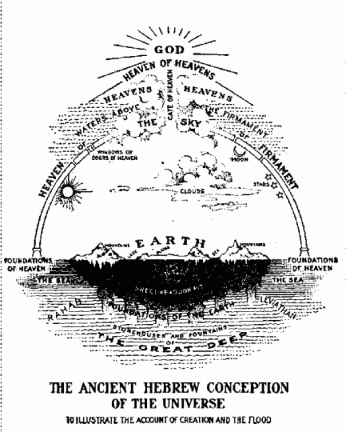
When the author of Genesis began writing his understanding of creation, he did not have the scientific knowledge that we have today, but he did have his own cosmology. His own understanding of the universe, which a careful and imaginative reading of Genesis can reveal.

Hebrew conception of universeThis cosmology can be demonstrated best by taking a bowl, turning it upside down, and pressing it down in the shallow end of a swimming pool. Imagine, instead of floating up, that this bowl would rest on pillars coming up from the bottom of the pool. Then, imagine a disk and place it inside the air pocket created by the bowl, and have it also supported by pillars. That disk is surrounded by water on all sides. Therefore, the disk is the dry land and if you were to look up, essentially looking up at the inside of the bowl, you would see the firmament, the heavens, where the sun, moon, stars, Pluto and all the rest are held. Below you, below this disk is Sheol, what we now call hell. Above the surface of the swimming pool is Heaven. So everything, the bowl, the dry land, the firmament, Sheol, everything is surrounded by water, and the water is chaos.



When God created the heavens and the earth, he brought them out of this chaos. He brought order. The flood during the time of Noah, was God allowing the water, the chaos to once again reign over creation. Moses and the Israelites passing through the Red Sea shows God delivering His people through the chaos and into the Promised Land.

All of this ties into the use of water at baptism, because going into the water is going into the chaos, going into disorder and death. Consider Paul’s words, “We have been buried with him by baptism into death, so that, just as Christ was raised from the dead by the glory of the Father, so we too might walk in newness of life.” Going into these waters of baptism, of chaos, is being buried in them. It is death.

Now, with that understanding of the waters, consider again our Gospel reading: “When evening came, his disciples went down to the sea, got into a boat, and started across the sea to Capernaum. It was now dark, and Jesus had not yet come to them. The sea became rough because a strong wind was blowing. When they had rowed about three or four miles, they saw Jesus walking on the sea and coming near the boat, and they were terrified.”

They were terrified because out of the darkness came this figure, walking across the waters of disorder, chaos, and death. With their understanding of the waters, can you imagine the fear they experienced? But then He spoke to them, “It is I; do not be afraid.”

The Psalmist wrote:

God is our refuge and strength,
a very present help in trouble.
Therefore we will not fear though the earth should change,
though the mountains shake in the heart of the sea;
though its waters roar and foam,
though the mountains tremble with its tumult.

And Jesus spoke to them, “It is I; do not be afraid.” And God spoke to them, “It is I; do not fear though the earth should change, though its waters roar and foam.” Do not be afraid.

Today, some are experiencing chaos in their own lives, but we can all look out towards the horizon of our own lives and and even though we may not hear the thunder, we can see the flashes of lightning in the clouds. “For he makes his sun rise on the evil and on the good, and sends rain on the just and on the unjust.” And so there are times in our lives when the rain falls, the thunder crashes, the seas roar, and we become afraid. There are days when we may not want to even come out of the minimal security of our rooms, but Jesus says, “It is I; do not be afraid.”

Put yourself in the place of the disciples on the boat. Jesus says, “It is I; do not be afraid.” Here He is, the one who treads on the waters of death and chaos, but do you trust Him or are you still afraid? And if you are afraid, what would you do if you weren’t?

For example: If you weren’t afraid of the storms that may come in your life, how much would you give? If you weren’t afraid that there wouldn’t be enough for you, that it wouldn’t run out, if you weren’t terrified by the proverbial rainy day, how much would you give?

If the events in your past life didn’t trap you in the fear that they might happen again, how much would you care? If you weren’t afraid of losing someone or something? Of being ridiculed or laughed at? If you weren’t afraid of shedding a tear, how much would you care for family, friends, or even a stranger?

If the chaos of loving someone hadn’t isolated you from loving others, how much would you love? We’ve all had our hearts broken at least once, but if you weren’t afraid of it happening again, how much would you love? If you weren’t afraid of revealing your true self, your greatest joys, hurts, weaknesses, strengths, and shortcomings; if you weren’t afraid of death, and if you weren’t afraid of being a true friend of Jesus, how much would you love?

In the midst of a terrible battle, two soldiers who were friends became separated. As the fighting raged on all sides, one of the two soldiers suddenly saw his friend lying on the ground, badly wounded and with no protection from the bullets and the bombs. The soldier turned to his lieutenant and begged for permission to go to his friend, to try to rescue him, to try to carry him out of the firefight and to safety. The lieutenant forbade him. “I order you not to go. You would stand no chance of coming back alive.”

A moment later, while the lieutenant was turned in another direction, the soldier took off. He ran into the clearing, knelt by his friend, picked him up and began to run. Part way back, a spray of bullets hit him. But stumbling, he made it back to safety with his friend. The lieutenant came over. He was furious and grief-stricken at the same time. He said to the soldier, “What a waste. Look at your friend. He’s dead. You brought back a corpse. And look at you. Look at your wounds. What a waste.” The soldier looked up at the lieutenant. He smiled and said, “Lieutenant, it wasn’t a waste. When I got out there, my friend was still alive and he looked up at me and said, ‘I knew you’d come.’”

Jesus says, “It is I; do not be afraid.” A quote that made the rounds awhile back, “Be the kind of person that when your feet hit the floor in the morning, the devil says, “Oh no, they’re up!”

In the beginning, God created. He created the heavens and the earth and everything in between. And he created you. He created you to love and worship Him, but He also created you to give, to care, to love one another. He created you to live. Still, He understands your fear of the stormy, chaotic waters of this life, but just as He did not abandon His disciples, He will not abandon you. Even now, He comes to you, walking on those waters. “Do not be afraid.” Do not be afraid to give, to care, to love. Do not be afraid to live.

Let us pray: O Dearly beloved Word of God, teach us to be generous, to serve You as You deserve, to give without counting the cost, to fight without fretting at our wounds, to labor without seeking rest, to spend ourselves without looking for any reward other than that of knowing that we do Your holy will. In Jesus Name we pray. Amen.

Sermon: Proper 10 / Pentecost 7 RCL B – “The Holy”

A story is told of a man who loved old books. He met an acquaintance who had just thrown away a Bible that for generations had been stored in the attic of his ancestral home. “I couldn’t read it,” the friend explained. “Somebody named Guten-something had printed it.” “Not Gutenberg!” the book lover exclaimed in horror. “That Bible was one of the first books ever printed. Why, a copy just sold for over two million dollars!” His friend was unimpressed. “Mine wouldn’t have brought a dollar. Some German fellow named Martin Luther had scribbled all over it.”

Holy Scripture. If you want to get into an argument, pull out a verse or two and start discussing them in a group. If you can find more than one who agrees with how you understand that particular passage, then you might be on to something. You may even want to consider seminary!

As a priest, I have stated as part of my vows what I believe of Holy Scripture, as have all priest. During the opening section of the ordination of a Priest, the candidate says, “I solemnly declare that I do believe the Holy Scriptures of the Old and New Testaments to be the Word of God, and to contain all things necessary to salvation.”

The Catechism in the back of the Book of Common Prayer (if you didn’t know we had one – or even if you did – you might want to consider taking the Confirmation class this fall!) states, we call the Holy Scriptures “the Word of God because God inspired their human authors and because God still speaks to us through the Bible.”

Now, I remind you of all this so that I can ask you a question. Take a look at your insert for this morning, the one with the readings printed in really small font that no one can really see. Look at the first lesson from the Old Testament. What is it? 2 Samuel 6:1-5, 12b-19. All things necessary for our salvation are included in Holy Scripture which God continues to speak to us through. So my question is: what happened in verses 6 through 12a? Did those who put the lectionary together not think that bit was important for our salvation? Was it just a long list of begats and a bit too boring to read?

I confess, when they leave out sections like this, I immediately go look up what they have omitted, and here’s what I discovered this time: We read that David and 30,000 of his men are returning the Ark of the Covenant to the City of David. They’re dancing, singing, and making sacrifices as they go. There is a seemingly minor detail mentioned, “Uzzah and Ahio, the sons of Abinadab, were driving the new cart with the ark of God.” Ahio was going before the Ark. It is here that the lectionary folks hit the fast forward button. What did we miss: “And when they came to the threshing floor of Nacon, Uzzah put out his hand to the ark of God and took hold of it, for the oxen stumbled. And the anger of the Lord was kindled against Uzzah; and God smote him there because he put forth his hand to the ark; and he died there beside the ark of God.”

Perhaps this is why they’ll never ask me to be on the Lectionary Committee, but in my opinion, that’s good stuff! I can preach that and I think I’m going to!

They’re going along, celebrating the return of the Ark. The Ark is on a cart that Uzzah is driving when suddenly they hit a pot hole – must have been in Enid – Uzzah is afraid that the Ark is going to fall off the cart, so he reaches out and steadies it. A natural reaction, but for this action, God smites Uzzah. Why?

For the answer, we must go back early in the history of the Ark, when the Israelites were still wandering in the wilderness. We know that when they were camped, the Ark was kept in the Tent of Meeting, but as they moved from one place to another, the Lord gave them specific instructions on how to “break camp”. When it came to the Ark and the other holy items, the Lord said, “When Aaron and his sons have finished covering the sanctuary and all the furnishings of the sanctuary, as the camp sets out, after that the sons of Kohath shall come to carry these, but they must not touch the holy things, lest they die.” The holy things cannot be touched. The unholy coming into contact with they holy ends in death.

We also know that not only touching the holy brings death, but even looking upon the holiness of God will end in death. Moses, while on the mountain, asked to see the face of God, but God says, “You cannot see my face; for man shall not see me and live.” The prophet Isaiah has a vision of the Lord, and even there he is afraid saying, “Woe is me! For I am lost; for I am a man of unclean lips, and I dwell in the midst of a people of unclean lips; for my eyes have seen the King, the Lord of hosts!” He’s afraid he’s going to die.

The unholy, the unclean coming in contact or within sight of the holy leads to death. You touch God, you die. You see God, you die.

“In the beginning was the Word, and the Word was with God, and the Word was God.” Jesus said, “I and my Father are one.” Jesus said, “He who has seen me has seen the Father.” Jesus is God. Jesus is the holiness of God. Yet, how many saw him as he went about the work of the Father and yet lived? How many touched him, but didn’t end up dead like Uzzah? How many did he touch, that instead of dying were healed or brought back to life? With Jesus, we know that things are different. We know that God is with us and that he came so that we “may have life.” We know that he is “the way, and the truth, and the life.”

We can see him and we can touch him. Something has changed in our relationship with God. What is that? Through the Blood of Christ, we have been made clean, we have been made holy. Paul declares, “You were washed, you were sanctified, you were justified in the name of the Lord Jesus Christ and in the Spirit of our God.”

Like Adam and Eve before the fall, we are allowed into the presence of God. We are even invited into the presence of God, but… but… make no mistake about it, you are still coming into the presence of the holy. And even though you have been invited, it is not a safe place. Things happen in the presence of the holy. Lives are transformed. The unclean is burned away. The light shines in the darkest corners and exposes everything that is hidden there. This is the holy, this is Your God and let me tell you, He is not safe.

In a scene from The Lion, the Witch, and the Wardrobe, that great classic by CS Lewis, two children, Susan and Lucy ask Mr. and Mrs. Beaver to describe Aslan, who is the Christ figure in the story. They ask if Aslan is a man. Mr. Beaver replies, ”Aslan a man? Certainly not. I tell you he is the King of the wood and the son of the great Emperor-beyond-the Sea. Don’t you know who is the King of Beasts? Aslan is a lion– the Lion, the great Lion.” “Ooh!” said Susan. “I’d thought he was a man. Is he–quite safe? I shall feel rather nervous about meeting a lion.” “That you will, dearie, and make no mistake,” said Mrs. Beaver, “if there’s anyone who can appear before Aslan without their knees knocking, they’re either braver than most or else just silly.” “Then he isn’t safe?” said Lucy. “Safe?” said Mr. Beaver. “Don’t you hear what Mrs. Beaver tells you? Who said anything about being safe? ‘Course he isn’t safe. But he’s good. He’s the King, I tell you.”

Paul, in his letter to the Hebrews wrote, “Let us then with confidence draw near to the throne of grace, that we may receive mercy and find grace to help in time of need.” But he also spoke true a bit further on in that same letter, “It is a fearful thing to fall into the hands of the living God.”

We may come with confidence before the throne of God, but we must also remember that like Moses before the burning bush, we are on holy ground and it is not safe. Great and awesome things happen in the presence of our God. He is Alpha and Omega, beginning and end. King of Kings and Lord of Lords. He is the Bright Morning Star. And as he tells Moses, He is “I Am.” Therefore, when you come before Him, whether in prayer, in His Holy Scriptures, at the Eucharist, or wherever you may encounter Him, always remember who you are and always remember who He is.

Let us pray: Breathe in us, O Holy Spirit, that our thoughts may all be holy. Act in us, O Holy Spirit, that our works, too, may be holy. Draw our hearts, O Holy Spirit, that we love only what is holy. Strengthen us, O Holy Spirit, to defend all that is holy. Guard us so, O Holy Spirit, that we may always be holy. Amen.

Sermon: Proper 9 / Pentecost 6 RCL B – “Who do you think you are?”

In a trial, a Southern small-town prosecuting attorney called his first witness, a grandmotherly, elderly woman to the stand. He approached her and asked, ‘Mrs. Jones, do you know me?’

She responded, ‘Why, yes, I do know you, Mr. Williams. I’ve known you since you were a boy, and frankly, you’ve been a big disappointment to me. You lie, you cheat on your wife, and you manipulate people and talk about them behind their backs. You think you’re a big shot when you haven’t the brains to realize you’ll never amount to anything more than a two-bit paper pusher. Yes, I know you.’

The lawyer was stunned. Not knowing what else to do, he pointed across the room and asked, ‘Mrs. Jones, do you know the defense attorney?’

She again replied, ‘Why yes, I do. I’ve known Mr. Bradley since he was a youngster, too. He’s lazy, bigoted, and he has a drinking problem. He can’t build a normal relationship with anyone, and his law practice is one of the worst in the entire state. Not to mention he cheated on his wife with three different women. One of them was your wife. Yes, I know him.’

The defense attorney nearly died.

The judge asked both counselors to approach the bench and, in a very quiet voice, said, ‘If either of you idiots asks her if she knows me, I’ll send you both to the electric chair.’

In our Gospel reading, although Jesus was without sin, he experienced a similar response from the people of his hometown. It is clear that they had no idea who he was, but they sure thought they did: “What do you mean he’s a prophet? I changed his diapers for crying out loud.” “Didn’t Mary get pregnant with him out of wedlock. Claimed it was the Holy Spirit. Please!” “His dad is only a carpenter.” “The apple doesn’t fall far from the tree.” “Just look at his brothers and sisters.”

Because of their unbelief, Jesus was unable to do much for them except heal a few who were sick. However, when he left that place, he sent his disciples into the world, giving them instructions to take nothing with them, but to trust that God would provide. In addition, he told them if they were welcomed in a place then they were to stay in that place, but he added, “If any place will not welcome you and they refuse to hear you, as you leave, shake off the dust that is on your feet as a testimony against them.”

To “shake the dust off your feet” is an expression that has several nuances. For starters it can show a sign of separation: “If you don’t believe what we have to say, then we want no part of you.” Second, it assigns accountability, “We tried to put you on the right path, but you refused to believe; therefore, we are not responsible for what happens to you.” A third interpretation has to do with the emotional response. Take for example an event from Luke’s Gospel: Scripture says, as Jesus was on his way to Jerusalem, he “sent messengers on ahead, who went into a Samaritan village to get things ready for him; but the people there did not welcome him, because he was heading for Jerusalem. When the disciples James and John saw this, they asked, ‘Lord, do you want us to call fire down from heaven to destroy them?’ But Jesus turned and rebuked them.” What we learned earlier in Mark’s Gospel was, because of this event, Jesus referred to James and John as the “Sons of Thunder.” Not necessarily a compliment. So, the emotional response to shaking the dust off your feet is to remain undisturbed. Not to become angry or hold a grudge. in this situation, Jesus means: if the people don’t listen to you as you are going, don’t become angry, don’t hold a grudge.

The Gospel seems to present two separate events, Jesus being ridiculed and the twelve being sent out, but they are connected for a reason. In the first, the people of Jesus’ hometown thought they knew who he was, so they did not believe. “You’re Mary’s oldest. You’re just a carpenter.” These events demonstrated to Jesus’ disciples that there would be many who did not believe for a multitude of reasons, including a lack of faith in the messenger. Therefore, they could expect to be ridiculed, just as he was.

The second event tells teaches the disciples, yes, you will be ridiculed, but when you are, shake the dust from your feet. Show them that you have tried to lead them to righteousness and they have failed to hear the message, but at the same time, you must let it go. Your job is not to judge their unbelief or to call down thunder or to be angry. Your one job is to proclaim the gospel. This was the case with Jesus, with his disciples, and with Christians throughout the ages, therefore, it is true for you as well.

We would like to think that people don’t really know us for who we are, but like Grandma Jones knew those two lawyers, many folks actually do know you. They watched you grow up. They know your virtues and they know your sins. It’s just that most folks, unlike Grandma Jones, are too polite to say anything, but whether they say anything or not – they know; which generally means that when they discover that you are a Christian, they may have a pretty good laugh at your expense.

I remember when I first jumped on the social media bandwagon, particularly Facebook. When you signup, you enter all this information about who you are, what you are doing, where you work, went to school, etc. Then you post your profile and start looking for “friends.” Let me tell you, they come out of the woodwork. Folks from every stage of your life, high school, college, work, all of it. With some it’s great to hook up again; however, for some who requested to be my “friend” on Facebook I had to laugh and wanted to ask, “You couldn’t stand me in high school, so why do you want to be my friend now?”

Anyhow, I wasn’t always the saint you see standing before you today. I had my moments. So, when I joined Facebook I could only imagine the thoughts that were popping into folk’s heads when they discovered that I was a priest. “Wasn’t he the class clown?” “Didn’t he drink a lot?” “Weren’t his parents divorced?” “Didn’t he use to date a lot of older women?” “Are you kidding me, he was a jerk, a wisenheimer, a this, a that, and the other. He’s a priest!? If the church is letting the likes of him in, then I don’t want anything to do with it.”

How should I respond to that? Get angry? Cuss them out in some stupid online tirade? Call down fire from heaven? Should I quit the priesthood (don’t answer that)? Or should I just keep doing what it is God has called me to? I could argue until I’m blue in the face and still not convince anyone that God has accepted me, that I am trying to walk the path of righteousness. So instead of being angry and arguing, I’ll just show them. I’ll just prove it to them.

Remember in John’s Gospel when the religious leaders came to Jesus and questioned his authority? He could not convince them who he was with his words, so he said to them, “Do not believe me unless I do the works of my Father. But if I do them, even though you do not believe me, believe the works, that you may know and understand that the Father is in me, and I in the Father.”

St. Josemaría Escrivá wrote, “‘Is not this the carpenter’s son?  Is not this the carpenter, the son of Mary?’  This said of Jesus, may very well be said of you, with a bit of amazement and a bit of mockery, when you really decide to carry out the will of God, to be an instrument: ‘But isn’t this the one….?’”  His advice, “Say nothing, and let your works confirm your mission. “

Many will find all kinds of excuses for not believing the Gospel message. At times, you will be their excuse. They won’t believe because they think they know you and therefore, you discredit the message. “If God is so desperate to let you in, then the entire thing has to be a joke!” That type of response has a way of putting us on the defensive and getting us all riled up, but remember the words of Jesus, “If the world hates you, keep in mind that it hated me first… shake off the dust that is on your feet.” Let it go, persevere in your faithfulness, and proclaim the faith that is in you.

Hear this: Your life in Christ is no excuse for people to not believe. Instead, your life in Christ is a testimony as to why they should.

Sermon: Proper 7 / Pentecost 4 RCL B – “Where is God?”

Elmer Bendiner, in his book, The Fall of Fortresses, describes a bombing run over the German city of Kassel:

Our B-17 was barraged by flak from Nazi antiaircraft guns. That was not unusual, but on this particular occasion our gas tanks were hit. Later, as I reflected on the miracle of a twenty-millimeter shell piercing the fuel tank without touching off an explosion, our pilot, Bohn Fawkes, told me it was not quite that simple.

On the morning following the raid, Bohn had gone down to ask our crew chief for that shell as a souvenir of unbelievable luck. The crew chief told Bohn that not just one shell but eleven had been found in the gas tanks—eleven unexploded shells where only one was sufficient to blast us out of the sky. It was as if the sea had been parted for us. Even after thirty-five years, so awesome an event leaves me shaken, especially after I heard the rest of the story from Bohn.

He was told that the shells had been sent to the armorers to be defused. The armorers told him that Intelligence had picked them up. They could not say why at the time, but Bohn eventually sought out the answer.

Apparently when the armorers opened each of those shells, they found no explosive charge. They were clean as a whistle and just as harmless. Empty? Not all of them.

One contained a carefully rolled piece of paper. On it was a scrawl in Czech. The Intelligence people scoured our base for a man who could read Czech. Eventually, they found one to decipher the note. It set us marveling. Translated, the note read: “This is all we can do for you now.”

Czech slave labor in a Nazi ammunitions plant managed to do one small thing: not place the explosive charges in a few twenty-millimeter shells. How many more lives did these heroes save?

Paul wrote in his letter to the Corinthians, “As we work together with Christ, we urge you also not to accept the grace of God in vain. For he says, ‘At an acceptable time I have listened to you, and on a day of salvation I have helped you.’”

Today we read the story of David and Goliath. We learned that the Philistines had come to do battle with the Israelites and that their champion, Goliath, came forward to taunt and shame the Israelites. He called and called, but there wasn’t one who was willing to go forward and do battle with the giant. Not one, until the young shepherd boy, David, arrived.

At first King Saul said, “No,” but eventually relents when David said to him, “The LORD, who saved me from the paw of the lion and from the paw of the bear, will save me from the hand of this Philistine.” So Saul has David dressed in fine armor and equipped with his fiercest weapons to go forth and fight Goliath. Yet the boy was not strong enough to wear the armor or carry the weapon, so after taking it all off, he went and found five small stones that would fit in his sling. He then goes out into the field of battle to meet the giant. There is a rather colorful exchange between the two. Goliath makes his threats and David responds, “You come to me with sword and spear and javelin; but I come to you in the name of the LORD of hosts, the God of the armies of Israel, whom you have defied. This very day the LORD will deliver you into my hand, and I will strike you down.”

A these words, the Giant advances on David, but David does not wait for the giant to bear down on top of him, instead, “When the Philistine drew nearer to meet David, David ran quickly toward the battle line to meet the Philistine.” There he killed the giant with his sling and one of the small stones he had gathered.

“At an acceptable time I have listened to you, and on a day of salvation I have helped you.”

In our Gospel reading the disciples and Jesus go out on the Sea of Galilee. A fierce storm blows up around them, but this is not uncommon for the area. The Sea of Galilee is 680 feet below sea level and the hills to the east are over 2,000 feet high. When the cool air from above meets the hot muggy air near the sea, what do you get? (You folks are from Oklahoma, you know the answer!) You get a storm, and these storms are frequent, but the storms over the Sea of Galilee can arrive up so quickly that they catch you by surprise.

The disciples that are with Jesus know all about these storms. Why? Many of them are fishermen and have been fishing these waters all their lives. They know how the storms come up suddenly and they know how to handle themselves and the boats when they do occur. Yet in this case, the storm is overwhelming. They are in fear for their lives. Where is Jesus? Asleep! “We’re dying here! Don’t you care?!” “He woke up and rebuked the wind, and said to the sea, ‘Peace! Be still!’ Then the wind ceased, and there was a dead calm.”

“At an acceptable time I have listened to you, and on a day of salvation I have helped you.”

Twelve people are working through a Bible study getting ready for the Sunday service. They were apparently studying the exact same lessons as we had this morning, the African Methodist Episcopal Church uses the Revised Common Lectionary. They had read about the storm. About the disciples fear. How the disciples woke Jesus and asked, “Don’t you care that we are dying?” A visitor arrives and sits in for an hour, then without warning pulls out a gun and kills nine of those in attendance.

“At an acceptable time I have listened to you, and on a day of salvation I have helped you.” God helped them? I think some would say that God was still sleeping in the bow of the boat.

He’ll save a bomber during WWII bombing run. He’ll save a boy during a battle with a giant. He’ll show up and save twelve fellas who are about to drown in a sudden storm. But he won’t save nine people at a prayer meeting in a church?

Where was God? Is he sleeping? That idea of an absent landlord or sleeping God works, not only with Charleston, but in so many other tragedies, great and small. From what is taking place in the Middle East to Charleston to the hospital room where a little child lies dying of some incurable disease to a family that is breaking apart due to infidelity to the single dad who can’t pay the power bill and feed his children to this to that – and the list goes on. In witnessing these things, hope dies, faith dwindles and people begin to ask, first only in whispers but then in shouts, “Where is God?”

Elie Wiesel is a survivor of Auschwitz and author of numerous books. In his book Night, he describes how he and the other prisoners were forced to watch the hanging execution of two adults and one young boy. The two adults died quickly, but the young boy survived for quite some time. It was a horror to watch. Wiesel said that it was at that point he heard someone from behind him quietly ask, “Where is God now?” Wiesel says, “And I heard a voice within me answer him: ‘Where is He? Here He is—He is hanging here on this gallows…’”

The events of Charleston, in and of themselves, are events almost too horrible to contemplate. However, they have a tendency to force our focus on the more universal horrors that assault so many others and even ourselves. We can look at stories about Czech slaves saving the flying fortresses, about David and Goliath, and so many others, and say, “Yay! The good guys won.” Those are the days when it is easy to have faith and shout, “Our God is King.” But then in the very next breath the “good guys” end up suffering for no apparent reason. They lie dead by the hands of some plague of a human being. So, where is God? Here He is – He is lying in the church with those nine. He is in the bed next to the cancer patient. He is sitting with the family in distress. He is reaching out to the struggling father. He is hanging upon the cross and with his last breath, he is interceding for us, “Father, forgive them, for they know not what they do.” He is with us and He is redeeming us, even in the midst of so many horrors.

I lift up my eyes to the hills.
From whence does my help come?
My help comes from the Lord,
who made heaven and earth.
He will not let your foot be moved,
he who keeps you will not slumber.
Behold, he who keeps Israel
will neither slumber nor sleep.

Let us Pray: Living God, our refuge and strength, even the wind and sea obey your voice. Put the wind back in its place, and say to the sea: Peace! Be still! Fill us with great faith, and save us from the surging water, so that we may tell the good news of your saving love; through Jesus Christ our Lord, who is our Hope in the storm. Amen

Sermon: Proper 6 / Pentecost 3 RCL B – “Moments”

A preacher was completing a temperance sermon: with great expression he said, “If I had all the beer in the world, I’d take it and throw it into the river.”

With even greater emphasis, he said, “And if I had all the wine in the world, I’d take it and throw it into the river.”

And then, finally, he said, “And if I had all the whiskey in the world, I’d take it and throw it into the river.” He sat down.

The song leader then stood very cautiously and announced with a pleasant smile, “For our closing song, let us sing Hymn #365: ‘Shall We Gather At the River.’”

Do you ever walk away from church and think that being a Christian is really about following a bunch of rules so that you can avoid hell and get into Heaven? Don’t drink, don’t smoke, don’t cheat, etc. and good Ol’ St. Peter will let you through the Pearly Gates. Say your prayers, read your Bible, give ten percent, etc. and you won’t go to hell. Not all, but many understand that to be Christianity. One author wrote, “the Christian mode of life must be an intolerably dull and boring affair, a repressing of everything one wants to do, a forcing of oneself to comply with what nobody could wish or choose, a shivering with chattering teeth in the gloom of a chilly monastic twilight, out of the sunshine and free air that God made.” Oh, yes! Please sign me up!

Both of the short parables that Jesus taught in our Gospel this morning spoke of the small things that grow into maturity and produce good fruit, leading to the Kingdom of God. The grain of wheat that grows and is harvested and the mustard seed that produces a great sanctuary. How you and I relate to these parables is significant and worthy of our consideration, but every now and then I think that we can get so caught up in the destination – the Kingdom of God – that we miss out on the joy of the journey. We get wrapped up in legalistic discussions – do this, don’t do that – and you’ll reach the destination, yet in the process we forget there is this very glorious moment.

From The Perks of Being a Wallflower: “I can see it. This one moment when you know you’re not a sad story. You are alive. And you stand up and see the lights on the buildings and everything that makes you wonder. And you’re listening to that song, and that drive with the people who you love most in this world. And in this moment, I swear, we are infinite.”

Jesus often speaks of the Kingdom of God and we understand that to be in the future, but Jesus also says, “The kingdom of God is not coming with things that can be observed; nor will they say, ‘Look, here it is!’ or ‘There it is!’ For, in fact, the kingdom of God is among you.” The Kingdom of God is not only a future event, but it is now. The Kingdom of God is this moment. And the Lord did not place you here for you to experience a constant grind in everyday living. Jesus said, “I came that they may have life, and have it abundantly.” That is not speaking about an abundance of things, but an abundance of joy and blessing in all things.

It is a story that you may have heard before and is also one that Brennan Manning retells in his book, The Ragamuffin Gospel: A young monk is walking a jungle path when a tiger suddenly jumps out in front of him. The monk raced to the edge of a cliff, glanced back, and saw the growling tiger about to spring. The monk spotted a rope dangling over the edge of the cliff. He grabbed it and began shimmying down the side of the cliff out of the clutches of the tiger. Whew! Narrow escape. The monk then looked down and saw a quarry of jagged rocks five hundred feet below. He looked up and saw the tiger poised atop the cliff with bared claws. Just then, two mice began to nibble at the rope. What to do?

The monk saw a strawberry within arm’s reach, growing out of the face of the cliff. He plucked it, ate it, and exclaimed, “Yum! That’s the best strawberry I’ve ever tasted in my entire life.” (The Ragamuffin Gospel, p. 54.)

The Kingdom of God that is now, the abundant life, is not necessarily found in great events, on a beach in the Bahamas, or really through any act of our own. The Kingdom of God, the abundant life is found in the strawberries and moments along the way.

A child’s question from the backseat: “Are we there yet?” The answer: Nope. We have thousands of miles to go, and isn’t it wonderful. What will we experience along the way? Perhaps a better question is: What won’t we? There are baseball games on warm summer nights, books to read that take us on thousands of journeys, the feel of a baby’s hand as she grips your finger, a kiss on the cheek from Aunt Marge. How many strawberries and moments there are if we will only see them for what they are. Stop chasing after what you don’t have and enjoy that which God has blessed you with in this most sacred moment.

What comes after our moments are done and that future Kingdom of God arrives? I don’t know this for certainty – no one does, but it’s not over. Life is changed not ended. I believe the moments with God continue. We will have reached our destination, but the journey is not over.

I’ve mentioned before that I’m a fan of The Lord of the Rings by J.R.R. Tolkien. Both the books and movies are delightful. In the movies, one of the young Hobbits, Pippin, is afraid that he will soon be killed in battle. Turning to the great wizard, Gandalf, Pippin says:

Pippin: I didn’t think it would end up this way.

Gandalf: End? No, the journey doesn’t end here. Death is just another path, one that we all must take. The grey rain-curtain of this world rolls back, and all turns to silver glass, and then you see it.

Pippin: What? Gandalf? See what?

Gandalf: White shores, and beyond, a far green country under a swift sunrise.

Pippin: Well, that isn’t so bad.

Gandalf: No. No, it isn’t.

And the moments continue.

In all this, there is one other important point. We are to take joy in the moments that God gives us, but do not forget, for someone in here or out there, you might be the instrument of God’s blessing. You might just be the strawberry on the side of the cliff that helps them to experience the Kingdom of God in this present life. Do not underestimate the power you have in a simple touch, a smile, a kind word. Don’t just be a consumer, but share what is within you.

Yes, we must practice our faith. We must strive for heaven. We must avoid sin and the occasions of sin. We must study, pray, worship, and give. We must work to become Saints of God, and that is no small task; however, God did not give us this life so that it would be some sort of drudge, day-to-day just waiting and – in some cases – praying for the end. God gave us life that we might have life and live it abundantly.

Ralph Waldo Emerson wrote, ”To finish the moment, to find the journey’s end in every step of the road, to live the greatest number of good hours, is wisdom.” I think he was onto something.

Throughout the Gospels we will read the statement, “The Kingdom of God is like….” The sentence is finished with imagery like what we heard today, a seed that grows and a mustard seed. In other places the Kingdom of God is described as a pearl of great worth, leaven, a treasure in a field, a net catching fish. Each is an attempt to describe some aspect of the infinite. We must study these statements and understand what it is Jesus is teaching us, but in the process, we should never forget that the Kingdom of God is also now, in this very moment.

Please turn to page 837 of The Book of Common Prayer and join with me in the Litany of Thanksgiving.

Let us give thanks to God our Father for all his gifts so freely bestowed upon us.

For the beauty and wonder of your creation, in earth and sky and sea.
We thank you, Lord.

For all that is gracious in the lives of men and women, revealing the image of Christ,
We thank you, Lord.

For our daily food and drink, our homes and families, and our friends,
We thank you, Lord.

For minds to think, and hearts to love, and hands to serve,
We thank you, Lord.

For health and strength to work, and leisure to rest and play,
We thank you, Lord.

For the brave and courageous, who are patient in suffering and faithful in adversity,
We thank you, Lord.

For all valiant seekers after truth, liberty, and justice,
We thank you, Lord.

For the communion of saints, in all times and places,
We thank you, Lord.

Above all, we give you thanks for the great mercies and promises given to us in Christ Jesus our Lord;
To him be praise and glory, with you, O Father, and the Holy Spirit, now and for ever. Amen.

Sermon: Ephrem of Edessa

Over time, I think the Gospel reading we heard today will become a clue as to what our Saint for the day is known for: “Therefore every scribe who has been trained for the kingdom of heaven is like the master of a household who brings out of his treasure what is new and what is old.”

“Therefore every scribe.” We had this reading just a few Wednesdays back when we studied Alcuin, who was a librarian of sorts. It also shows up when we celebrate the great historian, The Venerable Bede; the theologian, Thomas Aquinas; and a more contemporary writer who we recently studied a great deal, Dietrich Bonhoeffer. We hear this reading and we understand that our Saint is one whose gift involved the writings of the Church. Ephrem of Edessa, who we celebrate today is no different.

Early on he served in the household of Bishop Jacob of Nisbis and it is likely that he attended the Council of Nicea (where the Nicene Creed was composed) with the Bishop in 325. Following the Bishop’s death, Ephrem would remain in service to Jacob’s successors, but would eventually be forced to flee following the Persian invasion. He would then settle in a cave, where he lived out the remainder of his life.

Although living an austere life, he would continue to be active in preaching and writing, and would be ordained a deacon. Of his writings, not only did he write the hymn we read, but also over 400 others that were used to teach the orthodox faith, which is how he became known as “The Harp of the Holy Spirit.” He would die in the year 373 from exhaustion while caring for the sick.

There is much for Ephrem to be remembered by, but it is his role as “scribe” that most stands out. For some, his writings are a bit too flowery, but many others find great beauty and comfort in his writings. In one particular hymn, he addresses the Upper Room where the Last Supper was held: “O blessed spot! No one has seen or shall see the things which you have seen. In you the Lord himself became true altar, priest, and bread and chalice of salvation. He alone suffices for all, yet none suffices for him. He is Altar and Lamb, victim and sacrifice, priest as well as food.”

In the Gospels, Jesus is never pleased with the scribes. He sees them, along with the sadducees and pharisees, as being those who place stumbling blocks before the people, at one point saying, “But woe to you, scribes and Pharisees, hypocrites! For you lock people out of the kingdom of heaven. For you do not go in yourselves, and when others are going in, you stop them.” Yet Jesus says what is needed in order to be a faithful scribe, it is one “who brings out of his treasure what is new and what is old.” It is one understands the writings of those that have gone before, and then understands that those writings are speaking of and pointing to the Savior.

Ephrem was one who learned this lesson, and through his own writings instructed the people of his time and throughout the centuries to us today, on the Kingdom of Heaven. We give thanks for him and all those who have passed on such knowledge, which leads to salvation through Jesus.

Sermon: Proper 5 / Pentecost 2 RCL B – “Kings”

Republicans. Democrats. Libertarians. I’ve already had enough of the Presidential election, and lucky for us there are only 519 days until it actually occurs. It’s true. All these folks are going to come out and tell us how they, and they alone, can turn the economy around, bring about world peace, save the planet, and give everyone a cute kitten. Oy.

With all this going on, I thought it would be fun to conduct our own straw poll this morning to see who we might vote for. I’ve got three candidates for you. I’m going to describe them, then we’ll have a vote by hands. OK?

Candidate A: Associates with crooked politicians, and consults with astrologists. He’s has two mistresses. He also chain smokes and drinks quite a few martinis a day. Candidate B: He was kicked out of office twice, sleeps until noon, used opium in college and drinks a great deal of whisky every evening. Candidate C: He is a decorated war hero. He’s a vegetarian, doesn’t smoke, drinks an occasional beer and hasn’t had any extramarital affairs. Got it? Let’s vote? Who is for candidate A, the smoking carouser? B, sleepy drug user? And C, Mr. Upstanding citizen? Good choice! Candidate A is Franklin D. Roosevelt, Candidate B is Winston Churchill, and Candidate C is Adolph Hitler. Thanks for playing, you just elected yourself a dictator with a splash of psychopath thrown in for good measure! I’m not convinced that we always know what it good for us. History has proven time and time again that we don’t.

In our Old Testament lesson this morning we read about Samuel. At the time, he was the prophet in Israel. In this capacity as Prophet, Samuel is God’s representative on earth. His role is quite similar to that of Moses, which means that it is God who rules – who is King – and Samuel who carries out God’s commands. However, the Israelites begin to call for an earthly king, which angers the Lord. He says to Samuel, “Listen to the voice of the people in all that they say to you; for they have not rejected you, but they have rejected me from being king over them.” By asking for a king, the people are greatly sinning because they are asking to replace the Kingship of the Father.

Even though they are sinning, the Lord allows it to proceed, but first he tells Samuel, “You shall solemnly warn them, and show them the ways of the king who shall reign over them.” And Samuel did.

Samuel told the people what the Lord had spoken. The new king will take from them their families, their possessions, their money, their food, their wine, their freedoms. Everything. The Lord concluded by saying, “And in that day you will cry out because of your king, whom you have chosen for yourselves; but the LORD will not answer you in that day.” Did the people hear and understand? Not at all. Their response: “No! but we are determined to have a king over us.” So the Lord gave them what they asked for, and they got Saul.

Robert Blake – not Baretta – but the English Historian, in 1982 described one particular monarch: he “was a tyrannical monster. His rule echoed Caligula’s and prefigured that of Hitler or Stalin. Parliament was his collective accomplice: it blotted out his debts, it carried acts of attainder which deprived his enemies or imagined enemies of land, title and life without even the form of trial, it altered the succession, it allowed the king to bequeath the Crown by will, it gave his proclamations the force of statutory law.” This monarch’s official title was a bit on the wordy side, “By the Grace of God, King of England, France and Ireland, Defender of the Faith and of the Church of England and also of Ireland in Earth, under Jesus Christ, Supreme Head.” We know him as Henry VIII.

When the Israelites asked for a king, they got Saul. I don’t know that he was as bad as Henry VIII, but it doesn’t seem he was much better.

Following Saul’s death, it should have been his son Jonathan that ascended to the throne, but Jonathan was killed in the same battle that Saul died, which led to David becoming king over Israel.

We know that David was the greatest king that Israel had, but he wasn’t without his faults, just ask Uriah, Bathsheba’s former husband. Oh, you can’t, David had him killed. However, even though David sinned, his reign prefigured that of Jesus’. We read of one occasion in 2 Samuel 9.

David was reigning as king and one day he called to one of his servants and asked if there was anyone still living who was a descendant of Saul. The servant reported to David that there was a grandson, Jonathan’s son, who lived. His name was Mephibosheth. David had him sent for, but when the boy arrived he was afraid. Not surprising, if he was an heir to Saul and Jonathan, he may have thought David would have him done away with since he may rightfully have had a claim to the throne. However, when he arrived, David said to him, “Do not be afraid, for I will show you kindness for the sake of your father Jonathan; I will restore to you all the land of your grandfather Saul, and you yourself shall eat at my table always.”

The Lord told the people, when you get a king, the king will take everything from you, and they did. However, in this instance, we see the king restoring the possessions of one who had lost everything. In this, we see a glimpse of the Christ who was to come.

Israel had a King and Yahweh is His name. The Lord Our God. Yet, they wanted to be like everyone else. They wanted a king made of flesh and blood that could march with them against their enemies. They said in their hearts, we can serve the Lord and serve a king. They were wrong. The Lord gave them what they asked for, but in the process, the Israelites destroyed themselves. Jesus said, “If a house is divided against itself, that house will not be able to stand,” and Israel was divided in who they served.

A Texas rancher bought 10 ranches and put them together to form one giant spread. His friend asked him the name of his new mega-ranch. He replied, “It’s called The Circle Q, Rambling Brook, Double Bar, Broken Circle, Crooked Creek, Golden Horseshoe, Lazy B, Bent Arrow, Sleepy T, Triple O Ranch.”

“Wow,” said his friend, “I bet you have a lot of cattle.”

“Not really,” explained the rancher. “Not many survive the branding.”

You’ve probably all seen the suits that race car drivers wear. They are covered in patches with the logos of all the team sponsors. If they win a race, it seems there’s a person standing next to them whose sole job is to change the driver’s cap with one logo after another receiving billboard space on top of the driver’s head. Since we were speaking of politicians earlier, one joke has suggested that politicians should also be required to wear similar suits.

We’ve said it before, the Lord Our God is a jealous God. He says it Himself, time and time again, and He is jealous for us. James writes, “God yearns jealously for the spirit that he has made to dwell in us.”

We know this to be true, but I have to wonder, like those race car drivers and politicians, do our bodies bear the logos and brands of all those we serve? The answer: Yes. We’ve become like the Israelites, believing we can serve all these other kings in our lives. Like them, we have said that we can serve them and our Lord. And like them, we are mistaken.

These kings in our lives, whatever form they may come in, rob us of much. The king of anger robs us of peace. You chase after your own imaginations and hurt feelings in an attempt to serve him. You can become so consumed in his biddings that you ignore family and friends or worse, treat them with contempt. The king of pride constantly pushes us toward self-centeredness and the neglect of others. The king of money demands that we set aside family and friend in pursuit of his illusions. On and on. All of them rule over our lives and rob us of our life with God, with those we love, and with our neighbors.

Yet, here is the Good News. David came to Mephibosheth and restored him. Returned to him all that was lost. In an even greater way – an eternal way – Jesus does the same for us. He restores us to the Father, and our life that was divided is reunited under His reign.

I invite you this day to cast off the kings of this world and submit to the One who sits enthroned at the right hand of the Father. I invite you to serve Him and Him alone, because it is only in Him that you will find true happiness. Say with the Psalmist:

Rest in God alone, my soul,
for my hope comes from Him.

He alone is my rock and my salvation,
my stronghold; I will not be shaken.

My salvation and glory depend on God, my strong rock.
My refuge is in God.

Sermon: Trinity Sunday RCL B – “Love bade me welcome…”

Love is…

When my grandma got arthritis, she couldn’t bend over and paint her toe nails anymore. So my grandpa does it for her now all the time, even when his hands got arthritis too. That’s love. – Rebecca – age 8

Love is when a girl puts on perfume and a boy puts on shaving cologne and they go out and smell each other. – Kari – age 5

Love is when you tell a guy you like his shirt, then he wears it every day. – Noelle – age 7

Love is… I remember when my grandparents were older. My granny was wearing a shirt and a yellow sweater over it. She got hot while cooking, so without a word, my granddaddy got up and helped her get the sweater off so that in doing so she wouldn’t mess up her hair. That may sound silly to some, but for what ever reason I still remember it to this day. I remember being almost embarrassed in seeing it, because it seemed so intimate.

In Love’s Labour’s Lost, Shakespeare wrote, “When Love speaks, the voice of all the gods make heaven drowsy with harmony.” Maybe that’s what I saw with my grandparents. Harmony. Unity. After sixty some years of marriage, the two had truly become one.

But with us, love doesn’t always last. There was a group of women at a seminar on how to live in a loving relationship with your husband. The women were asked, ‘How many of you love your husbands?’ All women raised their hands. Then they were asked, ‘When was the last time you told your husband you loved him?’ Some women answered today, some yesterday, some didn’t remember. The women were then told to take their phones and send the following text: ‘I love you, sweetheart.’ Then the women were told to exchange phones and read the responding text messages. For the record, the roles could have been switched, the husband could have been the ones sending the messages and the replies may have been different, but the sentiment would have been the same. In response to, “I love you, sweetheart,” some husbands wrote back, “I love you, too.” Others wrote back with:

– Who is this?
– Eh, mother of my children, are you sick?
– I don’t understand what you mean?
– What did you do now? I won’t forgive you this time.
– Don’t beat about the bush, just tell me how much you need?
– Am I dreaming?
– If you don’t tell me who this message is actually for, someone will die.
– I asked you not to drink anymore. I’ll leave if you are tired of me.

Now that’s enough to put a damper on your Sunday morning. What we think about love when we are children is different than how we view it as adults. As children, we’ll crawl up into the lap of a perfect stranger and tell them all about our day. By the time we are adults, we often don’t even share our feelings with those we hold most dear.

There are of course exceptions, but for you and I, love and our understanding of it is fluid, ever moving and changing. It is determined by everything from past experiences and the movies we watch to whether or not the sun is shining and are we having a good hair day. I’m not sure why, but when I get overly hungry, I get angry. Janie has labeled it “hangry.” When I’m hangry, I don’t loves nobody!

Now don’t go thinking I’m a cynic when it comes to love. I’m not at all, but my point – Yes, Fr. John, the point please – my point is that love for us is inconsistent. It may last, it may not. It may burn like the noonday sun and end in a whimper or age like fine wine.

So, why all this talk about love? Today is Trinity Sunday, the day we celebrate the three persons of the Godhead: Father, Son, and Holy Spirit. I call this day Heresy Sunday, because it is the day that more heresies are spouted from the pulpit than on any other Sunday. If you add anything to the sentence that begins, “The Holy Trinity is like…,” then there is a 99.999% chance you will commit heresy. Was that heresy intentional? Most likely not, but even St. Patrick’s explanation of the Trinity as a three-leaf clover can be viewed as heretical. That, however, hasn’t stopped folks from trying. From St. Augustine and his great work De Trinitate to William Young who in his novel The Shack attempts to define the Holy Trinity, portraying Jesus as a carpenter, the Holy Spirit as an Asian woman named Sarayu, and God the Father as a large black woman named “Papa,” all are an attempt by mortal sinful man to explain that which is immortal and unexplainable.

So, how do we explain the Holy Trinity? The only safe bet is to read the Creed of St. Athanasius, which can be found in the historical documents in the back of The Book of Common Prayer: “The Catholic Faith is this: That we worship one God in Trinity,  and Trinity in Unity, neither confounding the Persons, nor dividing  the Substance.” It goes on from there, but the bottom line is that if you don’t believe it, you burn in hell. There you have it. End of sermon. Let’s go home. Maybe not.

The Holy Trinity is truly a Divine Mystery. Your salvation is not dependent upon knowing how it works. That 14th century monk and my good friend, Thomas à Kempis, states: “What good does it do to speak learnedly about the Trinity if, lacking humility, you displease the Trinity? Indeed it is not learning that makes a man holy and just, but a virtuous life makes him pleasing to God. I would rather feel contrition than know how to define it. For what would it profit us to know the whole Bible by heart and the principles of all the philosophers if we live without grace and the love of God? Vanity of vanities and all is vanity, except to love God and serve Him alone.”

The Holy Trinity is Divine Mystery, but there are things we can know about its nature, and the characteristic that is perhaps the most significant and the one we can know with all certainty: “God is love.” The trouble with hearing this is that we take our understanding of love with all its inconsistencies, variables, memories, moods, and whatever else, and apply it to how we view God as love. I get hangry, so God must get hangry, too. However, unlike our human love with all of its inconsistencies, God’s love is unchanging and unchangeable. God “is the same yesterday and today and forever.” God does not have bad hair days. God may get angry and, as we learned last week, send his people into exile, but God does not ever stop loving his people. “God is love.” That cannot change.

So, God is love and that love is perfect. “Be perfect, therefore, as your heavenly Father is perfect.” The love of God is perfect. Where this love is present there is life. Where it is absent, only death. Nothing can exist outside of it. This perfect love of God exists in the Holy Trinity. Richard of St. Victor wrote that it was this perfect love that bound the Trinity together – probably a heresy – but here is the part that should pickle your brain and bring you to your knees: the perfect love of God that exists in the Holy Trinity is directed at you. You are the object of God’s perfect love.

“For God so loved the world….” That is not a cliché or some catchy snippet you’ll find on a Valentine’s Day card. That is the love song of the One who spoke all of creation into being, and it is sung for you.

This love of God is relentless in its pursuit of you. Adam and Eve sinned in the Garden and when they heard God walking in the garden, they hid, and God called to them, “Where are you?” From that point on, God’s love has pursued His people so that they might return to Him and have eternal life.

George Herbert is one of the greatest Anglican poets. He wrote a poem with a very simple title: Love.

LOVE bade me welcome; yet my soul drew back,
Guilty of dust and sin.
But quick-eyed Love, observing me grow slack
From my first entrance in,
Drew nearer to me, sweetly questioning
If I lack’d anything.

‘A guest,’ I answer’d, ‘worthy to be here:’
Love said, ‘You shall be he.’
‘I, the unkind, ungrateful? Ah, my dear,
I cannot look on Thee.’
Love took my hand and smiling did reply,
‘Who made the eyes but I?’

‘Truth, Lord; but I have marr’d them: let my shame
Go where it doth deserve.’
‘And know you not,’ says Love, ‘Who bore the blame?’
‘My dear, then I will serve.
‘You must sit down,’ says Love, ‘and taste my meat.’
So I did sit and eat.

You don’t have to understand the workings of the Holy Trinity. Your salvation is not dependent upon it. You must only understand that Love has bade you welcome. From there you must decide whether or not you will accept the invitation. By accepting, by coming to the table, sitting, and eating, you become a child of God and an heir to the very Kingdom of Heaven with Christ Jesus.

Sit.

Eat.

Taste and see that the Lord is good!