LISTEN HUMBLY TO THE WORDS OF GOD. MANY DO NOT HEED THEM –
THE VOICE OF CHRIST
MY CHILD, hear My words, words of greatest sweetness surpassing all the knowledge of the philosophers and wise men of earth. My words are spirit and life, and they are not to be weighed by man’s understanding. They are not to be invoked in vanity but are to be heard in silence, and accepted with all humility and with great affection.
THE DISCIPLE
“Happy is the man whom Thou admonishest, O Lord, and teachest out of Thy law, to give him peace from the days of evil,”[31] and that he be not desolate on earth.
THE VOICE OF CHRIST
I taught the prophets from the beginning, and even to this day I continue to speak to all men. But many are hardened. Many are deaf to My voice. Most men listen more willingly to the world than to God. They are more ready to follow the appetite of their flesh than the good pleasure of God. The world, which promises small and passing things, is served with great eagerness: I promise great and eternal things and the hearts of men grow dull. Who is there that serves and obeys Me in all things with as great care as that with which the world and its masters are served?
“Be thou ashamed, O Sidon, for the sea speaketh.”[32] And if you ask why, listen to the cause: for a small gain they travel far; for eternal life many will scarcely lift a foot from the ground. They seek a petty reward, and sometimes fight shamefully in law courts for a single piece of money. They are not afraid to work day and night for a trifle or an empty promise. But, for an unchanging good, for a reward beyond estimate, for the greatest honor and for glory everlasting, it must be said to their shame that men begrudge even the least fatigue. Be ashamed, then, lazy and complaining servant, that they should be found more eager for perdition than you are for life, that they rejoice more in vanity than you in truth.
Sometimes indeed their expectations fail them, but My promise never deceives, nor does it send away empty-handed him who trusts in Me. What I have promised I will give. What I have said I will fulfill, if only a man remain faithful in My love to the end. I am the rewarder of all the good, the strong approver of all who are devoted to Me.
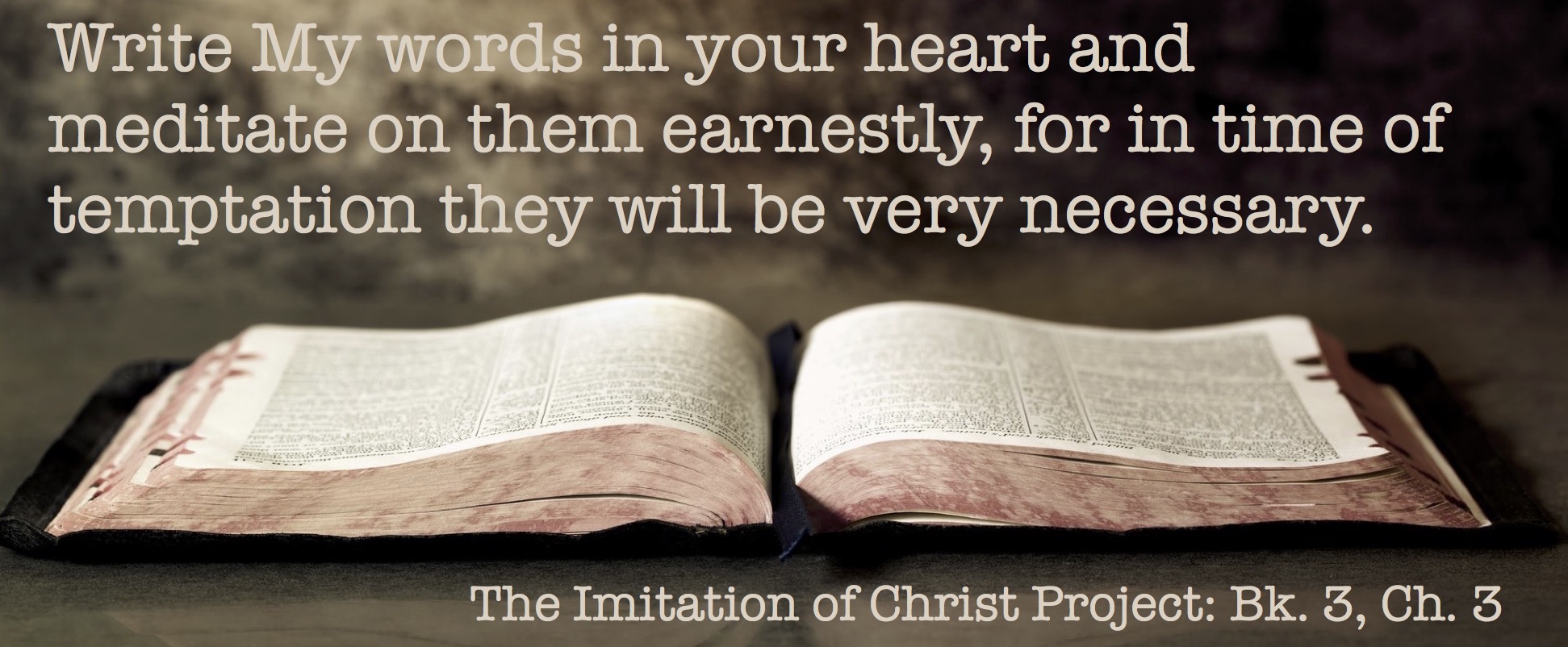
Write My words in your heart and meditate on them earnestly, for in time of temptation they will be very necessary. What you do not understand when you read, you will learn in the day of visitation. I am wont to visit My elect in two ways — by temptation and by consolation. To them I read two lessons daily — one reproving their vices, the other exhorting them to progress in virtue. He who has My words and despises them has that which shall condemn him on the last day.
A PRAYER FOR THE GRACE OF DEVOTION
O Lord my God, You are all my good. And who am I that I should dare to speak to You? I am Your poorest and meanest servant, a vile worm, much more poor and contemptible than I know or dare to say. Yet remember me, Lord, because I am nothing, I have nothing, and I can do nothing. You alone are good, just, and holy. You can do all things, You give all things, You fill all things: only the sinner do You leave empty-handed. Remember Your tender mercies and fill my heart with Your grace, You Who will not allow Your works to be in vain. How can I bear this life of misery unless You comfort me with Your mercy and grace? Do not turn Your face from me. Do not delay Your visitation. Do not withdraw Your consolation, lest in Your sight my soul become as desert land. Teach me, Lord, to do Your will. Teach me to live worthily and humbly in Your sight, for You are my wisdom Who know me truly, and Who knew me even before the world was made and before I was born into it.
Elmer Bendiner, in his book, The Fall of Fortresses, describes a bombing run over the German city of Kassel:
Our B-17 was barraged by flak from Nazi antiaircraft guns. That was not unusual, but on this particular occasion our gas tanks were hit. Later, as I reflected on the miracle of a twenty-millimeter shell piercing the fuel tank without touching off an explosion, our pilot, Bohn Fawkes, told me it was not quite that simple.
On the morning following the raid, Bohn had gone down to ask our crew chief for that shell as a souvenir of unbelievable luck. The crew chief told Bohn that not just one shell but eleven had been found in the gas tanks—eleven unexploded shells where only one was sufficient to blast us out of the sky. It was as if the sea had been parted for us. Even after thirty-five years, so awesome an event leaves me shaken, especially after I heard the rest of the story from Bohn.
He was told that the shells had been sent to the armorers to be defused. The armorers told him that Intelligence had picked them up. They could not say why at the time, but Bohn eventually sought out the answer.
Apparently when the armorers opened each of those shells, they found no explosive charge. They were clean as a whistle and just as harmless. Empty? Not all of them.
One contained a carefully rolled piece of paper. On it was a scrawl in Czech. The Intelligence people scoured our base for a man who could read Czech. Eventually, they found one to decipher the note. It set us marveling. Translated, the note read: “This is all we can do for you now.”
Czech slave labor in a Nazi ammunitions plant managed to do one small thing: not place the explosive charges in a few twenty-millimeter shells. How many more lives did these heroes save?
Paul wrote in his letter to the Corinthians, “As we work together with Christ, we urge you also not to accept the grace of God in vain. For he says, ‘At an acceptable time I have listened to you, and on a day of salvation I have helped you.’”
Today we read the story of David and Goliath. We learned that the Philistines had come to do battle with the Israelites and that their champion, Goliath, came forward to taunt and shame the Israelites. He called and called, but there wasn’t one who was willing to go forward and do battle with the giant. Not one, until the young shepherd boy, David, arrived.
At first King Saul said, “No,” but eventually relents when David said to him, “The LORD, who saved me from the paw of the lion and from the paw of the bear, will save me from the hand of this Philistine.” So Saul has David dressed in fine armor and equipped with his fiercest weapons to go forth and fight Goliath. Yet the boy was not strong enough to wear the armor or carry the weapon, so after taking it all off, he went and found five small stones that would fit in his sling. He then goes out into the field of battle to meet the giant. There is a rather colorful exchange between the two. Goliath makes his threats and David responds, “You come to me with sword and spear and javelin; but I come to you in the name of the LORD of hosts, the God of the armies of Israel, whom you have defied. This very day the LORD will deliver you into my hand, and I will strike you down.”
A these words, the Giant advances on David, but David does not wait for the giant to bear down on top of him, instead, “When the Philistine drew nearer to meet David, David ran quickly toward the battle line to meet the Philistine.” There he killed the giant with his sling and one of the small stones he had gathered.
“At an acceptable time I have listened to you, and on a day of salvation I have helped you.”
In our Gospel reading the disciples and Jesus go out on the Sea of Galilee. A fierce storm blows up around them, but this is not uncommon for the area. The Sea of Galilee is 680 feet below sea level and the hills to the east are over 2,000 feet high. When the cool air from above meets the hot muggy air near the sea, what do you get? (You folks are from Oklahoma, you know the answer!) You get a storm, and these storms are frequent, but the storms over the Sea of Galilee can arrive up so quickly that they catch you by surprise.
The disciples that are with Jesus know all about these storms. Why? Many of them are fishermen and have been fishing these waters all their lives. They know how the storms come up suddenly and they know how to handle themselves and the boats when they do occur. Yet in this case, the storm is overwhelming. They are in fear for their lives. Where is Jesus? Asleep! “We’re dying here! Don’t you care?!” “He woke up and rebuked the wind, and said to the sea, ‘Peace! Be still!’ Then the wind ceased, and there was a dead calm.”
“At an acceptable time I have listened to you, and on a day of salvation I have helped you.”
Twelve people are working through a Bible study getting ready for the Sunday service. They were apparently studying the exact same lessons as we had this morning, the African Methodist Episcopal Church uses the Revised Common Lectionary. They had read about the storm. About the disciples fear. How the disciples woke Jesus and asked, “Don’t you care that we are dying?” A visitor arrives and sits in for an hour, then without warning pulls out a gun and kills nine of those in attendance.
“At an acceptable time I have listened to you, and on a day of salvation I have helped you.” God helped them? I think some would say that God was still sleeping in the bow of the boat.
He’ll save a bomber during WWII bombing run. He’ll save a boy during a battle with a giant. He’ll show up and save twelve fellas who are about to drown in a sudden storm. But he won’t save nine people at a prayer meeting in a church?
Where was God? Is he sleeping? That idea of an absent landlord or sleeping God works, not only with Charleston, but in so many other tragedies, great and small. From what is taking place in the Middle East to Charleston to the hospital room where a little child lies dying of some incurable disease to a family that is breaking apart due to infidelity to the single dad who can’t pay the power bill and feed his children to this to that – and the list goes on. In witnessing these things, hope dies, faith dwindles and people begin to ask, first only in whispers but then in shouts, “Where is God?”
Elie Wiesel is a survivor of Auschwitz and author of numerous books. In his book Night, he describes how he and the other prisoners were forced to watch the hanging execution of two adults and one young boy. The two adults died quickly, but the young boy survived for quite some time. It was a horror to watch. Wiesel said that it was at that point he heard someone from behind him quietly ask, “Where is God now?” Wiesel says, “And I heard a voice within me answer him: ‘Where is He? Here He is—He is hanging here on this gallows…’”
The events of Charleston, in and of themselves, are events almost too horrible to contemplate. However, they have a tendency to force our focus on the more universal horrors that assault so many others and even ourselves. We can look at stories about Czech slaves saving the flying fortresses, about David and Goliath, and so many others, and say, “Yay! The good guys won.” Those are the days when it is easy to have faith and shout, “Our God is King.” But then in the very next breath the “good guys” end up suffering for no apparent reason. They lie dead by the hands of some plague of a human being. So, where is God? Here He is – He is lying in the church with those nine. He is in the bed next to the cancer patient. He is sitting with the family in distress. He is reaching out to the struggling father. He is hanging upon the cross and with his last breath, he is interceding for us, “Father, forgive them, for they know not what they do.” He is with us and He is redeeming us, even in the midst of so many horrors.
I lift up my eyes to the hills.
From whence does my help come?
My help comes from the Lord,
who made heaven and earth.
He will not let your foot be moved,
he who keeps you will not slumber.
Behold, he who keeps Israel
will neither slumber nor sleep.
Let us Pray: Living God, our refuge and strength, even the wind and sea obey your voice. Put the wind back in its place, and say to the sea: Peace! Be still! Fill us with great faith, and save us from the surging water, so that we may tell the good news of your saving love; through Jesus Christ our Lord, who is our Hope in the storm. Amen
TRUTH SPEAKS INWARDLY WITHOUT THE SOUND OF WORDS –
THE DISCIPLE
SPEAK, Lord, for Thy servant heareth.” “I am Thy servant. Give me understanding that I may know Thine ordinances . . . Incline my heart to Thine ordinances . . . Let Thy speech distil as the dew.”
The children of Israel once said to Moses: “Speak thou to us and we will hear thee: let not the Lord speak to us, lest we die.”
Not so, Lord, not so do I pray. Rather with Samuel the prophet I entreat humbly and earnestly: “Speak, Lord, for Thy servant heareth.” Do not let Moses or any of the prophets speak to me; but You speak, O Lord God, Who inspired and enlightened all the prophets; for You alone, without them, can instruct me perfectly, whereas they, without You, can do nothing. They, indeed, utter fine words, but they cannot impart the spirit. They do indeed speak beautifully, but if You remain silent they cannot inflame the heart. They deliver the message; You lay bare the sense. They place before us mysteries, but You unlock their meaning. They proclaim commandments; You help us to keep them. They point out the way; You give strength for the journey. They work only outwardly; You instruct and enlighten our hearts. They water on the outside; You give the increase.
They cry out words; You give understanding to the hearer.
Let not Moses speak to me, therefore, but You, the Lord my God, everlasting truth, speak lest I die and prove barren if I am merely given outward advice and am not inflamed within; lest the word heard and not kept, known and not loved, believed and not obeyed, rise up in judgment against me.
Speak, therefore, Lord, for Your servant listens. “Thou hast the words of eternal life.” Speak to me for the comfort of my soul and for the amendment of my life, for Your praise, Your glory, and Your everlasting honor.
A preacher was completing a temperance sermon: with great expression he said, “If I had all the beer in the world, I’d take it and throw it into the river.”
With even greater emphasis, he said, “And if I had all the wine in the world, I’d take it and throw it into the river.”
And then, finally, he said, “And if I had all the whiskey in the world, I’d take it and throw it into the river.” He sat down.
The song leader then stood very cautiously and announced with a pleasant smile, “For our closing song, let us sing Hymn #365: ‘Shall We Gather At the River.’”
Do you ever walk away from church and think that being a Christian is really about following a bunch of rules so that you can avoid hell and get into Heaven? Don’t drink, don’t smoke, don’t cheat, etc. and good Ol’ St. Peter will let you through the Pearly Gates. Say your prayers, read your Bible, give ten percent, etc. and you won’t go to hell. Not all, but many understand that to be Christianity. One author wrote, “the Christian mode of life must be an intolerably dull and boring affair, a repressing of everything one wants to do, a forcing of oneself to comply with what nobody could wish or choose, a shivering with chattering teeth in the gloom of a chilly monastic twilight, out of the sunshine and free air that God made.” Oh, yes! Please sign me up!
Both of the short parables that Jesus taught in our Gospel this morning spoke of the small things that grow into maturity and produce good fruit, leading to the Kingdom of God. The grain of wheat that grows and is harvested and the mustard seed that produces a great sanctuary. How you and I relate to these parables is significant and worthy of our consideration, but every now and then I think that we can get so caught up in the destination – the Kingdom of God – that we miss out on the joy of the journey. We get wrapped up in legalistic discussions – do this, don’t do that – and you’ll reach the destination, yet in the process we forget there is this very glorious moment.
From The Perks of Being a Wallflower: “I can see it. This one moment when you know you’re not a sad story. You are alive. And you stand up and see the lights on the buildings and everything that makes you wonder. And you’re listening to that song, and that drive with the people who you love most in this world. And in this moment, I swear, we are infinite.”
Jesus often speaks of the Kingdom of God and we understand that to be in the future, but Jesus also says, “The kingdom of God is not coming with things that can be observed; nor will they say, ‘Look, here it is!’ or ‘There it is!’ For, in fact, the kingdom of God is among you.” The Kingdom of God is not only a future event, but it is now. The Kingdom of God is this moment. And the Lord did not place you here for you to experience a constant grind in everyday living. Jesus said, “I came that they may have life, and have it abundantly.” That is not speaking about an abundance of things, but an abundance of joy and blessing in all things.
It is a story that you may have heard before and is also one that Brennan Manning retells in his book, The Ragamuffin Gospel: A young monk is walking a jungle path when a tiger suddenly jumps out in front of him. The monk raced to the edge of a cliff, glanced back, and saw the growling tiger about to spring. The monk spotted a rope dangling over the edge of the cliff. He grabbed it and began shimmying down the side of the cliff out of the clutches of the tiger. Whew! Narrow escape. The monk then looked down and saw a quarry of jagged rocks five hundred feet below. He looked up and saw the tiger poised atop the cliff with bared claws. Just then, two mice began to nibble at the rope. What to do?
The monk saw a strawberry within arm’s reach, growing out of the face of the cliff. He plucked it, ate it, and exclaimed, “Yum! That’s the best strawberry I’ve ever tasted in my entire life.” (The Ragamuffin Gospel, p. 54.)
The Kingdom of God that is now, the abundant life, is not necessarily found in great events, on a beach in the Bahamas, or really through any act of our own. The Kingdom of God, the abundant life is found in the strawberries and moments along the way.
A child’s question from the backseat: “Are we there yet?” The answer: Nope. We have thousands of miles to go, and isn’t it wonderful. What will we experience along the way? Perhaps a better question is: What won’t we? There are baseball games on warm summer nights, books to read that take us on thousands of journeys, the feel of a baby’s hand as she grips your finger, a kiss on the cheek from Aunt Marge. How many strawberries and moments there are if we will only see them for what they are. Stop chasing after what you don’t have and enjoy that which God has blessed you with in this most sacred moment.
What comes after our moments are done and that future Kingdom of God arrives? I don’t know this for certainty – no one does, but it’s not over. Life is changed not ended. I believe the moments with God continue. We will have reached our destination, but the journey is not over.
I’ve mentioned before that I’m a fan of The Lord of the Rings by J.R.R. Tolkien. Both the books and movies are delightful. In the movies, one of the young Hobbits, Pippin, is afraid that he will soon be killed in battle. Turning to the great wizard, Gandalf, Pippin says:
Pippin: I didn’t think it would end up this way.
Gandalf: End? No, the journey doesn’t end here. Death is just another path, one that we all must take. The grey rain-curtain of this world rolls back, and all turns to silver glass, and then you see it.
Pippin: What? Gandalf? See what?
Gandalf: White shores, and beyond, a far green country under a swift sunrise.
Pippin: Well, that isn’t so bad.
Gandalf: No. No, it isn’t.
And the moments continue.
In all this, there is one other important point. We are to take joy in the moments that God gives us, but do not forget, for someone in here or out there, you might be the instrument of God’s blessing. You might just be the strawberry on the side of the cliff that helps them to experience the Kingdom of God in this present life. Do not underestimate the power you have in a simple touch, a smile, a kind word. Don’t just be a consumer, but share what is within you.
Yes, we must practice our faith. We must strive for heaven. We must avoid sin and the occasions of sin. We must study, pray, worship, and give. We must work to become Saints of God, and that is no small task; however, God did not give us this life so that it would be some sort of drudge, day-to-day just waiting and – in some cases – praying for the end. God gave us life that we might have life and live it abundantly.
Ralph Waldo Emerson wrote, ”To finish the moment, to find the journey’s end in every step of the road, to live the greatest number of good hours, is wisdom.” I think he was onto something.
Throughout the Gospels we will read the statement, “The Kingdom of God is like….” The sentence is finished with imagery like what we heard today, a seed that grows and a mustard seed. In other places the Kingdom of God is described as a pearl of great worth, leaven, a treasure in a field, a net catching fish. Each is an attempt to describe some aspect of the infinite. We must study these statements and understand what it is Jesus is teaching us, but in the process, we should never forget that the Kingdom of God is also now, in this very moment.
Please turn to page 837 of The Book of Common Prayer and join with me in the Litany of Thanksgiving.
Let us give thanks to God our Father for all his gifts so freely bestowed upon us.
For the beauty and wonder of your creation, in earth and sky and sea. We thank you, Lord.
For all that is gracious in the lives of men and women, revealing the image of Christ, We thank you, Lord.
For our daily food and drink, our homes and families, and our friends, We thank you, Lord.
For minds to think, and hearts to love, and hands to serve, We thank you, Lord.
For health and strength to work, and leisure to rest and play, We thank you, Lord.
For the brave and courageous, who are patient in suffering and faithful in adversity, We thank you, Lord.
For all valiant seekers after truth, liberty, and justice, We thank you, Lord.
For the communion of saints, in all times and places, We thank you, Lord.
Above all, we give you thanks for the great mercies and promises given to us in Christ Jesus our Lord; To him be praise and glory, with you, O Father, and the Holy Spirit, now and for ever. Amen.
Over time, I think the Gospel reading we heard today will become a clue as to what our Saint for the day is known for: “Therefore every scribe who has been trained for the kingdom of heaven is like the master of a household who brings out of his treasure what is new and what is old.”
“Therefore every scribe.” We had this reading just a few Wednesdays back when we studied Alcuin, who was a librarian of sorts. It also shows up when we celebrate the great historian, The Venerable Bede; the theologian, Thomas Aquinas; and a more contemporary writer who we recently studied a great deal, Dietrich Bonhoeffer. We hear this reading and we understand that our Saint is one whose gift involved the writings of the Church. Ephrem of Edessa, who we celebrate today is no different.
Early on he served in the household of Bishop Jacob of Nisbis and it is likely that he attended the Council of Nicea (where the Nicene Creed was composed) with the Bishop in 325. Following the Bishop’s death, Ephrem would remain in service to Jacob’s successors, but would eventually be forced to flee following the Persian invasion. He would then settle in a cave, where he lived out the remainder of his life.
Although living an austere life, he would continue to be active in preaching and writing, and would be ordained a deacon. Of his writings, not only did he write the hymn we read, but also over 400 others that were used to teach the orthodox faith, which is how he became known as “The Harp of the Holy Spirit.” He would die in the year 373 from exhaustion while caring for the sick.
There is much for Ephrem to be remembered by, but it is his role as “scribe” that most stands out. For some, his writings are a bit too flowery, but many others find great beauty and comfort in his writings. In one particular hymn, he addresses the Upper Room where the Last Supper was held: “O blessed spot! No one has seen or shall see the things which you have seen. In you the Lord himself became true altar, priest, and bread and chalice of salvation. He alone suffices for all, yet none suffices for him. He is Altar and Lamb, victim and sacrifice, priest as well as food.”
In the Gospels, Jesus is never pleased with the scribes. He sees them, along with the sadducees and pharisees, as being those who place stumbling blocks before the people, at one point saying, “But woe to you, scribes and Pharisees, hypocrites! For you lock people out of the kingdom of heaven. For you do not go in yourselves, and when others are going in, you stop them.” Yet Jesus says what is needed in order to be a faithful scribe, it is one “who brings out of his treasure what is new and what is old.” It is one understands the writings of those that have gone before, and then understands that those writings are speaking of and pointing to the Savior.
Ephrem was one who learned this lesson, and through his own writings instructed the people of his time and throughout the centuries to us today, on the Kingdom of Heaven. We give thanks for him and all those who have passed on such knowledge, which leads to salvation through Jesus.
Republicans. Democrats. Libertarians. I’ve already had enough of the Presidential election, and lucky for us there are only 519 days until it actually occurs. It’s true. All these folks are going to come out and tell us how they, and they alone, can turn the economy around, bring about world peace, save the planet, and give everyone a cute kitten. Oy.
With all this going on, I thought it would be fun to conduct our own straw poll this morning to see who we might vote for. I’ve got three candidates for you. I’m going to describe them, then we’ll have a vote by hands. OK?
Candidate A: Associates with crooked politicians, and consults with astrologists. He’s has two mistresses. He also chain smokes and drinks quite a few martinis a day. Candidate B: He was kicked out of office twice, sleeps until noon, used opium in college and drinks a great deal of whisky every evening. Candidate C: He is a decorated war hero. He’s a vegetarian, doesn’t smoke, drinks an occasional beer and hasn’t had any extramarital affairs. Got it? Let’s vote? Who is for candidate A, the smoking carouser? B, sleepy drug user? And C, Mr. Upstanding citizen? Good choice! Candidate A is Franklin D. Roosevelt, Candidate B is Winston Churchill, and Candidate C is Adolph Hitler. Thanks for playing, you just elected yourself a dictator with a splash of psychopath thrown in for good measure! I’m not convinced that we always know what it good for us. History has proven time and time again that we don’t.
In our Old Testament lesson this morning we read about Samuel. At the time, he was the prophet in Israel. In this capacity as Prophet, Samuel is God’s representative on earth. His role is quite similar to that of Moses, which means that it is God who rules – who is King – and Samuel who carries out God’s commands. However, the Israelites begin to call for an earthly king, which angers the Lord. He says to Samuel, “Listen to the voice of the people in all that they say to you; for they have not rejected you, but they have rejected me from being king over them.” By asking for a king, the people are greatly sinning because they are asking to replace the Kingship of the Father.
Even though they are sinning, the Lord allows it to proceed, but first he tells Samuel, “You shall solemnly warn them, and show them the ways of the king who shall reign over them.” And Samuel did.
Samuel told the people what the Lord had spoken. The new king will take from them their families, their possessions, their money, their food, their wine, their freedoms. Everything. The Lord concluded by saying, “And in that day you will cry out because of your king, whom you have chosen for yourselves; but the LORD will not answer you in that day.” Did the people hear and understand? Not at all. Their response: “No! but we are determined to have a king over us.” So the Lord gave them what they asked for, and they got Saul.
Robert Blake – not Baretta – but the English Historian, in 1982 described one particular monarch: he “was a tyrannical monster. His rule echoed Caligula’s and prefigured that of Hitler or Stalin. Parliament was his collective accomplice: it blotted out his debts, it carried acts of attainder which deprived his enemies or imagined enemies of land, title and life without even the form of trial, it altered the succession, it allowed the king to bequeath the Crown by will, it gave his proclamations the force of statutory law.” This monarch’s official title was a bit on the wordy side, “By the Grace of God, King of England, France and Ireland, Defender of the Faith and of the Church of England and also of Ireland in Earth, under Jesus Christ, Supreme Head.” We know him as Henry VIII.
When the Israelites asked for a king, they got Saul. I don’t know that he was as bad as Henry VIII, but it doesn’t seem he was much better.
Following Saul’s death, it should have been his son Jonathan that ascended to the throne, but Jonathan was killed in the same battle that Saul died, which led to David becoming king over Israel.
We know that David was the greatest king that Israel had, but he wasn’t without his faults, just ask Uriah, Bathsheba’s former husband. Oh, you can’t, David had him killed. However, even though David sinned, his reign prefigured that of Jesus’. We read of one occasion in 2 Samuel 9.
David was reigning as king and one day he called to one of his servants and asked if there was anyone still living who was a descendant of Saul. The servant reported to David that there was a grandson, Jonathan’s son, who lived. His name was Mephibosheth. David had him sent for, but when the boy arrived he was afraid. Not surprising, if he was an heir to Saul and Jonathan, he may have thought David would have him done away with since he may rightfully have had a claim to the throne. However, when he arrived, David said to him, “Do not be afraid, for I will show you kindness for the sake of your father Jonathan; I will restore to you all the land of your grandfather Saul, and you yourself shall eat at my table always.”
The Lord told the people, when you get a king, the king will take everything from you, and they did. However, in this instance, we see the king restoring the possessions of one who had lost everything. In this, we see a glimpse of the Christ who was to come.
Israel had a King and Yahweh is His name. The Lord Our God. Yet, they wanted to be like everyone else. They wanted a king made of flesh and blood that could march with them against their enemies. They said in their hearts, we can serve the Lord and serve a king. They were wrong. The Lord gave them what they asked for, but in the process, the Israelites destroyed themselves. Jesus said, “If a house is divided against itself, that house will not be able to stand,” and Israel was divided in who they served.
A Texas rancher bought 10 ranches and put them together to form one giant spread. His friend asked him the name of his new mega-ranch. He replied, “It’s called The Circle Q, Rambling Brook, Double Bar, Broken Circle, Crooked Creek, Golden Horseshoe, Lazy B, Bent Arrow, Sleepy T, Triple O Ranch.”
“Wow,” said his friend, “I bet you have a lot of cattle.”
“Not really,” explained the rancher. “Not many survive the branding.”
You’ve probably all seen the suits that race car drivers wear. They are covered in patches with the logos of all the team sponsors. If they win a race, it seems there’s a person standing next to them whose sole job is to change the driver’s cap with one logo after another receiving billboard space on top of the driver’s head. Since we were speaking of politicians earlier, one joke has suggested that politicians should also be required to wear similar suits.
We’ve said it before, the Lord Our God is a jealous God. He says it Himself, time and time again, and He is jealous for us. James writes, “God yearns jealously for the spirit that he has made to dwell in us.”
We know this to be true, but I have to wonder, like those race car drivers and politicians, do our bodies bear the logos and brands of all those we serve? The answer: Yes. We’ve become like the Israelites, believing we can serve all these other kings in our lives. Like them, we have said that we can serve them and our Lord. And like them, we are mistaken.
These kings in our lives, whatever form they may come in, rob us of much. The king of anger robs us of peace. You chase after your own imaginations and hurt feelings in an attempt to serve him. You can become so consumed in his biddings that you ignore family and friends or worse, treat them with contempt. The king of pride constantly pushes us toward self-centeredness and the neglect of others. The king of money demands that we set aside family and friend in pursuit of his illusions. On and on. All of them rule over our lives and rob us of our life with God, with those we love, and with our neighbors.
Yet, here is the Good News. David came to Mephibosheth and restored him. Returned to him all that was lost. In an even greater way – an eternal way – Jesus does the same for us. He restores us to the Father, and our life that was divided is reunited under His reign.
I invite you this day to cast off the kings of this world and submit to the One who sits enthroned at the right hand of the Father. I invite you to serve Him and Him alone, because it is only in Him that you will find true happiness. Say with the Psalmist:
Rest in God alone, my soul,
for my hope comes from Him.
He alone is my rock and my salvation,
my stronghold; I will not be shaken.
My salvation and glory depend on God, my strong rock.
My refuge is in God.
THE INWARD CONVERSATION OF CHRIST WITH THE FAITHFUL SOUL –
I WILL hear what the Lord God will speak in me.”
Blessed is the soul who hears the Lord speaking within her, who receives the word of consolation from His lips. Blessed are the ears that catch the accents of divine whispering, and pay no heed to the murmurings of this world. Blessed indeed are the ears that listen, not to the voice which sounds without, but to the truth which teaches within. Blessed are the eyes which are closed to exterior things and are fixed upon those which are interior. Blessed are they who penetrate inwardly, who try daily to prepare themselves more and more to understand mysteries. Blessed are they who long to give their time to God, and who cut themselves off from the hindrances of the world.
Consider these things, my soul, and close the door of your senses, so that you can hear what the Lord your God speaks within you. “I am your salvation,” says your Beloved. “I am your peace and your life. Remain with Me and you will find peace. Dismiss all passing things and seek the eternal. What are all temporal things but snares? And what help will all creatures be able to give you if you are deserted by the Creator?” Leave all these things, therefore, and make yourself pleasing and faithful to your Creator so that you may attain to true happiness.
When my grandma got arthritis, she couldn’t bend over and paint her toe nails anymore. So my grandpa does it for her now all the time, even when his hands got arthritis too. That’s love. – Rebecca – age 8
Love is when a girl puts on perfume and a boy puts on shaving cologne and they go out and smell each other. – Kari – age 5
Love is when you tell a guy you like his shirt, then he wears it every day. – Noelle – age 7
Love is… I remember when my grandparents were older. My granny was wearing a shirt and a yellow sweater over it. She got hot while cooking, so without a word, my granddaddy got up and helped her get the sweater off so that in doing so she wouldn’t mess up her hair. That may sound silly to some, but for what ever reason I still remember it to this day. I remember being almost embarrassed in seeing it, because it seemed so intimate.
In Love’s Labour’s Lost, Shakespeare wrote, “When Love speaks, the voice of all the gods make heaven drowsy with harmony.” Maybe that’s what I saw with my grandparents. Harmony. Unity. After sixty some years of marriage, the two had truly become one.
But with us, love doesn’t always last. There was a group of women at a seminar on how to live in a loving relationship with your husband. The women were asked, ‘How many of you love your husbands?’ All women raised their hands. Then they were asked, ‘When was the last time you told your husband you loved him?’ Some women answered today, some yesterday, some didn’t remember. The women were then told to take their phones and send the following text: ‘I love you, sweetheart.’ Then the women were told to exchange phones and read the responding text messages. For the record, the roles could have been switched, the husband could have been the ones sending the messages and the replies may have been different, but the sentiment would have been the same. In response to, “I love you, sweetheart,” some husbands wrote back, “I love you, too.” Others wrote back with:
– Who is this?
– Eh, mother of my children, are you sick?
– I don’t understand what you mean?
– What did you do now? I won’t forgive you this time.
– Don’t beat about the bush, just tell me how much you need?
– Am I dreaming?
– If you don’t tell me who this message is actually for, someone will die.
– I asked you not to drink anymore. I’ll leave if you are tired of me.
Now that’s enough to put a damper on your Sunday morning. What we think about love when we are children is different than how we view it as adults. As children, we’ll crawl up into the lap of a perfect stranger and tell them all about our day. By the time we are adults, we often don’t even share our feelings with those we hold most dear.
There are of course exceptions, but for you and I, love and our understanding of it is fluid, ever moving and changing. It is determined by everything from past experiences and the movies we watch to whether or not the sun is shining and are we having a good hair day. I’m not sure why, but when I get overly hungry, I get angry. Janie has labeled it “hangry.” When I’m hangry, I don’t loves nobody!
Now don’t go thinking I’m a cynic when it comes to love. I’m not at all, but my point – Yes, Fr. John, the point please – my point is that love for us is inconsistent. It may last, it may not. It may burn like the noonday sun and end in a whimper or age like fine wine.
So, why all this talk about love? Today is Trinity Sunday, the day we celebrate the three persons of the Godhead: Father, Son, and Holy Spirit. I call this day Heresy Sunday, because it is the day that more heresies are spouted from the pulpit than on any other Sunday. If you add anything to the sentence that begins, “The Holy Trinity is like…,” then there is a 99.999% chance you will commit heresy. Was that heresy intentional? Most likely not, but even St. Patrick’s explanation of the Trinity as a three-leaf clover can be viewed as heretical. That, however, hasn’t stopped folks from trying. From St. Augustine and his great work De Trinitate to William Young who in his novel The Shack attempts to define the Holy Trinity, portraying Jesus as a carpenter, the Holy Spirit as an Asian woman named Sarayu, and God the Father as a large black woman named “Papa,” all are an attempt by mortal sinful man to explain that which is immortal and unexplainable.
So, how do we explain the Holy Trinity? The only safe bet is to read the Creed of St. Athanasius, which can be found in the historical documents in the back of The Book of Common Prayer: “The Catholic Faith is this: That we worship one God in Trinity, and Trinity in Unity, neither confounding the Persons, nor dividing the Substance.” It goes on from there, but the bottom line is that if you don’t believe it, you burn in hell. There you have it. End of sermon. Let’s go home. Maybe not.
The Holy Trinity is truly a Divine Mystery. Your salvation is not dependent upon knowing how it works. That 14th century monk and my good friend, Thomas à Kempis, states: “What good does it do to speak learnedly about the Trinity if, lacking humility, you displease the Trinity? Indeed it is not learning that makes a man holy and just, but a virtuous life makes him pleasing to God. I would rather feel contrition than know how to define it. For what would it profit us to know the whole Bible by heart and the principles of all the philosophers if we live without grace and the love of God? Vanity of vanities and all is vanity, except to love God and serve Him alone.”
The Holy Trinity is Divine Mystery, but there are things we can know about its nature, and the characteristic that is perhaps the most significant and the one we can know with all certainty: “God is love.” The trouble with hearing this is that we take our understanding of love with all its inconsistencies, variables, memories, moods, and whatever else, and apply it to how we view God as love. I get hangry, so God must get hangry, too. However, unlike our human love with all of its inconsistencies, God’s love is unchanging and unchangeable. God “is the same yesterday and today and forever.” God does not have bad hair days. God may get angry and, as we learned last week, send his people into exile, but God does not ever stop loving his people. “God is love.” That cannot change.
So, God is love and that love is perfect. “Be perfect, therefore, as your heavenly Father is perfect.” The love of God is perfect. Where this love is present there is life. Where it is absent, only death. Nothing can exist outside of it. This perfect love of God exists in the Holy Trinity. Richard of St. Victor wrote that it was this perfect love that bound the Trinity together – probably a heresy – but here is the part that should pickle your brain and bring you to your knees: the perfect love of God that exists in the Holy Trinity is directed at you. You are the object of God’s perfect love.
“For God so loved the world….” That is not a cliché or some catchy snippet you’ll find on a Valentine’s Day card. That is the love song of the One who spoke all of creation into being, and it is sung for you.
This love of God is relentless in its pursuit of you. Adam and Eve sinned in the Garden and when they heard God walking in the garden, they hid, and God called to them, “Where are you?” From that point on, God’s love has pursued His people so that they might return to Him and have eternal life.
George Herbert is one of the greatest Anglican poets. He wrote a poem with a very simple title: Love.
LOVE bade me welcome; yet my soul drew back,
Guilty of dust and sin.
But quick-eyed Love, observing me grow slack
From my first entrance in,
Drew nearer to me, sweetly questioning
If I lack’d anything.
‘A guest,’ I answer’d, ‘worthy to be here:’
Love said, ‘You shall be he.’
‘I, the unkind, ungrateful? Ah, my dear,
I cannot look on Thee.’
Love took my hand and smiling did reply,
‘Who made the eyes but I?’
‘Truth, Lord; but I have marr’d them: let my shame
Go where it doth deserve.’
‘And know you not,’ says Love, ‘Who bore the blame?’
‘My dear, then I will serve.
‘You must sit down,’ says Love, ‘and taste my meat.’
So I did sit and eat.
You don’t have to understand the workings of the Holy Trinity. Your salvation is not dependent upon it. You must only understand that Love has bade you welcome. From there you must decide whether or not you will accept the invitation. By accepting, by coming to the table, sitting, and eating, you become a child of God and an heir to the very Kingdom of Heaven with Christ Jesus.
The Western Wall or Wailing Wall is a part of the wall that surrounded the Temple in Jerusalem. It is the holiest site in Judaism and this portion of the wall is of particular significance because it was nearest the Temple itself. You can even go on the Internet and get a live video feed of what is going on there. (http://english.thekotel.org/cameras.asp)
A young woman journalist assigned to the Jerusalem bureau has an apartment overlooking the Wailing Wall. At certain times every day when she looks out her window she sees an old bearded Jewish man praying solemnly, his lips moving and his eyes closed. Certainly, he would be a good interview subject, so the journalist walks down to the Wall and introduces herself to the old man after his prayers.
She asks, “You come every day to the Wall; how long have you done that, and what are you praying for?”
The old man replies, “I have come here to pray every day for 25 years. In the morning I pray for world peace and for the brotherhood of man. I go home have lunch, and in the afternoon I come back and pray for the eradication of illness and disease from the earth, that children will someday not go hungry, and I pray for wisdom for our leaders as they guide us in this fearful world. And, very important, I pray for peace and understanding between the Israelis and Palestinians.”
The journalist is moved to silence, so humbled is she by the sincerity of this old man. Then she remembers her training and asks her second question.
“So,” she asks, “how does it feel to come here every day for 25 years and pray for these wonderful things? What’s it like?”
The old man shrugs his shoulders and replies, “Like talking to a wall.”
Have you ever said your prayers day after day and come away thinking the same thing? God’s not listening. God doesn’t care what I think. God doesn’t love me. I’m talking to a wall! Of course you have. We all have. But, did you ever stop to consider that maybe God looks down on us and thinks the same thing? They’re not listening. They don’t care what I think. They do not love me. “Oy vey! It’s like talking to a wall with these people!” I don’t believe that God is whiny like we can be, but he has said these things in the past and he eventually gets fed up.
During the reign of the Babylonian king, Nebuchadnezzar, the Israelites rebelled against God. They worshipped the false gods, they intermarried with the other tribes, they did not honor the Sabbath, and through this disobedience, they desecrated the Temple of God. He called to them time and time again, but they failed to listen and paid the price for their disobedience. The Prophet Ezekiel, one who had warned them, writes:
The word of the Lord came to me: You, O mortal, thus says the Lord God to the land of Israel:
An end! The end has come
upon the four corners of the land.
Now the end is upon you,
I will let loose my anger upon you;
I will judge you according to your ways,
I will punish you for all your abominations.
My eye will not spare you, I will have no pity.
I will punish you for your ways,
while your abominations are among you.
The Lord said, “It’s like talking to a wall with these people.” So, the Lord allowed Nebuchadnezzar to attack and destroy the city of Jerusalem and the Temple – this was in the year 586 B.C. In the process 10,000 Israelites were sent into exile in Babylon, hence the name Babylonian Captivity. Among those 10,000 was Ezekiel.
Ezekiel prophesied against the people, but toward the end he began to offer hope. We read a part of it today: “The Lord set me down in the middle of a valley; it was full of bones… Thus says the Lord GOD to these bones: ‘I will cause breath to enter you, and you shall live.’ … and they lived, and stood on their feet, a vast multitude…. ‘I will put my spirit within you, and you shall live, and I will place you on your own soil; then you shall know that I, the Lord, have spoken and will act,’ says the Lord.”
And He did. Seventy years after the fall of Jerusalem, the people were allowed to return. He breathed life into a people who were dead and returned them to the Promised Land. Did it last? No. The cycle repeated itself and again the Lord moved against his people. He is, after all, a jealous God.
The Lord made a covenant with his people, but they were unable to keep it. They tried, but they always failed. Yet this cycle of beginnings and failures served a greater purpose. It allowed the people to understand that they were not able to accomplish God’s commanded holiness on their own and that a permanent solution was needed.
The Eucharistic Prayer we’ve been using during this Season of Easter so beautifully sums it up: “When our disobedience took us far from you, you did not abandon us to the power of death. In your mercy you came to our help, so that in seeking you we might find you. Again and again you called us into covenant with you, and through the prophets you taught us to hope for salvation. Father, you loved the world so much that in the fullness of time you sent your only Son to be our Savior.… To fulfill your purpose he gave himself up to death; and, rising from the grave, destroyed death, and made the whole creation new.”
And, once again, God gives His Holy Spirit “his own first gift to those who believe, to complete his work in the world, and to bring to fulfillment the sanctification of all.”
“To bring to fulfillment the sanctification of all.” To finally bring about the holiness that we could never accomplish on our own. To breath life into these dead dry bones of ours. “For mortals it is impossible, but for God all things are possible.” You have been made holy.
“Once you were not a people,
but now you are God’s people;
once you had not received mercy,
but now you have received mercy.”
Jesus said, “Be perfect, therefore, as your heavenly Father is perfect,” and it is through Jesus and the giving of God’s Holy Spirit that you are indeed made perfect.
The Holy Spirit has many names: The Spirit of Christ, Advocate, Paraclete, Counselor. The Spirit is the Wind, the very Breath of God. The opening verses of Genesis declare, “In the beginning God created the heavens and the earth. The earth was without form, and void; and darkness was on the face of the deep. And the Spirit of God was hovering over the face of the waters.” It is the same Spirit of God that hovered over the waters that is breathed into us. That same Spirit allows us to become one with God – He in us and we in Him.
When we speak to God, it is not speaking to a wall. When God speaks to us, he is not speaking to a wall. As Paul said to us, “The Spirit helps us in our weakness; for we do not know how to pray as we ought, but that very Spirit intercedes with sighs too deep for words. And God, who searches the heart, knows what is the mind of the Spirit, because the Spirit intercedes for the saints according to the will of God.”
Today, Pentecost, we celebrate the giving of God’s Holy Spirit. In sending the Spirit, Jesus fulfilled his promise. He did not leave us alone, but is with us always. Therefore, as Jesus said to his disciples, I say to you, “Receive the Holy Spirit.” Receive the Breath of God and live.
///
Pentecost is also considered the birthday of the Church, so on this day it is appropriate that we receive new members into Christ’s One Holy Catholic and Apostolic Church through the sacrament of Baptism. Therefore, continuing on page 301 of the BCP, “The Candidates for Holy Baptism will now be presented.”












 Candle in a Cave