Reflection: TAK IOC Bk. 4, Ch.3.2

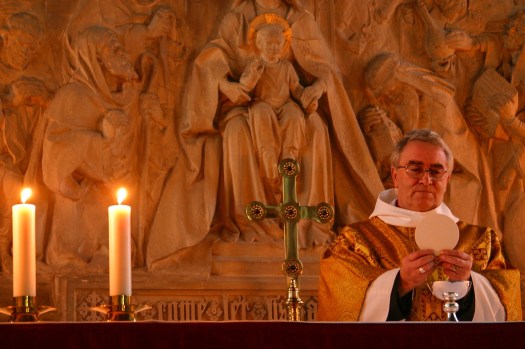
communion-2263987_1280


Then Jesus called his disciples to him and said, “I have compassion for the crowd, because they have been with me now for three days and have nothing to eat; and I do not want to send them away hungry, for they might faint on the way.” (Matthew 15:32)

Jesus had given so much of himself in the healing of the crowd, yet he continues to have compassion for them and their needs.  Therefore, he feeds the 4,000 with seven loaves of bread and a few small fish.

Jesus also has the same compassion for us as he did for that crowd.  Yet, the food he gives to us is himself.

While they were eating, Jesus took a loaf of bread, and after blessing it he broke it, gave it to the disciples, and said, “Take, eat; this is my body.”  Then he took a cup, and after giving thanks he gave it to them, saying, “Drink from it, all of you; for this is my blood of the covenant, which is poured out for many for the forgiveness of sins. (Matthew 26:26-28)

Brother Thomas writes:

Therefore must I often come to Thee, and receive Thee as the medicine of my salvation, lest perhaps I faint in the way, should I be deprived of this heavenly food.  For so thou, O most merciful Jesus, when thou hadst been preaching to the people and curing the various maladies, didst once say: I will not send them fasting to their home, lest they faint on the way.

The Lord does not send us away with our soul’s fasting.  He nourishes us with his body and blood.  No greater love.

Sermon: Proper 5 RCL B – “The Other”

The podcast can be found here.


man-person-people-emotions


A fellow had just been hired as the new CEO of a large corporation. The current CEO was stepping down and met with the new hire privately in his office, where he handed him three numbered envelopes.

“Open these if you run up against a problem you don’t think you can solve,” the first CEO said.

Things went along pretty smoothly for the first six months, but then sales took a downturn and the new CEO began catching a lot of heat. He went to his drawer and took out the first envelope. The message read, “Blame your predecessor.”

The new CEO called a press conference and tactfully laid the blame at the feet of the previous CEO. Sales began to pick up and the problem was soon behind him.

About a year later, the company was again experiencing a slight dip in sales, combined with serious product malfunctions. Having learned from his previous experience, the CEO opened the second envelope. The message read, “Reorganize.” This he did, and the company quickly rebounded.

After several consecutive profitable quarters, the company once again fell on hard times. The CEO went to his office, closed the door and opened the third envelope.

The message said, “Prepare three envelopes.”

About a week ago one of those funny memes circulated on Facebook.  I’ve no idea if Teddy Roosevelt actually said it, but he was quoted: “if you could kick the person in the pants responsible for most of your trouble, you wouldn’t sit for a month.”  It is easy to blame others, reshuffle, reorganize, put up smokescreens, but on many occasions, our problems arise from inside our own skin.

To my knowledge it was never required reading, but if you attend Deacon Janie’s class, you will most likely have to read Robert Louis Stevenson’s classic, Dr. Jekyll and Mr. Hyde.  It is a fun monster read, but it also explores this idea of the “other” person in us all.  That “other” who has a tendency to get us into trouble.

Dr. Jekyll writes: “With every day, and from both sides of my intelligence, the moral and the intellectual, I thus drew steadily nearer to the truth, by whose partial discovery I have been doomed to such a dreadful shipwreck: that man is not truly one, but truly two.”  Continuing on he says, “If each, I told myself, could be housed in separate identities, life would be relieved of all that was unbearable; the unjust might go his way, delivered from the aspirations and remorse of his more upright twin; and the just could walk steadfastly and securely on his upward path, doing the good things in which he found his pleasure, and no longer exposed to disgrace and penitence by the hands of this extraneous evil. It was the curse of mankind that these incongruous personas were thus bound together—that in the agonized womb of consciousness, these polar twins should be continuously struggling.”

St. Paul sums up the issue that Dr. Jekyll is experiencing: “I do not understand what I do. For what I want to do I do not do, but what I hate I do… For I have the desire to do what is good, but I cannot carry it out.  For I do not do the good I want to do, but the evil I do not want to do—this I keep on doing.”  Yet Jesus says, “If a kingdom is divided against itself, that kingdom cannot stand. And if a house is divided against itself, that house will not be able to stand.”  So within us all are these polar twins, Jekyll and Hyde, constantly divided and at war within us, however, in order for us to stand firmly in our faith, those divisions must cease.  So how do we evict the evil and remain righteous?

First, we must understand that until we are reborn through the resurrection, we will always have this battle with in us, but the battle within can be brought into some control.  

It is an old story, but one worth repeating:

One evening, an elderly Cherokee brave told his grandson about a battle that goes on inside people.

“My dear one, the battle between two ‘wolves’ is inside us all. One is evil. It is anger, envy, jealousy, sorrow, regret, greed, arrogance, self-pity, guilt, resentment, inferiority, lies, false pride, superiority and ego.

The other is good. It is: joy, peace, love, hope, serenity, humility, kindness, benevolence, empathy, generosity, truth, compassion and faith.”

The grandson thought about it for a moment and then asked his grandfather: “Which wolf wins?”

The old Cherokee replied, “The one you feed.”

To subdue this battle within, we must not feed or entertain the evil desires that spring up inside of us.  We must overcome them and perhaps one of the best ways of doing that is by practicing acts of righteousness, of good.  You want to rail against someone—pray for them instead.  You’re invited to participate in something that is not becoming—go and perform some act of charity instead.  Whatever the “other” Mr. Hyde is pressing you for, turn it into good.  When you fail, remember the words of Jesus, “Truly I tell you, people will be forgiven for their sins and whatever blasphemies they utter.”    As St. John tells us in his first epistle, “If we confess our sins, he is faithful and just and will forgive us our sins and purify us from all unrighteousness.”  There is only one catch to that statement.  Jesus continues, “Truly I tell you, people will be forgiven for their sins and whatever blasphemies they utter, but whoever blasphemes against the Holy Spirit can never have forgiveness, but is guilty of an eternal sin.”

“Guilty of an eternal sin.”  That one has confused and concerned people for centuries.  What did he mean?  Have I committed that sin?  Am I eternally damned?  Many have written on this topic, but it was Billy Graham who put it into words I can understand: “The unpardonable sin is rejecting the truth about Christ. It is rejecting, completely and finally, the witness of the Holy Spirit, which declares that Jesus Christ is the Son of God who alone can save us from our sins.”  The unpardonable sin is recognizing that Jesus is the only one who can redeem the Mr. Hyde in you, knowing for certain that he can and is willing to atone for your sins, and then rejecting him outright.  The eternal sin is the intentional and unwavering rejection of the Truth—of Jesus—for by refusing Him, He cannot save you.

There is story of a magnificently handsome young man sitting in a congregation.  After service the young man stayed for confession.  He confessed so many terrible sins that the priest was horrified.  The priest says, “You must have lived long to have done all that.”  The young man replied, “My name is Lucifer and I fell from heaven at the beginning of time.”  “Even so,” said the priest, “say that you are sorry, say that you repent and even you can be forgiven.”  The legend has it that the young man looked at the priest for a moment and then turned and walked away.  In his pride, he could not ask for forgiveness.  He refused to try again to follow the ways of God and left that place eternally damned.

St. Josemaria writes, “You tell me that in your heart you have fire and water, cold and heat, empty passions and God: one candle lit to St. Michael and another to the devil [you are trying to be on good terms with both]…. Calm yourself.  As long as you are willing to fight there are not two candles burning in your heart.  There is only one: the archangel’s.”

There is a battle that rages within us all, but there is only one flame that burns: the flame of Truth.  Through the grace imparted to you, practice your faith and overcome evil with holiness, recognizing that nothing is possible without Jesus and the Holy Spirit working within you.  Do these things and in the day of trial, you will stand.

Let us pray: “Holy Michael Archangel, defend us in the day of battle; be our safeguard against the wickedness and snares of the devil. May God rebuke him we humbly pray; and do thou Prince of the heavenly host, by the power of God, thrust down to hell Satan and all wicked spirits who wander through the world for the ruin of souls. Amen.”

Reflection: TAK IOC Bk. 4, Ch.1.9

TAK = Thomas à Kempis

IOC = Imitation of Christ


IMG_0965


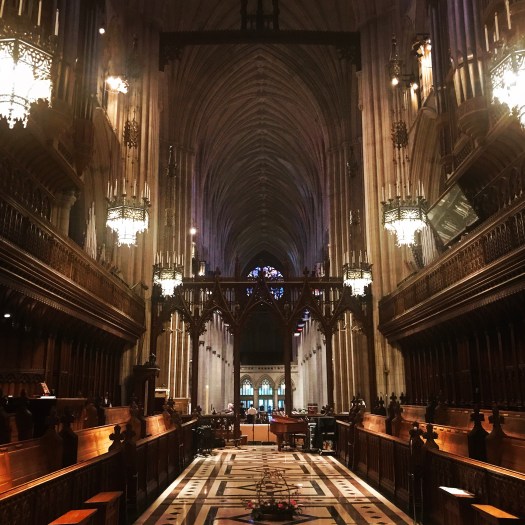
Last year I had the opportunity to visit the National Cathedral in Washington D.C.  It was spectacular and truly I could have spent several days there poking into the various rooms, chapels, and nooks.  I would have liked the time to stop and pray here and there and allow my soul to drift upwards.  It seemed, for whatever worldly reason, that I was nearer to my God.  I would not call it a religious experience, but it came close.

Many people travel far to honor the relics of the saints, marveling at their wonderful deeds and at the building of magnificent shrines. They gaze upon and kiss the sacred relics encased in silk and gold; and behold, You are here present before me on the altar, my God, Saint of saints, Creator of men, and Lord of angels!

Often in looking at such things, men are moved by curiosity, by the novelty of the unseen, and they bear away little fruit for the amendment of their lives, especially when they go from place to place lightly and without true contrition. But here in the Sacrament of the altar You are wholly present, my God, the man Christ Jesus, whence is obtained the full realization of eternal salvation, as often as You are worthily and devoutly received. To this, indeed, we are not drawn by levity, or curiosity, or sensuality, but by firm faith, devout hope, and sincere love.

I wonder and am ashamed.  Here in my church in Enid, Oklahoma, below the sanctuary lamp and within the chamber of the Tabernacle is my Lord!  Why is it that I do not desire and seek to know the Living God, to explore Him as I did that great building of wood, stone, and mortar?

Turn the eyes of my soul to Thee, my God, that I may behold the glory of Thy Presence.  That I may seek Thee where Thou truly are.

Sermon: Proper 4 RCL B – “The Sabbath”

The podcast can be found here.


pexels-photo-167964


A young man was the youth pastor in a rather conservative church.  At one meeting of the youth he decided to teach on evangelism.  The church was conservative enough, that films had never been shown within its walls; however, the youth pastor decided it was time they introduced some modern tools to engage the youth, but so as not to upset anyone, he selected a film that documented the work of missionaries.  We’re talking simple, safe, black-and-white religious-oriented movie. He showed the film, but less than hour after the film projector had been off the group of elders in the church called him in and asked him about what he had done. They asked, “Did you show the young people a film?” In all honesty he responded, “Well, yeah, I did.” “We don’t like that,” they replied. Without trying to be argumentative, the youth worker reasoned, “Well, I remember that at the last missionary conference, our church showed slides—” One of the church officers put his hand up signaling him to cease talking. Then, in these words, he emphatically explained the conflict: “If it’s still, fine. If it moves, sin! You can show slides, but when they start movin’, you’re gettin’ into sin.”

The church has been largely unsuccessful, but this has not deterred the church throughout the ages from trying all sorts of angles to keep folks from “gettin’ into sin.”  Some of those attempts were extreme.

In the fall of 1541 a certain preacher entered Geneva, Switzerland with a serious plan to bring religious reform to the city, so that the folks there would quit sinning. One of his first acts was to draft a set of laws that would govern the populace. Some of the laws were fairly typical of his day: swearing, gambling, drunkenness, and sexual immorality were outlawed.

But some of the other laws were probably as strange then as they seem now. People were not allowed to play cards, speak disrespectfully to others, feast, dance, sing, create art, wear jewelry, or skip church. Oh, and all children had to be named after characters from the Old Testament.  There were plenty of male names to go around, but I’m guessing there were a lot of Ruths and Esthers.

First time offenders were usually let off with a simple warning, but second time offenses drew a fine of some sort. For those who were bent on wearing earrings to the town dance, steeper penalties were enacted. Some lawbreakers were banished from the city. A dad who insisted on naming his son Claude spent four days in jail. A rebellious kid who got into a fight with his parents was beheaded. Women found pregnant out of wed-lock were drowned (along with her lover if he could be found). In the enforcement of his rules, the preacher was no respecter of persons. His step-son was found guilty of adultery and his daughter-in-law was caught behind a haystack with another man. All four of the criminals were executed.  

Today, this preacher is considered one of the great theologians and his teachings provide the foundation for many churches.  History has a way of washing away the dirt, even so, I’ve never really been a fan of John Calvin. (There’s a rant just waiting to boil over!).  But it wasn’t just Calvin.  From the beginning, the religious have attempted to legislate morality and the same was true for the Pharisees in the time of Jesus.

Our Gospel reading today begins with the third of three conflicts Jesus has with the Pharisees.  In the first, Jesus is found eating with the wrong sorts of people, leading the Pharisees to ask Jesus’ disciples, “Why does he eat with tax collectors and ‘sinners’?”  The second incident involved fasting.  The Pharisees asked Jesus, “How is it that John’s disciples and the disciples of the Pharisees are fasting, but yours are not?”  Today, they call Jesus out because they believe that Jesus and his disciples are “working” on the Sabbath.

We know that keeping the Sabbath holy is in the top ten commandments (#4): “Remember the sabbath day, and keep it holy.  Six days you shall labor and do all your work.  But the seventh day is a sabbath to the Lord your God; you shall not do any work.”

What were Jesus and the disciples doing?  As they were walking along the road they passed a wheat field.  Reaching out, they pulled a stalk of wheat and nibbled on the grain.  The pulling of the stalk was viewed as “harvesting,” therefore, it was work.  They had committed a most grievous sin! 

Jesus does not deny that they have plucked some wheat, but instead, he points to another incident when David and his men were hungry and also broke the law by eating the bread that was reserved for the priest, yet David and his men were not condemned.  (It is a completely different sermon, but Jesus has just set himself on an equal plain with great King David.)  Jesus then says, “The sabbath was made for humankind, and not humankind for the sabbath; so the Son of Man is lord even of the sabbath.”  Jesus says, “You’ve got it wrong.  The Sabbath was given, not as something to be legislated.  It was given to you as a gift.  It was given to you as a time of renewal for your body and your spirit.”  The very next incident in our Gospel shows this.

It is again the Sabbath and Jesus enters the synagogue.  There is a man with a deformed hand and Jesus asked him to stand so that everyone could see him.  Jesus then asked the Pharisees, “Is it lawful to do good or to do harm on the sabbath, to save life or to kill?”  They knew the answer.  They knew what was right, but they were so caught up, not only in maintaining the law, but also proving Jesus wrong, that they refused to say anything.  “They were silent. [Jesus] looked around at them with anger; he was grieved at their hardness of heart and said to the man, ‘Stretch out your hand.’ He stretched it out, and his hand was restored.”

The key to understanding these incidents occurs when Jesus asked the man to stand in the center of the room.  The man does, and Jesus asked, “Is it lawful to do good or to do harm on the sabbath, to save life or to kill?”  You see, Jesus was not asking about the law, Jesus was asking about the man.  By having him stand in the center of the room, he was asking the Pharisees, “What do you see?  Do you see someone who is suffering?  Do you see someone who is deprived of a full life?  Do you see someone afflicted?”  That deformed hand could also represent a deformed soul.  Somewhat caught up in sin.  Someone who has been emotionally harmed.  Someone who has given up on life.  And Jesus could very well have asked, “What do you see?  Are you unwilling to forgive them, to heal their souls, just because it is the sabbath?  Are you unwilling to restore them to spiritual health, because of some rule you have established?  This is the sabbath for crying out loud!  Of all days, this is the day of healing, of rest, of renewal, of worship, but you are so worried about someone plucking a head of wheat that you can’t be concerned with those souls that are dying all around you.”

I’ve always said that no one wakes up and decides, “Oh, I think I’ll become a heretic today.”  It comes from strong held beliefs.  The same applies to the Pharisees.  I don’t believe they intentionally sought to oppose God, but over time, they had these strong held beliefs about God and how He worked and that is through the application of the Law.  They then became so obsessed with this application of the Law that they no longer saw the person as the pinnacle of all God’s creation.  Instead they saw the person as a “project.”  Someone who needed to be legislated into holiness.  When Jesus entered the scene, they could either recognize the truth he was speaking or reject him, become hard hearted.  They chose the latter and like petulant children, they stuck their fingers in their ears and cried out, “We can’t hear you.”  But, because Jesus was gaining followers, because the people they so desperately wanted to legislate into holiness were following after this trouble maker, the Pharisees, Herodians and others begin looking for a way to destroy Jesus.

What does this look like in our own lives?  Imagine, if you will, that it is the sabbath and you are the man in the temple, the one with the withered hand.  You’ve not been able to care for yourself or your family.  You are in constant pain.  You are looked down upon because you are a drain on society.  You are considered sinful, because God does not afflict the righteous with such trials.  Jesus ask you to come and stand before everyone in all your brokenness and sinfulness.  Imagine you are that man. 

Now here is a truth: it is the sabbath and… you are that man, that woman.  You are the one afflicted, hurting, looked down upon, sinful.  Jesus, the one and only source of your healing stands before you, but someone raises a question and in so doing, reminds everyone of God’s Law: “Is it lawful to do good or to do harm on the sabbath, to save life or to kill?”  Question: How would you like for Jesus to respond?

Today’s lesson: “Go and do likewise.”

Let us pray: 

Father of love, hear our prayer. 

Help us to know Your Will 

and to do it with courage and faith. 

Accept the offering of ourselves,

all our thoughts, words, deeds, and sufferings. 

May our lives be spent giving You glory. 

Give us the strength to follow Your call, 

so that Your Truth may live in our hearts 

and bring peace to us and to those we meet, 

for we believe in Your Love.

Amen.

Sermon: Joan of Arc

The podcast can be found here.


pix_910x400_banner
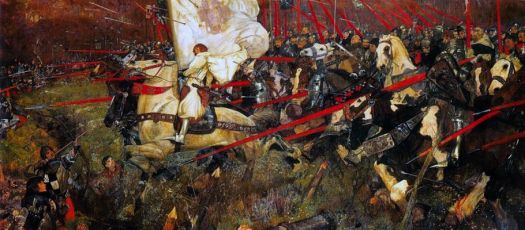
Jeanne d’Arc à la bataille de Patay by Franck Craig (circa 1900)

She “was a being so uplifted from the ordinary run of mankind that she finds no equal in a thousand years. She embodied the natural goodness and valour of the human race in unexampled perfection. Unconquerable courage, infinite compassion, the virtue of the simple, the wisdom of the just, shone forth in her. She glorifies as she freed the soil from which she sprang.” — Sir Winston Churchill

She is easily and by far the most extraordinary person the human race has ever produced.” — Mark Twain

Who is she?  Joan of Arc, “The Maid of Orléans.”

In her own words, she tells of how it all began: I was thirteen when I had a Voice from God for my help and guidance. The first time that I heard this Voice, I was very much frightened; it was mid-day, in the summer, in my father’s garden. I had not fasted the day before. I heard this Voice to my right, towards the Church; rarely do I hear it without it being accompanied also by a light. This light comes from the same side as the Voice. Generally it is a great light. Since I came into France I have often heard this Voice. 

The voice, God, told her to go forth and force the English out of France and then take the Dauphin (the first born son of the Charles VI) to Reims where he would be coronated.  However, driving out the French had proven problematic for the French.  The French military was in such disarray that it was often said that 200 English “could put to flight 1,000 of the French.”  Yet Joan persisted that God wold prevail in fulfilling her visions; therefore, the Dauphin’s religious leaders recommended putting her to the test.  If this peasant girl can rout the English out of Orléans, then she is who she says she is.  What the French had not been able to accomplish for many months, they accomplished in five days with Joan as their rallying point.

Her story is absolutely too fascinating for me to try or even want to summarize here, so I’ll share with you one of my favorite quotes of hers.  The episode occurs as she is traveling to see the Dauphin for the first time.  The journey is dangerous, with those in her party always in danger of being attacked by the English.  However, Joan’s faith in what God has called her to do is unwavering.  She says to those with her, “I do not fear the soldiers, for my road is made open to me; and if the soldiers come, I have God, my Lord, who will know how to clear the route that leads to messire the Dauphin. It was for this that I was born!”

Over time, that passage has been shortened to a “Tweetable” length: ”I am not afraid.  I was born to do this.”

God has not given us all visions, but we know that he has counted all the days of our lives and is as near to us as we are to ourselves; therefore, look to Joan and witness her unwavering faith and do not be afraid to live, for as God was with Joan, He is with all who love Him and follow his ways.

Let us pray: Oh God, Who hast raised up in an admirable manner, the virgin of Domremy, Saint Joan of Arc, for the defense of the faith and country, by her intercession, we ask Thee that the Church triumph against the assaults of her enemies and rejoice in lasting peace; through Jesus Christ Our Lord. Amen.


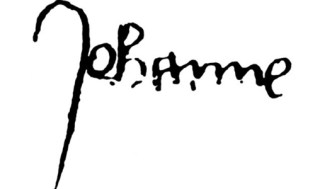
18a1f5dcc1f99f70a00e38ae3055157b_jehanne-signature-jpg

Sermon: Bede the Venerable

The podcast can be found here.


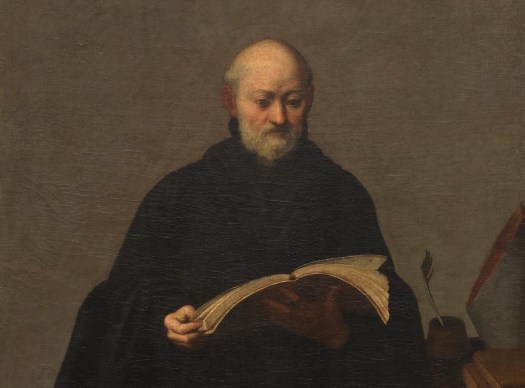
San_Beda,_de_Bartolomé_Román_(Museo_del_Prado)
San Beda, by Bartolomé Román

Today we celebrate the Venerable Bede.  The title, “Venerable” is used in the Episcopal Church for an Archdeacon, but in the Catholic Church, and in describing Bede, it refers “to a deceased person who has attained a certain degree of sanctity but has not been fully beatified or canonized.”  At the time it was given Bede, it was a title not widely, and although he has been canonized since, he is most often referred to as the Venerable Bede and not Saint Bede.  Perhaps that is because of the way he received “Venerable” as a title.

Legend has it that a monk was working on the inscription for Bede’s tomb and could not quite determine what he wanted it to say.  As he wrapped up the day, all he had was, Hac sunt in fossa, Bedae ____ ossa. “This grave contains, the ____ Bede’s remains.”  That night, an angel filled in the blank: Venerabilis.  Venerable.  How did he acquire such praise from the angel?

We’ve said in the past, that most of the Saints we venerate were not always the saintliest of people, apparently Bede is the exception that proves the rule.

In 686, the plague swept through England and infecting a particular monastery, wiped out all of the choir monks, which left them unable to properly sing the Divine offices (the seven times a day that the monks came together for prayer).  The abbot and a young boy were the only ones remaining who could do it, but to make the work easier for just the two of them, the abbot decided that the Psalms would only be chanted during two of the offices; however, after a week, with the assistance of only the boy, the abbot returned to chanting at every office.  We might think that’s not so difficult, we only did four verses of a Psalm today, but at that time, in the monasteries, all 150 Psalms were chanted through each week.  Want to guess as to how many verses that equals?  2,526.  The young boy that helped the abbot was the Venerable Bede, who entered the monastery and began studying at the age of seven.  After such an ordeal, you may think that someone so young would grow tired, but he was very dedicated to the daily offices.  He wrote, “I know that the angels are present at the canonical Hours, and what if they do not find me among the brethren when they assemble? Will they not say, Where is Bede? Why does he not attend the appointed devotions with his brethren?”

Tomb of the Venerable Bede
Tomb of the Venerable Bede, Durham Cathedral

He was ordained a deacon at age 19 (he needed special permission because the minimum age was 25) and was priested eleven years later.  In his work, he proved to be an imminent scholar and theologian and also considered to be one of the greatest Historians of the time, his most significant contribution being his History of the English Church (completed in 731), the primary source for almost all English history up to that time.  All this and he never lived more that sixty miles from where he was born.  When he died, upon hearing the news, St. Boniface wrote, “The candle of the Church, lit by the Holy Spirit, has been extinguished.”

Today, our Psalmist declared:
“We will recount to generations to come
the praiseworthy deeds and the power of the Lord,
and the wonderful works he has done.”

This was the work of Bede.  Passing on to the next generation the knowledge and wisdom of the past.  For this and his humble life, the angel gave him the title “Venerable.”  I wonder, if there were a blank before your name, what title would the angel give to you?

Sermon: Pentecost RCL B – “Fire”

The podcast can be found here.


pexels-photo-2


Gaston, a Cajun highlander from Rapides Parish in central Louisiana, was an older, single gentleman, who was born and raised a Baptist, living in South Louisiana. Each Friday night after work, he would fire up his outdoor grill and cook a venison steak. Now, all of Gaston’s neighbors were Catholic.  All was well with the neighbors until Lent came around.  The Catholics were forbidden to eat meat and the delicious aroma from the grilled venison steaks was causing such a problem for the Catholic faithful that they finally talked to their priest. The priest came to visit Gaston, and suggested that Gaston convert to Catholicism.

After several classes and much study, Gaston attended Mass and as the priest sprinkled holy water over him, he said, “You were born a Baptist and raised a Baptist, but now you are Catholic.”

Gaston’s neighbors were greatly relieved, until Lent and Friday night rolled around again, and the wonderful aroma of grilled venison filled the neighborhood.

The priest was called immediately by the neighbors and as he rushed into Gaston’s yard, clutching a rosary and prepared to scold him, he stopped in amazement and watched.

There stood Gaston, clutching a small bottle of water which he carefully sprinkled over the grilling meat, and chanted: “You wuz born a deer and you wuz raised a deer, but now you a catfish.”

Last week we talked about being transformed by God into temples of the Holy Spirit and the analogy that scripture sometimes uses for transformation is that of someone making a pot.  The potter cast the clay on the wheel and as it spins, the pot is formed.  In the process of turning the pot, the pot can be spoiled, so the potter takes the clay off and begins again.  However, once the pot is formed, it is still not finished.  It is still just clay and must be fired in a kiln—an oven—before it is suitable for use.  While in the oven, several chemical reactions take place.

When the clay reaches a temperature of almost 1000º, all of the water is finally pushed out of the clay and the pot becomes very fragile.  When the pot reaches a temperature just over 1800º it becomes what is known as ‘biscuit ware.’  It is very porous and absorbs water, but is relatively strong, because the clay has actually begun to melt and fuse together.  To get that glossy look and seal the clay, the pot must be allowed to cool, a compound is applied and the pot is fired again.  All this sounds easy enough, but it is a process that has been refined over the past 18,000 years.

As for us: “The Lord God formed man from the dust of the ground, and breathed into his nostrils the breath of life.”  God formed us from the earth and formed us in his image, as a potter forms the clay: “O Lord, you are our Father; we are the clay, and you are our potter; we are all the work of your hand.”  But in order for us to be completely formed as pots, temples of the Holy Spirit, then there must also be heat—fire.  “When the day of Pentecost had come, the disciples were all together in one place. And suddenly from heaven there came a sound like the rush of a violent wind, and it filled the entire house where they were sitting. Divided tongues, as of fire, appeared among them, and a tongue rested on each of them.”

Archbishop Michael Ramsey pointed out that the fire of the Holy Spirit serves two very specific purposes: light and warmth.  He writes, “The Holy Spirit enables you to see, and to see like a Christian—perceiving things as they really are in the eyes or mind of Jesus, and perceiving people as they really are with the light of Jesus upon them.”  The Potter forms you, then the fire of the Spirit comes upon you and its light allows you to see and understand your need for God and your relation to others.  The fire also provides warmth—love.  Not some sentimental or superficial love, but a love that lays down ones life for one friends.  A love directed toward God and neighbor.  You can see and you can feel, but you are not there yet, because the fire must do one thing before this work is completed: the fire must burn.  Ramsey writes, “The Spirit will burn his way through to the core of our being in the ever painful process of disclosure, penitence, and divine forgiveness.  Only by such burning can our heart be exposed fully to the warmth, and our mind be exposed fully to the light.”  Just as the potter places the pot into the kiln to transform it from clay to a usable vessel, we are placed into the fire of the Holy Spirit, which burns away the impurities of our lives, forming us into those vessels, those temples for the Spirit of God and sealed with the Holy Spirit.  Bishop Ramsey summarizes: “There is no seeing and no warming without burning.”  Anybody got a match?!

In addition, as the pot is glazed, sealed, we too are sealed in the Holy Spirit.  The priest pronounces while making the sign of the cross on the forehead of the newly baptized with chrism (holy oil), “You are sealed with the Holy Spirit in Baptism and marked as Christ’s own for ever.”  You have been transformed—not into a catfish—but a temple, a sanctified, holy temple for our God.  In the words of Pastor Garland Ray Hall of St. Stephen’s AME Church, “Somebody say, ‘Amen!’”  Now we’re getting somewhere.

At the time, it probably wasn’t easy for the disciples to hear: Jesus was telling them that he was leaving, that he would be put to death, but as he spoke to them he said, “I tell you the truth: it is to your advantage that I go away, for if I do not go away, the Advocate will not come to you, but if I go, I will send him to you.”  In order for us to receive our salvation, Jesus had to be put to death.  Had he gone and not sent the Holy Spirit, then our interaction with God would have been similar to what it had been before his coming.  The Patriarch of Antioch, Ignatius IV of the Greek Orthodox Church speaking to the World Council of Churches in 1968 put it this way, “Without the Holy Spirit God is far away. Christ stays in the past. The Gospel is simply an organization. Authority is a matter of propaganda. The Liturgy is no more than an evocation. Christian loving is a slave mentality. But in the Holy Spirit, the cosmos is resurrected and grows with the birth pangs of the Kingdom. The Risen Christ is there. The Gospel is the power of life. The Church shows forth the life of the Trinity. Authority is a liberating service. Mission is a Pentecost. The Liturgy is both renewal and anticipation. Human action is deified.”

Jesus died and in so doing, God transformed us into temples, so that when Jesus ascended, the Holy Spirit—the third person of the Holy Trinity—could be sent, and we could receive Him.  St. Paul writes, “The Lord is the Spirit, and where the Spirit of the Lord is, there is freedom.  And all of us, with unveiled faces, seeing the glory of the Lord as though reflected in a mirror, are being transformed into the same image from one degree of glory to another; for this comes from the Lord, the Spirit.”  Therefore, as Jesus said to those first disciples, I say to you, “Receive the Holy Spirit” and be transformed into the temple, the glory, and the image of the Lord.

Let us pray: Come, O Spirit of GOD, with God the Father’s love, by Christ’s Body and Blood; in the new birth of Thine own breath. Come to cure our littlenesses and consume our sins, to direct all our desires and doings; come with counsel on our perplexities, with light from Thy everlasting scriptures; come to reveal the deep things of GOD, and what He prepareth for them that love Him; come with Thy prayer into ours.  Jesus we pray.  Amen. 

Sermon: St. Dunstan

The podcast can be found here.


Dunstan and the devil 2


In the year 909, an expectant mother attended Candlemas in a crowded church.  As part of the service, everyone held a lit candle.  Suddenly, all the candles went out except for the one held by the expectant mother.  All those in attendance then came to her and relit their candle from hers.  When all were burning again, a holy many prophesied, “This child that is in her womb shall light all England with his holy life in time to come.”  That child was Dunstan and he did just that.

It seems that with each new king in England, Dunstan would rise or fall from favor, but in the times of favor, he did much to increase the sanctity of the church and would go on to become Archbishop of Canterbury.  As Archbishop, he continued that reform and did so by correcting those in error, even the king, who Dunstan once gave penance stating that for seven years the king would not be allowed to wear his crown—which he didn’t!  Following his penance, it was Dunstan who placed the crown back on the king’s head.  Much of the reforms he put into place were handled in a similar manner, which perhaps gave rise to one of the greatest legends about his life.

Legend says that Dunstan, who was also a great artist and craftsman, was working in a blacksmith shop.  While going about his business, a man appeared at the window and asked if Dunstan would make for him a chalice.  He agreed and let the man in; however, soon afterwards, the man began changing.  At times he was the old man, then a young boy, then a beautiful woman.  Dunstan realized that this was the devil trying to trick him, but instead of jumping in fear, he went about his work and casually placed the tongs on the fire.  When the tongs were red hot, he snatched them up and grabbed the devil by the nose.

The devil raged, but could not get free of Dunstan’s grasp.  When Dunstan felt as though he had won the battle, he pulled the devil outside by his nose and released him.  The devil fled down the road crying out, “Woe is me! What has that bald devil done to me? Look at me, a poor wretch, look how he has tortured me!”  Ever notice how the bully cries the loudest when they finally get their due?  Anyhow… one of the English folk rhymes tells the story:

British Library, Add MS 42130, f. 54v.


St Dunstan, as the story goes,

Once pull’d the devil by the nose

With red-hot tongs, which made him roar,

That he was heard three miles or more


Dunstan was one who did not hesitate to grab by the nose the devil, kings, priests, religious, or laity and bring them to a place penance.  

Jesus said, “Who then is the faithful and wise slave, whom his master has put in charge of his household, to give the other slaves their allowance of food at the proper time? Blessed is that slave whom his master will find at work when he arrives.”  Dunstan was faithful and therefore was one who was placed in charge of many.  In small ways and great, we are also placed over others, whether it be in our jobs, families, or other organizations.  I don’t recommend grabbing anyone by the nose, but we should all be prepared in our service to God, to watch over and correct those placed in our responsibility as Dunstan cared for those placed in his.