Sermon: Christmas 1 RCL A – “In the beginning…”

The podcast is available here.


The story of Adam and Eve was being carefully explained in the children’s Sunday School class. Following the story, the children were asked to draw some picture that would illustrate the story. Little Johnny was most interested and drew a picture of a car with three people in it. In the front seat, behind the wheel was a man and in the back seat, a man and a woman. The teacher was at a loss to understand how this illustrated the lesson of Adam and Eve, but little Johnny was prompt with his explanation, “Why, this is God driving Adam and Eve out of the garden!”

The story of Adam and Eve always conjures up thoughts of the creation and those famous first words, “In the beginning.” These three words appear several times throughout scripture, but I think we know them best from the prologue to St. John’s Gospel that we read this morning and also the opening words of book of Genesis, “In the beginning God created the heavens and the earth. The earth was without form, and void; and darkness was on the face of the deep. And the Spirit of God was hovering over the face of the waters.”

In the news we always get artist’s renditions of what something might look like and I’ve often wonder what their rendition of these opening words of Holy Scripture would be. In my mind, I see a black orb floating in black space, there are no stars or other planets, just this single orb, and it is covered in water. The water does not move. There is no life. It just sits, not stagnant, but still. I also see over the water a mist, a fog that is illuminated and it glows in a most holy and sacred light created of itself. The orb of course is earth, before God began his seven days of work, and the mist is the Spirit of God waiting in anticipation, hovering above the water.

And then as divine inspiration begins to churn, so do the heavens and the waters. Lights appear in the skies, creatures in the water. Land. Mountains. Rivers. Lakes. Trees. Animals. So creative is God in his holy work that not even a single snowflake on the highest peak is alike. Everything is divinely different, although some are similar, one polar bear is similar to another, but they are both unique in themselves.

And yet before all of this, “In the beginning” was also the Word, the Logos of God. The Logos of God is one of those very deep conversations, but we can simplify it by saying that Jesus is the incarnate Logos of God and so, in the beginning was Jesus and all that has been created was created through him.

In the New Testament we learn that you and I were also there. Not in bodily form, but in spirit – perhaps our soul. We know this because St. Paul teaches us, “God chose us in Jesus before the foundation of the world.” Before the foundation of the world God was, His Spirit was, Jesus was, and we were.

That’s the part that sort of trips up the brain. There was a movie in the eighties, The Seventh Sign, that popularized the idea of a place where the souls of every human being are held until they are born: the Guf. The movie was a bit off, but the idea of the Guf comes from Jewish mysticism.

In Jewish mysticism, the Chamber of Guf or body is also called the Hall of Souls, located in the Seventh Heaven. Every human soul is held to emanate from the Guf. In keeping with other Jewish legends that envision souls as bird-like, the Guf is sometimes described as a columbarium, or birdhouse. Folklore says sparrows can see the soul’s descent and this explains their joyous chirping. Is there any truth behind this teaching? Nothing biblical at all. It seems to be more a nice way to explain the unexplainable: how God could know us before the beginning of the world.

The point being, “In the beginning” when there was only God, we also existed in some form, whether as a thought of God or a soul, scripture is not clear, but that’s not the important part. The important part is that we may be similar to one another in body and form, but just as all the individual polar bears and snow flakes are unique, so are we. Therefore, before the beginning, God knew us individually and assigned each of us a unique role to play in His creation.

I was talking to my friend Heidi and she noted that, in spite of the fact that God knew who we were going to be and how we were going to turn out – the good, the bad, and the ugly – he still created us, because we, in small ways or great, were created to serve in his divine plan. What will that part be?

There is a plaque marking Abraham Lincoln’s birthplace near Hodgenville, Kentucky. On it is recorded this scrap of conversation between two fellas: “Any news down ‘t the village, Ezry?” “Well, Squire McLain’s gone t’ Washington t’ see Madison swore in, and ol’ Spellman tells me this Bonaparte fella has captured most o’ Spain. What’s new out here, neighbor?” “Nuthin’ nuthin’ a’tall, ‘cept fer a new baby born t’ Tom Lincoln. Nothin’ ever happens out here.”

What will our part be? We just don’t know. It might seem that nothing ever happens to us, but we have a unique role to play in God’s divine plan. If you’re like me, you would probably feel more comfortable with this unique role if God would provide a road map or something to help us figure it out instead of allowing us to stumble around in the dark, but in truth, he has. “In the beginning was the Word, and the Word was with God, and the Word was God. He was in the beginning with God. All things came into being through him, and without him not one thing came into being. What has come into being in him was life, and the life was the light of all people. The light shines in the darkness, and the darkness did not overcome it.”

A buddy was bike riding with some friends and they took a trek that led them through a very long train tunnel. The tunnel took a bend in the middle and so there was quite a bit of time when they could not see the beginning or the end of the tunnel. All they had to rely on were the small head lights on their bikes; however, even with them it was still almost pitch black. The tunnel seemed to absorb every ray of light. His comment to the rest of the group traveling with him, “There is never enough light in the tunnel when you can’t see the end.”

That seems to sum up nicely the role God has called each of us to play. We are not sure where it has been and even more uncertain as to where it is going, but the light of Christ shines just enough to overcome this present darkness that surrounds us and in that we can have faith in knowing that God is with us.

In the beginning you were with God even before he laid the foundations of the world. You are with him now even though you fear that you are sometimes lost. However, you will be with him forever because that is the ultimate goal of his divine plan.

Let us pray:
God of love, Father of all,
the darkness that covered the earth
has given way to the bright dawn of your Word made flesh.
Make us a people of this light.
Make us faithful to your Word,
that we may bring your life to the waiting world.
Grant this through Christ our Lord.

Amen.
Sermon: Christmas Eve 2019

The podcast is available here.


Photo by Martin Sattler on Unsplash

A fella reports that his grandmother, a staunch Southern Baptist, had marched him off to Sunday school and church regularly. So when he switched to the Episcopal church after marriage, she challenged him: “What’s wrong with the Baptist Church, son?”… ”Well,” he explained, “my wife and I flipped a coin to see if we would go to her church—the Episcopal Church—or mine, and I lost.” … ”Serves you right,” said his grandmother. “Good Baptists don’t gamble.”

I am not a good Baptist, but I am a good Episcopalian, which means I don’t mind putting a few dollars on a pony, but I won’t gamble away the paycheck; however, there are some who will stack up all their chips and shove them into the pot, hoping for the big payday. When it comes to hard earned money, that is not for me. When it comes to living my life… well, let’s just say I’m a bit conservative, although I have been loosening up a bit here recently. But what about when it comes to faith—a relationship with God? Well, as a good Episcopalian, I would wager that even if we were 100% certain of our faith, there was solid proof of God’s existence, the pearly gates, and all that… If we were 100% certain, I would wager that most of us would still hold back some for ourselves, unwilling to give our entire life to God.

Everyone that knows me knows that I have a wealth of information about sports. For example, I know that Lebron Jones was a running back for the OKC Heat. Great hockey team. That said, I recently read a fascinating article about Shelly Pennefather who was a huge basketball star for Villanova during the mid-1980s. Following college, she could have signed a contract worth $200,000 a year with the national league in Japan, which would have made her one of the highest paid women athletes. Yet, in June of 1991, she drove to the Monastery of the Poor Clares in Alexandria, Virginia where she would be received as one their members, no longer known as Shelly Pennefather, but as Sister Rose Marie of the Queen of Angels.

Unlike many monasteries where the nuns or monks are allowed to go out into the world, the one Sister Rose Marie is a member of is a cloistered community. The reporter writes: “The Poor Clares are one of the strictest religious orders in the world. They sleep on straw mattresses, in full habit, and wake up every night at 12:30 a.m. to pray [for those suffering in the world], never resting more than four hours at a time. They are barefoot 23 hours of the day, except for the one hour in which they walk around the courtyard in sandals… [Sister Rose Marie] gets two family visits per year, but converses through a see-through screen. She can write letters to her friends, but only if they write to her first. And once every 25 years, she can hug her family.” (Source) The occasion of the article was the 25th anniversary of Sister Rose Marie’s entrance into the monastery. On that day, she renewed her commitment and hugged her family and friends, she also hugged her 78-year-old mother for the first time in 25 years, realizing that her mother would need to live until she was 103 in order to hug her again.

Not only is the story fascinating, but I was also struck by the reporter, Elizabeth Merrill, who was struggling with understanding why someone with so many gifts would give it all up to… pray. Perhaps it was Sister Rose Marie’s friend, Father John Heisler who stated it best: “It’s a mystery to me too about why [the Poor Clares would] take somebody so talented, so giving, so energetic. She could help so many other young ladies to be women … to be strong, too, in their identity. Why should she be so hidden now? I’ve been really thinking … about the mystery of the stars. They’re so distant, yet they’re so beautiful.” The reporter couldn’t understand the “Why?” of Sister Rose Marie’s decision and neither could her friend, a priest.

I said I would wager that even if we were 100% certain of God that most of us would still hold back some for ourselves. We would be unwilling to give our entire life to God. So what was it that compelled a young woman with the promises of fame and riches to give it all up and lock herself away so that she could spend the remainder of her life praying for humanity? The answer is discovering that love is not about a Hallmark card, but about God, the Word that became flesh, and lived among us. And on this night, that love can be found wrapped in swaddling clothes, and lying in a manger.

There are people like Sister Rose Marie who encounter that love in such a manner that nothing else matters. To them, that love is life itself, and in order to have it, to be near it and experience it, and to share it, these individuals will sacrifice anything and everything, for there is nothing greater. These are willing to say with my friend St. Josemaría Escrivá, “How little a life is to offer to God!”

Tonight, I’m not asking you all to run off and join a monastery. That life is not for everyone, but I would ask, what are you prepared to sacrifice in order to experience more fully the babe in the manger? What would you give for this love of God? And I ask, what would you do, what would you give, because although this love is freely given, it does not come without transformation. You are loved as you are, but God does not expect you to remain as you are. That wonderful poet and writer, Kahlil Gibran, wrote in The Prophet:

“When love beckons to you follow him, Though his ways are hard and steep. And when his wings enfold you yield to him, Though the sword hidden among his pinions may wound you. And when he speaks to you believe in him, Though his voice may shatter your dreams as the north wind lays waste the garden. For even as love crowns you so shall he crucify you. Even as he is for your growth so is he for your pruning. Even as he ascends to your height and caresses your tenderest branches that quiver in the sun, So shall he descend to your roots and shake them in their clinging to the earth.”

So, what would you do, what would you give, to experience this transforming love? What will you “gamble”? My recommendation to you is to not rely on yourself, your own strength and courage to make such a decision. My recommendation to you is to humbly kneel before the baby in the manger, Jesus, and allow the love that saved the world to bring new life to you. In doing so, you will discover what Sister Rose Marie discovered who said at the end of her once every twenty-five years visit with family and friends: “I love this life. I wish you all could just live it for a little while just to see. It’s so peaceful. I just feel like I’m not underliving life. I’m living it to the full.” Kneel before the manger. Be transformed. Live life to the full.

Let us pray: Lord our God, with the birth of your Son, your glory breaks on the world. Through the night hours of the darkened earth, we your people watch for the coming of your promised Son. As we wait, give us a foretaste of the joy that you will grant us when the fullness of his glory has filled the earth, who lives and reigns with you for ever and ever. Amen.

Sermon: Advent 4 RCL A – Wedding Day

The podcast is available here.


Three men, one from Texas one from Mississippi and one from Louisiana were sitting together bragging about how they had given their new wives duties.

The one from Texas had, of course, married a girl from Texas and bragged that he told his wife she was to do all the dishes and house cleaning. He said it took a couple of days but on the third day he came home to a clean house and clean dishes.

The man from Mississippi had married a girl from Florida and bragged how he told her she was to clean the house, wash the dishes and have his supper on the table when he got hone. By the third day things fell right into place, the house was cleaned, the dishes all washed and his supper was on the table when he got home.

The third man, old Boudreaux had married Chlotiel from Louisiana and boasted that he told her that her duties were to keep the house clean, dishes washed, and the lawn mowed and a hot meal on the table. The first day he didn’t see anything, the second day he didn’t see anything, but by the third day, most of the swelling had gone down and he could see a little out of his left eye, enough to fix himself something to eat, load the dishwasher, and telephone a landscaper.

Marriage is difficult and not all of us have been very successful at it, but can you imagine an angel of the Lord telling you that you are to marry the Lord’s chosen vessel and be the Son of God’s stepdad? It’s an old joke, but think of it: Joseph tells Jesus to do something and little Jesus puts his hands on his hips and responds, “You can’t tell me what to do. You’re not my real dad.” Seriously. What are you going to do with that? But God in his wisdom knew what kind of man Joseph was and God knew that if there was any one man that could be the earthly father to his One and Only Son, it would be Joseph. Therefore, as our Gospel reading stated, “When Joseph awoke from sleep, he did as the angel of the Lord commanded him; he took [Mary] as his wife.” They were married and yet, even though it is perhaps the most famous of all marriages, we know very little about their life together.

Following the birth of Jesus, they fled to Egypt to avoid Herod’s murderous nature, then returned to Nazareth where they led a quiet life, except for the time Jesus got left behind in Jerusalem. We know very little, but apparently the marriage of Mary and Joseph had a profound effect on Jesus, for he used the language of marriage throughout his ministry and teachings. For example, “Let not your hearts be troubled. Believe in God; believe also in me. In my Father’s house are many rooms. If it were not so, would I have told you that I go to prepare a place for you? And if I go and prepare a place for you, I will come again and will take you to myself, that where I am you may be also.” Jesus spoke these words to the disciples, shortly before his death, but in a traditional Jewish wedding, these are the words that a groom would say to his fiancé. I’m going to prepare a place for us to live and when it is ready, I’ll come back for you and we can be married.

We also know that the language of the last supper is almost identical to the marriage covenant made between a man and a woman: “This cup is the new covenant in my blood.” These are the words of Jesus at the Last Supper, but the groom says similar words to the bride, out of love for you, if necessary, I will shed my blood, I will lay down my life, all of which points us to that greatest of all expressions of love: the cross and Jesus’ death.

Following his death and resurrection, the disciples continued to use the language of marriage to describe the relationship between Christ and the Church, the church being referred to as the Bride of Christ; and as the Church, this is something we confirm at the beginning of every wedding:

Dearly beloved: We have come together in the presence of God to witness and bless the joining together of this man and this woman in Holy Matrimony. The bond and covenant of marriage was established by God in creation, and our Lord Jesus Christ adorned this manner of life by his presence and first miracle at a wedding in Cana of Galilee. It signifies to us the mystery of the union between Christ and his Church, and Holy Scripture commends it to be honored among all people.”

Ask ol’ Boudreaux and he’ll likely tell you that he is prayin’ for an early death just to get out of his marriage, but in its perfected state, marriage “signifies to us the mystery of the union between Christ and his Church,” which is why marriage is not just about the happy couple. It is for us all, for on the last day, we are all the bride—the bride of Christ—therefore, as any bride would do, we make ourselves ready. From John’s Revelation:

“Let us rejoice and exult
and give him the glory,
for the marriage of the Lamb has come,
and his Bride has made herself ready;
it was granted her to clothe herself
with fine linen, bright and pure.”

And since we do not know the hour or the day of this great wedding feast, then everyday, we as the bride, must be prepared, we make ourselves ready, everyday; dressed in fine linen, bright and pure, because everyday has the potential of being our wedding day. Everyday there exists the possibility that we will see our Groom standing there, beckoning us to himself.

As the young woman says in the Song of Solomon:

The voice of my beloved!
Behold, he comes,
leaping over the mountains,
bounding over the hills.
My beloved is like a gazelle
or a young stag.
Behold, there he stands
behind our wall,
gazing through the windows,
looking through the lattice.
My beloved speaks and says to me:
“Arise, my love, my beautiful one,
and come away,
for behold, the winter is past;
the rain is over and gone.
…
Arise, my love, my beautiful one.”
…
“My beloved is mine, and I am his.”

Our beloved Christ Jesus calls to us: “Arise, my love, my beautiful one, for he is ours and we are his. Therefore, let us prepare ourselves for our wedding, to our beloved.

The light of God surrounds us,
The love of God enfolds us,
The power of God protects us,
The presence of God watches over us,
Wherever we are, God is,
And where God is, all is well.
Amen.

Sermon: John of the Cross

The podcast is available here.


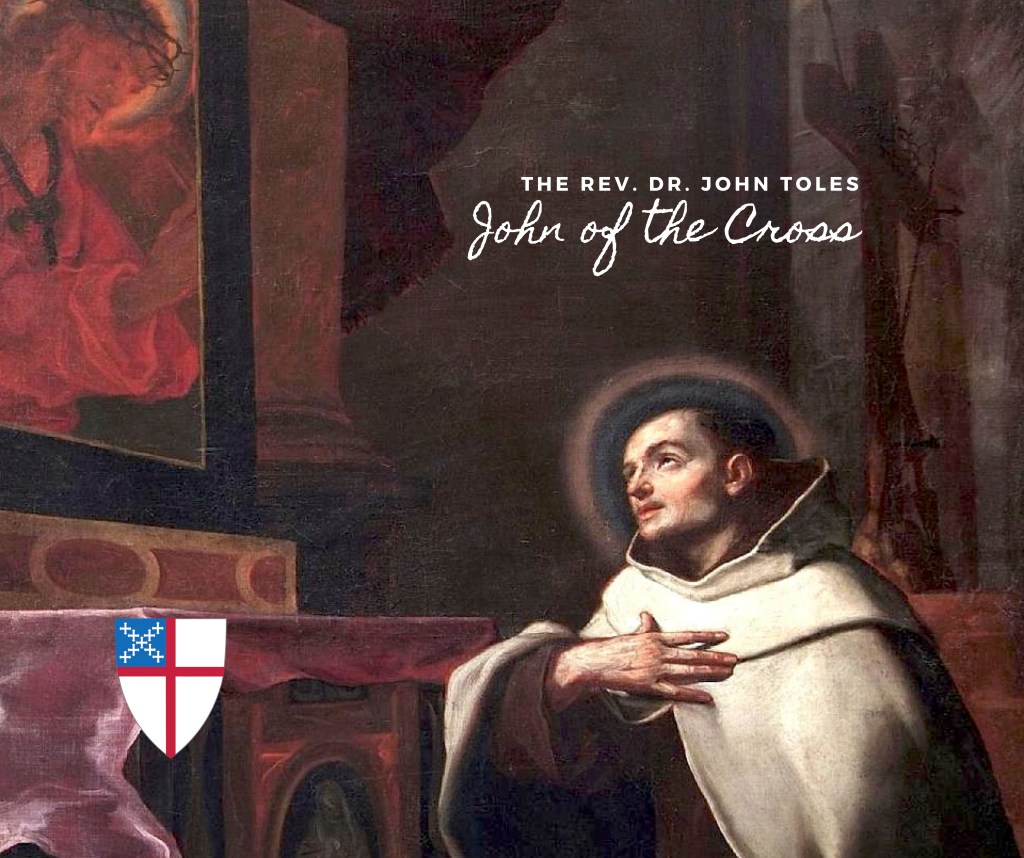
He stood at only four feet ten inches tall, but John of the Cross was a powerhouse.  A penitent writes, “Something shone through him or this witness saw something of God in him, lifting her eyes as it were beyond herself to look at and listen to him.  Looking at him she seemed to see in him a majesty beyond that given to men of this world.” (Source, p.144)  And our friend Teresa of Ávila said of him, he was “very spiritual and has great experience and learning.”  She declared him to be “the father of my soul.”   And writing to another nun, she says, “He is a divine, heavenly man.  I assure you, my daughter, since he left us I have not found another like him in the whole of Castile, nor anyone else who inspires souls with such fervor to journey to Heaven.  You would never believe how lonely I feel without him.” (Source, p. 145-6)  

Much of John’s writings and work deal with the progress of the soul toward perfection, so it is only fitting that our Gospel reading spoke of the Holy Spirit: Jesus said, “I still have many things to say to you, but you cannot bear them now. When the Spirit of truth comes, he will guide you into all the truth; for he will not speak on his own, but will speak whatever he hears, and he will declare to you the things that are to come.”

It is the Holy Spirit that guides us into all truth, but what we must also remember is that Christianity exists within the community.  So, with regard to learning the things of God and the work of the Holy Spirit, when St. Paul tells us to “test everything,” (1 Thessalonians 5:21) he is not suggesting that we test everything against our own knowledge and understanding, but that we instead test it in the context of scripture, tradition and reason.  We test things within the context of the Church.  If we try and go it alone, if we try to practice our faith outside of the Church, then we are likely to deceive ourselves and fall into error.  That is something that John of the Cross understood.  He writes, “The virtuous soul that is alone and without a master, is like a lone burning coal; it will grow colder rather than hotter. Those who fall alone remain alone in their fall, and they value their souls little since they entrust it to themselves alone. If you do not fear falling alone, do you presume that you will rise up alone? Consider how much more can be accomplished by two together than by one alone.” 

This then points to the fact that attending church is not something we do when it is convenient or when we don’t have anything else going on.  For the safety of our soul, attending church and participating in corporate worship are essential.  It is also the fulfillment of the first promise we make at our baptism and confirmation: “Will you continue in the apostles’ teaching and fellowship, in the breaking of bread, and in the prayers.”

At the moment, I’m preaching to the choir—you are all here, but this is something that we must all be reminded of and remind others of.  Billy Sunday said, “Going to church doesn’t make you a Christian any more than going to a garage makes you an automobile.”  That is a true statement, but going to Church will at least get you in the place where you might just encounter God, who will then accomplish the rest. 


Sermon: Thomas Merton

The podcast is available here.


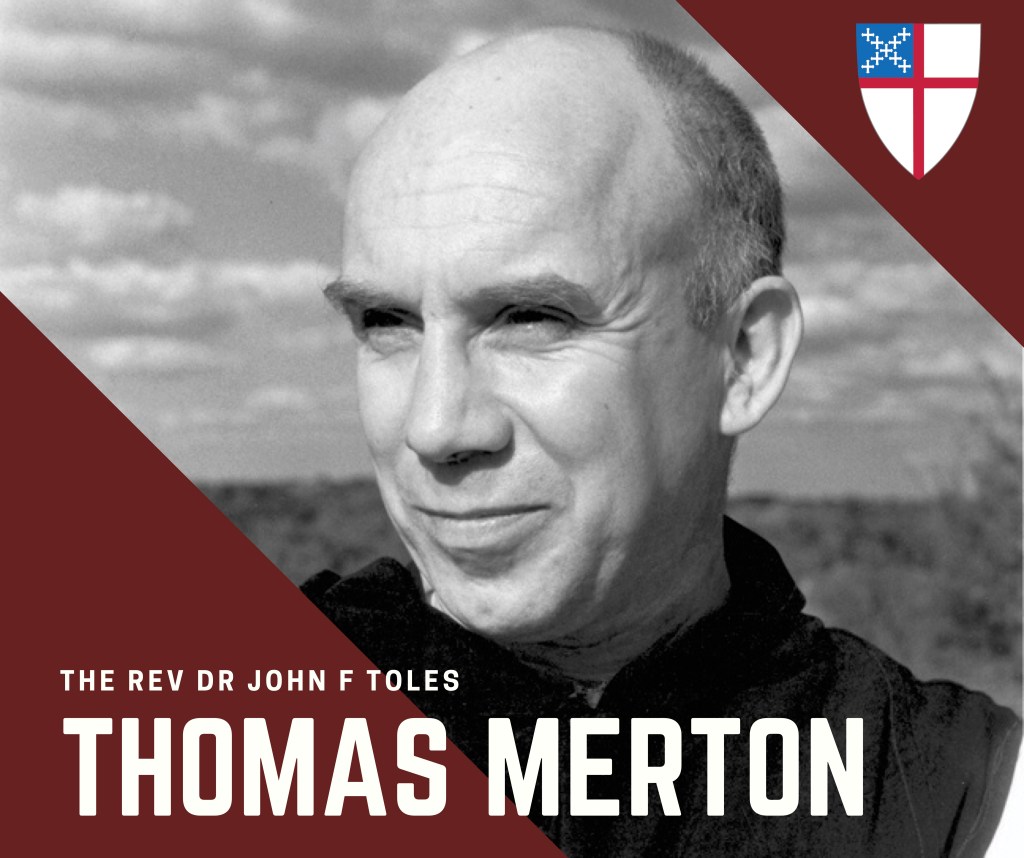
When he was fifty-one years old, he had romance with a nineteen year old nursing student who most authors simply refer to as “M.”  He also enjoyed sneaking off with friends and going out drinking.  Only problem: at the time of these events, he was a Trappist monk living in monastery.  Thomas Merton was not always as saintly as we would like to think and I do not believe that my friends Josemaría Escrivá or Thomas à Kempis would approve of his life, but what draws me to him, is that—unlike those two friends—I can relate to the humanness of Merton and the very real struggle that exists for us all.  That is, the struggle between our desire to follow God and our desires to experience the joys of being alive, which often appear—and most likely are—sinful.

We are currently reading the autobiography about Merton’s early life: The Seven Storey Mountain.  He wrote another autobiography which most are not so familiar with: The Other Side of the Mountain.  There are some who say, because of the sins of his later life and his studies into eastern religions, that we should not study anything that he has written—he was clearly not the person he led us to believe, while others simply excuse him, and still others attempt to understand what happened.  Mark Shaw falls into that latter group.  Shaw wrote Beneath the Mask of Holiness: Thomas Merton and the Forbidden Love Affair that Released Him.  During an interview, Shaw said of Merton,

“Becoming a monk was supposed to cleanse him of these sins, but from his own private journals, I knew this was not true. Instead, Merton’s failure to understand what loving, and being loved were all about caused him frustration, turmoil, and even depression. Beneath the mask of holiness, the plastic saint image promoted by the Catholic Church, was a sunken man who yearned for love while realizing he could never truly be one with God until he found it. Then, as I wrote in the book, the skies opened up and there was a gift, the love of a woman. It is no wonder Merton grabbed the chance to experience love despite the risks involved. And [“M”] taught him about loving, and being loved, opening up a path to freedom Merton never knew existed.” (Source)

I will never look for ways to justify my sins or anyone else’s, but I’m also not going to sit in God’s chair.  He is the One who judges and he will judge us all.  As Jesus said, “Now is the judgment of this world; now the ruler of this world will be driven out. And I, when I am lifted up from the earth, will draw all people to myself.”  In judgment, either for eternal life or eternal death, Jesus will draw all people to himself, but what we have to remember is that even for those who are judged for eternal life, the path by which they traveled is never straight, not even for the greatest of saints.

So, what are we to make of this sinful saint and his not so straight path?  In 1999, Nelson Mandela spoke at Rice University.  “Following his speech, Mandela took questions from the audience, including one from a 12-year-old who asked him how he wants to be remembered.  Mandela responded, ‘I never wanted to be regarded as an angel. I am an ordinary man with weaknesses.  I am not a saint, unless you think of a saint as a sinner who keeps trying.’” (Source)  Based on what I know of Thomas Merton, I think he would say, “Yes.  That’s me too.”  I also think that it is the best we can say of ourselves… but never use that as an excuse to sin.  Keep aiming to be a saint.


Sermon: Advent 2 RCL A – Holy Fear

The podcast is available here.


Fear. Jerry Seinfeld says, “According to most studies, people’s number one fear is public speaking. Number two is death. Death is number two. Does that sound right? This means to the average person, if you go to a funeral, you’re better off in the casket than doing the eulogy.”

Fear is one of those excellent motivators. For most (not all), fear of losing your job is a motivator to work harder or at least update the resumé. Fear of being caught and punished is motivation enough for most to obey the law. Fear of not passing is a motivator for students to study. The list goes on. For others, fear / or a rush, motivates folks to go bungee jumping or perform dangerous stunts. However, I think most of us would like to limit our fear to a scary movie and not find ourselves or put ourselves in a position where true fear is a possibility.

Throughout history, there have been a number of individuals who have struck fear in the hearts of many. From Genghis Khan to Dracula, these individuals have wreaked havoc on people’s blood pressure. Paul Harvey, that great voice of radio, also tells us of another who struck fear in the masses. In fact, this one’s name was enough to do the trick. Harvey tells:

“He was a professional thief… He terrorized the Wells Fargo stage line for thirteen years, roaring like a tornado in and out of the Sierra Nevada’s, spooking the most rugged frontiersmen. In journals from San Francisco to New York, his name became synonymous with the danger of the frontier. During his reign of terror between 1875 and 1883, he is credited with stealing the bags and the breath away from twenty-nine different stagecoach crews. And he did it all without firing a shot… Black Bart. A hooded bandit armed with a deadly weapon. What was his deadly weapon? One word, it was FEAR!”

The funny bit about Black Bart, is that he was nothing to be afraid of. According to Harvey, “When the authorities finally tracked down the thief, they didn’t find a bloodthirsty bandit from Death Valley; they found a mild-mannered druggist from Decatur, Illinois. The man the papers pictured storming through the mountains on horseback was, in reality, so afraid of horses he rode to and from his robberies in a buggy. He was Charles E. Boles – the bandit who never once fired a shot, because he never once loaded his gun.” (Paul Harvey’s The Rest of the Story, p. 117)

So, if we’re smart, we’ll be afraid of the right things and work to avoid them, or if we’re a bit goofy we’ll go looking for a certain amount of fear, and on occasion, the boogie man we all fear turns out to be a mild-mannered druggist from Illinois. Meanwhile, there’s God. St. Paul writes, to the Hebrews, “For we know him who said, ‘Vengeance is mine; I will repay.’ And again, ‘The Lord will judge his people.’ It is a fearful thing to fall into the hands of the living God,” yet—and this is the crazy bit—we may be afraid of getting a speeding ticket, but we’re no more afraid of being judged by the Creator of the heavens and the earth than we are of being afraid of a puppy. Why is that?

Michael Yaconelli, in his book Dangerous Wonder, provides us with a bit of insight into why: “We have become comfortable with the radical truth of the gospel; we have become familiar with Jesus; we have become satisfied with the church. The quick and sharp Bible has become slow and dull; the world-changing church has become changed by the world; and the life-threatening Jesus has become an interesting enhancement to modern life.” (p.113)

Take our Gospel reading from today: “You brood of vipers! Who warned you to flee from the wrath to come?… Do not presume to say to yourselves, ‘We have Abraham as our ancestor’… the ax is lying at the root of the trees; every tree therefore that does not bear good fruit is cut down and thrown into the fire….
He will baptize you with the Holy Spirit and fire…. he will clear his threshing floor and will gather his wheat into the granary; but the chaff he will burn with unquenchable fire.” Does that spark in fear in your soul? No. I’m guilty of it. I listen to those words, think how much I like John the Baptist’s style, and go home; never giving, “He will baptize you with the Holy Spirit and fire,” a second thought. “It is a fearful thing to fall into the hands of the living God.” Cool.

I’m not saying that we need the kind of fear that drives us to go running through the streets like we’re being chased by some rabid clown straight out of a Stephen King novel, but I do think we need to more closely consider who it is we serve. Once, Hugh Latimer had to preach to King Henry VIII and he reports that he said to himself, “Latimer! Latimer! Remember that the king is here; be careful what you say.” After considering this, he said to himself, “Latimer! Latimer! Remember that the King of kings is here; be careful what you do not say.”

Granted, as we draw closer to Jesus, it does seem that we should in fact be more comfortable with God, but consider the time that the disciples and Jesus were out on the sea when the great storm came up. The disciples feared for their lives, but Jesus was asleep in the bow of the boat. They cried out to him, “Teacher, do you not care that we are perishing?” They feared for their lives, so they called to Jesus, and Mark’s Gospel tells us that Jesus “awoke and rebuked the wind and said to the sea, Peace! Be still!’ And the wind ceased, and there was a great calm. He said to them, ‘Why are you so afraid? Have you still no faith?’ And they were filled with great fear and said to one another, “Who then is this, that even the wind and the sea obey him?” Jesus calmed the storm and the disciples “were filled with great fear.” They were with him, they knew him, they walked and ate with him, but they had not become comfortable with this Jesus and the things he did. They loved him and they knew that he loved them, and they would go on to follow him—literally—to their dying breath, but there was always this holy fear of what this Jesus, this God would do. And maybe, that points us to the real problem. Maybe we do fear God, but not with a holy fear. Maybe we’re simply afraid to wake him, because we are afraid of what he might do. We’re afraid of how he may change us and our lives. We’re afraid of what it will look like if we give ourselves to Him. We’re afraid of who we’ll become, which means we are afraid of being transformed into the person God created us to be.

I’m fairly certain it was the final installment of the Calvin and Hobbes comic strip: the scene is a blanket of heavy snow, Calvin is all bundled up, and Hobbes the tiger is carrying the sled. Calvin says, “Wow, it really snowed last night! Isn’t it wonderful?” Hobbes replies, “Everything familiar has disappeared! The world looks brand-new.” “A new year… a fresh clean start!” Calvin adds and then, “It’s a magical world, Hobbes, ol’ Buddy… let’s go exploring!”

What if in our relationship with God we let go of the familiar and entered into the words of Jesus, “Behold, I make all things new.” What if, in union with and in holy fear of our God, we went exploring… what if we went boldly into the world in anticipation and wonder of what our God might do? What if, during this season of Advent, as we read about the Son of God coming into the world we actually allowed him to come into our lives and transform us? What if…

Let us pray: Father, in the wilderness of the Jordan you sent a messenger to prepare people’s hearts for the coming of your Son. Help us to hear his words, so that we may clearly see the way to walk, the truth to speak, and the life to live for Him, our Lord Jesus Christ. Amen.

Photo by Marina Vitale on Unsplash