MY CHILD, do not take it to heart if some people think badly of you and say unpleasant things about you. You ought to think worse things of yourself and to believe that no one is weaker than yourself. Moreover, if you walk in the spirit you will pay little heed to fleeting words. It is no small prudence to remain silent in evil times, to turn inwardly to Me, and not to be disturbed by human opinions. Do not let your peace depend on the words of men. Their thinking well or badly of you does not make you different from what you are. Where are true peace and glory? Are they not in Me? He who neither cares to please men nor fears to displease them will enjoy great peace, for all unrest and distraction of the senses arise out of disorderly love and vain fear.
Boudreaux, Thibodeaux, and Hebert were sitting around talking one afternoon after enjoying a little crawfish boil, and the conversation turned to what they would like to have people say about them if they suddenly died. Hebert says, “Me, if I could hear what dey are saying while I’m laying in my casket is dat I was a great doctor and a good family man.” Thibodeaux says, “Me, I would like to hear dem say dat I was a good husband and a great teacher, and made a difference in de lives of hundreds of childrens.” Boudreaux thinks for a minute and says, “Mais, me, I would like to hear somebody say, ‘Look, he’s moving!’”
I’ve been working through a book recently, Dangerous Wonder, by Michael Yaconelli. It is one of those books you could easily read in a day, but I’ve been taking my time, because it seems that each chapter takes awhile to work into the system. During this Season of Advent, you’ll likely hear me reference it and talk about it more than once. In one of the early chapters, Yaconelli quotes Juan Carlos Ortiz who is an evangelist and pastor from Argentina. Ortiz writes, “The living Jesus is a problem in our religious institutions. Yes. Because if you are having a funeral, a nice funeral, and the dead person starts to move, there goes the funeral! And dear brothers and sisters, Jesus is moving!”
This is the first Sunday of Advent, the church new year. During these Sundays of Advent, we hear about the second coming of Jesus and his first coming. There are readings that call for us to be aware and to be awake. However, as we look for his second coming, we must also be aware of his current presence. Sounds a bit confusing, but we know that even though Jesus is coming again, he is also with us until the very end of the age, so in order for us to know him then, we must also know him now, for as he says, “The kingdom of God is within you… the kingdom of God is now.” Therefore, it seems that when Jesus says to us, “Keep awake” and “Be ready,” he is not only talking about being awake and ready for the great and terrible day of the Lord, but that he is also talking about being awake and being ready for this and everyday. Unfortunately, for any number of reasons our faith can become dry and sterile, and our daily lives with God and our corporate and personal worship of the Creator of the Heavens and the Earth begins to more closely resemble a funeral than it does a celebration. God becomes a backup plan and our worship is a job, something to check off the to do list. In his own life, Yaconelli tells us that it was because he was working so hard for God that he fell into this trap and forgot to see, to encounter God, and he realized this when he visited L’Arche Daybreak Retreat Center, the same place that Henri Nouwen went to live when he decided to give up all the writing and speaking and the “working” for God.
L’Arche is a place where severely mentally and physically handicapped individuals are sent, and in many cases, abandoned. Those who work there care for these individuals, where—due to the limitations of the individual—a small breakfast can take quite some time. Yaconelli tells that soon after his arrival he met Robert, a young man whose vocabulary was limited to a couple of hundred words. The first thing Robert said to Michael was a question: “Busy?” Michael responded, “Yes, Robert. I’m very busy.” “Too Busy,” Robert asked. “Yes, Robert. I’m too busy,” Michael answered. Robert’s questions and his answers got Michael to thinking: why am I so busy? He concluded: “Why was I so busy? Because I still was hanging on to the belief that God’s affection for me was measured by my activity for Him. The more things I did for God, the more He would love me.” Michael said that he had this “need to prove to God I was worth loving.”
Here is someone whose entire life was dedicated to the work of the Kingdom of God, but he could never truly experience God, because he was so caught up in trying to convince God to love him. If someone like Yaconelli can fail to truly see and encounter God, then it is no wonder that any of the rest of us, for any number of reasons, can and will do the same.
Jesus said, “You also must be ready, for the Son of Man is coming at an unexpected hour.” We cannot encounter God today, because we keep thinking that the “unexpected hour” is off in the distance, when in fact, it is now. What did Paul say to the Romans in our reading? “You know what time it is, how it is now the moment for you to wake from sleep. For salvation is nearer to us now than when we became believers; the night is far gone, the day is near.” The time is now…
T-ball or baseball for younger children. Prop the ball up on the jumbo golf tee and let the kids swing away. Everyone plays and everyone is a winner, but not all of them are athletes. Enter Tracy. She is described as as “not very good. She had coke-bottle glasses and hearing aids on each ear. She ran in a loping, carefree way, with one leg pulling after the other, one arm windmilling wildly in the air.” At bat, she might generate enough air around the ball that it fell off the tee or she would hit the tee and send the ball rolling forward, but she never got a proper hit until the last game of the season when the stars aligned perfectly. It wasn’t just a hit. She apparently clobbered it, sending the ball sailing over heads and then rolling between legs.
She windmilled her way to first base and the coach waved her on (by then, the entire opposing team was in the outfield, chasing the ball.) When she got to second, the third base coach called her on, so she ran some more. The ball finally made it back into play, but for some reason ended up along the first base line. At this point, the entire stadium of parents, on both sides, were going wild cheering for Tracy—this was going to be a home run for the girl who never even got a hit. The third base coach waved Tracy on and she was headed to home plate “and then it happened. During the pandemonium, no one had noticed the twelve-year-old geriatric mutt that had lazily settled itself down in front of the bleachers five feet from the third-base line. As Tracy rounded third, the dog, awakened by the screaming, sat up and wagged its tail at Tracy as she headed down the line. The tongue hung out, mouth pulled back in an unmistakable canine smile, and Tracy stopped, right there. Halfway home, thirty feet from a legitimate home run. She looked at the dog. Her coach called, “Come on, Tracy! Come on home!” He went to his knees behind the plate, pleading. The crowd cheered, “Go, Tracy, go! Go, Tracy, Go!” She looked at all the adults, at her own parents shrieking and catching it all on video. She looked at the dog. The dog wagged its tail. She looked at her coach. She looked at home. She looked at the dog. Everything went to slow motion. She went for the dog!” The crowd went completely silent, then broke into cheers of approval, as Tracy knelt down and hugged the dog…… Please do not tell the Bishop that Fr. John said Jesus was a twelve-year-old geriatric mutt with a goofy grin, but what if we had that the same spirit about encountering Jesus today as Tracy had in encountering that silly dog? What if, in the midst of all the world’s shouting, expectations, opportunities for success, even the encouragement of well intentioned individuals… we put a stop to it all and embraced Jesus instead?
Jesus is coming, but the body is moving and Jesus is now. Seek him today, while he wills to found.
Our Collect of the Day read: Almighty God, give us grace to cast away the works of darkness, and put on the armor of light, now in the time of this mortal life in which your Son Jesus Christ came to visit us in great humility; that in the last day, when he shall come again in his glorious majesty to judge both the living and the dead, we may rise to the life immortal… but to close, I would like to change that bit, because we can cast away the darkness and put on the armor of light, not just on the last day, but today as well, for this is indeed a day that the Lord hath made…
Let us pray: Almighty God, give us grace to cast away the works of darkness, and put on the armor of light, now in the time of this mortal life in which your Son Jesus Christ came to visit us in great humility; so that not only will we be raised with him on the last day, but so that we may be surprised by him today when we encounter him in the face of family, friends and strangers, that we may know him as we journey toward the manger, and that we will have the courage, despite the encouragement of world, to stop all our running and embrace him, even if he is standing along the third base line. This we pray in His Name. Amen.
It seems that kids are getting creative when they don’t know the answer on a test. Examples:
“What did Mahatma Gandhi and Genghis Khan have in common?” — Unusual names.
“Name six animals which live specifically in the Arctic?” — Two polar bears and three… four seals.
“What is the highest frequency noise that a human can register?” — Mariah Carey
“What is a fibula?” — A little lie.
“What is a vibration?” — There are good vibrations and bad vibrations. Good vibrations were discovered in the 1960s.
Finally… “Briefly describe what hard water is.” — Ice.
All this goes to prove that the answer you are expecting may not necessarily be the one you get.
Today, we read, “Some were speaking about the temple, how it was adorned with beautiful stones and gifts dedicated to God.” The temple. It was a magnificent structure. We know, they are still there today, that some of the stones that made up the walls and other structures, weighed up to 160,000 pounds—eighty tons! It was impressive in size and beauty. There are several descriptions of its beauty, one of which comes to us from the historian Josephus, who would have actually seen it. He writes, “The exterior of the building lacked nothing to astonish either the soul or the eyes. For being covered all over with massive plates of gold, as soon as the sun was up, it radiated to a fiery beam of light that it forced those straining to look at its emanations to turn away their eyes, as if from solar rays. To approaching strangers it appeared from a distance like a snow-clad mountain; for all that was not overlaid with gold was of the purest white.”
Yet, as those with Jesus are gazing upon this beautiful structure, “Jesus said, ‘As for these things that you see, the days will come when not one stone will be left upon another; all will be thrown down.’”
And so they asked him a question, “Teacher, when will this be, and what will be the sign that this is about to take place?’” I’m guessing that the answer they received was not the one they expected: “Beware that you are not led astray… The time is near!… Nation will rise against nation, and kingdom against kingdom… they will arrest you and persecute you.” And, of course, it all came to pass.
The Israelites had been in rebellion against Rome and controlled the Jerusalem for four years and in 70 a.d., the Romans had finally had enough. They laid siege to Jerusalem and on August 30, 70 a.d. broke through the walls and sacked the city. Not only did they destroy the city, but, as Jesus prophesied, set fire to the temple and destroyed it. Josephus records the events: “As the flames shot into the air the Jews sent up a cry that matched the calamity and dashed to the rescue, with no thought now of saving their lives or husbanding their strength; for that which hitherto they had guarded so devotedly was disappearing before their eyes.” (Source) The description of what occurred next is not suitable for a Sunday morning, suffice it to say, those who tried to fight the fire were put to the sword by the Romans soldiers.
The only thing that I think would really compare to this for you and I is the bombing of the World Trade Center in New York. We all stopped. We all watched. We were all horrified. And there was nothing to be done about it.
Following what we heard today in our Gospel reading, Jesus continues with his discourse on the horrors to come: “When you see Jerusalem being surrounded by armies, you will know that its desolation is near. Then let those who are in Judea flee to the mountains, let those in the city get out, and let those in the country not enter the city.” There is talk of signs in the heavens and all sorts of other calamities. What makes this relevant for us today, is that not only do we understand these words of Jesus to be speaking about the destruction in 70 a.d., but we also understand him to be speaking about the end of days, when he shall come again. These events—destruction, end of days, wars, signs, persecution—these events are going to occur again, and just as the Israelites could not prevent them in their day, there is nothing we can do to prevent them from occurring in ours. People say that the world is in a terrible mess, that it can’t get much worse, and I just want to say, “Your kidding, right? Have you read about what is to come?” But here’s the thing: we can get in this mindset, many do, about looking for these signs and we can fall into a place of depression, fear, and dread. Why? This sermon is a perfect example of why. We get so focused on ‘all this’, that we miss the words spoken of our salvation. We hear of insurrections, death, earthquakes, persecutions, but in listening to these words of Jesus, did you hear of your salvation? It was right at the end: “But not a hair of your head will perish. By your endurance you will gain your souls.”
Yes. The teachings about the end are important and we should pay close attention to them. On hearing these words, as our collect for the day said, we should “hear them, read, mark, learn, and inwardly digest them,” but not so that we can fall into that place of dread, but so “that we may embrace and ever hold fast the blessed hope of everlasting life.” So that in the midst of the ugliness, we might endure.
Jack Canfield tells about a young high school student whose father was a horse trainer. Because the family had to follow the horse-racing season, the young boy had to change schools throughout the year. During his senior year he was asked to write a paper about what his dreams for the future were. His paper described his dream of owning a 200-acre horse ranch with stable and tracks, and a 4,000-square-foot home. He even drew a diagram of the property and the design of his house. He turned the paper in…and two days later it came back with an “F” on the front and note to see the teacher. After class, the teacher explained to the boy that his dream was “unrealistic.” The teacher said that if the boy rewrote the paper with a much more realistic dream, he would reconsider the grade. The boy went home and asked his father what to do. “It’s your decision,” said the father. Dad knew this was a very important decision. The boy kept the paper for a week and then returned it to his teacher after class. “Here” the boy said, “you can keep the ‘F’ and I’ll keep my dream.” (Source, p.25-26)
We as a Christian people can become so jaded and discouraged by the world around us. We look at the world and see all its failures and we understand what is to come, we watch others suffer and we experience our own pain and loss, we see the temple standing in all its glory and we visualize the final destruction, we see the “F” on the page and we wonder what is to be done. It is then that Our Father in Heaven tells us, “It’s your decision. I have told you that not a hair of your head will perish eternally, so you can either drown in the ugliness that is or you can hold onto the dream… the promises I have made to you.” What are those promises? Jesus said, “Do not let your hearts be troubled. You believe in God; believe also in me. My Father’s house has many rooms; if that were not so, would I have told you that I am going there to prepare a place for you? And if I go and prepare a place for you, I will come back and take you to be with me that you also may be where I am.” As we learned in our study of Romans: “Those who are led by the Spirit of God are the children of God. The Spirit you received does not make you slaves, so that you live in fear again; rather, the Spirit you received brought about your adoption to sonship. And by him we cry, ‘Abba, Father.’”
When the world begins to question you, “Isn’t all this a waste of time? Is there any real sense carrying on?” Give them an answer they don’t expect: “You can keep your failures and your ugliness and I’ll keep my dream. I’m holding to the promises of my God, my Abba, my Father, who is faithful and true. He is making all things new.”
Let us pray: Father in Heaven, ever-living source of all that is good, keep us faithful in serving You. Help us to drink of Christ’s Truth, and fill our hearts with His Love so that we may serve You in faith and love and reach eternal life. In the Sacrament of the Eucharist You give us the joy of sharing Your Life. Keep us in Your presence. Let us never be separated from You and help us to do Your Will. Amen.
Simon Peter said to Him, “Lord, where are You going?”
Jesus answered him, “Where I am going you cannot follow Me now, but you shall follow Me afterward.”
Peter said to Him, “Lord, why can I not follow You now? I will lay down my life for Your sake.”
Jesus answered him, “Will you lay down your life for My sake? Most assuredly, I say to you, the rooster shall not crow till you have denied Me three times.”
A few hours later…
“One of the servants of the high priest, a relative of him whose ear Peter cut off, said, ‘Did I not see you in the garden with Him?’ Peter then denied again; and immediately a rooster crowed.”
You are all familiar with that passage. The event took place on the night before Jesus was crucified. Peter’s denial.
On the night before the crucifixion, had you been in Peter’s place, what would you have done? It would be very easy for me to stand up here and say, “Peter needed to have more faith. Courage, man!” But it was Socrates who said, “Know thyself,” and I do, at least a bit. The part I know says that I would have stood beside Peter and boldly declared, “I will never deny you” and would also have ended up alongside Peter in torment over my failure.
Yet, for each of our failures, Jesus comes to us and restores us to himself just as he did Peter. From our Gospel, “Simon son of John, do you love me more than these?” “Yes, Lord; you know that I love you.” “Feed my lambs.” “Do you love me? Feed my sheep.” And again, “Do you love me? Feed my sheep.” Three times Peter denied him and three times Jesus restored him.
What I find interesting about this event is that in restoring Peter to himself, you would think that Jesus would not have asked Peter, “Do you love me?,” but would have instead said to him, “Peter, I love you.” This seems that it would have been much more soothing to Peter’s soul, but then again, Jesus had already shown Peter how much he loved him. As we pray during Morning Prayer, “Lord Jesus Christ, you stretched out your arms of love on the hard wood of the cross that everyone might come within the reach of your saving embrace.”
Because of his failure, Jesus knew that Peter was doubting his love for him. So, Jesus knew that it wasn’t he who needed to convince Peter of his love by saying, “I love you. I love you. I love you.” Jesus had said that as loudly and clearly as he possibly could from the hard wood of the Cross. What Peter needed was to convince Peter – himself – that he loved Jesus. Only then could Peter go out and do as Jesus had commanded him to do and feed his sheep.
The great Anglican priest and one of the co-founders of the Church Missionary Society, Charles Simeon (d. 1836), who we celebrate today wrote, “We shall do well ever to remember, that Christianity is not a mere speculative theory that is to inform the mind; but a great practical lesson, to renew the heart, and to bring us back to the state from whence we are fallen.”
Many times, like Peter, we will stumble and fall and deny Christ by our words and actions. It is through God’s grace and love that our hearts are renewed and we are restored to that state from where we have fallen. Through the Cross, Jesus has proven his love to us, and the greatest barrier to receiving that grace is not God or the world – it’s us. Through the Cross Jesus has said, “I love you.” He then asks each of us, as he did Peter, “Do you love me?”
SELF-LOVE IS THE GREATEST HINDRANCE TO THE HIGHEST GOOD
THE VOICE OF CHRIST
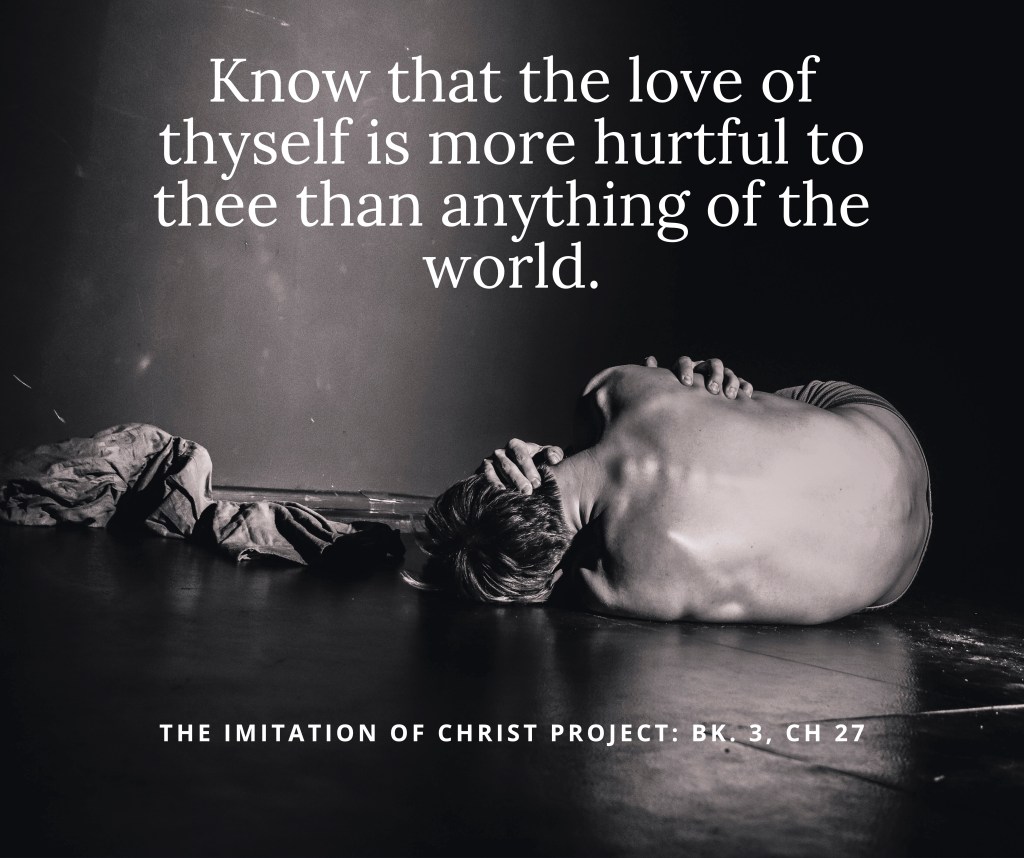
MY CHILD, you should give all for all, and in no way belong to yourself. You must know that self-love is more harmful to you than anything else in the world. In proportion to the love and affection you have for a thing, it will cling to you more or less. If your love is pure, simple, and well ordered, you will not be a slave to anything. Do not covet what you may not have. Do not possess anything that can hinder you or rob you of freedom.
It is strange that you do not commit yourself to Me with your whole heart, together with all that you can desire or possess. Why are you consumed with foolish sorrow? Why are you wearied with unnecessary care? Be resigned to My will and you will suffer no loss.
If you seek this or that, if you wish to be in this place or that place, to have more ease and pleasure, you will never rest or be free from care, for some defect is found in everything and everywhere someone will vex you. To obtain and multiply earthly goods, then, will not help you, but to despise them and root them out of your heart will aid. This, understand, is true not only of money and wealth, but also of ambition for honor and desire for empty praise, all of which will pass away with this world.
The place matters little if the spirit of fervor is not there; nor will peace be lasting if it is sought from the outside; if your heart has no true foundation, that is, if you are not founded in Me, you may change, but you will not better yourself. For when occasion arises and is accepted, you will find that from which you fled and worse.
A young lady was soaking up the sun’s rays on a Florida beach when a little boy in his swimming trunks, carrying a towel, came up to her and asked her, “Do you believe in God?” She was surprised by the question but she replied, “Why, yes, I do.” Then he asked her: “Do you go to church every Sunday?” Again, her answer was “Yes!”
He then asked: “Do you read your Bible and pray everyday?” Again she said, “Yes!” By now her curiosity was very much aroused. The little lad sighed with relief and said, “Will you hold my quarter while I go in swimming?”
Apparently finding a person honest enough to hold your quarter is a difficult task.
According to a Gallup poll, a number of factors go into how we will perceive a person’s level of honesty, one of which is their profession. Who do we judge as the most honest profession? Nurses. The least honest? Well that one’s not hard—members of congress. Heck, even telemarketers did better than them. Surprisingly (or maybe not so much), clergy came in eighth place, just below funeral directors. (Source) All this talk on honesty to say: this morning, let’s be honest.
As we were saying/singing the Psalm, did you actually pay attention to the words? Listen to this bit again… it begins:
“Hear my plea of innocence, O Lord;
give heed to my cry…”
And then a verse on:
“Weigh my heart, summon me by night,
melt me down; you will find no impurity in me.
I give no offense with my mouth as others do;
I have heeded the words of your lips.
My footsteps hold fast to the ways of your law;
in your paths my feet shall not stumble.”
Honestly… I know that I was lying when I said those words. Honestly, there are more than a few impurities in me, I do offend with my mouth, I don’t always heed the words of the Lord, and honestly, my footsteps take me down some less than holy paths. Yet, when we die, according to what Jesus said to the Sadducees who were quibbling with him this morning, when we die we “are like angels and are children of God, being children of the resurrection.” Honestly, how that occurs is a miracle in itself, but I still have to wonder how it happens. In the end, it is a great mystery, but given the nature of God—God is Love—we may have a clue.
Franz Kafka, author of the novella that many have struggled through, The Metamorphosis, died at the age of forty-one from tuberculosis. A story about him began to circulate following his death that is reported to have taken place in the last year of his life.
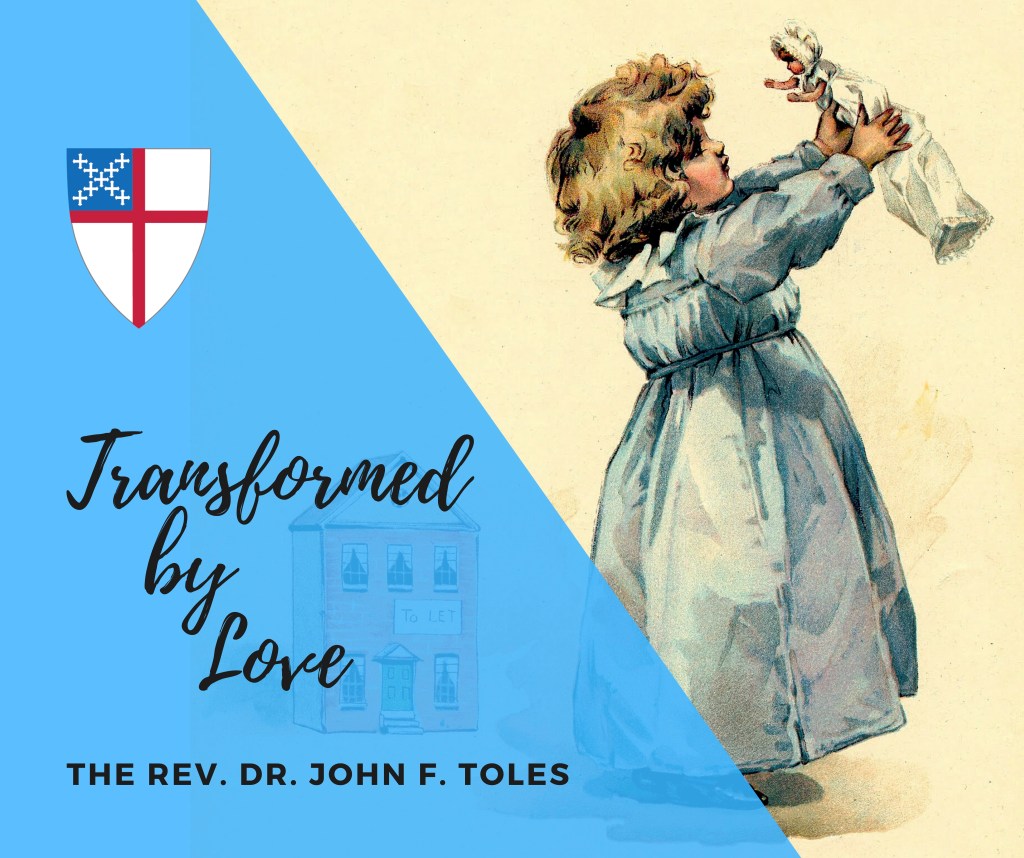
It tells of Kafka walking through a park when he encounters a young girl who is distressed and crying, she has lost her doll. Kafka agrees to help her look and when they are unable to find it, volunteers to come back the following day and help her look some more. That evening, Kafka went home and wrote a letter. A letter from the doll to the little girl. In it, the doll says to the girl, “Please do not mourn me, I have gone on a trip to see the world. I will write you of my adventures.” Over the course of the next several weeks, Kafka delivers numerous letters to the little girl from her doll, all telling about her adventures. At their last meeting, Kafka presents the girl with a new doll. It looks nothing like her original, but she accepts it with gratitude.
Years later, the girl, now a woman, discovers a letter that she did not know existed, tucked away in the sleeve of the dolls dress. In the closing paragraph of that letter, the doll stated, “My travels have changed me. Everything that you love, you will eventually lose, but in the end, love will return in a different form.”
My impurities, my offensive mouth, my wandering footsteps—my travels… in me, these are the things that I love, but as I continue to travel, not alone, but with He who created me, I begin to… not necessarily lose, but set aside those things that I love, because a true Love has entered in. My travels with Jesus begin to change me. Not to the point that I can in good conscience declare the Psalm, fully vindicated, but I have begun. It is as St. Paul teaches us, “The Lord is the Spirit, and where the Spirit of the Lord is, there is freedom. And we all, who with unveiled faces contemplate the Lord’s glory, are being transformed into his image with ever-increasing glory, which comes from the Lord, who is the Spirit.” (2 Corinthians 3:17-18) We “are being transformed into his image.” Not there yet, but getting there, so that on the last day, the day of the resurrection of the dead, we will truly be transformed into the children of God. You see, we are all Kafka’s doll, traveling this earth, being changed by Love. Changed by the One who is Love. Therefore, we may not be able to fully declare the words of the Psalmist, but we can declare with Job what we read:
“I know that my Redeemer lives,
and that at the last he will stand upon the earth;
and after my skin has been thus destroyed,
then in my flesh I shall see God,
whom I shall see on my side,
and my eyes shall behold, and not another.”
Now, don’t tune me out here, because you’re going to think that I’m changing the subject on you, but I’m not: this sermon that I’m preaching to you, this is the big pledge sermon. The sermon where I ask you to financially support the church. You should receive your pledge card on Monday. When we think of the pledge drive, we most often think of paying bills and salaries. But I have to be honest with you, paying bills doesn’t do much for me. Does not motivate me. I even occasionally forget to do it, just ask my landlord. And if I were to ask you to give so that we could pay the bills… well, I wouldn’t expect you to be excited or motivated about it either. But the thing is, I’m not asking you to pledge simply so that we can pay bills. I’m asking you to pledge, because as I said a minute ago, we are all Kafka’s doll—not just those of us in this sanctuary, but all, everyone created in God’s image is Kafka’s doll, and we, through the work and ministry of this church, have the capacity to show the world true Love—not just so they can experience the outward expression of love through our works, but more importantly so that they can encounter Love in the person of Jesus Christ.
When I’m honest with myself, I know who I was and and I know who I am today after traveling with Jesus for awhile. I think if you are honest with yourself, you also know the same difference. Not yet perfected, but drawing ever closer with each step. I firmly believe that your pledge does the same for others. As one Kafka doll to another, who has been transformed by Love, I ask that you will prayerfully and faithfully participate in this journey with your pledge to St. Matthew’s.
Let us pray:
O my Divine Saviour,
Transform me into Yourself.
May my hands be the hands of Jesus.
Grant that every faculty of my body
May serve only to glorify You.
Above all,
Transform my soul and all its powers
So that my memory, will, and affection
May be the memory, will, and affections
Of Jesus.
I pray for You
To destroy in me
All that is not of You.
Grant that I may live,
But in You, by You and for You,
So that I may truly say,
With St. Paul,
“I live – now not I –
but Christ lives in me”.
Amen.
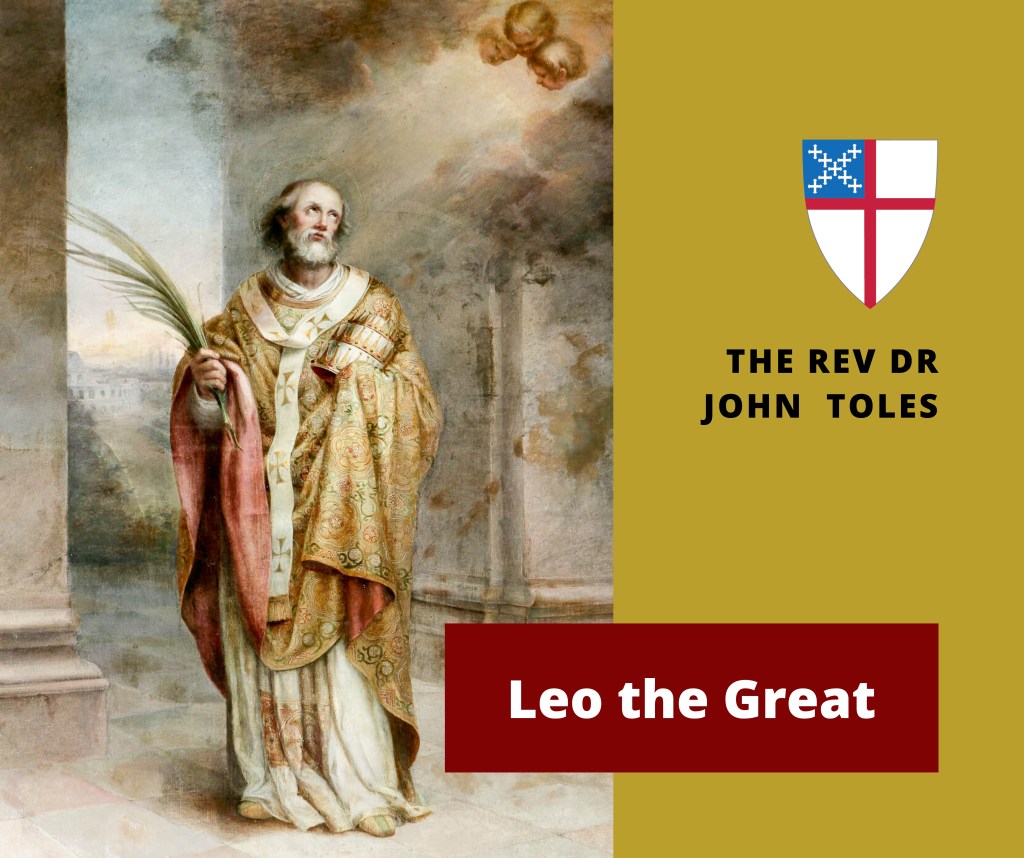
I don’t know that there are many who would have come face-to-face with Attila the Hun, opposed him, and lived to tell the tale, but our saint for today, Leo the Great, was one who did and in the process, convinced him not to sack Rome. However it came about, Leo would later be elected as Bishop of Rome in the year 440 and hold the position until his death on November 10, 461. He received the title “the Great” because of his great work while holding the position.
As I was reading on him, I was struck by a passage from one of his sermons: “There are two loves from which all wishes proceed, and they are as different in quality as they are different in their sources. For the reasonable soul, which cannot exist without love, is the lover either of God or the world… As the world attracts us with its appearance and abundance and variety, it is not easy to turn away from it unless in the beauty of things visible the Creator rather than the creature is loved; for, when He says, ‘You shall love the Lord your God with all your heart, and with all your soul, and with all your mind (Matt. 22:37),’ He wishes us in nothing to loosen ourselves from the bonds of His love.” (Leo the Great, Sermon XC, ch. iii)
“As the world attracts us with its appearance and abundance and variety, it is not easy to turn away from it…” Ever go shopping for a pair of socks and end up walking out of the store with a new suit or a new purse? Ever been in one relationship, only to find that you are suddenly attracted to someone else? Ever sit down, fully intent on saying your prayers, and half an hour later, find yourself cruising the internet? Yes. The world does attract us with its appearance, abundance, and variety, and it really can be difficult to turn away from. As we know, its appearance, abundance, and variety can also draw us away from God. In one instance, we are bathed in the light of the Gospel and in the next… off we go, wandering off into dark recesses.
Jesus said, “You are the salt of the earth; but if salt has lost its taste, how can its saltiness be restored? It is no longer good for anything, but is thrown out and trampled under foot.” How do we lose our saltiness? Jesus said, “No one after lighting a lamp puts it under the bushel basket, but on the lamp stand, and it gives light to all in the house.” How is it we put our light under a basket? We lose our saltiness and hide our light by allowing the attractions of this world to draw us in, and love them more than we love the One who created them. How do we avoid the trap? To use the language of Leo, don’t allow any attraction of this world, no matter how beautiful, to loosen the bonds of love that you have for the Creator—for God. Always keep Him as the center, the focus of your every action and thought, and in this way, you will remain the salt of the earth and the light of the world.
There was a man in England who put his Rolls-Royce on a boat and went across to Europe to go on a vacation. While he was driving around Europe, something happened to the motor of his car. He phoned the Rolls-Royce people back in England and asked, “I’m having trouble with my car; what do you suggest I do?” Well, the Rolls-Royce people flew a mechanic over! The mechanic repaired the car and flew back to England and left the man to continue his vacation. As you can imagine, the fellow was wondering, “How much is this going to cost me?” So when he got back to England, he sent an email and asked how much he owed them. He received a reply from the Rolls-Royce office that read: “Dear Sir: There is no record anywhere in our files that anything ever went wrong with a Rolls-Royce.”
We’ve all been subjected to it more than once and many claim that it is a very misunderstood poem, but for today’s purpose…
Two roads diverged in a yellow wood,
And sorry I could not travel both
And be one traveler, long I stood…
(The Road Not Taken, Robert Frost)
I thought of that when it struck me that today’s parable from Jesus could begin, “Two roads diverged at the Temple doors….” I would like to say that I’m like the guy in the back, and there are some days that I may actually pull it off, but I know that there are other days when I am the Pharisee. To try and squeeze myself in either of the individuals is the square peg round hole problem—it’s not going to work, because I am not either/or… depending on the day, I am both, because there is a certain appeal to both.
The appeal of the Pharisee: black and white, right and wrong. The Pharisee does not really have to think about his faith, he only has to practice it. Thou shall have no other gods: check. Thou shall not commit adultery: check. Thou shall not murder:… ummm… check. Those are easy, until somebody comes along and says things like, “‘You shall not commit adultery.’ But I tell you that anyone who looks at a woman lustfully has already committed adultery with her in his heart.” That aside, why is there this appeal of the Pharisee and the legalistic approach to our faith?
Brennan Manning answered that one nicely in his book Reckless Confidence: “One of the telltale signs in the contemporary American church that trust in God is on the wane is the meteoric rise of legalistic religion. It will continue to flourish and attract an enormous number of devotees. For legalism is born of fear. It is a religious response to human fear. What makes legalism so attractive is that it meets a basic human need—security…. We create a very solid foundation for our lives, because the God who has been absolutized by us can never surprise us.” (p. 138)
Once the Devil was walking along with one of his cohorts. They saw a man ahead of them pick up something shiny. “What did he find?” asked the cohort. “A piece of the truth,” the Devil replied. “Doesn’t it bother you that he found a piece of the truth?” asked the cohort. “No,” said the Devil, “I will see to it that he makes a religion out of it.” (Source)
The appeal of the Pharisee is that he was given the truth in the form of the Mosaic Law, but instead of using the Law to follow God, the Law became the religion. The Law was what was worshipped and adored and not the Giver of the Law. Yet, it is appealing—give me a law and I can be secure in my legalistic faith as long as I follow that law. Give me a law and I can use that law to know who is in and who is out. Who I have to love and who I can cast away. Give me a law and I’ll use it to put you in your place and demonstrate to you how superior I am to you. Only problem: what happens when I’m the one who broke the law, which brings up the appeal of the second path, the path of the tax collector. We’ll call him the Rogue.
The Rogue stands at the back, dares not look toward Heaven. The Rogue is a rogue and he knows it, so speaking softly to God, he says, “God, be merciful to me, a sinner!” “God, be merciful to me, a sinner!” “God, be merciful to me, a sinner!” The appeal of the Rogue: grace, mercy, forgiveness. Going home justified. The Rogue knows he’s a rogue, even though he tries to be a saint. The Rogue humbles himself before a righteous God and begs to be made clean. And the God who created the Rogue, loves him, and makes him whiter than snow. However, the way of the Rogue is not without its pitfalls.
For starters, and this is something we talked about in Confirmation Class this past week: God may send the Rogue home justified, but the Rogue simply does not believe it. Pitfall: spiritual pride—we hear the words of our absolution, but we believe our sin too great to actually be forgiven. When we believe that, we are saying the Cross—the bloody sacrifice of Jesus—is too small to cover my sins, to justify us before God. The Apostle John teaches us, Jesus “is the atoning sacrifice for our sins, and not only for ours but also for the sins of the whole world,” and we add, except for mine. That is one pitfall of the Rogue, hearing that he is justified, but not believing it. Another is actually a combination of the two. Let’s call this one the Pharisaical Rogue.
The Pharisee is one who made a religion out of the Mosaic Law and worshipped it instead of God. The Pharisaical Rogue sits in the pews at church praying, “God, be merciful to me, a sinner!” But at the same time denies others the same mercy and grace that he is requesting for himself. The Pharisaical Rogue has accepted God’s mercy for themselves, but has established his own law that determines who is in and who is out. It is another form of legalism, but it comes with a spiritual arrogance, for it professes to not only know the mind of God, but to also be the gate through which God’s mercy and grace will be allowed to flow. It forgets, “judgment without mercy will be shown to anyone who has not been merciful. Mercy triumphs over judgment.” (James 2:12) The author of Proverbs writes, “Do not withhold good from those to whom it is due, when it is in your power to act.” (Proverbs 3:27)
“Though justice be thy plea, consider this,
That, in the course of justice, none of us
Should see salvation: we do pray for mercy;
And that same prayer doth teach us all to render
The deeds of mercy.”
(William Shakespeare, The Merchant of Venice, Act IV, Scene I)
We are not to withhold mercy, when it is in our power to show it.
Two roads diverged in a yellow wood… Two roads diverged at the Temple doors… and I… I take them both.
What are we to do—and I say ‘we’… and I hope this doesn’t sting too much… I say we, because I know I’m not in this boat alone—What are we to do? I believe we should all remember a couple of things. The first is what St. Paul said to the Corinthians: “We must all appear before the judgment seat of Christ, so that each of us may receive what is due us for the things done while in the body, whether good or bad.” (2 Corinthians 5:10) The second is what Paul said in his second letter to Timothy when Paul was in prison in Rome and had gone on trial: “At my first defense no one came to my support, but all deserted me. May it not be counted against them! But the Lord stood by me and gave me strength.” (2 Timothy 4:16-17a) On the last day, we will all stand before the judgment seat of Christ, and we will either be condemned for the evil we have committed and the mercy we did not show or, it will kinda be like the letter the man received from Rolls-Royce: Jesus will stand beside us and say, “There is no record in God’s files that you have ever done anything wrong. You have been shown mercy. You may enter your eternal home… justified.”
Allow God’s grace and mercy to work in you and allow that same grace and mercy work in others. Allow them to be justified as you have been justified.
Let us pray: Hail, holy Queen, Mother of mercy, hail, our life, our sweetness and our hope. To thee do we cry, poor banished children of Eve: to thee do we send up our sighs, mourning and weeping in this valley of tears. Turn then, most gracious Advocate, thine eyes of mercy toward us, and after this our exile, show unto us the blessed fruit of thy womb, Jesus, O merciful, O loving, O sweet Virgin Mary! Amen.