Eva Lee Matthews was born in 1862. Her father was a US Senator who would later go on to become a Supreme Court justice. She was a debutante. It would seem such a life would have created another woman of society; however, the Lord had different plans for Eva and she was obedient to God’s call.
She was a devout Episcopalian and for a number of years served the poor in Omaha, Nebraska and Cincinnati, Ohio. However she and a coworker, in 1898, did something quite remarkable: they founded a new religious order within the Episcopal Church: The Community of the Transfiguration. It was a house that was to be based in the lives of Mary and Martha. Mother Eva Mary, as she came to be known, believed that the Christian was to be a servant of God and that the light of Christ should flow through them. She once said, “The vision of the King is his beauty and is given that the light may shine through us and guide others to know, love, and glorify him.”
She was fond of writing short poems, one of which she wrote shortly after she and her friend took their final vows of profession.
Life for Life—Yea, Lord, so let it be, My life for Thine as Thine was given for me, How could I think a lesser gift to bring, Some broken, useless, fragmentary thing?
Nay, let it be the perfect crystal, Lord, Offered up whole, unbroken, and unmarred, No part kept back for self or sin or strife, But laid at Thy feet, the full price of a life.
Men see the work which is the outer shell, The humble vessel, be it ill or well, That holds the life elixir for a space ‘Ere it be poured from its discarded vase.
They only see the outside of the cup, Thou seest within the Life that’s offered up. The heart of love in penitence immersed Drink, Lord of Life, and quench Thy loving thirst. (Source)
In our gospel reading today, the woman in Bethany anointed Jesus body. It was to prepare him for his burial that was to come. Speaking of her, Jesus said, “Truly I tell you, wherever this good news is proclaimed in the whole world, what she has done will be told in remembrance of her.”
There are many men and women throughout the world, like the woman in Bethany and Mother Eva Mary, who go quietly about the business of serving Jesus. They don’t ask for recognition or accolades, but they are remembered by God. They hand themselves over to God’s will and ask to be used by him in whatever manner he chooses. We can all learn from them.
In our Saints Book Club we are reading In this House of Brede. Early on, one of the nuns tells another, “What is really apostolic, what really speeds God’s glory, is not the time given to work, but the holiness of the worker.” That too is our calling whether in great ways known by all or the simple quiet ways of serving a single soul. In either case, we serve Jesus by serving them and the glory of God, the holiness of God is revealed to others through our works, and it draws them into closer relationship with their Savior.
It would not be proper if I did not begin by wishing you all a happy 4th of July! Our nation is now 244 years old. All those years ago we seemed to have been a child that was far too wise for its age, but today… well, we seem to have reverted to some other child, pitching temper tantrums in the middle of the grocery store aisle. That said…
We may not always be happy with the direction of things, but we’ll defend the leaders and the rest of the motley crew to the death.
Yesterday, as I was writing on The Marble Finger and at the end of an intercalary chapter, I added: The Rev. Timothy Powell was always a bit of a coward. And all this talk of the talons of hell had brought on a severe case of nerves in his bowels…. (I’m not going to give things away here!) The question I have: who the hell is this guy? I was minding my own business, writing a book, and then this Rev. Timothy Powell with the bowels shows up! What the heck is he up to? That is one of the joys of writing fiction, but it also makes you feel a bit schizophrenic. There you are, minding your own business, and… BAM!… somebody shows up that you don’t know or someone does something unexpected…. Yeah. It is fun. Tomorrow will be another day of edits… two chapters for that… and writing. I still like Hemingway’s advice on this: “Write drunk. Edit Sober.” Well, I won’t be getting drunk, but the adult beverage on a day off is a given… “Cheers to you!”
For me, with books or movies, if it ain’t no good, I don’t bother finishing. I’ve got other things to do with my time, which is why there is no movie report today. I started several, got a few minutes in (one even 30 minutes) and hit the exit button. Awful. If you’ve got a title, please feel free to pass it along. And, let’s be honest, watching foxes bounce on trampolines are hard to beat, which reminds me… I have discovered the short films on YouTube. Why did I not know they were out there? Between eight and thirty minutes… sci-fi, drama, comedy… some of these are quite brilliant. They are like the “tweet” version of a regular movie. Here’s a good sci-fi short with an excellent moral teaching…
Whichever genre you’re a fan of, you’ll likely be able to find some pretty amazing shorts. I tend to go for the sci-fi or comedy, but there are some that are brilliant, but will break your dang heart.
I’m not real sure how today’s preachy thing went, but I liked the message. Perhaps the Spirit worked in the midst of my ramblings and someone heard a note that resonated with them. Each week I try and do better than I did the previous…. that is accomplished at times and at others… not so much. Like writing fiction, if you are trying to listen, you don’t always know where things are going or the message that is trying to spoken, but the LORD does and I’m confident he will use our most floundering attempts for his purposes. I do know that if I apply myself fully to the task and do the best I can, then I feel that I’ve been faithful to the calling. I’ll find out at the end of days.
I planted rocks a month or so back, but now I’m wondering if I should have planted wildflowers instead. They are lovely… I’m a fan of symmetry, but I think to break it up enhances it in other ways. Thoughts?
What did I learn today? Within each of us is another that is who we truly are. That other wants to be known, because that other is the one that is true. How many layers must be excavated before the other is revealed? There will always be one who knows it… just one… but seek to make the other known, for that is who you were meant to be. Who you were created to be. I said it during the sermon, but perhaps not so clearly: Allow the other one to shine. He / She is your purpose.
Thought for the day: “When I look through God’s eyes at my lost self and discover God’s joy at my coming home, then my life may become less anguished and more trusting.” ― Henri J.M. Nouwen, Return of the Prodigal Son // What if… and just play along for a minute, because most don’t believe this to be true… What if God really loves you? What if you are a miracle of God and God desires to perform miracles through you? What if it is all true? Then………….
In a Charlie Brown comic strip, Linus, not looking at all happy, is sitting, holding his blanket, with his thumb in his mouth. He then asks Lucy, his sister, “Why are you always so anxious to criticize me?” Lucy smugly replies, “I just think I have a knack for seeing other people’s faults.” Throwing his hands in the air, Linus shouts, “But what about your own faults?!” Without missing a beat, Lucy responds, “I have a knack for overlooking them.”
Lucy, well, Lucy can just be a rather unpleasant person, but why does Linus even care? Shouldn’t he just be able to let the criticisms go and move on? And wouldn’t it be nice if Linus wasn’t the only one that the negative comments actually effected. Wouldn’t it be nice if we were immune to them as well. The crazy thing is… science has demonstrated how we are more or less hardwired to hear and internalize the negative far more so than the positive. It is referred to as the negativity bias. It is the negative things that people say about us personally or in general—about society, life, other people—that sticks. That criticism about us personally can have long term negative effects, but if that negative is about someone else, it has a way of cheering us up, especially if it is about someone famous.
A 2015 study published in Social Neuroscience demonstrated that the “reward center in the brain, was activated in response to negative gossip about celebrities; subjects seemed to be amused or entertained by salacious celebrity scandals.” (Source) That helps explain why so many are captivated by tabloid news and “royals” on Oprah. Are you susceptible? Here’s a test: according to federal statistics, 600,000 individuals are released from prison and some 9 million rotate in and out of local jails on an annual basis. (Source) If I was to ask 99.99% of the people in USA to name one of those individuals, who would it be? Bill Cosby. The news media know of our fancy for this type of thing, so they feed it to us in large doses. Not because its really news, but because it sells advertising. {rabbit trail… sorry} The point: it is the juicy gossip, the scandal, the fall of the famous, that draw us in and in order to be included in society, we join in. If my friends—or those I want to be friends with—are scandalized by the scandal, then I too will be scandalized in order to be a part of the group. The gossip or criticism, the negativity bias came into play, and we can all point our finger together, and the person we are all pointing at loses all credibility and all status. They become the scapegoat for all the things we see that are wrong with the world.
“Jesus came to his hometown, and his disciples followed him. On the sabbath he began to teach in the synagogue, and many who heard him were astounded. They said, ‘Where did this man get all this? What is this wisdom that has been given to him? What deeds of power are being done by his hands! Is not this the carpenter, the son of Mary and brother of James and Joses and Judas and Simon, and are not his sisters here with us?’” Hello. We know this guy and he’s know Messiah. Didn’t his mamma get pregnant before she was married? Don’t you remember that? My goodness… and Joseph married her anyhow. Can you say, ‘guilty conscious’? Enquiring minds want to know.
Jesus went to Nazareth, his hometown, and the people criticized and scandalized. The negativity bias almost infected the entire community, because we are told that only a few of the sick were healed. However, no sooner had he and the disciples left Nazareth that Jesus began to send the disciples out two-by-two, having given “them authority over the unclean spirits.” What was the result? “They went out and proclaimed that all should repent. They cast out many demons, and anointed with oil many who were sick and cured them.” They had not been infected by the criticism of Nazareth. They continued in faith, believing in Jesus and believing in the authority that he had given them. Nazareth—only a few, but out in the world, at the hands of those who kept the faith—many demons were cast out and many sick were healed.
I’m not talking about having a positive mental attitude. That’s not part of the discussion. What we’re seeing in the disciples is faith—a deep and abiding knowledge in the one who sent them and belief in the authority he had given them. And it is through the giving of the Holy Spirit that this knowledge and authority have been handed down through the generations to God’s Church and to you, his chosen people and royal priesthood. (cf. 1 Peter 2:9) Before he ascended into heaven, Jesus gave the Great Commission: “Go and make disciples of all nations, baptizing them in the name of the Father and of the Son and of the Holy Spirit, and teaching them to obey everything I have commanded you.” (Matthew 28:19-20a) And within you is the potential to fulfill that commission, but what is potential? Merriam-Webster defines it as, “existing in possibility: capable of development into actuality.” Poise your finger above the smooth surface of the water and you have the potential, the possibility of causing ripples that will reach further than you could have imagined, but the ripples will not actually appear until you act and touch. Within you is the possibility, but only the possibility, and the capability given through the Holy Spirit to cause the ripples, that will bring about the fulfillment of the Great Commission, but one of the greatest hinderances to this work will be falling in with the people of Nazareth and allowing the negative to seep in: Jesus was only a really good person. God doesn’t heal like he use to. There are no more miracles. I don’t know how to do this. I’m not good enough. This is too much religion. If I do that, I’ll look like some freak and then… then people will start talking about me. Jesus said, “If the world hates you, keep in mind that it hated me first.” (John 15:18) If they criticized him, they will criticize you.
The story is told of a judge who had been frequently ridiculed by a conceited lawyer. When asked by a friend why he didn’t rebuke his assailant, he replied, “In our town lives a widow who has a dog. And whenever the moon shines, it goes outside and barks all night.” Having said that, the magistrate shifted the conversation to another subject. Finally someone asked, “But Judge, what about the dog and the moon?” “Oh,” he replied, “the moon went on shining—that’s all.” What did my friend St. Josemaría Escrivá say: “Don’t waste your time and your energy — which belong to God — throwing stones at the dogs that bark at you on your way. Ignore them.” (The Way, #14)
Through Christ Jesus, you have great potential to do amazing work. If the dogs bark, let them bark. If the critics criticize, ignore them. You… you continue to shine.
I give you this blessing today: May God give you more than you can ever think or ask; May He use you far beyond the boundary of your task. May God lead you further than your vision can yet see; May He mould you, day by day, more perfectly. May God guide you and keep you in the way He sees best; And may he bless you—Father, Son, and Holy Spirit—so that every life you touch is blessed. Amen.
Homemade bread… so good when it is fresh out of the oven. This is an artesian round loaf. Very simple. Rises for 24 hours then… deliciousness. Make that fabulous dipping sauce of Italian seasoning, ev olive oil, and balsamic vinegar. Eat until it is time for supper. Oy!
But then, it is not done, because there is… homemade bread sandwiches, homemade bread toast, homemade bread toast with local honey, homemade bread toast with the center cut out and the egg fried in the middle (like they do in Moonstruck), and then there’s homemade toast slathered in butter with peanut butter (and you absolutely must spread the peanut butter while the toast is still hot so that the peanut butter gets all melty and gooey)… Yes, Lawds. M.O.O.N…. that spells Tom Cullen! And Tom Cullen knows what he likes (not the Dark Man!) You’ve got to keep up with the movie references on this blog! Speaking of which….
Hector and the Search for Happiness was a delightful film. I’m going to give this one ⭐️⭐️⭐️⭐️1/2⭐️. To describe it in terms of other movies… It has got a bit of Lost in Translation, The Secret Life of Walter Mitty, and a touch of The Best Exotic Marigold Hotel (all of which are exceptional movies.) Two lines: “All those faces. All those hearts. I am such a lucky woman.” and “Listening is loving.” Simon Pegg (Shaun of the Dead… brilliant!) and Rosamund Pike (I Care A Lot) are great together. “How many of us can recall when we experienced happiness as a state of being?” I can. It was at night, a hallway, a goodbye, tension…. M.O.O.N. If you are looking for something that is more than just a touch twisted, you’ll want the slow-burn, violent (as a priest, I’ve never watched this 😉 only heard about it) and more than slightly deranged… The Loved Ones. Very messed up. That’s it for movie reviews.
For the priesty work… today I preached a sermon on confession (acts of penance) that I felt really good about. Probably more instruction than sermonating, but I believe it worked… so much so that I included it as the cover article for this month’s newsletter. This was actually closely related to the sermonette from Morning Prayer today, which was talking about Simony and how we relate giving to the church in a commoditized culture. I then got to go out and give $1,000 to two organizations in town that are doing remarkable work. One of those gifts purchased 6,000 diapers, which equates to a LOT of dirty bottoms, but happy moms. Love my church!! Tomorrow is Sunday sermon writing time… working title: Limits or Limitless? I feel like it will preach.
Looking forward to a long weekend, although I’m more and more convinced that we would have been better off with old King G., but lets not go down that road. Friday and Saturday, I hope, are dedicated to writing on The Marble Finger and taking some nice long walks… I’m getting fat again: why is this a constant battle {shaking head]…. probably all that bread I talked about earlier!
What did I learn today: my dad is coming up next weekend for a couple of days and we’re going to a baseball game together. Need I say more?
Thought for the day: “And the day came when the risk to remain tight in a bud was more painful than the risk it took to blossom.” ― Anaïs Nin Still love this quote! We all have options and at the top of the food chain is our decision to Believe (read the sermons if you need to know what I’m talking about [hint: Jesus].) Next on the list is the option to live or die (keeping in mind that many people have died, decades before they are properly dead).
The Venerable Fulton Sheen said, “Hearing nuns’ confessions is like being stoned to death with popcorn.” I’m thinking that he means they aren’t all that exciting. I don’t know if I’ve heard more exciting than I have given, but there are some who come for confession that I know I’m going to feel like a hypocrite for sitting there and listening to.
As you are probably aware, confession (a.k.a. The Reconciliation of a Penitent) is not all that popular in the Episcopal Church. I encourage it because I know how helpful it can be, but as many are fond of saying, “All may, none must, some should.”
In the Book of Common Prayer (p.447), following the confession, the penitent says to the priest, “I humbly beg forgiveness of God and his Church, and ask you for counsel, direction, and absolution,” and the rubrics state that the priest is to give these things. That is the individual confession, but in the general confession, the one we say together, has no instructions. It is expected that you will have done some preparation prior to making the general confession, but in the end, you simply pray the confession and receive absolution, with no counsel, direction, etc. Not mentioned in either form is the giving of any act of penance: “Say five Hail Marys and two Our Fathers,” “Fifty lashes”, etc. Perhaps the reason being is that forgiveness of sins is a gift, so there should be no suggestion that you are somehow “paying” for that forgiveness through some act on your part. I get that, but should there still be some type of act / response on our part in receiving absolution? I believe the answer is “Yes” and it would seem that this is one of the many lessons we can take from our Gospel reading today.
Before Jesus was crucified, Peter denied him three times, so we understand why Jesus asked him three times, “Do you love me.” It was to fully restore Peter back to himself. Peter responds in the positive, “Yes, you know that I love you,” but as we read, Jesus didn’t pat Peter on the head and say, “Good boy.” No. Jesus gave Peter a means of responding to the forgiveness of sins, “Feed my sheep.” “Do you love me?” “Yes. I love you.” “Good. Go out and show the love you have for me to others. Remember: ‘Truly, I say to you, as you did it to one of the least of these my brothers, you did it to me.’”
For the forgiveness of our sins, Jesus died on the cross. The absolution we receive for our sins is a free gift, an expression of Jesus’ love for us. Therefore, it is fitting that we respond to this love of Jesus by an act of penance. Not because we have to or we are being compelled to, but because we want to love Jesus by loving others.
An act of penance is not a punishment for our sins, nor is it payment for the absolution we received. An act of penance is an expression of love, freely given as a response to the great love that has been shown to us. So whether you have made a personal confession or a general confession, ask yourself, “How might I love others in response to the love I have been shown.”
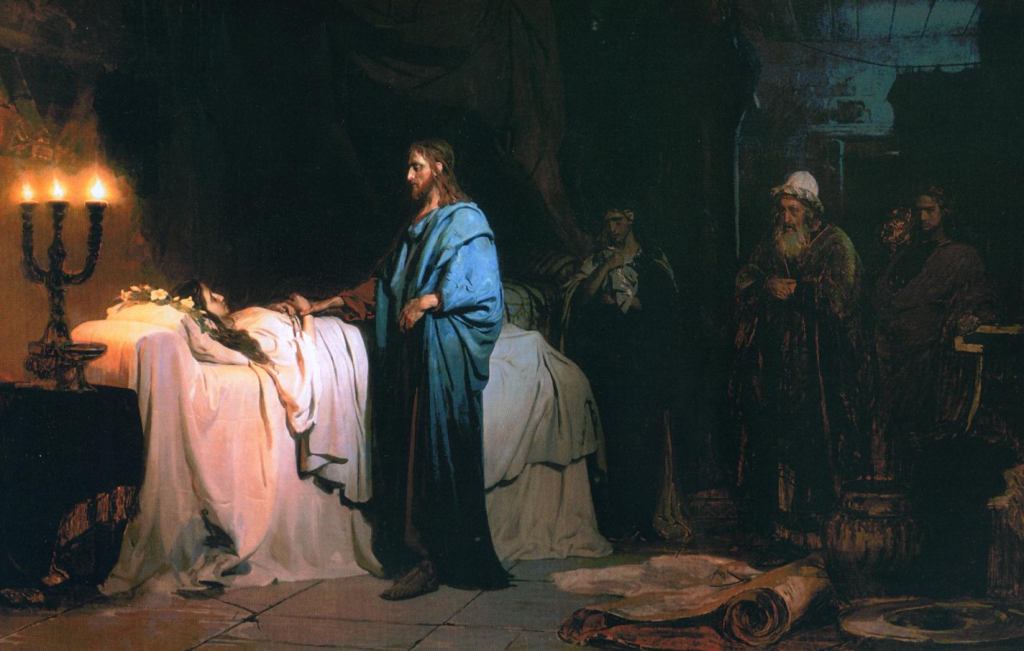
The Raising of Jarius’ Daughter by Ilja Jefimowitsch Repin
Boudreaux and Rupert are out in the woods doin’ some squirrel hunting when Rupert suddenly collapses. Ol’ Boudreaux checks him over and Rupert doesn’t seem to be breathing and his eyes are starting to glaze over, so Bourdreaux whips out his phone and calls the emergency services. He gasps, “I think Rupert is dead! What can I do?” The 911 operator says, “Calm down. I can help. First, let’s make sure he’s dead.” Boudreaux says, “Ok. Hang on.” There is a silence; then the 911 operator hears a gun shot. Boudreaux then gets back on the phone and says, “OK, now what?”
In the Fantastic Voyage: Destination Brain, the great science fiction author, Isaac Asimov wrote, “Life is pleasant. Death is peaceful. It’s the transition that’s troublesome.” (Especially if you’ve got friends like Boudreaux who might hurry it along!) When you begin to obsess over that “troublesome” part, it can turn into thanatophobia, which is the fear of death. No, I’m not going to get all morbid on you by talking solely about death, but the topic is a bit unavoidable given our lessons for today. And it was that first lesson that actually explains why it is troublesome and even our fear of death. I don’t normally do this, but it is short enough, so I want to read it to you again, because it is from the Apocrypha and we don’t hear it too often (as you know, we consider the writings of the Apocrypha to be good in providing examples of life and teaching, but not the inspired word of God). Solomon writes:
“God did not make death, And he does not delight in the death of the living. For he created all things so that they might exist; the generative forces of the world are wholesome, and there is no destructive poison in them, and the dominion of Hades is not on earth. For righteousness is immortal.
“God created us for incorruption, and made us in the image of his own eternity, but through the devil’s envy death entered the world, and those who belong to his company experience it.” (Wisdom of Solomon 1:13-15; 2:23-24)
Why is dying troublesome to some and why do we have this fear of death? Because “God did not make death… God created us for incorruption, and made us in the image of his own eternity.”
I think I’ve told you this before, but so many will tell you that “Dying is a part of living” or “Death is natural.” No! God did not make death. Dying and death are the most unnatural things we do. It is why we fight it so hard, do all we can to extend our lives, hurt for others when they are dying or losing loved one. Death is anything but natural, so how did it come about? We understand the fall in the Garden of Eden and how sin entered, but Solomon, in the same chapter of Wisdom as our reading, expands on that:
“The ungodly by their words and deeds summoned death; considering him a friend, they pined away and made a covenant with him, because they are are fit to belong to his company.” (Wisdom of Solomon 1:16)
What did the ungodly do? According to Solomon, they looked only to themselves, fulfilling their every desire while neglecting and oppressing those who were weaker. They rebelled against God, turning on his Holy One. And so through those words and deeds, they invited death into the world and condemned themselves, and in the process they dragged the righteous down with them, even the twelve year old daughter of Jarius that we read about in our Gospel. Just as the sun rises on the evil and the good / the rain falls on the righteous and the unrighteous (cf. Matthew 5:45), so does death come to all, but that is where the equality ends, because from there the ungodly receive their punishment, but the righteous, Solomon tells us:
“Those who trust in [the Lord] will understand truth, and the faithful will abide with him in love, because grace and mercy are upon his holy ones, and he watches over his elect.” (Wisdom of Solomon 3:9)
The righteous will abide with God and he will speak to them in a similar way as Jesus spoke, “Little girl, get up.” “Get up,” he will say to them, because you were not made for death or corruption. Get up, “you who are blessed by my Father, inherit the kingdom prepared for you from the foundation of the world.” (Matthew 25:34) For the us, there really is only one bit of trouble with all this (and maybe I’m just speaking for myself, but I don’t think so): I’m nowhere near as innocent as a twelve year old and I know in my heart that I’m not one of the righteous. (I could… not going to… but I could give you the names of more than a few that would be more than happy to attest to it!) I am not one of the righteous: I do try—Lord knows I do—but through my words and my deeds, I’m one who has summoned death, so how can I even think to hear him speak those words, “Get up!” Answer: because in my heart, I have this hope, this faith that speaks into that potential despair and says, “If I but touch his clothes, I will be made well.”
If I did not believe that were true, I would not be standing here today. If I thought that I was beyond the saving grace of Jesus, I truly would give myself over to being the “ungodly,” for without this hope, I know that I would be condemned forever, but I do have hope, this faith that speaks to my soul and tells me I will hear those words: Get up and enter, “your faith has made you well; go in peace, and be healed of your disease.” Go in peace and be raised up from death.
The anthem from the beginning of the burial rite:
“I am Resurrection and I am Life, says the Lord. Whoever has faith in me shall have life, even though he die. And everyone who has life, and has committed himself to me in faith, shall not die for ever. —and a few lines further— After my awaking, he will raise me up; and in my body I shall see God.” (Book of Common Prayer, p.491)
“Do not fear, only believe.” We may sleep, but he will awaken us. That is the message for us all. It is not a message of death, but of life eternal.
Let us pray (adapted from Psalm 16:8-11): Gracious Father, we set you always before us; because you are at our right hand, we shall not be shaken. Therefore our hearts are glad, and our bodies rejoice; for our flesh dwells secure in your loving embrace. You will not abandon our souls in death, or let them taste corruption. You make known to us the path of life; in your presence there is fullness of joy; and in your right hand are pleasures forevermore. Amen.
Having completed the Sunday sermon and chores, I have been scanning Amazon Prime for a Friday afternoon matinee. What do the following four movies have in common?
Well [duh]. Daniel Radcliffe. I’ve seen them all and to tell you the truth, I think “Harry Potter” is doing some great work. One not shown is Horns, based on the Joe Hill novel (read it). I’ve seen that one as well, but think I should watch again before I give it an honest review, but even though I’m uncertain about the movie, Radcliffe was good. The Woman in Black was also entertaining, just not all that scary. He’s got about four of five others out there that I haven’t seen yet, but when they pop up on Prime, I will give them a day in court… just like a slice key lime pie (name that movie!) It is also nice to see that these are mostly independent films and that he is lending his talent and name to a new generation of film makers. All that to say, I’m off to watch… not one of these, but my favorite monster movie…
… and that was fun!
Confession: I love to cook and most of the time… kinda tasty. That said, I remember cooking as far back as grade school (boiling potatoes, etc), but I’ve also never really known any pots and pans that were not teflon coated (or teflon peeling, because, let’s face it, with those early teflon coated pans, we ate more of the teflon than what remained on the pan, and you didn’t throw them out until most of it was gone!) So, cooking with all this teflon, I’ve grown up with a great fear. A fear that brought on nightmares of three hour soaks and scouring pads cutting into your fingers from all the scrubbing. Yes. I confess. I have been afraid of the stainless steel cookware, but… not any more!!!
I got my first set this week. Unboxed it and stared at it for a couple of days as it sat taunting me on the stove: “I dare you. I double dog dare you. You’ll be pitching me in the landfill after your first scrambled eggs!” Well, the scrambled eggs worked out ‘almost’ perfectly this morning (the pan was just a bit too hot), but tonight for dinner…
Just say, Yum. Pan came out perfectly clean with a little soap and water. Three tricks: preheat the pan prior to putting anything (no oil, butter… nothin’) in it, let what you’re cooking sit a bit before messing with it (didn’t even look at the chicken for five minutes and could have gone longer), and deglaze all the tasty bits when you’re done with the cooking. There are all sorts of good videos on YouTube to help you along.
What did I learn today: God is good, trolls are real, stainless steel pans are excellent (and add another level to the cooking experience), I am highly entertained by little things, and wild flowers don’t last very long in a vase.
Thought for the day: “The only real stumbling block is fear of failure. In cooking you’ve got to have a what-the-hell attitude.” ― Julia Child. Maybe I’m wrong, but that just might apply to some aspects of life as well.
Happiness is waking up, looking at the clock and finding that you still have two hours left to sleep. — Charles M. Schulz
We used to sleep five to a bed and three of them used to wet the bed. I learnt to swim before I could walk. — Bernard Manning
Some national parks have long waiting lists for camping reservations. When you have to wait a year to sleep next to a tree, something is wrong. — George Carlin
Never under any circumstances take a sleeping pill and a laxative on the same night. — Dave Barry
I’ve always envied people who sleep easily. Their brains must be cleaner, the floorboards of the skull well swept, all the little monsters closed up in a steamer trunk at the foot of the bed. — David Benioff
Our Gospel reading from Mark began, “When evening had come, Jesus said to his disciples, ‘Let us go across to the other side.’” When it was dark, the disciples went out onto the waters. Mark gives us time and place, a time and place that are reminiscent of another time and place: “In the beginning, God created the heavens and the earth. The earth was without form and void, and darkness was over the face of the deep.” (Genesis 1:1-2) The deep is what rose up in the time of Noah and destroyed every living soul except for those on the Ark. The deep is what swept down and destroyed the armies of Pharaoh. The deep is the place Jonah was cast into and devoured by the whale. The deep is the home of the Leviathan. The deep is the chaos of the world. The deep is death. And the disciples go off into the darkness and onto the face of the deep, and it is then that the wind blows and this deep, this chaos and death begins to churn, thrashing the boat and making the disciples fear for their lives. They call out to Jesus who is sleeping in the bow of the boat, “Teacher, do you not care that we are perishing?” Do you not care that we are descending into the chaos and the death? Of course he cares, so he rebukes the wind and the rain, “‘Peace! Be still!’ and a dead calm returns to the face of the deep.” The disciples then ask, “Who then is this, that even the wind and the sea obey him?” Who then is this that even the chaos and death obey? The disciples have not yet grasped the truth of who Jesus is, for there is only one who can calm the chaos and put an end to death. From our Psalm today:
“[The Lord] stilled the storm to a whisper and quieted the waves of the sea.” (Psalm 107:29)
It is the Lord our God who commands the chaos and it is the Son of God that rebukes and conquers death. So why is it that Jesus sleeps?
A story tells of a young man who applied for a job as a farmhand. When the farmer asked for his qualifications, he responded, “I can sleep when the wind blows.” This puzzled the farmer, but he liked the young man and hired him. A few days later, the farmer and his wife were awakened in the night by a violent storm.
They quickly began to check things out to see if all was secure. They found that the shutters of the farmhouse had been securely fastened. A good supply of logs had been set next to the fireplace. The farmer and his wife then inspected their property. They found that the farm tools had been placed in the storage shed, safe from the elements. The tractor had been moved into the garage. The barn was properly locked. Even the animals were calm. All was well. And they found the farmhand sound asleep. The farmer then understood the meaning of the young man’s words, “I can sleep when the wind blows.” The farmhand did his work loyally and faithfully when the skies were clear, so he had faith that whenever a storm would blow in, all would be well. He was not afraid and so he slept in peace.
Jesus slept when the wind blew, because he knew that all had been cared for by his Father. He knew that God’s purposes were being fulfilled and that his Father was with him. As the Psalmist says:
Where shall I go from your Spirit? Or where shall I flee from your presence? If I ascend to heaven, you are there! If I make my bed in Sheol, you are there! If I take the wings of the morning and dwell in the uttermost parts of the sea, even there your hand shall lead me, and your right hand shall hold me. (Psalm 139:7-10)
Jesus slept, even when the chaos was blowing and the smell of death was in the air because he had faith in… because he knew of the Father’s presence and the loving hold that that the Father had on his life. And here’s the Good News: Jesus slept because he knew of the Father’s presence and Jesus slept so that we could also know of the Father’s presence… so that we could see that we have no need to be afraid of the chaos or even death itself. Jesus slept so that we would know that we could sleep.
There will always be storms, chaos, and death, but these things do not have the final word. Jesus is the final word and he declares, “I am the Alpha and the Omega, the first and the last, the beginning and the end.” (Revelation 22:13) And his end is life eternal.
He who dwells in the shelter of the Most High will abide in the shadow of the Almighty. I will say to the Lord, “My refuge and my fortress, my God, in whom I trust.”
Because you have made the Lord your dwelling place— the Most High, who is my refuge— no evil shall be allowed to befall you, no plague come near your tent. For he will command his angels concerning you to guard you in all your ways. (Psalm 91:1-2, 9-11)
Yes, Jesus calms the storm, but you have been set free so that you may sleep while it is blowing.
Let us pray: O Christ Jesus, when all is darkness and the storms rage, and when we feel our weakness and helplessness, give us the sense of Your presence, Your love, and Your strength. Help us to have perfect trust in Your protecting love and strengthening power, so that nothing may frighten or worry us, for, living close to You, we shall see Your hand, Your purpose, Your will through all things. Amen.
Today began with a walk, but only in my mind. It seemed like a reasonably good idea when I woke up, but by the time I rolled out (which was relatively early for a Saturday morning with no obligations) all motivation had seeped from my head and my legs, so I propped up in the comfy chair (everyone should have one: it is ugly, should be burned, and you find interesting things from years past in-between the cushions) and finished reading The Plot by Jean Hanff Korelitz. This is a book I’m going to give a solid ⭐️⭐️⭐️⭐️ 1/2. I’ve no complaints other than the cadence of some of the sentences… they just lost their rhythm on occasion and and I had to go back and try again (probably a personal problem). After many hours of reading, I wandered over to the movies and found myself enjoying (once again) The Secret Life of Walter Mitty (2013) with Ben Stiller. I have not watched the 1947 version, but I’ve never been a fan of the black and white films. Hard to believe that it is the same guy in the new Walter Mitty that plays in Zoolander and other goofiness (and I’ve watched that too.) Next on the list to read, In this House of Brede by Rumer Godden. This is the next selection for the Saints’ Book Club at St. Matthew’s. Keep you up to date on how that one goes.
Tomorrow is the Lord’s Day, so will be doing the preachy thing. The sermon was finished up on Thursday, so I’ll have to go back and and look it over in the morning before attempting to preach (I’d do that anyways, even if I had just finished writing it.) The big debate raging at the moment is do I stop for an unhealthy fast-food breakfast or take the time to prepare one myself… we shall see, but sushi does appear to be on the menu for lunch.
Before I forget: I did finish up The Ring of Kerry (Conqueror Series) <– Yes. If you click that link I get some sort of point for referring you over to their site. The Ring was 124 miles and it took me too long to complete, but winter around here did not allow for as much walking as I would have liked… same problem with the heat now (hmmm… maybe I’m finding too many excuses not to walk)… so I’ve signed up for the next one and seriously cut my timeframe. This is the St. Francis Way and is 312 miles. As I get a bit closer to the Camino, I’ll start posting more under that menu item with maps of the walks. For now, I’m happy with the four milers, but hope to add a few more when the heat is not so high.
And then there’s this…. It has found its way to the surface. My goal: before winter sets in…..
It is good to discover who you are and who you are not. When it comes to my vocation, I have come to be very pleased to be a parish priest. I suppose that when we are younger, we all have certain aspirations (for the priest: purple shirts and big rings), but when we become not as young, we discover that what we really want (and need!) are good friends, comfy chairs, and the God who loves us. Ah… Harry Potter… The Mirror of Erised: “The happiest man on earth would be able to use the Mirror of Erised like a normal mirror, that is, he would look into it and see himself exactly as he is.” — Albus Dumbledore
Thought for the day: never pass up an opportunity to pick blueberries.