In 1722 a composer applied for a music director job in Leipzig. There were five other candidates. The city council seemed to be looking for a college education, which this composer lacked. They offered the job to two other candidates, who both declined. One councilman commented when they were calling the third candidate, “Since we cannot get the best, we will have to be satisfied with a mediocre one.” That mediocre candidate turned out to be Johann Sebastian Bach.
The great composer Johannes Brahms wrote to a friend about a composition by Bach, “The man writes a whole world of the deepest thoughts and most powerful feelings. If I could picture myself writing, or even conceiving, such a piece I am sure that the extreme excitement and emotional tension would have driven me mad.”
It would seem that a driving factor for Bach and the music he composed was God. He says, “All music should have no other end and aim than the glory of God and the soul’s refreshment; where this is not remembered there is no real music but only a devilish hub-bub.” Bach’s works are so explicitly biblical that the famous missionary doctor Albert Schweitzer, who was also an expert on Bach, called him “the Fifth Evangelist.”
As part of his duties in one position, Bach was to provide an original composition for each Sunday’s church service, as well as various feast days. Bach thus set about composing a five-year cycle of cantatas, amounting to 60 cantatas a year, for a total of 300 works of an average duration of 25 minutes, so on average he produced more than one cantata a week during that five year period.
He lived until age 65 and died in 1750 and neither he nor his contemporaries had any idea that his music would last throughout the ages. In fact he was obscure for a century after his death until he was rediscovered by Felix Mendelssohn. It is likely that many of those hundreds of compositions were simply lost, but on those that do survive there is an interesting notation on some: in Bach’s own handwriting, the letters J.J. at the beginning of each and S.D.G. at the end. They are abbreviations for the Latin, Jesu Juva (Jesus Help Me!) at the beginning and Soli Deo Gloria (To the Glory of God Alone!) at the end.
We often say that things are done to the glory of God, but it was my friend, St. Josemaría Escrivá who helped me to understand the meaning of the phrase: “Dei omnis gloria—All glory to God. It is an emphatic confession of our nothingness. He, Jesus, is everything. We, without him, are worth nothing: Nothing. Our vainglory would be just that: vain glory; it would be sacrilegious theft; the ‘I’ should not appear anywhere.” (The Way #780) Like Bach, that is definitely something to consider the next time we say, “to the Glory of God.” However, there is a consolation: we may be ‘nothing,’ but we are God’s nothing and in the end… that is really something!
I can’t sing it, but I’ll share the words of one of Bach’s most famous hymns (surprisingly, it is not in our hymnal!)
Jesu, joy of man’s desiring, Holy wisdom, love most bright; Drawn by Thee, our souls aspiring Soar to uncreated light.
Word of God, our flesh that fashioned, With the fire of life impassioned, Striving still to truth unknown, Soaring, dying round Thy throne.
Through the way where hope is guiding, Hark, what peaceful music rings; Where the flock, in Thee confiding, Drink of joy from deathless springs.
Theirs is beauty’s fairest pleasure; Theirs is wisdom’s holiest treasure. Thou dost ever lead Thine own In the love of joys unknown.
On the day of Dr. Urbino’s death, Florentino Ariza announced to the ever elusive Fermina Urbino, “I have waited for this opportunity for more than half a century, to repeat to you once again my vow of eternal fidelity and everlasting love.” This particular wine is Fermina in her younger years, when she sat out on the porch, gazing at the young man, Florentino, across the park, and watching him as he composed his letters of love to her. Either that or I just like the name. Either way, she is tasty. She was bottled today, which is a week later than planned–when trying last week, I accidentally hit the bottom of the carboy and disturbed the fine sediment. It was worth the wait. She settled out real purty. It came to 27 bottles, so that’ll make for some happy dinner parties in the near future (speaking of which, Creamy Chicken Francese is on the menu this Wednesday, served up with some Brussel Sprouts roasted in olive oil and balsamic vinegar, and fresh made bread.)
Today, we had excellent church with several visitors… always a good thing! I had a preaching break and Ash C. stepped in for me. Love to preach, but nice to have the occasional Sunday off, plus it is good for everyone to hear from someone other than me. A line from Ash’s sermon that hit home: “We have expectations of how things should be and how we should respond to them, and yet when we turn our troubles to God we are surrendering our abilities to interfere and putting complete trust in him taking over and meeting our needs.” Yeah… she nailed it. She will make an excellent Dominican.
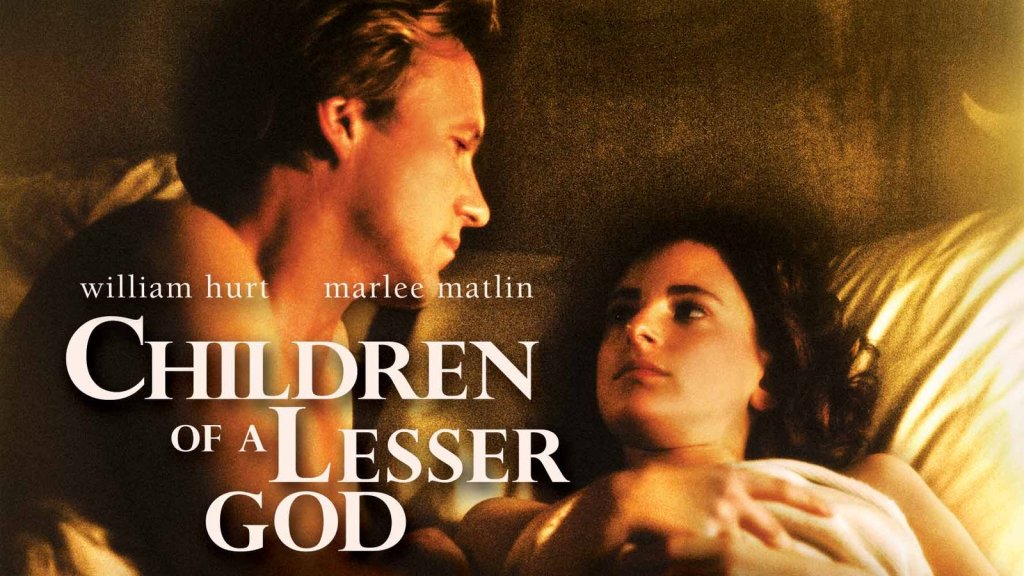
The most recent movie I watched comes from 1986, but one I’ve not seen before: Children of a Lesser God. Quite a remarkable film, especially the script that allowed for the audience to “hear” both sides of the conversation. Beautiful line: “Do you think we could find a place where we could meet… not in silence and not in sound.” Perhaps that finds the heart of most difficulties we experience when with others: we each want the other to enter our world, while we are unwilling to enter their’s. Perhaps a true and lasting relationship is one that discovers–together–the… new. Ah, but then we would have to sacrifice a part of ourselves and we just can’t have that! (So we retire to our separate corners for a respite and then come back out–gloves up.) I understand that the title of the movie is from a line in the poem Idyllys of the King by Alfred Lord Tennyson:
I found Him in the shining of the stars, I marked Him in the flowering of His fields, But in His ways with men I find Him not. I waged His wars, and now I pass and die. O me! for why is all around us here As if some lesser god had made the world, But had not force to shape it as he would, Till the High God behold it from beyond, And enter it, and make it beautiful?
Thought for the day (and as it is Sunday): “Wine is like the incarnation–it is both divine and human.” ― Paul Tillich. I’ve had the first bottle of Fermina chilling for four hours… time to see how she really tastes.
What if we decided that a person’s right to oxygen was more important than a ten minute joy ride in space?
What if we decided that children should not be soldiers instead of being offended that someone might use our preferred pronoun when speaking to/of us?
What if we decided that raising people out of poverty where they live in garbage was more important than a film festival?
What if lives in India mattered as much as lives anywhere else?
What if a drink of water meant more than you getting to work faster?
You can call me a communist or something worse for thinking these “what ifs”, but I think of it as being a Christian. St. Paul would not rest until the sisters and brothers cared for those around them. Why do we?
Oxygen is a basic human right. What if we worked on solving this and then work our way up to the joy rides of our own egos and offenses. I am offended that we are not.
A particular bishop brought in a consultant group to work with each individual church. They were reported to do wonders for any church who was willing to put in the effort. The only issue was that the consultants were all cannibals, so when the bishop hired them, he made them promise not to eat anyone. They all agreed.
After meeting with almost forty churches, things were going splendidly and each of those churches was growing and thriving, but then one day, the leader of the cannibal consulting group got a phone call from the bishop. Seems the secretary at the last church had gone missing and he wanted to make sure that it wasn’t the cannibals doings. Once he got off the call with the bishop, he asked his fellow workers if anyone had something to do with the missing secretary. One cannibal sheepishly raised his hand.
“You fool!” said the leader. “For weeks we’ve been eating clergy and no one noticed anything, but no, you had to go and eat someone important!”
Today, our Gospel reading was from Mark 6:30-34 and then we skipped to 53-56. What I immediately wanted to know is what went on in verses 35-52. Turns out, we skipped right over the feeding of the 5,000 and Jesus walking on water. Huh? Why on earth would we skip those two events? They seem kind of important to me, but the more I thought on it, I realized that I was falling into the same mindset as so many during the time of Jesus. Jesus even pointed this out in John’s Gospel when someone came looking for a miracle. Jesus said, “Unless you see signs and wonders you will not believe.” (John 4:48) Yes. We give thanks for the miracles that occurred then and continue to occur today, but they also serve a very specific purpose outside of those who benefit from them.
Let’s say that St. Matthew’s becomes a place of miracles. Now, I believe we see them all the time, we just don’t recognize them as such, but let’s say that they are undeniable: someone who is blind… born blind comes to our church, they receive the sacrament of healing and prayer and… they see. And then there is someone who has never walked in their life and they are prayed over and they walk. After a couple of events like this, word starts getting around: people are getting healed at St. Matthew’s. Others begin to arrive, slowly at first, to check things out and see what all the fuss is about, but I guarantee you this, if that begins to happen, after a short while, you won’t be able squeeze in here with a shoehorn and not just on Sundays. This will be wall-to-wall people. Some coming to worship, some bringing others in search of a miracle, some bringing themselves in search of the same, and even some who will come to criticize and tear down, but what is the purpose of this all? Episcopalians be like: as long as no one sits in my pew, it’s all good, but seriously, in all that is taking place, what is the purpose? Is it solely for the healings / miracles? Those are important and amazing, but they are not the purpose. Is it that more people are coming to church? Again, good, but not the purpose. How about those whom the healings are taking place through? Yes, yes, and yes. All good, but the purpose behind it all is so that the Good News can be proclaimed. The miracles, the feeding of the 5,000, walking on water, site for the blind are like beacons in a dark night, guiding people to a place where they can encounter God and hear the message. What is the message? Jesus is Lord. Forgiveness of sins. Salvation. Eternal life. The miracles occur so that this message, which is the Good News, can be proclaimed. Miracle: Lazarus was raised from the dead. It got a lot of people’s attention, but Lazarus is going to die again. Good News: Lazarus may die again, but through the forgiveness of sins and his faith in Jesus Christ, Lazarus will rise again, but this time he will rise to eternal life. The miracles demonstrate Jesus’ authority, so that we might believe his teaching and his word: salvation has come to all who believe.
The miracles then are like a beacon, calling out to those who would see and know God. Before Jesus, that beacon was to be God’s chosen people, the Israelites. Speaking through the prophet Isaiah, God said:
“You are my servant, Israel, in whom I will be glorified.” (Isaiah 49:3)
And a few verses further:
“It is too light a thing that you should be my servant to raise up the tribes of Jacob and to bring back the preserved of Israel; I will make you as a light for the nations, that my salvation may reach to the end of the earth.” (Isaiah 49:6)
The Lord is saying, it is not just the Israelites that I want to hear of my salvation, but all of humankind, so you will lead them. You will be a beacon to the world, but our reading today from Jeremiah tells us that they did not succeed: “Woe to the shepherds who destroy and scatter the sheep of my pasture!… It is you who have scattered my flock, and have driven them away, and you have not attended to them.” The shepherds might as well have been eaten by cannibals, because no one would have even noticed if they were gone. To be honest, I don’t believe it was a task that could have ever been fulfilled through human hands, but they were still the chosen ones, so when they failed, God said, If you want something done right, you just have to do it yourself. Continuing to speak through the Prophet Jeremiah, God said, “I myself will gather the remnant of my flock out of all the lands where I have driven them, and I will bring them back to their fold, and they shall be fruitful and multiply. I will raise up shepherds over them who will shepherd them, and they shall not fear any longer, or be dismayed, nor shall any be missing, says the Lord.”
And here is where our Gospel reading comes in. Jesus and the apostles had been doing the work, but Jesus also recognized their need for rest, so they tried to get away for a short time, but the crowds found them. Jesus could have pushed on and said, “Enough! We’re on vacation,” but that was not Jesus. Instead, “As he went ashore, he saw a great crowd; and he had compassion for them, because they were like sheep without a shepherd; and he began to teach them many things.” Israel was to be the beacon and the shepherd of God’s people, but when they failed, God said, “I myself will gather the remnant of the flock…”… I myself will be the beacon and the Shepherd. And Jesus said, “I am the good shepherd.” (John 10:11). “And I, when I am lifted up from the earth, will draw all people to myself.” (John 12:32)
The miracles that were performed by Jesus and the Apostles acted as a beacon, so that the world would be drawn in to hear the teachings and the message of salvation. And now we, as the Church, have been entrusted with the task of continuing that great work, but where are the miracles? Where are the beacons? Answer: sitting in the pews. You are the miracle. Your very life is a beacon, a testimony of God’s great work in this world and your life is a testimony that needs to be heard. You are a miracle that the world would in fact know was missing; therefore, through both words and deeds, live into your calling as witnesses to the Good News of God and then watch in joy and amazement as the miracle that is you, takes place in others.
Let us pray: Loving God, Send us out to draw others to You, into Your peace, into the Church, into lives dedicated to the Gospel. May our voices speak of hope and welcome to all. May our hands lift high the torch of new life in You. May our hearts yearn for justice and truth. Renew in us the courage and strength to reach out to the neediest in our midst. United in faith and prayer, with Mary, keep us ever steadfast in Your love as we strive for Your vision of a world renewed. We ask this through Christ, Our Lord. Amen.
#1 danger of journaling late at night… you might tell the truth!
THOUGHTS:
You have to look at your own life. Your own sins. And then you wonder how you can change. At what point do we recognize that we’re not any better. You try so damn hard to be holy and righteous in the eyes of the Lord and fail so miserably every damn day. It’s funny how you look at the world differently. What do you want?
What if someone actually gives you permission to love? You don’t have to seek anyone’s approval, really not even your own. It is just something you know. Why sit around second-guessing your heart?
The world is full of such beautiful people. Where does hate come from? Why don’t we love the color of their lives?
To have someone pray for you in the language that they understand. Their words touch the face of God.
There’s nothing to be afraid of.
I write these words because I have no voice to speak to Him. I write these words because the sun rose behind the moon and there was no light except for you.
Life should be color. A riot of color.
#1 danger of journaling late at night… you might tell the truth!
What I learned today: see above.
Thought for the day: We need more scars. They hide the fresh wounds.
As the header states, this is a shameless plug for The Golden Fistula. The price has been lowered to $.99 for the eBook and will eventually go to free (just in case you’re holding out for the real bargain.) Trying to do one more sales run before the second book in the series, The Marble Finger, comes out, which will hopefully be by the end of the year. That said, click the image below to order your copy today!
Friday night was the night at the ballpark and a visit from dad, Saturday was a writing day (added 3,500 words to The Marble Finger) and today was the preaching day (the sermon–you can find it here–seemed to work) followed by a nice nap. That, my friends, is a delightful weekend. Now, to ease into next week and get a few more items checked off the list, one of which is Contemporary Koinonia a.k.a. COKO.
COKO is a journal that a priesty friend and I are starting. We both got so tired of hearing all the bad / angry news out there about the Episcopal Church and we both knew that there were some remarkable stories to tell, so we are in the process of creating a resource for sharing them. It is not a local journal, although some stories will be, but we are working to bring the stories of the church into a tool that will allow congregations, clergy, and bishops to see and hear about the great and transformative work that is taking place in our church. More to come on this later, but the first issue–we hope–will be out in October. Don’t worry, you won’t need a subscription. Good news should always be free!
Hard change of gears (hear them grinding) and we’re off to the movies….
After watching Snatch, I’m wondering who does crazy better, Brad Pitt or Jack Nicholson. “All work and no play makes Jack a dull boy.” And we all know Jack Torrance is about as crazy as they come! That said, Mickey O’Neil (Brad Pitt) is an excellent nut case and the movie is fun, but I have to wonder if Jack Torrance (Jack Nicholson / The Shining) could take him. I’ll let you all weigh in on this one. Oh… it was a bit back we discussed Judi Dench’s laugh… brilliant, but I forgot about Brooke Adams in Invasion of the Body Snatchers (1973). It’ll make you happy just to hear it (and the movies is one my favs.)
And now we begin a new week. What surprises will it bring… a friend unexpectedly pulling up in your driveway, a moment to see Jesus in the face of another, a few more words in the novel… who knows. Maybe all of the above. Hoping your week is filled with the unexpected… that reminds me of a sermon I preached years ago: there are no coincidences, there are only God-incidences–it was probably as goofy then as it sounds now, but you get the point.
What I learned today (at least for me): being disciplined requires a goal. To simply say I’m going to do something doesn’t generally motivate me to accomplish it. I need a carrot. Perhaps that’s OK, but wouldn’t it be nice… and perhaps even easier… if you could do something simply for the love of it? I think I need to work on this (although I do love my work and wouldn’t trade that for anything!)
Thought for the day: “Do not be afraid; our fate cannot be taken from us; it is a gift.” ― Dante Alighieri, Inferno It’s probably one of those that you print on a coffee cup and remember to read every now and then, but… that doesn’t make it any less true.
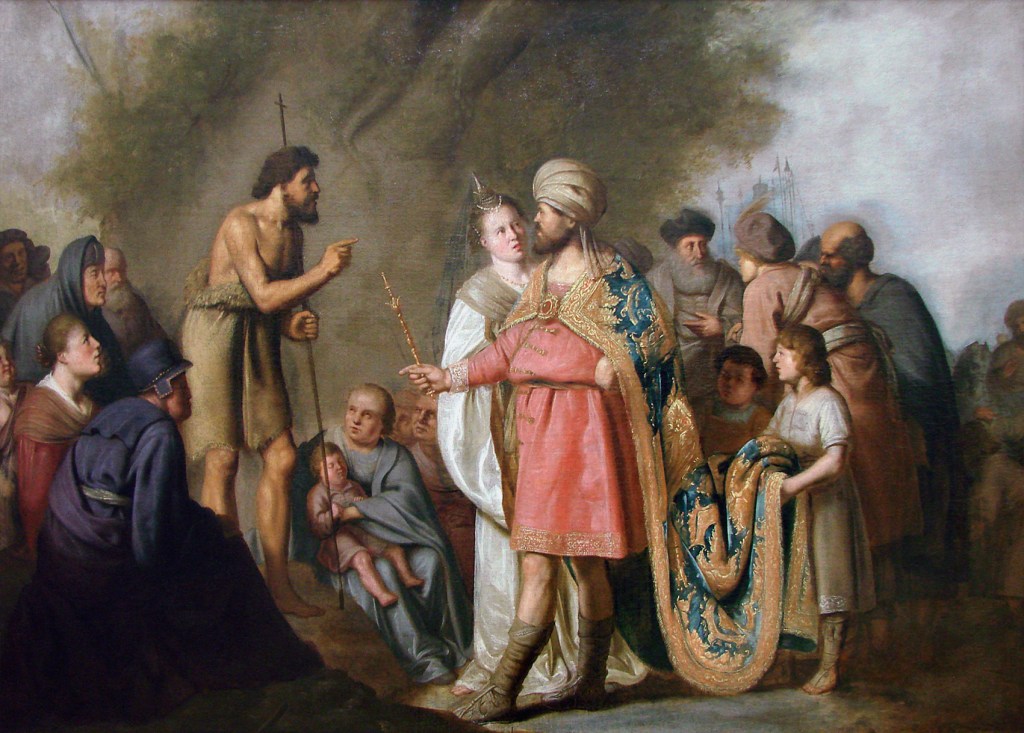
Saint Jean Baptiste prêchant devant Hérode Antipas by Pieter de Grebber
Hibbard “Hib” Johnson was an associate of Thomas Edison and was a partner in the organization that is now General Electric. He is also the Father of the Electric Christmas Tree Light. Given all that, he was fairly well off, being worth about $30M in today’s dollars, which means he could have what he wanted and he wanted a house built by Frank Lloyd Wright and… he got it. Only problem, the roof leaked, and one evening when Johnson was entertaining distinguished guests for dinner, and after several attempts to repair, it leaked again, dripping steadily onto Hibbard’s head. It is reported that Hib, irate, called Wright in Phoenix, Arizona. “Frank,” he said, “you built this beautiful house for me and we enjoy it very much. But I have told you the roof leaks, and right now I am with some friends and distinguished guests and it is leaking right on top of my head.” Wright’s reply, supposedly heard by all: “Well, Hib, why don’t you move your chair?”
I’m sure I can be stubborn at times, but not so pig-headed as to not move the chair. However, when we get our minds set on something, we can get a bit stubborn, whether we know we are right or wrong. Why? Because we want to get our way. We want what we want. After thinking on our Gospel lesson, I believe that was what was behind Herodias’ desire to have John put to death.
A little background, which is the story of three Herods. There was Herod the Great. He was the Herod that the three wisemen came to visit and that had all the young children in Bethlehem put to death. Then there was Herod II, son of Herod the Great. Herod II was heir apparent to the throne and married to Herodias; however, just days prior to Herod the Great’s death, Herod II fell out of favor with dad and it was Herod Antipas (we’ll call him Antipas) who was Herod II’s brother by another mother, that became king. Clear as mud? So, Herod II is married to Herodias and Antipas is married to a foreign princess. Herod II loses the throne to Antipas, and this is where things get really complicated. Antipas and Herodias, have a little thing on the side and both end up divorcing their spouses and marrying one another. Some might say they fell in love, but it would seem to me that Herodias just wanted to be queen, no matter what. She got it and was determined to remain so, but then, along comes John the Baptist, calling them out on their sin: you can’t marry your brother’s wife.
That would certainly be enough to get John in trouble, but as Herod was king and Herodias queen, they would have received criticism from many, and if those critics get too loud, you get rid of them, but there was something about John that was different from those other critics. Our reading said, “Herodias had a grudge against him, and wanted to kill him. But she could not, for Herod feared John, knowing that he was a righteous and holy man, and he protected him. When he heard him, he was greatly perplexed; and yet he liked to listen to him.”
Enter the dancing daughter. Must have been a fine dance, because Herod offers her half the kingdom. Being the devoted daughter, she asks momma: “Momma, we can have half the kingdom. What should I ask for?” She could have had so much, but instead she asked for John’s death. Why? I think part of the answer lies in the fact that Herod “liked to listen to” John. And what if, in all his talking that Herod like to listen to, one day, John was able to finally convince Herod that he shouldn’t be married to Herodias? Herodias understood that. Herod could as easily divorce her as he did his first wife. She could have had anything she wanted, but she could have lost what she so stubbornly went after: being queen. So, she had eliminated the one that might bring about her demise. “Well, Hib, why don’t you move your chair?” “Well, Herodias, why don’t you stop being so pig-headed and listen to God?”
This incident tells us about the lives of the king and queen and the death of John, is a microcosm of the world that Jesus entered into. A world where those who rule, both civilly and religiously, are corrupt and sinful. A world that does whatever it wants in order to get whatever it wants, whether it be right or wrong. A world that will put to death those who try to speak the word of God into the sinfulness. It is a story about how the world goes about silencing God. The entire incident, therefore, is a foreshadowing of what is to happen with Jesus, for like John, Jesus is going to call them all out on their sinfulness and as we know, they will silence him as well.
Today… today we also silence God. From taking prayer out of schools to perverting God’s word to suit our purposes, whether using it as a weapon against those who are different or by reinterpreting the difficult bits so that we no longer call sin sin. These and in so many other ways we silence God. But not only do we see the silencing of God in the world around us, but we silence him in our own lives as well.
Think of Herod and Herodias and John calling them to repentance. John was performing the same function that the Holy Spirit performs in our lives. With the king and queen, he spoke to them, showing them the errors they were making, and then showing them the path of righteousness. The same is true with the workings of the Holy Spirit in our own lives, and like Herod and Herodias, when that voice in the wilderness speaks to us, pointing out our errors and showing us the path of righteousness, we can become stubborn in our sin and effectively tune out and silence the Spirit. If we persist, then we put ourselves in danger of no longer even recognizing that voice, and then we really are in trouble, but we are not lost. Our God is one that seeks out the lost.
They brought to Jesus “a man who was deaf and had a speech impediment, and they begged him to lay his hand on him. And taking him aside from the crowd privately, he put his fingers into his ears, and after spitting touched his tongue. And looking up to heaven, he sighed and said to him, ‘Ephphatha,’ that is, ‘Be opened.’ And his ears were opened, his tongue was released, and he spoke plainly.” (Mark 7:32-35)
We can silence God to the point where we become deaf to God, but if we will allow it by not being stubborn in our sin, if we will accept his corrections, then he can once again open our ears and our spirits to the voice of the Spirit of God, that we might walk in paths of righteousness. Consider the first verse of our Psalm:
“I will listen to what the Lord God is saying, for he is speaking peace to his faithful people and to those who turn their hearts to him.” (Psalm 85:8)
Don’t be the one who is too stubborn to move your chair when the water is pouring on you. Don’t be the one who silences God when God is trying to correct you. Pray that the ears of your heart will be opened, then turn your heart to him and listen to what the Lord God is saying and he will be faithful to you and lead you along the path of righteousness.
Let us pray: Come Holy Spirit, fill the hearts of your faithful and kindle in them the fire of your love. Send forth your Spirit and they shall be created. And You shall renew the face of the earth. Amen.
Dad is coming tomorrow and tomorrow evening is St. Matthew’s Night at the Ballpark. We shall see if I’m throwing out the first pitch (always an embarrassment for everyone concerned.) I use to play baseball when I was a kid, but some forty odd years later… I don’t remember so much, especially how to throw the ball.
Thursdays are my Fridays and I always find them difficult, mainly because it is no one else’s Friday and I spend the evening at home with the Queen. She’s around somewhere, but not very talkative. So, I’m generally searching for something, but I never really know what that is and no matter what… eat, drink, write, talk… it is never really satisfying. Always looking for something in the void.
I worked on the sermon today and finished up a bit later than I planned. It also was not the sermon I thought I would be preaching. This one came out a bit “harder” than what I’m accustomed to, but still very valid and relevant to the Gospel. It is interesting when we begin to look at the historical application and the immediate application. It is then that we begin to realize the complexity and genius of the Gospels. The “Living” Word is so very true. It moves… now, don’t misinterpret… I am NOT saying that it moves and we are free to interpret according to our whims (Heaven forbid! We would end up with no bookends/brackets/”Law” and it would all be higgelypiggely according to our own desires. “God created man in his image and man returned the favor” type of nonsense!) Grace supersedes it all, but grace does not allow for shenanigans! Can I get an, “Amen!”
This is what I have for tonight. It is a rambling mess, but it is a journal and journals are allowed to be rambling messes.
What did I learn today: I’m not always prepared to listen to my own preaching.
Thought for the day: Richard Baxter (don’t we loathe the Reformers and Protestants, especially when they speak truth! Oy!) “Take heed to yourselves, lest you perish, while you call upon others to take heed of perishing; and lest you famish yourselves while you prepare food for them.” I would die for them. I am so very thankful that He died for me! A room in the basement of Heaven with a cot is all I ask for, but I will give it up for the least of those I’m called to serve. Why should they suffer or be held accountable for my shortcomings?
I have no pictures this evening, so we’ll just settle for this video (fast forwarding) of me writing this particular post….