
Jesus said, “Every scribe who has been trained for the kingdom of heaven is like the master of a household who brings out of his treasure what is new and what is old.”
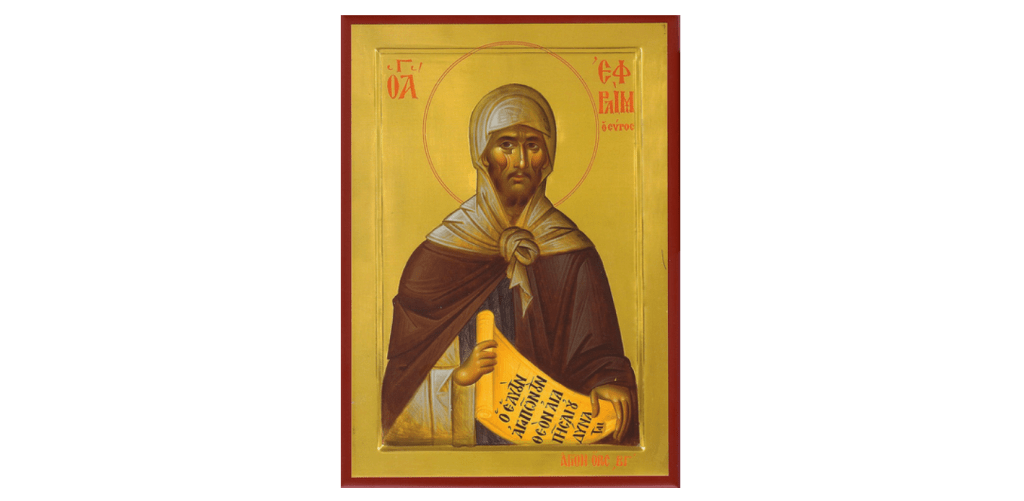
“Every scribe.” We heard this reading just a few Wednesdays ago when we studied Alcuin, who was a librarian of sorts. It also appears when we celebrate the great historian, the Venerable Bede; the theologian, Thomas Aquinas; and a more contemporary writer we studied at length, Dietrich Bonhoeffer. We hear this reading and understand that our Saint’s gift involved the Church’s writings. Ephrem of Edessa, whom we celebrate today, is no different.
Early on, he served in the household of Bishop Jacob of Nisbis, and it is likely that he attended the Council of Nicaea (where the Nicene Creed was composed) with the Bishop in 325. Following the Bishop’s death, Ephrem remained in service to Jacob’s successors but was eventually forced to flee following the Persian invasion. He then settled in a cave, where he lived out the remainder of his life.
Although he lived an austere life, he remained active in preaching and writing and was ordained a deacon. Of his writings, he not only wrote the hymn we read but also over 400 others used to teach the orthodox faith, which is how he became known as “The Harp of the Holy Spirit.” He died in 373 from exhaustion while caring for the sick.
There is much for Ephrem to be remembered for, but his role as “scribe” stands out most. For some, his writings are a bit too flowery, but many others find great beauty and comfort in them. In one particular hymn, he addresses the Upper Room where the Last Supper was held: “O blessed spot! No one has seen or shall see the things which you have seen. In you the Lord himself became true altar, priest, and bread and chalice of salvation. He alone suffices for all, yet none suffices for him. He is Altar and Lamb, victim and sacrifice, priest as well as food.”
In the Gospels, Jesus is never pleased with the scribes. He sees them, along with the Sadducees and Pharisees, as placing stumbling blocks before the people, at one point saying, “But woe to you, scribes and Pharisees, hypocrites! For you lock people out of the kingdom of heaven. For you do not go in yourselves, and when others are going in, you stop them.” Yet Jesus says that what is needed to be a faithful scribe is one “who brings out of his treasure what is new and what is old.” It is one who understands the writings of those who have gone before and recognizes that those writings speak of and point to the Savior.
Jesus said, “For truly I tell you, whoever gives you a cup of water to drink because you bear the name of Christ will by no means lose the reward.” Ephrem was one who, through his writings, gave us a “cup of water to drink,” and therefore has received his reward. We give thanks for him and all those who have passed on such knowledge, which leads to salvation through Jesus.

