
The lineup for the St. Louis Wolves baseball team: Who’s on first, What’s on second, and I Don’t Know is on third. I do believe that trying to keep track of the seven Heavenly Virtues can at times be equally as confusing. Just be thankful I opted not to include the discussion on the seven Capital Virtues and the seven Deadly Sins—maybe another day.
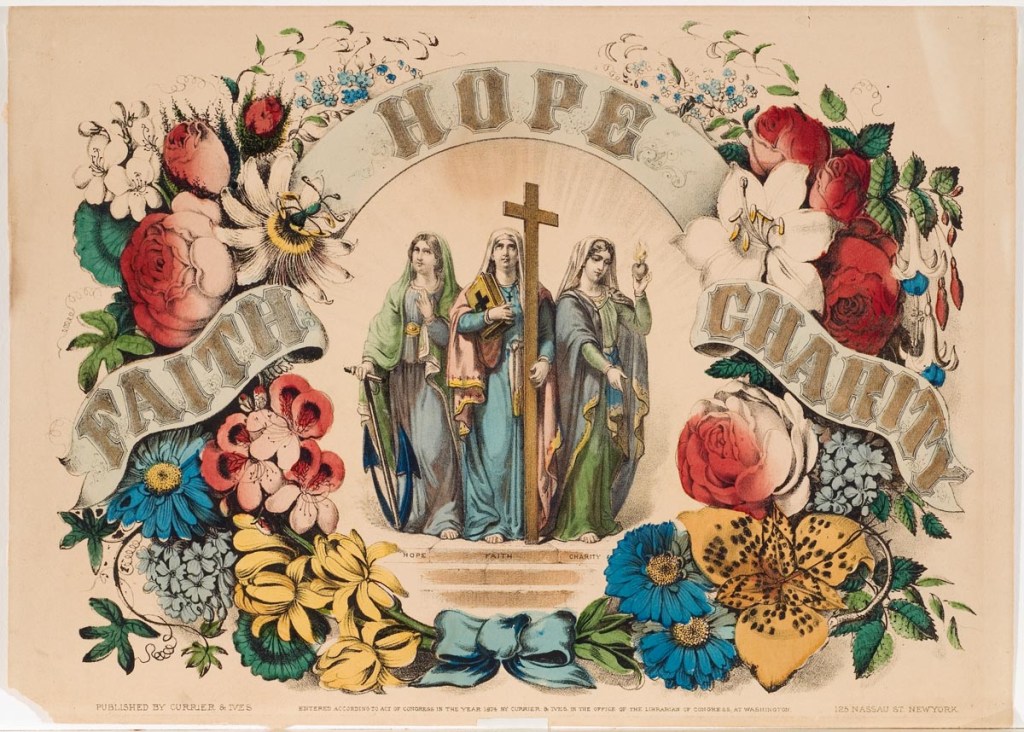
To bring everyone up to speed: the seven Heavenly Virtues consist of the four Cardinal Virtues and the three Theological Virtues. So far, we’ve covered the Cardinal Virtues: fortitude (spiritual courage), justice (seeking the common good), prudence (setting rules and measures), and temperance (moderation and balance). The Theological Virtues are perhaps more familiar: faith, hope, and charity or love. Today, we turn our attention to the first—faith.
Holy Scripture is full of discussions about faith; after all, that is what it all revolves around. There are many passages we can quote, and one of the more well-known is found in St. Paul’s second letter to the Corinthians—“We walk by faith, not by sight” (2 Corinthians 5:7). We enjoy quoting this, but I have to wonder—Do we truly walk by faith and not by sight? I would like to say yes, but I don’t think that is entirely accurate. Not because we don’t believe it to be true, but because we don’t fully understand what it means to have the faith that is proclaimed in the Bible. The issue began around the time of the Enlightenment (17th and 18th centuries), and it can be narrowed somewhat to that deep philosophical statement by the French (those darn French!) mathematician and philosopher René Descartes. He said, “I think, therefore I am.” Why is that a problem? That one little word “I.”
The word “I” shifts faith from the realm of God the Creator into the realm of us, the created. By doing so, faith becomes individualistic. It becomes what I can see, what I can do, and what I believe, which may sometimes align with other believers but often differ vastly. For example, consider the Apostles’ and Nicene Creeds.
“I believe in one God, the Father Almighty… and in one Lord Jesus Christ. I believe in the Holy Ghost the Lord, and Giver of life.” Now, before I go further, please don’t rush to the Bishop and tell him, “Father John says the Creeds are a problem!” I’m not saying that. But when we declare these statements, I know for a fact that we don’t all understand them the same way. More importantly, even though these statements speak of our faith, they do so intellectually; knowing something intellectually doesn’t have the power to transform lives. I can know that Jesus is Lord intellectually, but that knowledge won’t help much when the doctor calls up and says, “Stage four.” I firmly believe that knowledge is power, but when it comes to our faith, that knowledge must be incorporated into a life that is lived.
Another way we misunderstand faith is how we perceive it working in our lives. Say you get that call from the doctor. In your mind, you might think, “I’ll need to have greater faith to see me through this.” Or when things aren’t going well, someone who should be slapped silly might say, “You just need to have more faith.” In both cases, faith becomes something akin to adding more horsepower to an engine. “I’m gonna nitro-infuse the dual turbocharged manifold of my faith and supercharge it!” I know nothing about cars, but you get the idea. But what happens when the turbocharged faith fails? What happens when the doctor says, “We’ve done all we can do”? Didn’t you have enough faith? Was God angry with you? Or do we couch it in easier-to-swallow but vague spiritual language, “It’s God’s will”?
Our beliefs and our turbocharged faith, or lack thereof, are just two reasons why I don’t think we truly understand what Holy Scripture means by faith. There are more reasons, but enough about what faith isn’t. So, what exactly is faith? A specific incident in Matthew’s Gospel helps us grasp the answer.
“When Jesus got into the boat, his disciples followed him. And behold, there arose a great storm on the sea, so that the boat was being swamped by the waves; but he was asleep. And they went and woke him, saying, ‘Save us, Lord; we are perishing.’ And he said to them, ‘Why are you afraid, O you of little faith?’ Then he rose and rebuked the winds and the sea, and there was a great calm. And the men marveled, saying, What sort of man is this, that even winds and sea obey him?’” (Matthew 8:23-27)
This is a familiar story and a favorite for many. We understand that water symbolizes chaos and death, and that the storm represents the world around us with its challenges, concerns, hardships, and more. We are the disciples—concerned, confused, afraid, and dying. Jesus… well, Jesus is conked out in the bow of the boat. From our intellect, we shout out at the storm, “I believe in one God, Father Almighty…,” but the storm still rages. We say, “I will turbocharge my faith,” but the storm still rages. We bargain with God, saying, “Get me through this, and I’ll attend every service during Holy Week,” but the storm still rages. Do all you know to do, but the storm is still going to rage. Why? Because rage is what storms do. You try to influence that storm with your intellectual understanding or your turbocharged faith, but it doesn’t work. Yes, in this particular instance, Jesus calmed the storm, but consider this: years later, after Jesus ascended into Heaven, Peter faced another storm in Rome. Jesus didn’t calm that storm, and it ended with Peter being crucified upside down. Bartholomew was caught in a storm that ended with him being flayed alive. James faced a storm that led to his beheading. All those men in that boat—the exception might be John, who likely saw his fair share of storms—had storms that ended in their brutal and merciless deaths. Did they not have enough faith? Was their faith not turbocharged? No!
In that boat on the sea, when the storm was raging, and the disciples were terrified, Jesus was not only sleeping peacefully. He was also teaching. He was demonstrating to them—and to us—what true faith in the Father Almighty actually looks like. He was teaching that storms are going to do what storms do—rage—but you, no matter what appearance the storms in your life may take, can rest secure in the Father’s arms, knowing—not just believing—but knowing that the Father Almighty will see you through. It’s not about the storms that blow out there—you can’t change them; they will do what they do—instead, it’s about the storms that blow within your soul, and you can do something about them. True faith says, “Regardless of what I know in my mind, regardless of what I see with my eyes, and even regardless of the final outcome, there is God, and where God is… How did David put it?”
“If I ascend to heaven, you are there!
If I make my bed in Sheol, you are there!
If I take the wings of the morning
and dwell in the uttermost parts of the sea,
even there your hand shall lead me,
and your right hand shall hold me.
If I say, “Surely the darkness shall cover me,
and the light about me be night,”
even the darkness is not dark to you;
the night is bright as the day,
for darkness is as light with you
(Psalm 139:8-12).
“I think, therefore I am.” “I will turbocharge my faith.” No. Faith is not about “I.” Faith is relational. “We walk by faith, not by sight.” Faith is a life walking with God and a life transformed by that relationship. If we walk by what we can see, the storm will terrify us; therefore, we walk by what we cannot see. That is faith.
Such faith is a grace, a gift from God. Do you need more of this faith? Then follow the example of the disciples. Ask Jesus for more—“Lord, increase our faith!” “Lord, all I can see is the storm. Help me to see you. Help me to know how to lie down in the bow of the boat next to you and rest in the Father’s arms. Help me to grow more deeply into a relationship with You.”
That is faith; however, there is more to this walk with God, for St. Paul also tells us, “Faith is the assurance of things hoped for, the conviction of things not seen” (Hebrews 11:1). Question: What is this hope he speaks of?
Let us pray: Lord God, grant us the faith to know Your will, the hope to accept it, and the love to do it, even when we don’t understand, trusting that Your way is best. We ask this through Christ Our Lord. Amen.
 Candle in a Cave