
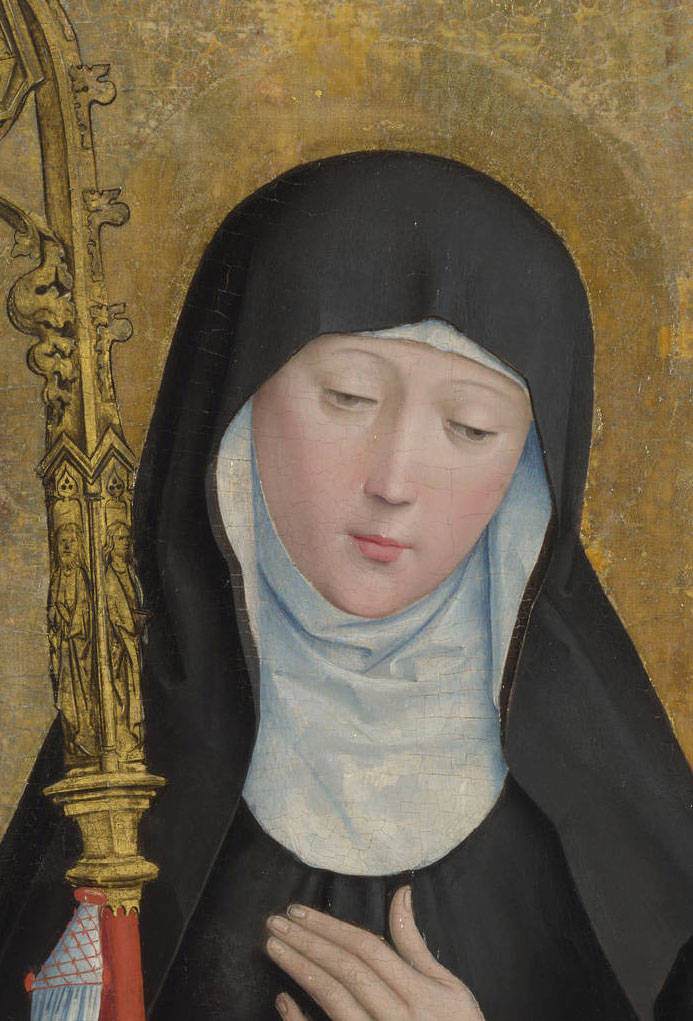
Most would agree that twins share a very special bond, and our Saint for today, Scholastica, helped prove that point. Her twin and only brother was none other than Saint Benedict.
They grew up in a wealthy family, yet early on they both felt a calling to a more austere, holy life. Benedict was the first to leave home and would eventually form a monastery based on his Rule—the Rule of St. Benedict. Witnessing such a life, Scholastica sought and received approval to form a convent, following the rule established by her brother. It was the first Benedictine Convent and was located about five miles from her brother’s monastery.
I’m certain they exchanged many letters, but as close as they were—in proximity and relationship—they only met once a year. Pope Saint Gregory the Great records their last meeting.
“Scholastica, the sister of Saint Benedict, had been consecrated to God from her earliest years. She was accustomed to visiting her brother once a year. He would come down to meet her at a place on the monastery property, not far outside the gate.
“One day she came as usual and her saintly brother went with some of his disciples; they spent the whole day praising God and talking of sacred things. As night fell they had supper together.
Their spiritual conversation went on and the hour grew late. The holy nun said to her brother: “Please do not leave me tonight; let us go on until morning talking about the delights of the spiritual life.” “Sister,” he replied, “what are you saying? I simply cannot stay outside my cell.”
“When she heard her brother refuse her request, the holy woman joined her hands on the table, laid her head on them and began to pray. As she raised her head from the table, there were such brilliant flashes of lightning, such great peals of thunder and such a heavy downpour of rain that neither Benedict nor his brethren could stir across the threshold of the place where they had been seated. Sadly he began to complain: “May God forgive you, sister. What have you done?” “Well,” she answered, “I asked you and you would not listen; so I asked my God and he did listen. So now go off, if you can, leave me and return to your monastery.”
Reluctant as he was to stay of his own will, he remained against his will. So it came about that they stayed awake the whole night, engrossed in their conversation about the spiritual life.
“It is not surprising that she was more effective than he, since as John says, God is love, it was absolutely right that she could do more, as she loved more.
“Three days later, Benedict was in his cell. Looking up to the sky, he saw his sister’s soul leave her body in the form of a dove, and fly up to the secret places of heaven. Rejoicing in her great glory, he thanked almighty God with hymns and words of praise. He then sent his brethren to bring her body to the monastery and lay it in the tomb he had prepared for himself.
“Their minds had always been united in God; their bodies were to share a common grave.”
St. Paul begins his famous passage on love by saying, “If I speak in the tongues of men or of angels, but do not have love, I am only a resounding gong or a clanging cymbal. If I have the gift of prophecy and can fathom all mysteries and all knowledge, and if I have a faith that can move mountains, but do not have love, I am nothing. If I give all I possess to the poor and give over my body to hardship that I may boast, but do not have love, I gain nothing… Love never fails.” And it did not fail Scholastica. She said, “I asked you [Benedict] and you would not listen; so I asked my God and he did listen.”
Through the pure love of God and her brother, Scholastica asked that God hear her prayer. God did. When you pray, ask yourself, “Am I asking out of pure love, or do I have some other motive?” I would suggest that by answering that question, you have a very good chance of knowing how God will answer your prayer.
 Candle in a Cave