
A fable passed down for generations tells of an elderly man traveling with a boy and a donkey. As they walked through a village, the man led the donkey, and the boy walked behind. The townspeople called the old man a fool for not riding, so to please them, he climbed onto the animal’s back. When they reached the next village, the people said the old man was cruel to let the child walk while he rode. So, to please them, he got off, set the boy on the animal’s back, and continued on his way. In the third village, people accused the child of being lazy for making the old man walk, and someone suggested they both ride. So the man climbed on, and they set off again. In the fourth village, the townspeople were indignant at the cruelty to the donkey because he was made to carry two people. The frustrated man was last seen carrying the donkey down the road.
In the 1950s, the Polish-American psychologist Solomon Asch conducted a series of conformity experiments. The tests were simple, but the results were profound. Since then, the tests have been replicated numerous times. What doesn’t change are the results.
The test was administered to college men and billed as a vision/eyesight test, but it was much more.
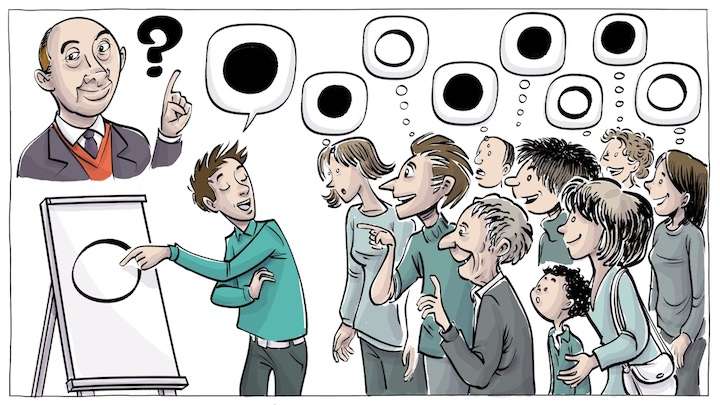
Asch created an image with three vertical lines of varying length and labeled them A, B, and C. He then brought in a group of individuals and asked which of the three lines was the longest. Simple enough, but there was a twist. If there were eight individuals in the room being tested, seven of them—known as confederates—were in on the experiment. The odd man out was the subject. The questioning would then begin. “Which of the three lines is the longest?” The confederates always answered first, and the subject last.
At first, the confederates would give the correct answer, but after a few rounds, they would all intentionally choose the wrong answer.
You’ve got lines A, B, and C. A is the longest, and everyone chooses A. All is well. Then you are shown a new set of lines in which C is the longest, but all seven confederates say B is the longest. When it’s the subject’s turn to answer, and he plainly sees that C is the longest, how will he answer? Will the subject be truthful, regardless of what everybody else has said, and choose C (the longest), or will he cave to social pressure and go along with the confederates’ choice of B? Remember, the subject thinks this is a vision test, so there’s no pressure to “get along.” Nothing high-stakes about the choice. Yet, of all the subjects tested, only about 25% never conformed, giving in to social pressure. 75% conformed at least some of the time, and 33% gave in to peer pressure 100% of the time, even though the answer was clearly wrong.
The big question then is “Why?” Asch concluded there were several factors—a desire to be accepted, fear of being different, and conflict avoidance. People would rather be wrong than be ostracized.
Because the experiment was conducted on college students, Asch concluded, “The tendency to conformity in our society is so strong that reasonably intelligent and well-meaning young people are willing to call white black. This is a matter of concern. It raises questions about our ways of education and about the values that guide our conduct.”
He made that statement about young people, but I would be willing to make a substantial wager that it applies to us all. True? I believe so. Ever go along with something you didn’t feel was right, but participate because everybody else was doing it? Yeah. Everybody nod your head.
Social conformity exerts great pressure on us all, leading us to conform to the person others expect us to be rather than the person we truly are. This is a good thing when it comes to taking a bath or brushing your teeth. However, in other situations, it can take a very bad turn. Consider what happened to the average German citizen during the 1930s and the rise of Nazism.
A week or so ago, I came across a quote but was unable to identify the author. I liked it enough to include it in my journal. It is on the New Age side of things, but bear with me. It reads, “You will never be free until you realize this. It was never about what they think. It was always about whether you listen to yourself. We spend so much of life chasing approval, fitting into shapes that were never ours, walking paths paved by other people‘s expectations. But have you noticed? The more you chase what pleases them, the further you drift from what fulfills you. The universe gave you a compass, not in your pocket but in your chest. Your intuition is the echo of the cosmos whispering through you. And yet, how often do we trust our fear more than we trust that quiet knowing? Do not fear walking alone. Do not fear growing alone. Because to stand in your own light is to remember the truth.”
It sounds like Asch. We chase approval, fit into shapes that are not our own, and follow paths that are not ours—we conform. We chase or believe in things that don’t fulfill us, and have nothing to do with who we want to become, yet we do it to get along. Mustn’t go against the grain. However, within us is a voice that speaks truth. A voice that will guide us along a path that will fulfill us and even transform us into the person we were created to be.
Today, we read from St. Paul’s first letter to the Corinthians. He said, “For what human being knows what is truly human except the human spirit that is within? So also no one comprehends what is truly God’s except the Spirit of God. Now we have received not the spirit of the world, but the Spirit that is from God, so that we may understand the gifts bestowed on us by God.”
Paul is saying that no one can truly know another person simply by looking at them or even by being in relationship with them. A part remains hidden, perhaps even from themselves. Since that is true, if we can’t even know another person, then knowing God is even less possible, unless—and there is the key—unless we have the Spirit of God within. Through the Spirit, God chooses to reveal Himself to His children. Still, we live in the world, and the spirit of the world can influence our lives. It is this spirit that wants us to conform, to chase approval, walk paths that are not our own, and turn from God. Therefore, in his letter to the Romans, Paul writes, “I appeal to you therefore, brothers, by the mercies of God, to present your bodies as a living sacrifice, holy and acceptable to God, which is your spiritual worship. Do not be conformed to this world, but be transformed by the renewal of your mind, that by testing you may discern what is the will of God, what is good and acceptable and perfect.” (Romans 12:1-2)
Paul implores us not to listen to the spirit of this world but to look to the Compass within our chest, our soul, and to listen to the whisperings of God’s Holy Spirit. Such actions may bring on the feelings Asch described in his experiment, primarily fear of being different and of being ostracized, but “Fear not,” Jesus says. “You will not have to walk alone, for I am with you.”
Jesus says, “Don’t be afraid to be different. Why? Because I created you to be different. I created you to be the salt of the Earth. I set you on a path not to be conformed to this dark world but to be the light of the world. Therefore, ‘let your light shine before others, so that they may see your good works and give glory to your Father in heaven.’”
Will such a life make a difference?
In his experiments, Asch introduced a variable. What if one of the confederates dissented and chose the truth? In almost every case, the subject, seeing an ally—someone they could stand with—chose the truth. The truth doesn’t need a majority, just company.
If you become the light, you will give others the courage to do the same. You may or may not be able to change the world around you, but by living out the truth, by shining the light of Christ, by not conforming, by not ending up carrying the stupid donkey, and ultimately by living according to the Spirit of God, you will fulfill the will of God in your life (which, by the way, is far more important than winning the battle).
The author of Proverbs writes,
“The way of the wicked is like deep darkness;
they do not know over what they stumble.”
“But the path of the righteous is like the light of dawn,
which shines brighter and brighter until full day.”
(Proverbs 4:19 & 18)
Walk the path of righteousness and be that light. It is why God, in His infinite wisdom, created you.
Let us pray (Hymnal 1982 #656 by John Keble):
Blest are the pure in heart,
for they shall see our God;
the secret of the Lord is theirs,
their soul is Christ’s abode.
The Lord, who left the heavens
our life and peace to bring,
to dwell in lowliness with us
our pattern and our King;
He to the lowly soul
will still himself impart and
for his dwelling and his throne
will choose the pure in heart.
Lord, we thy presence seek;
may ours this blessing be;
give us a pure and lowly heart,
a temple fit for thee.
 Candle in a Cave