
If I told you the number 218, what do you think it would represent? It is roughly the number of times St. Paul speaks the name “Jesus” in his writings. This number doesn’t include the times Paul uses “Christ” instead—just Jesus.
Consider the beginning of Paul’s greeting in his First Epistle to the Corinthians.
“Paul, called to be an apostle of Christ Jesus by the will of God, and our brother Sosthenes,
To the church of God in Corinth, to those sanctified in Christ Jesus and called to be his holy people, together with all those everywhere who call on the name of our Lord Jesus Christ—their Lord and ours:
Grace and peace to you from God our Father and the Lord Jesus Christ.”
He clearly stated from the start who he would be discussing—Jesus.
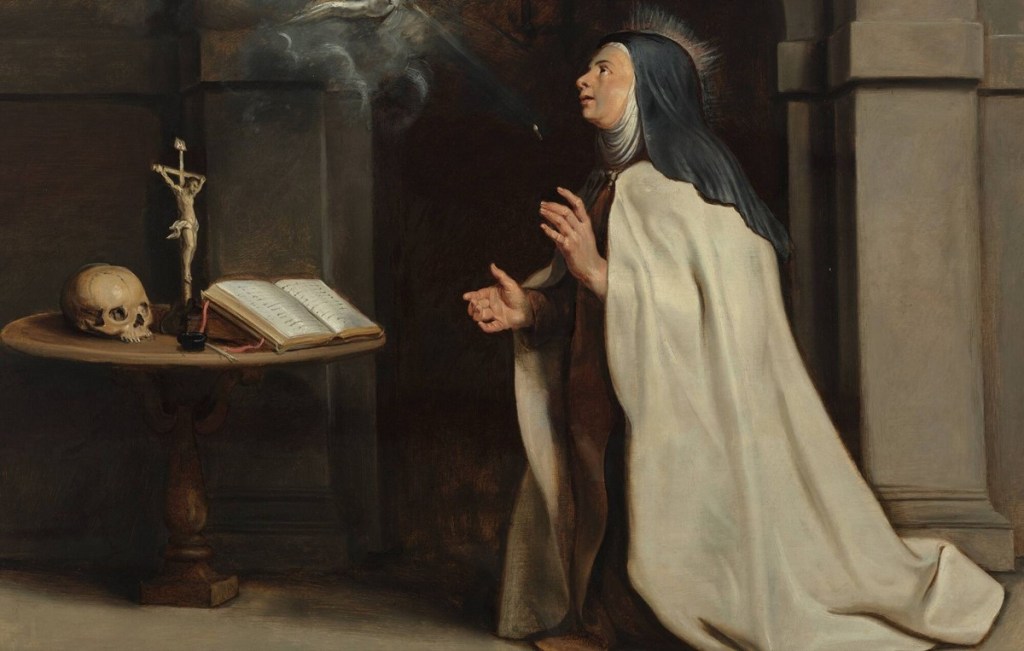
It is this frequent use of the name Jesus that St. Teresa of Avila, whom we celebrate today, noted in her writing (this is a longer selection).
“If Christ Jesus dwells in a man as his friend and noble leader, that man can endure all things, for Christ helps and strengthens us and never abandons us. He is a true friend. And I clearly see that if we expect to please him and receive an abundance of his graces, God desires that these graces must come to us from the hands of Christ, through his most sacred humanity, in which God takes delight.
“Many, many times I have perceived this through experience. The Lord has told it to me. I have definitely seen that we must enter by this gate if we wish his Sovereign Majesty to reveal to us great and hidden mysteries. A person should desire no other path, even if he is at the summit of contemplation; on this road he walks safely. All blessings come to us through our Lord. He will teach us, for in beholding his life we find that he is the best example.
“What more do we desire from such a good friend at our side? Unlike our friends in the world, he will never abandon us when we are troubled or distressed. “Blessed is the one who truly loves him and always keeps him near. Let us consider the glorious Saint Paul: it seems that no other name fell from his lips than that of Jesus, because the name of Jesus was fixed and embedded in his heart. Once I had come to understand this truth, I carefully considered the lives of some of the saints, the great contemplatives, and found that they took no other path: Francis, Anthony of Padua, Bernard, Catherine of Siena. A person must walk along this path in freedom, placing himself in God’s hands. If God should desire to raise us to the position of one who is an intimate and shares his secrets, we ought to accept this gladly.
“Whenever we think of Christ we should recall the love that led him to bestow on us so many graces and favours, and also the great love God showed in giving us in Christ a pledge of his love; for love calls for love in return. Let us strive to keep this always before our eyes and to rouse ourselves to love him. For if at some time the Lord should grant us the grace of impressing his love on our hearts, all will become easy for us and we shall accomplish great things quickly and without effort.”
She wrote, “Love calls for love in return—Jesus’ love for us calls out our love for Him; therefore—Let us strive to keep this [love] always before our eyes and to rouse ourselves to love him.”
How do we accomplish this? As with Teresa, Paul, Catherine, Francis, and so many others, keep the name of Jesus always before you. In all whom you see, in all that you do, speak His Name, and you will rouse yourself to love Him and others.
 Candle in a Cave