
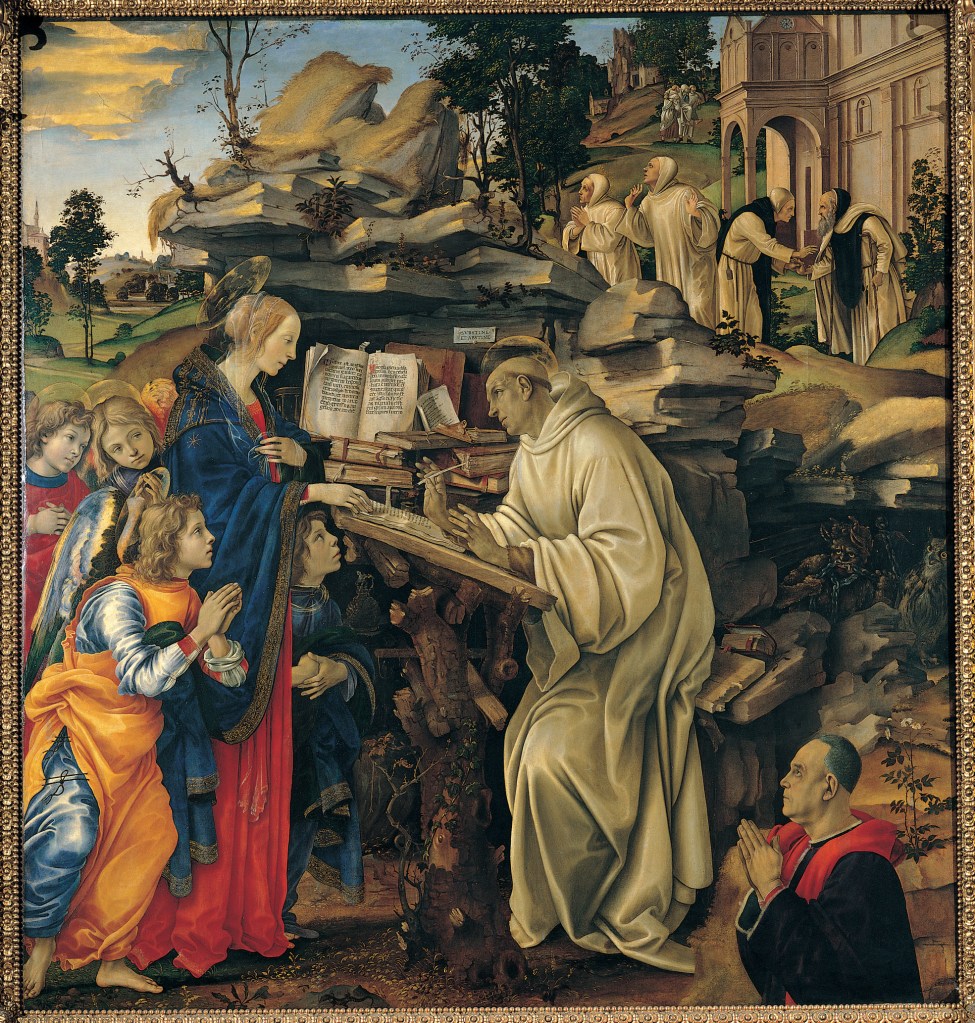
Born in 1090, Bernard of Clairvaux grew to become a force to be reckoned with. Not only did he establish a monastery at Clairvaux, but through his teachings, sixty other monasteries were founded and linked with Clairvaux. That alone was a great achievement, but he was also a poet and hymn writer, a preacher of the Crusades, a priest to the Knights Templar, and an advisor to popes and kings. “By 1140, his writings had made him one of the most influential figures in Christendom.”
In his writings, especially those addressed to Pope Eugenius III, Bernard emphasized moderation in all things. He wrote to the overburdened pope, “As the Lord says, ‘What does it profit you to gain the whole world, but lose yourself alone?’ Now since everyone posses you, make sure that you too are among the possessors.” Yes, Bernard is saying, dedicate yourself fully to the work the Lord has called you to, but don’t forget the Lord or yourself in the process. However, if there was one area where Bernard would not preach such moderation, it would be in “love,” for when it comes to love, Bernard knows no limits. For Bernard, this understanding of love partly stems from his meditations on our Gospel reading.
Jesus said, “If you abide in me, and my words abide in you, ask for whatever you wish, and it will be done for you.” Bernard understood “in me,” in God, to mean, in love with God. To be in God is to be in love with God. He believes we are called to be in love with God and were created for this purpose, writing, “God hath endowed us with the possibility of love.” When someone asked him, “Why should we love God?”, he answered, “You want me to tell you why God is to be loved and how much. I answer, the reason for loving God is God himself; and the measure of love due to him is immeasurable love.” He concludes by asking, “Is this plain?” A more modern way of saying “Is this plain?” could be something like, “Duh!”
Not only should our love extend to God, but also to one another. Perhaps one of his most famous quotes states, “Love me, love my dog.” If you are going to be in a relationship with someone, then you have to love everything about them, including the goofy dog with fleas, bad breath, and all the other unfortunate and annoying aspects of their character.
In living a life of moderation and love, Bernard fulfilled his own definition of a holy person: “seen to be good and charitable, holding nothing for himself, but using every gift for the common good.”
Centuries later, St. Josemaría Escrivá wrote, “Lord: may I have due measure in everything… except in Love.” Escrivá wasn’t speaking directly of Bernard, but those words clearly articulate the pattern of life that Bernard of Clairvaux would call us each to: a life of moderation and perpetual, unrestrained love.
 Candle in a Cave