
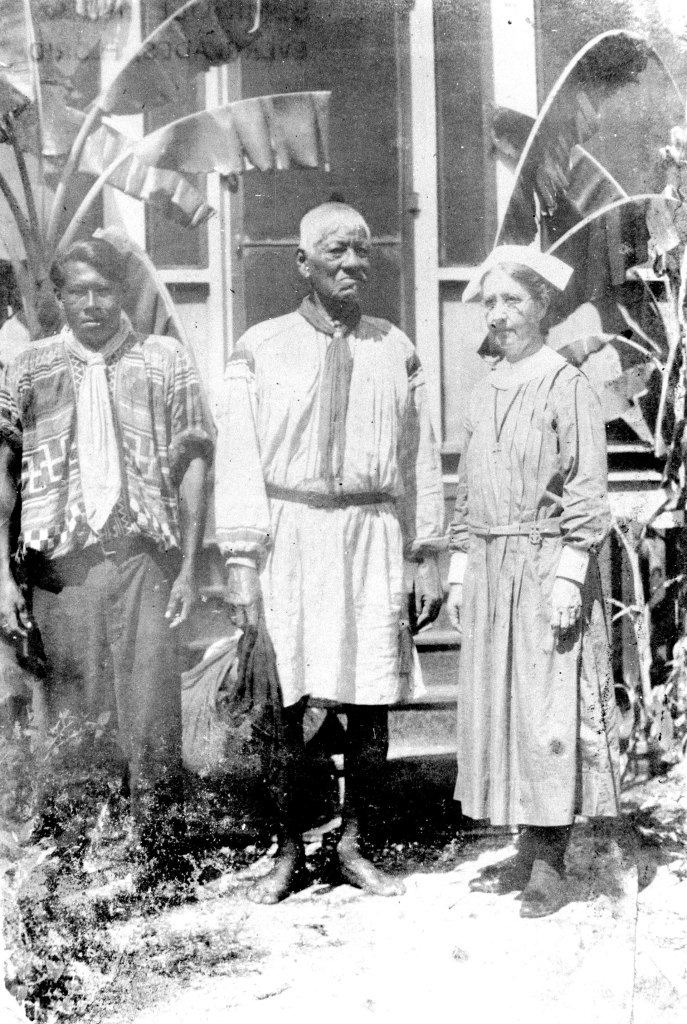
There are many sources within the Church listing the Saints celebrated. Because there are so many, most days have more than one Saint appointed. Today is no different. There are at least a dozen we could name. In the Episcopal Church, included in these feast days are those who may not be official Capital “S” Saints but who the Church describes as Holy Women and Holy Men. Today’s saint comes from this list, and she is closely linked to Oklahoma—Harriet Bedell.
Born in 1875, Harriet knew from an early age that she wanted to serve in the church, especially after hearing a missionary preach on the needs of those in China and Native Americans in this country. Her mother said no to her traveling abroad but allowed Harriet to go to school in New York to become a missionary/teacher in the United States.
She attended St. Faith’s Training School for Deaconesses. What is a Deaconess? Diane is training to be ordained a Deacon, but until 1970—Ladies, don’t shoot the messenger—until 1970, women were not allowed to be ordained, so the church created the position of deaconess. According to the Episcopalian Dictionary, “A deaconess used to be a ‘devoted unmarried woman’ appointed by the bishop to do just about anything that happened to be needed in a parish or an institution. She could be a spinster or a widow–if she married, that automatically terminated her appointment.
She wore a distinctive, identifying garb and went wherever she could make herself useful. She visited the sick and the poor, she gave Baptism and Confirmation instructions, she read Morning Prayer, Evening Prayer, and the Litany at public services, she specialized in work with women and children, and when licensed by the bishop to do so, she gave ‘addresses–which means she preached. And if circumstances called for it, she mopped the floor and mowed the lawn.” (Source)
The church may not have had ordained Deacons, but they had Deaconesses doing the work of one.
Following her training in New York, Harriet traveled to Watonga, Oklahoma, where she worked alongside Deacon David Pendleton Oakerhater at the Whirlwind Mission. The Cheyenne so respected her that she was adopted into the tribe and given the name Vicsehia, which translates as “Bird Woman.” She served there for ten years until contracting tuberculosis and moved to Colorado for treatment.
Afterward, she would serve various Native American nations in Alaska and Florida. She remained very active following her retirement in 1938 and died on this day in 1969.
The daughter of Pharoh was bathing in the river when a basket, holding the infant Moses, floated down to her. Moses’ sister saw all this and ran to the daughter of Pharaoh and asked if she could find a nursemaid for the child. Pharaoh’s daughter said yes, so Moses’ sister brought Moses’ mother. Pharaoh’s daughter said to her, “Take this child and nurse it for me, and I will give you your wages.”
Harriet lived her life as though she had heard those exact words, except that in her case, the child she was to care for was the Native Americans she was called to live among. She also understood that the wages she would receive were not worldly but, instead, blessings from Our Father in Heaven and entry into His Heavenly Kingdom.
I wonder, how might our Lord be saying to you, “Take this child and nurse it for me, and I will give you your wages.”
 Candle in a Cave