It is 43° F and raining. Any other time and place, that would be a perfect excuse to stay at home and stay warm. However, being here, that’s really not an option. Today I can sleep late, but tomorrow they are going to kick me out come rain or shine. Though nuanced with gray clouds, the perfectly blue sky is still out there. Time to go enjoy it and live a life. FYI: cod stew makes for some very wild dreams.
Flashback to trip to Lisbon… I washed clothes last night and with great apprehension, I felt them today. No hairdryer required.
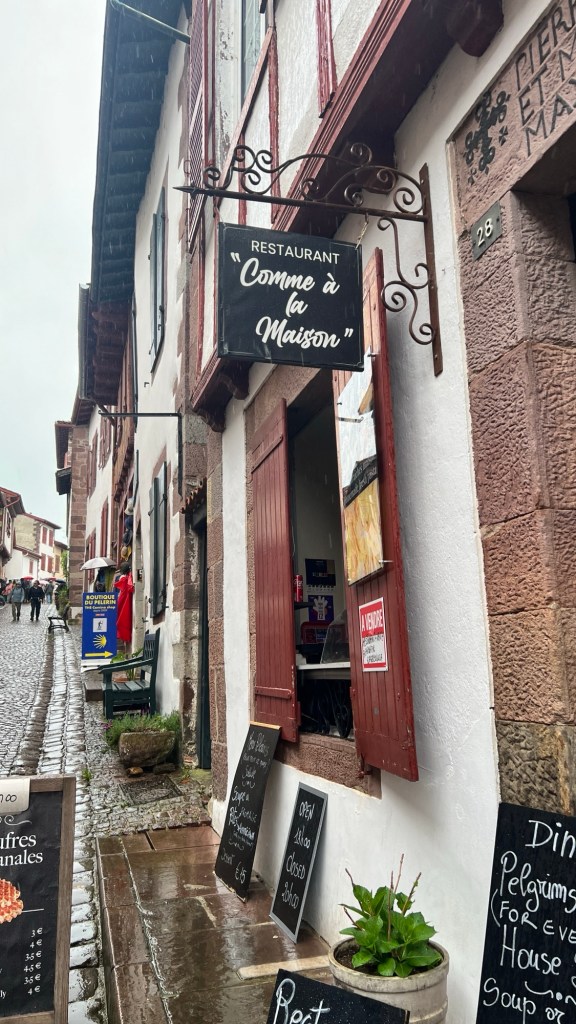
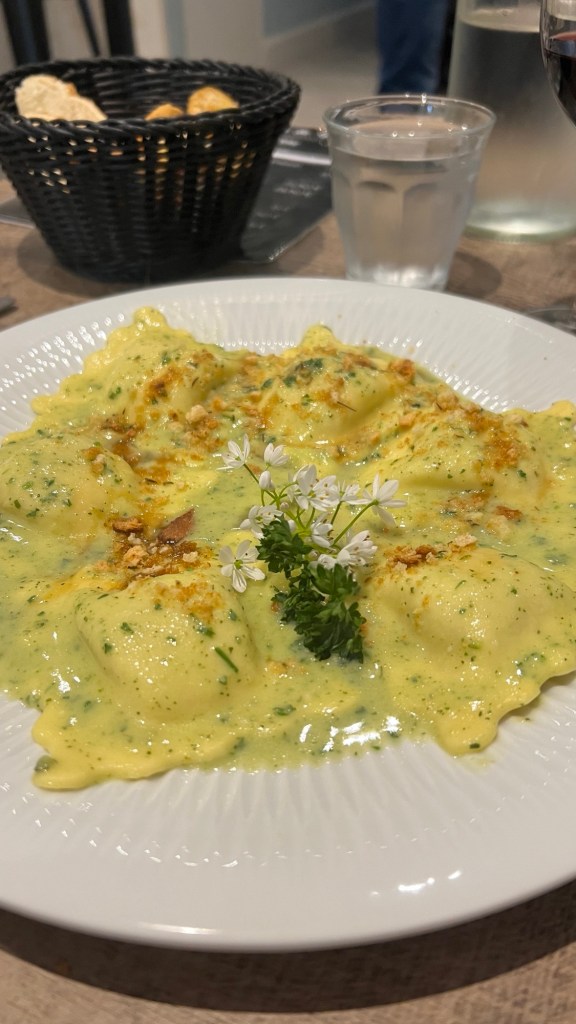
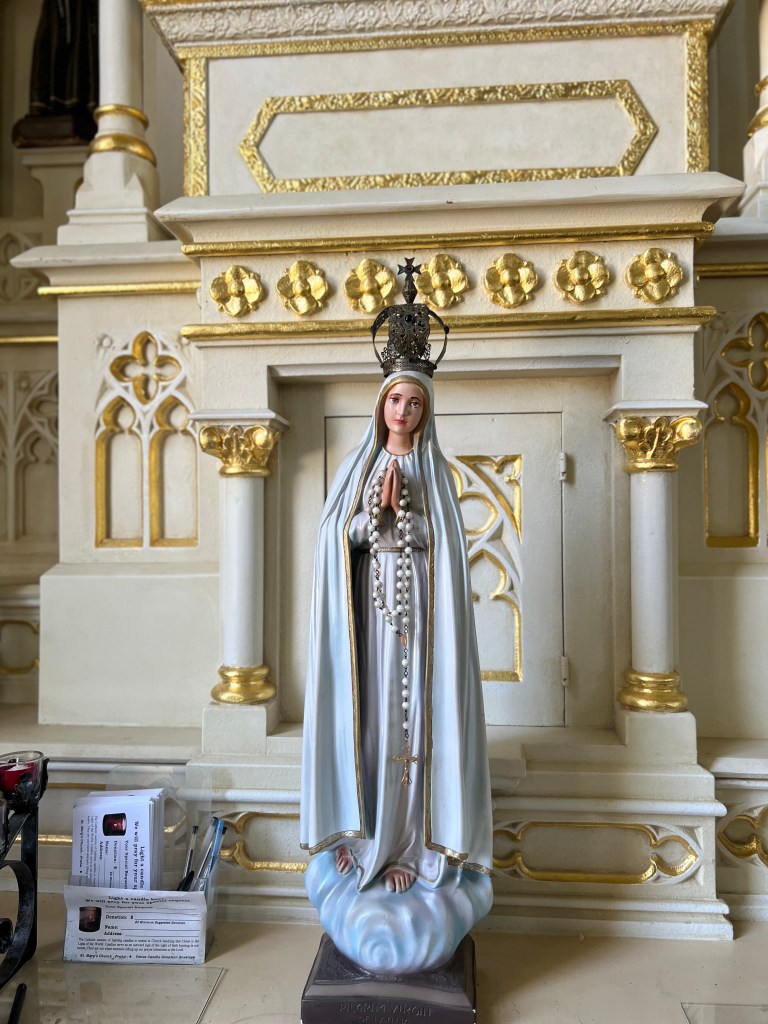
I have spent the day walking around. It rained most of the morning and part of the afternoon but the sun is trying to come out now. I prayed my rosary at a beautiful church, and then had a delicious lunch at Comme à la Maison. Very quaint little restaurant. Five stars in my book.
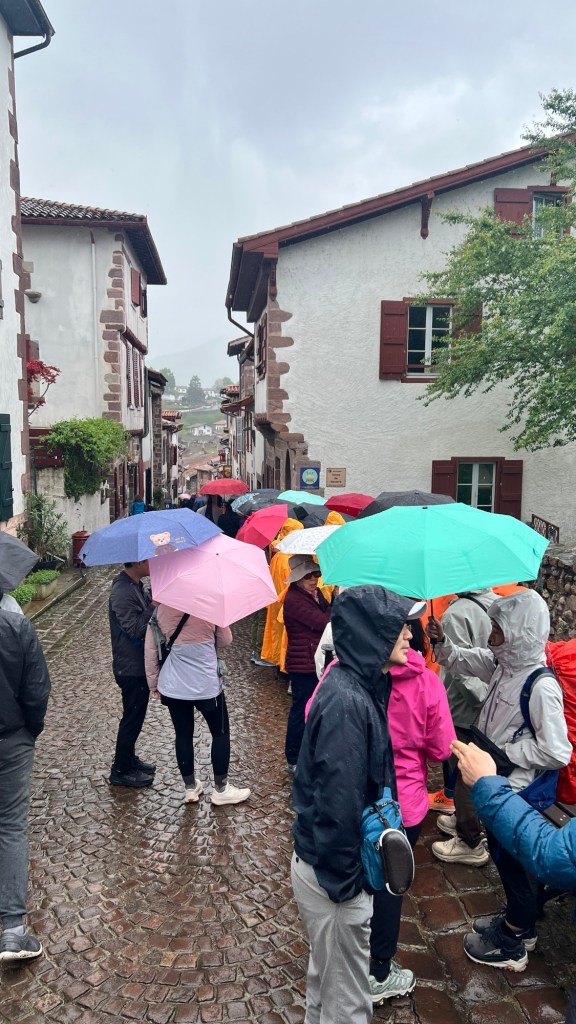
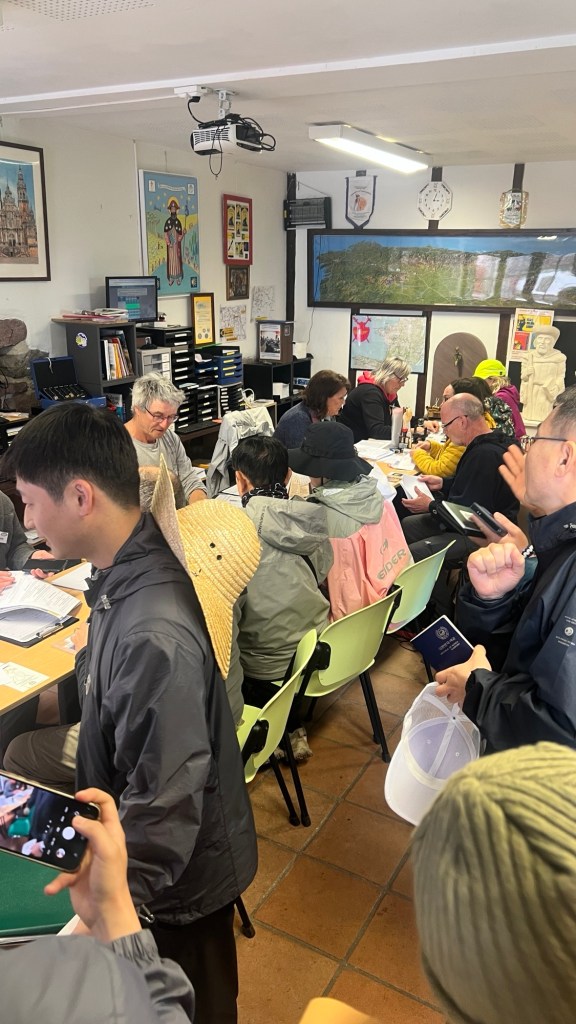
Afterwards I made my way up the hill a short ways to the pilgrims office. Had to wait in line for about half an hour, but it was a cheerful place. As large group from South Korea in front of me. Everyone was quite excited.
I then made my way indoors…
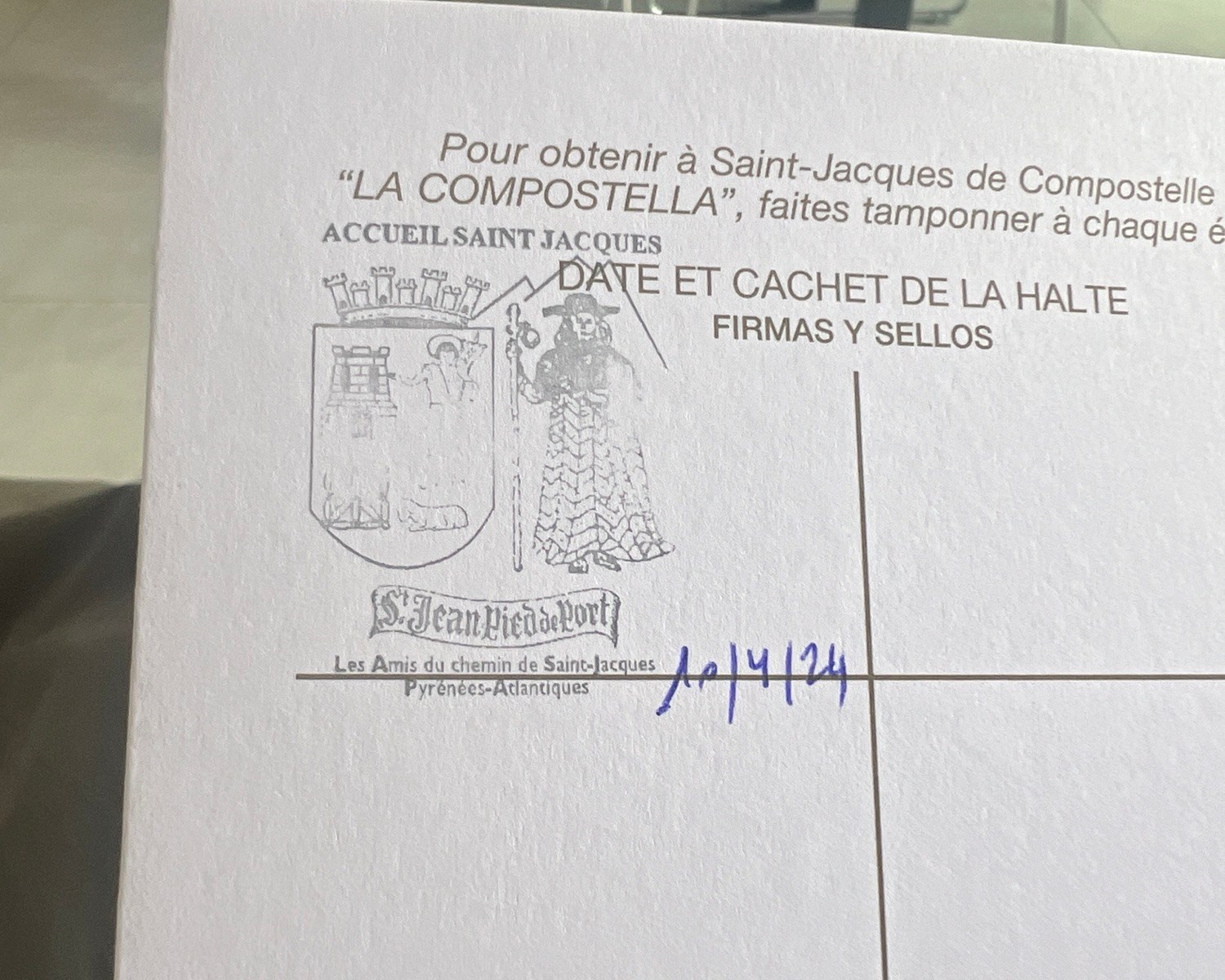
And there it is. My first stamp.
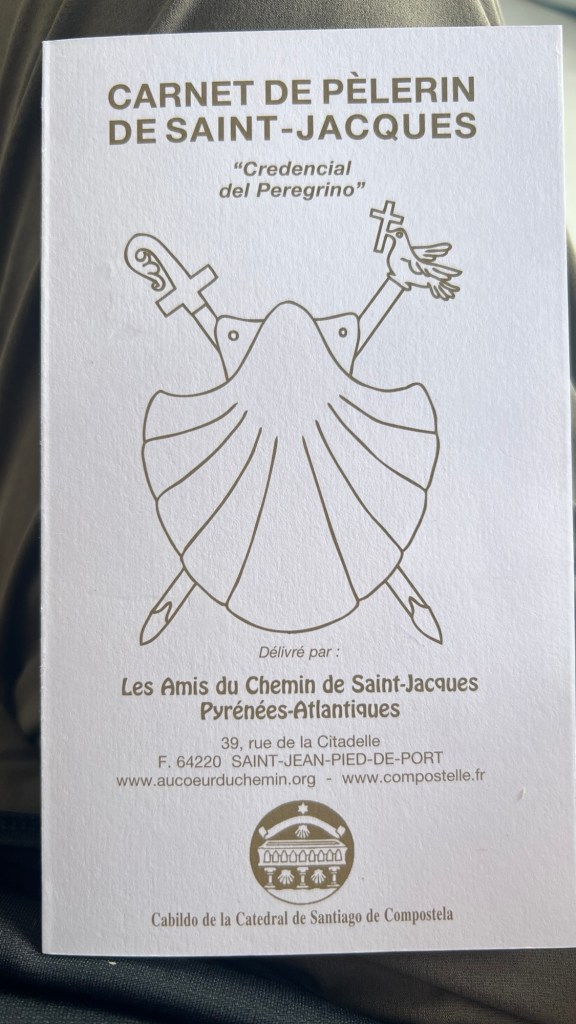
Each day on the Camino, a pilgrim must receive a stamp in their “Credencial del Peregrino” as proof they have been there. it is the pilgrims passport. Note to self: don’t lose it!
I’m going to be still and quiet for the rest of the day. Tomorrow morning I start walking. My first stop isn’t too far and not that difficult—Valcarlos— about 7 miles. It will be one of my shorter days, but Thursday is all uphill. There is no need to worry about that today though. 
I did not know I was tired until I slept and I did not know I was hungry until I ate. What a good night. I spent the night in the Mercure hotel in Bordeaux. A delightful place. The staff were very kind, even though I don’t speak a lick of French. Maybe they all roll their eyes after I turned away but I didn’t see it. I also did not sense it. Which I think is even more important. Check out is not until noon but I think I’ll pack things up here and head over to the train station. What better place to watch humanity. More later.
11:34 a.m. I am at the train station. I’m looking for pilgrims, but I have not seen one yet. I suppose in one way or another we are all pilgrims, but I’m looking for some very specific ones. I would like to wish someone, Buen Camino.
11:41 a.m. and as I stand here, I just remembered Blaine the Mono. Stephen King fans unite!
12:19 p.m. I have met my first pilgrim, although she walked it two years ago. She saw the Cross of St. James on my pack (thank you, Dana, for sewing them on—I haven’t forgotten our deal!) I am smiling. Becoming more real.
1:10 p.m. I just began The Road to Daybreak by Henri Nouwen. The first two sentences: “This is the first day of my new life! Though it sounds melodramatic, I cannot avoid feeling that something significant is starting today.” Ummm…..
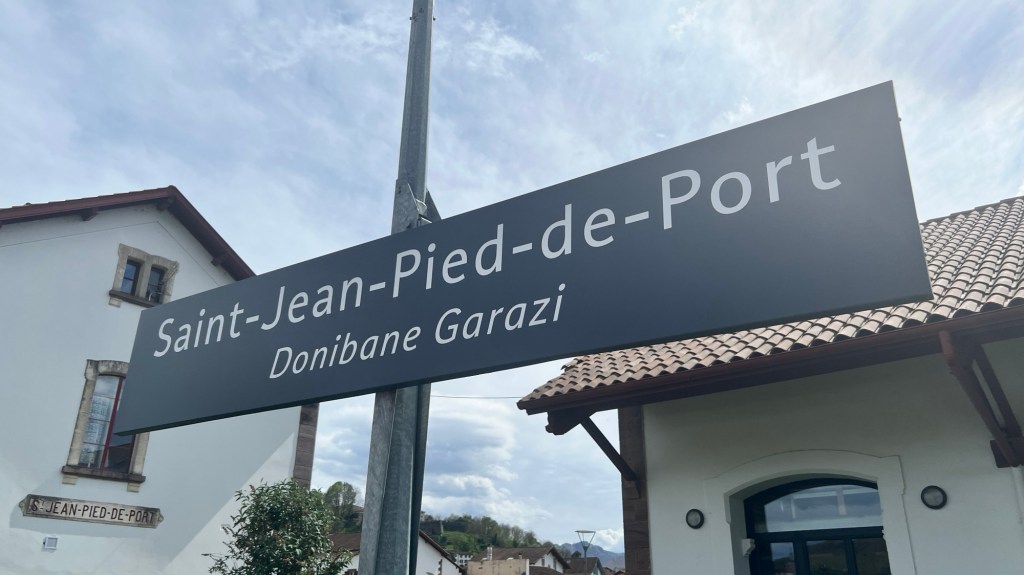
2:23 p.m. on the train to Saint-Jean-Pied-de-Port. Many pilgrims.
3:24.
4:21 p.m. Arrived at my apartment for the next two nights. It is lovely—Gîtes Vue Montagne St-Jean-Pied-de Port. Five stars and I haven’t even checked out the bed.
7:53 p.m. I walked back into town to find a bite to eat and a few groceries for the next couple of days. Not much. Just a few eggs and bread. I’ll go back in tomorrow for a bigger meal.
As I walked, I was thinking about the pilgrims I met… no, “met” is the wrong word… encountered or bumped into along the way today. *WE* were all still caught up in our normal lives. We were rushing and pushing and jostling. We were not good pilgrims (I don’t even know that we are pilgrims yet.) We were our normal selves. Always in a hurry. Always checking the clock. Always believing that our journey is of utmost importance. Not true Young Grasshoppa. This—in my no miles on the Camino, yet, opinion—is not the Way of St. James.
St. James was guided by an angel to his final resting place in Santiago. Perhaps, instead of guiding our own path, we allow God’s holy angels to guide us… is that a statement or a question?
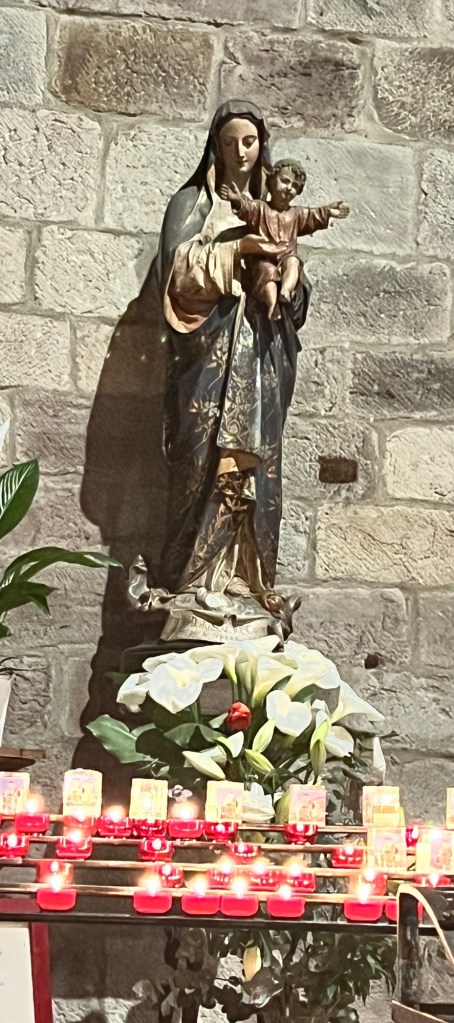
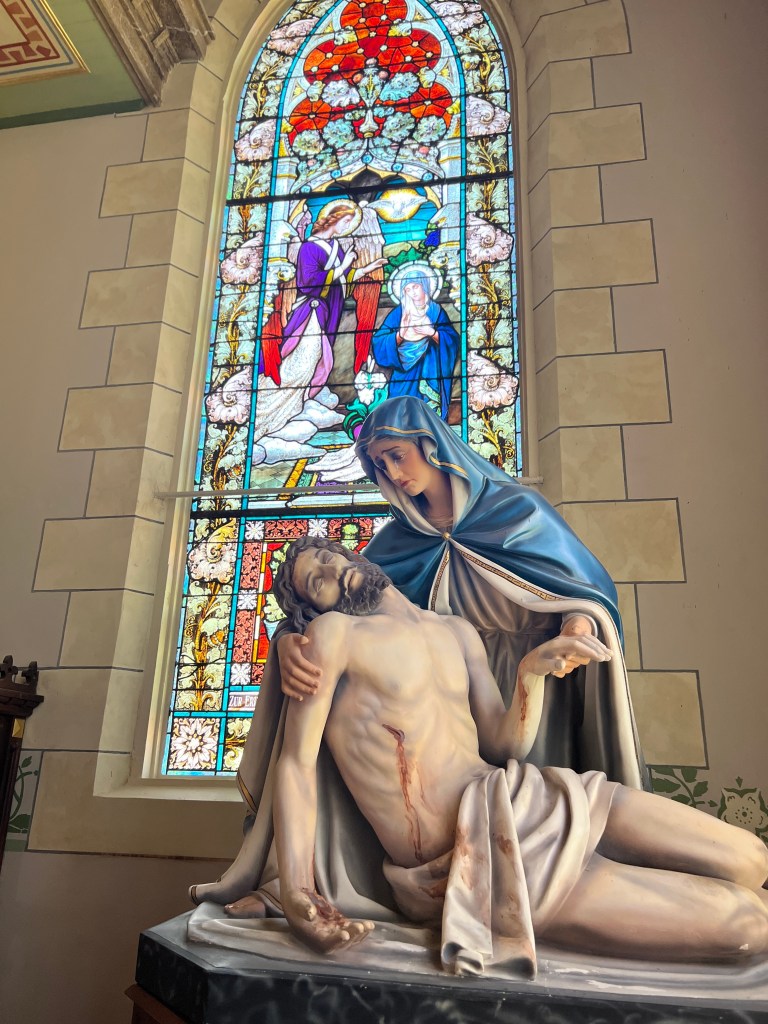
I prayed the Rosary today in a beautiful church. I understood that I was at the foot of the cross with Mary. I had my left hand on Jesus foot and Mary had a hand on mine. Mary had her right hand on Jesus’ other foot and I had my other hand on hers. We stood side by side. At first, I was distracted by the others coming and going, but Mary said for me not to listen to them. She said that I was to listen for His voice—that He would speak to me along the way. I will listen.
I lit a candle and asked her to pray for me along The Way. She will.
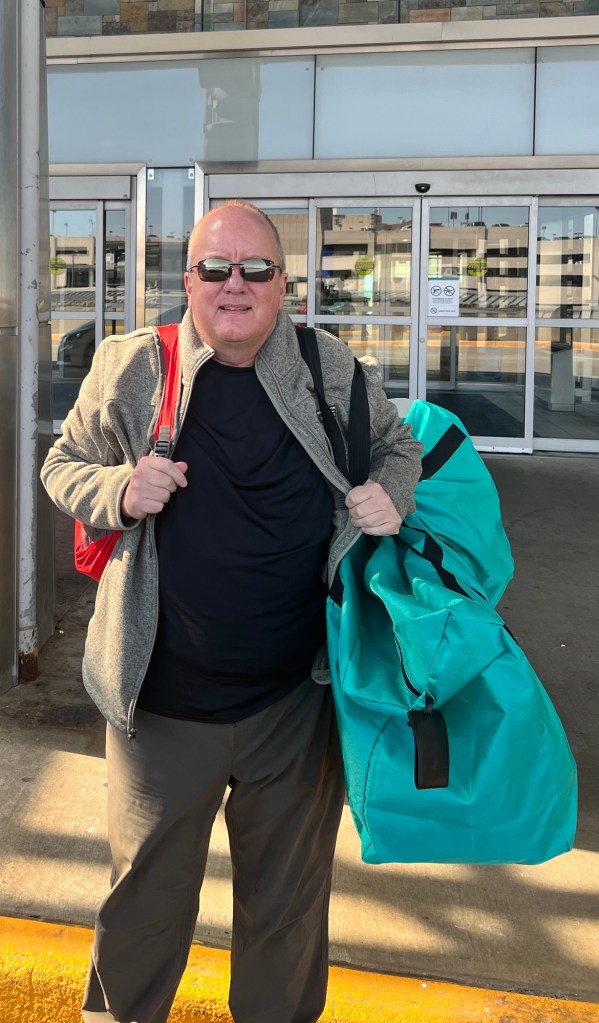
It is 11:09 AM and I am in the airport in Oklahoma City. My flight doesn’t leave for a couple more hours so I stopped for some breakfast. It was Andy who drove me to the airport and he took a before photo.
The next leg of the journey will take me from here to DFW, where I have another short layover before heading out to Paris.
The flight to Dallas was uneventful and short. I am hopeful that the next flight will at least be uneventful! It will be long…. about 10 hours/5,231 miles. I hope to sleep which is something I can never do on a plane. Don’t take that as complaining! I get to do this thing. Having a few French fries before boarding because you never really know about what will be served.
It is 12:02 Paris time and we are taxing to the runway at DFW.
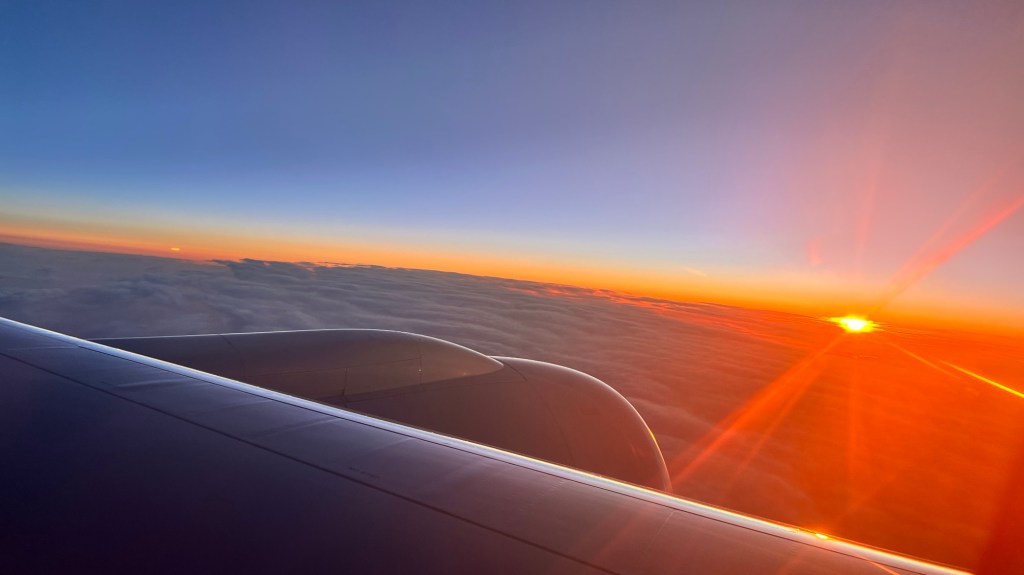
Sunrise at 37,000 feet. About an hour out from Paris.
Arrived in Paris without any trouble. Only was able to sleep for about an hour or so. I wish I could learn to do that. Sleep on the plane that is. Took a taxi to the Montparnasse train station, and then waited on the train.
Arrived in Bordeaux. 24 1/2 hours after I left. Long trip but not a complaint. I see sleeping in Babyland in my future.
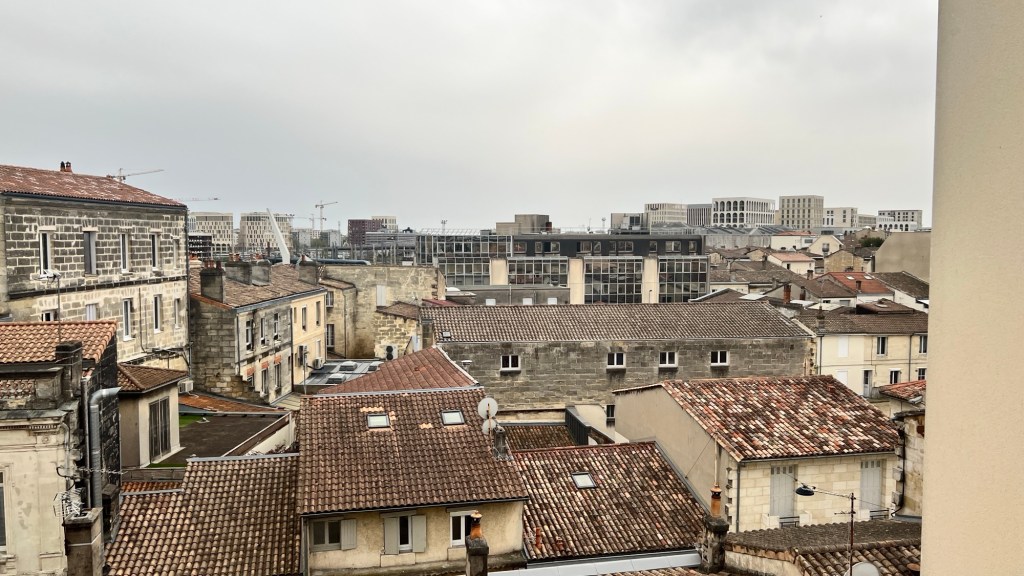
A room with a pretty nice view.
I have two trains tomorrow, but really a pretty easy day. Only about three hours of traveling and then I will be at Saint-Jean-Pied-de-Port. I have two nights there, which I’m really looking forward to. Not only will it give me the opportunity to rest up from the trip, but I can also explore the town at a leisurely pace.
In the final hours leading up to departure from Sherwood Forest, I am finally at rest. Everything is packed, and the house is clean. If I have forgotten it, I probably don’t need it. If it is not clean, it’s probably not all that dirty. I now sit with a glass of wine and a movie that I found–The Wall (I know nothing about it, but the blurb says it is a tour-de-force performance by Martina Gedeck. I don’t know her either, but I’m glad she had a forceful tour.)
The alarm is set for 7:30 a.m. tomorrow. My trusty chauffeur will be picking me up at 9:00 a.m. (trusty chauffeur is good for a snarky comment below.) Roughly 24 hours after I wake up in the a.m., I will be landing in Paris. Bonjour. Merci. Parlez vous Francais? Nope. I’m from Oklahoma, and the only thing we parlez vous around here is… well, I was hoping for another Come-for-da-bull joke there, but it didn’t work out.
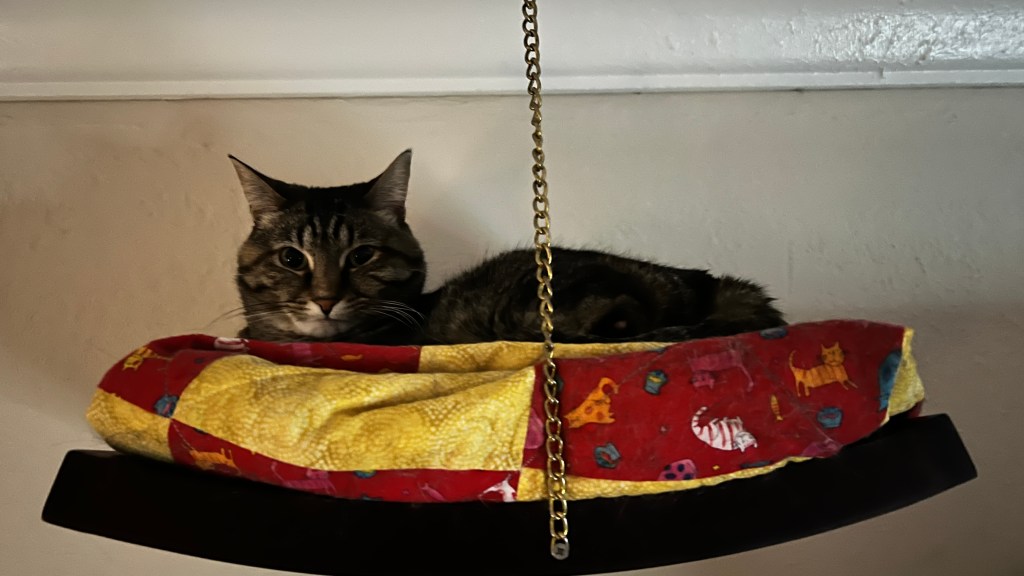
The Queen is on her perch, glaring down at me. She is beginning to catch on and the claws are flexing. Maybe I’ll make it out the door before she goes all screaming terrorist.
You all have a good night’s rest. I’ll try and update tomorrow, but I’m not sure how all that will work out, so it will likely be sometime Sunday and I’ll be in Bordeaux, France (poor me…. bwaahahahaha.) With that, “Good night, and good morning, in case we don’t talk before that!)
I’ve packed and repacked the backpack about 6 times now. In the process, I’ve lightened the load by 7 pounds and got the weight down to 25lbs, which includes water. Several items in the first picture did not make the cut. The only real luxury item is the iPad. On a shorter trip, I might consider leaving it at home, but I plan on doing some other writing while I’m there, and a keyboard attached to the phone just wouldn’t work.
I’ve done plenty of walking with weight, so I believe all shall be well. If not, all my pictures will be of me sitting on a beach somewhere in Europe (life could be a lot worse.)
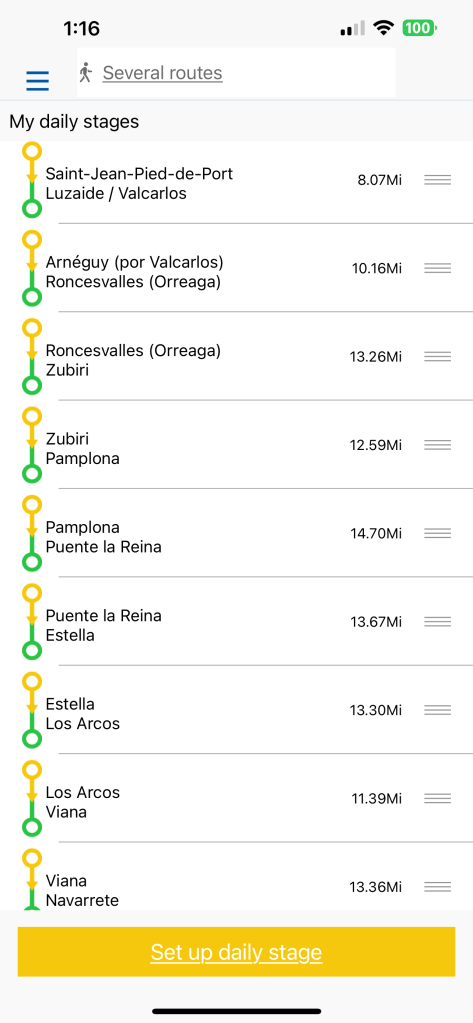
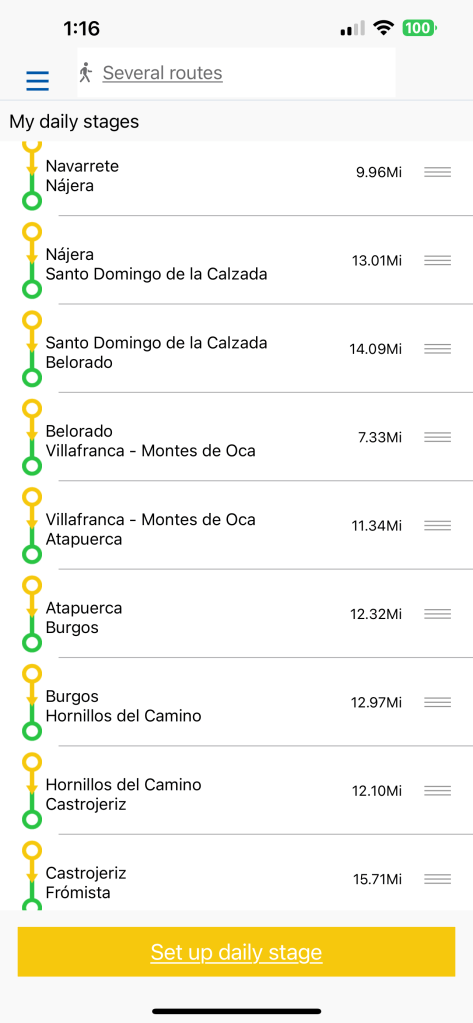
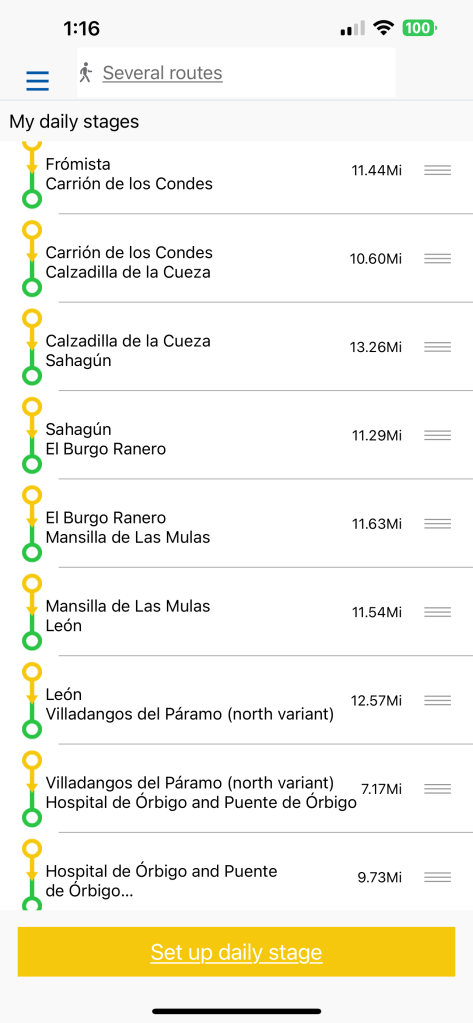
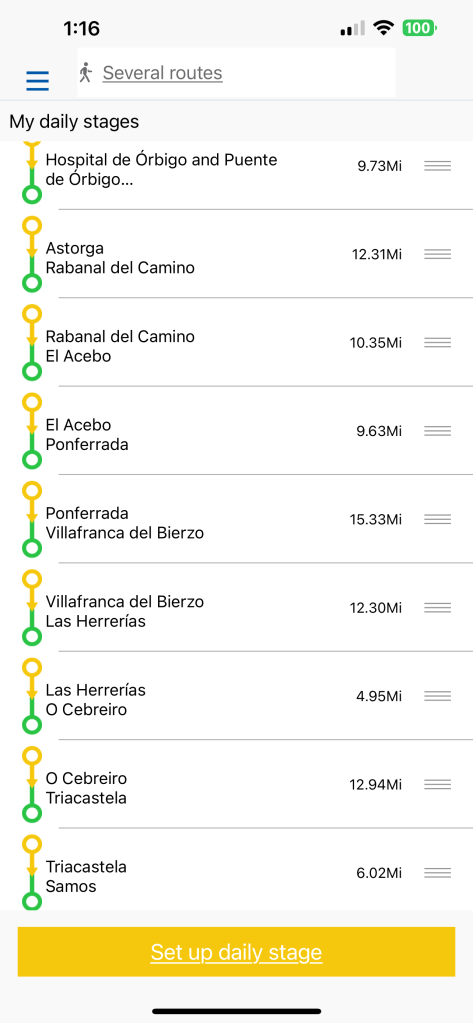
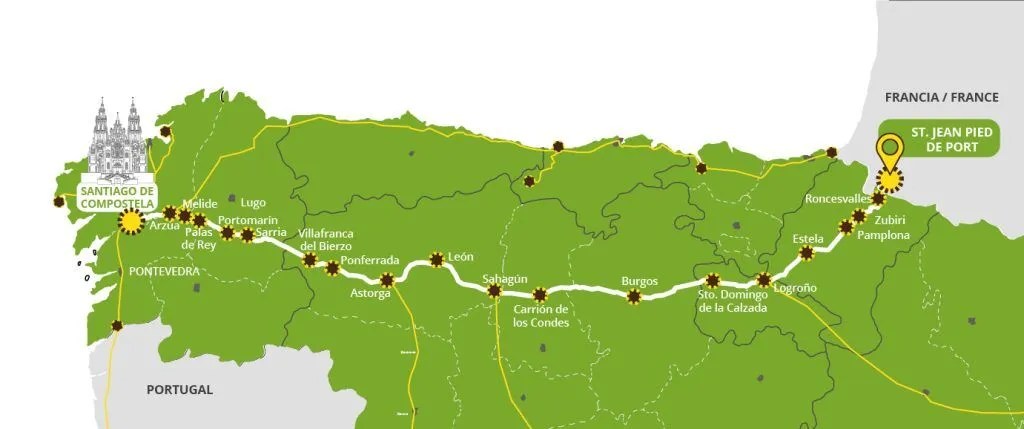
I’ve scheduled sixty days on the Camino with 46 walking days and 14 days off. This is what those stages look like, but could change once I’m there.
It looks a bit overwhelming when I look at some of the daily distances, but then I remember that it is not a race–although those 15+ mile days are a bit intimidating. On average, I’ll be walking 4 to 5 hours per day. Walk for a couple of hours in the morning, have lunch, have a siesta by the gurgling fountain, walk for a couple more hours, take off the boots, and enjoy the rest of the day. No problem (and everyone reading this rolls their eyes!)
I fly out on Saturday and arrive in Paris on Sunday Morning. From Paris, I take a train to Bordeaux where I’ll spend the night. The following day is a train ride to St-Jean-Pied-de-Port, where I’ll spend two nights getting my days in order and breathing. The pilgrimage officially begins on Wednesday, April 10th. If all goes well, I’ll be in Santiago around June 10th. Regardless of what happens, I’ll need to be back in Paris by June 26th–that’s my return flight.
In a conversation with C.S. Lewis, J.R.R. Tolkien said, “We have come from God, and inevitably the myths woven by us, though they contain error, will also reflect a splintered fragment of the true light, the eternal truth that is with God.” Within our legends and myths, there is a certain amount of truth. The same is true with what I would like to share today—a combination of facts, myths, and legends, and it all begins in the year 43 B.C. We can read about it in the Acts of the Apostles.
“Herod the king laid violent hands on some who belonged to the church. He killed James the brother of John with the sword, and when he saw that it pleased the Jews, he proceeded to arrest Peter also.” (Acts 12:1-3a) The Apostle James, brother of John and son of Zebedee, was martyred by beheading. It is from there that our legend begins.
Following his death, his followers, wanting to provide a proper burial for him but also wanting his body to be kept safe, took it to the coast, where they boarded a stone boat. The boat had no rudder or sail but was guided by an angel, which took it on a long journey across the Mediterranean, through the Strait of Gibraltar, and up to the northwest corner of Spain.
At this same time, a father was throwing a huge wedding party for his son. There was food, drinks, dancing, and games. One of the games played was abofardar—the men, riding horses, would take a spear and hurl it into the air as high and far as they could, then, charging forward, they would attempt to catch the spear before it hit the ground—very safe. The groom’s turn came, and he gave the spear a mighty throw. However, he was so focused on the spear that he paid little attention to where his horse was going, and he plummeted into the sea and disappeared. There was high tension as the crowd watched and waited for him to surface. Finally, he did. A way out from shore, the groom and horse popped up. Fortunately for them, there was a boat directly beside them. It was the stone boat carrying the body of the Apostle James.
After rescuing the groom and the horse, it was discovered that they were both covered in scallop shells. The followers of James on the boat saw this as a miracle, so the scallop shell became a symbol of all who were saved by coming to St. James.
Following these events, the body of St. James was secretly buried and essentially lost for almost 800 years until a hermit, Pelayo, noticed strange lights in the sky. Following the lights, Pelayo came to a field where he discovered the hidden tomb. He informed his Bishop, who, with several others, went to investigate and were able to determine that it was, in fact, the remains of the Apostle. A church was built over the tomb, and later a cathedral. The city that grew up around it that supported the pilgrims who came to venerate the saint was named Santiago de Compostella. Santiago is translated as St. James, and Compostella means “field of lights.” For the last 1,200 years, saints and sinners, lay people and clerics, rich and poor, popes and kings, have made the pilgrimage to pray before the remains of St. James the Great—one who was so very close and dear to Jesus.
The pilgrimage is called the Camino de Santiago, the Way of St. James, and the starting point for many is Saint-Jean-Pied-de-Port, which means St. John at the Foot of the Pass—the pass is the one that takes you over the Pyrenees Mountains, from France into Spain. On April 10th of this year, I will rename this town Jean-Pied-de-Port—John at the Foot of the Pass (unless, of course, I’m sainted in the next month, then I’ll keep it the same.) The French Way, the route I will be taking, is the most popular and the one pilgrims have walked for 1,200 years.
I’ll take more time and make more stops, but there are traditionally 31 stops along the way, and early on, pilgrims would make the journey there and back, so with the Cathedral counting as their destination, you would have 63 stops. As they did not have the benefit of GPS and a well-marked trail, early pilgrims relied on various maps, one of which was created by the Templars. That early map has evolved into a game still played today (and one our kids will have the opportunity to play while I’m away)—The Royal Game of the Goose. Thus enter Albert the Goose. Why a goose?
It was the Templars who were charged with protecting pilgrims as they made the pilgrimage, and so it was the Templars who made the original map. Looking at our game board, you will see many of the squares have symbols in them. The meaning of most of the symbols is lost. Still, the labyrinth could represent physical and spiritual growth, a well might represent a lousy day, and a bridge—although it may be a specific bridge—can also represent a spiritual crossing. And then there is the goose. For the Templars, the goose represented wisdom, and throughout the Camino, if you keep your eyes open, you will see a goose carved in the base of a statue or a distinctive goose track in various locations. There are also towns with “Goose” in their names: Villafranca de Montes de Oca, Castrojeriz (city of geese), El Ganso, Ocón, Puerto de Oca, Manjarín (man of geese). (Source) While I’m away, Albert will also be traveling, and you may find him at your front door looking for a place to rest.
In the very early days of the Camino, there were tens of thousands of pilgrims, but the numbers waned due to wars and other issues. Eventually, it nearly fell out of use, and in 1979, only twelve people completed the walk. However, popularity has increased dramatically. Last year, which was considered a holy year, over 442,000 individuals walked a Camino.
To officially walk a Camino, you must walk at least 100km (62 miles). From St-Jean, where I’ll start, it is 800km (500 miles), and last year, of the 442,000, about 23,000 made that distance. For each, regardless of the distance, the shell—like the one attached to the groom and his horse—has become the symbol of the Camino de Santiago. It is what designates a pilgrim—they attach one to their pack or hat—and it is what marks The Way, with signposts, wayfaring markers, and various marks in the road.
Finally, the Camino de Santiago is a physical exercise—putting one foot in front of the other for 500 miles—but more than that, it is a spiritual exercise. It is a journey of the soul. It is a way of letting go of all except the most necessary and, hopefully, along The Way, discovering that all you truly need is God and a few items you can carry on your back. As I walk, I hope to declutter my mind and my soul, and just as I might leave some gear that I don’t use along the way, I hope to leave the clutter and discover that life is far simpler than we make it.
I will be on the Camino for 60 days, and I’ll be out for fourteen weeks. I will be very out of touch, but I will pray for you every day. As I’ve told several people, St. Matthew’s was around for 125 years before I got here, so I know you’ll be just fine and in very capable hands. I encourage you to participate in the events and activities that have been planned. In the process, you might just discover the spirit of the Camino and find The Way opening up before you.
Let us pray (this is the traditional pilgrim’s prayer that was written in the 12th century):
O God, who brought your servant Abraham out of the land of the Chaldeans, protecting him in his wanderings, who guided the Hebrew people across the desert, we ask that you watch over us, your servants, as we walk in the love of your name.
Be for us our companion on the walk, Our guide at the crossroads, Our breath in our weariness, Our protection in danger, Our refuge on the Camino, Our shade in the heat, Our light in the darkness, Our consolation in our discouragements, And our strength in our intentions.
So that with your guidance we may arrive safe and sound at the end of the Road and enriched with grace and virtue we return safely to our homes filled with joy. In the name of Jesus Christ our Lord, Amen.
St. James the Greater, pray for us. Holy Mary, Mother of God, pray for us.
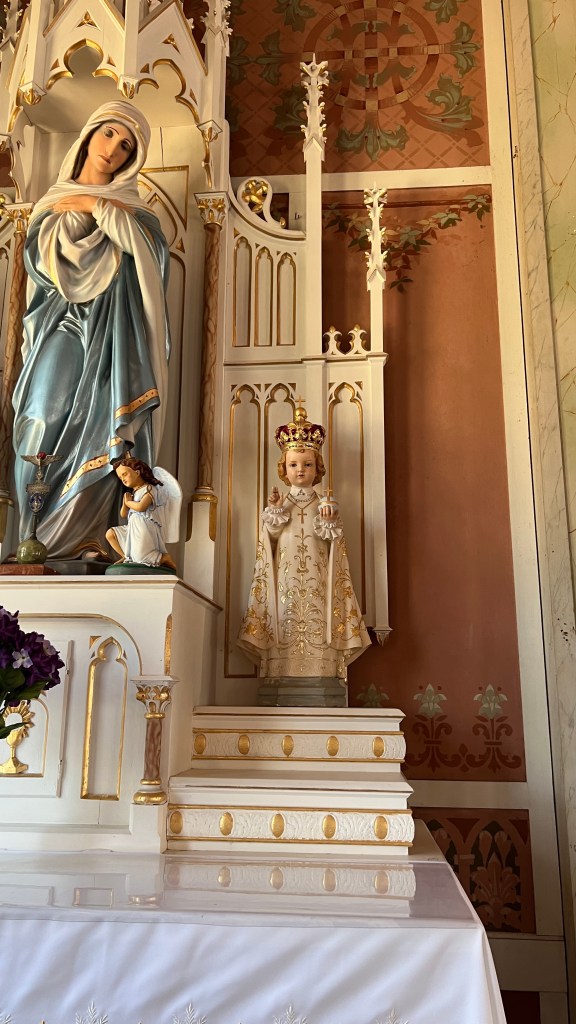
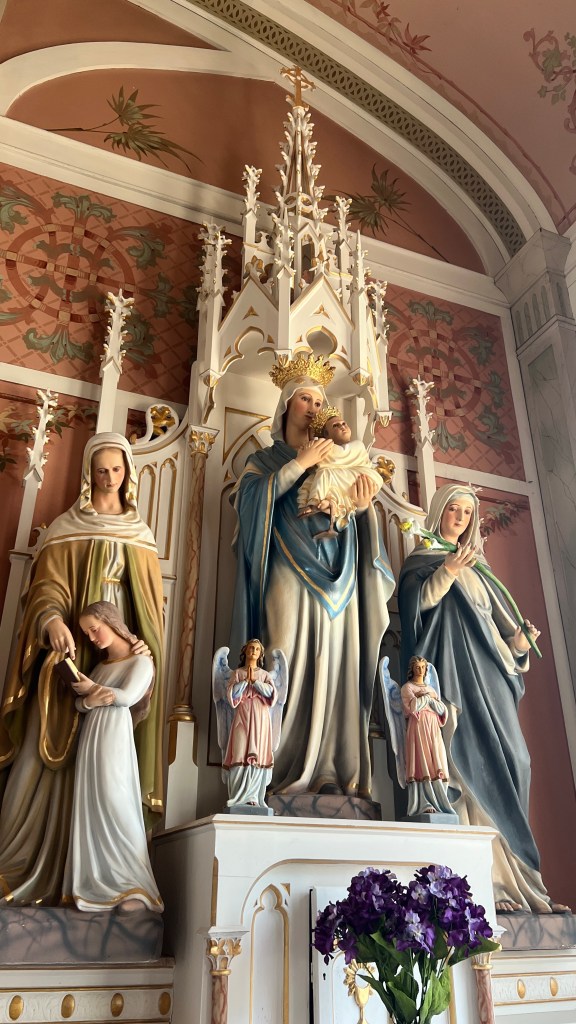
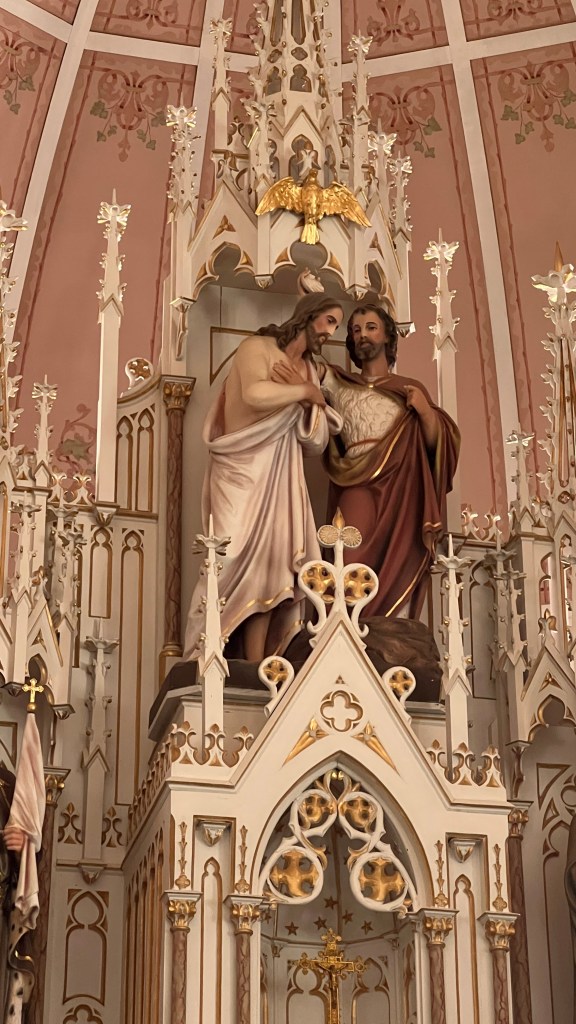
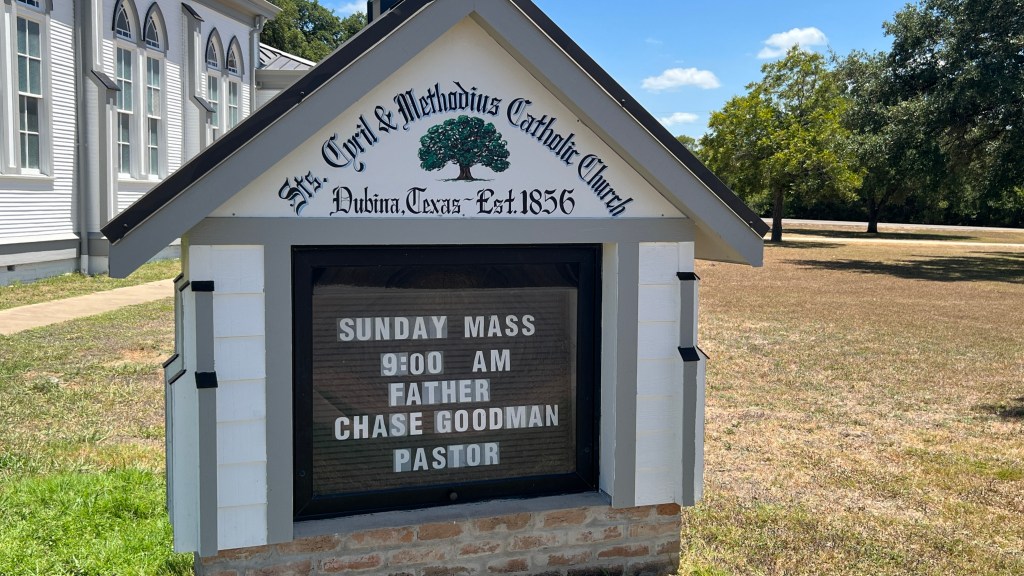
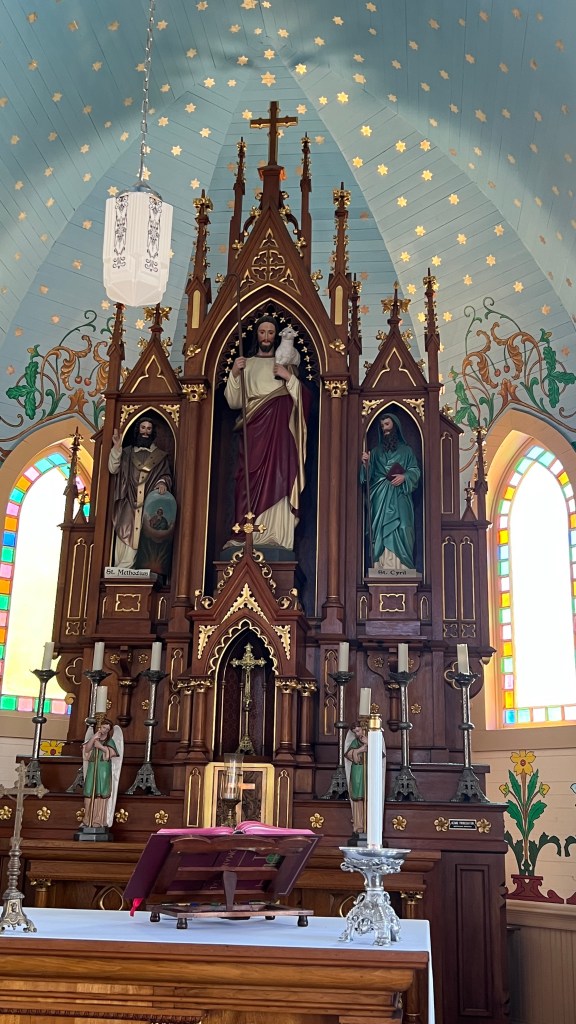
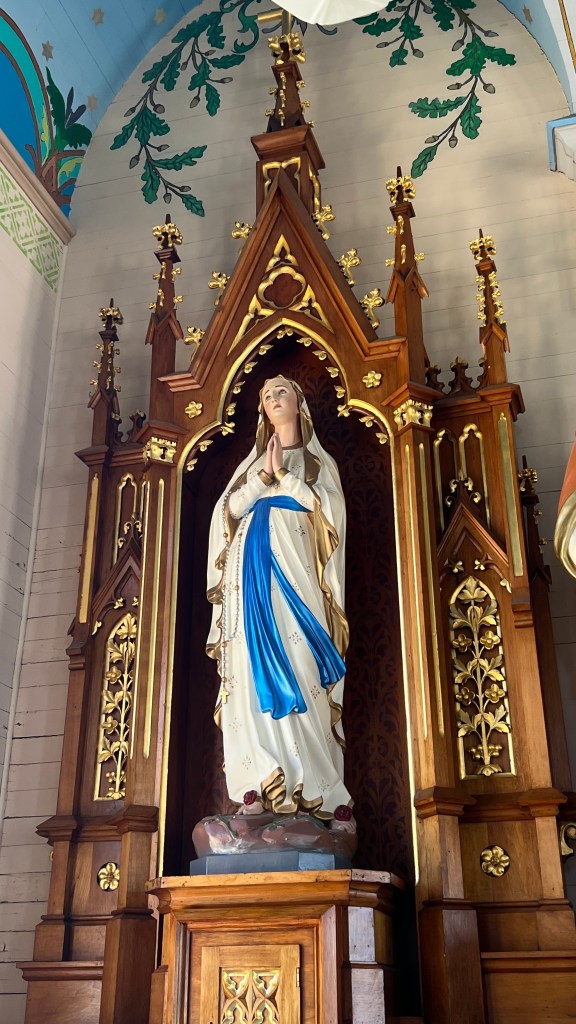
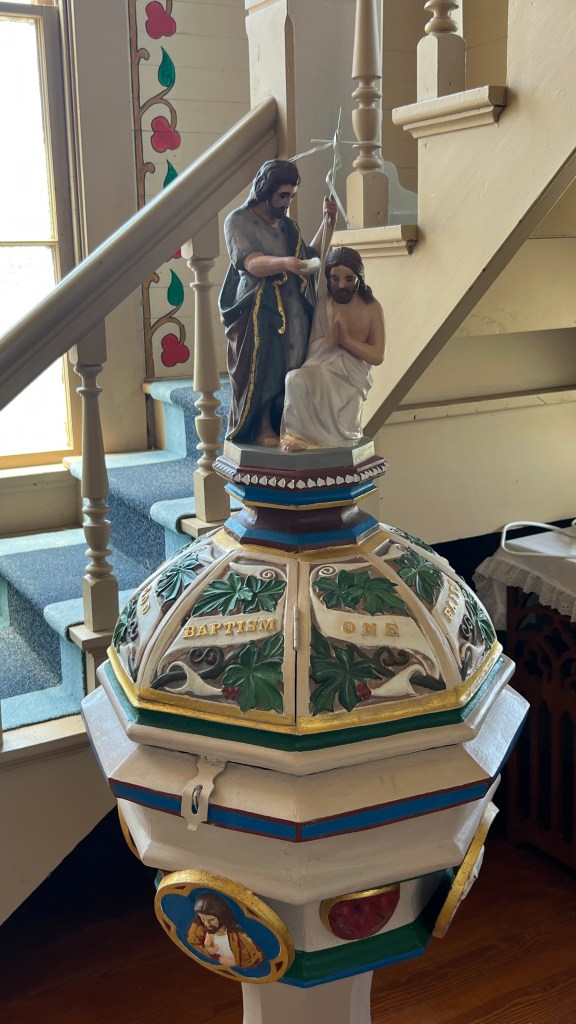
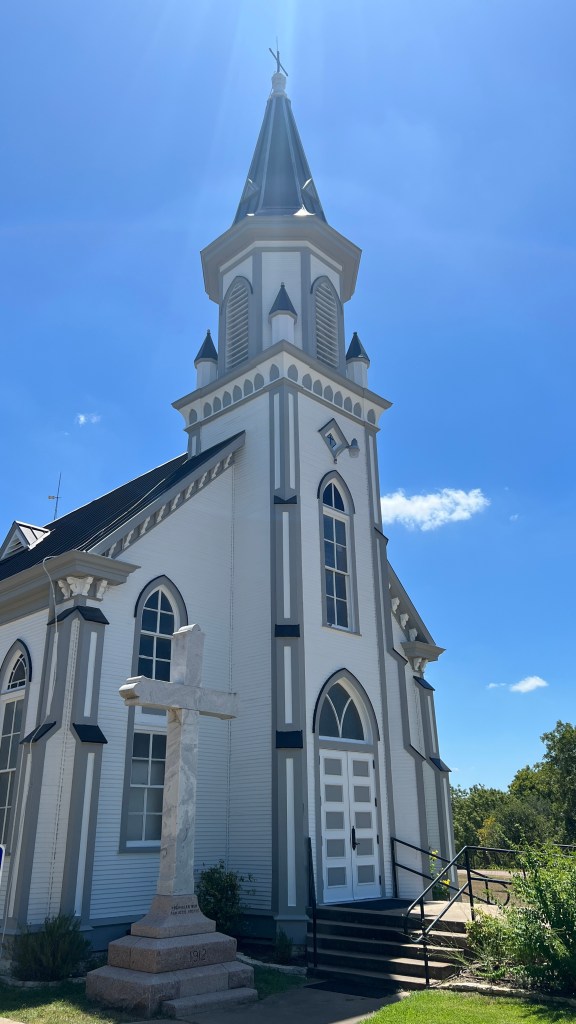
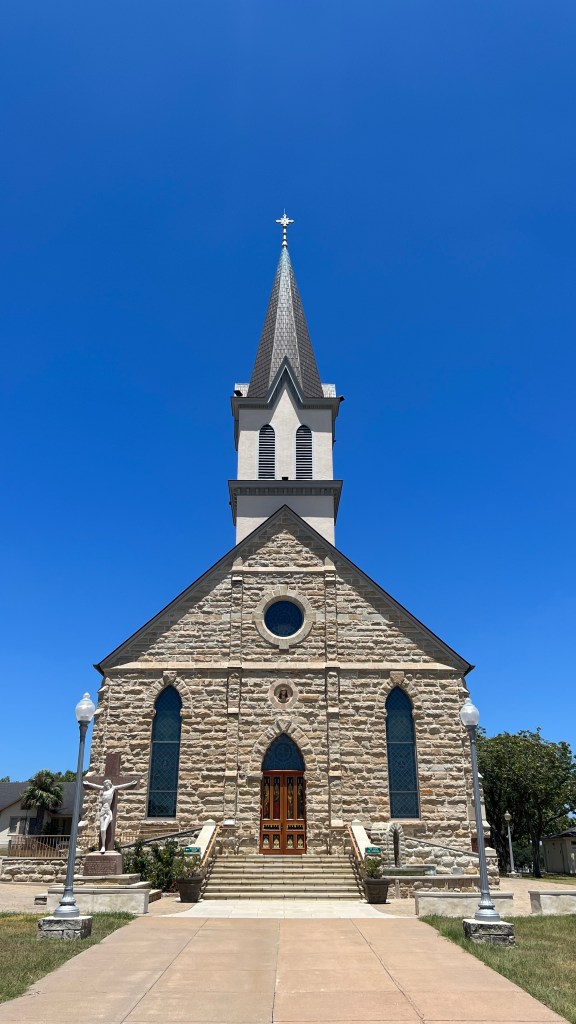
When Czech and German immigrants came to Texas in the 1800s, many settled in the central part of the state and named their towns after the places they’d left—Praha, Schulenburg, Dubina, Fredericksburg. These thriving communities prospered by working hard, helping one another, and praying together.
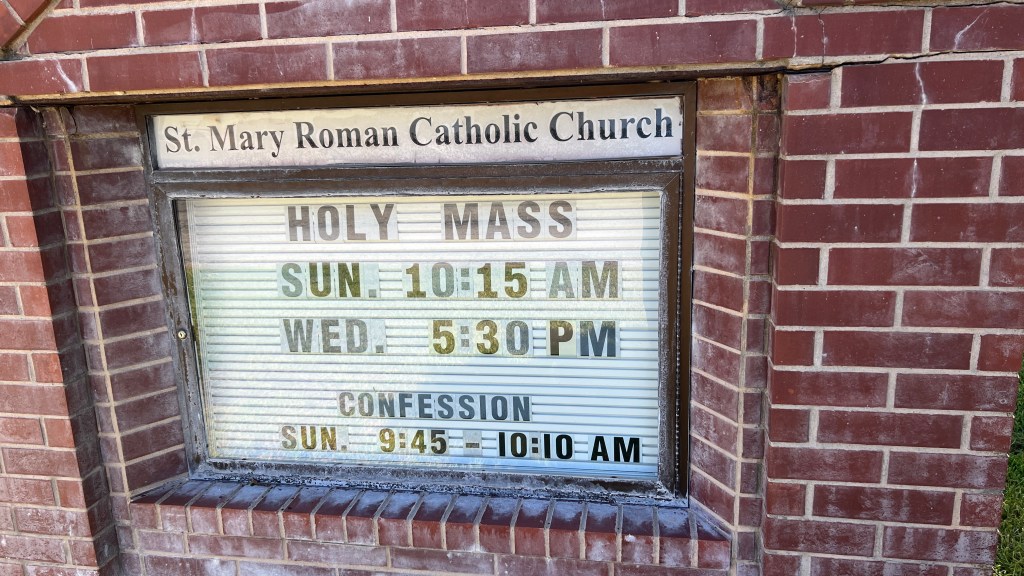
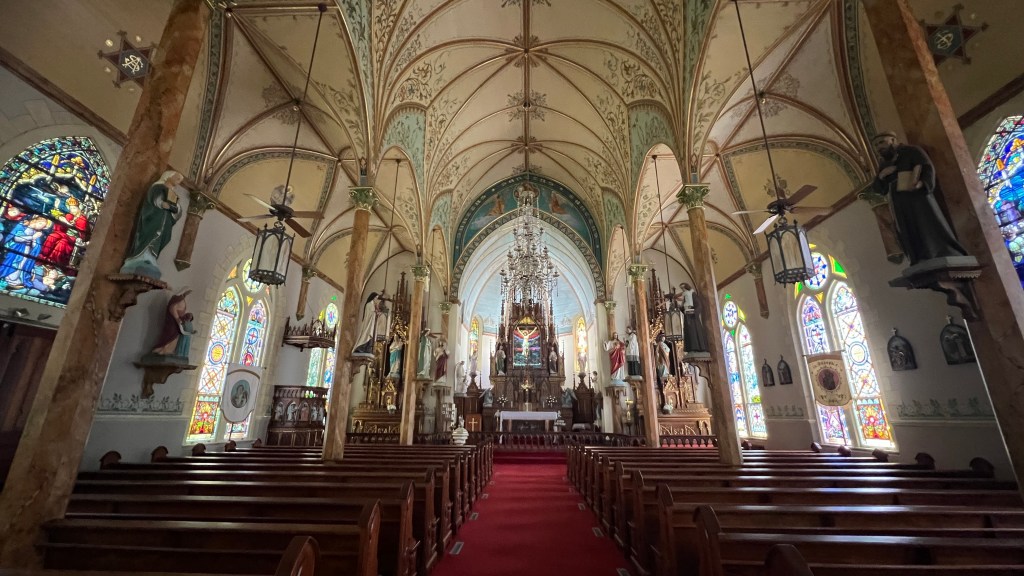
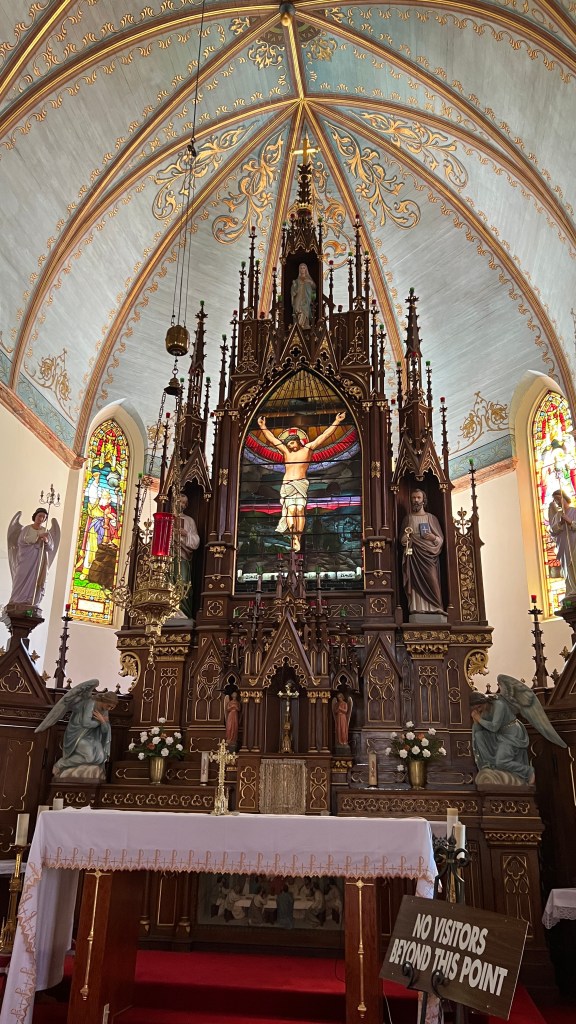
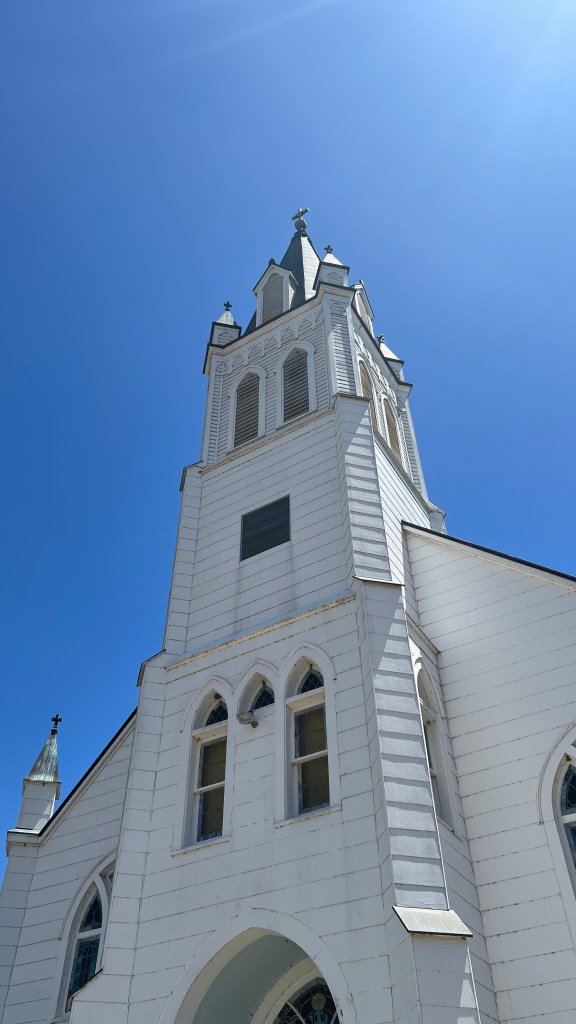
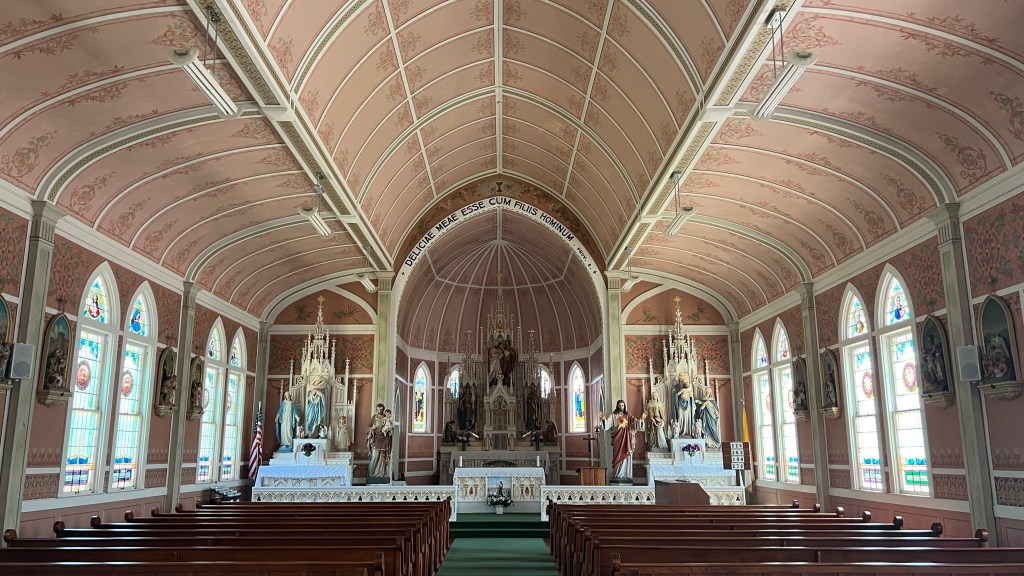
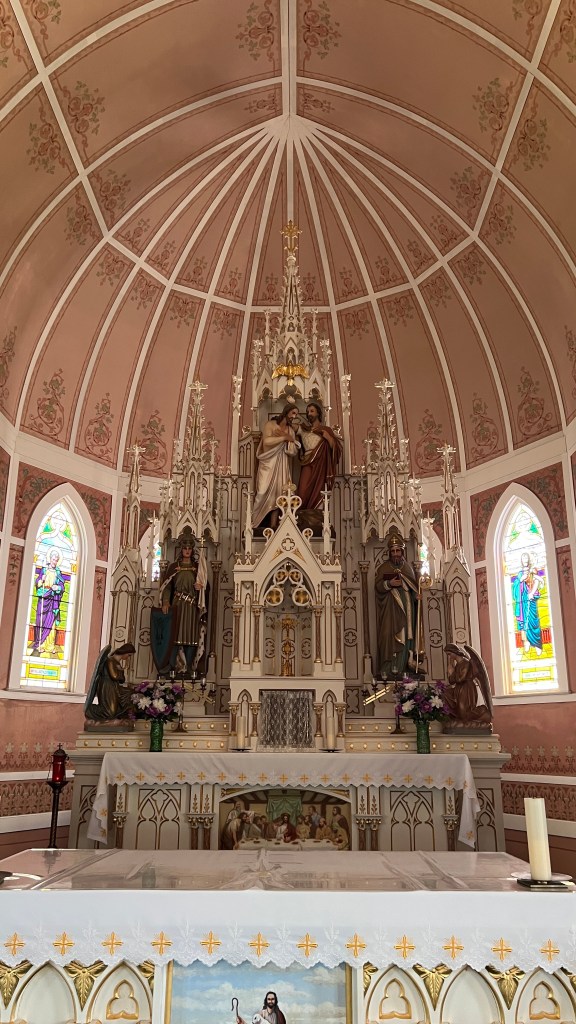
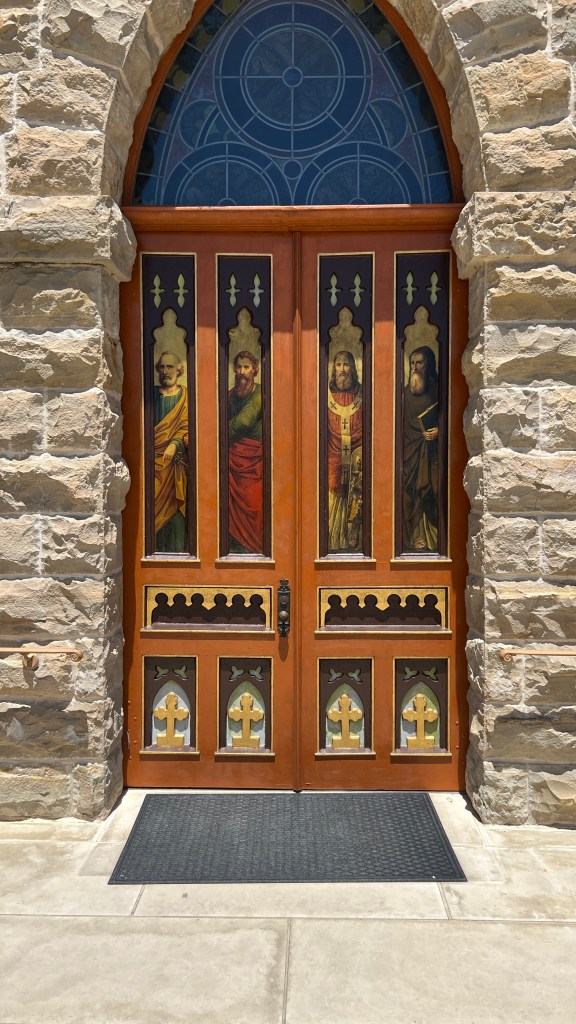
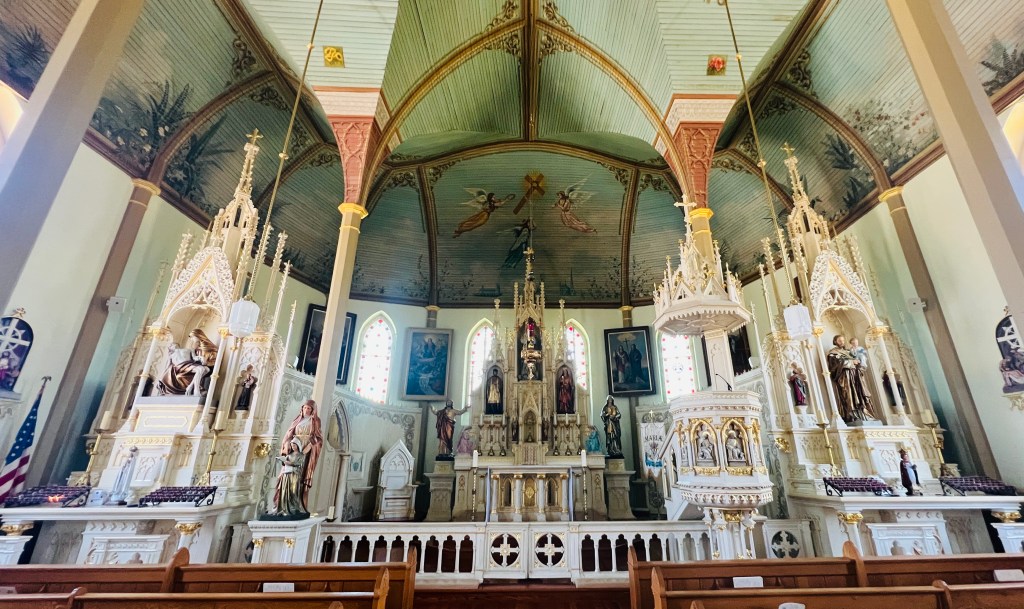
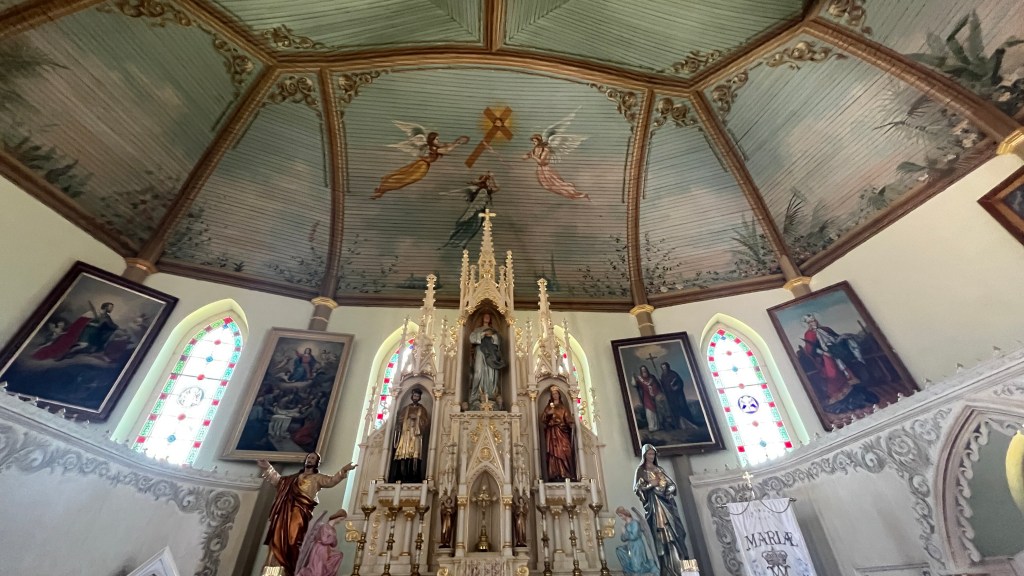
In an effort to make their new churches feel more like the ancient Gothic structures of their homelands, these early settlers painted the walls, altars, and arches of their simple wooden sanctuaries in colorful patterns and clever tromp l’oeil images. These buildings came to be known as the Painted Churches of Texas. Thankfully, they have been preserved and stand today in honor of those whose artistry and devotion created them. (Source)
St. Mary’s is considered the Queen of the Painted Churches located in High Hill
St. John the Baptist in Ammannsville (aka: the pink one)
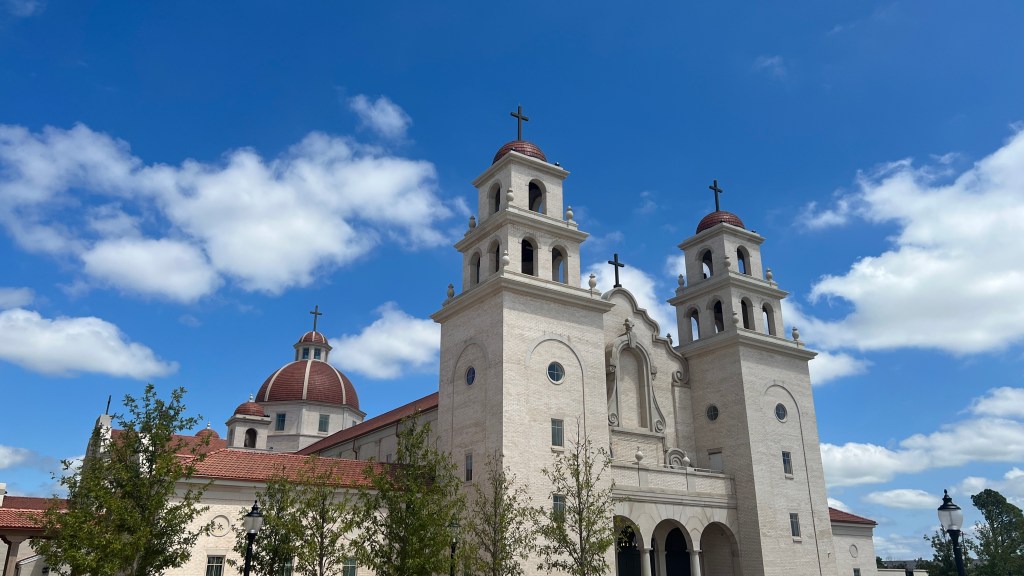
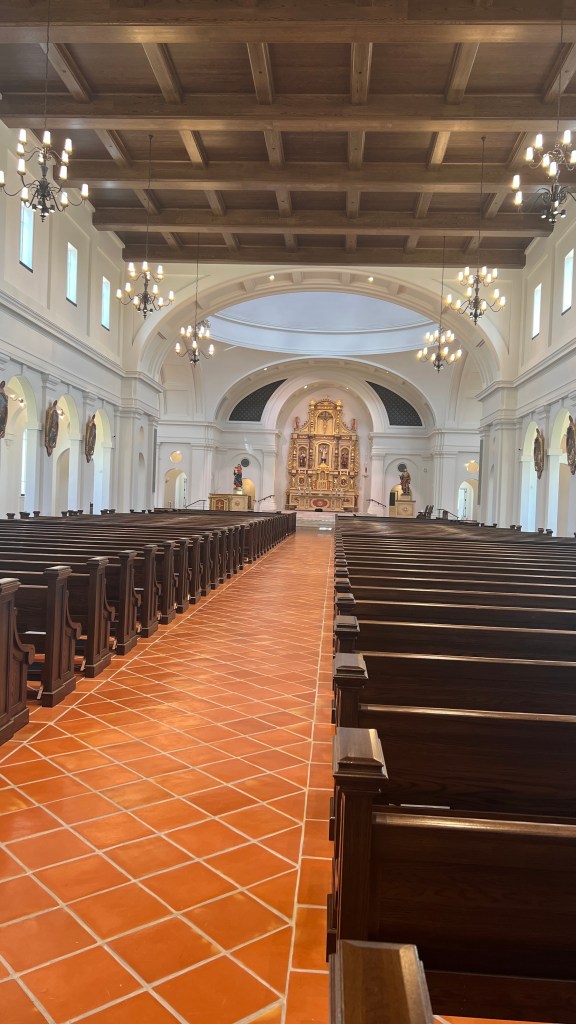
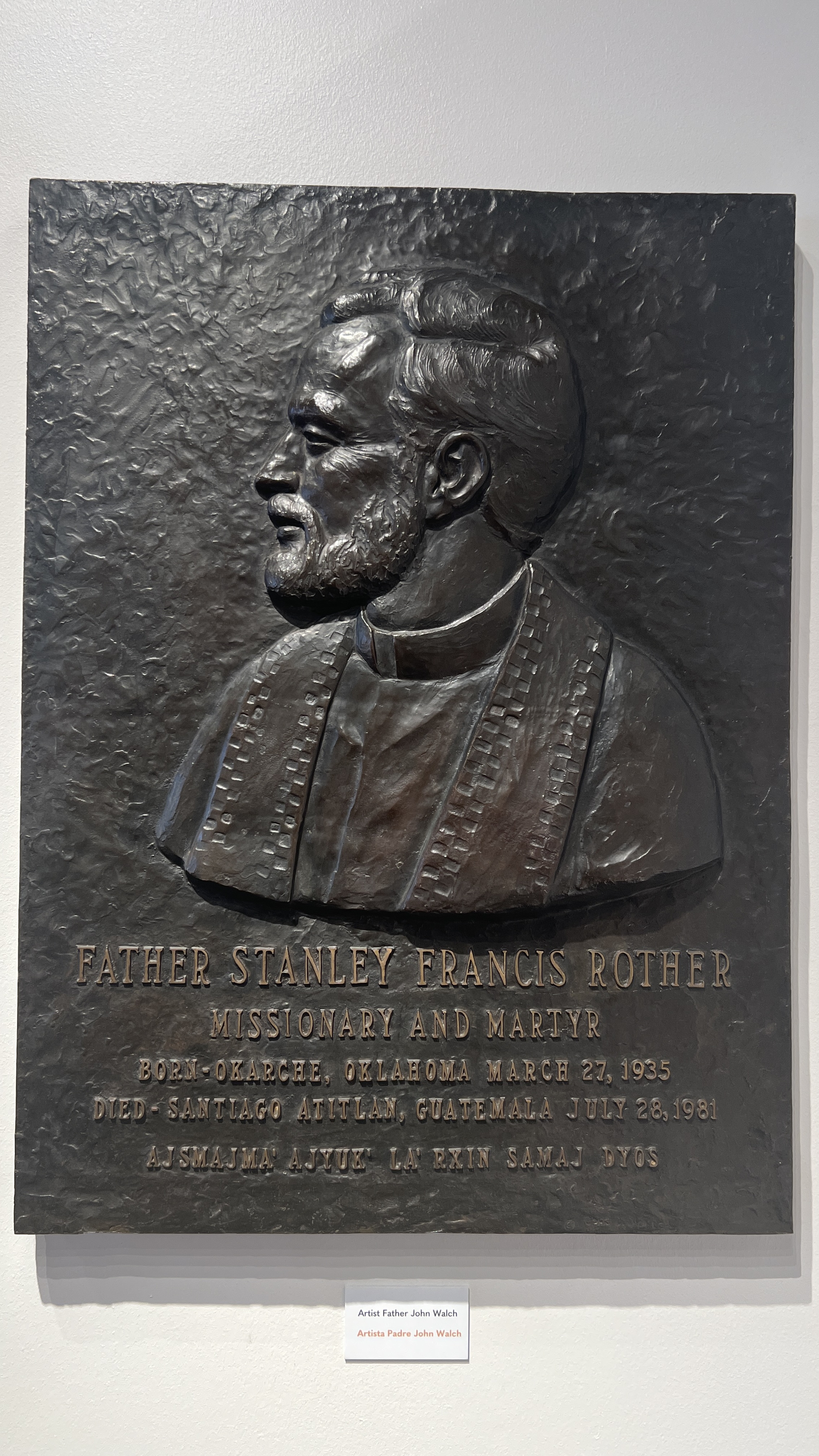
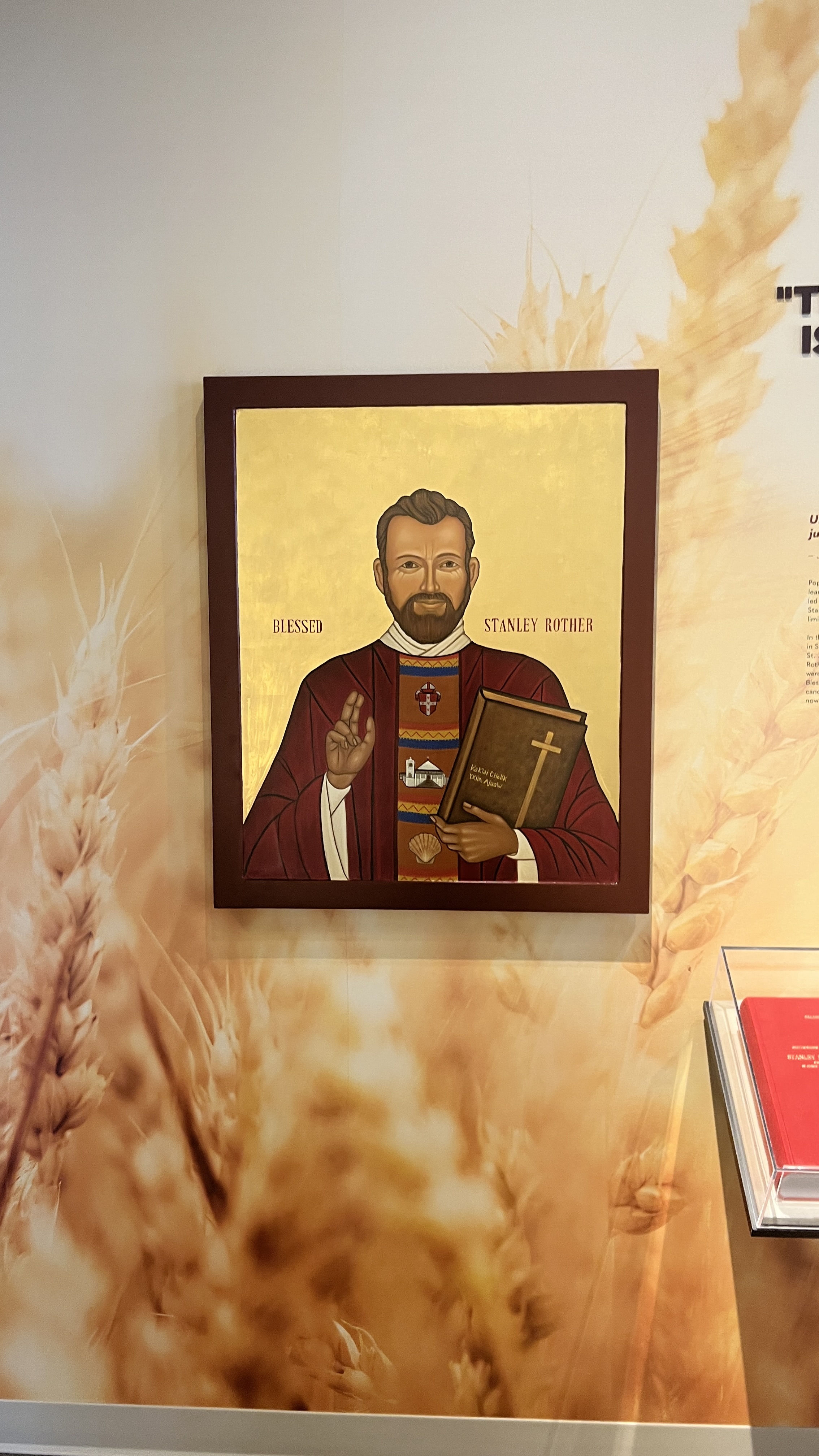
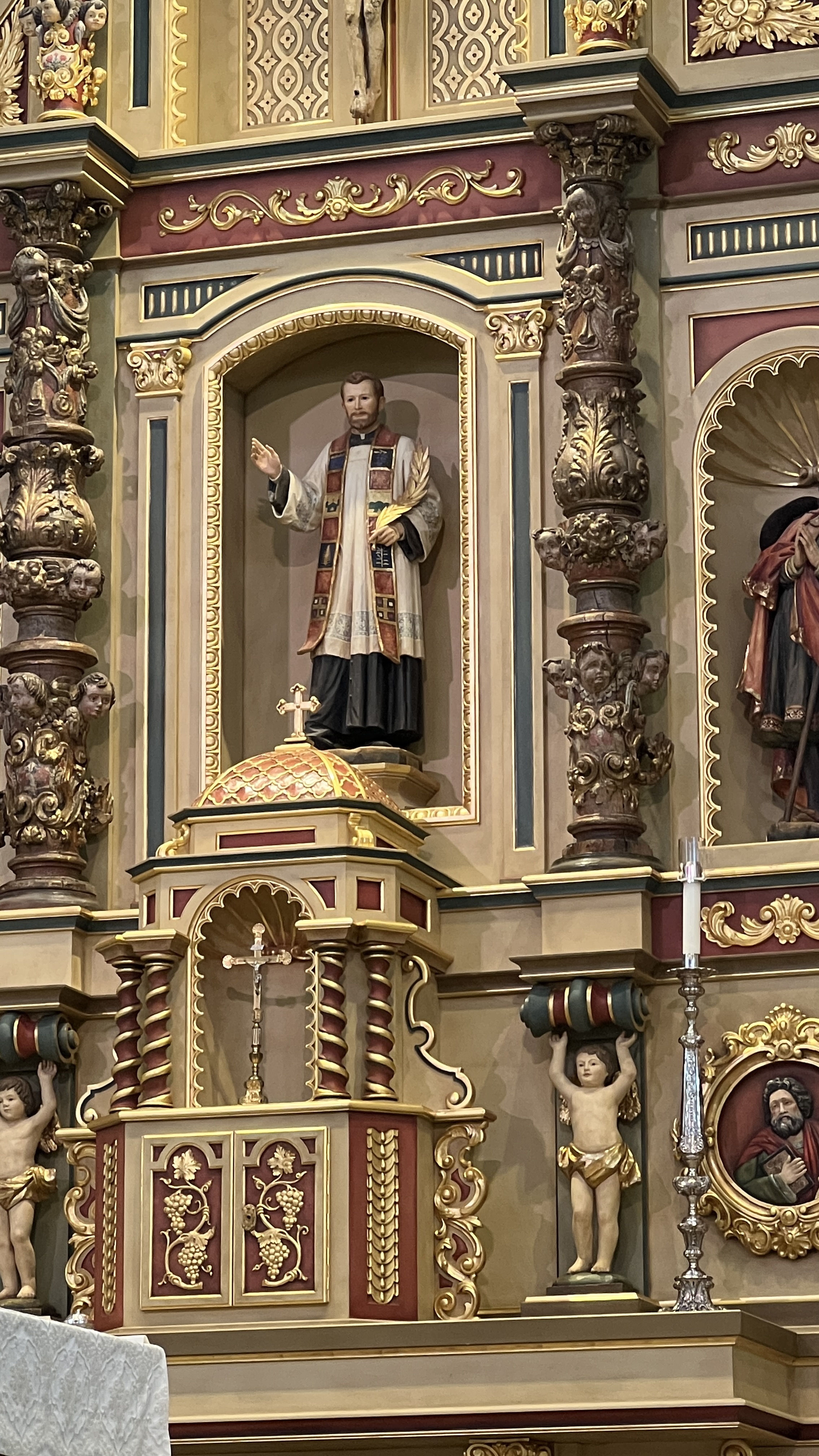
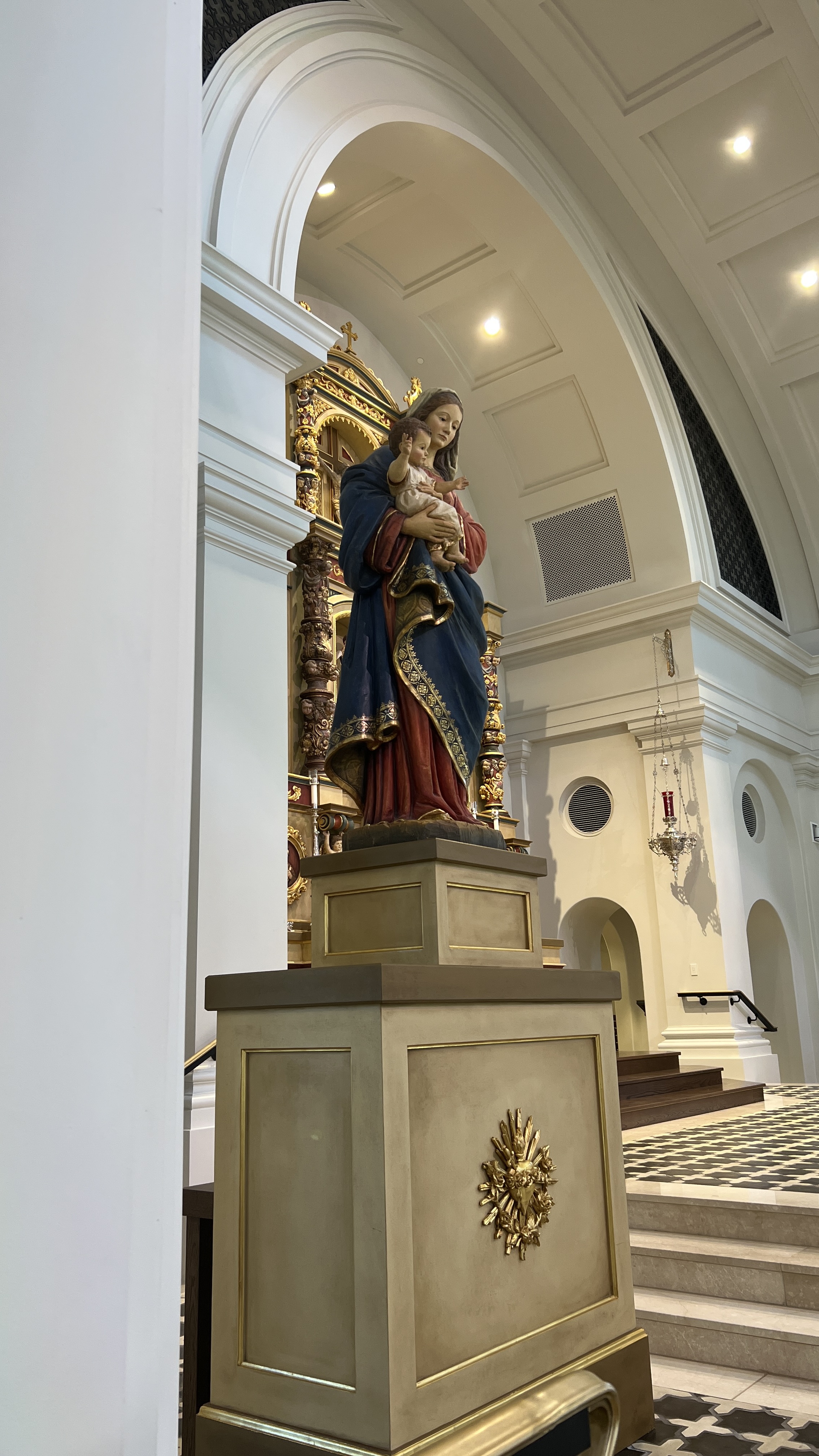
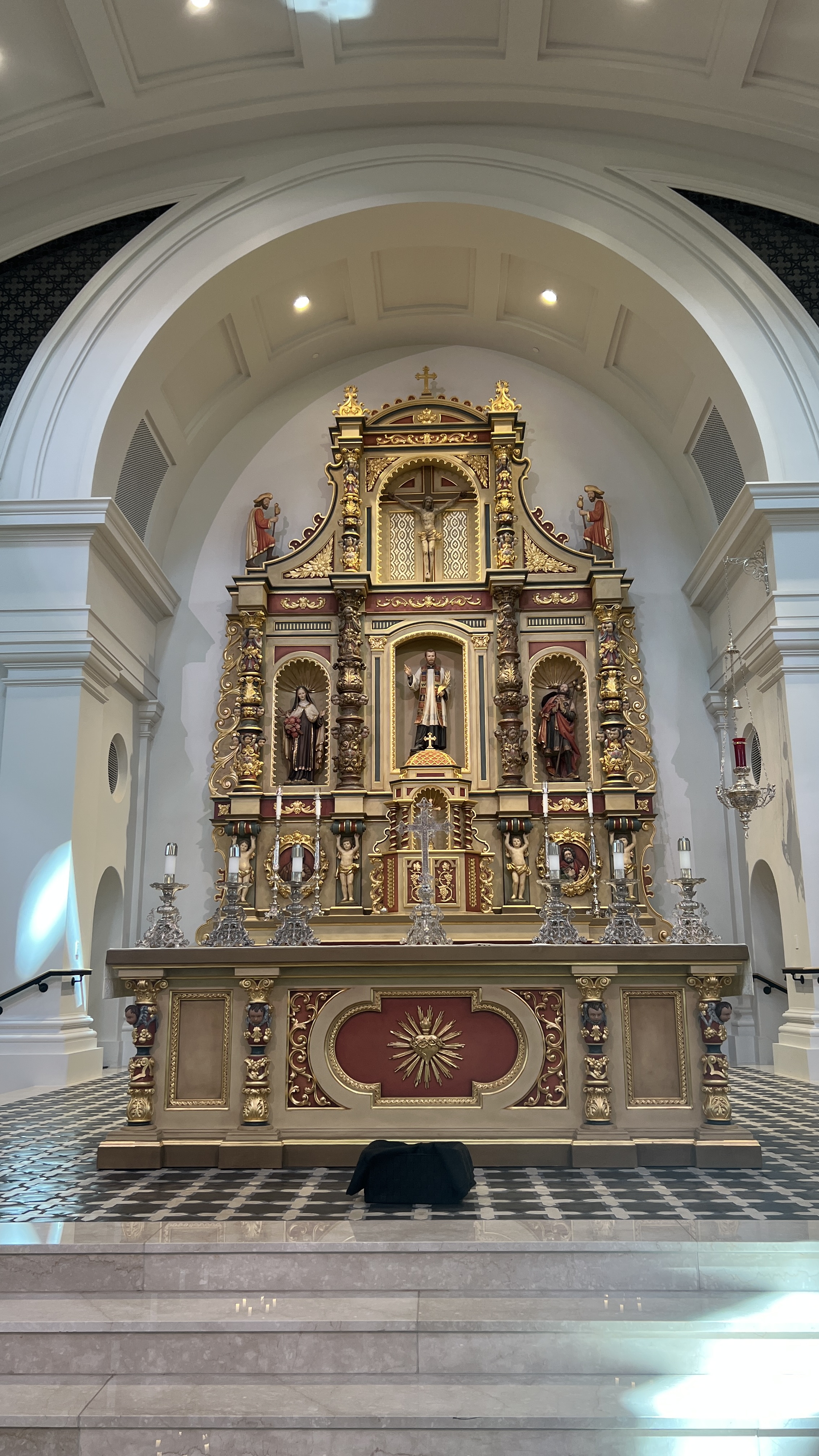
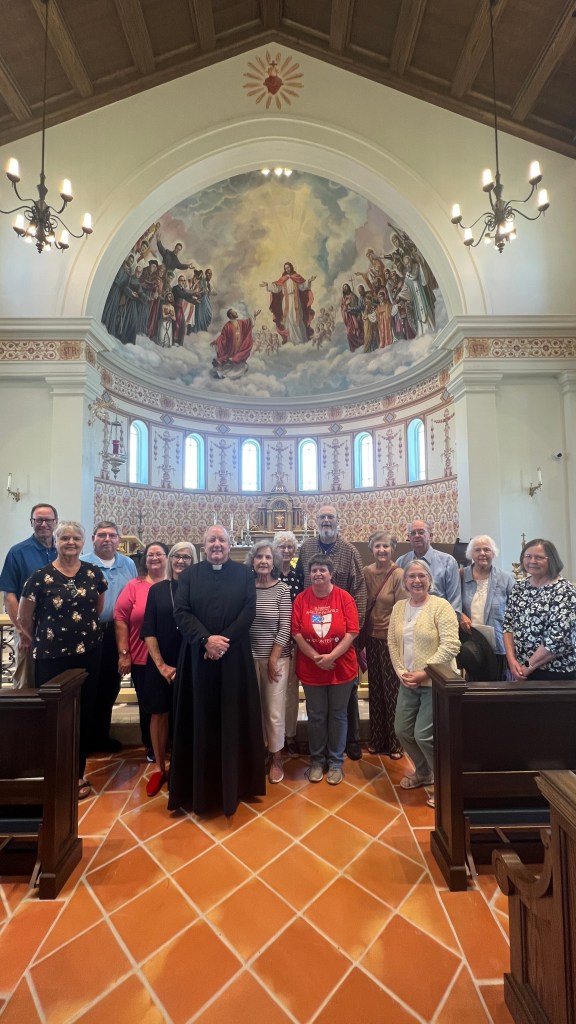
Today, I had the opportunity to take a small group to Oklahoma City to visit the Blessed Stanley Rother Shrine. Blessed Stanley is the first American Martyr in the Roman Catholic Church and an Oklahoman. Below is a history taken from the Archdiocese of Oklahoma City’s website. (Source) The pictures are ones I took.
Stanley Francis Rother was born March 27, 1935, in Okarche, Oklahoma. The oldest of the children born to Franz and Gertrude Rother, he grew up on a farm and attended Holy Trinity Catholic Church and School. He worked hard doing required chores, attended school, played sports, was an altar server and enjoyed the activities associated with growing up in a small town.
While in high school, he began to discern the possibility of a vocation to the priesthood. He was accepted as a seminarian and was sent to Assumption Seminary in San Antonio, Texas. He completed his studies at Mount Saint Mary’s Seminary in Emmitsburg, Maryland, and was ordained a priest on May 25, 1963. Father Rother served as an associate pastor for five years in Oklahoma.
He sought and received permission to join the staff at the Oklahoma diocese’s mission in Santiago Atitlan, Guatemala. He served the native tribe of the Tz’utujil, who are decedents of the Mayans. Although he struggled with Latin in the seminary, Father Rother learned Spanish and the Tz’utujil language in Guatemala. He celebrated Mass in their language and helped translate the New Testament.
Father Rother was surrounded by extreme poverty among the Tz’utujil, who were living in one-room huts growing what they could on their small plots of land. He ministered to his parishioners in their homes; eating with them, visiting the sick and aiding them with medical issues. He even put his farming skills to use by helping them in the fields, bringing in different crops, and building an irrigation system.
While he served in Guatemala, a civil war raged between the militarist government forces and the guerrillas. The Catholic Church was caught in the middle due to its insistence on catechizing and educating the people. During this conflict, thousands of Catholics were killed. Eventually, Father Rother’s name appeared on a death list. For his safety and that of his associate, Father Rother returned home to Oklahoma. He didn’t stay long, though, as he was determined to give his life completely to his people, stating that “the shepherd cannot run.” He returned to Santiago Atitlan to continue the work of the mission.
Within a few months, three men entered the rectory around 1 a.m. on July 28, 1981, fought with Father Rother and then executed him. His death shocked the Catholic world. No one was ever held responsible. The people of Santiago Atitlan mourned the loss of their leader and friend. They requested that Father Rother’s heart be kept in Guatemala where it remains enshrined today.
In 2007, his Cause for Canonization was opened. In June 2015, the Vatican in Rome voted to formally recognize Oklahoma’s Father Stanley Rother a martyr. The determination of martyrdom was a critical step in the Archdiocese of Oklahoma City’s Cause to have Father Rother beatified, the final stage before canonization as a saint.
On Dec. 1, 2016, Pope Francis officially recognized Father Rother as a martyr for the faith. He is the first martyr from the United States and the first U.S.-born priest to be beatified. The Rite of Beatification was held on Sept. 23, 2017, in downtown Oklahoma City – an event attended by more than 20,000 people from around the world.
Prayer for the Canonization of Blessed Stanley Rother
O God, fount of all holiness, make us each walk worthily in our vocation, through the intercession of your Saints, on whom you bestowed a great variety of graces on earth. Having graced your Church with the life of your priest and martyr, Blessed Stanley Rother, grant that by his intercession this humble flock may reach where the brave shepherd has gone. Grant that your Church may proclaim him a saint living in your presence and interceding for us. Through Christ our Lord. Amen.
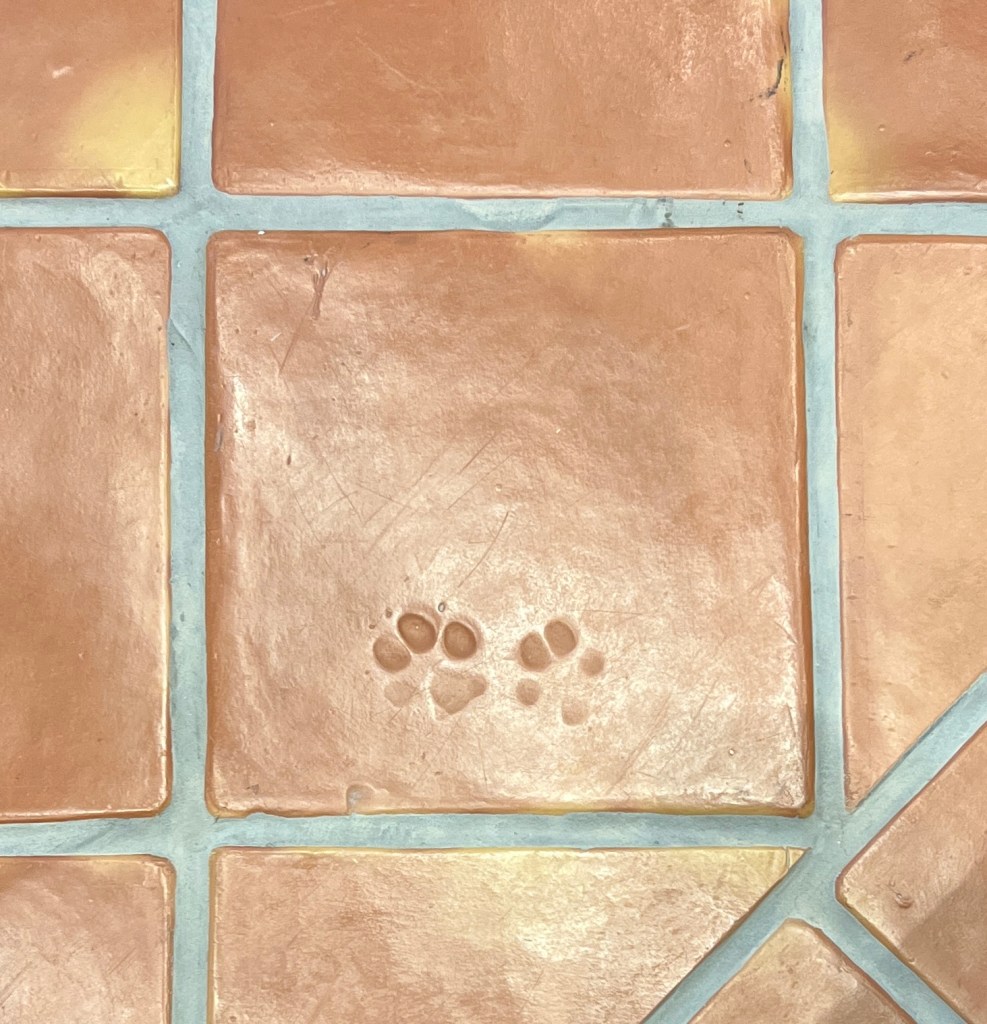
And God created Dog….
The floor tiles were made in Guatemala and dried outside. Throughout the building, you can see the tracks of the animals that passed by before the tiles were set.
Mark Twain wrote, “I have found out that there ain’t no surer way to find out whether you like people or hate them than to travel with them.” I think this is probably true and, as most of you know, the day after Christmas, I went traveling again, but this time I went by myself and discovered that I’m not a bad travel companion.
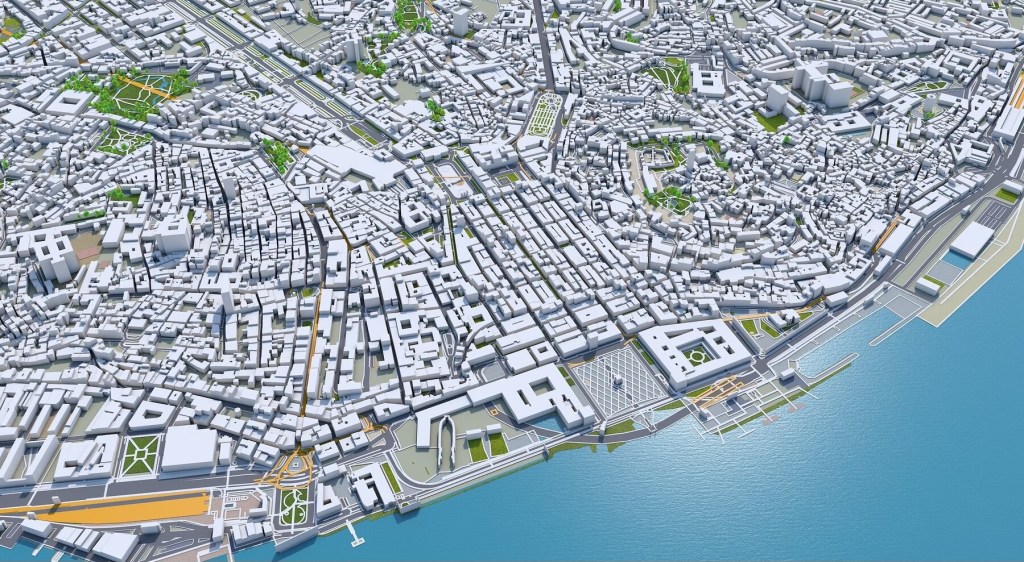
I went to Portugal on this trip and spent most of my time in Lisbon. However, I was able to travel to several nearby locations, including Fatima, the site of perhaps the most significant Marian apparitions.
I left Monday morning and arrived in Lisbon three flights and roughly twenty-six hours later. I want to be able to sleep on planes, especially flights that long, but that is not the case. In addition, the host of the VRBO that I would be staying in gave me a great restaurant to have lunch in when I arrived, so I passed on the last meal offered on the flight. Bottom line: when I got to Lisbon, I hadn’t slept or had anything to eat in quite some time. From there, the situation began to decline.
I had purchased an international data plan for my phone so that I would have access to Google maps and the like, yet, when I arrived, it would not connect, even after I spent half an hour on the phone with the provider. It was at this point that no sleep and no food gave me my first stupid idea: “I can do this. No problem.”
My host told me the subway to take and what stop to get off at. How hard could that be? The only piece of information I forgot was that, at one point, I needed to switch trains. I rode that train and rode that train, and when it finally came to a stop, and everyone was getting off, a little older lady leaned down to me—and I must have been looking baffled at this point—and said, “This is the end of the line.” I said, “Thank you,” but what I thought was, “No…. kidding.” I then proceeded to make my second mistake: I got off the subway and rode the elevator to street level, the entire time thinking, “Surely I’ll be able to recognize something.” The problem: no Google maps or any map for that matter. In The Fellowship of the Rings by J.R.R. Tolkien, Gandalf writes a letter to Frodo and the letter includes a poem. A line from that poem reads, “All that is gold does not glitter, not all those who wander are lost.” I got off that train, and I was one who was not only wandering but also terribly lost and—no sleep, no food—did not have the sense to figure it out, so I found a spot in the shade and just stood there, staring blankly into a city I knew nothing about.
A wristwatch used to have only one function: tell the time. After a while, they added the date, then Seiko and the others added calculators, etc., and now, we have the Apple Watch and other similar devices that have more computing power than the first rocket to the moon. This little watch can do all sorts of things, but for the most, it is tied to your phone, so if your phone has no signal, your watch isn’t going to do much. If it is connected, then you’ll be able to get notifications on your watch.
As I stood there in the shade, staring blankly into that unknown city, my watch vibrated and dinged, and I was suddenly elated. That notification could mean only one thing: I had data services and could find my way out of this mess. However, specific functions on the watch work without data, one of which is the healthcare monitoring functions. Specifically, in this case, it was the heart rate monitor.
I raised my wrist, hoping to have a data-related message, but what I read was this: “High Heart Rate: your heart rate rose above 120 BPM while you seemed to be inactive for ten minutes.” You know you’re a little stressed when your watch tells you to chill out.
I took a deep breath and slowly walked around until I spotted a police officer. He didn’t speak a lick of English, but we were able to mime communicate enough that I could tell him where I was trying to get; when he realized where it was, I didn’t understand what he said, but it meant, “How in blue blazes did you get all the way over here?”
I asked, “How do I get there? Can I walk?” “No,” he said, wide-eyed. He then indicated he would get me to the train station; I said, “No. Taxi.” He then gently took me by the arm and led me to the street. Standing there with me, he flagged me a cab. He had a conversation with the taxi driver and told him where I needed to go. There was more to the conversation than this, but I didn’t understand any of it other than the grin, and the eye roll exchanged between them.
I don’t know either of these two individuals’ names, but the police officer I named Angel because, following a fifteen-minute taxi ride, I was deposited in the exact spot I needed to be.
For the duration of the trip, when I was out and about, I had no data services, but André, my VRBO host, was brilliant and helped me learn how to get around. After a thirteen-hour nap and some tasty food the following day, I set off into that remarkable city and had a brilliant time. I got lost a few more times and occasionally missed a train stop, but I really had no problem getting around after that first day.
St. Augustine of Hippo (d.430) was one of the greatest theologians the Church has known. One of his books is the City of God. In it, he writes of the City of Man and the City of God, where “the earthly city glories in itself, the Heavenly City glories in the Lord.” There are many other comparisons: “The earthly city was created by self-love reaching the point of contempt of God, the Heavenly City by the love of God carried as far contempt of self.” Although there are two cities, they are intertwined, just as in the parable of the wheat and the weeds that grow in the field together.
Augustine says that it is in this intertwined city that we live, and it is a place where, for the most part, “the strongest oppress the others because all follow after their own interests and lusts.” It is a city where it is easy to become lost, bouncing from one thing to another, never settled, anxious, and not truly knowing where you are going.
It was in such a city, such a time, that Jesus was born and lived. People wandered in the city, lost with no means of finding their way. Anxious, with no knowledge of how to calm their hearts and their souls. But then, like my angel in Lisbon, along came John the Baptist, who took them by the arm and directed them to the one… the only one, who could bring peace to their souls and get them to where they needed to be: “Here is the Lamb of God who takes away the sin of the world!” So, coming to Jesus, they asked, “Rabbi—teacher—where are you staying?” “Where are you staying? We are lost. How do we get there?” And Jesus responds, “Come and see.” Jesus says, “Come with me, and I will show you the way through this city. I will show you the path that leads to God, for not only can I show you the way, but I Am The Way.”
If you are anxious and lost in the city, there are many here who can help show you to the one who is the Way. If you know of someone who is lost, be a John the Baptist to them, be an Angel to them, and point them to the Lamb of God, who will give them safe passage through this City of Man to the Eternal City, the City of Our God.
While in Portugal, I had the opportunity to visit Fatima, the site of the great Marian Apparition. During one of the apparitions, the Virgin Mary gave the children a prayer she asked to be prayed at the end of each decade of the Rosary. It is brief but addresses our most profound need while we walk the streets of this City of Man. Let us pray: “O my Jesus, forgive us our sins, save us from the fires of hell, lead all souls to Heaven, especially those most in need of Thy mercy. Amen.”