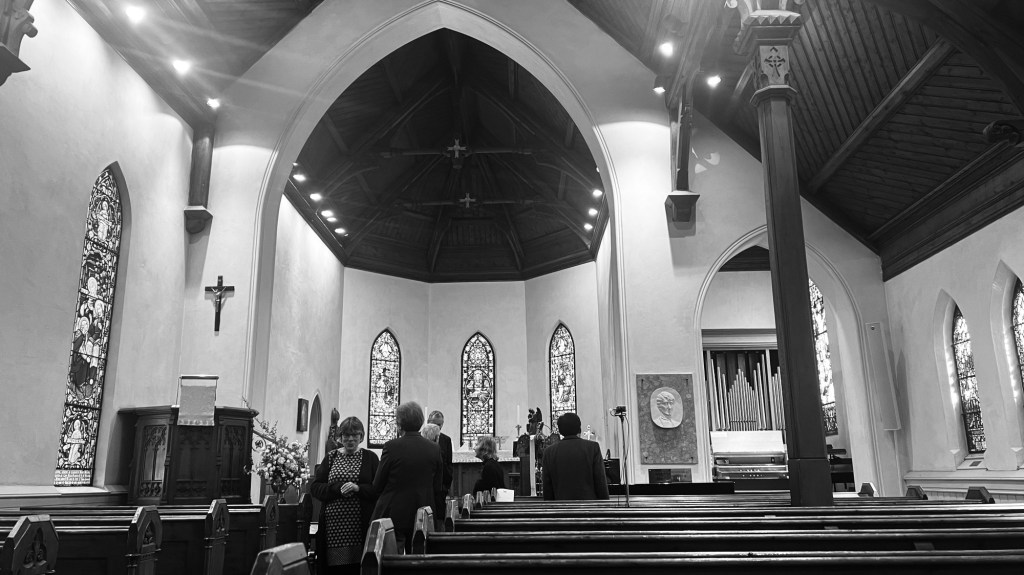
Today, I attended St. Edmund’s Church (Church of England). The Rt. Rev. Dr. Robert Innes, Bishop of the Diocese of Europe was the Celebrant with Confirmations. It appeared to be a very special day for the congregation. I had a minute to visit with the Chaplain, The Rev. Canon Joanna Udal.
The service was in English and similar to ours, but with a different order for some parts.
Bishop Innes doing bishopy things. It took a few seconds to realize that it is a map of Europe on his miter.
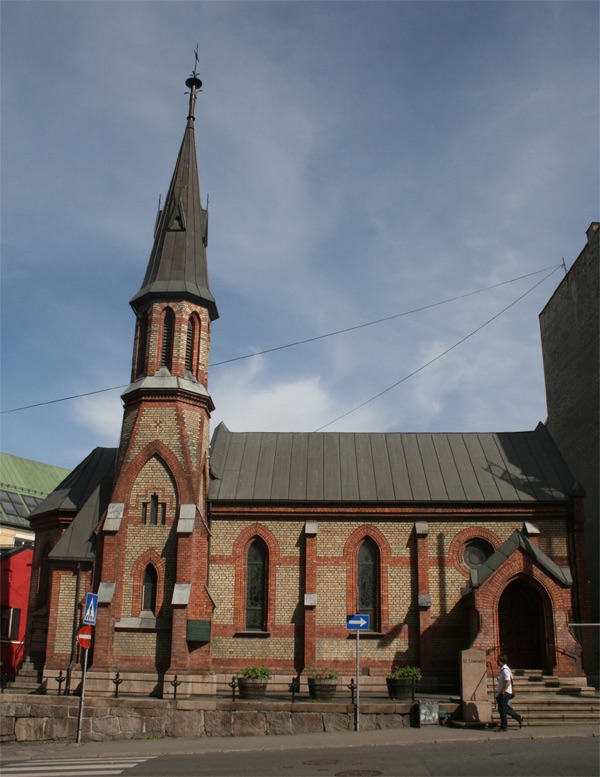
There was so much construction out front, that it was difficult to get a good picture, so I stole this one from the web.
At the end of June, they will be celebrating their 140th anniversary, so by European standards, it is a very new congregation/church.
The walk to the church this morning was lonely business. Very little movement on the streets. It is my experience that most European cities are trashed on Sunday mornings with garbage everywhere.
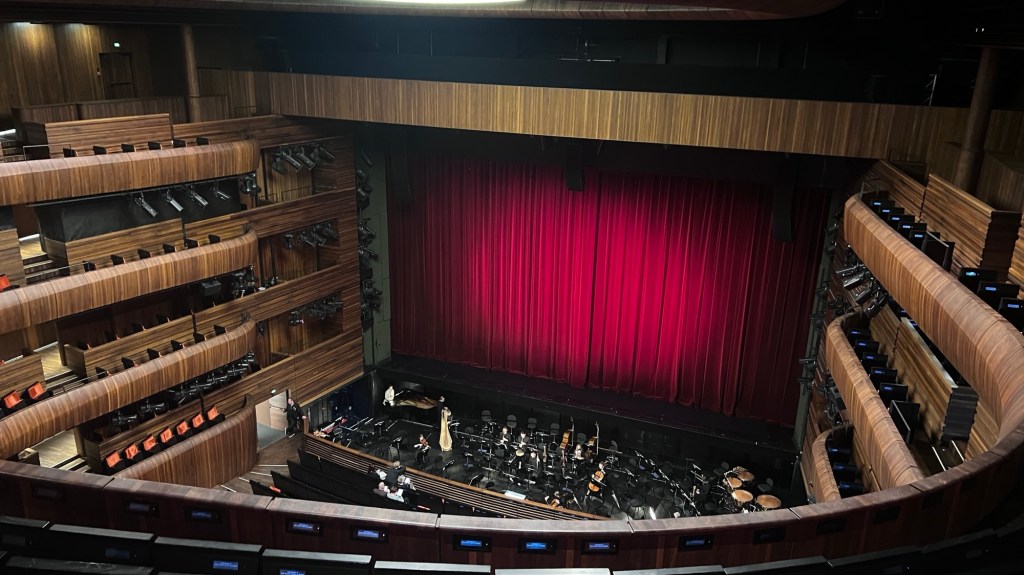
I got a double shot of culture today at the Operahuset i Oslo, Den Norske Opera & Balletts (Opera House in Oslo, Norway Opera & Ballet.
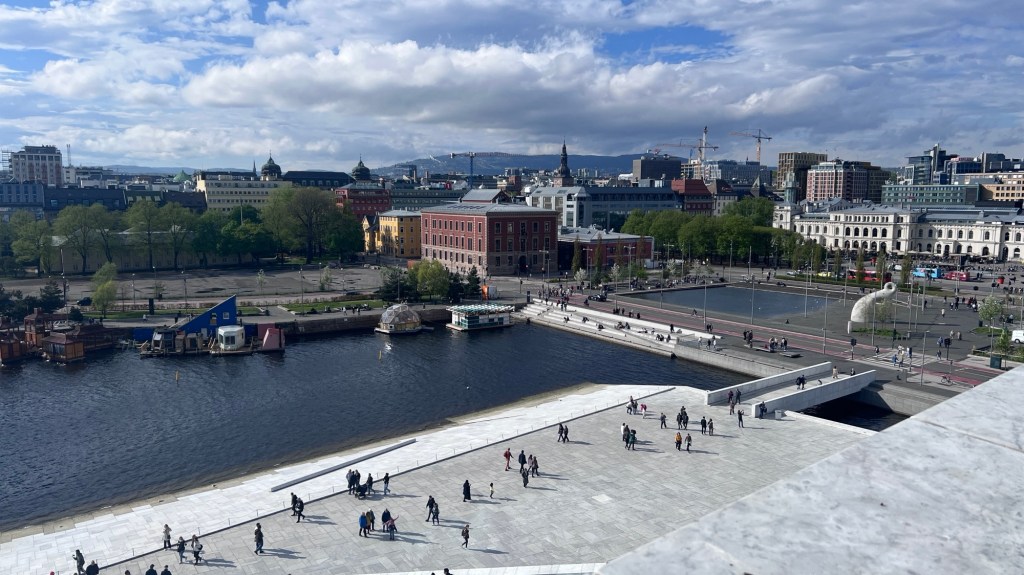
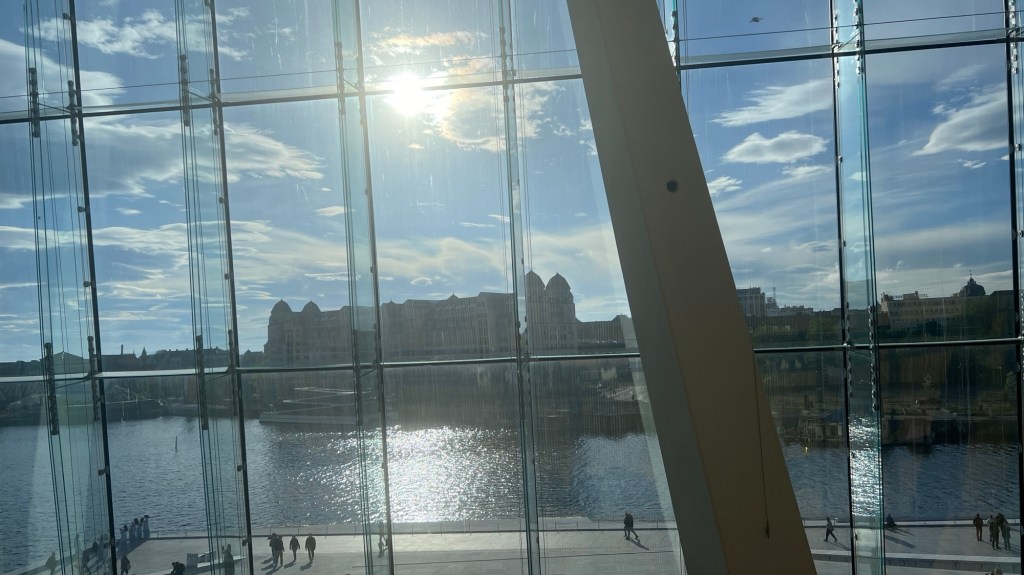
As above, so below. You are able to walk up to the roof, which provides great views of the city and fjord.
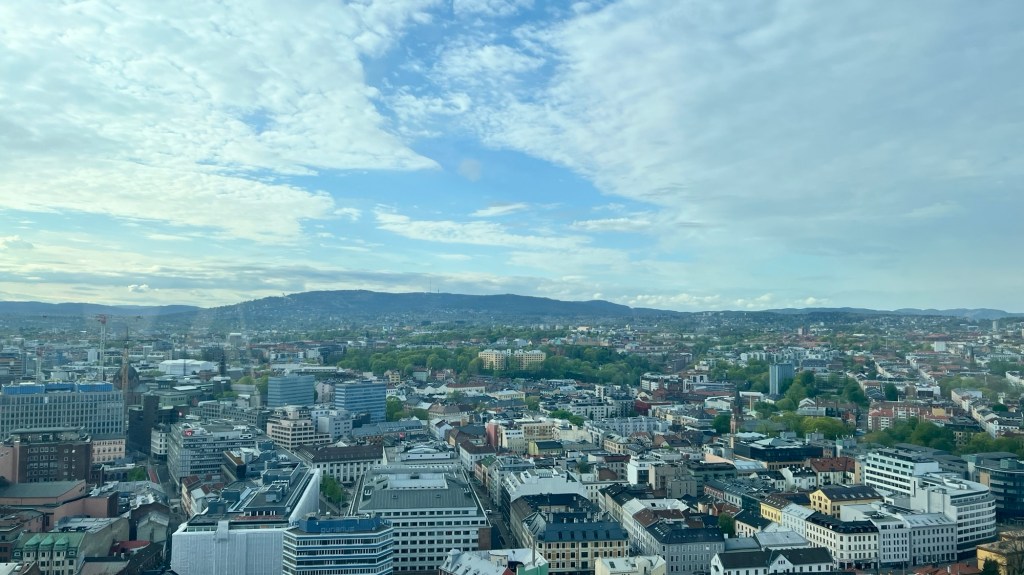
Little red circle is my room at the Radisson Blu Plaza on the 21st floor.
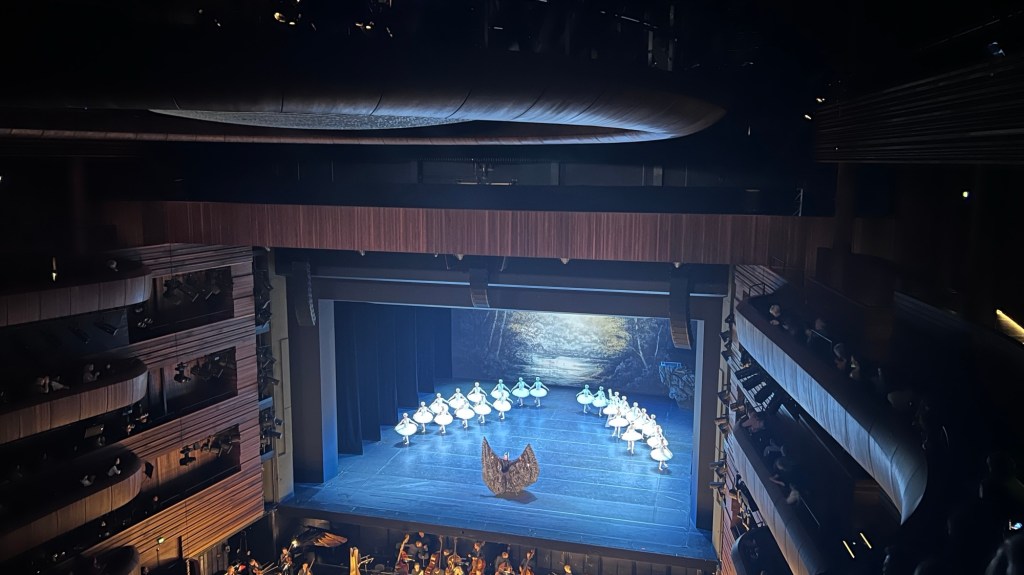
The main show was Swan Lake, Act 2 (a new production). My seat was on the very back row, but still enjoyable.
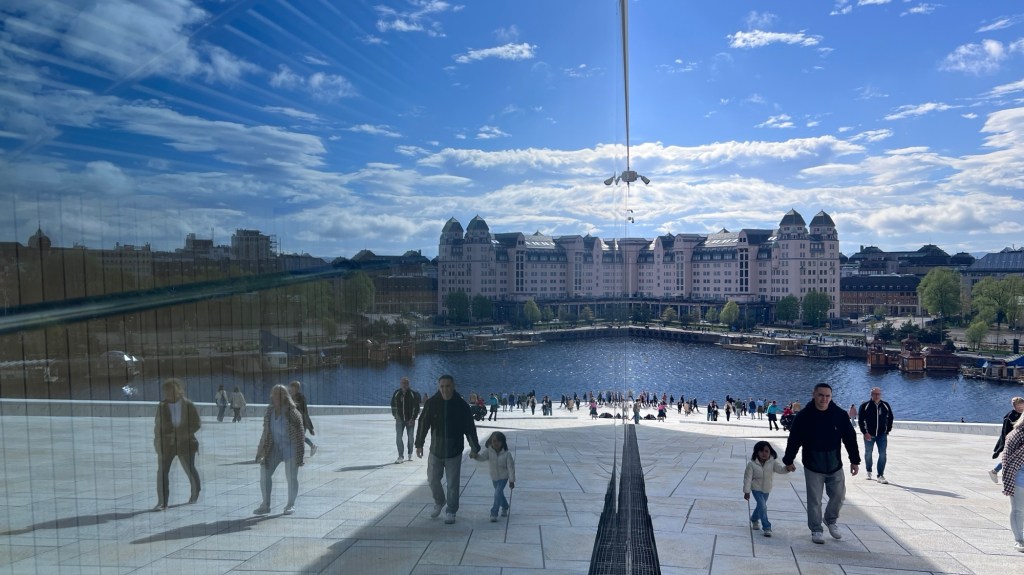
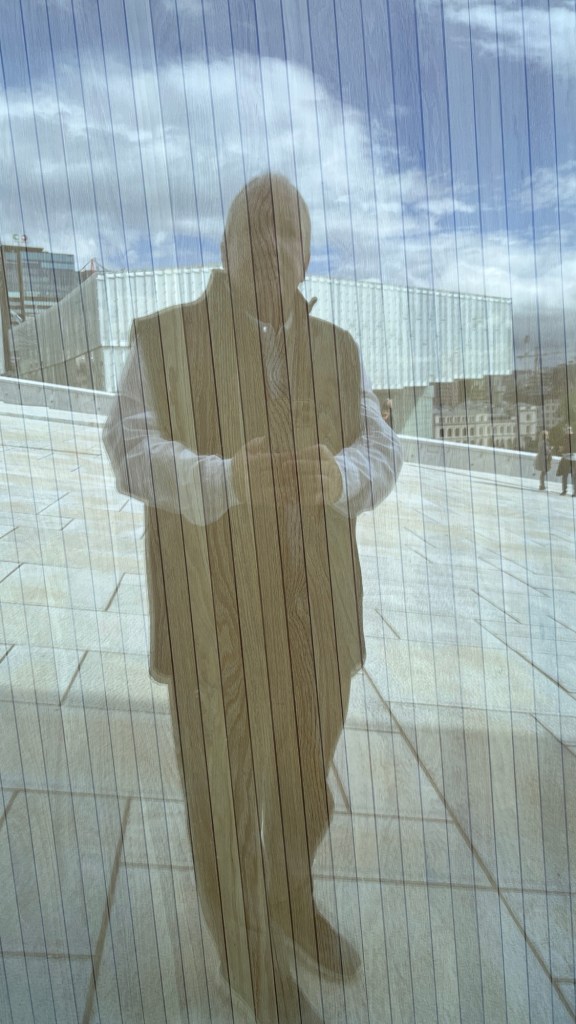
While on the roof, I enjoyed playing with the reflection off the glass.
Of course, the day would not be complete without the obligatory selfie.
Finally, I came across this question in some of my reading from this morning: “If I had infinite money, already traveled the world, had no fear, and didn’t receive any recognition for what I do, what would I do or what would I create?” My next question was, “Then why aren’t you doing that?”
The next couple of days will probably be pretty quiet here. I’m looking forward to some reading and… yeah…. Reading.
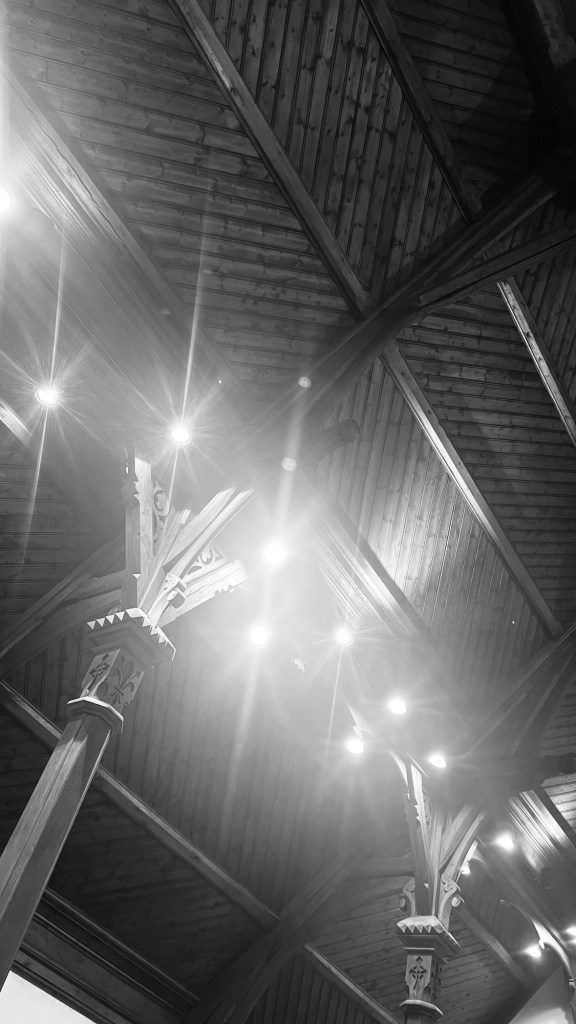
Just a note on the pictures for today: the light was really weird and I had a hard time getting good photos, so I’ve fiddled with most of these trying to pull the details out.
The first stop was a return to St. Olav Church to pray my Rosary, then I made my way to the Royal Palace. The seagull perched upon the rider’s head took center stage.
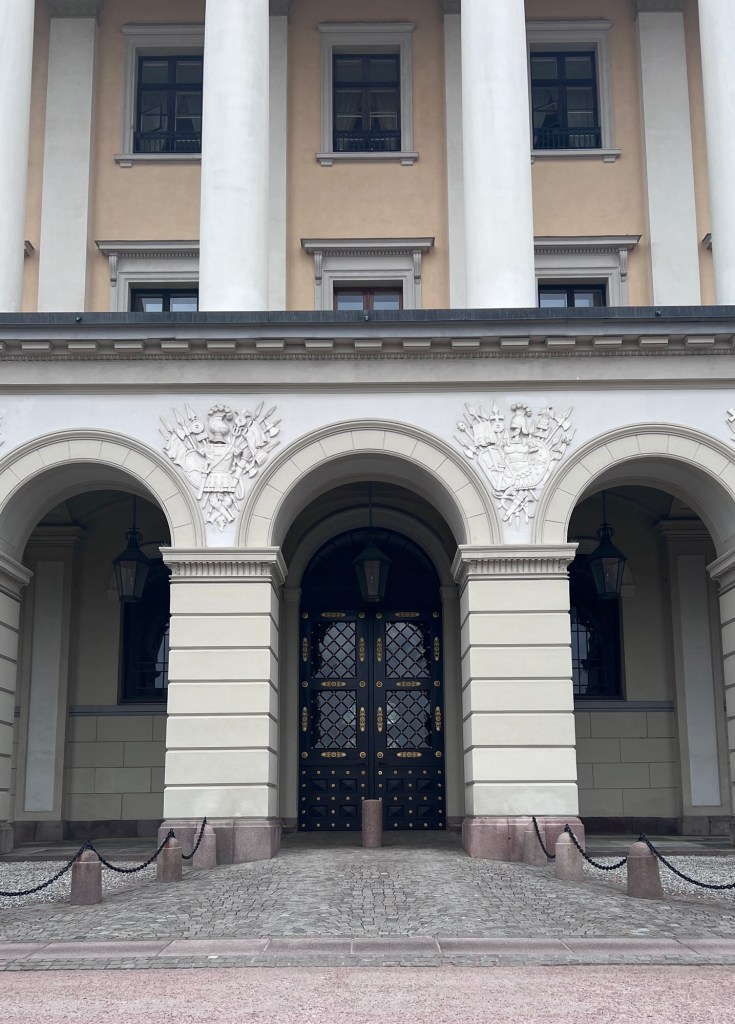
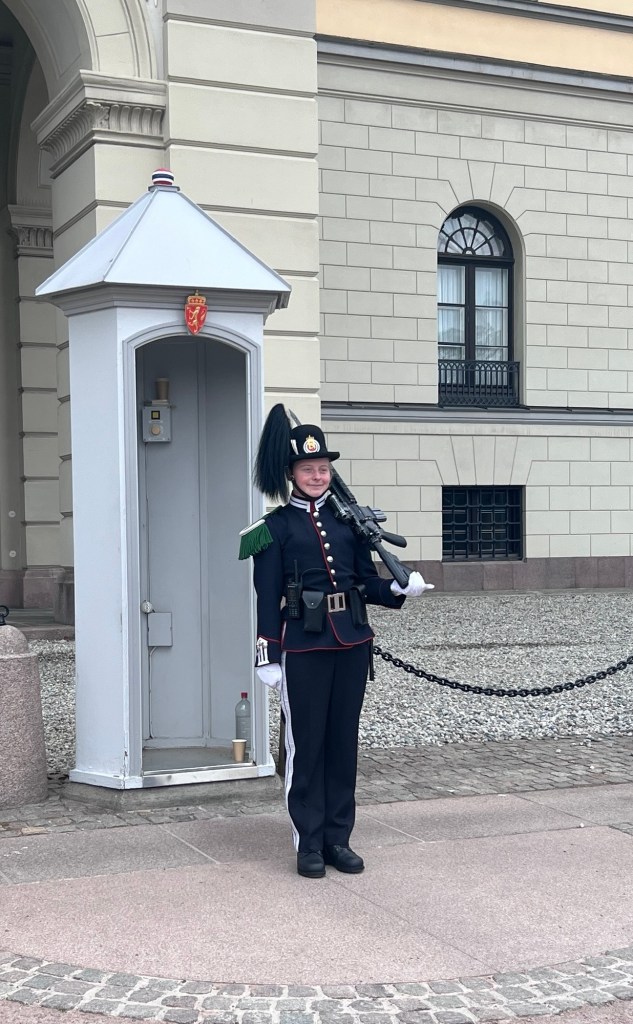
There is a tour that will allow you entry and I may try and do that next week. For now, the main doors leading in and the very happy security guard (she will smile for the camera, but I’m guessing she can handle the rifle.)
I had hoped to be invited in by King Harald V for a cup of coffee, but apparently he did not get my memo.
It was at this point that Siri got me good and lost. She said go this way and pointed in another direction. Switched over to Google Maps and got back on track, but put an extra mile on beforehand. FYI: Apple Maps does a fine job in the USA, but it seems Google Maps is the better choice when traveling abroad.
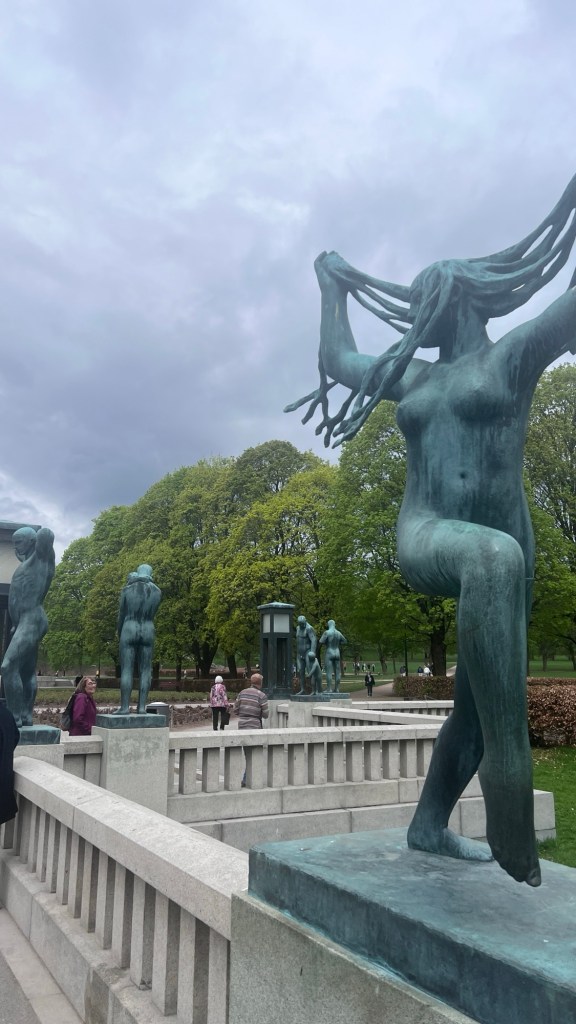
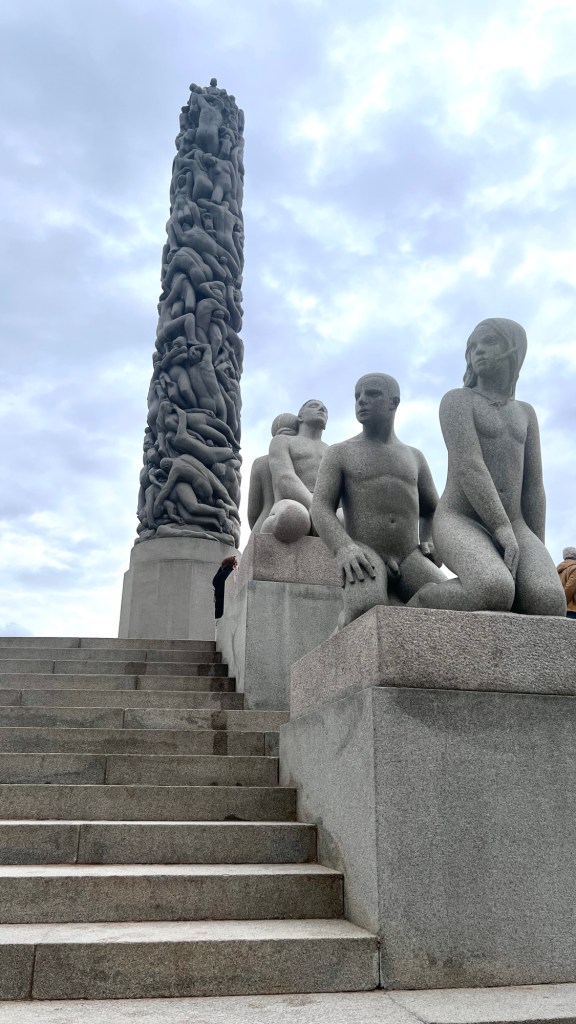
Eventually, I found my destination: Vigelandsparken (The Viegland Park), which is apparently what tourists call it, but known as Frogner Park to the locals.
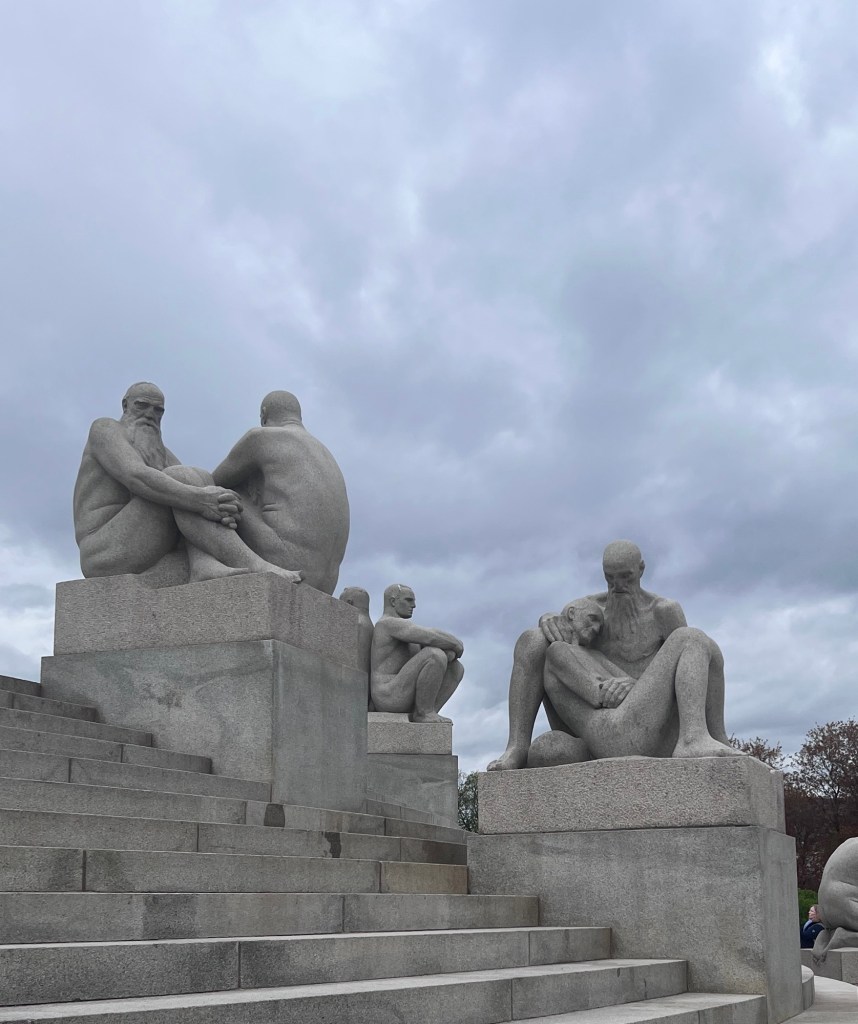
The Gustav Vigeland statutes and other works—there are 212 of them—take up only a small portion of the park.
If you are offended by nudity, you may want to stop here. Vigeland wanted the pieces to remain timeless, so they are all nudes. It does makes sense. Clothing dates a piece.
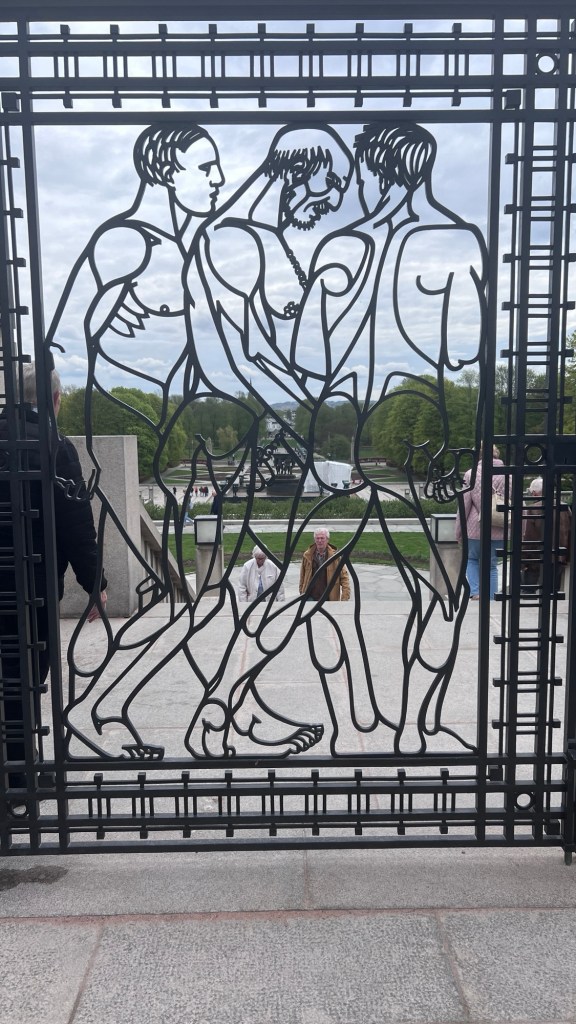
Scene from the gate (the monolith is in the distance)…
Further down the lane, you cross the Bridge that has 29 statues on both sides.
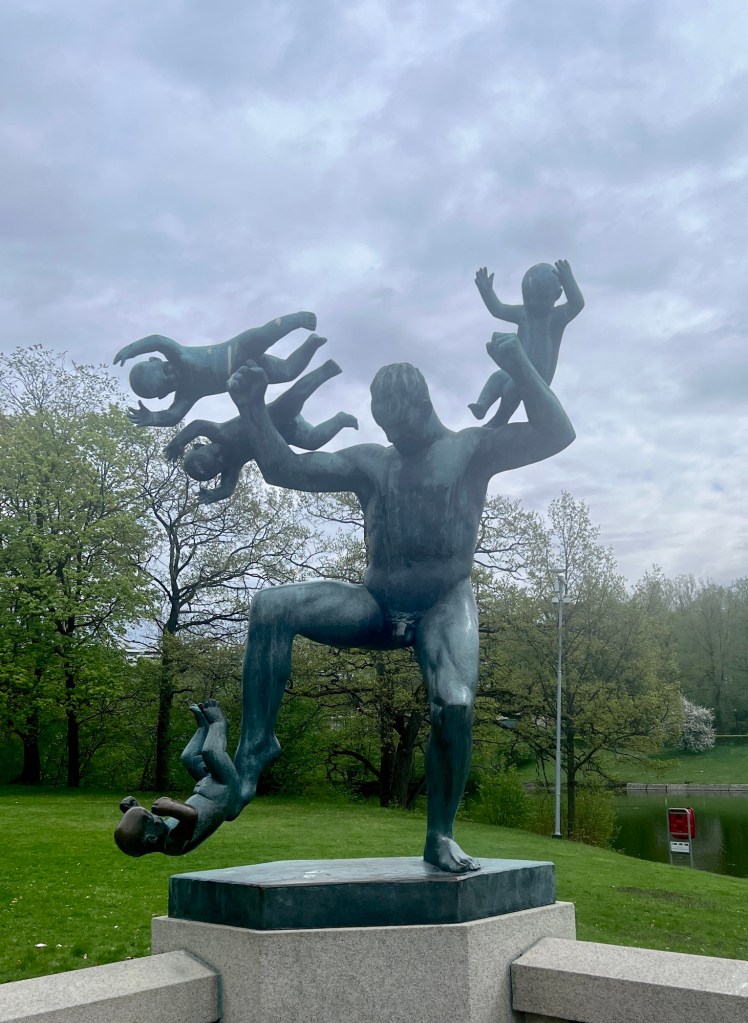
For the record, this is not a man drop kicking a baby. The “babies” are actually Genii spirits/demons and he is fighting them off. Think of it as the devil on your shoulder.
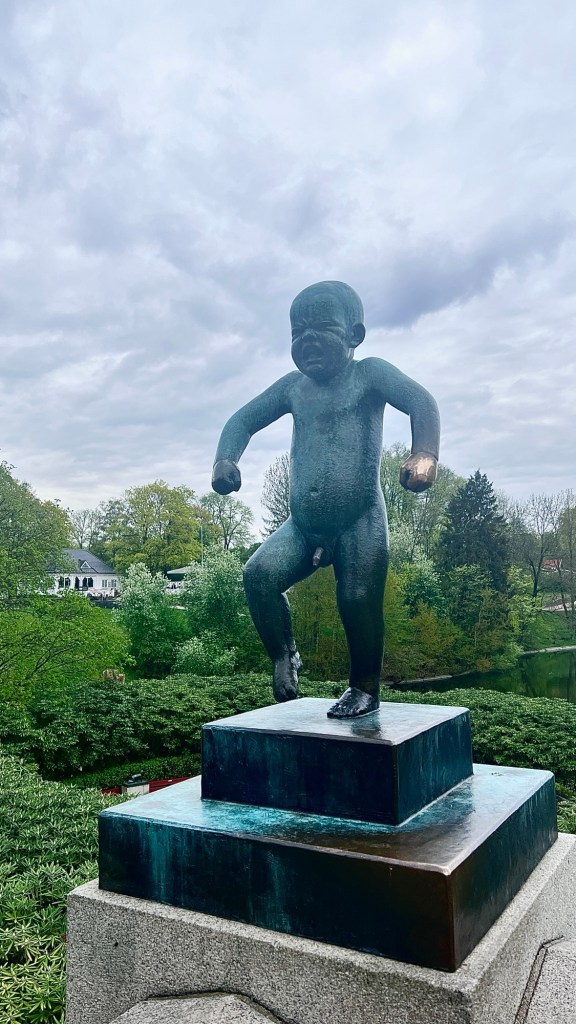
And then there is perhaps the most famous of the bridge statues, The Angry Child. For whatever reason, it is believed you can touch his hand for good luck. That is why it is so shiny—the oxidation patina has been rubbed off. They’ve asked people to stop rubbing it as this may damage the statue.
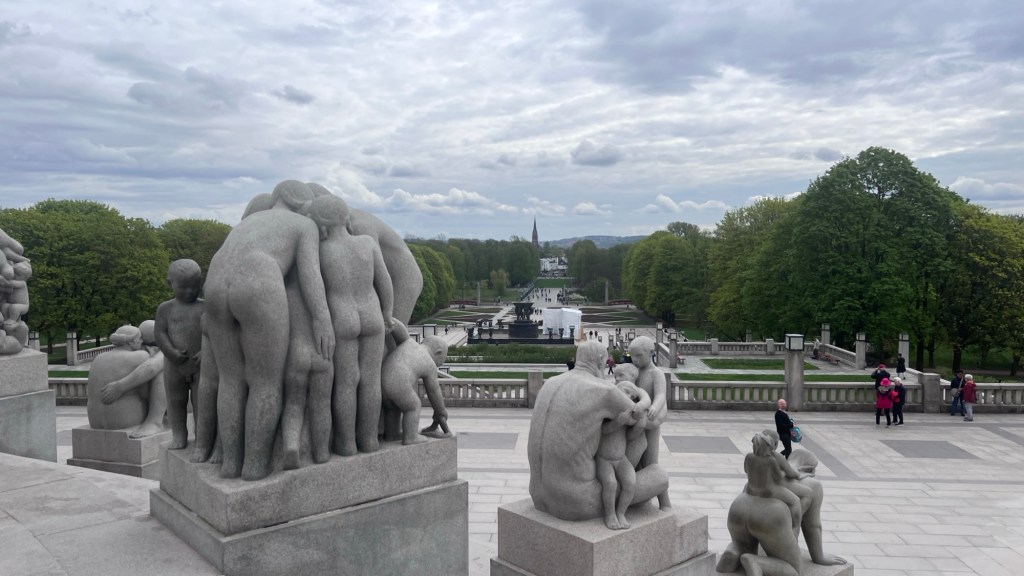
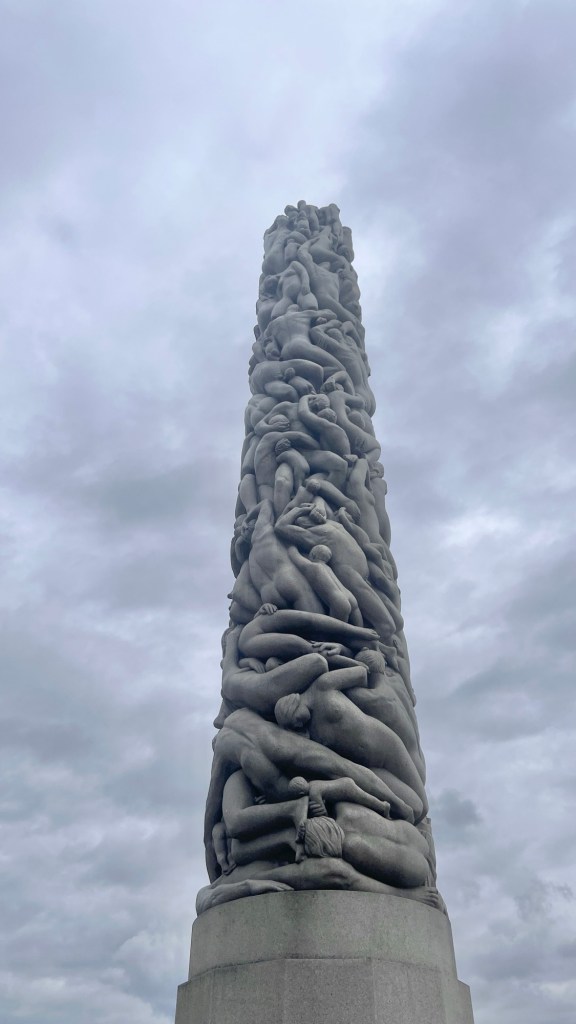
From here, you climb the steps, enter through the iron gates, and make your way to the monolith. There is much going on in these works of granite. The various figures represent different stages of life.
And then there is the monolith. It is a single piece of granite weighing several hundred tons. It took fourteen years to complete, is just over 46 feet tall, and consists of 121 figures.
Further on you come to the Circle of Life.
A view from the top looking back down toward the main gate…
Pope Clement XIII would have a coronary walking through Oslo and seeing all the nudes. He would hire an army of sculptures to create hundreds of fig leaves to cover the nudity. I am no prude, but I confess I am not accustomed to seeing so much. I believe that says more about me than it does the art.
Having done more walking than I should have, I got myself a cab. The driver was a very chatty Pakistani who was delighted to tell me about every building we passed. When we arrived at the hotel, he gave me his phone number, promising to provide me with excellent service during my stay. I do believe he would.
A trip to The Top, which is the restaurant on the 33rd floor of the hotel.
To begin, I had a tasty glass of wine and the oysters. For those who know my palate, the jalapeño is not generally on it, but the seeds had been removed leaving only the flavor. Both were exquisite and the hostess assured me that the wine was an excellent pairing with the main course.
THE TOP OYSTERS Lemon verbena granite, apple, jalapeño
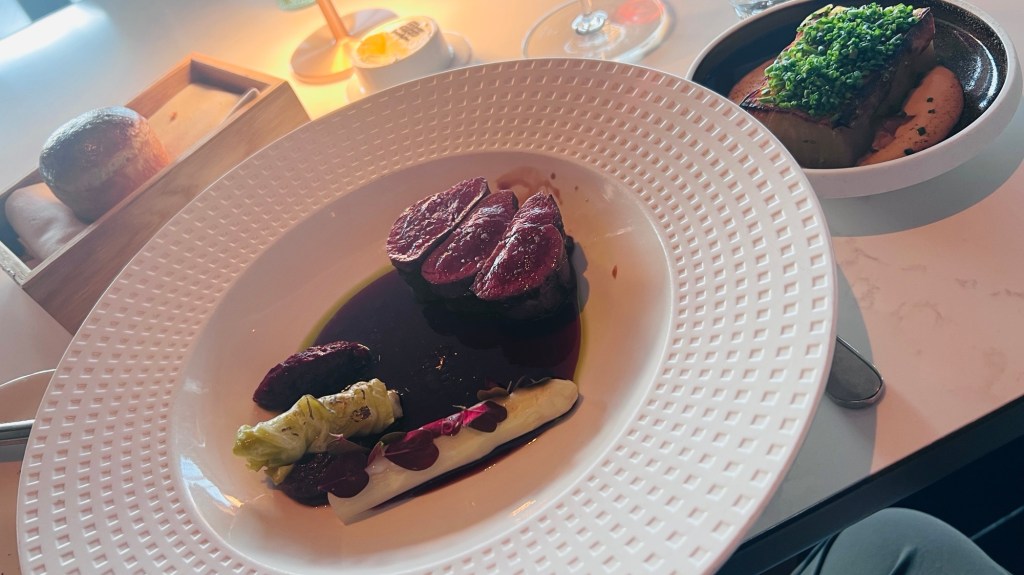
This was followed by the main course. FYI: if it is a foggy night, Christmas Eve Mass will be cancelled, because I ate Rudolph.
I have had some very tender meat in time, but this was ridiculous. When in Norway, do yourself a solid and have a little reindeer.
The side dish was a scalloped potato and amazing. Had I been in the restaurant alone, I would have picked up all the plates and licked them clean, which reminds me…
John visited his 90-year-old grandpa who lived way out in the country. On the first morning of the visit, John’s grandpa prepared a breakfast of bacon and eggs. John noticed a film-like substance on his plate, and asked, “Are these plates clean?”
His grandpa replied, “They’re as clean as cold water can get them. Just go ahead and finish your meal.”
For lunch, Grandpa made hamburgers. Again, John was concerned about the plates, as his appeared to have specks of dried egg on it. “Are you sure these plates are clean?” he asked.
Without looking up, Grandpa said, “I told you before, those dishes are as clean as cold water can get them!”
Later, as John was leaving, his grandpa’s dog started to growl and wouldn’t let him pass.
John said, “Grandpa, your dog won’t let me get by!”
Grandpa yelled to the dog, “Cold Water, go lie down!”
After Cold Water got the dishes cleaned, I made my way to desert.
Yeah, beneath the rabbit food is a dark and white chocolate bar. Yummy.
I finished the meal up with an Oban 14 (neat).
I’m not spoiled. I’m glad this was in Kronor because, otherwise, I would be sending out one of those text messages about being broke in a foreign country and needing some financial assistance!
As for the rest of the day… I spent it resting the foot (8 miles yesterday), which is doing really well. Only a little ache today. I also did some reading, writing, and napping. If you can spend a Tuesday doing the same, I highly recommend it! Tomorrow, I’m off to see naked people. Apparently, there are 212 of them. Keep you posted.
I know that I talk about this topic a lot, but it is a problem that I hope to solve. From my early morning thoughts…
If you hate someone, then you do not care what you do to them and you don’t care about what happens to them. If something good happens, you sneer about it and if something bad happens to them, then you say they are getting what they deserve. The same thing it’s true about hating and loving yourself. If you hate yourself, you don’t care what you do to yourself and all the bad that can happen you deserve. If you love yourself–and not in a conceited, self-absorbed way, but in a Godly way–then you will care about who you are, how you treat yourself, and are thankful in knowing when good things come your way.
I figure if you’ve read this far, you deserve more than a restaurant review.
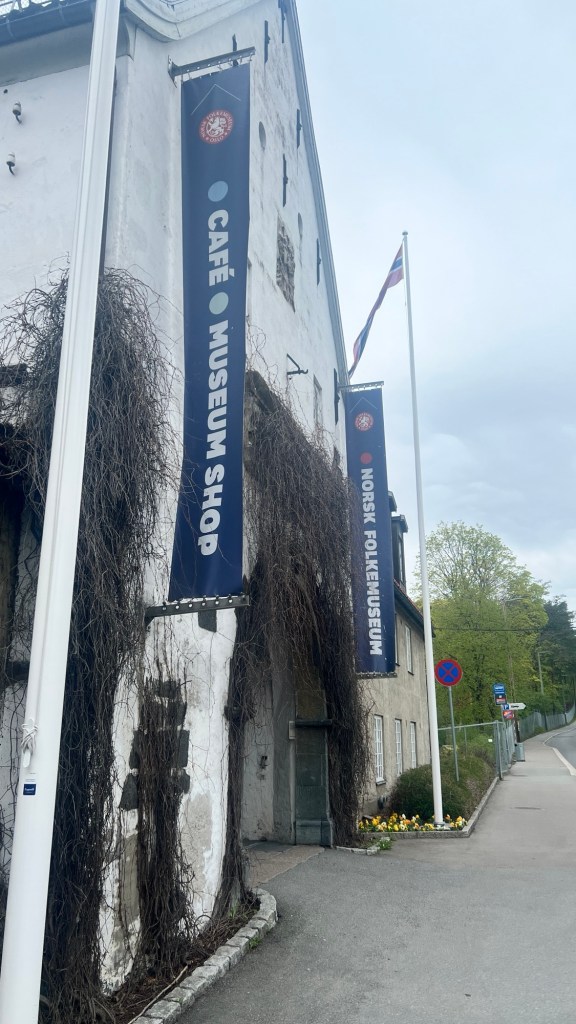
I made my way across the fjord to visit the Folkenmuseum, which is a collection of buildings and artifacts from all across the time and landscape of Norway.
As with most countries, Norway also has a surprisingly violent history. Following the violence was the development of a class system. That also seems to be true for most societies.
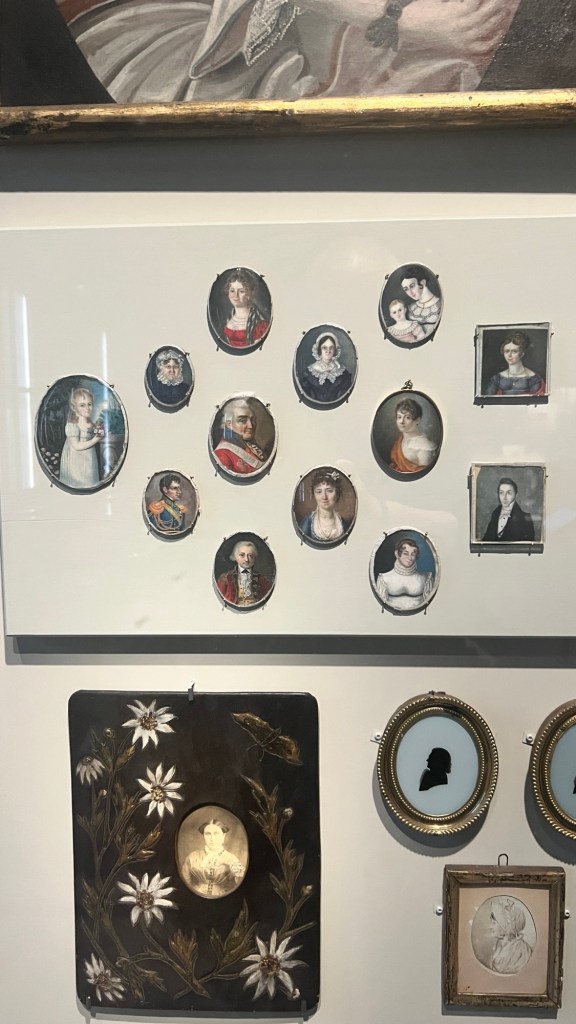
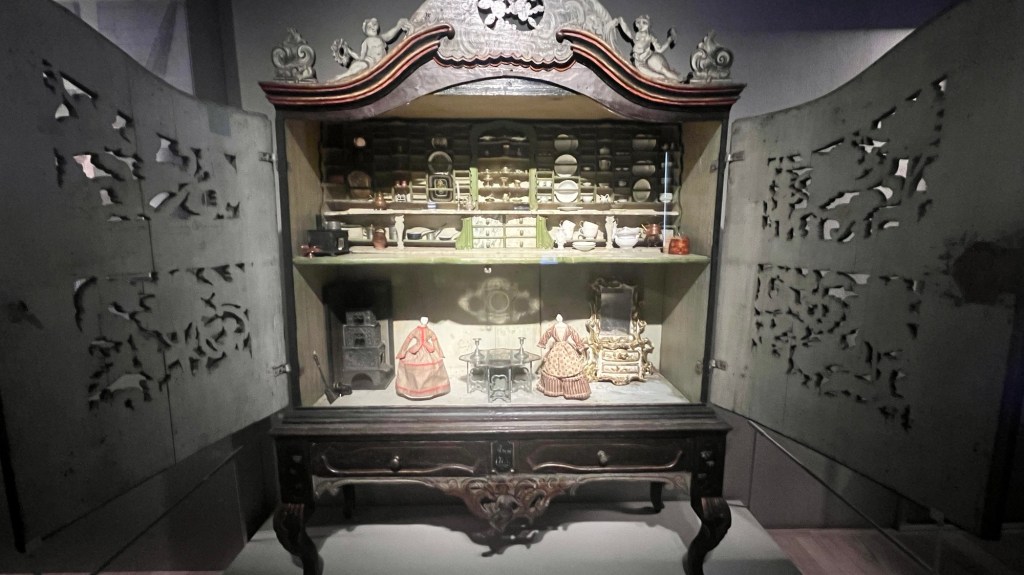
About the little girl on the far left: ELEONORE BERG 1814 • Miniature by Charlotte Berg In this miniature portrait, Charlotte Berg, née Schilling, (1786-1866) has painted her daughter Eleonore (1811-1845) standing next to a column which carries the name of her little brother who had died. The picture references many of the well-known symbolic elements found at the time in pictures commemorating people who had passed away: the white dress, the column, the flowers, the cypresses and the weeping willows in the background, all of which denote grief and sorrow. The adult Eleonore married her maternal uncle, Captain Adolph Schilling (1795-1886), who was 16 years her senior.I am guessing that not even the highest priced Barbie set can compare to this. I do not think that Ken could have afforded it. 
I then wandered about the grounds looking at various buildings until I spotted in the distance the one that I had come to see. 
Who knew that you needed a lawnmower in order to repair your roof. 
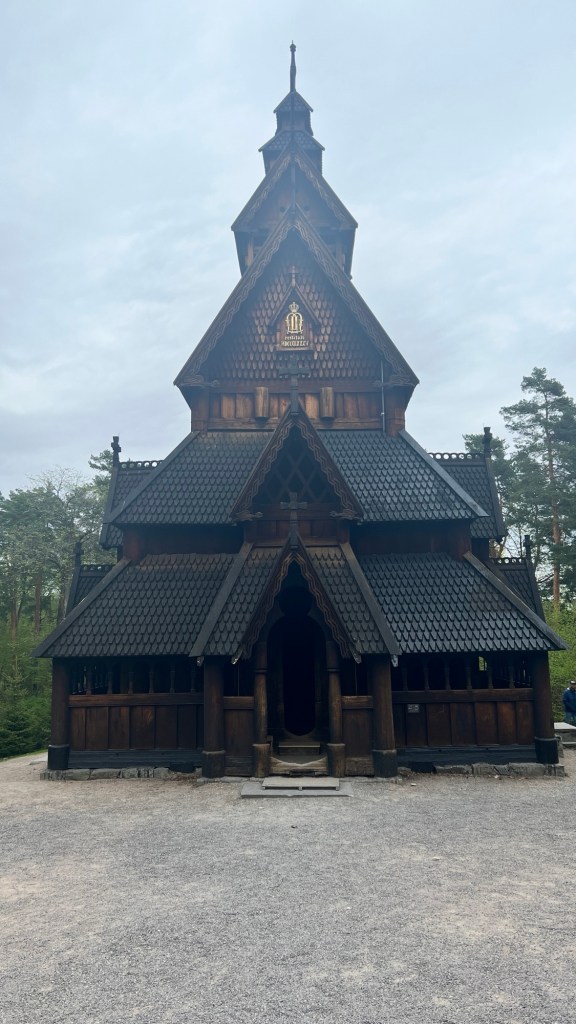
Did you see it just there?
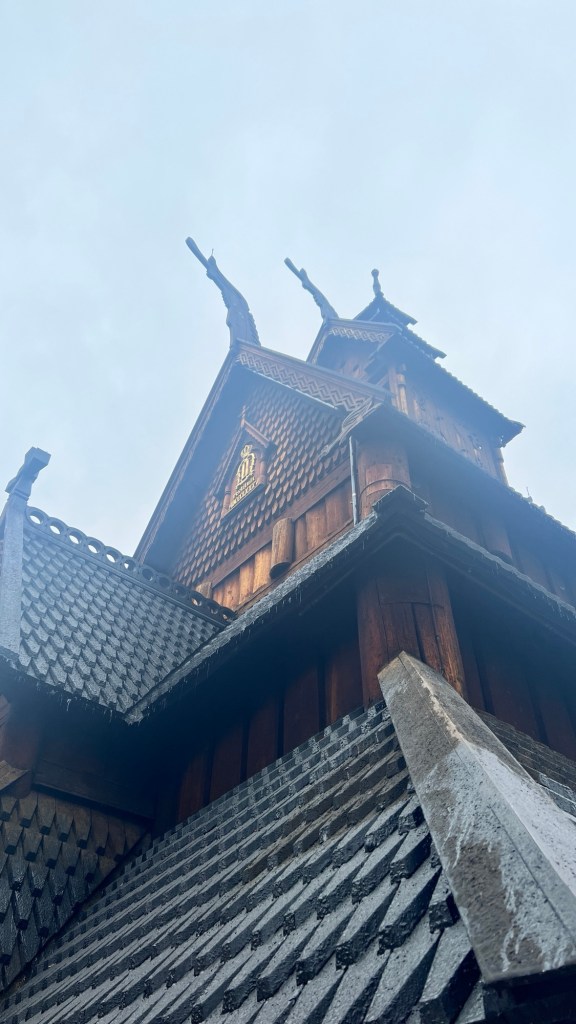
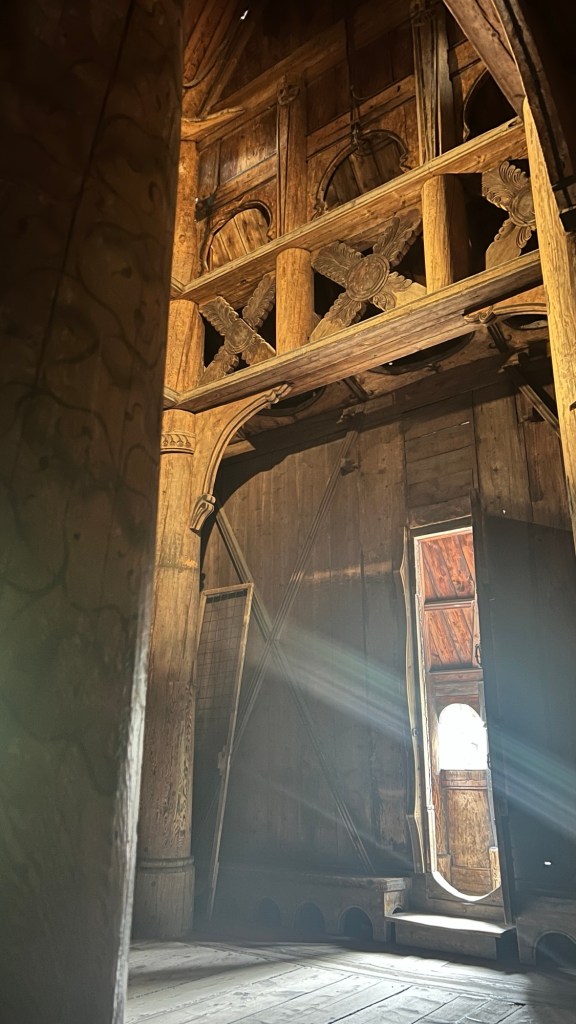
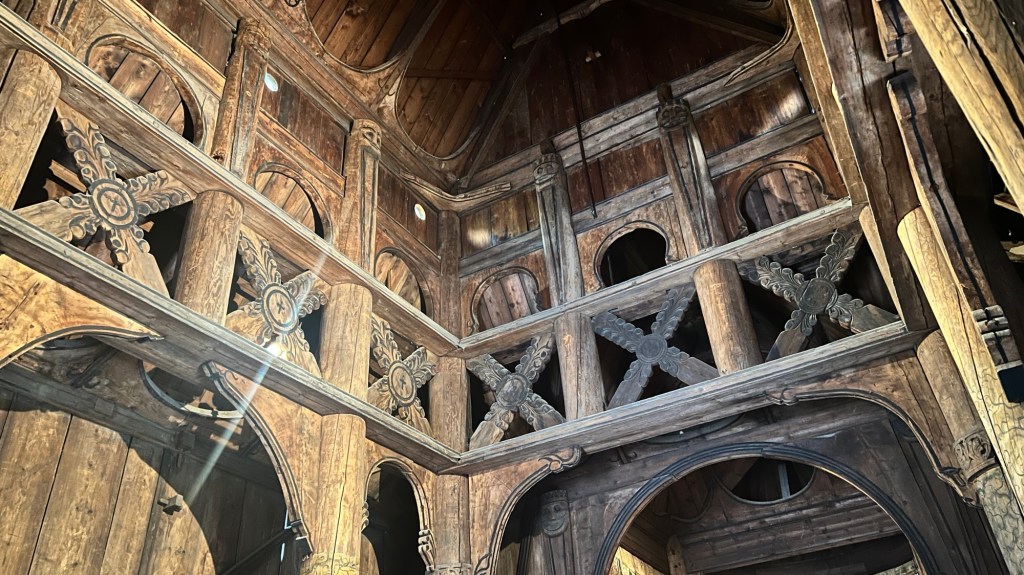
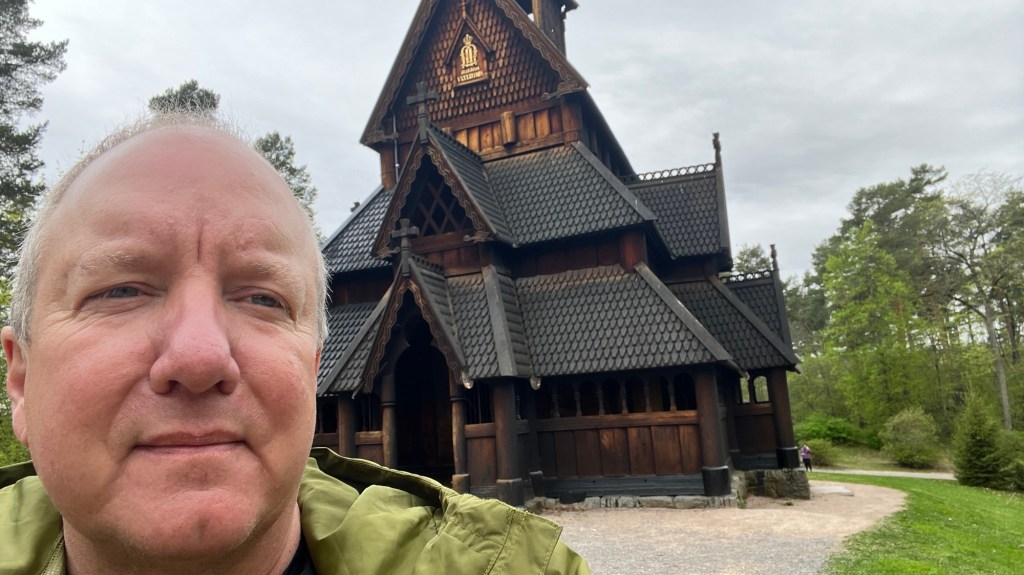
That is a Stave Church. Stave (I believe) refers to the type of architecture. It has to do with the way that the cross beams are placed on top of the vertical beams. Quite remarkable.
There were a number of reasons that I came to Norway, but this is in the top two. I wanted to see this church. It was actually moved from another location, but it is an excellent example. A wooden church that has survived for 900 years. Imagine. One of the reasons that it has survived has to do with the way that the wood was “cured.”
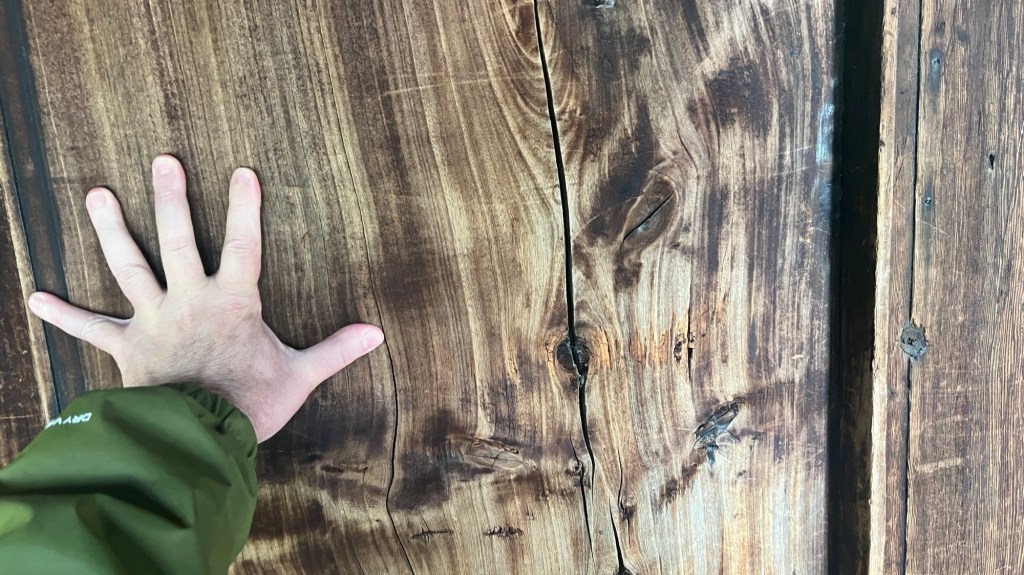
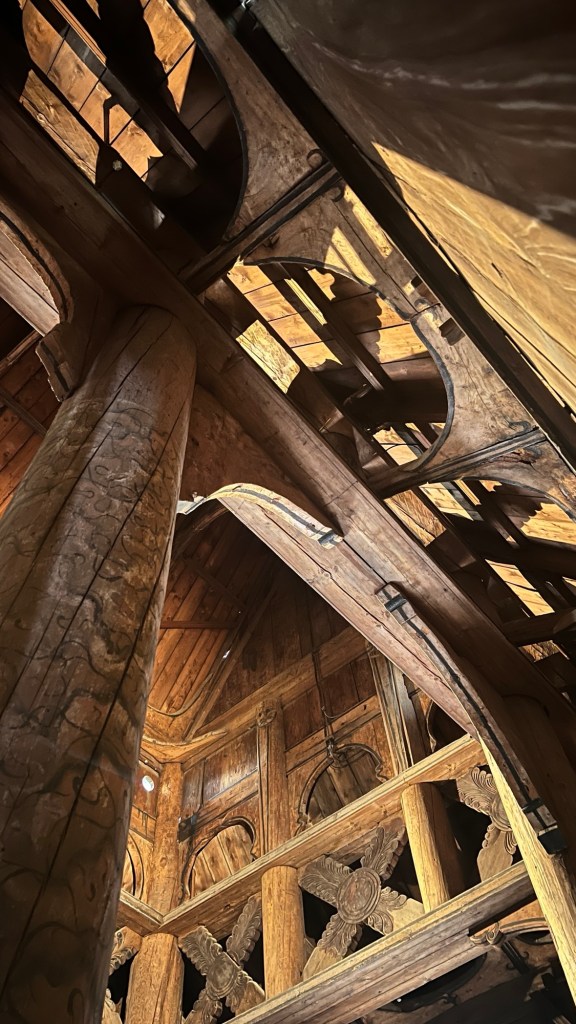
The primary supporting beams are from old growth forest. To give you an idea as to how old the trees were…
Instead of being cut down, all the limbs are trimmed off of the pines and the sap then saturates the heart of the tree. It is then harvested and the resulting wood is far more impervious to disease, rot, and other natural decaying elements.
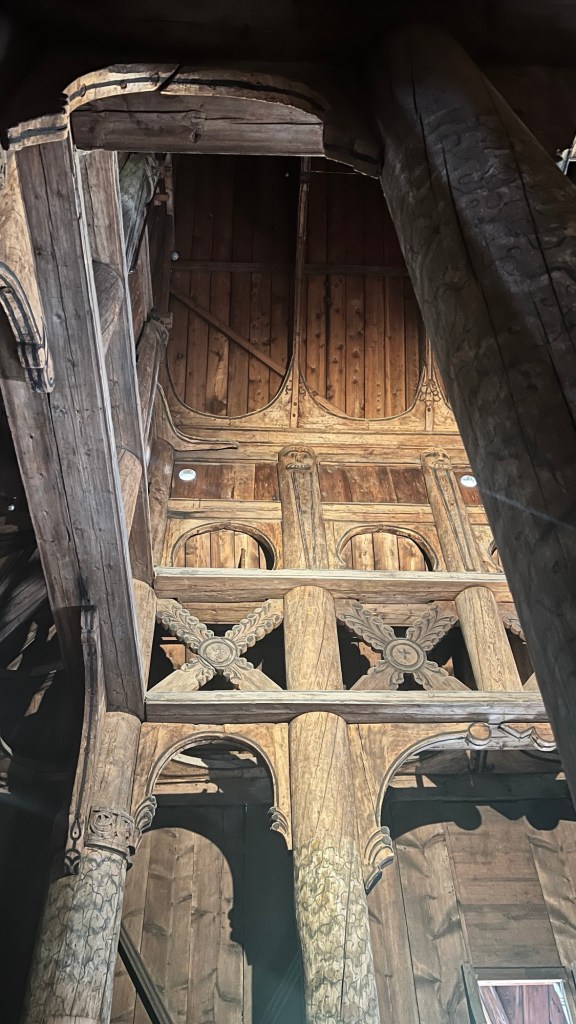
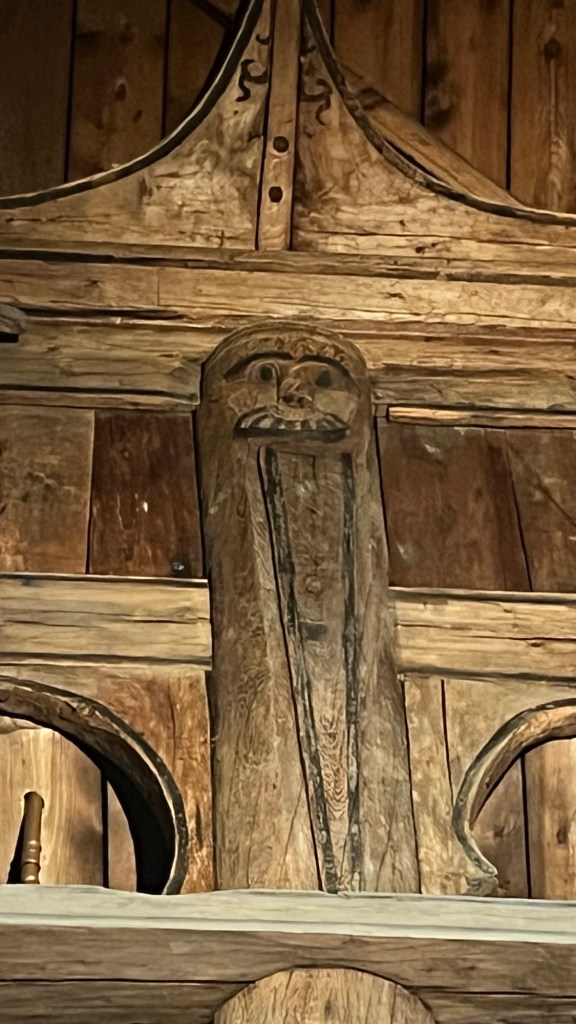
At the top of each of the primary pillars was a face. There were three on each side, so 3×4 = 12… I think, Apostles.
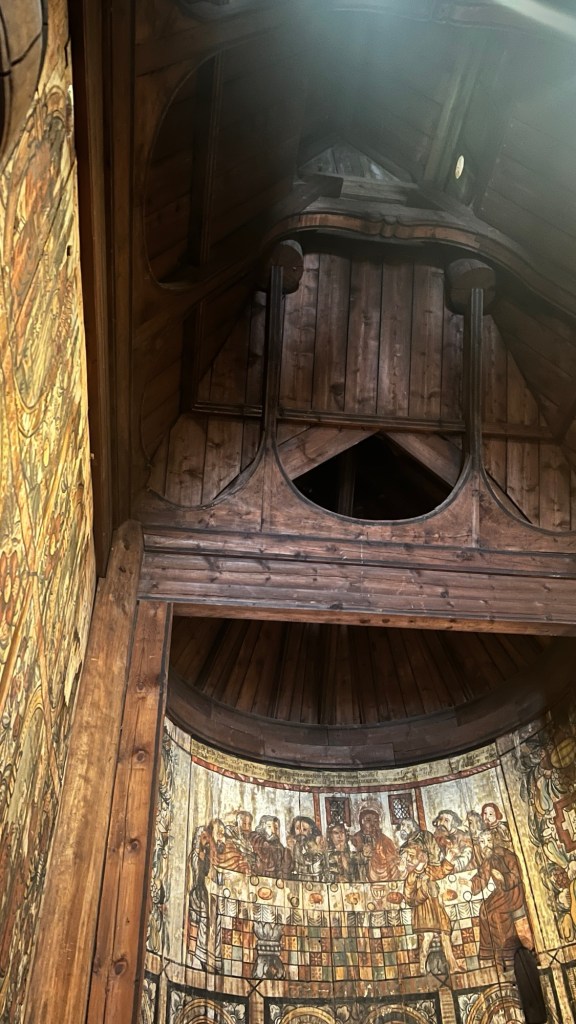
In the latter years, the church was Protestant, however, it began its life as a Catholic Church. Much of the ornate beauty would have been removed. (A bit more about that in a minute.)
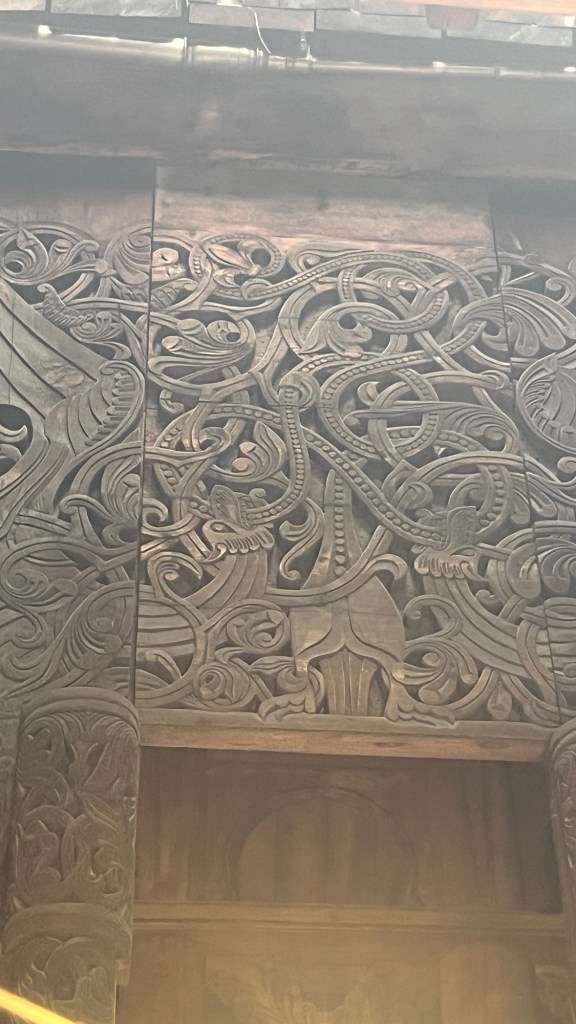
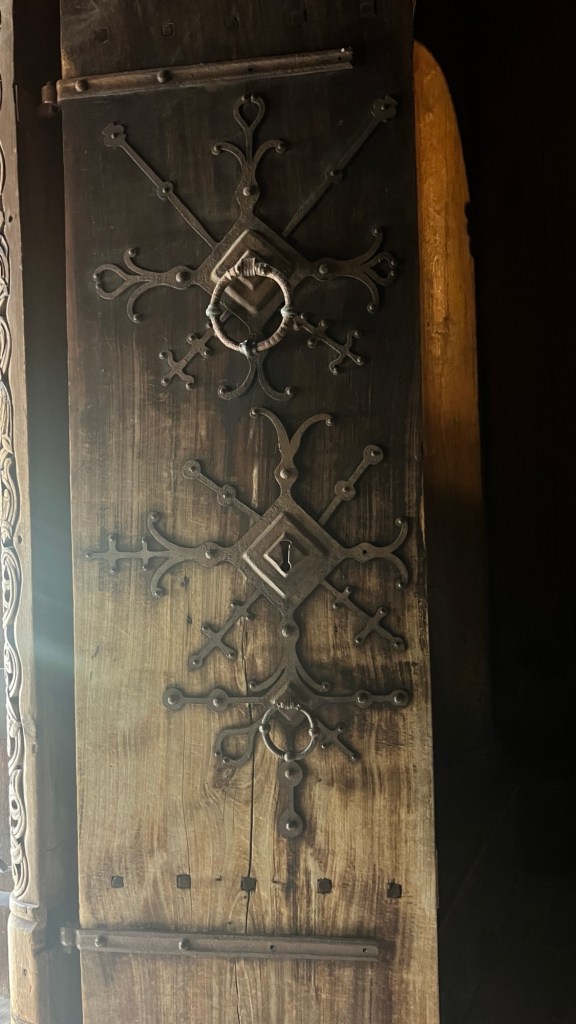
In the woodwork, you can see much of the Norse Heritage. There is much discussion on whether or not the Viking Compass is a contemporary invention or an historic fact. After looking at this door, which is about 900 years old, I think it’s more historic than recent. 
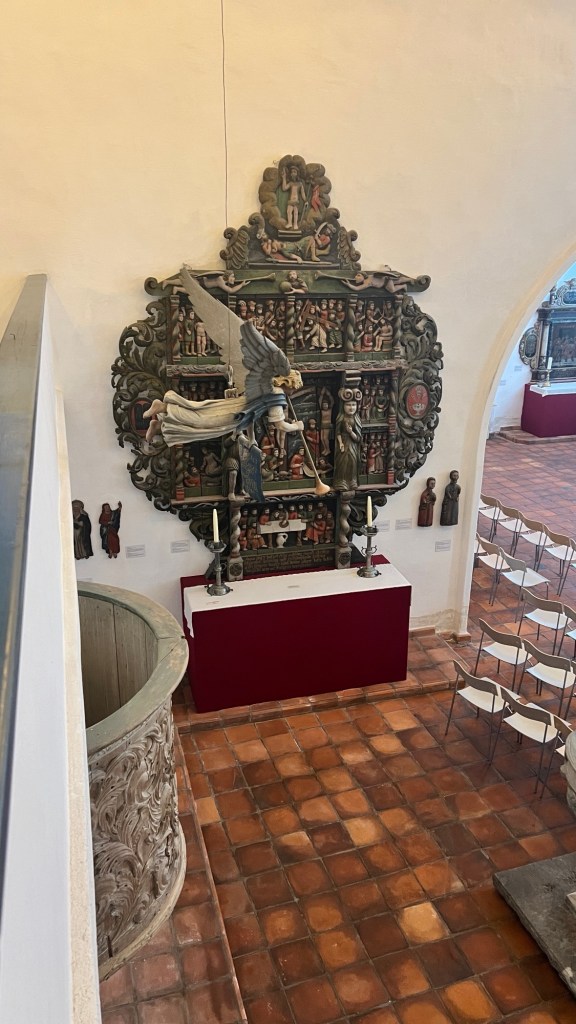
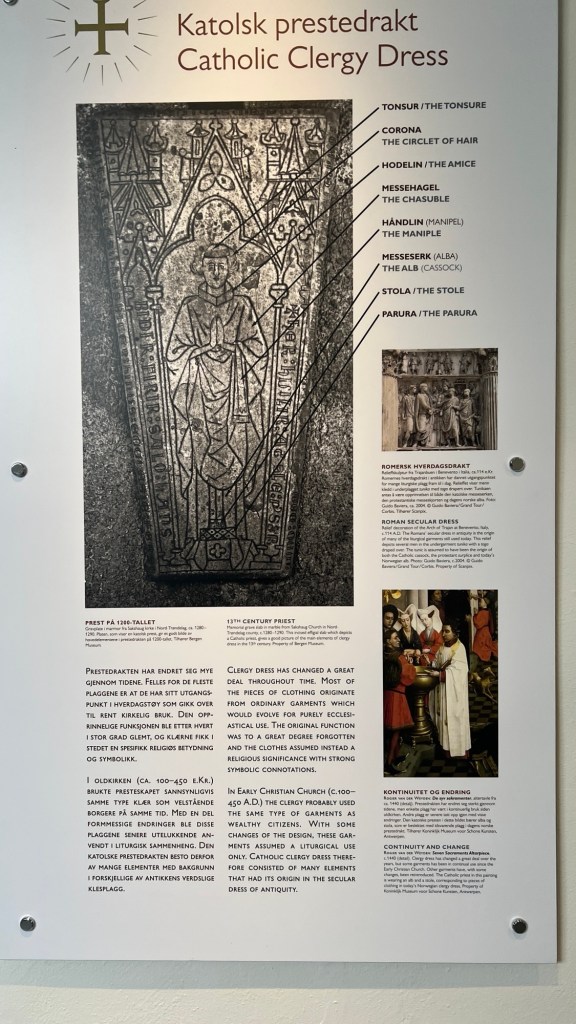
I made my way further into the museum and came to a section dedicated to the transitions from the Roman Catholic Church to the reformation.
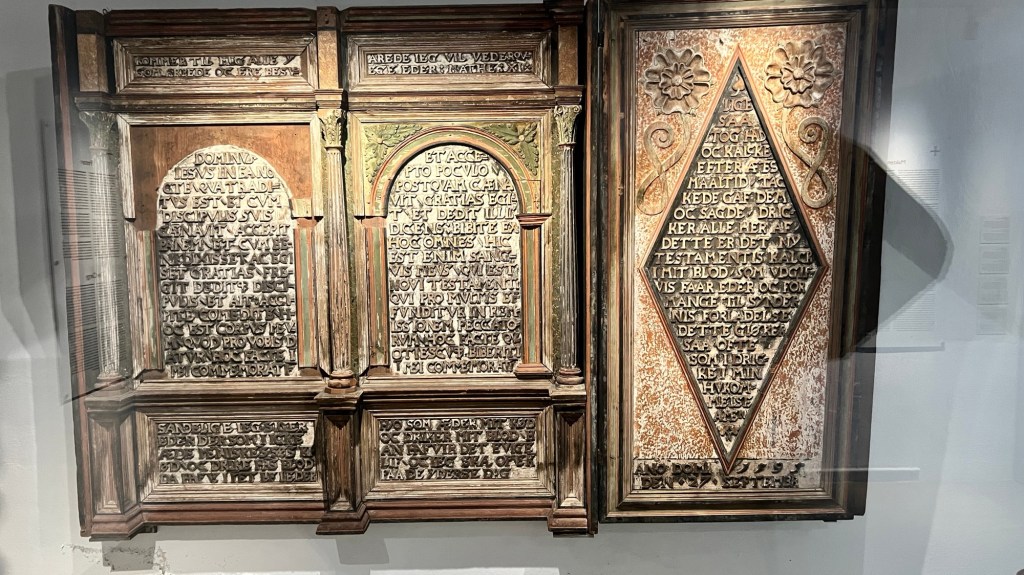
Commentary Warning: Whether intentional or not, I believe they pointed out the biggest problem with the verbiage on this plaque.
ALTARPIECE
HEGGEN CHURCH, BUSKERUD COUNTY.
DATED 1595. THE LEFT WING IS MISSING.
According to the teachings of Luther the only path to salvation was through God’s Word in the Bible. After the Reformation, some clergymen understood this to mean that pictoral renditions in the church could lead to idolatry and divert attention from the Scriptures. In several churches, Catholic altarpieces with depictions of saints were therefore replaced with so-called text altarpieces.
A total of 78 are known in Norway, mainly from 1580-1625.
With Luther, the practice of worshiping the “text” as God became popular. When will we begin to worship GOD?…. Thus endeth the commentary.
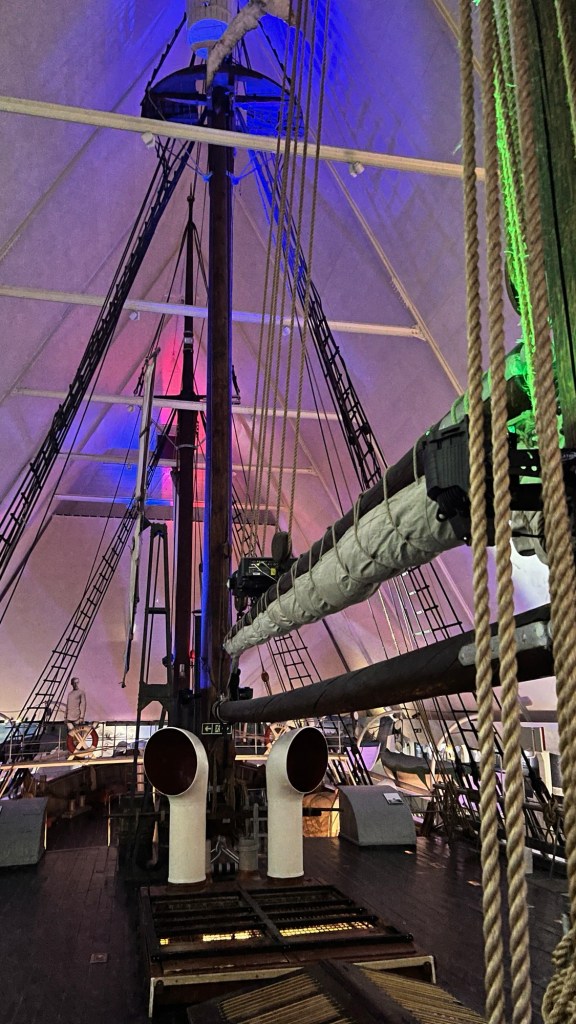
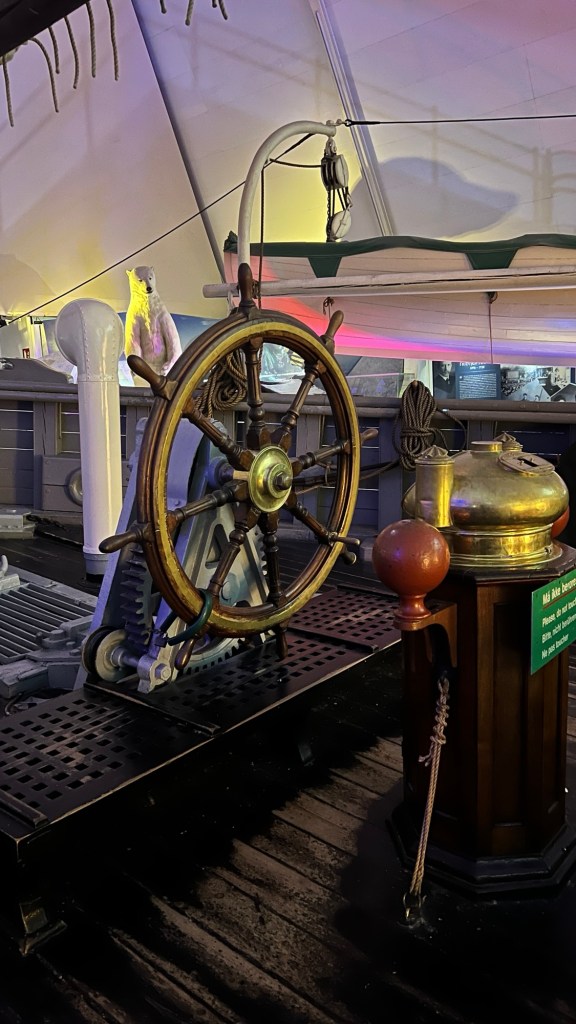
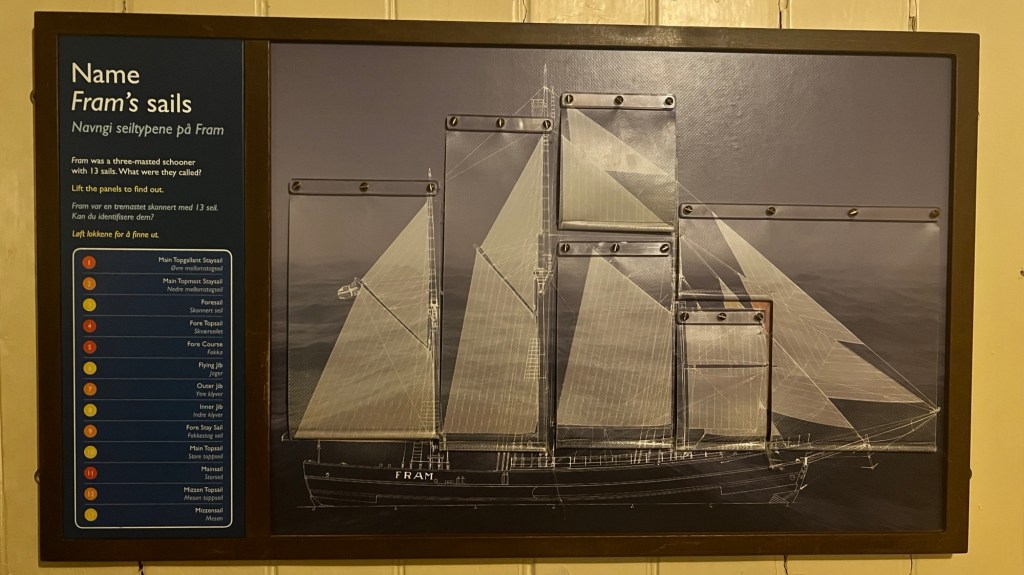
Another mile on the feet and I came to the Fram Museum which was the celebration of the Norwegian exploration of the polar regions.
An amazing boat…
I thought it would be something about the Vikings, but… interesting.
As I made my way back to the ferry, I came across this statue. They are remembered in Norway and I know that there were many across the world who are remembered for this time as well.
The plaque speaks of the 4,500 Norwegian sailors who lost their during WWII.
Having crossed the fjord, I went in search of a church that was open. At first, I was very discouraged, but then I found the church of Saint Olaf. It seemed to be closed, but after following a few young men who appeared to know where they were going, I came to a door that allowed me in.
I was tired, so my first three decades were basically wasted, but then I was able to focus for a while.
I embraced the foot of the cross. It was then that Jesus said to me, “Look at me. I did not endure this so that you would carry your sins forever. Look at me. You only see my death. See my humanity. See the life I lived for you. Will you waste yours? Look at me! I love you. Look at me. See all that I have given you.”
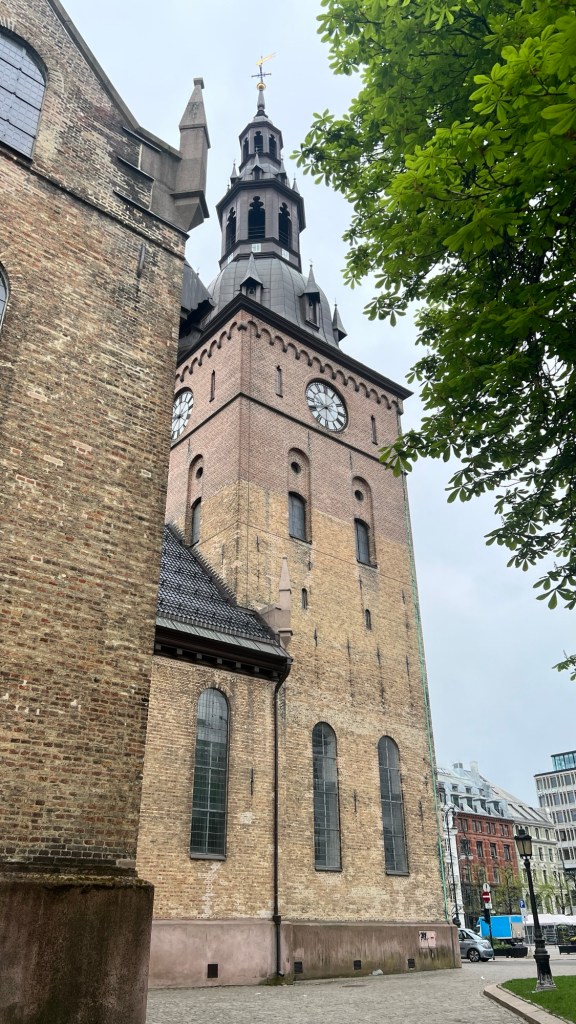
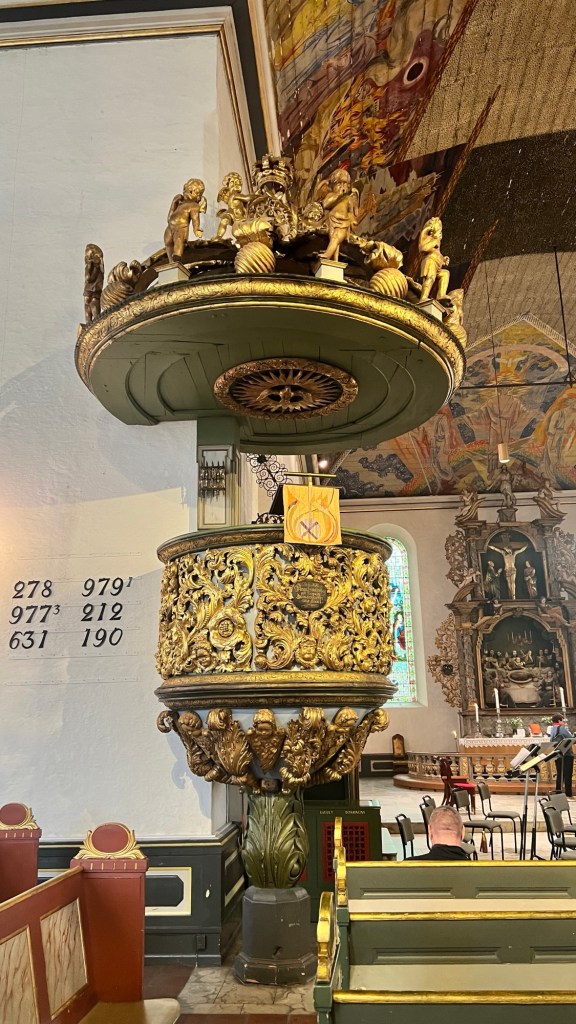
Today, I attended Mass at the Oslo Domkirke (Cathedral), built between 1694-97, restored in 2010. As you approach from the front, you encounter the massive bronze doors depicting the Beatitudes. Across the top reads “Salice er,” “Blessed are….” Just to the right of the doors is “The Devil of Oslo,” a sculpture showing a man being consumed by evil, represented by a lion and a dragon. It was created in the 12th century and found in the ruins of St. Hallvard’s Cathedra.
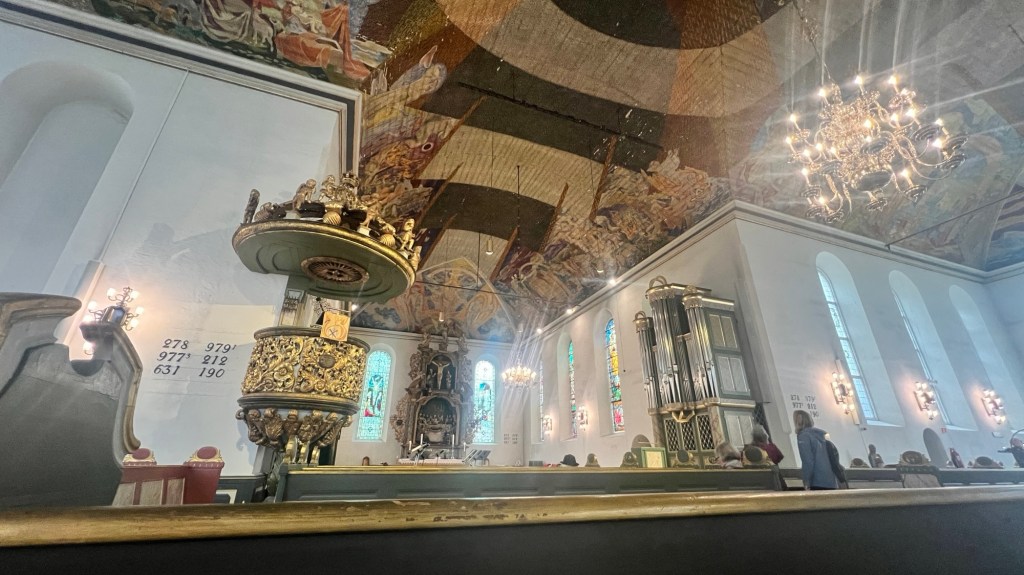
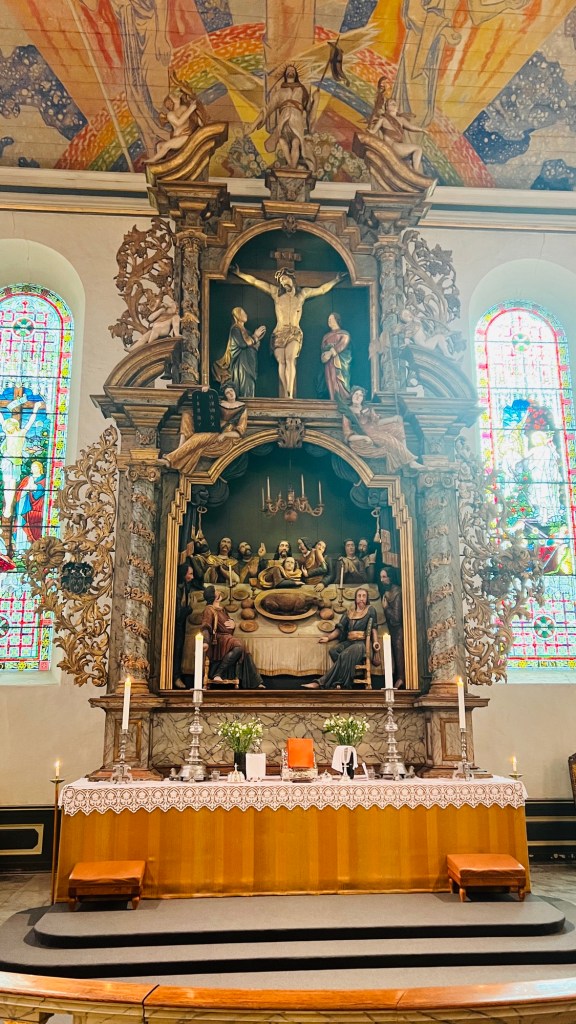
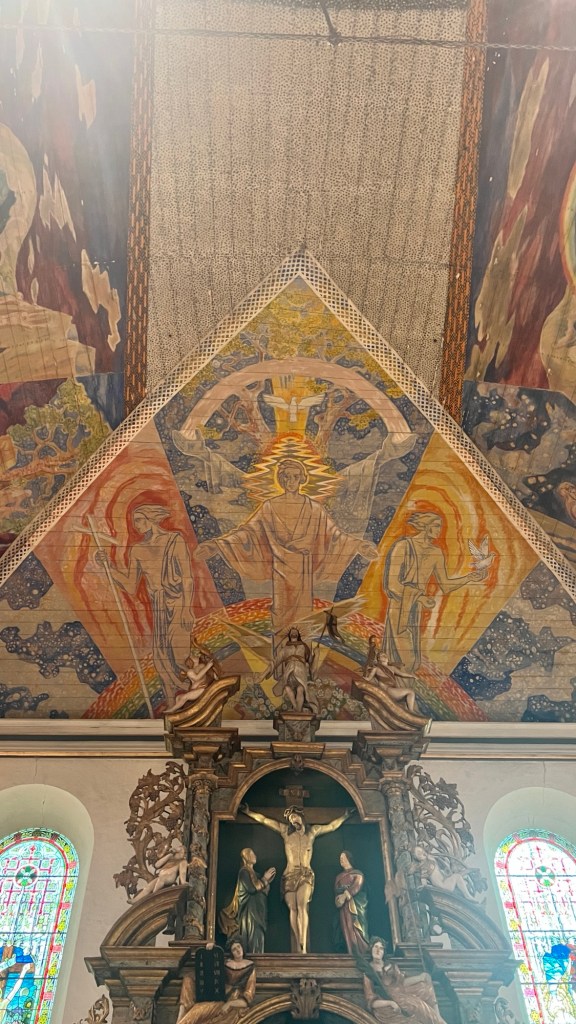
Entering the sanctuary, I was bit surprised. I had anticipated it would be much more austere, and although not as ornate as many of the churches I’ve seen, it was still quite ornate and beautiful.
I wanted to get up there and preach a bit, but I didn’t think they would appreciate me doing so.The box on the left is reserved for the Royal Family.
The service was in Norwegian, so I again did not understand a word of it; even so, it was very edifying, and I found myself feeling immensely blessed as I left. I took a minute to visit with the Pastor who was delighted to learn that I was a priest. He stated that much of their liturgy is based on the Anglican tradition. Even though I did not understand it all, I knew parts and definitely the rhythm. It was a well-ordered service and “polite”—that was the impression for me.
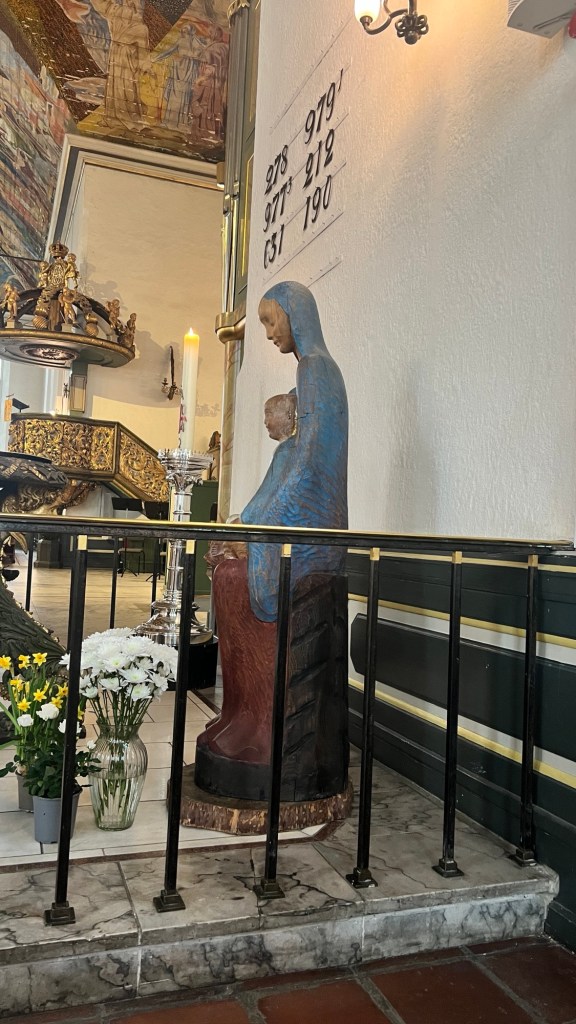
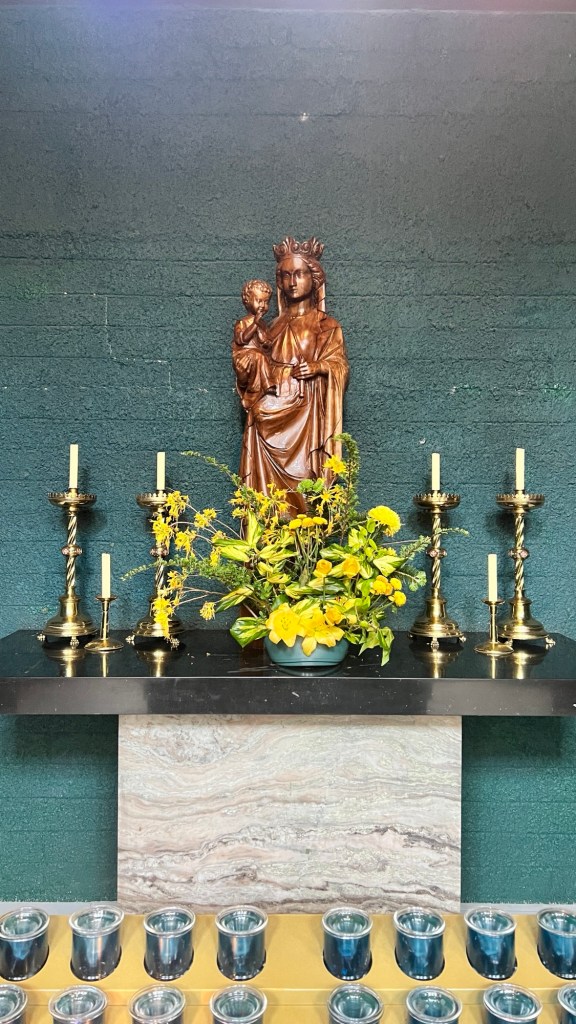
I intentionally arrived an hour early so that I could pray my Rosary. I did not expect there to be a statue of Mary, but…
This was by far the most meaningful of all the Rosaries I’ve prayed on this journey. I was finally able to experience His presence more deeply. Perhaps I’m finally feeling rested and at peace instead of being rushed and pushed.
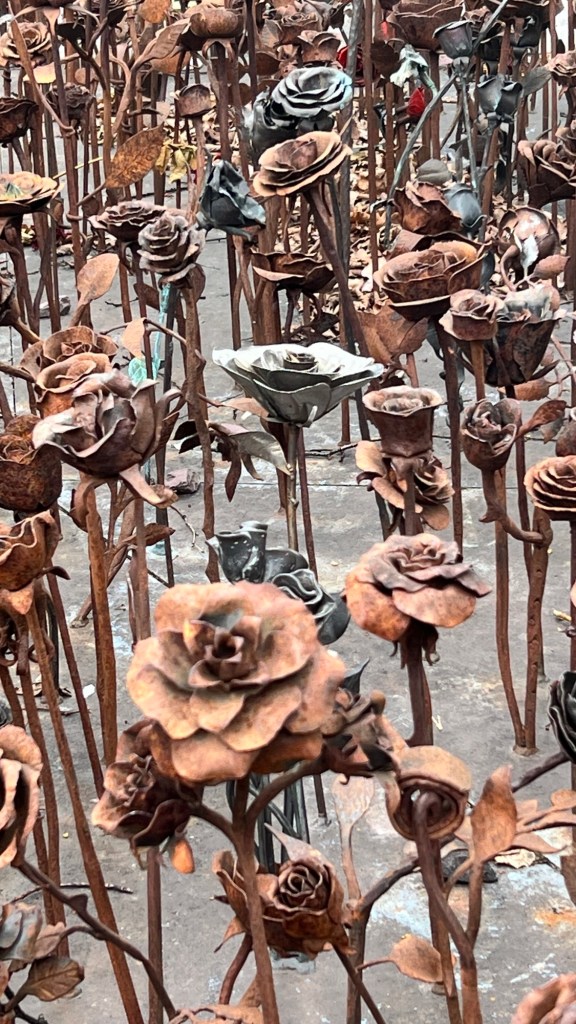
Outside the cathedral is a memorial to the 77 people who were murdered on July 22, 2011, by a domestic terrorist. The marker reads,
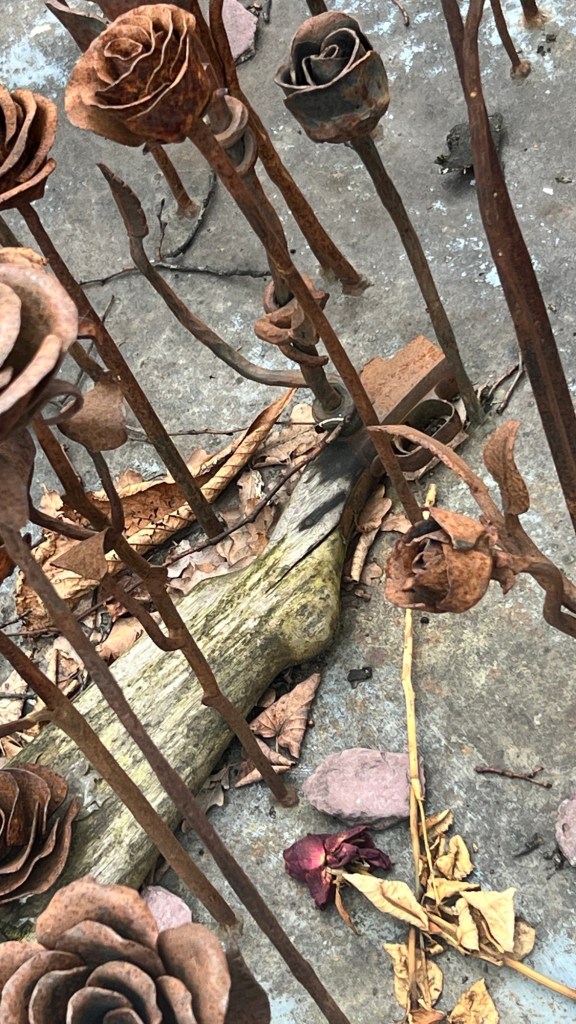
On 22 July 2011, an act of terrorism ended the lives of 77 persons in Norway. In a spontaneous act of solidarity, thousands of people laid down roses in front of Oslo Cathedral. Inspired by this sea of roses, artists Tobbe Malm and Tone Karlsrud initiated a project in which smiths from all over the world, survivors and others affected by the attack were invited to forge roses from iron. Iron Roses is a memorial from the people, for the people.
Iron Roses created by Tobbe Malm and MDH Arkitekter 2019
I saw this part by accident. Haunting.
The city is quiet today, with the exception of many tourists pulling suitcases to the train station, so I plan to open the windows of my room, read a little and continue writing on the new novel. Did I mention I was working on a new project? It’ll be quite different than what I’ve done before. The first chapter is only three sentences long: “No one claimed responsibility, and the nuclear blast left no evidence. Those who died in the initial blast and from the fallout were the fortunate ones. Those who survived lived and died in great horror.” The working title is Triskelion.
Perhaps I also forgot to mention that I have a new book coming out early fall. It is not a Father Anthony, but maybe you’ll enjoy. I think I’ve got the cover about right…
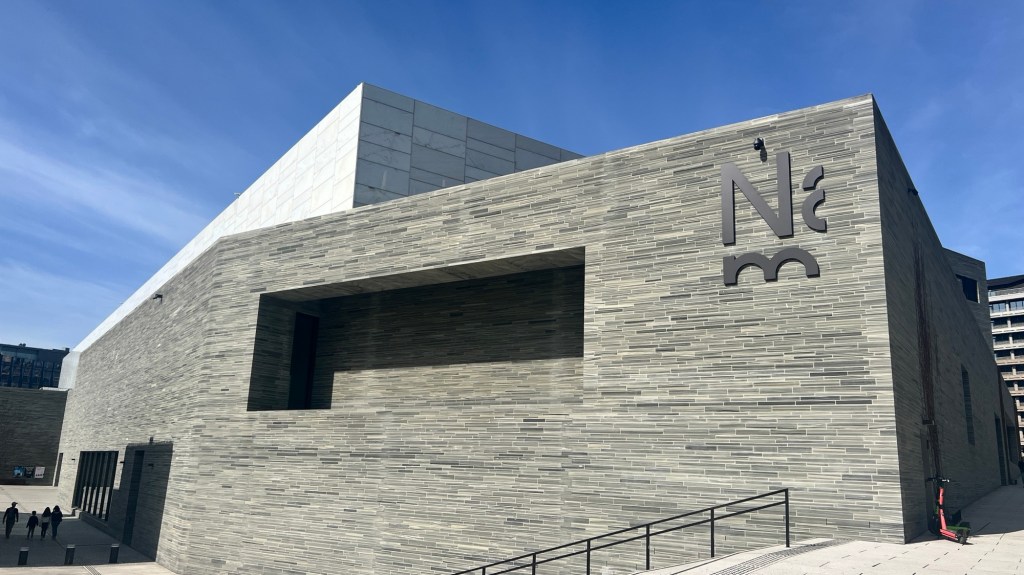
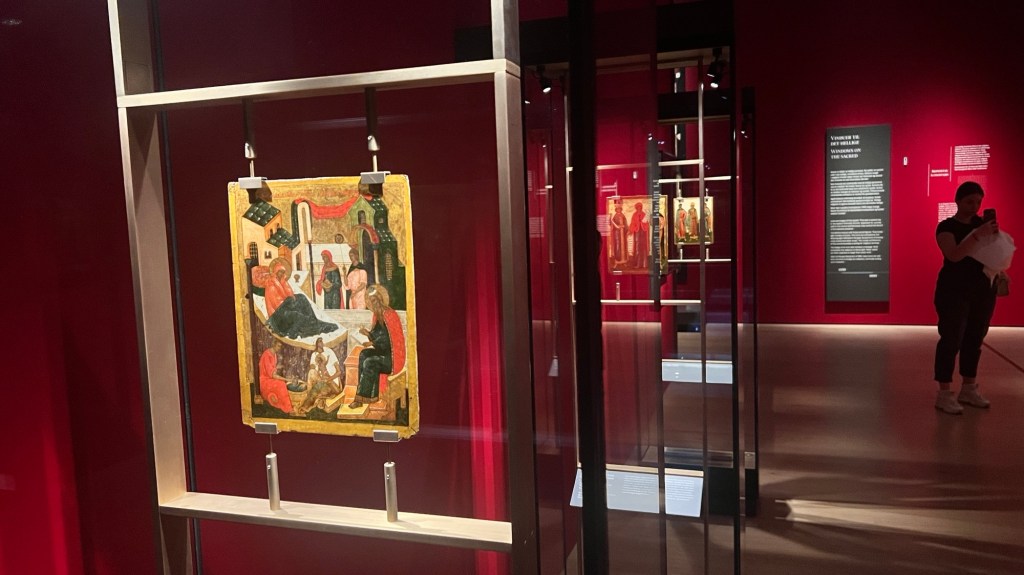
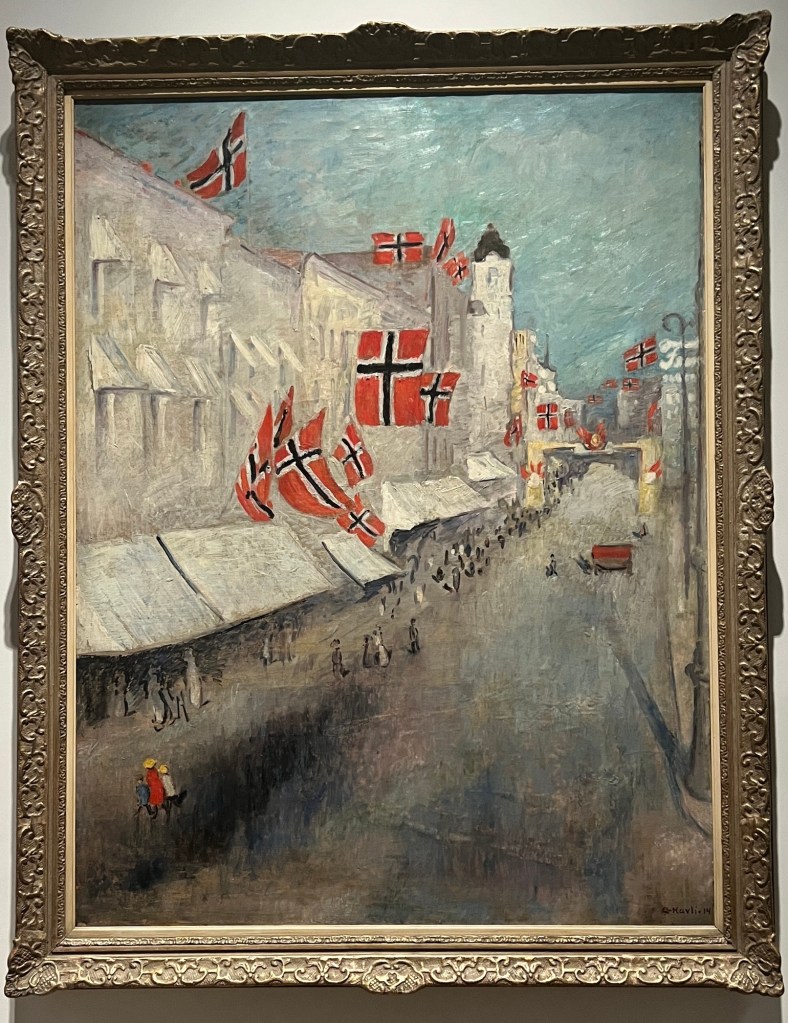
After about a 1 mile walk, I arrived at the Nasjonalmuseet, The National Museum.  It is a collection of over 400,000 pieces and holds many of the national treasures of Norway.  I was drawn to the religious art (big surprise there), but there were many other pieces that I enjoyed.
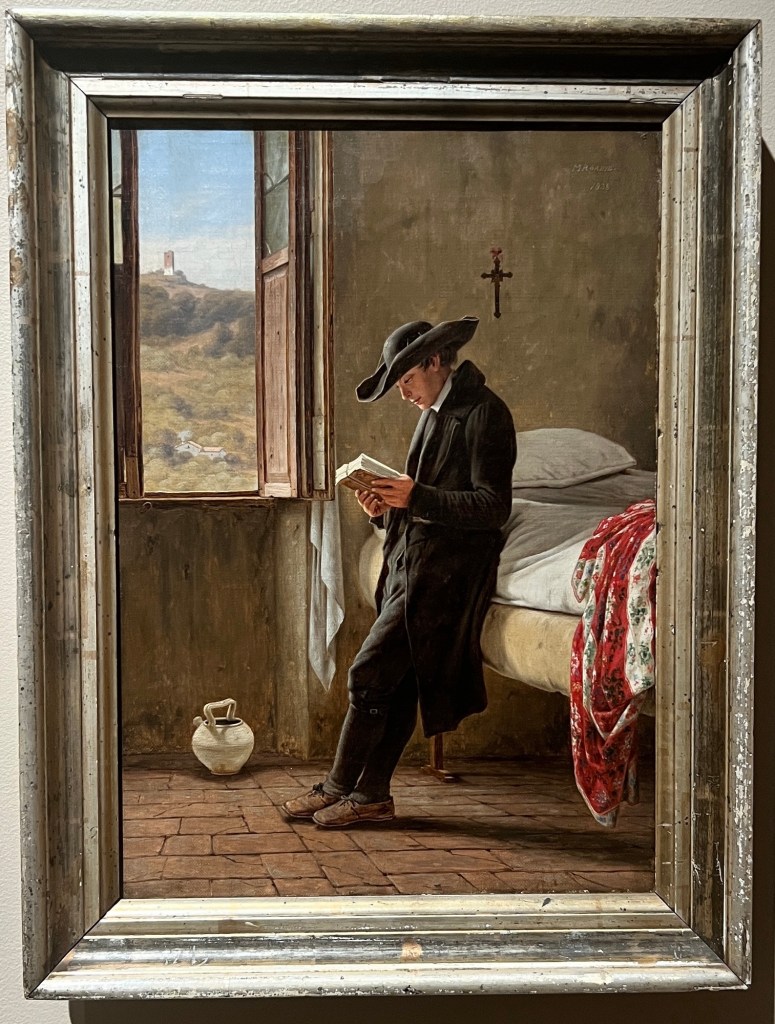
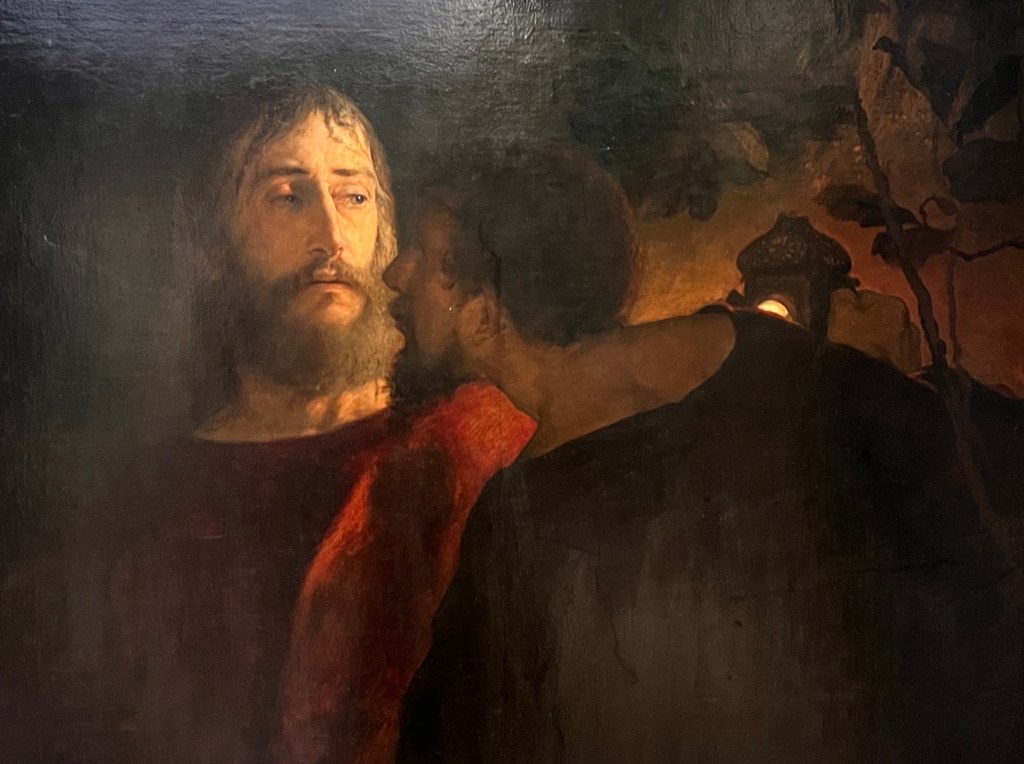
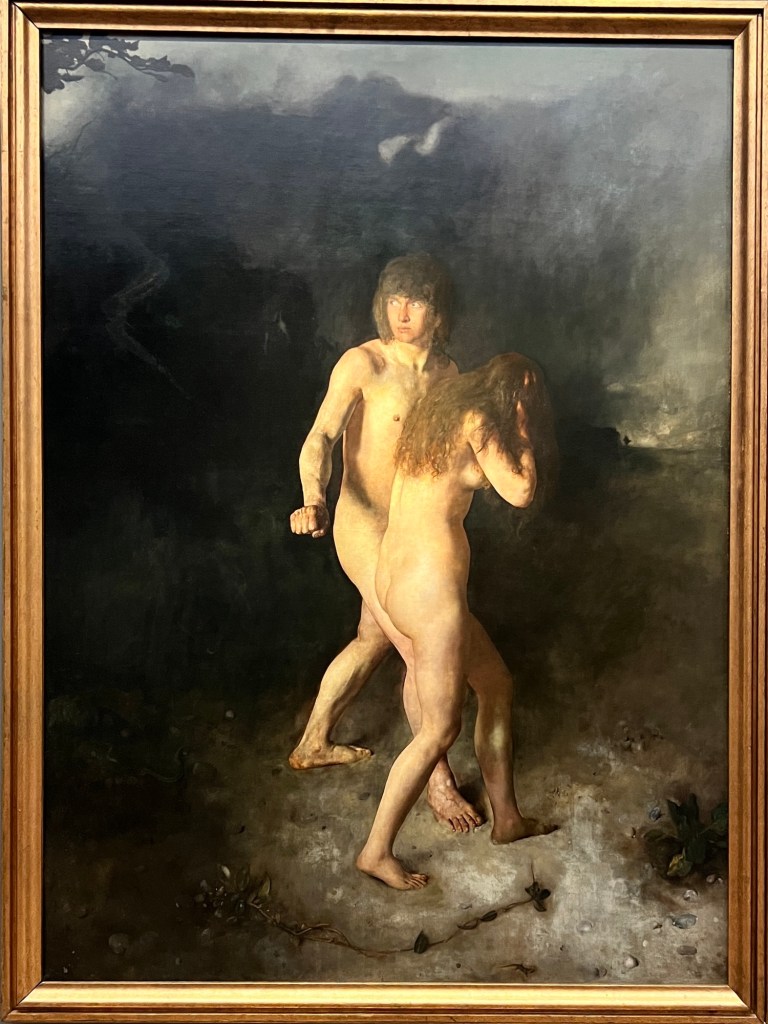
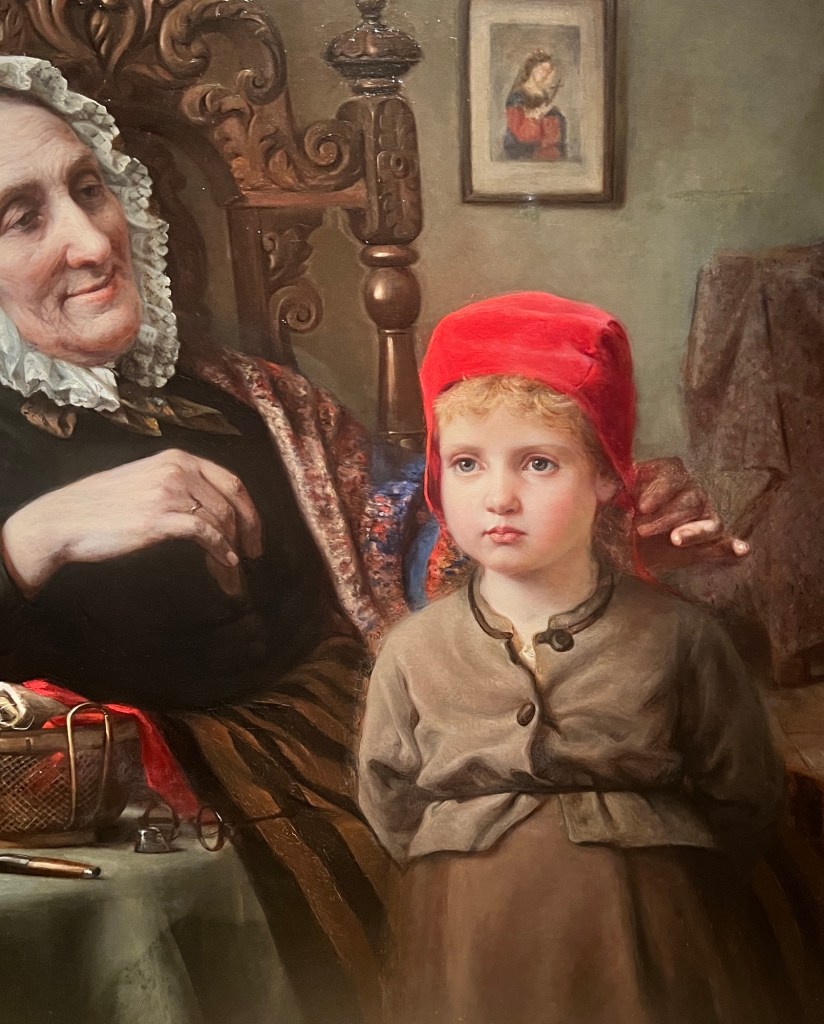
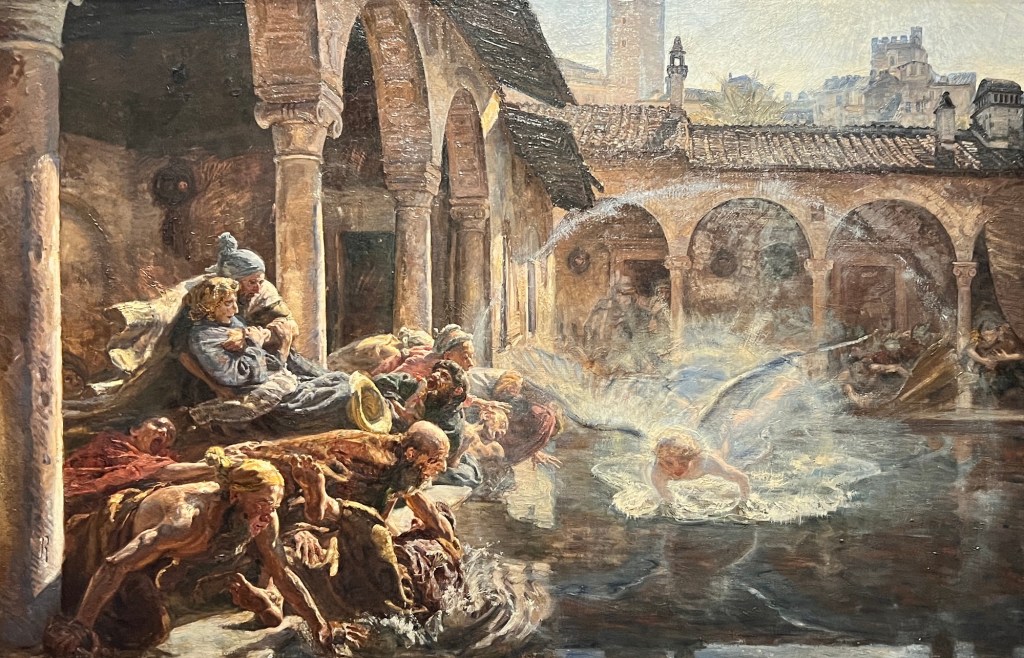
This is “The Vicar and Moses.” Apparently, Moses was not impressed with the Vicar’s preaching as he fell asleep. Lavik by Moonlight / Johan Christian Dahl. Landscapes bathed in moonlight are full of atmosphere and mystery. Such scenes are popular in 19 century painting and are one of Dahl’s specialities. The painting depicts the harbour town of Larvik on the Oslofjord, with an emphasis on shipping trade and the lumber industry. People appear small in relation to nature.I forgot to take a picture of the plaque of this one, but I liked it so you get to see it. Abbot Reading by Martinus RørbyeJudas Iscariot by Ellif Peterssen. I was very pleased with the way this photo came out. In the museum, Judas was so dark that you could barely see him. I guess the camera setting brightened  him up a bit.The Expulsion from Paradise by Hans Heyerdahl. I’m not even going to tell you the name of this one. You already know. It is by Harriet BackerThe Angel Touching the Water in the Pool of Bethesda by Joakim Skovgaard. This and the one of the expulsion from the garden interested me because it’s not something you normally see in a painting. At least I haven’t. 
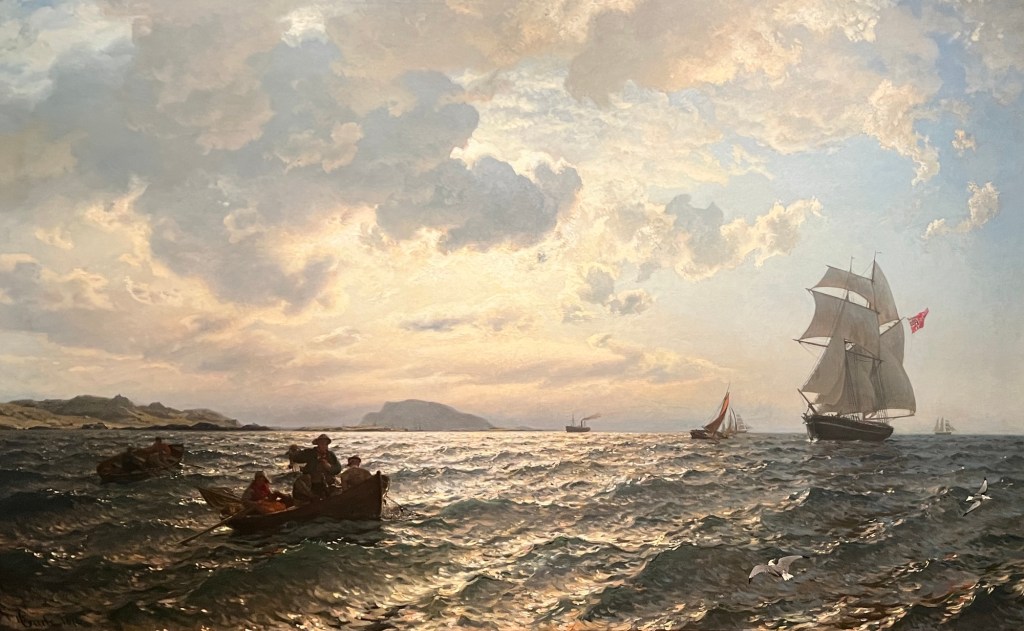
My feet were tired at this point, so I sat down in front of the painting below and just enjoyed it. After a few minutes, I noticed the seagull down in the bottom right corner. There were actually two of them. The painting is Fresh Breeze on the Norwegian Coast by Hans Gude.
“Sunlight is breaking through the clouds and reflecting on the water. Does it warm the fishermen? Boats are under full sail, while in the distance a steamer reminds us that times are changing. As a teacher and professor at German academies in Düsseldorf, Karisruhe and Berlin, Gude is important for several generations of artists.”
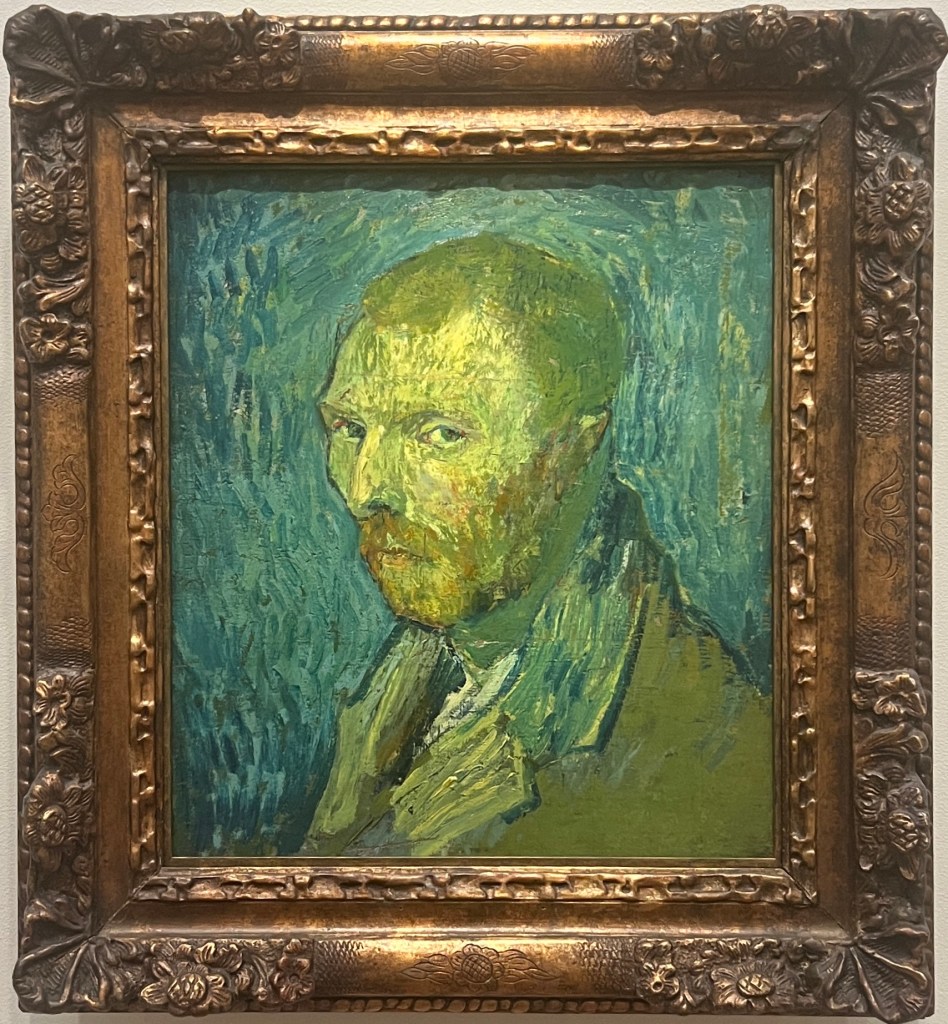
And then we came across this fella. This is a self portrait of Vincent van Gogh that was painted in 1889 and purchased by the museum in 1910. In 1970 it was questioned as to whether or not it was actually a van Gogh. It was confirmed in 2020. Van Gogh was in a deep state of psychosis at the time of the painting.
In the portrait, dated August 1889, the artist’s expression is lifeless and the image is dominated by a dreary and downbeat greenish-brown tone.
“The Oslo self-portrait depicts someone who is mentally ill,” the museum said. “His timid, sideways glance is easily recognisable and is often found in patients suffering from depression and psychosis.”
Van Gogh admitted himself to a small asylum in Saint-Rémy, France, in May 1889 andii was struck down by a severe psychotic episode in July that lasted for a month and a half.
The painting can be linked to a letter that the artist wrote to his brother Theo in September, about a self-portrait “attempt from when I was ill”.
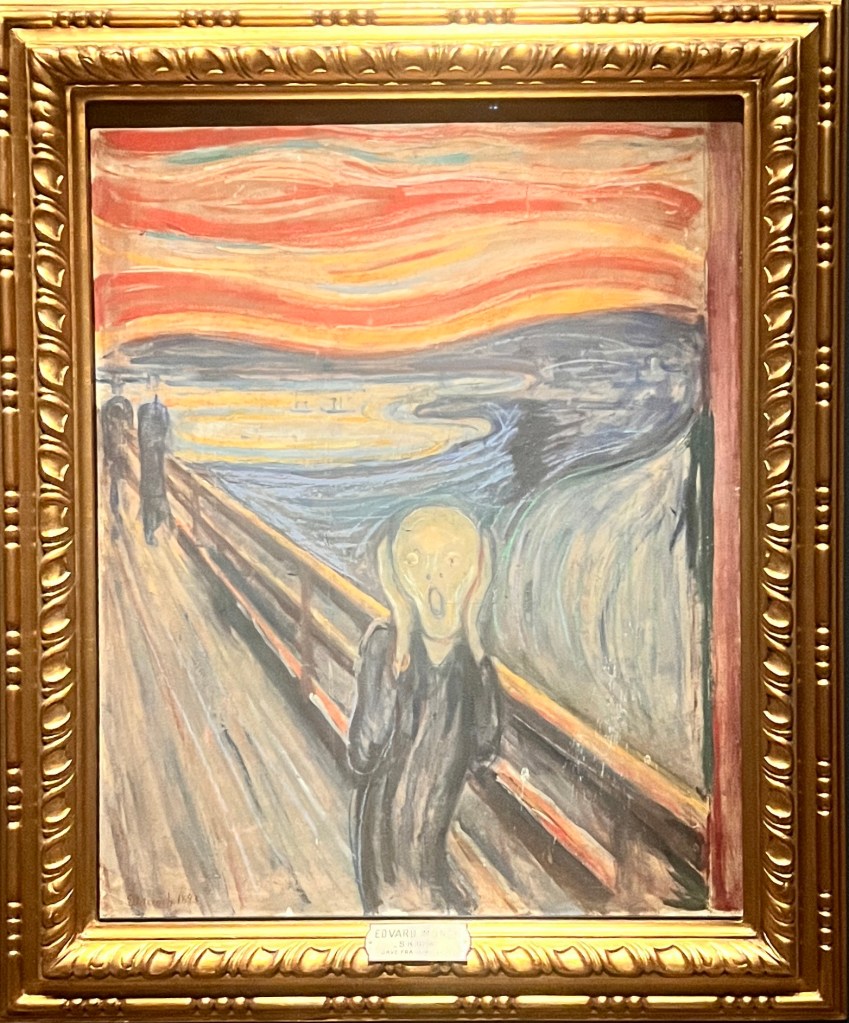
Try not to be too scared by what you see next. There are many amazing pieces of art in the museum, but this is perhaps the most famous. The Scream by Edvard Munch (yes, he is a Norwegian.) It was the only painting that I saw where a security guard was posted beside it. My guess is that the recent acts of vandalism against famous pieces of art has brought this on.
And yes, I am a dork.
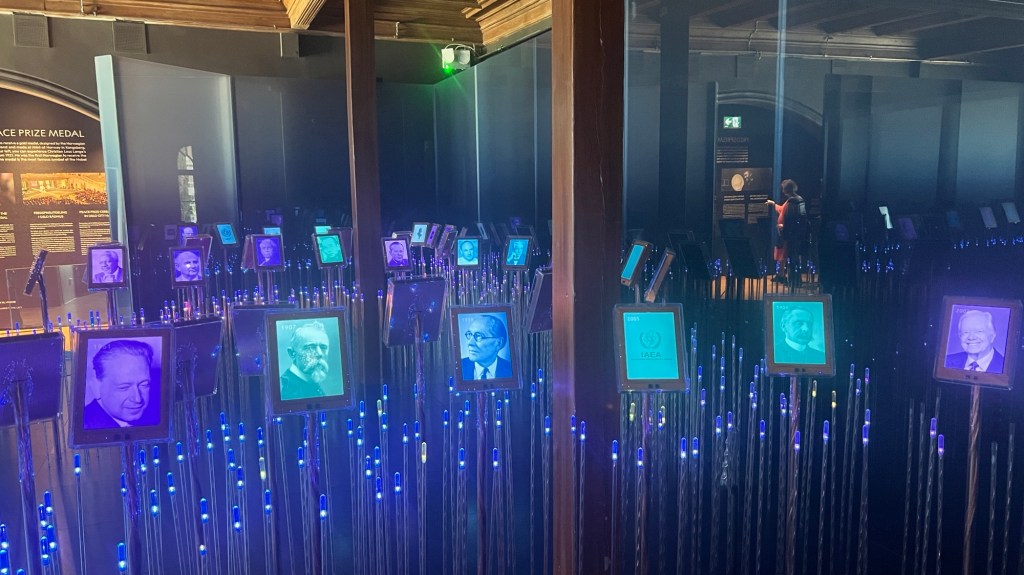
After coming out of the museum and allowing my eyes a few minutes to adjust, I discovered that I was right next to the Nobel Peace Prize Center. I enjoyed my walk-through. There were many that I knew, but I sought out my two favorites.
Narges Mohammadi from Iran was the 2023 recipient of the award. Her story is quite fascinating.
Just a few photos from my walking about.
One more from the museum. It seems fitting that it should be at the bottom of this post. The title is Hell by Gustav Vigeland. The central figure is modeled after Rodin’s Gates of Hell. Old Scratch is seen here as a thinker.
A two hour drive today out to the Cliffs of Moher, which are on the edge of the Burren. A beautiful scene looking up and down the coast and out over the Atlantic. There at mid-day, so the sun wasn’t quite on the cliffs at the time.
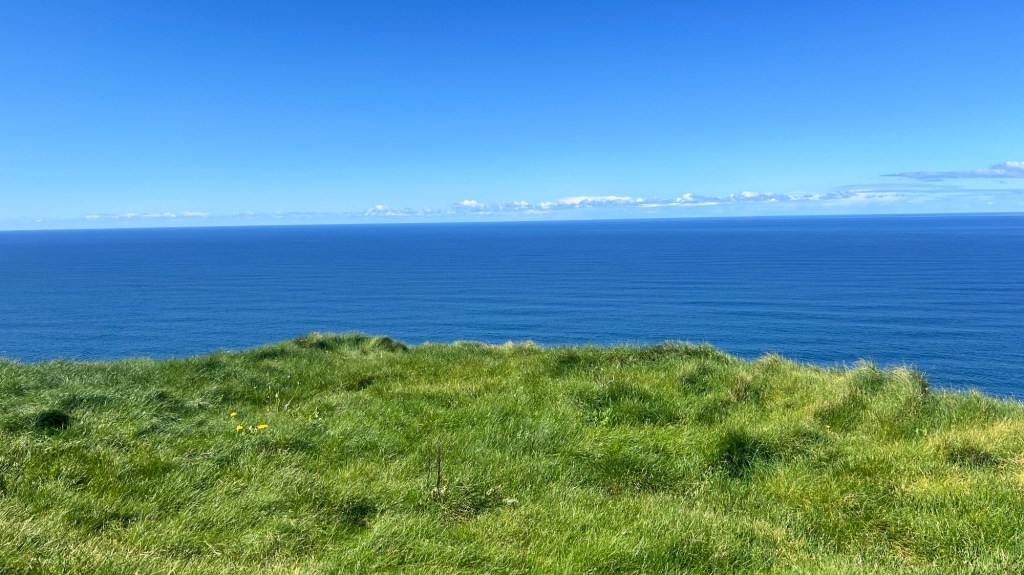
If you keep traveling in that direction, you will his the good ol’ USA.
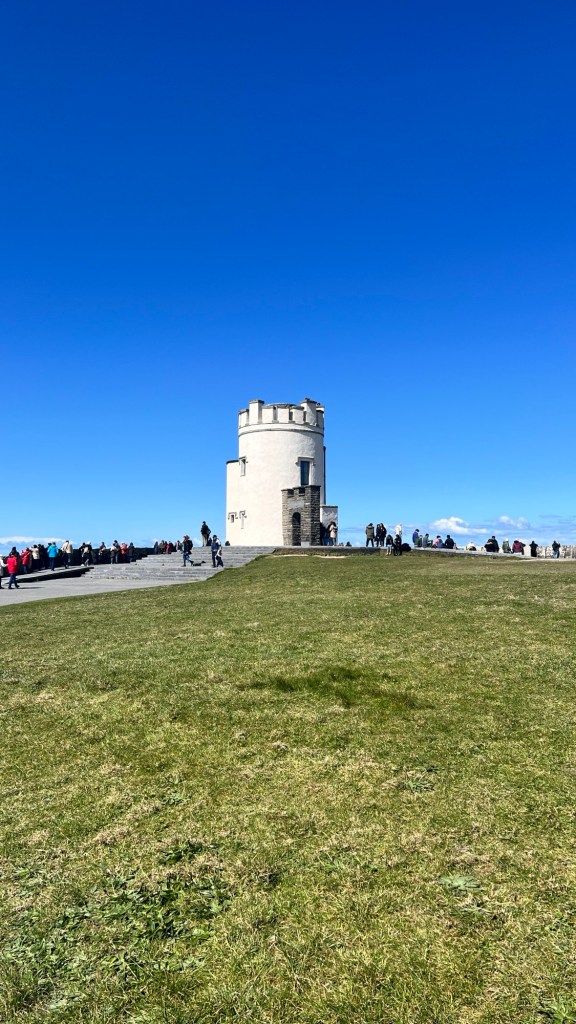
Directly behind me from the 2nd picture above is O’Brien’s Tower, which was constructed in 1835.
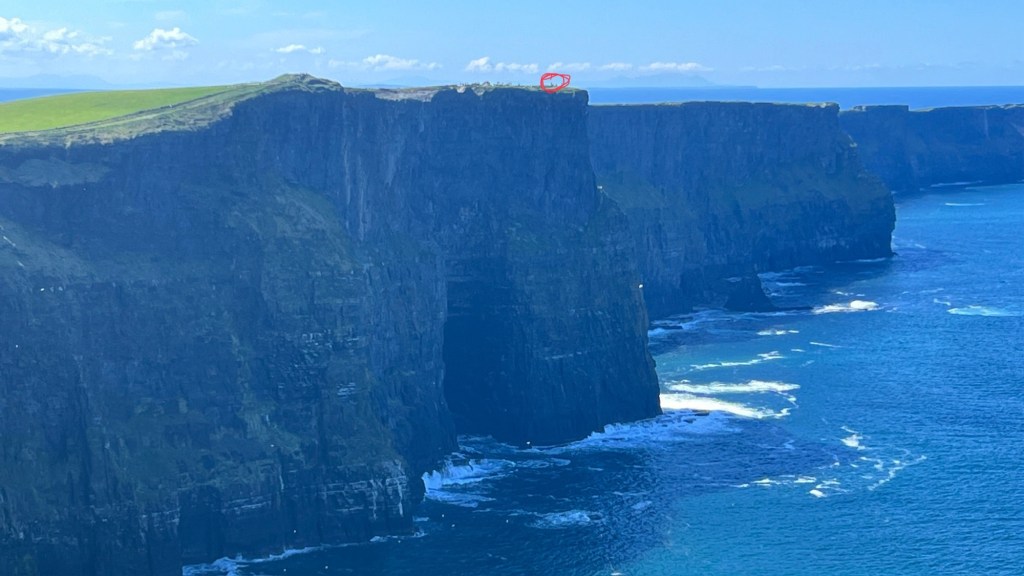
For you Harry Potter fans, that cave is where Harry and Dumbledore found the locket…
To give you a perspective as to how tall the cliffs are, I’ve circled some people standing at the top. Apparently it is the place to fling yourself off if you’ve been rejected by your love. I think it would do the job.
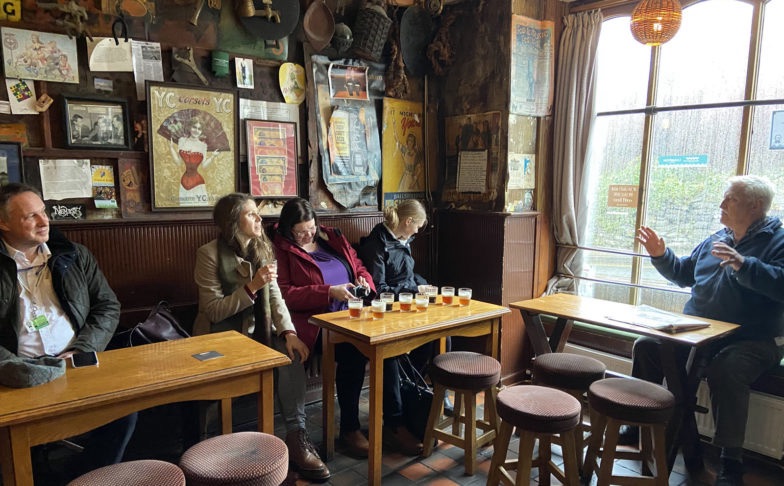
If you ever make it to Lisdoonvarna, County Clare, I can earnestly recommend to you The Roadside Tavern. (Pictures not mine) I had the lamb, which was outstanding. I sat at the table there in the middle, although I did not line the beers up like that.
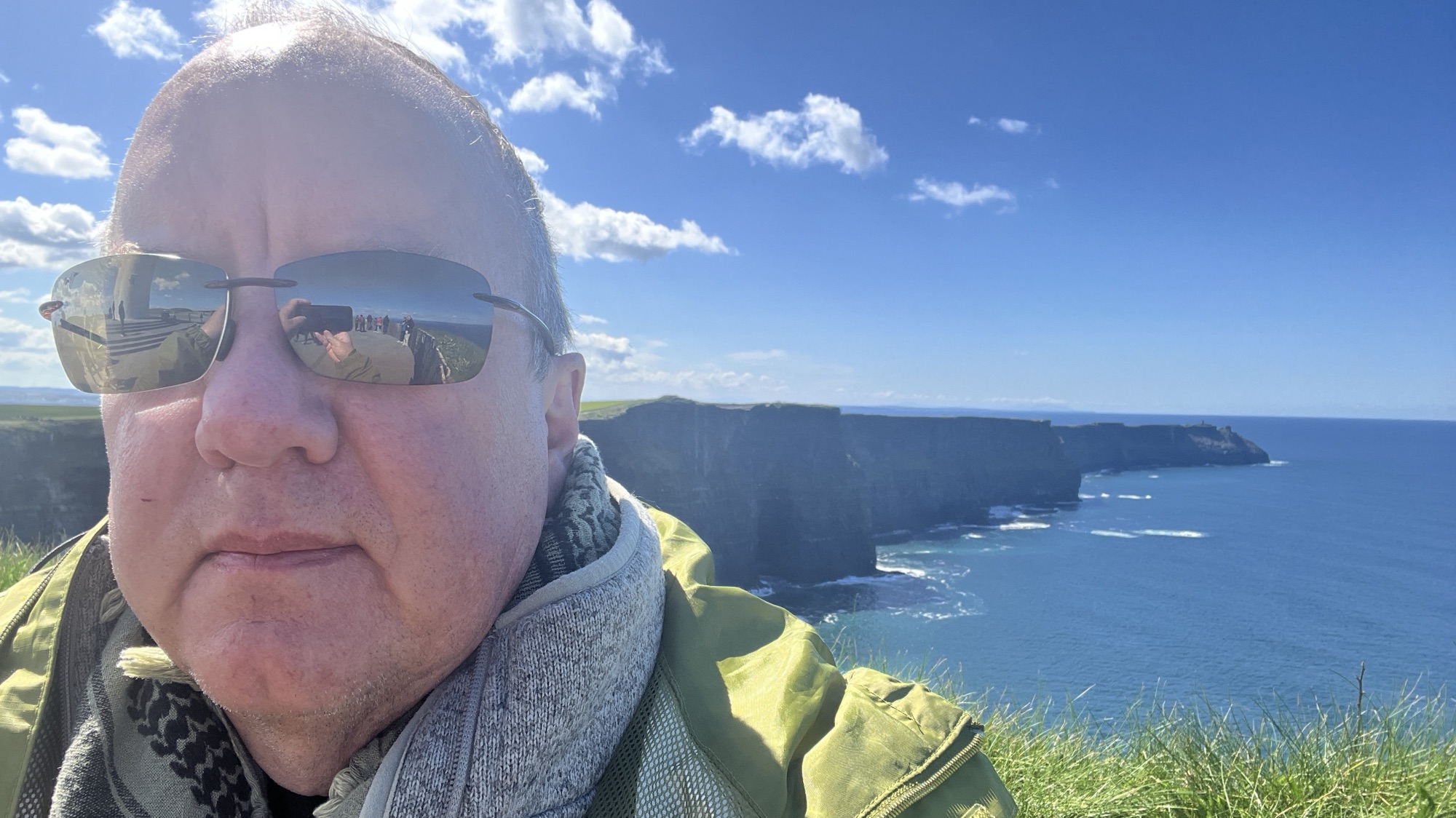
Your’s truly looking particularly windblown and in need of a shave.





















































 Candle in a Cave