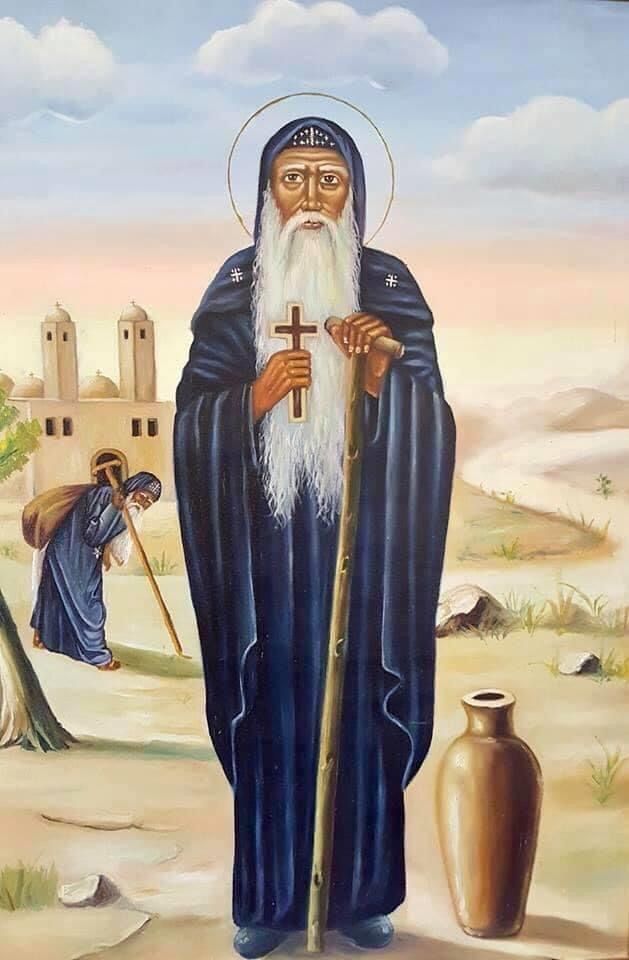
Moses the Black, an Ethiopian living in Egypt during the 4th century, was born a slave and later became a bandit. After years as a feared criminal, he repented and approached the doors of a desert monastery, weeping for his sins. Because of his past, the monks did not allow him entry, even afraid at the mention of his name. However, after some time, they received and accepted him.
Although a member of the monastery, his passions continued to wage a spiritual battle, so he sought the help of the elder Abba Isidore. Moses followed Isidore’s instructions, from eating just enough to sustain himself while remaining hungry at all times, to standing all night in prayer. At night, Moses was led by the ladder to take on the task of fetching water from the well for the other brothers, especially those who were older and lived farthest from the well.
One night, while drawing water, Moses felt a sharp blow to his back and was knocked into the well, where he lay until he was found the next morning when the other brothers discovered him. A year passed before he was fully recovered, and it was then that Isidore declared him to be clean of his demons and ordered him to be ordained a deacon. On the day of his ordination, the bishop clothed Moses in white robes and declared, “Now Abba Moses is entirely white!” Moses replied, “Only outwardly, for God knows that I am still dark within.”
Continuing to protest his worthiness to serve at the altar, the Bishop set out to test him and ordered the other clergy to drive Moses from the altar and the church. Moses accepted this without protest. Witnessing this and being convinced of Moses’ humility, the Bishop ordained him a priest, a role he faithfully served for fifteen years until his martyrdom in 400 AD.
Moses learned that the monastery would soon be attacked by bandits and encouraged the others to flee. All did, except for seven who remained with Moses. When he was urged to leave, he responded, “For many years already I have awaited the time when the words which my Master, the Lord Jesus Christ, should be fulfilled: “All who take up the sword, shall perish by the sword” (Mt. 26:52). (Source)
The good thief hanging on the cross to the right of Jesus rebuked the other thief, saying, “Do you not fear God, since you are under the same sentence of condemnation? And we indeed have been condemned justly, for we are getting what we deserve for our deeds, but this man has done nothing wrong.”
I don’t know why Moses chose to remain, knowing that staying would almost certainly be a death sentence. Perhaps he thought he could buy the others more time to escape if he put up a fight. Whatever the case, I wonder if he heard the words of the good thief as he waited, “We indeed have been condemned justly.” I also wonder if he heard the words of St. Paul, “Wretched man that I am! Who will deliver me from this body of death? Thanks be to God through Jesus Christ our Lord!” (Romans 7:24-25a)
We are all rightly condemned for our actions. Thanks be to God through Jesus Christ, our Lord! Through Him, we are saved. He remembers us and, on our last day, brings us into the eternal paradise of His kingdom.
You know him, but you probably don’t know him by name—Jonathan Goldsmith. A few facts about his life: his passport requires no photograph, his business card simply says ‘I’ll Call You,’ and he brought a knife to a gunfight—just to even the odds. He is The Most Interesting Man in the World, and from 2006 to 2016, he was often heard saying, “I don’t always drink beer, but when I do, I prefer Dos Equis.” Of course, the internet got hold of that, and the memes continue to explode.
I don’t always live dangerously, but when I do, I press send before proofreading.
I don’t always pass slow drivers, but when I do, I check to see if they look as stupid as they drive.
I don’t always “Whoop,” but when I do, there it is.
On days when I know I have a service or will be out and about doing priesty things, I wear my cassock and collar. It really does change the way people look at me and respond. When I’m dressed in regular street clothes, most folks just pass by. When I’m in the cassock and collar, most will speak. The cassock and collar identify me with the church, faith, and hopefully, God. I believe it’s important and helps people see “the church” in the world. The other day, I made a hospital visit, so I was in cassock and collar. On the way back to my car, a mom, a dad, and their four children were heading in. One of the boys looked over at me and then shouted, “Dad, it’s the Pope!” His dad corrected him and told him that I was a priest, but it made me think, “I don’t always wear a cassock and collar, but when I do, people think I’m the Pope!” How you doin’?
There are certain individuals, organizations, and ideas that hold a place of honor in our lives. When we see or think about them, we want to be associated with them. If we can’t necessarily be in a relationship with them, then we will seek ways to be identified with them. Can I just say, “Go, Thunder!” Score of 103-91. A few years ago, I attended an OSU basketball game, but it and the final against the Pacers were the only basketball games I’ve seen in at least a decade, if not more. Yet, when the Thunder won, I—and I’m sure every other Oklahoman—didn’t say, “The Thunder won!” Instead, it was, “WE won!” We won the national championship. Yes, indeed. The most difficult thing I did that entire evening was feeding myself, but WE won. We celebrate in the parade, we wear our gear, and we boast that we are champions.
No, I don’t believe that I’m the Pope, but I do closely associate and am aligned with the Church. My identity is deeply tied to it. This association, I pray that this connection also reflects my relationship and identity in God: Father, Son, and Holy Spirit.
Being associated and finding identity with the Church, God, and even the Thunder isn’t a bad thing. It brings joy, happiness, and, for the Church and God, a sense of purpose. It fulfills me. However, such connection and identity can sometimes lead to undesirable effects and actions.
In Luke’s Gospel, leading up to our reading today, the Apostles witnessed and experienced many exciting and miraculous events. They saw Jesus calm the storm, feed the 5,000, cast out demons, and heal the sick. Peter declared Jesus to be the Christ, and together with James and John, they witnessed the Transfiguration. Additionally, Jesus sent them out to do the same works He was doing: preaching, healing, and casting out demons. When they return, they report their successes. Because of their association and identification with Jesus, they also began to see themselves as closely linked with the One Jesus identified with—the Father. This, in itself, is a very good thing. They begin to understand that they are truly God’s children; however, after the Transfiguration, things take an unpleasant turn.
The Apostles begin to think that if they were with Jesus, they could sit in the seats of honor in the coming kingdom, which they still only understood as an earthly kingdom. They start arguing about who is the greatest, so that they can rule, not only over the kingdom but also over each other. Going even further, now that they were in so tight with Jesus and, through association, to the Father, they begin to see themselves having the same rights and powers that belong exclusively to God. When the Samaritan village turns away from Jesus, “James and John saw it, they said, ‘Lord, do you want us to command fire to come down from heaven and consume them?’”
Remember Abraham’s nephew, Lot. God had enough of the wickedness of Sodom and Gomorrah, so the “Lord rained down burning sulfur on Sodom and Gomorrah—from the Lord out of the heavens. Thus, he overthrew those cities and the entire plain, destroying all those living in the cities—and also the vegetation in the land.” When Abraham looked down from the mountains, “he saw dense smoke rising from the land, like smoke from a furnace.”
James and John believed they had the right to judge as only God can judge. They not only wanted to be associated with and identified with Jesus and the Father, but they also sought God’s power. They wanted to judge, rage against those they saw as God’s enemies, and exact vengeance on them. They wanted to play God.
I’m not surprised that the Scriptures tell us Jesus rebuked them, but I am actually quite surprised that the Scriptures didn’t say, “And Jesus looked at them in dismay and said, ‘Are ya stupid? Nobody can call down fire from Heaven. That’s the dumbest thing I’ve ever heard.’” Why didn’t He say that? Because maybe we can’t burn a place or person down like what happened at Sodom and Gomorrah, but we can and do call down fire in other ways.
We put on our Jesus gear. We’ve got the crosses we wear and the clothes with messages that proclaim our faith. We talk openly about our faith. We post messages on social media for all the world to see. And if there were a Jesus parade, we’d jump in and want to ride on the float. We want to be associated and identified with Jesus and our faith. Good. Keep it up. There are many ways to proclaim the Good News. But, like the Apostles, we can take this too far.
We can come to believe that because we are with Jesus, we are holy or even holier than others. We can come to believe that if someone opposes our beliefs, they are opposing God, and therefore must be silenced because they are wrong and evil. We may believe that if they fail to keep our standards (even though we fail to do so ourselves), they are weak and unloved by God. We can look at others and then to Jesus and ask, “Lord, do you want us to command fire to come down from heaven and consume them?” When we do this, we take on the exclusive powers of God, playing God ourselves. In doing so, our sins become greater than those we judge, and we are the ones who need rebuking.
However, there is a way for us to play God, and in doing so, we take on not just what we understand as the power of God, but God’s true nature, as witnessed in Jesus. For if we have seen Jesus, we have seen the Father. What do we see in Jesus? St. Paul summed it up for us in his letter to the Galatians that we read this morning. We see in Jesus “love, joy, peace, patience, kindness, generosity, faithfulness, gentleness, and self-control.” Through the Spirit of God, we have the power to live this life.
William Temple was the Archbishop of Canterbury in the early 1940s. He writes,
“It is no good giving me a play like Hamlet or King Lear and telling me to write a play like that. Shakespeare could do it—I can’t. And it is no good showing me a life like the life of Jesus and telling me to live a life like that. Jesus could do it—I can’t. But if the genius of Shakespeare could come and live in me, then I could write plays like this. And if the Spirit [of God] could come into me, then I could live a life like His.”
Children may think I’m the Pope, but I’m smart enough to know I’m not even close. However, I desire to be so closely associated with and identified with Jesus that I begin to resemble Him. This transforming work is accomplished through the Spirit of God living within, and the fruit of this work is “love, joy, peace, patience, kindness, generosity, faithfulness, gentleness, and self-control.” Therefore, we must invite God’s Holy Spirit to take up residence in our soul, in our entire being, so that we may be as He is.
If you want to play God, bring peace. If you want to play God, remain faithful. If you want to play God, show kindness. In this way, you will not only be associated with and identified with the Lord, but you will also become like the Lord.
Let us pray (by St. Augustine): Breathe into me, Holy Spirit, that my thoughts may all be holy. Move in me, Holy Spirit, that my work, too, may be holy. Attract my heart, Holy Spirit, that I may love only what is holy. Strengthen me, Holy Spirit, that I may defend all that is holy. Protect me, Holy Spirit, that I may always be holy. Amen.
Last week, we discussed how we are bombarded with so much information—74 GB every day. It’s no wonder we can never find our keys. Their location gets pushed out to make room for something else.
This week, I would like to talk about stuff. Not in general kind of stuff, but the stuff that fills our houses. I came across some amazing facts on the topic.
I don’t know who collects this kind of data, but the LA Times reports that the average American home contains 300,000 items. This is probably why one out of every ten American homes rents off-site storage and why another 25% of those with two-car garages can’t fit even one car in them.
3.1% of the children in the world live in the USA, but they are responsible for 40% of worldwide toy sales, averaging 238 toys per child.
When it comes to shopping, we spend more on shoes, jewelry, and watches than on higher education. Women in the USA and Europe will, on average, spend 8 years of their lives shopping.
Currently, the 12 percent of the world’s population that lives in North America and Western Europe accounts for 60 percent of private consumption spending, while the one-third of the world’s population living in South Asia and sub-Saharan Africa accounts for only 3.2 percent. Of that consumption, Americans spend $1.2 trillion on nonessential items—things we don’t need.
We have all this and desire even more for ourselves, but what’s funny (not haha) is the fact that even with all we spend, on average, we only donate 1.9% to charitable organizations. (Source for above statistics)
You might say, “None of that is true.” However, if you’ve ever had to move or clean out someone else’s house, you know it’s pretty much spot on.
You all know that my dad died last summer, and we had to go in and clean out his apartment. Throughout his life, he lived in larger places, and each time he moved, he collected more and more stuff. Later in life, he had to downsize. As a result, the number of items he had collected over the years became fewer and fewer. In the years before he died, he had a small but comfortable apartment, and all that stuff was distilled down to what he cherished the most— a piece of art or a picture of him walking on the beach with my niece.
At first, the task of cleaning out was overwhelming. What to do with this or that? Eventually, my brother and I decided that everyone could take what they wanted, and we would give the rest to Goodwill. In the end, my brother had about a shoebox full of things, and I made it up to a paper box along with some pictures. Other family members did the same. When we finished, at least 95% of what my dad valued went to Goodwill. It held value for him but not for anyone else, and that’s OK.
It’s not that we didn’t love our dad; it’s just that he valued things that weren’t important to us. I know that when I’m gone, the same thing will happen. Someone will come and clean out my place. There may or may not be anything that anyone wants to keep. If I’m in Enid, I suspect 98% of what I consider valuable will end up at one of the thrift stores. It’s all just “stuff.”
That pig right there represents the 98% of my stuff that will end up in the thrift store, but it holds value for me. What would I trade my stuff for? What would I not? Better question: Who would I trade my stuff for? Who would I not?
Our Gospel reading today is from Mark. (The image on the front of your bulletin depicts the same event, but from Matthew’s perspective. Mark says there was only one demoniac, but Matthew says there were two.) Jesus enters the lands of the Gentiles and encounters a man who lives in the tombs near the city. Upon seeing Jesus, the man cries out, “What have you to do with me, Jesus, Son of the Most High God? I beg you, do not torment me.” What follows is the classic order of an exorcism. Jesus commands the demon to come out of the man, eventually gaining the demon’s name. The demon says its name is Legion. A legion in the Roman army consisted of 6,000 soldiers, so the man is possessed by many demons. Knowing that Jesus can cast them back into the abyss, they beg to be sent into a nearby herd of pigs. The demons had brought insanity and chaos to the man’s life, and they do the same to the pigs upon entering them. It drives them to madness, and they drown themselves.
The pigs might disagree, but this would appear to be a happy ending. The man is freed from his demons and asks to follow Jesus. However, the pig herders rushed to town to report what had happened. Upon hearing the news, the townspeople came out and essentially said the same thing to Jesus as the demon had, “What have you to do with us, Jesus, Son of the Most High God? We beg you, go away. We don’t want you here.”
Having witnessed such a miracle, why would the people not welcome Jesus? Why did they send Him away?
There are a number of fringe thoughts on this. Some say they recognized the divine in Jesus, and everyone knows you really don’t want your gods walking around among you. There’s no telling what they’ll do. Closely related to this is the fear of the supernatural. We fear what we don’t understand. Both of these fears are likely part of the answer; however, most people agree that they asked Jesus to leave because He had deprived them of their stuff.
Mark said it was a “large herd of swine,” and Jesus had just inflicted a huge economic blow through their deaths. Notice that when the townspeople arrived, they didn’t give thanks for the recovery of the demon-possessed man. They didn’t even mention him. No, it was their pigs, which impacted their stuff, that they were upset about. They showed more concern for material possessions than for the soul of a man.
In our lives, we place value on people just as we place value on stuff. Family, spouses, and children are—or should be—at the top of the list. Next come close friends, and, in some cases, friends of friends—I think church family falls into those two categories. Then we have people we don’t even know but feel connected to, such as public figures, celebrities, and the like. These are followed by acquaintances and fellow countrymen (which is naturally divided by our biases: race, religion, creed, etc.), and finally, everyone else. The way we respond to each of these individuals and groups reflects the value we place on them. A child who is sick with a fever will receive far more thought, consideration, compassion, and support than, say, the 279 people who were killed in the Air India crash or the 500K who have been killed in Russia’s war on Ukraine. Stalin summarized this by saying, “One death is a tragedy. A million is a statistic.” It comes down to the way we’re wired, mentally and emotionally.
From that list, who would I trade my stuff for? Who would I not? What part of my stuff is the soul of a loved one worth? What part of my stuff is the soul of someone on the other side of the world worth?
For someone we love, we’d likely give it all, but what about that person on the other side of the planet? You don’t know them. Maybe they’re Muslim or Hindu. They look very different from you—hair, skin color, clothes. What is the value of their soul?
St. John Chrysostom wrote, “I am not about to mourn over many cities, or whole nations, yet shall I mourn over a soul which is of equal value with many such nations, yea even more precious…. For it is not the overthrow of a city which I mourn, nor the captivity of wicked men, but the desolation of a sacred soul, the destruction and effacement of a Christ-bearing temple.” (Two Exhortations to Theodore After His Fall)
There are many ministries of the Church, but it is the salvation of souls that is our singular calling. So, I’m not going to chastise you over stuff, I don’t know that I’ve got 300,000 items, but I’ve got plenty. I’m not going to ask you to go on mission trips around the world, proclaiming the Good News. I’m not even going to ask you to give money to support the work of spreading the Gospel. Instead, I’m going to ask you to find one person, one soul, and do exactly what Jesus, in our Gospel reading, asks the demoniac to do: “Return to your home, and declare how much God has done for you.”
Within Judaism, there is a saying from the Mishnah, “Whoever saves a single life is considered to have saved the whole world.” (Mishnah Sanhedrin 4:5) Archbishop of Canterbury, Michael Ramsey, teaches us, “The one man, one woman, one child, are of infinite worth to God. … For the infinite worth of the one is the key to the Christian understanding of the many.” (The Christian Priest Today, 42)
“Return to your home, and declare how much God has done for you,” for the one soul you speak to is of infinite worth to our God.
Let us pray: Heavenly Father, pour forth your Holy Spirit to inspire us. Stir in our souls the desire to renew our faith and deepen our relationship with your Son, our Lord Jesus Christ, so that we might truly believe in and live the Good News. Open our hearts to hear the Gospel and grant us the confidence to proclaim the Good News to others. Pour out your Spirit, so that we might be strengthened to go forth and witness to the Gospel in our everyday lives through our words and actions. Amen.
The story is told of Franklin Roosevelt, who often endured long receiving lines at the White House. He complained that no one truly paid any attention to what was said. One day, during a reception, he decided to conduct an experiment. To each person who passed by and shook his hand, he murmured, “I murdered my grandmother this morning.” The guests responded with phrases like, “Marvelous! Keep up the good work. We are proud of you. God bless you, sir.” It was not until the end of the line, while greeting the ambassador from Bolivia, that his words were actually heard. Nonplussed, the ambassador leaned over and whispered, “I’m sure she had it coming.”
A recent article stated that 96% of people believe they are good listeners. The article also stated, “The bad news is that there’s a massive disconnect between the confidence in our listening and our actual abilities.”
There are several reasons for this: we are more interested in what we will say than in listening to what the other person is actually saying; we drift off—tune out because we aren’t interested, or we are more interested in something else. Another article stated, “In the act of listening, the differential between thinking and speaking rates means that our brain works with hundreds of words in addition to those that we hear, assembling thoughts other than those spoken to us. To phrase it another way, we can listen and still have some spare time for thinking.” (Source)
Your brain works much faster than a person can speak, although I have known some individuals who can put the words out there at a remarkable pace. In between the spoken words, our brain processes not only what we hear but all sorts of other information. What does this mean? How do I respond? Can this person really be this thick? Did I remember to start the dishwasher? I wonder who just texted me? Oh, heck, I’m going to be late!
There are things we need to hear, but there is so much more information coming at us. “Scientists have measured the amount of data that enter the brain and found that an average person living today processes as much as 74 GB in information a day (that is as much as watching 16 movies), through TV, computers, cell phones, tablets, billboards, and many other gadgets. Every year, it’s about 5% more than the previous year. Only 500 years ago, 74 GB of information would be what a highly educated person consumed in a lifetime, through books and stories.” (Source) That was written in 2012, and if you were listening, you know that the amount of information increases by 5% a year. I’ll let you do the math as to how much information there is now, because I didn’t listen so good in math class, but it is a massive amount of information.
So, when you’re having a conversation with someone and they tell you the time and place of a particular event, and ten minutes later you can’t even remember who you were talking to, much less what the conversation was about… blame it on that 74 GB of information pouring into your head along with your own desire to speak and your general lack of attention.
“Jesus said to the disciples, ‘I still have many things to say to you, but you cannot bear them now. When the Spirit of truth comes, he will guide you into all the truth; for he will not speak on his own, but will speak whatever he hears, and he will declare to you the things that are to come.’” And we all respond, “I’m sorry, JC, what was that?”
The Holy Spirit of God will guide us and speak to us what He hears from Jesus and the Father. Yet, in this noisy world, how easy do you think it will be to truly hear what God is saying to His people? Perhaps if He sent His words out in an email or text message, we might take the time to read them; however, His words are communicated to us far more softly. We must learn to listen, and what is spoken will not always be displayed in flashing neon messages.
You know, I went on vacation to Japan. It was a wonderful trip, but the language barrier is real. While in Osaka, I went to the Doguyasuji Arcade, a large outdoor covered mall filled with hundreds of small and large restaurants. It is also wall-to-wall people, mostly teenagers. At the time of day or the day I visited, I was very much in the minority, and I was surrounded by all these young, energetic Japanese teens, who were all speaking Japanese. In addition, all the signs were in Japanese, and even Google Maps was messing up and showing everything in Japanese, leaving this particular older Caucasian a bit lost. However, as I walked along, there was one thing I briefly heard—two people walking in the opposite direction speaking English. In the midst of that cacophony of noise, language, lights, signs, and information, I could isolate one soft voice that I could hear and understand.
When I lived in Montana, I had some friends who owned a small ranch that was located down in a narrow valley. They kept about seventy cattle, and the second quarter of each year was calving season. One year, they wanted to take a week away and asked if I would watch the ranch. No problem. I had done it before and enjoyed it. Only a few mommas hadn’t calved, and they weren’t expected to that week while I was on duty. To keep me company, other than the cows, there was Bear. Bear was a great big ol’ fluffy mixed-breed of a dog, and Bear never barked—never—unless he spotted a coyote.
One evening, it is about nine o’clock, I’m sitting inside watching TV. I start to hear a dog barking, but I live in town and am accustomed to hearing dogs bark. For probably fifteen minutes, I didn’t think much of it. Dogs are always barking, but then it clicked. I jumped up and ran, stopping only long enough to grab a shotgun on my way out the door. One of the mommas had calved, the coyotes had smelled it and came down into the valley, and Bear, who never barked, was raising a fuss. I was so accustomed to hearing barking dogs that I had almost become deaf to one when it really mattered.
One more story, also from adventures in Japan. Japan is an incredibly clean country. Truly. There is literally no garbage on the streets and no graffiti on the buildings. Shopkeepers are out every day, sweeping up leaves and any other debris. Cement trucks, eighteen-wheelers, and dump trucks—all of them, even though in use, look like they just drove off the showroom floor, spotless and shiny. Additionally, Japan is as safe as it is clean; the crime rate is almost non-existent.
I’m in Tokyo, and I’ve no idea where I am, but I’m safe and I’m exploring. I turn onto one street and then another. There are a lot fewer people. I see someone sitting on a curb, drinking from a bottle. That was very unusual. Next, for the only time I’m in Japan, someone approaches me and offers to sell me drugs. Wow, I think, this is so weird. I look down, and it strikes me, there’s garbage on the street. It is exceptionally rare and quite small, but I have managed to find the bad side of Tokyo. If I had been paying a little closer attention, I would have picked up on these subtle changes long before I ended up where I shouldn’t have been.
You know how a dog will cock its head when it’s listening, trying to understand and hear more clearly? That should be us as we practice listening to the Holy Spirit. Listening in this way implies a sense of bending or leaning our body or mind toward a source. Since the Holy Spirit isn’t providing God’s word to us through neon signs, we must learn to isolate the Spirit’s voice from the cacophony of voices that surrounds us, knowing that the Spirit’s voice is the voice of truth. We must not become so accustomed to listening to all the other voices and the incessant flow of information that we grow deaf to the voice of the Spirit, ignoring it when it truly matters. We must also open our eyes, paying attention to the subtle changes around us and acknowledging that these changes may very well be the Spirit’s voice warning us of potential dangers.
In these and many other ways, God speaks His truth to us, speaks His word to us, and guides and teaches us. We may get by with truly hearing only 50% of what other people may say to us, but we can ill afford to listen to only 50% of what God tells us.
When the Lord wanted to speak to the young Prophet Samuel, Eli the priest instructed the boy to say, “Speak, Lord, for your servant is listening.” This must be our prayer as well: “Speak, Lord, for your servant is listening—listening in all the many ways You may speak to Your people—so that I may grow in Your ways, know Your truth, and follow where You lead.”
Let us pray: Come, Holy Spirit, Creator blest, and in our souls take up Thy rest; come with Thy grace and heavenly aid to fill the hearts which Thou hast made. O comforter, to Thee we cry, O heavenly gift of God Most High, O fount of life and fire of love, and sweet anointing from above. Amen.
There was a blind girl who hated herself because she was blind. In fact, she disliked everyone, except her loving boyfriend, who was always there for her. She used to tell her boyfriend, “If I could only see the world, I would marry you.”
One day, someone donated a pair of eyes to her. When the bandages came off, she was able to see everything, including her boyfriend, for the first time.
He asked her, “Now that you can see the world, will you marry me?”
The girl looked at her boyfriend and saw that he was blind. The sight of his closed eyelids shocked her. She hadn’t expected that. The thought of looking at them the rest of her life led her to refuse to marry him.
Her boyfriend left her in tears and days later wrote a note to her saying: “Take good care of your eyes, my dear, for before they were yours, they were mine.”
We have so many different ways of communicating these days—in person, via text messaging, through video calls, emails, and more. When you think about it, you realize that each form of communication involves some aspect of time, which can be summed up in that workplace complaint, “I survived another meeting that should have been an email.” If you have time, an in-person or video call is fine, but if you are rushed, then fire off a quick email or text message. This applies not only to work but also to our personal relationships.
I remember watching a movie where one of the ladies said, “If I want to spend an hour with my husband, I have to call his secretary and make an appointment.” Maybe it was a book, but some character requested an hour of someone’s time. The response was, “No one gets an hour.”
We’re so busy these days that no one gets an hour, and if they do, they’re going to have to make an appointment and pay for it.
Perhaps it’s not all that bad, but there are days that seem like it. Days when, even though you live in the same house with someone, the best you can hope for is to wave at each other as you come and go.
Given these circumstances, which I believe are true for many, it got me to wondering about the phrase, “I love you.” No one gets an hour. No one gets that much of our time, so when we say, “I love you,” to someone—be they our children, spouses, etc.—when we say, “I love you,” what do we mean? What message are we trying to convey, or is it just a nice way to conclude the interactions we have with one another as we pass each other in our comings and goings?
Text message: “Don’t forget to pick up eggs. Thanks. I love you.” In that message, what is more important—the eggs or the love?
Don’t get me wrong. I’m not saying you don’t mean it when you say, “I love you,” but do you actually think about it when you say it? Is it something that grabs you down here in your gut, or is it an afterthought at the end of the day?
Today, in our Gospel reading, Jesus said, “I give you a new commandment, that you love one another. Just as I have loved you, you also should love one another. By this everyone will know that you are my disciples, if you have love for one another.” Three times: love one another. Love one another. Love for one another.
Maybe I’m just making an observation, or I could be completely off base. But if this is true, if no one gets an hour and we are just shouting out “I love yous” as we pass one another, then how do we, as a community of believers, express love to one another as Jesus has called us to? Put another way, Jesus said, “Everyone will know that you are my disciples, if you have love for one another.” Will those around us know that we are Jesus’ disciples based on what they witness between us?
A story is told about a pastor traveling with a Brazilian seminary student studying in the US. Along the way, the pastor asked the student if he would like to stop for a cup of coffee. The student said, “I would be honored.” So the pastor swung into a Starbucks and went through the drive-thru.
Once on their way again the student was very quiet and when pressed about his silence he said, “I thought you were asking me to be your friend. I thought we were going to sit together and share life.” (From a sermon by Monty Newton, The Making of a Compelling Christian Community)
If the world is to know that we are Jesus’ disciples, then it is more than a coffee on the go. We must sit together and share life. We must be committed to one another. I’m not saying that you are not already doing this, but like the “I love you” tagline at the end of a text message can become something that is just said but doesn’t really carry much weight, so can our commitment to one another in a Christian community. We may be there in our minds, but do our relationships reflect it?
St. John wrote in his first epistle, “Beloved, let us love one another, for love is from God, and whoever loves has been born of God and knows God. Anyone who does not love does not know God, because God is love…. Beloved, if God so loved us, we also ought to love one another.” (1 John 4:7-8, 11)
Reflecting on this passage, N.T. Wright said, “The Christian faith grows directly out of, and must directly express, the belief that in Jesus the Messiah the one true God has revealed himself to be-love incarnate. And those who hold this faith, and embrace it as the means of their own hope and life, must themselves reveal the self-same fact before the watching world. Love incarnate must be the badge that the Christian community wears, the sign not only of who they are but of who their God is.” (The Early Christian Letters, p.169)
To be committed to one another and to be that community of believers requires more than simply waving at each other on Sunday mornings. We like to wear our shirts with little alligators or polo players stitched on them, but we must exhibit our love for one another even more boldly. How do we accomplish this?
The Abbot of the monastery wanted the community he led to be much more committed to one another. Needing advice on the subject, the Abbot visited his good friend Jeremiah, a wise old Jewish rabbi. After hearing the Abbot, Jeremiah asked if he could share an experience. “Please do,” responded the Abbot. “Anything you can offer.”
Jeremiah told the Abbot that he had received an important vision: the Messiah was among the ranks of the monks. The Abbot was flabbergasted. One among his own, living in the monastery, was the Messiah! The Christ! Who could it be? He knew it wasn’t himself, but who? He raced back to the monastery and shared this exciting news with his fellow monks.
The monks grew silent as they looked into each other’s faces. Was this one the Messiah? Or that one? From that day forward, the atmosphere in the monastery changed. No one wanted to miss the opportunity to be with the Messiah. If harm was done, they immediately sought forgiveness. The monks began serving one another in ways they had never considered, looking out for opportunities to assist and seeking healing and companionship.
As travelers found their way to the monastery, word soon spread about the remarkable spirit of the place. People took the journey to the monastery and found themselves renewed and transformed. All because those monks knew the Messiah was among them. All because the visitors recognized that those monks were true disciples of Jesus. All because those monks were loving one another as Christ had loved them.
Please don’t think that I’m saying you are not committed to one another. I believe you are committed in a rather remarkable way, but we must always seek ways to strengthen the bonds between us and to bring others into our community. Not so that we can have a bigger church, but so that we can have a stronger, more faithful, and more committed church. So that everyone will know that we are Jesus’ disciples. So that everyone will know that Jesus is in our midst.
Dietrich Bonhoeffer stated in Life Together, “We must be ready to allow ourselves to be interrupted by God. God will be constantly crossing our paths and canceling our plans by sending us people with claims and petitions.”
Love one another by allowing God to interrupt you. Give each other an hour. Sit together and share life. Along the way, you will discover that the Messiah is among the members of our church. Along the way, you will love one another as Christ loves us.
Let us pray:
Heavenly Father,
look upon our community of faith
which is the Church of your Son, Jesus Christ.
Help us to witness to his love
by loving all our fellow creatures without exception.
Johnny Carson would begin one of his bits by saying something like, “Its so hot…,” and before he could fill in the blank, the audience would shout back, “How hot is it?” Carson would then fill in the rest. With that in mind, “I’m so confused…”
I’m more confused than an Amish electrician.
I’m more confused than a vegan at a BBQ.
I’m more confused than a goat on astroturf.
I’m more confused than a chameleon in a bag of Skittles.
And I’m also hoping you don’t feel that confused by the time I’m done with this sermon.
I’ve told you before that those who wrote Holy Scripture didn’t write fluff. When they communicate something, even the smallest detail carries significance and plays a role in our understanding of the passage. Today’s Gospel reading is no different.
The first two sentences we read: “At that time the festival of the Dedication took place in Jerusalem. It was winter, and Jesus was walking in the temple, in the portico of Solomon.”
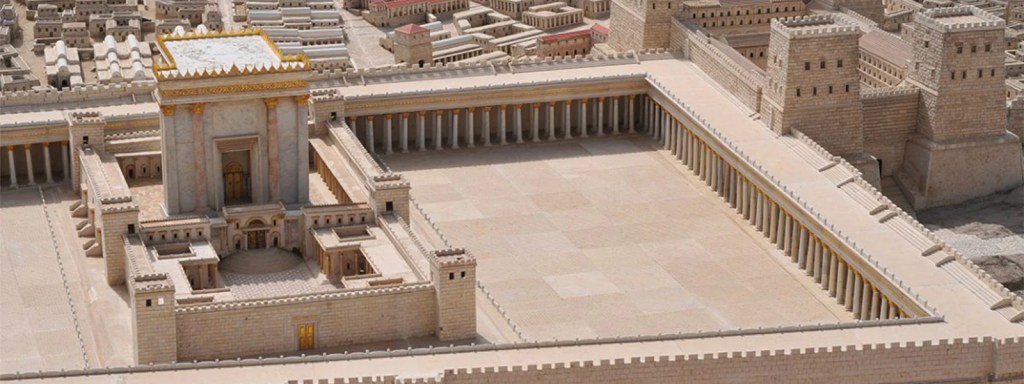
Initially, the verse seems to only tell us that a Jewish festival was occurring in Jerusalem and that Jesus was present at the Temple. However, for a Jewish listener at the time it was written, those two sentences were like a bomb with the fuse lit—a bomb that was first constructed some six hundred years prior and spoken by the Prophet Daniel.
In the Book of Daniel, an angel of the Lord speaks to Daniel and tells of a day to come. A day when an enemy will rise up against God’s people. According to the words of the angel, “Forces sent by [this leader] shall occupy and profane the temple and fortress. They shall abolish the regular burnt offering and set up the desolating sacrilege.” (Daniel 11:31) About 450 years later, in 147 BC, this prophecy was fulfilled.
Antiochus IV, one of the Syrian kings, conquered Jerusalem. First Maccabees picks up the story: “Now on the fifteenth day of Chislev, in the one hundred forty-fifth year, [the enemy] erected a desolating sacrilege on the altar of burnt offering. They also built altars in the surrounding towns of Judah and offered incense at the doors of the houses and in the streets.” (1 Maccabees 1:54-55) Antiochus brought the sacrificial system of the Jews to an end, built a statue of Zeus inside the Temple of God, and then proceeded to sacrifice pigs on the altar (in the eyes of Jewish people, the pig is a filthy animal—unclean). This is the original Abomination of Desolation—an event that is detestable in the eyes of God and brings about great ruin.
Antiochus remained and began forcing the Israelites to worship the Syrian gods and to make sacrifices to them. However, when Daniel made the prophecy, he also said, “The people who are loyal to their God shall stand firm and take action.” (Daniel 11:32) Three years after the Abomination of Desolation, this part of the prophecy was fulfilled.
Antiochus’ men arrived in the town of Modein and were forcing the citizens to make sacrifices to the false gods. This is when they encountered Mattathias, a man zealous for God’s covenant and Law. He refused the orders to sacrifice and rebelled. It wasn’t long after that he died, but with his dying words, he said to his sons, “Now, my children, show zeal for the law and give your lives for the covenant of our ancestors.” (1 Maccabees 2:50) They did, led by one of Mattathias’ sons, Judas Maccabeus.
It took several years, but the Maccabeans were eventually able to retake Jerusalem and the Temple. They cleansed the Temple, tore down the profaned altar, and built another one. They then prepared all the sacred vessels and instruments so that the worship of the One True God could again take place. The only problem was that the sacred lampstand, the Menorah, required a specially prepared oil that took eight days to make ready, and they only had one day’s worth. Not wanting to delay the right worship of God by another minute, they began anyway, and the oil that was to last only one day lasted eight, until the new oil had been prepared—the Miracle of Light. Those eight days we know as Hanukkah. The word Hanukkah means dedication.
Put all of this together—the Maccabeans revolted against an occupying army, recaptured the Holy City, and rededicated the Temple of God. They celebrated with a great festival that lasted eight days. This celebration is known as Hanukkah, and is also known as the Festival of the Dedication. Our Gospel reading began, “At that time the festival of the Dedication took place in Jerusalem. It was winter, and Jesus was walking in the temple, in the portico of Solomon.”
Throughout the Scriptures, a shepherd is one who leads the people. All the way back to the Book of Numbers, we hear this. Moses asked the Lord, “Let the Lord, the God of the spirits of all flesh, appoint a man over the congregation who shall go out before them and come in before them, who shall lead them out and bring them in, that the congregation of the Lord may not be as sheep that have no shepherd.” (Numbers 27:16-17) The phrase “lead them out and bring them in” expresses the Hebrew idea of a person who manages the daily affairs of the people and leads them in battle. Judas Maccabeus was one who did just that; he was a shepherd for the people.
Now, during the Festival of Dedication, Jesus claims to be the Good Shepherd. He is claiming that He will lead the people and help them conquer their enemies. So, how do you think those who hear these words will respond?
I find it interesting that our Gospel reading ended with John, chapter 10, verse 30. In verse 30, Jesus said, “I and the Father are one,” but it is in verse 31 that we learn how those who heard Jesus’ words responded. “The Jews—[the religious leaders]—picked up stones again to stone him.” But why?
Jesus has already cleansed the Temple of the moneychangers, having done so in chapter 2 of John’s Gospel. Now, claiming to be the Good Shepherd, He declares that He will wage a battle against those who are now oppressing God’s people. You would have thought it would be the Romans, who were then occupying the land, that would become angry with Jesus, but no. It is the religious leaders. Why? Because they knew that Jesus was not talking about the Romans; he is talking about them—the religious leaders—and they don’t much like it.
Why is Jesus talking about the religious leaders? Because they have erected another Abomination of Desolation. It is detestable in the eyes of God and is bringing about great ruin. What is it? The religious leaders themselves and their application of God’s Law. “Woe to you, scribes and Pharisees, hypocrites! For you lock people out of the kingdom of heaven…. you tithe mint, dill, and cumin and have neglected the weightier matters of the law: justice and mercy and faith.” Shortly before this confrontation, Jesus had said to them, “You are of your father the devil, and your will is to do your father’s desires. He was a murderer from the beginning, and does not stand in the truth, because there is no truth in him. When he lies, he speaks out of his own character, for he is a liar and the father of lies.” (John 8:44) Jesus is saying to the religious leaders, ‘You are lying to the people. Through your application of God’s Law, you are driving the people from God and bringing ruin upon them all, and this is detestable to the Father.’
It seems that the Abomination of Desolation is a single event in the history of God’s people. However, it also appears that a “spirit” of the original Abomination of Desolation continued to work in the world during the time of Jesus. Therefore, the question we must ask ourselves today is: does this same spirit continue to work in our world? Is there an agent around us that is detestable to God and seeks to bring ruin? To make it personal, is there a spirit at work in your life doing the same?
I can think of several instances of this spirit working in the world, but then this would just turn into a commentary of sorts. But only you can identify and name the spirit working in you.
St. Paul wrote, St. Paul wrote, “Do you not know that your bodies are temples of the Holy Spirit, who is in you, whom you have received from God? You are not your own; you were bought at a price.” (1 Corinthians 6:19-20) So, if today were the Festival of Dedication and Jesus were walking through the temple of your body, what would He see? Would He see something that is bringing ruin to your life? Something that needs to be torn down and cast out? What would He see?
Allow Jesus to be the Good Shepherd who leads and guides you. If there is a spirit other than His working in you, ask Him to do battle with it, so that you may be set free from the one who seeks to separate you from God and bring you to ruin.
There is a time to sing, “Jesus loves me,” but there is also a time to roll up our sleeves and go to work. Jesus does love you, but don’t forget there’s still a battle taking place.
Let us pray: Holy Michael, the Archangel, defend us in battle. Be our safeguard against the wickedness and snares of the devil. May God rebuke him, we humbly pray; and do you, O Prince of the heavenly host, by the power of God cast into hell Satan and all the evil spirits who wander through the world seeking the ruin of souls. Amen.
I take no credit for this one. Mike Goodwin, a young Black man, is a comedian, speaker, and leadership coach. You can find plenty of his videos online; that’s where I discovered this story he shares about his grandmother.
Mike says, “My grandmother says there are only two things in your life that you have to worry about: whether you’re healthy or whether you’re sick. If you’re healthy, you ain’t got nothing to worry about. But if you’re sick, you’ve got two things to worry about: whether you’re gonna get better or whether you’re gonna get worse. If you get better, you’ve got nothing to worry about. But if you get worse, you’ve got two things to worry about: whether you’re going to live or whether you’re going to die. If you live, you’ve got nothing to worry about. If you die, you’ve got two things to worry about: whether you go to heaven or whether you go to hell. If you go to heaven, you’ve got nothing to worry about. If you go to hell, you’ve got two things to worry about: crispy or extra crispy.”
For many, a life with God has much to do with Heaven and Hell. For them, this is how the conversation of God begins: “Do you want to go to Heaven?” With that question, the opposite is implied: “Do you want to go to Hell?” So, if I approach someone and ask, “Do you want to go to Heaven?”, who do you imagine is going to say, “No, I’m good with Hell.” When the one asking the question, “Do you want to go to Heaven?” receives confirmation, “Yes, I want to go to Heaven,” the next question will be, “Do you accept Jesus as your Lord and Savior?” If the person responds affirmatively, “Yes, I accept Jesus as my Lord and Savior,” you have what is known as “the Moment of Salvation.”
This Moment of Salvation has a great deal to the sorrow and repentance of sin, the turning to Jesus, and making amends for wrongs done. Again, not a thing in the world wrong with any of this; however—my dear Protestant leaning friends, please don’t shoot the teacher, just presenting the history here—this idea of a Moment of Salvation didn’t really come about until the Great Awakening of the 17th and 18th centuries. Prior to this, salvation was more a journey than a moment, and that journey began when you heard the words of Jesus, “Follow me.”
“Follow me” implies not a moment of salvation but a journey of salvation and a lifetime of sanctification—the process of discipleship, that is, each day becoming more of a follower of Jesus. In following, we begin to live the life He calls us to—a life where we believe in Him and His word, a life of denying ourselves, a life of taking up our cross, a life of being a servant, a life of proclaiming the Good News, all of which is a life that cannot be sustained by only wanting to avoid Hell and go to Heaven. Therefore, Jesus never asked anyone if they wanted to go to Heaven. Jesus asked, “Do you love me?”
Peter denied Jesus three times on the night before the crucifixion; therefore, to restore him, Jesus asked Peter three times, “Do you love me?” However, this question to Peter wasn’t only about restoring him. It was also about the journey and sanctification through discipleship. In asking, “Do you love me?” Jesus was also asking, “Will you follow me? Do you believe in me? Will you deny yourself? Will you take up your cross? Will you be a servant? Will you lay down your life as I have laid down Mine? Will you do all these things and more because this is what it means to love Me?” In light of that, “Do you want to go to Heaven?” is a child’s question, a “no-brainer.” However, the answer to the question, “Do you love me?” is not. It isn’t about a moment of salvation or a moment in time. The answer to the question, “Do you love me?” is a lifetime.
Remember when Jesus said, “Not everyone who says to me, ‘Lord, Lord,’ will enter the kingdom of heaven, but only the one who does the will of my Father in heaven. On that day many will say to me, ‘Lord, Lord, did we not prophesy in your name, and cast out demons in your name, and do many mighty works in your name?’ Then I will declare to them, ‘I never knew you; go away from me, you who behave lawlessly.’” (Matthew 7:21-23) How could such a thing happen? Why is that? Because there are many who will say they want to go to Heaven, but not all are willing to give up their lives for Jesus. Not all can say they love Jesus as He calls us to.
What’s also interesting about this exchange with Peter is that Jesus did not say, “I love you, Peter, do you love me?” Why? As we said last week, Jesus proved His love on that hill outside of Jerusalem where He was crucified. If Peter didn’t understand that then, and we don’t understand that now, then we are not paying attention. Jesus’ crucifixion and death on the Cross declared in no uncertain terms, “God so loved the world that He gave His only begotten Son.” Now Jesus, now God asks us, “Do you love me?”
When asked which was the greatest commandment, Jesus said, “‘You shall love the Lord your God with all your heart and with all your soul and with all your mind.’ This is the greatest and first commandment.” (Matthew 22:37-38)
When Jesus asked Peter, “Do you love me?” he was asking Peter, “Do you agree with this? Will you love Me with all that you are?”
When Peter said, “Yes, Lord, you know that I love you,” Jesus told Peter, “Then go, feed my sheep, and fulfill the second greatest commandment—‘Love your neighbor as yourself.’” (Matthew 22:39)
When you die, you’ve got two things to worry about: whether you go to heaven or whether you go to hell. If you love God, if you love Jesus in the way He calls us to… you’ve got nothing to worry about.
Let us pray: God, our Father, may we love You in all things and above all things. May we reach the joy which You have prepared for us in Heaven. Nothing is good that is against Your Will, and all that is good comes from Your Hand. Place in our hearts a desire to please You and fill our minds with thoughts of Your Love, so that we may grow in Your Wisdom and enjoy Your Peace. Amen.
Two brothers went to an elder monk who lived alone in Scete. The first one said, “Father, I have learned all of the Old and New Testaments by heart.” The elder replied, “You have filled the air with words.” The other brother said, “I have copied out the Old and New Testaments and have them in my hut.” To this, the elder responded, “You have filled your window with parchment, but do you not know Him who said, ‘The kingdom of God is not in words, but in power?’ and again, ‘Not those who hear the law will be justified before God, but those who carry it out.’”
As holy as scripture is and as life-giving as the sacred texts are, they remain limiting, for if we find Jesus only in the words, He is confined to our intellectual ability to understand that which cannot truly be understood. But, as we know, Jesus is not just a figure in a book, nor a distant memory of ancient events; He is a living presence. Therefore, we are not only called to know about Jesus, but more importantly, we are called to know Jesus. We do this not only by listening to the voices of others, but also by hearing the voice of Jesus for ourselves.
My favorite monk, Thomas a Kempis, wrote, “O God, You Who are the truth, make me one with You in love everlasting. I am often wearied by the many things I hear and read, but in You is all that I long for. Let the learned be still, let all creatures be silent before You. You alone speak to me.”
Unless the Lord speaks to us and writes the words of scripture on our hearts, we are merely engaging in an academic exercise.
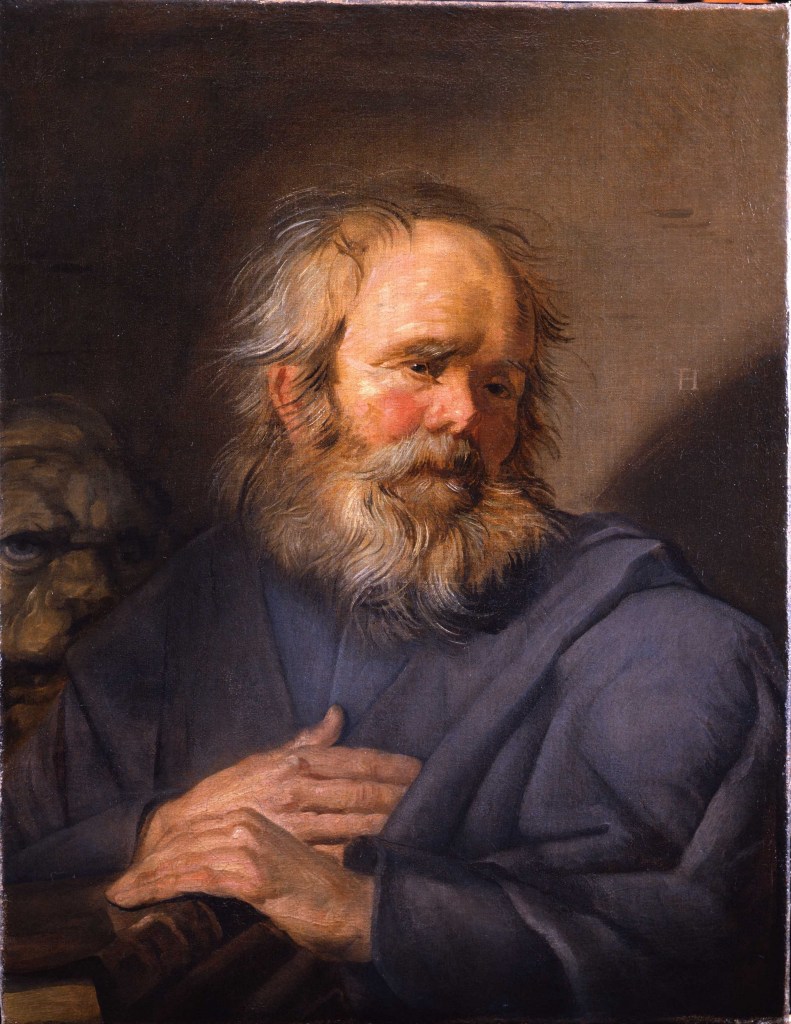
Holy Scripture does not say it specifically, but I feel as though St. Mark was someone who met Jesus, talked with Him, and so on. Scripture also indicates that he went on missions with Paul and Barnabas, and that he sat at the feet of the great Apostle Peter, learning much from him. Yet, even with all this, there had to come a day in his life when he set aside the writings and said, “Lord, You alone speak to me.” There must have been a day when he encountered and witnessed the crucified and resurrected Lord for himself, because his Gospel is a testimony to that encounter and a desire for you to have a similar experience.
The first words of his Gospel are, “The beginning of the good news of Jesus Christ, the Son of God.” From there, he narrates the story of Jesus in very succinct language.
In his Gospel, Mark tells the story of the Good News of Jesus Christ. After the apostles had encountered Jesus for themselves, they went out and proclaimed salvation so that others might experience Jesus—so that you and I might experience Jesus, not just in the words of the text but in our lives.
I encourage you, in your times of prayer and study, to set aside the scriptures and the prayer book—to set aside all those other voices, including your own—and say, “Lord, You alone speak to me,” allowing the One who has been handed down to us in the texts to speak to you personally.
I know I’ve shared this story at a funeral, but I don’t believe I’ve ever shared it with you.
A man was once sentenced to solitary confinement in a pitch-black prison cell. To relieve his boredom and keep his sanity, he threw a marble against the walls—day in, day out, bang, bang, bang. The marble would bounce off the wall onto the floor and then roll around the room until the man could locate it and repeat the procedure.
One day, he decided to do something different—he would throw the marble up and try to catch it as it came down. Of course, in the pitch black, he missed the catch quite often, so he would listen as the marble hit the floor and bounced around. Feeling around in the general direction of the sound, he would locate it and try again. The longer this went on, the more proficient he became, and the more proficient he became, the higher he would throw the marble. However, when he made his highest throw ever, he did not catch it, and neither was there any sound. The marble simply did not come back down. He became more and more disturbed. What had happened to his precious marble? How could it disappear into thin air like that?! He spent the rest of his life wondering what had happened to his marble, and it eventually drove him to madness, and he died.
We all have things we wonder about and questions that we seek answers to. Sometimes, we have questions about life: Why does so-and-so not love me? How come all my luck is bad? What did I do to deserve this?
At other times, we question the world around us: Why is the sky blue or the grass green? How was the universe formed? How does Santa get into houses without chimneys? (Just seeing if you were paying attention.)
We also have questions about our faith. Does God hear my prayers? Do I matter to God? Or even, is there a God?
For life’s questions, through our faith, we learn to understand and take each day as it comes. For the questions about the world around us, we explore and study. And for the questions about our faith, we pray and study scripture. However, when it comes to these questions of faith, we also tend to try to make a few deals with God. Why do the hard work if there’s a shortcut?
I’ve never been a Janis Joplin fan in the tiniest little bit, but I remember a song of hers that we would laugh and sing as kids, if only the first verse.
Oh Lord, won’t you buy me a Mercedes-Benz? My friends all drive Porsches, I must make amends
That’s about all we knew as kids, but it is the third verse that gets to the theological heart of the matter.
Oh, Lord, won’t you buy me a night on the town? I’m counting on you Lord, please don’t let me down Prove that you love me and buy the next round
And there it is. “Prove that you love me.” Prove to me that You hear my prayers. Prove to me that I matter to You. Prove to me that You are there.
The first stanza of the poem, Doubt, by Norman Shirk
Let me meet you on the mountain, Lord, just once. You wouldn’t have to burn a whole bush, Just a few smoking branches, And I would surely be your Moses
In the end, it all comes down to the same statement: “Unless I see the mark of the nails in his hands, and put my finger in the mark of the nails and my hand in his side, I will not believe.”
It is easy to criticize poor ol’ Thomas, but there’s a bit of him—maybe a little or maybe a lot—there’s a bit of Thomas in us all.
Like Thomas, in order to increase our faith, we ask the Lord to meet us halfway. However, He already has. The Lord Jesus met us halfway between heaven and hell. He met us on that hill outside of Jerusalem. He met us outside the empty tomb, and He continues to meet us every day exactly where we are. He also meets us at that altar in the Sacrament of His body and blood.
But you say, “Yes, yes, Father John. That’s real nice, but today, I want to be Thomas. I want to see Him, hear Him, and touch Him. I need the burning bush. I need the missing piece of the puzzle. I need to find the stupid marble that fella pitched up into the air and never came back down. Give me these things, and I will.”
A line from a movie I watched inspired the title of my blog—Candle in a Cave. In the movie, an older priest tells a younger one, “We are all blind men in a cave looking for a candle that was lit 2,000 years ago.”
In some sense, this is true because I can’t show you a burning bush or guide your hands and allow you to touch the wounds of Christ. Sorry, I can’t do it. If I could, we would have folks flocking to this church by the millions to see it. Why? Because they want God to prove Himself to them, to give them a sign. Like Job, they ask God to explain Himself.
But remember, the Lord was patient with Job for a while, but after much questioning, the Lord answered, “Who is this that darkens my counsel with words without knowledge?” “Where were you when I laid the earth’s foundation? Tell me, if you understand. Who marked off its dimensions? Surely you know! Who stretched a measuring line across it? Who created the sky, the animals? Were you there when I breathed life into the dust and created you?”
Like Job, and even during Jesus’ time on earth, we desire signs and wonders, miracles. Scripture states that at one point during Jesus’ ministry, some Pharisees and teachers of the law questioned him: “Teacher, we want to see a miraculous sign from you.” Jesus answered, “A wicked and adulterous generation asks for a miraculous sign! But none will be given it except the sign of the prophet Jonah. For as Jonah was three days and three nights in the belly of a huge fish, so the Son of Man will be three days and three nights in the heart of the earth.”
You see, the problem is not with God; it is with us. The Lord has already given us a sign. After three days and three nights in the heart of the earth, He rose! How? Truly, the Lord only knows. As the Psalmist says, “Such knowledge is too wonderful for me, too lofty for me to attain.” But Jesus rose from the grave. How much more proof does a person need? Just because there were no witnesses to the resurrection, does it mean it did not occur? No. Remember what Billy Graham said, “Can you see God? You haven’t seen him? I’ve never seen the wind. I see the effects of the wind, but I’ve never seen the wind. There’s a mystery to it.”
No one witnessed the resurrection of Jesus, but from that day forward, we have all been witnesses to, and have experienced for ourselves, the effects of the resurrection—this new life in Christ Jesus—and it didn’t involve getting a Mercedes-Benz. Therefore, “Do not doubt but believe.”
Remember our prisoner and his marble? When the guards later entered the cell to remove his body, a glint of light caught one of the guards’ eyes. He looked up toward the ceiling to see the most astonishing sight—a marble caught in a spider’s web. “Of all the crazy things,” he thought. “How on earth did the spider manage to get a marble up there?” He spent the rest of his life wondering.
There are many mysteries in our lives with God, things we can wonder about and seek answers to throughout our lives. However, the question of the resurrection is not one of them, for the proof is all around us.
Let us pray: Praised be the God and Father of our Lord Jesus Christ, He who in His great mercy gave us new birth, a birth unto hope which draws its life from the resurrection of Jesus Christ from the dead; a birth to an imperishable inheritance, incapable of fading or defilement, which is kept in heaven for you who are guarded with God’s power through faith; a birth to a salvation which stands ready to be revealed in the last days. Amen.







 Candle in a Cave