Sermon: Easter 5 RCL C – “Love One Another”

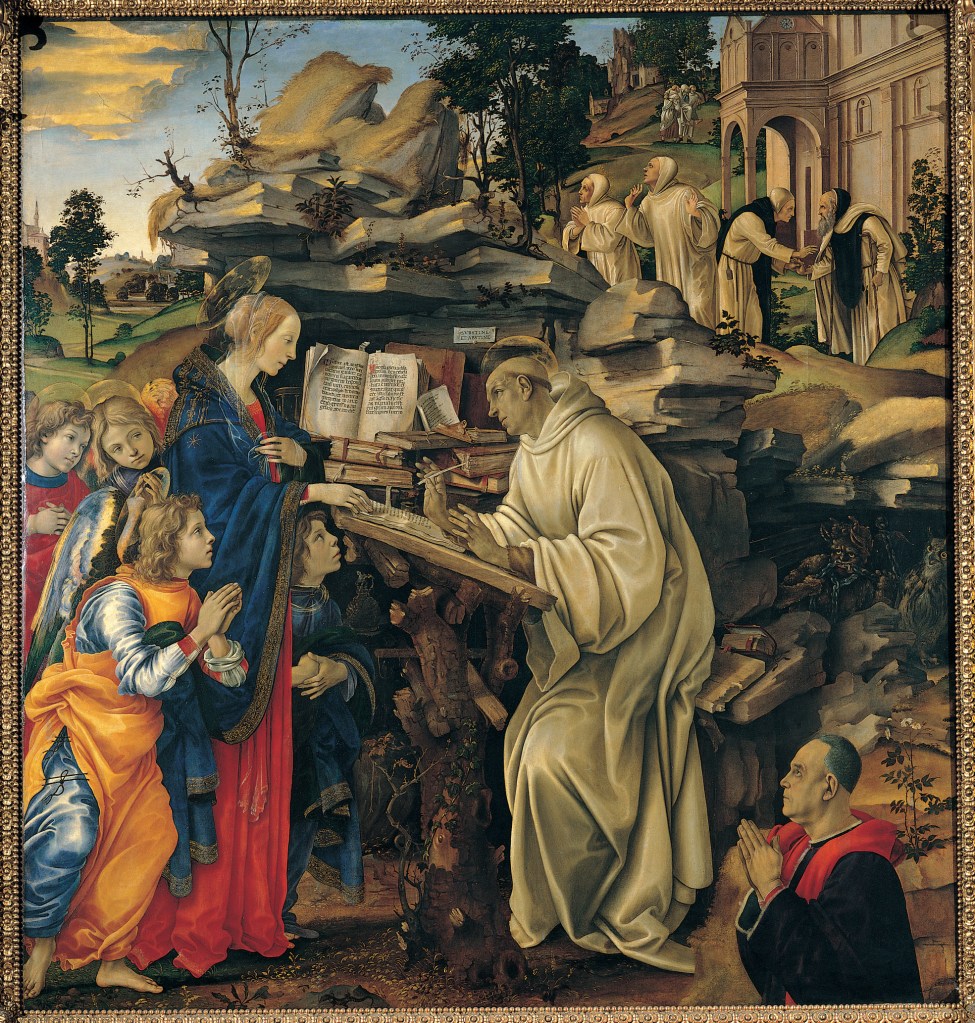
Four Monks by Claudio Rinaldi

You won’t like this one.

There was a blind girl who hated herself because she was blind. In fact, she disliked everyone, except her loving boyfriend, who was always there for her. She used to tell her boyfriend, “If I could only see the world, I would marry you.”

One day, someone donated a pair of eyes to her. When the bandages came off, she was able to see everything, including her boyfriend, for the first time.

He asked her, “Now that you can see the world, will you marry me?”

The girl looked at her boyfriend and saw that he was blind. The sight of his closed eyelids shocked her. She hadn’t expected that. The thought of looking at them the rest of her life led her to refuse to marry him.

Her boyfriend left her in tears and days later wrote a note to her saying: “Take good care of your eyes, my dear, for before they were yours, they were mine.”

We have so many different ways of communicating these days—in person, via text messaging, through video calls, emails, and more. When you think about it, you realize that each form of communication involves some aspect of time, which can be summed up in that workplace complaint, “I survived another meeting that should have been an email.” If you have time, an in-person or video call is fine, but if you are rushed, then fire off a quick email or text message. This applies not only to work but also to our personal relationships.

I remember watching a movie where one of the ladies said, “If I want to spend an hour with my husband, I have to call his secretary and make an appointment.” Maybe it was a book, but some character requested an hour of someone’s time. The response was, “No one gets an hour.”

We’re so busy these days that no one gets an hour, and if they do, they’re going to have to make an appointment and pay for it.

Perhaps it’s not all that bad, but there are days that seem like it. Days when, even though you live in the same house with someone, the best you can hope for is to wave at each other as you come and go.

Given these circumstances, which I believe are true for many, it got me to wondering about the phrase, “I love you.” No one gets an hour. No one gets that much of our time, so when we say, “I love you,” to someone—be they our children, spouses, etc.—when we say, “I love you,” what do we mean? What message are we trying to convey, or is it just a nice way to conclude the interactions we have with one another as we pass each other in our comings and goings? 

Text message: “Don’t forget to pick up eggs. Thanks. I love you.” In that message, what is more important—the eggs or the love?

Don’t get me wrong. I’m not saying you don’t mean it when you say, “I love you,” but do you actually think about it when you say it? Is it something that grabs you down here in your gut, or is it an afterthought at the end of the day?

Today, in our Gospel reading, Jesus said, “I give you a new commandment, that you love one another. Just as I have loved you, you also should love one another. By this everyone will know that you are my disciples, if you have love for one another.” Three times: love one another. Love one another. Love for one another. 

Maybe I’m just making an observation, or I could be completely off base. But if this is true, if no one gets an hour and we are just shouting out “I love yous” as we pass one another, then how do we, as a community of believers, express love to one another as Jesus has called us to? Put another way, Jesus said, “Everyone will know that you are my disciples, if you have love for one another.” Will those around us know that we are Jesus’ disciples based on what they witness between us?

A story is told about a pastor traveling with a Brazilian seminary student studying in the US. Along the way, the pastor asked the student if he would like to stop for a cup of coffee. The student said, “I would be honored.” So the pastor swung into a Starbucks and went through the drive-thru. 

Once on their way again the student was very quiet and when pressed about his silence he said, “I thought you were asking me to be your friend. I thought we were going to sit together and share life.” (From a sermon by Monty Newton, The Making of a Compelling Christian Community)

If the world is to know that we are Jesus’ disciples, then it is more than a coffee on the go. We must sit together and share life. We must be committed to one another. I’m not saying that you are not already doing this, but like the “I love you” tagline at the end of a text message can become something that is just said but doesn’t really carry much weight, so can our commitment to one another in a Christian community. We may be there in our minds, but do our relationships reflect it?

St. John wrote in his first epistle, “Beloved, let us love one another, for love is from God, and whoever loves has been born of God and knows God. Anyone who does not love does not know God, because God is love…. Beloved, if God so loved us, we also ought to love one another.” (1 John 4:7-8, 11)

Reflecting on this passage, N.T. Wright said, “The Christian faith grows directly out of, and must directly express, the belief that in Jesus the Messiah the one true God has revealed himself to be-love incarnate. And those who hold this faith, and embrace it as the means of their own hope and life, must themselves reveal the self-same fact before the watching world. Love incarnate must be the badge that the Christian community wears, the sign not only of who they are but of who their God is.” (The Early Christian Letters, p.169)

To be committed to one another and to be that community of believers requires more than simply waving at each other on Sunday mornings. We like to wear our shirts with little alligators or polo players stitched on them, but we must exhibit our love for one another even more boldly. How do we accomplish this?

The Abbot of the monastery wanted the community he led to be much more committed to one another. Needing advice on the subject, the Abbot visited his good friend Jeremiah, a wise old Jewish rabbi. After hearing the Abbot, Jeremiah asked if he could share an experience. “Please do,” responded the Abbot. “Anything you can offer.”

Jeremiah told the Abbot that he had received an important vision: the Messiah was among the ranks of the monks. The Abbot was flabbergasted. One among his own, living in the monastery, was the Messiah! The Christ! Who could it be? He knew it wasn’t himself, but who? He raced back to the monastery and shared this exciting news with his fellow monks.

The monks grew silent as they looked into each other’s faces. Was this one the Messiah? Or that one? From that day forward, the atmosphere in the monastery changed. No one wanted to miss the opportunity to be with the Messiah. If harm was done, they immediately sought forgiveness. The monks began serving one another in ways they had never considered, looking out for opportunities to assist and seeking healing and companionship.

As travelers found their way to the monastery, word soon spread about the remarkable spirit of the place. People took the journey to the monastery and found themselves renewed and transformed. All because those monks knew the Messiah was among them. All because the visitors recognized that those monks were true disciples of Jesus. All because those monks were loving one another as Christ had loved them.

Please don’t think that I’m saying you are not committed to one another. I believe you are committed in a rather remarkable way, but we must always seek ways to strengthen the bonds between us and to bring others into our community. Not so that we can have a bigger church, but so that we can have a stronger, more faithful, and more committed church. So that everyone will know that we are Jesus’ disciples. So that everyone will know that Jesus is in our midst.

Dietrich Bonhoeffer stated in Life Together, “We must be ready to allow ourselves to be interrupted by God. God will be constantly crossing our paths and canceling our plans by sending us people with claims and petitions.” 

Love one another by allowing God to interrupt you. Give each other an hour. Sit together and share life. Along the way, you will discover that the Messiah is among the members of our church. Along the way, you will love one another as Christ loves us.

Let us pray: 

Heavenly Father,

look upon our community of faith

which is the Church of your Son, Jesus Christ.

Help us to witness to his love

by loving all our fellow creatures without exception.

Under the leadership or our Bishop

keep us faithful to Christ’s mission

of calling all men and women

to your service so that there may be

“one fold and one shepherd.”

We ask this through Christ, our Lord.

Amen.

Sermon: Easter 4 RCL C – “Abomination of Desolation”


Johnny Carson would begin one of his bits by saying something like, “Its so hot…,” and before he could fill in the blank, the audience would shout back, “How hot is it?” Carson would then fill in the rest. With that in mind, “I’m so confused…” 

I’m more confused than an Amish electrician.

I’m more confused than a vegan at a BBQ.

I’m more confused than a goat on astroturf.  

I’m more confused than a chameleon in a bag of Skittles.

And I’m also hoping you don’t feel that confused by the time I’m done with this sermon.

I’ve told you before that those who wrote Holy Scripture didn’t write fluff. When they communicate something, even the smallest detail carries significance and plays a role in our understanding of the passage. Today’s Gospel reading is no different. 

The first two sentences we read: “At that time the festival of the Dedication took place in Jerusalem. It was winter, and Jesus was walking in the temple, in the portico of Solomon.”

Initially, the verse seems to only tell us that a Jewish festival was occurring in Jerusalem and that Jesus was present at the Temple. However, for a Jewish listener at the time it was written, those two sentences were like a bomb with the fuse lit—a bomb that was first constructed some six hundred years prior and spoken by the Prophet Daniel.

In the Book of Daniel, an angel of the Lord speaks to Daniel and tells of a day to come. A day when an enemy will rise up against God’s people. According to the words of the angel, “Forces sent by [this leader] shall occupy and profane the temple and fortress. They shall abolish the regular burnt offering and set up the desolating sacrilege.” (Daniel 11:31) About 450 years later, in 147 BC, this prophecy was fulfilled.

Antiochus IV, one of the Syrian kings, conquered Jerusalem. First Maccabees picks up the story: “Now on the fifteenth day of Chislev, in the one hundred forty-fifth year, [the enemy] erected a desolating sacrilege on the altar of burnt offering. They also built altars in the surrounding towns of Judah and offered incense at the doors of the houses and in the streets.” (1 Maccabees 1:54-55) Antiochus brought the sacrificial system of the Jews to an end, built a statue of Zeus inside the Temple of God, and then proceeded to sacrifice pigs on the altar (in the eyes of Jewish people, the pig is a filthy animal—unclean). This is the original Abomination of Desolation—an event that is detestable in the eyes of God and brings about great ruin.

Antiochus remained and began forcing the Israelites to worship the Syrian gods and to make sacrifices to them. However, when Daniel made the prophecy, he also said, “The people who are loyal to their God shall stand firm and take action.” (Daniel 11:32) Three years after the Abomination of Desolation, this part of the prophecy was fulfilled. 

Antiochus’ men arrived in the town of Modein and were forcing the citizens to make sacrifices to the false gods. This is when they encountered Mattathias, a man zealous for God’s covenant and Law. He refused the orders to sacrifice and rebelled. It wasn’t long after that he died, but with his dying words, he said to his sons, “Now, my children, show zeal for the law and give your lives for the covenant of our ancestors.” (1 Maccabees 2:50) They did, led by one of Mattathias’ sons, Judas Maccabeus.

It took several years, but the Maccabeans were eventually able to retake Jerusalem and the Temple. They cleansed the Temple, tore down the profaned altar, and built another one. They then prepared all the sacred vessels and instruments so that the worship of the One True God could again take place. The only problem was that the sacred lampstand, the Menorah, required a specially prepared oil that took eight days to make ready, and they only had one day’s worth. Not wanting to delay the right worship of God by another minute, they began anyway, and the oil that was to last only one day lasted eight, until the new oil had been prepared—the Miracle of Light. Those eight days we know as Hanukkah. The word Hanukkah means dedication. 

Put all of this together—the Maccabeans revolted against an occupying army, recaptured the Holy City, and rededicated the Temple of God. They celebrated with a great festival that lasted eight days. This celebration is known as Hanukkah, and is also known as the Festival of the Dedication. Our Gospel reading began, “At that time the festival of the Dedication took place in Jerusalem. It was winter, and Jesus was walking in the temple, in the portico of Solomon.”

Throughout the Scriptures, a shepherd is one who leads the people. All the way back to the Book of Numbers, we hear this. Moses asked the Lord, “Let the Lord, the God of the spirits of all flesh, appoint a man over the congregation who shall go out before them and come in before them, who shall lead them out and bring them in, that the congregation of the Lord may not be as sheep that have no shepherd.” (Numbers 27:16-17) The phrase “lead them out and bring them in” expresses the Hebrew idea of a person who manages the daily affairs of the people and leads them in battle. Judas Maccabeus was one who did just that; he was a shepherd for the people. 

Now, during the Festival of Dedication, Jesus claims to be the Good Shepherd. He is claiming that He will lead the people and help them conquer their enemies. So, how do you think those who hear these words will respond? 

I find it interesting that our Gospel reading ended with John, chapter 10, verse 30. In verse 30, Jesus said, “I and the Father are one,” but it is in verse 31 that we learn how those who heard Jesus’ words responded. “The Jews—[the religious leaders]—picked up stones again to stone him.” But why?

Jesus has already cleansed the Temple of the moneychangers, having done so in chapter 2 of John’s Gospel. Now, claiming to be the Good Shepherd, He declares that He will wage a battle against those who are now oppressing God’s people. You would have thought it would be the Romans, who were then occupying the land, that would become angry with Jesus, but no. It is the religious leaders. Why? Because they knew that Jesus was not talking about the Romans; he is talking about them—the religious leaders—and they don’t much like it. 

Why is Jesus talking about the religious leaders? Because they have erected another Abomination of Desolation. It is detestable in the eyes of God and is bringing about great ruin. What is it? The religious leaders themselves and their application of God’s Law. “Woe to you, scribes and Pharisees, hypocrites! For you lock people out of the kingdom of heaven…. you tithe mint, dill, and cumin and have neglected the weightier matters of the law: justice and mercy and faith.” Shortly before this confrontation, Jesus had said to them, “You are of your father the devil, and your will is to do your father’s desires. He was a murderer from the beginning, and does not stand in the truth, because there is no truth in him. When he lies, he speaks out of his own character, for he is a liar and the father of lies.” (John 8:44) Jesus is saying to the religious leaders, ‘You are lying to the people. Through your application of God’s Law, you are driving the people from God and bringing ruin upon them all, and this is detestable to the Father.’

It seems that the Abomination of Desolation is a single event in the history of God’s people. However, it also appears that a “spirit” of the original Abomination of Desolation continued to work in the world during the time of Jesus. Therefore, the question we must ask ourselves today is: does this same spirit continue to work in our world? Is there an agent around us that is detestable to God and seeks to bring ruin? To make it personal, is there a spirit at work in your life doing the same? 

I can think of several instances of this spirit working in the world, but then this would just turn into a commentary of sorts. But only you can identify and name the spirit working in you. 

St. Paul wrote, St. Paul wrote, “Do you not know that your bodies are temples of the Holy Spirit, who is in you, whom you have received from God? You are not your own; you were bought at a price.” (1 Corinthians 6:19-20) So, if today were the Festival of Dedication and Jesus were walking through the temple of your body, what would He see? Would He see something that is bringing ruin to your life? Something that needs to be torn down and cast out? What would He see? 

Allow Jesus to be the Good Shepherd who leads and guides you. If there is a spirit other than His working in you, ask Him to do battle with it, so that you may be set free from the one who seeks to separate you from God and bring you to ruin.

There is a time to sing, “Jesus loves me,” but there is also a time to roll up our sleeves and go to work. Jesus does love you, but don’t forget there’s still a battle taking place.

Let us pray: Holy Michael, the Archangel, defend us in battle. Be our safeguard against the wickedness and snares of the devil. May God rebuke him, we humbly pray; and do you, O Prince of the heavenly host, by the power of God cast into hell Satan and all the evil spirits who wander through the world seeking the ruin of souls. Amen.

Sermon: Easter 3 RCL C – “Do you love Me?”


I take no credit for this one. Mike Goodwin, a young Black man, is a comedian, speaker, and leadership coach. You can find plenty of his videos online; that’s where I discovered this story he shares about his grandmother.

Mike says, “My grandmother says there are only two things in your life that you have to worry about: whether you’re healthy or whether you’re sick. If you’re healthy, you ain’t got nothing to worry about. But if you’re sick, you’ve got two things to worry about: whether you’re gonna get better or whether you’re gonna get worse. If you get better, you’ve got nothing to worry about. But if you get worse, you’ve got two things to worry about: whether you’re going to live or whether you’re going to die. If you live, you’ve got nothing to worry about. If you die, you’ve got two things to worry about: whether you go to heaven or whether you go to hell. If you go to heaven, you’ve got nothing to worry about. If you go to hell, you’ve got two things to worry about: crispy or extra crispy.”

For many, a life with God has much to do with Heaven and Hell. For them, this is how the conversation of God begins: “Do you want to go to Heaven?” With that question, the opposite is implied: “Do you want to go to Hell?” So, if I approach someone and ask, “Do you want to go to Heaven?”, who do you imagine is going to say, “No, I’m good with Hell.” When the one asking the question, “Do you want to go to Heaven?” receives confirmation, “Yes, I want to go to Heaven,” the next question will be, “Do you accept Jesus as your Lord and Savior?” If the person responds affirmatively, “Yes, I accept Jesus as my Lord and Savior,” you have what is known as “the Moment of Salvation.” 

This Moment of Salvation has a great deal to the sorrow and repentance of sin, the turning to Jesus, and making amends for wrongs done. Again, not a thing in the world wrong with any of this; however—my dear Protestant leaning friends, please don’t shoot the teacher, just presenting the history here—this idea of a Moment of Salvation didn’t really come about until the Great Awakening of the 17th and 18th centuries. Prior to this, salvation was more a journey than a moment, and that journey began when you heard the words of Jesus, “Follow me.” 

“Follow me” implies not a moment of salvation but a journey of salvation and a lifetime of sanctification—the process of discipleship, that is, each day becoming more of a follower of Jesus. In following, we begin to live the life He calls us to—a life where we believe in Him and His word, a life of denying ourselves, a life of taking up our cross, a life of being a servant, a life of proclaiming the Good News, all of which is a life that cannot be sustained by only wanting to avoid Hell and go to Heaven. Therefore, Jesus never asked anyone if they wanted to go to Heaven. Jesus asked, “Do you love me?”

Peter denied Jesus three times on the night before the crucifixion; therefore, to restore him, Jesus asked Peter three times, “Do you love me?” However, this question to Peter wasn’t only about restoring him. It was also about the journey and sanctification through discipleship. In asking, “Do you love me?” Jesus was also asking, “Will you follow me? Do you believe in me? Will you deny yourself? Will you take up your cross? Will you be a servant? Will you lay down your life as I have laid down Mine? Will you do all these things and more because this is what it means to love Me?” In light of that, “Do you want to go to Heaven?” is a child’s question, a “no-brainer.” However, the answer to the question, “Do you love me?” is not. It isn’t about a moment of salvation or a moment in time. The answer to the question, “Do you love me?” is a lifetime.

Remember when Jesus said, “Not everyone who says to me, ‘Lord, Lord,’ will enter the kingdom of heaven, but only the one who does the will of my Father in heaven. On that day many will say to me, ‘Lord, Lord, did we not prophesy in your name, and cast out demons in your name, and do many mighty works in your name?’ Then I will declare to them, ‘I never knew you; go away from me, you who behave lawlessly.’” (Matthew 7:21-23) How could such a thing happen? Why is that? Because there are many who will say they want to go to Heaven, but not all are willing to give up their lives for Jesus. Not all can say they love Jesus as He calls us to.

What’s also interesting about this exchange with Peter is that Jesus did not say, “I love you, Peter, do you love me?” Why? As we said last week, Jesus proved His love on that hill outside of Jerusalem where He was crucified. If Peter didn’t understand that then, and we don’t understand that now, then we are not paying attention. Jesus’ crucifixion and death on the Cross declared in no uncertain terms, “God so loved the world that He gave His only begotten Son.” Now Jesus, now God asks us, “Do you love me?”

When asked which was the greatest commandment, Jesus said, “‘You shall love the Lord your God with all your heart and with all your soul and with all your mind.’ This is the greatest and first commandment.” (Matthew 22:37-38)

When Jesus asked Peter, “Do you love me?” he was asking Peter, “Do you agree with this? Will you love Me with all that you are?”

When Peter said, “Yes, Lord, you know that I love you,” Jesus told Peter, “Then go, feed my sheep, and fulfill the second greatest commandment—‘Love your neighbor as yourself.’” (Matthew 22:39)

When you die, you’ve got two things to worry about: whether you go to heaven or whether you go to hell. If you love God, if you love Jesus in the way He calls us to… you’ve got nothing to worry about.

Let us pray: God, our Father, may we love You in all things and above all things. May we reach the joy which You have prepared for us in Heaven. Nothing is good that is against Your Will, and all that is good comes from Your Hand. Place in our hearts a desire to please You and fill our minds with thoughts of Your Love, so that we may grow in Your Wisdom and enjoy Your Peace. Amen.

Sermon: Mark


Two brothers went to an elder monk who lived alone in Scete. The first one said, “Father, I have learned all of the Old and New Testaments by heart.” The elder replied, “You have filled the air with words.” The other brother said, “I have copied out the Old and New Testaments and have them in my hut.” To this, the elder responded, “You have filled your window with parchment, but do you not know Him who said, ‘The kingdom of God is not in words, but in power?’ and again, ‘Not those who hear the law will be justified before God, but those who carry it out.’”

As holy as scripture is and as life-giving as the sacred texts are, they remain limiting, for if we find Jesus only in the words, He is confined to our intellectual ability to understand that which cannot truly be understood. But, as we know, Jesus is not just a figure in a book, nor a distant memory of ancient events; He is a living presence. Therefore, we are not only called to know about Jesus, but more importantly, we are called to know Jesus. We do this not only by listening to the voices of others, but also by hearing the voice of Jesus for ourselves.

My favorite monk, Thomas a Kempis, wrote, “O God, You Who are the truth, make me one with You in love everlasting. I am often wearied by the many things I hear and read, but in You is all that I long for. Let the learned be still, let all creatures be silent before You. You alone speak to me.”

Unless the Lord speaks to us and writes the words of scripture on our hearts, we are merely engaging in an academic exercise.

Holy Scripture does not say it specifically, but I feel as though St. Mark was someone who met Jesus, talked with Him, and so on. Scripture also indicates that he went on missions with Paul and Barnabas, and that he sat at the feet of the great Apostle Peter, learning much from him. Yet, even with all this, there had to come a day in his life when he set aside the writings and said, “Lord, You alone speak to me.” There must have been a day when he encountered and witnessed the crucified and resurrected Lord for himself, because his Gospel is a testimony to that encounter and a desire for you to have a similar experience.

The first words of his Gospel are, “The beginning of the good news of Jesus Christ, the Son of God.” From there, he narrates the story of Jesus in very succinct language.

In his Gospel, Mark tells the story of the Good News of Jesus Christ. After the apostles had encountered Jesus for themselves, they went out and proclaimed salvation so that others might experience Jesus—so that you and I might experience Jesus, not just in the words of the text but in our lives.

I encourage you, in your times of prayer and study, to set aside the scriptures and the prayer book—to set aside all those other voices, including your own—and say, “Lord, You alone speak to me,” allowing the One who has been handed down to us in the texts to speak to you personally.

Sermon: Easter 2 RCL C – “Resurrection”


I know I’ve shared this story at a funeral, but I don’t believe I’ve ever shared it with you. 

A man was once sentenced to solitary confinement in a pitch-black prison cell. To relieve his boredom and keep his sanity, he threw a marble against the walls—day in, day out, bang, bang, bang. The marble would bounce off the wall onto the floor and then roll around the room until the man could locate it and repeat the procedure.

One day, he decided to do something different—he would throw the marble up and try to catch it as it came down. Of course, in the pitch black, he missed the catch quite often, so he would listen as the marble hit the floor and bounced around. Feeling around in the general direction of the sound, he would locate it and try again. The longer this went on, the more proficient he became, and the more proficient he became, the higher he would throw the marble. However, when he made his highest throw ever, he did not catch it, and neither was there any sound. The marble simply did not come back down. He became more and more disturbed. What had happened to his precious marble? How could it disappear into thin air like that?! He spent the rest of his life wondering what had happened to his marble, and it eventually drove him to madness, and he died. 

We all have things we wonder about and questions that we seek answers to. Sometimes, we have questions about life: Why does so-and-so not love me? How come all my luck is bad? What did I do to deserve this?

At other times, we question the world around us: Why is the sky blue or the grass green? How was the universe formed? How does Santa get into houses without chimneys? (Just seeing if you were paying attention.)

We also have questions about our faith. Does God hear my prayers? Do I matter to God? Or even, is there a God?

For life’s questions, through our faith, we learn to understand and take each day as it comes. For the questions about the world around us, we explore and study. And for the questions about our faith, we pray and study scripture. However, when it comes to these questions of faith, we also tend to try to make a few deals with God. Why do the hard work if there’s a shortcut?

I’ve never been a Janis Joplin fan in the tiniest little bit, but I remember a song of hers that we would laugh and sing as kids, if only the first verse.

Oh Lord, won’t you buy me a Mercedes-Benz?
My friends all drive Porsches, I must make amends

That’s about all we knew as kids, but it is the third verse that gets to the theological heart of the matter.

Oh, Lord, won’t you buy me a night on the town?
I’m counting on you Lord, please don’t let me down
Prove that you love me and buy the next round

And there it is. “Prove that you love me.” Prove to me that You hear my prayers. Prove to me that I matter to You. Prove to me that You are there.

The first stanza of the poem, Doubt, by Norman Shirk

Let me meet you on the mountain, Lord, just once.
You wouldn’t have to burn a whole bush,
Just a few smoking branches,
And I would surely be your Moses

In the end, it all comes down to the same statement: “Unless I see the mark of the nails in his hands, and put my finger in the mark of the nails and my hand in his side, I will not believe.” 

It is easy to criticize poor ol’ Thomas, but there’s a bit of him—maybe a little or maybe a lot—there’s a bit of Thomas in us all.

Like Thomas, in order to increase our faith, we ask the Lord to meet us halfway. However, He already has. The Lord Jesus met us halfway between heaven and hell. He met us on that hill outside of Jerusalem. He met us outside the empty tomb, and He continues to meet us every day exactly where we are. He also meets us at that altar in the Sacrament of His body and blood.

But you say, “Yes, yes, Father John. That’s real nice, but today, I want to be Thomas. I want to see Him, hear Him, and touch Him. I need the burning bush. I need the missing piece of the puzzle. I need to find the stupid marble that fella pitched up into the air and never came back down. Give me these things, and I will.”

A line from a movie I watched inspired the title of my blog—Candle in a Cave. In the movie, an older priest tells a younger one, “We are all blind men in a cave looking for a candle that was lit 2,000 years ago.” 

In some sense, this is true because I can’t show you a burning bush or guide your hands and allow you to touch the wounds of Christ. Sorry, I can’t do it. If I could, we would have folks flocking to this church by the millions to see it. Why? Because they want God to prove Himself to them, to give them a sign. Like Job, they ask God to explain Himself. 

But remember, the Lord was patient with Job for a while, but after much questioning, the Lord answered, “Who is this that darkens my counsel with words without knowledge?” “Where were you when I laid the earth’s foundation? Tell me, if you understand. Who marked off its dimensions? Surely you know! Who stretched a measuring line across it? Who created the sky, the animals? Were you there when I breathed life into the dust and created you?” 

Like Job, and even during Jesus’ time on earth, we desire signs and wonders, miracles. Scripture states that at one point during Jesus’ ministry, some Pharisees and teachers of the law questioned him: “Teacher, we want to see a miraculous sign from you.” Jesus answered, “A wicked and adulterous generation asks for a miraculous sign! But none will be given it except the sign of the prophet Jonah. For as Jonah was three days and three nights in the belly of a huge fish, so the Son of Man will be three days and three nights in the heart of the earth.”

You see, the problem is not with God; it is with us. The Lord has already given us a sign. After three days and three nights in the heart of the earth, He rose! How? Truly, the Lord only knows. As the Psalmist says, “Such knowledge is too wonderful for me, too lofty for me to attain.” But Jesus rose from the grave. How much more proof does a person need? Just because there were no witnesses to the resurrection, does it mean it did not occur? No. Remember what Billy Graham said, “Can you see God? You haven’t seen him? I’ve never seen the wind. I see the effects of the wind, but I’ve never seen the wind. There’s a mystery to it.”

No one witnessed the resurrection of Jesus, but from that day forward, we have all been witnesses to, and have experienced for ourselves, the effects of the resurrection—this new life in Christ Jesus—and it didn’t involve getting a Mercedes-Benz. Therefore, “Do not doubt but believe.” 

Remember our prisoner and his marble? When the guards later entered the cell to remove his body, a glint of light caught one of the guards’ eyes. He looked up toward the ceiling to see the most astonishing sight—a marble caught in a spider’s web. “Of all the crazy things,” he thought. “How on earth did the spider manage to get a marble up there?” He spent the rest of his life wondering.

There are many mysteries in our lives with God, things we can wonder about and seek answers to throughout our lives. However, the question of the resurrection is not one of them, for the proof is all around us.

Let us pray: Praised be the God and Father of our Lord Jesus Christ, He who in His great mercy gave us new birth, a birth unto hope which draws its life from the resurrection of Jesus Christ from the dead; a birth to an imperishable inheritance, incapable of fading or defilement, which is kept in heaven for you who are guarded with God’s power through faith; a birth to a salvation which stands ready to be revealed in the last days. Amen.

Sermon: Maundy Thursday


From The Dolorous Passion, chapter 7:

“Jesus, in the vestibule, told John to take a basin, and James a pitcher filled with water, with which they followed him into the room, where the chief steward had placed another empty basin.

“Jesus, on returning to his disciples in so humble a manner, addressed them a few words of reproach on the subject of the dispute which had arisen between them, and said among other things, that he himself was their servant, and that they were to sit down, for him to wash their feet. They sat down, therefore, in the same order as they had sat at table. Jesus went from one to the other, poured water from the basin which John carried on the feet of each, and then, taking the end of the towel wherewith he was girded, wiped them. Most loving and tender was the manner of our Lord while thus humbling himself at the feet of his Apostles.”

And then there was Peter. “‘You will never wash my feet.’ Jesus answered, ‘Unless I wash you, you have no share with me.’ Simon Peter said to him, ‘Lord, not my feet only but also my hands and my head!’”

It is easy to pick on Peter, but would we have acted any differently? Jesus is kneeling before you and says He’s about to wash your feet. What do you do? Yeah. Me too. “Lord, this is so far below You, and I am so unworthy of such an honor.” Yet, as with Peter, this act of washing the disciples’ feet points to something beyond itself.

Jesus says, “Unless I wash you, you have no share with me.” The term “share” can also be interpreted as “heritage” or “inheritance.” In the context of the Old Testament, the Lord speaks to Moses about the Israelites’ inheritance, which is the Land of Canaan, also known as the Promised Land. The Lord declares, “This is the land that shall fall to you for an inheritance, the land of Canaan as defined by its borders.” (Numbers 34:2) In the New Testament, we learn that Jesus will say to the righteous, “Come, you who are blessed by my Father, inherit the kingdom prepared for you from the foundation of the world.” (Matthew 25:34) Unless Jesus washes Peter’s feet, Peter will have no part in the New Promised Land, the very Kingdom of God.

However, remember what Jesus said before he washed their feet. He said, “You do not know now what I am doing, but later you will understand.” This indicates that foot washing is not only about humbly serving one another. It is also pointing to something greater than itself, and the Disciples would not understand until after the Resurrection. St. Paul says it plainly in his letter to the Philippians—“Being found in human form, [Jesus] humbled himself by becoming obedient to the point of death, even death on a cross.” (Philippians 2:8)

The washing of the Disciples’ feet is pointing to the cleansing of sin from their souls, but not just theirs “only but also for the sins of the whole world.” We, like Peter and everyone else who desires the Kingdom of God, must submit to the humility of Jesus and allow Him to wash our feet—allow Him to wash our souls, for “no one comes to the Father except through” Him, and these great acts He performed in the Upper Room and on the hill outside Jerusalem, upon the Cross.

Tonight, I invite you to come forward so that I can learn more about the humility of our Savior by washing your feet. However, remember that these acts serve as an example established by Jesus. Therefore, we are not only witnesses to them but also called to practice them. As Jesus tells us, “Very truly, I tell you, servants are not greater than their master, nor are messengers greater than the one who sent them. If you know these things, you are blessed if you do them.”

Sermon: Dietrich Bonhoeffer


A man was painting the home of an 89-year-old lady in Spokane. She had a large family Bible prominently displayed on the coffee table and remarked that it was 116 years old and a priceless heirloom. The painter commented on how remarkable that was and added, “It doesn’t matter how old the Bible might be; what’s on the inside is what matters.” She immediately replied, “Oh, I know. That sure is the truth. Why, we have family records and births and marriages, and deaths that go so far back, all recorded in that Bible; we could never replace them.” 

Episcopalians may be accused of being the “frozen chosen” or because of the Book of Common Prayer, “Those Who Read to God,” but no one can ever accuse us of not reading our Bibles.  I think we read more Holy Scripture on a Sunday than any other church out there.

In the study of Holy Scripture, I know of some who set themselves a plan to read the entire Bible in a year, some in three years, and others – well, others are pretty much like that lady having her house painted. It’s a good book to have around to record family relations or press flowers, but other than that…  

I suppose we all have our favorite books of the Bible, but I’ve also heard folks say that if it’s not printed in red (meaning the words of Christ), they can’t be bothered.  It is also true for many that they, with perhaps the exception of the Psalms, don’t read any of the Old Testament.  Their reasoning is, “I don’t like the God of the Old Testament.” 

Yet, what we learn from studying the Gospels is that Jesus was a big fan of the Old Testament. He quoted it about 80 times, the most memorable instance being when he spent 40 days in the desert and rebuked the devil. It seems that Jesus was considering Deuteronomy when the devil came along because all three of those rebukes came from that book.

For us, the Old Testament also enhances our understanding of God and shows how everything that occurred points to the need for a Savior.  This is what Jesus referred to in our Gospel today when he said, “Therefore every scribe who has been trained for the kingdom of heaven is like the master of a household who brings out of his treasure what is new and what is old.” To truly know God and Jesus, we must study both the old and the new- the God of the Law and the God of the Law revealed and fulfilled.  The same God, but a more complete and accurate picture.

Dietrich Bonhoeffer, whom we celebrate today, understood this.  He wrote, “My thoughts and feelings seem to be getting more and more like those of the Old Testament. It is only when one knows the unutterability of the name of God that one can utter the name of Jesus Christ; it is only when one loves life and this earth so much that without them everything seems to be over that one may believe in the resurrection; it is only when one submits to God’s law that one may speak of grace. It is not Christian to want to take our thoughts and feelings too directly from the New Testament.”

The Holy Bible is more than just a collection of Sunday school stories and nice sayings; it is the history of our God.  In both the Old and New Testaments, it serves as the place to discover Him, know Him, and be known by Him.  

Sermon: Lent 5 – Piercing the Side of Jesus


Jesus has spoken His final words, “It is finished” (John 19:30), and given up His spirit, yet the soldiers doubt He is dead. Anne Catherine Emmerich, in The Dolorous Passion of Our Lord Jesus Christ, picks up the story from there in chapter 48, “The Opening of the Side of Jesus.”

The executioners still appeared doubtful whether Jesus was really dead, and the brutality they had shown in breaking the legs of the thieves made the holy women tremble as to what outrage they might next perpetrate on the body of our Lord. But Cassius, the subaltern officer, a young man of about five-and-twenty, whose weak squinting eyes and nervous manner had often excited the derision of his companions, was suddenly illuminated by grace, and being quite overcome at the sight of the cruel conduct of the soldiers, and the deep sorrow of the holy women, determined to relieve their anxiety by proving beyond dispute that Jesus was really dead. The kindness of his heart prompted him, but unconsciously to himself he fulfilled a prophecy. He seized his lance and rode quickly up to the mound on which the Cross was planted, stopped just between the cross of the good thief and that of our Lord, and taking his lance in both hands, thrust it so completely into the right side of Jesus that the point went through the heart, and appeared on the left side. When Cassius drew his lance out of the wound a quantity of blood and water rushed from it, and flowed over his face and body.

The Prophet Ezekiel received a vision from God. In this vision, an angel of the Lord guided him, and Ezekiel saw the heavenly temple and the New Jerusalem, where God brought about the salvation of His people. He reports that the angel led him to “the temple, and behold, water was issuing from below the threshold of the temple toward the east (for the temple faced east). The water was flowing down from below the south end of the threshold of the temple, south of the altar. Then he brought me out by way of the north gate and led me around on the outside to the outer gate that faces toward the east; and behold, the water was trickling out on the south side.” (Ezekiel 47:1-2) However, if we refer back to the original Hebrew Scriptures, we discover that, while accurate, they do not state that the waters originated from the south side of the Temple. Instead, the Hebrew Scriptures indicate that they came from the “right side” of the Temple.

How should we understand the nature of the Temple that Ezekiel describes?   

Following the Triumphant Entry, Jesus went to the Temple in Jerusalem. Upon his arrival, He became enraged because, as He stated, “It is written, ‘My house shall be called a house of prayer,’ but you make it a den of robbers.” (Matthew 21:13) He then drove the moneychangers and others out with a whip. When asked by what authority he was doing these things, Jesus replied, “Destroy this temple, and in three days I will raise it up.” They responded, “It has taken forty-six years to build this temple, and will you raise it up in three days?” But he was speaking about the temple of his body. (John 2:19-21)

Ezekiel prophesied that water would flow from the right side of the Temple and the Temple was Jesus. Catherine spoke of this, and it is confirmed in Scripture: “One of the soldiers pierced his side with a spear, and at once there came out blood and water.” (John 19:34) 

What purpose does the water serve? Fifty years after Ezekiel, the Prophet Zechariah tells us, “On that day”—that is, the day the Lord intends to bring salvation to His People—“On that day there shall be a fountain opened for the house of David and the inhabitants of Jerusalem, to cleanse them from sin and uncleanness.” (Zechariah 13:1) 

The stream flowed from the right side of the Temple, and the Temple was Jesus. Water and blood flowed from Jesus’ right side after He was pierced with the spear, and this water and blood offered forgiveness of sins to all who would believe in Him. Jesus says, “If anyone thirsts, let him come to me and drink.” (John 7:37)

Today, it may seem that the stream from the side of Jesus is only available to us in a spiritual sense, but that’s not the case. Writing in the fourth century, St. Augustine tells us, “The Sacraments flowed out of the side of Christ.”

We who are touched by the waters of Baptism and who partake of the Lord’s body and blood in Holy Communion are the recipients of the same water and blood that flowed from the side of the crucified Lord and in the words of the Eucharistic Prayer, we receive “the innumerable benefits procured unto us by the same.” (BCP 335) That’s good stuff right there. You should say “Amen.”

When Jesus’ side was opened, and his most Sacred Heart pierced,  the very Gates of Heaven were opened. The blood and water, the River of Life, flowed out, creating a pathway for the healing of our souls and bodies.

Following the great tribulation in the Book of Revelation, John tells us, “The angel showed me the river of the water of life, bright as crystal, flowing from the throne of God and of the Lamb through the middle of the street of the” New Jerusalem. (Revelation 22:1-2)

On a scorching day in July 1864, weary from the heat, Robert Lowry, a Baptist minister, lay on a couch with no energy to do anything else. As he rested there, he meditated on this vision of the river of the water of life in John’s Revelation. The story goes, “While he was thus breathing heavily in the sultry atmosphere of that July day, his soul seemed to take new life from that celestial outlook. He began to wonder why the hymn-writers had said so much about “the river of death,” and so little about “the pure river of water of life, clear as crystal, proceeding out of the throne of God and of the Lamb.” (Source)

With this in mind, a hymn started to take shape in his mind. When the lyrics and music finally came together, he leaped up from the couch, sat down at his organ, and composed it in its entirety. You’ve likely heard it. The first stanza and refrain:

Shall we gather at the river,
where bright angel feet have trod,
with its crystal tide forever
flowing by the throne of God?

Refrain:
Yes, we’ll gather at the river,
the beautiful, the beautiful river;
gather with the saints at the river
that flows by the throne of God.

Through the sacraments, we participate in and receive the blood and water that flowed from Jesus’ pierced side. Therefore, with Robert Lowry, we can confidently say, “Yes, we will gather at the river, the beautiful, beautiful river.” 

Give thanks to the Lord our God, for He has literally opened Himself for you so that you may have access to Him.

Let us pray: Lord Jesus Christ, inexhaustible Fountain of love and grace, I bless and thank you for the ruthless piercing of your sacred side after you died.  It was then that you, holiest of all who are holy, were brutally struck on your right side by one of the soldiers holding a military lance.  It pierced so deeply that it entered the most tender part of your heart and from that wide-open wound there flowed a life-giving fountain of blood and water.  Would that the whole world had been sprinkled, it might then be saved!

O most devoted Jesus, you are the source of all our hearts’ secrets and you dwell in the hearts of those who love you!  O crucified Lord; you are the object of all contemplation!  O Divine Treasury of all gifts and graces, Christ the King and Redeemer of the faithful, you permitted your sacred side to be pierced by the head of a lance.  Open for me, I ask, the door of your mercy and permit me to enter through that wide opening in your side to the innermost recesses of your most sacred heart so that my heart may become powerfully inflamed and be united to you by the insoluble bond of love.  May I live in you and you in me and may we remain united forever.  Amen.

Sermon: Lent 4 – The Nails in His Feet


On the first Sunday of Lent, I shared that the movie The Passion of the Christ was heavily inspired by the text we’ve been meditating on for the past three weeks—The Dolorous Passion of Our Lord Jesus Christ by Anne Catherine Emmerich. One of the scenes in the movie, which is not found in Scripture, originates from Chapter 39.

I apologize in advance for reading too much to you today.

In the movie, the cross lies on the ground while Jesus is nailed to it. A hole has been dug at the base of the cross to allow it to stand upright. Now, with ropes tied to it, the soldiers are lifting the cross so that it will settle into the hole. When the cross is finally vertical, it drops violently a few feet into the prepared hole.

In chapter 39, Catherine speaks of this sudden violent dropping, the sound of it, and the result.

The cross was “raised up in the midst of the vast concourse of persons who were assembled all around…. The air resounded with acclamations and derisive cries when they beheld it towering on high, and after vibrating for a moment in the air, fall with a heavy crash into the hole cut for it in the rock. … When the solemn sound of the fall of the cross into the hole prepared for it in the rock was heard, a dead silence ensued, every heart was filled with an undefinable feeling of awe—a feeling never before experienced, and for which no one could account, even to himself; all the inmates of hell shook with terror, and vented their rage by endeavouring to stimulate the enemies of Jesus to still greater fury and brutality; the souls in Limbo were filled with joy and hope, for the sound was to them a harbinger of happiness, the prelude to the appearance of their Deliverer. Thus was the blessed cross of our Lord planted for the first time on the earth; and well might it be compared to the tree of life in Paradise, for the wounds of Jesus were as sacred fountains, from which flowed four rivers destined both to purify the world from the curse of sin, and to give it fertility, so as to produce fruit unto salvation.

The eminence on which the cross was planted was about two feet higher than the surrounding parts; the feet of Jesus were sufficiently near the ground for his friends to be able to reach to kiss them.”

In the New Testament, the Simon we are most familiar with is Simon Peter; however, there is another Simon, Simon the Pharisee, who we hear about in Luke’s Gospel.

Simon invites Jesus to dinner. While there, “A woman in that town, who lived a sinful life, learned that Jesus was eating at the Pharisee’s house, so she came there with an alabaster jar of perfume. As she stood behind him at his feet, weeping, she began to wet his feet with her tears. Then she wiped them with her hair, kissed them, and poured perfume on them.”

Simon, aware of this woman’s reputation, believes that if Jesus truly is who he claims to be, He would recognize that this woman is wicked. Understanding Simon’s thoughts, Jesus then told a parable. 

“Two people owed money to a certain moneylender. One owed him five hundred denarii, and the other fifty. Neither of them had the money to pay him back, so he forgave the debts of both. Now which of them will love him more?”

Simon replied, “I suppose the one who had the bigger debt forgiven.”

Simon receives the gold star. Jesus then says, “Do you see this woman? I came into your house. You did not give me any water for my feet, but she wet my feet with her tears and wiped them with her hair. You did not give me a kiss, but this woman, from the time I entered, has not stopped kissing my feet. You did not put oil on my head, but she has poured perfume on my feet. Therefore, I tell you, her many sins have been forgiven—as her great love has shown. But whoever has been forgiven little loves little.”

To the woman, Jesus says, “Your sins are forgiven…. Your faith has saved you; go in peace.” (Luke 7:36-50)

Gathered around Jesus as He hung upon His Cross were soldiers, religious leaders, gawkers, and followers. However, Catherine tells us that others were present—demons who cheered on those committing these evil acts and souls in Limbo, witnessing the coming of their salvation. Heaven, Hell, and all of creation witnessed the King upon the Cross, which we can break down into their respective categories. However, in the end, there are really only two categories, and Jesus identified them earlier in His ministry. He stated, “Whoever is not with me is against me, and whoever does not gather with me scatters.” (Matthew 12:30)

Gathered around the Cross were those who were either with Jesus or against Him. Present were those whose sins were forgiven and those who stood condemned. There is no gray area. Those who were forgiven, out of the deepest gratitude and adoration, came forward and, like the woman in Simon’s house, kissed the feet of Jesus. Like the Prodigal Son, they were the ones who knew they had been lost but also understood that they had been found, forgiven, and would be received into the Kingdom of God as sons and daughters. 

What is particularly interesting is the fact that in the past 2,000 years, nothing has changed. There is our crucified Savior upon His Cross, and gathered around Him are Heaven, Hell, and all Creation. As before, we can categorize them into their respective groups—white/black, Republican/Democrat, male/female, rich/poor, Asian/European, etc., etc., etc. However, as before, there are only two categories—those who are with Jesus or those who are against Him. Sons and daughters of God Most High or condemned. Some will time and time again nail Jesus’ feet to the cross, while others will, out of the deepest sense of gratitude and adoration, come forward and kiss His bloodied feet. There are those who will hear Jesus say, “I never knew you; depart from me” (Matthew 7:21), and there are those who will hear Jesus say, “Your sins are forgiven…. Your faith has saved you” (Luke 7:50).

Have faith. Within your soul, come and kneel before the Cross of Jesus, and kiss the nail-pierced feet. He is the only One who can forgive and save, and He endured all of this for you. He is waiting for you.

Let us pray… Lord Jesus Christ, author of our salvation and most gracious Dispenser of pardon, and most patient in tolerating man’s wickedness, I bless and thank you for the great pain, the many stripes, and the bloody wounds inflicted on your tender and noble body. From the soles of your feet to the crown of your head there was no area without its injury or lesion.

O precious wounds, supreme signs of incomparable love, abounding with divine sweetness, it is from you that the sinner learns abiding trust.. otherwise his guilty conscience would cause him to despair. In these wounds we find the medicine for life, abundant grace, full forgiveness, unstinting mercy, and the gateway to promised glory. Whatever defilement I incur or whatever sins of the flesh I commit, it is in these fountains that I wash myself clean, and am purified, and again made new. 

Lord Jesus Christ, fountain of holiness and sweetness, I bless and thank you for your abundant love… Instill in my flesh a fear of you, lest I yield to carnal appetites; pierce my hands, lest I yield to sloth; transfix my feet that I may remain firm and courageously endure toil and sorrows. May your nails enter my heart’s center and there inflict a saving wound, as a consequence of which and because of my overwhelming contrition, may I shed tears and be lost in love of you. Fill me with wonder and increase my devotion, until nothing will be more pleasant or dearer to my heart than Christ Jesus and him crucified. Amen.