Sermon: Dietrich Bonhoeffer


A man was painting the home of an 89-year-old lady in Spokane. She had a large family Bible prominently displayed on the coffee table and remarked that it was 116 years old and a priceless heirloom. The painter commented on how remarkable that was and added, “It doesn’t matter how old the Bible might be; what’s on the inside is what matters.” She immediately replied, “Oh, I know. That sure is the truth. Why, we have family records and births and marriages, and deaths that go so far back, all recorded in that Bible; we could never replace them.” 

Episcopalians may be accused of being the “frozen chosen” or because of the Book of Common Prayer, “Those Who Read to God,” but no one can ever accuse us of not reading our Bibles.  I think we read more Holy Scripture on a Sunday than any other church out there.

In the study of Holy Scripture, I know of some who set themselves a plan to read the entire Bible in a year, some in three years, and others – well, others are pretty much like that lady having her house painted. It’s a good book to have around to record family relations or press flowers, but other than that…  

I suppose we all have our favorite books of the Bible, but I’ve also heard folks say that if it’s not printed in red (meaning the words of Christ), they can’t be bothered.  It is also true for many that they, with perhaps the exception of the Psalms, don’t read any of the Old Testament.  Their reasoning is, “I don’t like the God of the Old Testament.” 

Yet, what we learn from studying the Gospels is that Jesus was a big fan of the Old Testament. He quoted it about 80 times, the most memorable instance being when he spent 40 days in the desert and rebuked the devil. It seems that Jesus was considering Deuteronomy when the devil came along because all three of those rebukes came from that book.

For us, the Old Testament also enhances our understanding of God and shows how everything that occurred points to the need for a Savior.  This is what Jesus referred to in our Gospel today when he said, “Therefore every scribe who has been trained for the kingdom of heaven is like the master of a household who brings out of his treasure what is new and what is old.” To truly know God and Jesus, we must study both the old and the new- the God of the Law and the God of the Law revealed and fulfilled.  The same God, but a more complete and accurate picture.

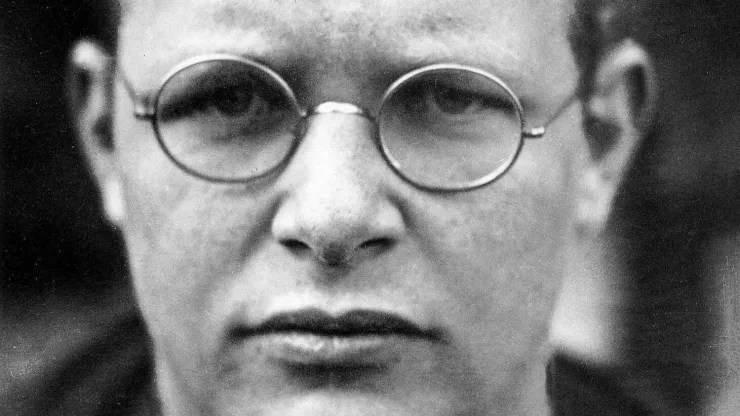
Dietrich Bonhoeffer, whom we celebrate today, understood this.  He wrote, “My thoughts and feelings seem to be getting more and more like those of the Old Testament. It is only when one knows the unutterability of the name of God that one can utter the name of Jesus Christ; it is only when one loves life and this earth so much that without them everything seems to be over that one may believe in the resurrection; it is only when one submits to God’s law that one may speak of grace. It is not Christian to want to take our thoughts and feelings too directly from the New Testament.”

The Holy Bible is more than just a collection of Sunday school stories and nice sayings; it is the history of our God.  In both the Old and New Testaments, it serves as the place to discover Him, know Him, and be known by Him.  

Sermon: Lent 5 – Piercing the Side of Jesus


Jesus has spoken His final words, “It is finished” (John 19:30), and given up His spirit, yet the soldiers doubt He is dead. Anne Catherine Emmerich, in The Dolorous Passion of Our Lord Jesus Christ, picks up the story from there in chapter 48, “The Opening of the Side of Jesus.”

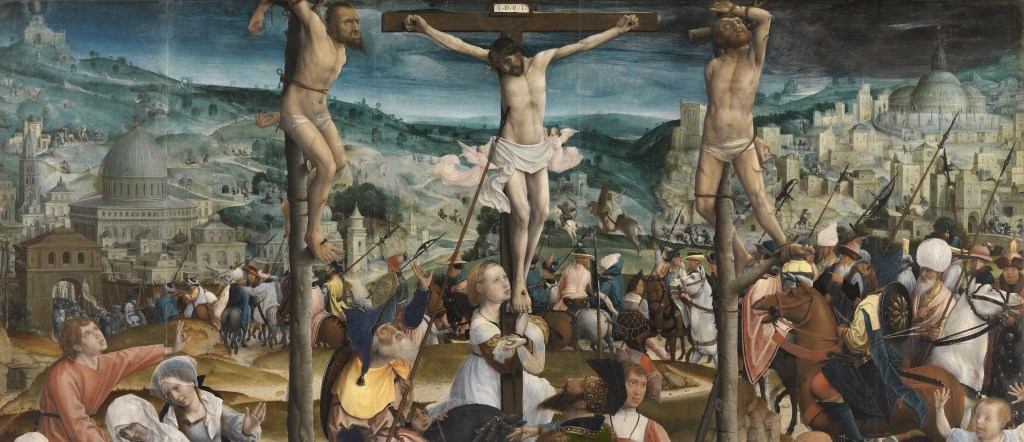
The executioners still appeared doubtful whether Jesus was really dead, and the brutality they had shown in breaking the legs of the thieves made the holy women tremble as to what outrage they might next perpetrate on the body of our Lord. But Cassius, the subaltern officer, a young man of about five-and-twenty, whose weak squinting eyes and nervous manner had often excited the derision of his companions, was suddenly illuminated by grace, and being quite overcome at the sight of the cruel conduct of the soldiers, and the deep sorrow of the holy women, determined to relieve their anxiety by proving beyond dispute that Jesus was really dead. The kindness of his heart prompted him, but unconsciously to himself he fulfilled a prophecy. He seized his lance and rode quickly up to the mound on which the Cross was planted, stopped just between the cross of the good thief and that of our Lord, and taking his lance in both hands, thrust it so completely into the right side of Jesus that the point went through the heart, and appeared on the left side. When Cassius drew his lance out of the wound a quantity of blood and water rushed from it, and flowed over his face and body.

The Prophet Ezekiel received a vision from God. In this vision, an angel of the Lord guided him, and Ezekiel saw the heavenly temple and the New Jerusalem, where God brought about the salvation of His people. He reports that the angel led him to “the temple, and behold, water was issuing from below the threshold of the temple toward the east (for the temple faced east). The water was flowing down from below the south end of the threshold of the temple, south of the altar. Then he brought me out by way of the north gate and led me around on the outside to the outer gate that faces toward the east; and behold, the water was trickling out on the south side.” (Ezekiel 47:1-2) However, if we refer back to the original Hebrew Scriptures, we discover that, while accurate, they do not state that the waters originated from the south side of the Temple. Instead, the Hebrew Scriptures indicate that they came from the “right side” of the Temple.

How should we understand the nature of the Temple that Ezekiel describes?   

Following the Triumphant Entry, Jesus went to the Temple in Jerusalem. Upon his arrival, He became enraged because, as He stated, “It is written, ‘My house shall be called a house of prayer,’ but you make it a den of robbers.” (Matthew 21:13) He then drove the moneychangers and others out with a whip. When asked by what authority he was doing these things, Jesus replied, “Destroy this temple, and in three days I will raise it up.” They responded, “It has taken forty-six years to build this temple, and will you raise it up in three days?” But he was speaking about the temple of his body. (John 2:19-21)

Ezekiel prophesied that water would flow from the right side of the Temple and the Temple was Jesus. Catherine spoke of this, and it is confirmed in Scripture: “One of the soldiers pierced his side with a spear, and at once there came out blood and water.” (John 19:34) 

What purpose does the water serve? Fifty years after Ezekiel, the Prophet Zechariah tells us, “On that day”—that is, the day the Lord intends to bring salvation to His People—“On that day there shall be a fountain opened for the house of David and the inhabitants of Jerusalem, to cleanse them from sin and uncleanness.” (Zechariah 13:1) 

The stream flowed from the right side of the Temple, and the Temple was Jesus. Water and blood flowed from Jesus’ right side after He was pierced with the spear, and this water and blood offered forgiveness of sins to all who would believe in Him. Jesus says, “If anyone thirsts, let him come to me and drink.” (John 7:37)

Today, it may seem that the stream from the side of Jesus is only available to us in a spiritual sense, but that’s not the case. Writing in the fourth century, St. Augustine tells us, “The Sacraments flowed out of the side of Christ.”

We who are touched by the waters of Baptism and who partake of the Lord’s body and blood in Holy Communion are the recipients of the same water and blood that flowed from the side of the crucified Lord and in the words of the Eucharistic Prayer, we receive “the innumerable benefits procured unto us by the same.” (BCP 335) That’s good stuff right there. You should say “Amen.”

When Jesus’ side was opened, and his most Sacred Heart pierced,  the very Gates of Heaven were opened. The blood and water, the River of Life, flowed out, creating a pathway for the healing of our souls and bodies.

Following the great tribulation in the Book of Revelation, John tells us, “The angel showed me the river of the water of life, bright as crystal, flowing from the throne of God and of the Lamb through the middle of the street of the” New Jerusalem. (Revelation 22:1-2)

On a scorching day in July 1864, weary from the heat, Robert Lowry, a Baptist minister, lay on a couch with no energy to do anything else. As he rested there, he meditated on this vision of the river of the water of life in John’s Revelation. The story goes, “While he was thus breathing heavily in the sultry atmosphere of that July day, his soul seemed to take new life from that celestial outlook. He began to wonder why the hymn-writers had said so much about “the river of death,” and so little about “the pure river of water of life, clear as crystal, proceeding out of the throne of God and of the Lamb.” (Source)

With this in mind, a hymn started to take shape in his mind. When the lyrics and music finally came together, he leaped up from the couch, sat down at his organ, and composed it in its entirety. You’ve likely heard it. The first stanza and refrain:

Shall we gather at the river,
where bright angel feet have trod,
with its crystal tide forever
flowing by the throne of God?

Refrain:
Yes, we’ll gather at the river,
the beautiful, the beautiful river;
gather with the saints at the river
that flows by the throne of God.

Through the sacraments, we participate in and receive the blood and water that flowed from Jesus’ pierced side. Therefore, with Robert Lowry, we can confidently say, “Yes, we will gather at the river, the beautiful, beautiful river.” 

Give thanks to the Lord our God, for He has literally opened Himself for you so that you may have access to Him.

Let us pray: Lord Jesus Christ, inexhaustible Fountain of love and grace, I bless and thank you for the ruthless piercing of your sacred side after you died.  It was then that you, holiest of all who are holy, were brutally struck on your right side by one of the soldiers holding a military lance.  It pierced so deeply that it entered the most tender part of your heart and from that wide-open wound there flowed a life-giving fountain of blood and water.  Would that the whole world had been sprinkled, it might then be saved!

O most devoted Jesus, you are the source of all our hearts’ secrets and you dwell in the hearts of those who love you!  O crucified Lord; you are the object of all contemplation!  O Divine Treasury of all gifts and graces, Christ the King and Redeemer of the faithful, you permitted your sacred side to be pierced by the head of a lance.  Open for me, I ask, the door of your mercy and permit me to enter through that wide opening in your side to the innermost recesses of your most sacred heart so that my heart may become powerfully inflamed and be united to you by the insoluble bond of love.  May I live in you and you in me and may we remain united forever.  Amen.

Sermon: Lent 4 – The Nails in His Feet


On the first Sunday of Lent, I shared that the movie The Passion of the Christ was heavily inspired by the text we’ve been meditating on for the past three weeks—The Dolorous Passion of Our Lord Jesus Christ by Anne Catherine Emmerich. One of the scenes in the movie, which is not found in Scripture, originates from Chapter 39.

I apologize in advance for reading too much to you today.

In the movie, the cross lies on the ground while Jesus is nailed to it. A hole has been dug at the base of the cross to allow it to stand upright. Now, with ropes tied to it, the soldiers are lifting the cross so that it will settle into the hole. When the cross is finally vertical, it drops violently a few feet into the prepared hole.

In chapter 39, Catherine speaks of this sudden violent dropping, the sound of it, and the result.

The cross was “raised up in the midst of the vast concourse of persons who were assembled all around…. The air resounded with acclamations and derisive cries when they beheld it towering on high, and after vibrating for a moment in the air, fall with a heavy crash into the hole cut for it in the rock. … When the solemn sound of the fall of the cross into the hole prepared for it in the rock was heard, a dead silence ensued, every heart was filled with an undefinable feeling of awe—a feeling never before experienced, and for which no one could account, even to himself; all the inmates of hell shook with terror, and vented their rage by endeavouring to stimulate the enemies of Jesus to still greater fury and brutality; the souls in Limbo were filled with joy and hope, for the sound was to them a harbinger of happiness, the prelude to the appearance of their Deliverer. Thus was the blessed cross of our Lord planted for the first time on the earth; and well might it be compared to the tree of life in Paradise, for the wounds of Jesus were as sacred fountains, from which flowed four rivers destined both to purify the world from the curse of sin, and to give it fertility, so as to produce fruit unto salvation.

The eminence on which the cross was planted was about two feet higher than the surrounding parts; the feet of Jesus were sufficiently near the ground for his friends to be able to reach to kiss them.”

In the New Testament, the Simon we are most familiar with is Simon Peter; however, there is another Simon, Simon the Pharisee, who we hear about in Luke’s Gospel.

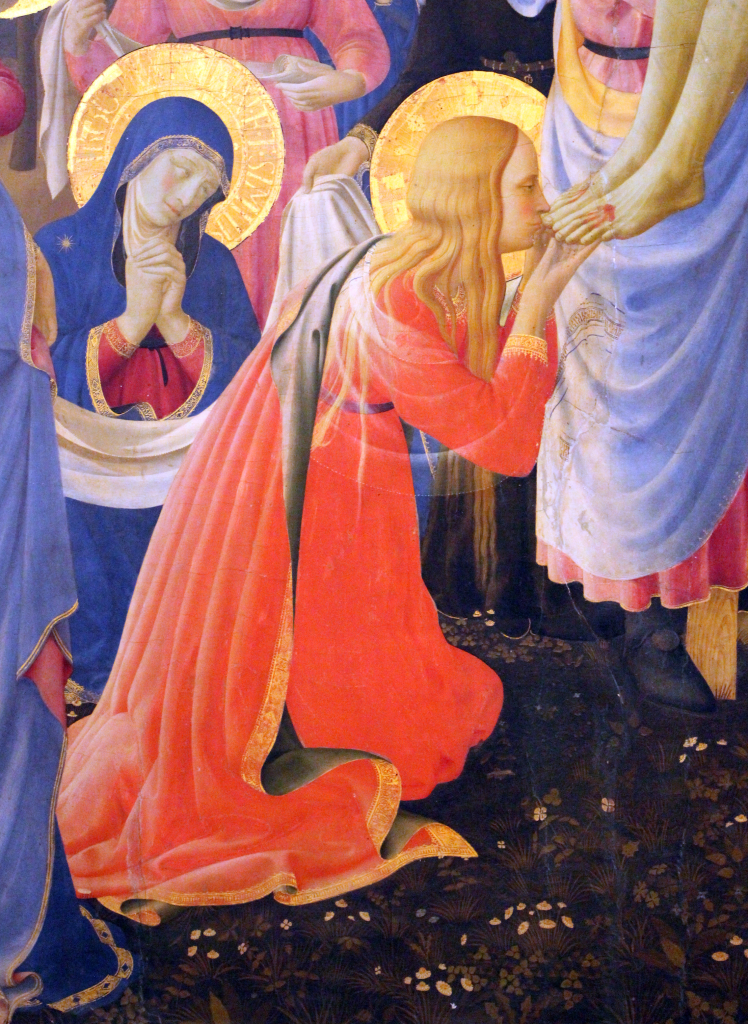
Simon invites Jesus to dinner. While there, “A woman in that town, who lived a sinful life, learned that Jesus was eating at the Pharisee’s house, so she came there with an alabaster jar of perfume. As she stood behind him at his feet, weeping, she began to wet his feet with her tears. Then she wiped them with her hair, kissed them, and poured perfume on them.”

Simon, aware of this woman’s reputation, believes that if Jesus truly is who he claims to be, He would recognize that this woman is wicked. Understanding Simon’s thoughts, Jesus then told a parable. 

“Two people owed money to a certain moneylender. One owed him five hundred denarii, and the other fifty. Neither of them had the money to pay him back, so he forgave the debts of both. Now which of them will love him more?”

Simon replied, “I suppose the one who had the bigger debt forgiven.”

Simon receives the gold star. Jesus then says, “Do you see this woman? I came into your house. You did not give me any water for my feet, but she wet my feet with her tears and wiped them with her hair. You did not give me a kiss, but this woman, from the time I entered, has not stopped kissing my feet. You did not put oil on my head, but she has poured perfume on my feet. Therefore, I tell you, her many sins have been forgiven—as her great love has shown. But whoever has been forgiven little loves little.”

To the woman, Jesus says, “Your sins are forgiven…. Your faith has saved you; go in peace.” (Luke 7:36-50)

Gathered around Jesus as He hung upon His Cross were soldiers, religious leaders, gawkers, and followers. However, Catherine tells us that others were present—demons who cheered on those committing these evil acts and souls in Limbo, witnessing the coming of their salvation. Heaven, Hell, and all of creation witnessed the King upon the Cross, which we can break down into their respective categories. However, in the end, there are really only two categories, and Jesus identified them earlier in His ministry. He stated, “Whoever is not with me is against me, and whoever does not gather with me scatters.” (Matthew 12:30)

Gathered around the Cross were those who were either with Jesus or against Him. Present were those whose sins were forgiven and those who stood condemned. There is no gray area. Those who were forgiven, out of the deepest gratitude and adoration, came forward and, like the woman in Simon’s house, kissed the feet of Jesus. Like the Prodigal Son, they were the ones who knew they had been lost but also understood that they had been found, forgiven, and would be received into the Kingdom of God as sons and daughters. 

What is particularly interesting is the fact that in the past 2,000 years, nothing has changed. There is our crucified Savior upon His Cross, and gathered around Him are Heaven, Hell, and all Creation. As before, we can categorize them into their respective groups—white/black, Republican/Democrat, male/female, rich/poor, Asian/European, etc., etc., etc. However, as before, there are only two categories—those who are with Jesus or those who are against Him. Sons and daughters of God Most High or condemned. Some will time and time again nail Jesus’ feet to the cross, while others will, out of the deepest sense of gratitude and adoration, come forward and kiss His bloodied feet. There are those who will hear Jesus say, “I never knew you; depart from me” (Matthew 7:21), and there are those who will hear Jesus say, “Your sins are forgiven…. Your faith has saved you” (Luke 7:50).

Have faith. Within your soul, come and kneel before the Cross of Jesus, and kiss the nail-pierced feet. He is the only One who can forgive and save, and He endured all of this for you. He is waiting for you.

Let us pray… Lord Jesus Christ, author of our salvation and most gracious Dispenser of pardon, and most patient in tolerating man’s wickedness, I bless and thank you for the great pain, the many stripes, and the bloody wounds inflicted on your tender and noble body. From the soles of your feet to the crown of your head there was no area without its injury or lesion.

O precious wounds, supreme signs of incomparable love, abounding with divine sweetness, it is from you that the sinner learns abiding trust.. otherwise his guilty conscience would cause him to despair. In these wounds we find the medicine for life, abundant grace, full forgiveness, unstinting mercy, and the gateway to promised glory. Whatever defilement I incur or whatever sins of the flesh I commit, it is in these fountains that I wash myself clean, and am purified, and again made new. 

Lord Jesus Christ, fountain of holiness and sweetness, I bless and thank you for your abundant love… Instill in my flesh a fear of you, lest I yield to carnal appetites; pierce my hands, lest I yield to sloth; transfix my feet that I may remain firm and courageously endure toil and sorrows. May your nails enter my heart’s center and there inflict a saving wound, as a consequence of which and because of my overwhelming contrition, may I shed tears and be lost in love of you. Fill me with wonder and increase my devotion, until nothing will be more pleasant or dearer to my heart than Christ Jesus and him crucified. Amen.

Sermon: Gregory the Great


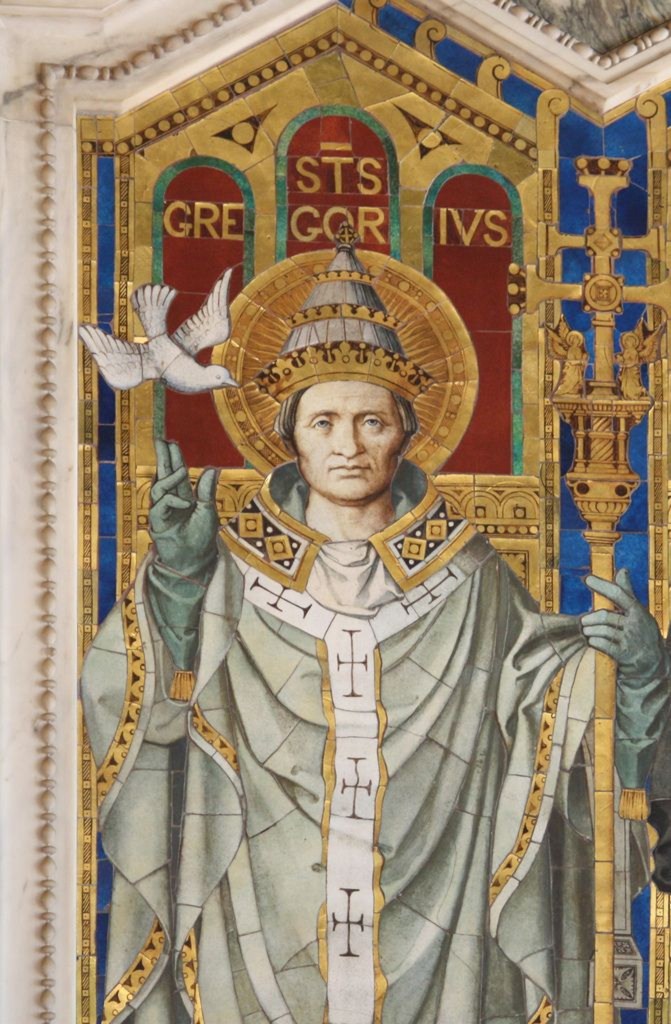
Gregory the Great, whom we celebrate today, was elected Pope in 590 and is one of only four Popes to have received the title “Great,” alongside Leo I, Nicholas I, and John Paul II. 

Gregory accomplished much in his ministry, but significant to us is the fact that he sent Augustine, who would become the first Archbishop of Canterbury, on a mission to the Anglo-Saxons in the year 595. This action led the Venerable Bede to refer to Augustine as the Apostle to the English. 

In addition to his other work, Gregory was also a prolific writer. Perhaps one of his best-known works is the Book of Pastoral Rule, which provides guidance to clergy on how to shepherd their flocks. As Pope, he viewed himself as the “servant of the servants of God,” making it clear why much of this work emphasizes the service and instruction that clergy are to provide to those in their care. One passage that resonated with me says, “Therefore, it should be said to the humble that whenever they lower themselves, they ascend to the likeness of God. At the same time, it should be said to the proud that whenever they take pride in themselves, they fall into imitation of the apostate angel. And what could be worse than pride, which by holding itself above everything, so unwinds itself from the stature of true greatness? And what is more sublime than humility, which by lowering itself unites with the Creator, who is above all things?”

Gregory speaks about humility and pride, but he also addresses how we are to serve one another. When we humble ourselves in service to others, we take on the likeness of our Savior. Additionally, we should not ask, “What’s in it for me?” If we serve with the aim of gaining something for ourselves or trying to elevate ourselves over others, then we are not truly serving them; we are serving ourselves. Remember what Jesus said: “If you love those who love you, what credit is that to you? For even sinners love those who love them. If you do good to those who do good to you, what credit is that to you? For even sinners do the same. If you lend to those from whom you hope to receive, what credit is that to you? Even sinners lend to sinners, to receive as much again. But love your enemies, do good, and lend, expecting nothing in return. Your reward will be great, and you will be children of the Most High.” In our Gospel, Jesus said, “Whoever wishes to become great among you must be your servant, and whoever wishes to be first among you must be slave of all.” These are the ideas that Gregory had in mind when he referred to the role of Pope as being the “servant of the servants of God,” and it is our calling as well.

You and I are called to be humble servants to each other, just as Jesus was to us. When you serve, do so sacrificially. 

One of my favorite prayers by St. Ignatius of Loyola:
Teach us, good Lord,
to serve you as you deserve,
to give and not to count the cost,
to fight and not to heed the wounds,
to toil and not to seek for rest,
to labour and not to ask for any reward,
save that of knowing that we do your will.
Amen.

Sermon: Matthias


The second string and benchwarmers are never good enough to have their names in light or pictures on the cover. It’s always the superstars that get all the press, while the rest of the team goes largely unnoticed. It is true in many different arenas.

Before the symphony begins, the stage is crowded with all the musicians warming up, except for the first-string violinist. Just as the performance is about to begin, they come out to the applause of the crowd, followed only by the conductor. It is as though all the other positions are there only to serve these two. Even so, Leonard Bernstein, who conducted the New York Philharmonic from 1958 to 1969, said, “Second fiddle. I can always get plenty of first violinists, but to find one who plays second violin with as much enthusiasm . . . now that’s the problem. And yet if no one plays second, we have no harmony.”

The “second fiddle” of the San Francisco Symphony said, “Playing second fiddle may connote being second best, but the preparation for playing first or second violin is exactly the same.”

When I was playing football in junior high, I was a benchwarmer who dreamed of one day making it to the second string. However, when I went to practice, the coach didn’t say, “You first stringers, give me 50 sit-ups, and you second stringers (or less) give me 25.” When it was time to practice, we all went at it the same way. On game day, we all suited up and were ready to play.

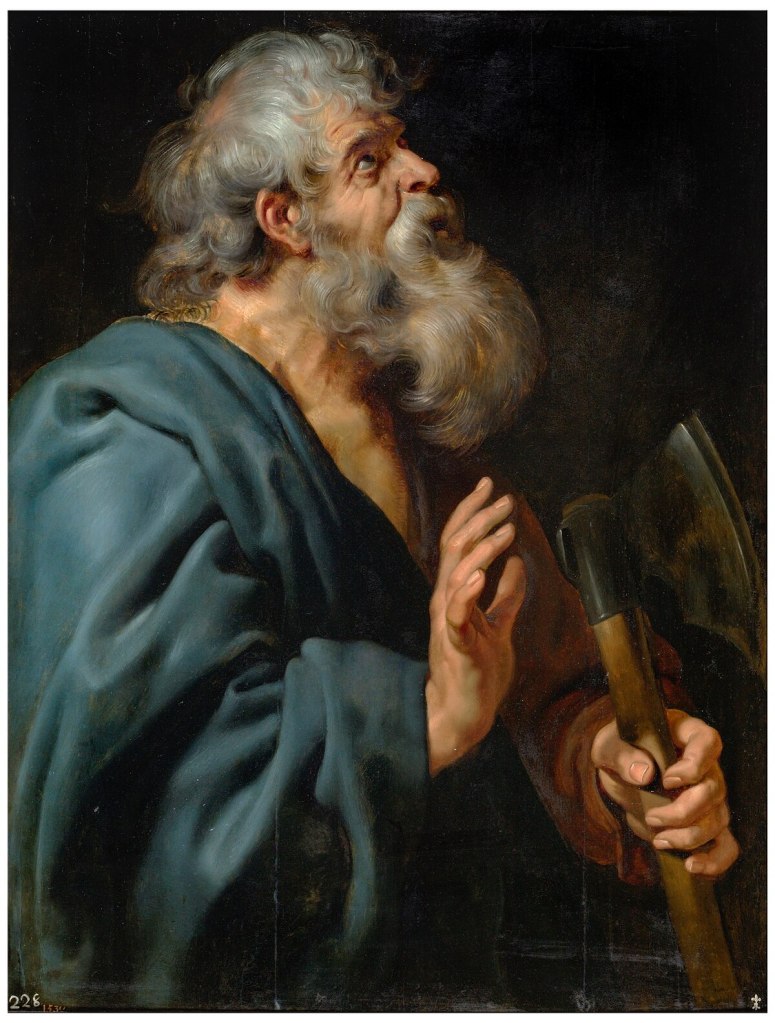
Following the death and resurrection of Jesus and prior to Pentecost, the disciples were gathered in Jerusalem. They had fellowship, prayer, and began establishing a plan for moving forward. In the process, they believed there needed to be twelve disciples, as Jesus had, so the first order of business was to replace Judas, the disciple who betrayed Jesus.

Peter said that the new apostle should be “one of the men who have accompanied us during all the time that the Lord Jesus went in and out among us, beginning from the baptism of John until the day when he was taken up from us—one of these must become a witness with us to his resurrection.”

After discussion, it came down to two. Scripture then says, “Then they prayed and said, ‘Lord, you know everyone’s heart. Show us which one of these two you have chosen to take the place in this ministry and apostleship from which Judas turned aside to go to his own place.’ And they cast lots for them, and the lot fell on Matthias; and he was added to the eleven apostles.”

The second string just got their shot at the big league.

Back to my football career, the coach occasionally let me in the game for a few plays, but that was about it. Some fellas were quite a bit better than me, so I understand now why I didn’t get to play much, but I think another problem wasn’t necessarily my lack of talent but the fact that I never believed I would be called up. I never felt that I could actually make first string. I don’t think it was an intentional act not to try harder, but, looking back, I don’t think I was intentional about improving either. I was just happy to be on the team, get to wear a letter jacket, and muddle along.

Perhaps that is OK in Jr. High football and even the symphony, but Matthias teaches us that when it comes to being a disciple of Jesus, we should constantly seek to improve ourselves and maintain our highest level of commitment, for we never know when God will call us into a greater responsibility.

Sermon: Epiphany VII – “Not ‘If'”

Photo by Igor Omilaev on Unsplash

I’ve complained to you once before about the headlines for newspaper articles. The situation has not improved. One newspaper reports, “Woman missing since she got lost.” I don’t know if the city or the newspaper is the rocket scientist on this one, but “City unsure why the sewer smells.” No concerns about the education system as “Hispanics ace Spanish tests.” Nothing offensive here, “Midget sues grocer, cites belittling remarks.” And in keeping with the politics of the day, “Ex-Minister breaks silence, says nothing.” And if you think those are idiotic, try these goofy phrases on for size.

“Love your enemies.”

“Do good to those who hate you.”

“Bless those who curse you.”

“If anyone strikes you on the cheek, offer the other also.”

And the clincher, “Do to others as you would have them do to you.”

The headlines are ridiculous, but when people start talking like this, I generally begin to think that some sort of rehab is in order.

Last week, we read that Jesus came to a level place with His disciples, and a great crowd gathered around them. Jesus then began to teach, saying, “Blessed are you who are poor, for yours is the kingdom of God.” He gave them the beatitudes. Today’s Gospel reading is a continuation of that same sermon, and the things Jesus says are radically the opposite of how people believed God operated and even more so on how the world operates.

For example, take the one mentioned, “Blessed are you who are poor, for yours is the kingdom of God.” The Old Testament does not directly say you are cursed if you are poor, but it does say the opposite. Proverbs 10:22, 

“The blessing of the Lord makes rich,
    and he adds no sorrow with it.”

Deuteronomy says, “You shall remember the Lord your God, for it is he who gives you power to get wealth, that he may confirm his covenant that he swore to your fathers.” (Deut. 8:18)

The Old Testament does not say you are cursed if you are poor, but for many, these texts imply it. If you are rich, then God is blessing you. If you are poor, you must have done something wrong to anger God. All the points Jesus made in our reading today are just as startling.

“Love your enemies.” We never seem to recall hearing this in the Old Testament because the opposite is so prevalent. Remember the Edomites and the Babylonians. They did not play well with others, and the Israelites saw them as bitter enemies. The Psalmist made that point quite clear. 

“Remember, O Lord, against the Edomites
    the day of Jerusalem,
how they said, “Lay it bare, lay it bare,
    down to its foundations!”

O daughter of Babylon, doomed to be destroyed,
    blessed shall he be who repays you
    with what you have done to us!

Blessed shall he be who takes your little ones
    and dashes them against the rock!” (Psalm 137:7-9)

Not quite the love we were hoping for. Yet, Jesus says we are to love our enemies. In the Sermon on the Mount, He even expanded on this by saying, “I say to you, Love your enemies and pray for those who persecute you.” (Matthew 5:43) 

We can look at this and everything that Jesus said and understand how radical His teachings were at the time—how controversial they must have been. Fortunately, that’s no longer the case. We love our enemies and never curse anyone. We always turn the other cheek and never strike back. We don’t judge or condemn, and we are incredibly forgiving. Am I right? 

I don’t always pull out the Greek Interlinear Bible (it provides a literal translation of the text), but I did with the passage. I was checking on a particular word—“if.” The translation we read says “If” in a few places, but it is not in the original Greek. Therefore, Jesus is not saying, “If you have enemies… if someone curses you… if someone strikes you… if someone steals from you and so on.” Instead, Jesus is saying, “You will have enemies; there will be those that curse you, someone will strike you, and others will steal from you. It will happen, but you are not to treat them like they treat you. You are to treat them the way you want them to treat you.” 

I would like to get up every morning and say my Stuart Smalley (Saturday Night Live) affirmations, “I’m good enough, I’m smart enough, and doggone it, people like me.” I would also like to believe that’s true; however, I may be good enough and smart enough, but not everybody likes me. I’m just not their cup of tea. I don’t think the way they think, believe what they believe, hold to the same politics as they do, or any number of other points of contention. The same is true for all of us. It may seem that everyone is giving you a thumbs up, but don’t be fooled; some are giving you a thumbs down (if not worse), so the question is not whether or not you have these people in your life. You do. The question is, how do you treat them? How do you respond to them? 

Jesus told us how, and St. Peter reaffirmed it in his first Epistle. He writes, “All of you, have unity of mind, sympathy, brotherly love, a tender heart, and a humble mind. Do not repay evil for evil or reviling for reviling, but on the contrary, bless, for to this you were called, that you may obtain a blessing.” He then quotes a portion of Psalm 34. “For

‘Whoever desires to love life
    and see good days,
let him keep his tongue from evil
    and his lips from speaking deceit;

let him turn away from evil and do good;
    let him seek peace and pursue it.’

We are called to be a light unto the nations, but when we act like everyone else, we only bring more darkness. N.T. Wright says that this type of behavior is “Another victory for the hostile world: when Christians ‘give as good as they get,’ repaying slander with slander, they are colluding with the surrounding world, just as surely as if they went along with immorality or financial corruption.” Therefore, our response is that which Jesus calls us to. That is, to behave and respond in a way that is radically the opposite of the world. We are to love instead of hate. Bless instead of curse. Give instead of take. Forgive instead of holding grudges. And this is not easy; even worse, it is not our natural inclination. Most people just aren’t that nice. Therefore, it must be an intentional way of life and a practiced one. 

If you want to love your enemies instead of hating them, you must make a conscious decision to love them and then practice it. If you are going to bless instead of curse, you will have to decide this before you even get out of bed, then you must put it into action. And we must do these things, not just with our lips and actions, but also in our hearts. If you are only washing the outside of the pot and the inside is still filthy, what good is that to you? 

One final note: Jesus said, “The measure you give will be the measure you get back.” But keep in mind that the measure you “get back” is not from this world. It is from your Heavenly Father. Therefore, not everyone is going to like you, and not everyone is going to play according to the same rules you’ve set for yourself. You may turn the other cheek, but you may also get smacked on that one as well. Yet, don’t let that stop you from living the life God has called you to.

The headlines are ridiculous, and the news behind them is often even more ludicrous and incomprehensible. Yet, amid the insanity of it all and in our personal lives, we are called to a different way of life. Will it be easy? No, and no one ever said it would be. Regardless, “be strong and courageous” and live this radically countercultural life Jesus calls us to.

Let us pray. (This is a prayer from Mother Teresa, and I’ve shared it with you before. Perhaps it is not as much a prayer as a commissioning.)

People are often unreasonable, illogical, and self-centered; forgive them anyway.

If you are kind, people may accuse you of selfish, ulterior motives; be kind anyway.

If you are successful, you will win some false friends and some true enemies; succeed anyway.

If you are honest and frank, people may cheat you; be honest and frank anyway.

What you spend years building, someone could destroy overnight; build anyway.

If you find serenity and happiness, they may be jealous; be happy anyway.

The good you do today, people will often forget tomorrow; do good anyway.

Give the world the best you have, and it may never be enough; give the world the best you’ve got anyway.

You see, in the final analysis, it is between you and your God;
It was never between you and them anyway.

Sermon: Epiphany 5 RCL C – “New Horizons”

Photo by Joshua Earle on Unsplash

What gameshow would you be on if you were in a studio audience filled with people in the wildest costumes, all holding up goofy signs and enthusiastically shouting? Let’s Make a Deal. You’ve got the audience, Jay, the man with the table, pretty Carol Merrill pulling back curtains and striking dramatic poses in front of “A brand new Chevy Vega,” and, of course, Mr. Gameshow host himself, Monty Hall.

I remember watching Let’s Make a Deal as a kid but not really understanding it. Now, you can watch all the episodes on the Internet, and they are funny.

Monty would pick one of the crazy-dressed audience members and offer them $300, or they could make a deal. That’s when Jay would appear, carrying his table with a box sitting on it. You could keep the $300 or trade it for the unknown. The audience member would hem and haw, then make a choice, and it would run from there. One deal after another until the big prize. Some people won big; others may walk away with an ox pulling a cart. However, in the end, for the grand prize finale, Monty makes the final deal. You could keep what you had or have what was behind door number three—and there would be the lovely Carol Merrill posing before the hidden prize.

You’ve got $5,000 in hand, or you could make the deal, give it all up, and see what was behind door number three. What do you do?

The Event Horizon Model describes a phenomenon related to how we categorize memories. For example, consider your time in school.

Your entire experience is of the education process, but that process consists of distinct phases, such as elementary school, high school, college, and graduate school. These represent your education, and you have memories that are stored and sorted within and in the context of each phase. Think of it as a library. In a library, you’ve got the fiction section, non-fiction, biography, etc. In the Event Horizon Model, your memory has a section for grade school, high school, etc., and your memories are filed according to those various events. The current or most recent phase holds the clearest memories, while those from the past are a bit hazy. You’re not forgetful; instead, the information from earlier events is less relevant, so it gets set aside or even offloaded.

Throughout our lives, we have various events. Perhaps it is our schooling. It might also be stages of life—child, teenager, adult, married, married with children, and so on. That is a fairly typical progression. However, have you noticed that when you go from one to the next, it often feels as though you are starting over?

I was in school for a while, then I graduated and started to work. A new event and a new beginning. I decided to get married. I stopped being single and started being a spouse. Another event, but also the process of starting over. It really is a bit like saying, “Monty, I think I’ll take what’s behind door number three.” Everything we think we know is taken from us, and we embark on this new thing, and, for the most part, we’ve no idea what we are doing. This can cause anxiety, confusion, and any number of other negatives that impact our lives.

In situations like this, what is needed is something constant and stable that travels with us from one event to the next. We may choose what lies behind door number three—it’s not a bad thing—but we need a place to stand—a place of grounding.

The scene from our Gospel reading today occurs very early in Jesus’ earthly ministry. Jesus had a meal at Peter’s house, but the disciples didn’t seem to be traveling with Him just yet. On this day, Jesus returns to Bethsaida, Peter’s hometown, and the crowds gather. To address them all, He gets into Peter’s boat and asks him to push out from the shore a bit so that He can see and speak to everyone gathered. Afterward, He instructs Peter to push out into the deep water and fish.

Peter says, “We’ve been doing this all night, but if you say so, we will.” They do, and we have the miraculous catch of fish. Peter doesn’t know what is going on, but he knows he is afraid. This Jesus is a holy man, and he doesn’t feel worthy to be near Him, but Jesus says, “You think this is amazing? Stick with me; I’ll show you something special.”

We can interpret this scene in many ways, but today, I would like you to consider it as a representation of your life.

Peter’s boat is more than just his livelihood. His ability to eat and feed his family, to care for them, and to provide for their other needs revolves around that boat. Peter’s boat is more than his livelihood; it is his life, and Jesus steps into it. Jesus steps into Peter’s life. This is an “invasion of grace.” Jesus, God has not taken away Peter’s free will, but through these actions, Jesus is saying to Peter, “I want to be a part of your life.”

This is also a doorway leading to a new event in Peter’s life. He was a fisher of fish. He is becoming a fisher of men. Going from one thing to the next, and the anxiety is setting in, “Go away from me, Lord, for I am a sinful man!” But Jesus tells him, “Do not be afraid. I will be with you. Always. To the end of the age. I will be with you from one horizon to the next. I will be your place to stand.”

Jesus says the same to us, but He is promising more than simply being present. In the context of this episode, I came to understand this at 1:04 a.m. Wednesday morning, and had to get up and write it down.

Jesus instructed Peter to head out into the deep water and cast his nets. Peter followed his advice, and they experienced a miraculous catch of fish—“They caught so many fish that their nets were beginning to break.” Question: What do you think Jesus was doing while all this was happening?

I always imagined Jesus sitting back and watching, but now I believe quite differently. I think He was right there with Peter. I think He rolled up his sleeves, grabbed hold of the net, and started hauling it in with all the rest. I believe He got soaking wet and stunk of all those fish, right along with Peter and the others. I think He joined His voice with Peter’s and shouted for the others to come and help. He laughed with them when James and John’s boat began to sink under the weight of all those fish. Jesus not only stepped into Peter’s life and turned it upside down, but He stepped into Peter’s life and lived it with him. Not as a bystander or judge to see how Peter would do but as a faithful friend. One who wanted the very best for Peter and the others and wasn’t afraid to step in and get dirty. And One who would be with them as they crossed the new horizons of their lives, providing them a firm place to stand, regardless of what was taking place.

Jimmy Buffett wrote a song—Door Number Three. The third stanza:

And I don’t want what Jay’s got on his table
Or the box Carol Merrill points to on the floor
No, I’ll hold out just as long as I am able
Until I can unlock that lucky door
Well, she’s no big deal to most folks
But she’s everything to me
Cause my whole world lies waiting behind door number three.

Some events in our lives are choices like going for what’s behind door number three. Other events are just life. You are in a phase of life where you are healthy, but life walks you through a doorway that leads to sickness. You are secure in your position then you find yourself unemployed. A relationship goes from good to awful. All these various events, where you pass through the doorway, and a new horizon lies before you, bringing the unknown, the destabilizing, the anxiety. However, if we have a place to stand, if we’ve allowed Jesus to step in our boats, invading our lives with His grace, then He will be with us regardless of the circumstances or the outcome. As with Peter, Jesus will be a faithful friend who is not afraid to get involved in the messiest parts of our lives, and along the way, He will provide that firm place for us to stand as we cross from one horizon to the next.

Jesus has climbed into your boat and asked you to put out into the deep. Do what He asks. Take what’s behind door number three.

Let us pray (pray this one for yourself as I read):
Father, I abandon myself into Your hands;
Do with me whatever You will.
Whatever You may do, I thank You.
I am ready for all, and I accept all.
Let only Your will be done in me,
And in all Your creatures.
I wish no more than this, O Lord.
Into Your hands, I commend my spirit;
I offer it to You, Lord,
and so need to give myself,
to surrender myself into Your hands,
Without reserve and with boundless confidence,
For You are my Father.
Amen.

Sermon: Thomas Aquinas


Can you prove to me that there is a God?  Sounds easy enough, but when it comes down to it… not so much.  However, several have tried, and in the eyes of many, including the Church, have succeeded, one of which is our Saint for today, Thomas Aquinas.

Thomas was born in 1225 in Italy. His teachings and writings can only be compared to those of St. Augustine of Hippo when considering their effect on Christian thought (think of them as the Einstein’s of Christianity).  It was during Thomas’ life that the writings of the great philosopher Aristotle were ‘rediscovered,’ and it was Thomas Aquinas who took these writings of Aristotle and integrated them into Christian thought, which means that a new way of understanding God was brought into Christian thinking and that understanding was through the use of reason.  How so?  Think of the polarized views of today.

On one side, we have science.  Science is essentially all reason.  A bit like math: one plus one equals two.  That same reason has led some in the scientific fields or understanding to deny the existence of God; for example, the creation of the universe came about through the Big Bang; therefore, all that business in Genesis is just a fairy tale, and God doesn’t exist.  The other side is Sola Scriptura, which declares that the Bible is all that is needed to prove the existence of God.  Aquinas would say, “Not so fast,” to both groups.

In his greatest work, Summa Theologica, Aquinas puts forward five logical arguments (reasons) for the existence of God, the first of which is the argument of motion.  He begins by simply saying things move.  We can all agree on that.  From there, he says, for things to move, something had to make them move.  Think of a ball on a pool table: if that ball is going to move, something has to move it, whether it is the cue stick or gravity or even a ghosty; something made it move, but what made that something move?  You can chase that as far back as you want. Still, for Aquinas, you eventually have to admit that there was something entirely different that made the very first thing move: the ‘first mover,’ something that was the initiator of all other movement, so why not call that ‘first mover’ God?  That doesn’t reveal the God of Christianity, but it establishes some ‘higher power,’ as some refer to it today.  So, when it comes to creation and someone arguing the Big Bang started it all, Aquinas would ask, “Who made it go bang?”  To those who say Sola Scriptura, Aquinas would say, “God gave you a brain.  Use it.”  The one thing the argument of reason cannot answer is how we go from ‘higher power’ to the God of Christianity.  For Aquinas, that takes one more step: revelation.

Revelation goes back to our study of St. Paul’s Epistle to the Romans, where we understood that our belief in God is a grace given to us by God.  Because of this grace, this revelation, even though we cannot prove that the ‘higher power’ is the God of Christianity, we can have faith and believe.  This same grace, faith, revelation helps us discern the Holy Trinity, the Incarnation, and ultimately the ability to declare that Jesus is Lord, for as Jesus said to Simon Peter when Peter declared Jesus as Lord, “Blessed are you, Simon Bar-Jonah! For flesh and blood has not revealed this to you, but my Father who is in heaven.”  “Flesh and blood,” that is ‘reason’ did not reveal this to you, but the “Father,” that is ‘revelation’ did.

Confused?  It’s OK if you are.  Most of us are.  The important thing to note is that there have been and are really great thinkers of the Christian faith, like Thomas Aquinas, and through their work, we can learn that things like reason and science and faith are not incompatible opposites but work together in providing a more clear understanding of God as revealed in the person of Jesus Christ.

Sermon: Epiphany 3 RCL C – “Not Just any Book”


During World War II, a soldier was stationed on an island in the South Pacific. Seeing him, one of the island’s inhabitants approached him and showed him a copy of the Holy Bible he had received from a missionary several years prior. The soldier told him, “O, we’ve outgrown that sort of thing.” The native smiled back and said, “Well, it’s a good thing we haven’t because if it weren’t for this book, you would be our evening meal.”

If you ever have to sit down with me and watch one of my favorite movies, I don’t guarantee you’ll appreciate it as much as I do. It is an odd and eclectic mix and, I confess, often violent, but let’s be honest, you’ve got to kill a zombie. One that came out in 2010 (no zombies but quite violent and rough language) was The Book of Eli, starring Denzel Washington. What is interesting, given the violence and language, is the fact that The Book of Eli appears on a number of best Catholic film lists. Why? It is about a man, Eli, living in a post-apocalyptic world trying to save the last known copy of the Holy Bible. 

Without spoiling the movie, I’ll tell you that another character, Carnegie (played by Gary Oldman), wants Eli’s Bible. Carnegie will go to any means necessary to have it. However, for Carnegie’s men, going to so much trouble for one book seems like a waste of time and resources, especially since so many are getting killed over it.

Regarding Eli and the book, Carnegie tells one of his chiefs, “Put a crew together; we’re going after him.”

“For a __ book?” The man snaps back.

Carnegie rages, “IT’S NOT [JUST A] BOOK! IT’S A WEAPON! A weapon aimed right at the hearts and minds of the weak and the desperate. It will give us control of them. If we want to rule more than one small, ___ town, we have to have it. People will come from all over; they’ll do exactly what I tell ’em if the words are from the book. It’s happened before, and it’ll happen again. All we need is that book.”

That would be funny if it weren’t true.

Robert Seiple, former president of World Vision, writes, “In 1915, A Russian Armenian was reading his Bible when he was beheaded. I saw the Bible—large, thick, and well-used. Inside was a reddish stain that permeated most of the book. The stain was the blood of this man, one of more than a million casualties of a religious and ethnic holocaust. About 70 years later, a large shipment of Bibles entered Romania from the West, and Ceausescu’s (dictator of Romania) lieutenants confiscated them, shredded them, and turned them into pulp. Then they had the pulp reconstituted into toilet paper and sold to the West.”

People want to take the Bible, weaponize it, and use it for gain, and others see it as so dangerous that they want to destroy it. One book is causing so much trouble. However, in America, studies show that we don’t read it and don’t think much of it. 

To be a member in good standing of the Episcopal Church, you only have to receive communion three times a year. That’s pretty low. When it comes to reading the Bible, American Christians as a whole aren’t much better. The American Bible Society “defines Bible users as people ‘who use the Bible at least 3–4 times each year on their own, outside of a church setting.’” 

We have a Book that people fight and die for, but we, as a Christian people, don’t give it much thought. Why?

My opinion—and that is what it is—is that it is too convenient. We’ve never had to fight for it. In this country, it’s a bit like running water. We don’t give it much thought unless, for some reason, we have to do without it. That is my opinion; however, Barna’s Christian research group has a more researched opinion.

Barna states, “We have shifted from being a nation in which people believed that right and wrong—i.e., morality—was defined by the Bible. We now live in a nation where only 42 percent believe that the Bible is true, accurate, and relevant, and where the largest share of adults believes there is no absolute moral truth, that all truth is determined by the individual.

“On what basis do they determine ‘their’ truth? Primarily emotions: if it feels like the right or appropriate thing to do, say, or believe, then that becomes the course of action, no questions asked.” (Source)

In other words, when it concerns the Bible, we’re like that World War II soldier, “We’ve outgrown that sort of thing.” Because of that attitude, the cracks are beginning to show.

In the time of Nehemiah, the people had returned to Jerusalem after being exiled to Babylon. In our reading today from Nehemiah, the people have completed rebuilding the walls around the city and have come together for one purpose—now that the city walls are restored, they want to restore their hearts to God. To do this, they ask that the Book of the Law be read so a day is set and a platform built. 

Generally, the Scriptures would have been read in the synagogue, but this day was special. We read, “Ezra opened the book in the sight of all the people, for he was standing above all the people; and when he opened it, all the people stood up. Then Ezra blessed the Lord, the great God, and all the people answered, ‘Amen, Amen,’ lifting up their hands. Then they bowed their heads and worshiped the Lord with their faces to the ground.” For about six hours, the people stood and attentively listened to God’s Word. When the reading was complete, the people got down on their knees, bowed their heads to the ground, and worshipped.

They worshipped because they had been provided the opportunity to hear God speak. Then, of all things, they wept. They cried over hearing God’s word. Why? It could have been for joy at knowing that through God’s word, they were being restored. It could have been bitter tears from knowing their sins and how far they had fallen. They could have been crying over the beauty of the message. They were likely crying for all these reasons and more, which led Nehemiah to tell them not to. He wanted them to rejoice in the Word of God and the fact that God, in His goodness and mercy, had provided them with a written document on how to maintain relationship with Him. And it is for this very reason that we, too, should be reading the Bible daily. It contains the words of life and, more importantly, the words of our God.

Preaching in the fourth century, St. John Chrysostom tells his congregation, “I exhort you, and I will not cease to exhort you to pay heed not only to what is said here, but when you are home also you should occupy yourselves attentively with the reading of Holy Scripture…. The reading of Scripture is a great defense against sin. Ignorance of the Scripture is a great misfortune, a great abyss. Not to know anything from the word of God is a disaster. This is what has given rise to heresies, to immorality; it has turned everything upside down.”

Seven or eight years ago, I had kidney stones—a most unpleasant experience. After the procedure, I still had some issues. My doctor responded to those issues: “Drink more water.” I said, “There’s also this going on.” He said, “Drink more water.” “And what about this,” I asked. “Drink more water.” When it was sorted out, I asked my doctor how I could prevent them in the future. He said, “Drink more water.” I began to see a trend.

Would you like to know more about God and how He works in the world? Read your Bible. Would you like to know about God’s plan for your life? Read your Bible. Would you like to have a better understanding of the world around you? Read your Bible. Would you like help getting from one day to the next? Read your Bible. See the trend? Don’t have a Bible? I’ll buy you one. Need help reading the Bible? Let’s talk.

Writing in the sixth century, St. Isidore says, “If a man wants to be always in God’s company, he must pray regularly and read regularly. When we pray, we talk to God; when we read, God talks to us.” Read your Bible. You haven’t outgrown it. Let God talk to you.

Let us pray: Blessed Lord, who caused all holy Scriptures to be written for our learning: Grant us so to hear them, read, mark, learn, and inwardly digest them, that we may embrace and ever hold fast the blessed hope of everlasting life, which you have given us in our Savior Jesus Christ; who lives and reigns with you and the Holy Spirit, one God, for ever and ever. Amen.