Sermon: Decisions

DecisionsDo you ever wonder if you are making the right decision? Have you ever wondered if the decisions you make are according to the will of God? When it comes to what color socks I’m going to wear, I don’t usually fret over that too much, but when it comes to decisions regarding the church, career, family I want to feel confident that God is with me. The trouble is that there are many factors that play into any of the decisions we make. For example, if someone comes to you and ask your opinion or ask you to help them with a project, what factors enter in? Who they are? What is your relationship to them? Do you even like them? How long will the project take? What might you have to sacrifice in order to help them? On the smaller and more personal issues we will often be on our own, but on the larger ones Jesus gives us some pretty good advice.

Jesus said, “Again, truly I tell you, if two of you agree on earth about anything you ask, it will be done for you by my Father in heaven. For where two or three are gathered in my name, I am there among them.” So with larger issues we can come together and if we seek the mind of Christ, then He will be with us. However, when two or three Christians get together, do they always come up with the right answer?

Let’s see: Westboro Baptist Church? No. David Koresch and Jim Jones? No and No. Those are obvious though. What about someone that we might think is really spot on, for example, Martin Luther. Was he always right? During his time, he backed the ruling class which led to the death of 100,000 peasants and he also wrote concerning the Jews and referred to them as a “miserable, blind, and senseless people” who, if necessary, must be driven “out like mad dogs.” Many agreed with him at the time, but do you think he was right? Perhaps this is heresy, but given our track record, I’m not at all convinced that we can know the will of God with 100% accuracy; however, I do believe that we can move in the right direction.

It begins with humility, but from there we must learn to discern what is motivating us and what our true intentions are. When it comes to knowing the mind and will of Christ, it is not about assessing the end result, it is about determining the “Why?” behind it.

You decide you want to build a grand cathedral filled with the finest accoutrements. The floors are rose marble. The walls of Granite. The chalice on the altar is pure gold. In and of itself it is a testament to the glory of God and the love of his people, but why did you build it? Was it truly for the glory of God or did you want God and everyone else to see how special you are? How wealthy you are? What a great magnanimous soul you have?

Gandhi wrote, “Before the throne of the Almighty, man will be judged not by his acts but by his intentions. For God alone reads our hearts.”

When two or three of us come together with our hopes and prayers that Christ will truly be with us, we must ask ourselves a few very important questions: is our motivation pure and will it bring glory to God? If we can answer “Yes” to these questions, then we can humbly move forward, all the while continuously assessing our hearts.
Sermon: “I’m just a ____.”

belThe play, Man of La Mancha, is based on the story of Don Quixote. Don Quixote falls for Aldonsa even though she is a prostitute. He begins to woo her with words in an attempt to win her over and refers to her as Dulcinea, “my sweet little one” and My Lady. However, given her hard life, she cannot take such sweet words and eventually becomes angry with him. I was born in a ditch. I have no idea who my father is. I’ve spent most of my life working on my back. She concludes by saying to him, “Blows and abuse I can take and give back again, but tenderness I cannot bear. I’m just a whore.” In God’s eyes, her own eyes, and the eyes of the world around her she thought she knew exactly who she was, a whore.

In our Gospel reading today, Jesus takes the twelve off by themselves to Caesarea Philippi. There he asks them a few questions. First, “Who do the people say that I am?” The apostles give him a few answers: John the Baptist, Elijah, or a prophet like Jeremiah. But then Jesus makes the question a bit more personal, “But who do you say that I am?” Simon Peter answered, “You are the Messiah, the Son of the living God.” Simon Peter got the gold star that day. He answered the question perfectly and the answer was not one that he could have known himself, but one that was revealed to him by God; however, Peter also could not have known that answer unless he first knew himself. Why? Because you can’t know Jesus as the Messiah, the Savior, unless you know yourself as a sinner – one in need of saving.

Peter, he knew the history of his people as well as his own. Like all those that had gone before him, he was unable to remain holy in the eyes of God. He may not have said, “I am just a whore,” but I suspect that he might have said something close to it and it was only in knowing himself that he knew he needed a savior, and was able to recognize that Savior in Jesus Christ.

When Aldonsa declared to Don Quixote, “I am just a whore,” he responded to her, “The past is over and done. We all stumble on the way to maturity. We all look for love in the wrong arms, happiness in the wrong places. But out of it, you’ve become real. You’ve got a heart of immense compassion for the brokenness of others. You are utterly incapable of hypocrisy and I am deeply in love with you.” Silence follows and finally Aldonsa answers, “From this day forward my name is no longer Aldonsa. I am Dulcinea,” My Lady.

We come before God and say to him, “I am a sinner.. a tax collector.. a whore.. a ___.” We know what we are, and in our confession, Jesus responds to us, “The past is over and done. We all stumble on the way. You are My Father’s child and I am deeply in love with you.” It is in recognizing who we are that, from that day forward, we can say to him, “You are the Messiah, the Son of the living God” and know in our hearts that we are free. Free to love and be loved by God.

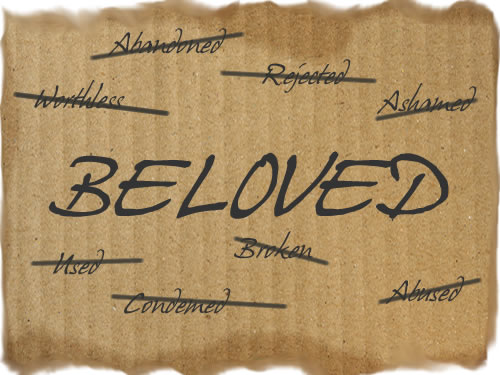
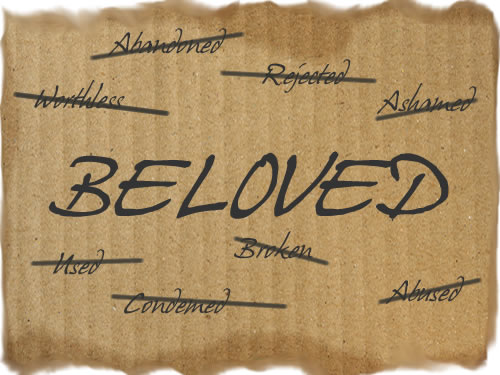
Jesus asks, “Who do you say that I am?” With all faith we can answer, “You are the Messiah, the Son of the living God. You are my Savior.” Jesus responds, “My child. My beloved.”

Sermon: Power of the Mustard Seed

mustard-seedI saw an interesting movie this past week: Lucy. The story is based on the scientific premise that we as human beings only use 10% of our brain. It then goes on to hypothesize on what we would become if we began to use 20%. 30%. 50%. 100% of our brain. In movie world, this is all played out by a woman – I won’t spoil it for you – a woman who begins to use more and more of her brain’s power. The things she is eventually able to do are astounding, not to mention a lot of shoot ‘em ups. It’s over simplified and does the movie no justice, but summed up the movie asked the questions, “What is our potential? What can we become?”

The first of the five parables Jesus tells us in our Gospel reading is making a statement, but it is also asking those same questions: “The Kingdom of Heaven is like a mustard seed… the smallest of seeds, but when it has grown it is the greatest.” What is the potential of the Kingdom of Heaven? What can we as individuals, even though small and insignificant in the larger scheme of things, become as children of God?

I could give you the example of a child born in a manger in Bethlehem 2,000 years ago, but some might argue that this is a poor example, given that He was the Son of God. But what about those twelve fellas that followed him around for three years? They were fishermen and tax collectors, but were they able to affect much change in the world? What about a little nun in a blue and white habit walking the streets of Calcutta? Was she able to bring about a portion of the Kingdom of Heaven? Yes, those are a few of the superstars of the faith, but let me ask you this: does a person who feeds one hungry child do any less for the Kingdom than they did?

We only expect to find the kingdom in cathedrals and mega-churches, in professional choirs and pipe organs, and those persons recognized worldwide for their contributions, but the parable of the mustard seed suggest that the real kingdom-power is to be found in the most humble of places and in the most humble of people.

Emil Bruner, a German theologian, writes, “the kingdom’s form is perpetually little, always seed-sized, divinely designed to be a treasure in earthen, not golden, vessels so that the exceeding greatness of the gospel’s power might always be God’s, not human beings.” The greatness of God is revealed in His ability to take the smallest of instruments and do the greatest of works. A still small voice. A little child. A few fish and a couple of loaves of bread. Three nails. That still small voice spoke all of creation into being. That little child was the savior of the world. A few fish and couple of loaves of bread fed thousands. Three nails held the sins of the world to the Cross.

So, what is your potential? What is it that God desires for you to become? What great things has the Lord prepared for you to do? Later in Matthew’s Gospel Jesus tells the disciples, “I tell you the truth, if you have faith as small as a mustard seed, you can say to this mountain, ‘Move from here to there’ and it will move. Nothing will be impossible for you.”

I don’t know what type of power we would have if, like Lucy, we were able to use 100% of our brains, but I do know this: you are a mustard seed and through the power of God, you are able to do great things.  What’s stopping you?

Sermon: “Carrying Donkeys”

aesops_donkeyOne of the fables of Aesop tells the story of a man, a boy, and a donkey. An elderly man was traveling with a boy and a donkey. As they walked through a village, the man was leading the donkey and the boy was walking behind. The townspeople said the old man was a fool for not riding, so to please them he climbed up on the animal’s back. When they came to the next village, the people said the old man was cruel to let the child walk while he enjoyed the ride. So, to please them, he got off and set the boy on the animal’s back and continued on his way. In the third village, people accused the child of being lazy for making the old man walk, and the suggestion was made that they both ride. So the man climbed on and they set off again. In the fourth village, the townspeople were indignant at the cruelty to the donkey because he was made to carry two people. So the boy and the man strapped the donkey to a pole by his feet and began to carry the donkey. Unfortunately, when they came to a bridge, the boy tripped, sending the donkey into the river below where he drowned.

In our Gospel reading, Jesus said, “We played the flute for you, and you did not dance;
we wailed, and you did not mourn.” He then goes on to say that the people criticized John the Baptist for his severe asceticism and criticized him for being a friend to the outcast and sinners. Both at either end of the spectrum and both criticized. What would the critics have preferred? What could John or Jesus have done to not be criticized by anyone? Absolutely nothing. Why? The philosopher Voltaire stated it like this, “If God created us in His image we have certainly returned the compliment.” The people wanted God’s message to be the message they wanted to hear, not the one that God wanted to give them.

We can find ourselves in a similar predicament. If we preach the Gospel message too strongly, then we will be referred to as Bible thumping fundamentalist. If we soften the message to make it more palatable, then we will be labeled apostate liberals. If we try and hold these two things in tension, then it will be lukewarm fence-sitters. What are we to do? The answer lies in following in the footsteps of John and Jesus, which was to disregard the clamoring of their detractors and seek to do God’s will and to please Him alone. Jesus said, “for I have come down from heaven, not to do my own will, but the will of him who sent me.”

If we try and please everyone in the way that we present and live out the Gospel message, then we will end up carrying a donkey that will eventually drown in a river. It just won’t work. But if we seek after God’s will and do as He asks, then we will accomplish much. In doing so, we will still have critics, but God won’t be one of them.

Thomas à Kempis wrote, “Who are you, then, that you should be afraid of mortal man? Today he is here, tomorrow he is not seen. Fear God and you will not be afraid of the terrors of men. What can anyone do to you by word or injury? He hurts himself rather than you, and no matter who he may be he cannot escape the judgment of God. Keep God before your eyes, therefore, and do not quarrel with peevish words.”

Keep God before your eyes. Seek to do His will. And let others carry the donkey.

Sermon – “Our Enemies”

love-your-enemiesPaul W. Chilcote, the visiting Professor of Practicing Evangelism at Duke University tells the story of the first time he met Jürgen Moltmann, a great German theologian. Then a graduate student, Chilcote describes how, over lunch, he told Moltmann about his life as a student at the university and his studies under Frank Baker. At the name of Frank Baker, Moltmann stopped Chilcote and offered a story about Frank and his wife Nellie.

During World War II there was a prisoner of war camp for captured Germans on the northeast coast of England. Frank and Nellie Baker served a small Methodist circuit of churches in the area and felt compelled to minister to captured German soldiers, so, with permission of the prison commander, each Sunday the couple would invite a few of the German prisoners to church to “share in Word and Sacrament” and then have them to their home to share dinner. Moltmann told Chilcote that this “small thing” took place each Sunday for the duration of the war.

Completing his story, Chilcote then says, “This world-famous theologian paused, looked at me intently, and said, ‘One of those soldiers was a young man named Jürgen Moltmann. And I want you to know that the seed of hope was planted in my heart around Frank and Nellie Baker’s Sunday dinner table.’”

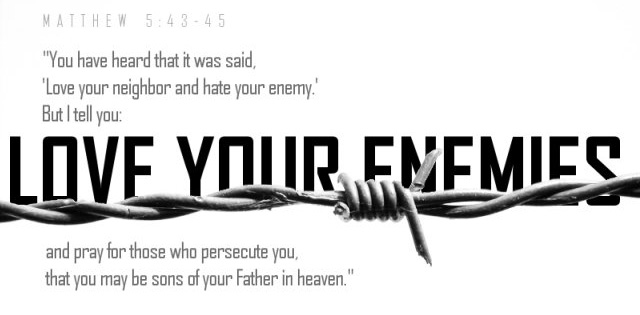
Jesus said, “I say to you, Love your enemies and pray for those who persecute you, so that you may be children of your Father in heaven.” During World War II, Frank and Nellie Baker had sufficient reason to hate those German soldiers, but instead, they lived out this teaching of Jesus and changed the heart the enemy. Can we do the same? Yes. We may not always succeed, but we can most certainly try.

In his letter to the Romans, the Apostle Paul expands on these words of Jesus. They are good words to live by:

Let love be genuine; hate what is evil, hold fast to what is good; love one another with mutual affection; outdo one another in showing honor.  Do not lag in zeal, be ardent in spirit, serve the Lord.  Rejoice in hope, be patient in suffering, persevere in prayer. Contribute to the needs of the saints; extend hospitality to strangers. Bless those who persecute you; bless and do not curse them.  Rejoice with those who rejoice, weep with those who weep.  Live in harmony with one another; do not be haughty, but associate with the lowly; do not claim to be wiser than you are.  Do not repay anyone evil for evil, but take thought for what is noble in the sight of all.  If it is possible, so far as it depends on you, live peaceably with all.  Beloved, never avenge yourselves, but leave room for the wrath of God; for it is written, “Vengeance is mine, I will repay, says the Lord.”  No, “if your enemies are hungry, feed them; if they are thirsty, give them something to drink; for by doing this you will heap burning coals on their heads.”  Do not be overcome by evil, but overcome evil with good.

Our enemies may not always turn out to be great theologians like Jürgen Moltmann, but they may end up being our friends. However, we will never know unless we extend to them the hand of love. This does not mean that they won’t try and snap it off, but we are called to love.

Sermon – “Arrogant Jesus?”

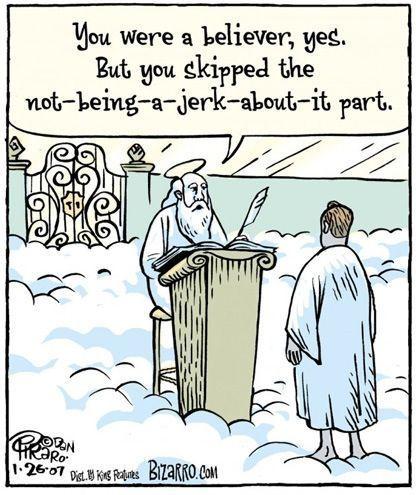
toonIt is a statement that offends many. They consider it religious arrogance: “I am the way, and the truth, and the life. No one comes to the Father except through me.”

Do you see any arrogance in Jesus? As he weeps at the tomb of his friend Lazarus is he declaring his superiority? When Jesus washes the feet of the disciples is he displaying a sense of entitlement? As he hangs naked, beaten, bruised, bleeding, dying on the cross, is this presumption?

No. Jesus is not being arrogant, superior, or presumptuous. So what we must consider when others believe that he is, is that what they are seeing of Jesus is those who act in His Name being arrogant and presumptuous. They believe these things about Jesus because they believe them about us.

Jesus said, “He who has seen me has seen the Father.” Are we showing the Father? Do we stand alongside a world that weeps for its sorrows and pains or do we stand above it, claiming superior knowledge and rights? Do we exhibit the nature of the One we claim is in us or do we demand to have our feet washed? Do we take up our cross and bear it or do we refuse to get our hands dirty? Do we show the world the God of Abraham, Isaac and Jacob and the Father of our Lord Jesus Christ or do we show them the God according to “I”?

I believe that if we as a Christian people do the things that Jesus did, then the world will once again be witness to the God and Father that Jesus demonstrated. It is then that the world will begin to see Jesus and us in an entirely different light. If we continue in the works and ways of Jesus then the world will begin to know for themselves that Jesus is the way, the truth, and the life. It is only then that they will also come to the saving knowledge of Jesus: through Him all may come to the Father.

Thomas a Kempis understood Jesus to say this to him, “Follow Me. I am the Way, the Truth, and the Life. Without the Way, there is no going. Without the Truth, there is no knowing. Without the Life, there is no living. I am the Way which you must follow, the Truth which you must believe, the Life for which you must hope. I am the unbreakable Way, the infallible Truth, the unending Life. I am the Way that is straight, the supreme Truth, the Life that is true, the blessed, the uncreated Life. If you abide in My Way you shall know the Truth, and the Truth shall make you free, and you shall attain life everlasting.”

Our journey through this life will lead us to eternal life, but it is our responsibility to show others that single path that leads to the Father. There is no pride or arrogance involved. It is a path of humility and obedience, but we are called to show it not just to those who think or look like us. Jesus said, “if you love those who love you, what reward do you have? Do not even the tax collectors do the same?  And if you greet only your brothers and sisters, what more are you doing than others? Do not even the Gentiles do the same?” We show the path that leads to eternal life, not just to those who think or look like us, but to all, so that all might come to the saving knowledge of our Lord.

Sermon: Wednesday – “What’s in a Name”

roseRomeo and Juliet, Act 2, Scene 2:
What’s in a name? that which we call a rose
By any other name would smell as sweet;

Moses went up on the mountain to see that wondrous sight of the burning bush. When the LORD saw that he had gone over to look, God called to him from within the bush, and the Lord called out to him by name, “Moses! Moses!” And Moses said, “Here I am.” “Do not come any closer,” God said. “Take off your sandals, for the place where you are standing is holy ground… I am the God of your father, the God of Abraham, the God of Isaac and the God of Jacob.”

God appeared to Jacob again and blessed him. God said to him, “Your name is Jacob, but you will no longer be called Jacob; your name will be Israel.”

The Lord called out to the Prophet Samuel when he was still a young boy, “Samuel! Samuel!” Then Samuel said, “Speak, for your servant is listening.”

Jesus called His disciples by name. Jesus looked at one who would become his disciple and said, “You are Simon son of John. You will be called Cephas” (which, when translated, is Peter).

For four days a man lay dead in the tomb, Jesus called in a loud voice, “Lazarus, come out!” and the dead man came out, his hands and feet wrapped with strips of linen, and a cloth around his face.

On the day of the resurrection, Mary Magdalene turned around and saw Jesus standing there, but she did not know that it was Jesus. Jesus said to her, “Woman, why are you weeping? Whom are you looking for?” Supposing him to be the gardener, she said to him, “Sir, if you have carried him away, tell me where you have laid him, and I will take him away.” Jesus said to her, “Mary!” She turned and said to him, “Teacher!”

The Lord called Moses by name and he led the Israelites out of slavery. Jacob was called by name as the father of nations. Samuel – called by name as prophet. Peter as an apostle. Lazarus was called out of death. Mary was called into the understanding of who Christ truly is.

Jesus tells us that – in the end – he will clothe in white those who are victorious in Him and will walk with them. Jesus declares, “I will never blot out the name of that person from the book of life, but will acknowledge that name before my Father and his angels.”

The Lord knows each and every one of us by name and he has known us from the beginning. The Psalmist declares, “You have searched me, LORD, and you know me. For you created my inmost being; you knit me together in my mother’s womb. My frame was not hidden from you when I was made in the secret place, when I was woven together in the depths of the earth. Your eyes saw my unformed body; all the days ordained for me were written in your book before one of them came to be.” The Lord knows us in the fullest sense..

In our Gospel reading to day Jesus says, “The one who enters by the gate is the shepherd of the sheep. The gatekeeper opens the gate for him, and the sheep hear his voice. He calls his own sheep by name and leads them out.”

There are times for all of us when we wonder if God thinks on us. Remembers us. There are presently over 6 billion people on the planet, can he know me as an individual? Yes. The Lord knows each of us by name and he calls us. He calls us to serve Him. He calls us to follow Him. He calls us out of darkness. By name, he calls us out of death. The Lord Your God is a great God. Have peace in knowing that you are His, precious in His sight.

Sermon: Dame Julian of Norwich

worldDame Julian of Norwich was born in the mid-15th century in England and was an anchoress, that is, one who withdraws from the world for the sake of spending a life in prayer. At age 30 she became ill and was so near death that she was given last rites; however, after seven days she suddenly appeared to heal, and was then given fifteen visions regarding Our Lord’s Passion. She would later write, “From that time I desired oftentimes to learn what was our Lord’s meaning and fifteen years after I was answered in ghostly understanding: ‘Wouldst thou learn the Lord’s meaning in this thing? Learn it well. Love was his meaning. Who showed it thee? Love. What showed he thee? Love. Wherefore showed it he? For Love. Hold thee therein and thou shalt learn and know more in the same.’ Thus it was I learned that Love was our Lord’s meaning.”

Julian recorded these visions – there is a short version and a longer one – and you can find them in the book Revelations of Divine Love. It is a bit too much reading for any sermon, but I would still like to share a short passage from one of the them. It is one of my favorite:

“And in this he showed me a little thing, the quantity of a hazel nut, lying in the palm of my hand, as it seemed. And it was as round as any ball. I looked upon it with the eye of my understanding, and thought, ‘What may this be?’ And it was answered generally thus, ‘It is all that is made.’ I marveled how it might last, for I thought it might suddenly have fallen to nothing for littleness. And I was answered in my understanding: It lasts and ever shall, for God loves it. And so have all things their beginning by the love of God. In this little thing I saw three properties. The first is that God made it. The second that God loves it. And the third, that God keeps it.”

A person could spend hours trying to understand all that is said in that one statement, Julian spent years attempting to understand it herself, but in it we can begin to see the vastness of God. We understand that all of creation rests in the palm of God’s hand. From the smallest particle of the atom to the seemingly infinity of the heavens. But not only does he hold it, but through His Son, Jesus, God is a part of that creation. If it stopped there, then we could at least know that there is someone out there who is in control, but it doesn’t stop there. The first of the three properties were that “God made it.” The third was that “God keeps it.” But the second is that “God loves it.” All that there is was made by God and is held by God and even though he is so vast and we so small, He loves.

The Psalmist asks:

When I consider Your heavens, the work of Your fingers,

The moon and the stars, which You have ordained,

What is man that You are mindful of him,

And the son of man that You visit him?

Why does God care about this small orb He holds in the palm of His hand? Because He loves you. Julian’s most famous passage sums it up for many, “All shall be well, and all shall be well, and all manner of things shall be well.” All shall be well, because God is love and God loves.

Sermon: Producing Good Fruit

22401563_BG1The young management consultant had an interview with the president of a major advertising firm. The young man was nervous. At that stage in his career, it wasn’t very often that he got to talk to the president of a company. The appointment was at 10:00 a.m., for one hour. He arrived early. Promptly at 10, he was ushered into a large and airy room, with furniture upholstered in bright yellow. The president had his shirtsleeves rolled up and a mean look on his face. “You’ve only got 20 minutes,” he barked. The young man sat there, not saying a word. “I said, you’ve only got 20 minutes.” “Your time’s ticking away. Why aren’t you saying anything?” “They’re my 20 minutes,” replied the young man, “I can do whatever I want with them.”

In Matthew’s Gospel Jesus said, “I tell you the truth, unless a kernel of wheat falls to the ground and dies, it remains only a single seed. But if it dies, it produces many seeds.” Not only is Jesus referring to himself, who died and rose again, but he is also referring to us. We must die to self, grow in Christ, and produce that good fruit. We are called to be the mustard seed in our Gospel today – small, but with purpose and results. Not only is this something Jesus instructs us to do, but is also something we have vowed to do – from the baptismal covenant, “Will you proclaim by word and example the Good News of God in Christ?” Our response, “I will, with God’s help.”

I have been told that there are some folks who can grow corn in Montana. I don’t believe it. I tried in Butte and I tried in Anaconda. The ears I grew were something less than pathetic. Now, when I lived down south with my granddaddy, we could grow just about anything: corn, squash, beans, all the good stuff. One year my Grandaddy got a hankering for some strawberries, so he planted two long rows in the front garden. They came in good and those first strawberries were wonderful; however, by the end of the summer we were swimming in strawberries. We had eaten all the strawberry pies we could eat, canned enough strawberry preserves to last a lifetime, and if we should show up at the neighbors with one more bag of strawberries I feel certain they would have sicced the dog on us.

Now consider this from a spiritual perspective: we are to grow in Christ and we are to produce good fruit. So, if you were called on by the Lord to display the fruit you had produced, what would it look like? My Montana corn or my grandaddy’s strawberries?

One of my favorite sayings of the desert fathers, “If a man settles in a certain place and does not bring forth the fruit of that place, the place itself casts him out, as one who has not borne its fruit.” We are to produce good fruit; therefore, we must wisely use the time we have been given.

That young management consultant had his twenty minutes. We can look at the span of your life as he looked at those 20 minutes. They are ours. We can do anything we like with them. We can squander them. We can spend them building up for yourselves treasures on earth. Or, we can use them – or at least a portion of them, say 10% – to produce an abundance of good fruit. Jesus said, “This is to my Father’s glory, that you bear much fruit, showing yourselves to be my disciples.”

Produce good fruit so that your Father in Heaven is glorified.