Sermon: Wednesday in Holy Week

It was Vincent Setterholm who put together a flowchart on how to solve problems with your ox according to the Mosaic Law. This is the chart (http://www.christianitytoday.com/ct/2014/february-web-only/bible-ox-law-flow-chart.html). The chart begins by asking, “Was the ox harmed?” Then Mr. Setterholm takes us through several “Yes/No” scenarios according to the Law.

He does this for every Law concerning the ox, one of which includes the question, “Did the ox gore someone to death.” If “Yes,” then there are questions about whether or not the ox has gored someone before, did the owner know, was the owner warned, all the way down to whether or not the person gored to death was a citizen or a slave. If a citizen, then there will be punishment, up to the stoning of the owner of the ox; however, if the person gored to death was a slave, see Leviticus 21:32: If the ox gores a male or female slave, the owner shall pay to the slaveowner thirty pieces of silver, which isn’t very much money.

To prove that it’s not much, thirty pieces of silver comes up again in the Book of the Prophet Zechariah. At one point, as an example of his ministry, he compares himself to a shepherd, who after his service is only paid thirty pieces of silver. Zechariah reports, “The Lord said to me, ‘Throw it into the treasury—this lordly price at which I was valued by them.’” He was being sarcastic when he referred to it as a “lordly price.” Thirty pieces of silver for the work performed was such an insult that it wasn’t even worth keeping.

We are all familiar with the last time thirty pieces of silver is mentioned in Scripture – from Matthew’s Gospel: Then one of the twelve, who was called Judas Iscariot, went to the chief priests and said, “What will you give me if I betray Jesus to you?” They paid him thirty pieces of silver.

Today, Jesus said to Judas, “Do quickly what you are going to do,” and he did. For the price of a slave gored by a bull, for an amount deemed unworthy to keep even by a shepherd (one of the lowest of all positions), Judas betrayed Jesus and turned him over to the authorities.

Why would Judas do such a thing? Jesus did not give him what he wanted, what he thought he needed, what he thought he deserved, so he gave up God for a paltry earthly reward, which unfortunately seems to be a human trait. Adam and Eve gave up paradise for bite of fruit. Lot’s wife gave up her life for one more look back (turned into a pillar of salt). Esau gave up his birthright for a bowl of stew. David gave up his integrity for a pretty girl. All these little things. All these thirty pieces of silver.

When considering our “little” sins and small vices, we often don’t see them as harming anyone, but they are. We are harming ourselves.

St. Josemaría Escrivá said, “Have you ever stopped to consider the enormous sum that many ‘littles’ can come to?” That can be a positive, because by faithfully attending to the little things in our lives, we are doing the will of God, but it can also be a negative, because one little thing done wrong, can bring down every good work.

I’m not really concerned that any of you are planning to go out and commit some great and heinous sin, but we must all be vigilant in watching over ourselves to insure that we don’t stumble over thirty pieces of silver.

Sermon: Patrick

A rich man named Proculus had hundreds of slaves. The slave named Paulus was so trustworthy that Proculus made him the steward over his whole household. One day Proculus took Paulus with him to the slave market to buy some new workers. Before the bargaining began, they examined the men to see if they were strong and healthy.

Among the slaves stood a weak, old man. Paulus urged his owner to buy this slave.

Proculus answered, “But he is good for nothing.”

“Go ahead, buy him,” Paulus insisted. “He is cheap. And I promise that the work in your household will get done even better than before.”

So Proculus agreed and purchased the elderly slave. And Paulus made good on his word. The work went better than ever. But Proculus observed that Paulus now worked for two men. The old slave did no work at all, while Paulus tended to him, gave him the best food, and made him rest.

Proculus was curious, so he confronted Paulus, “Who is this slave? You know I value you. I don’t mind your protecting this old man. But tell me who he is. Is he your father who has fallen into slavery?”

Paulus answered, “It is someone to whom I owe more than to my father.”

“Your teacher, then?”

“No. Somebody to whom I owe even more.”

“Who then?”

“This is my enemy.”

“Your enemy!”

“Yes. He is the man who killed my father and sold us, the children, as slaves.” Proculus stood speechless. “As for me,” said Paulus, “I am a disciple of Christ, who has taught us to love our enemies and to reward evil with good.” (http://www.preachingtoday.com/illustrations/2003/january/14119.html)

Jesus said, “If you love those who love you, what credit is that to you? For even sinners love those who love them.  If you do good to those who do good to you, what credit is that to you? For even sinners do the same.  If you lend to those from whom you hope to receive, what credit is that to you? Even sinners lend to sinners, to receive as much again.  But love your enemies, do good, and lend, expecting nothing in return.”

There is a lot we think we know about St. Patrick, but there is actually very little, except for bits of his writings. From that we know that when he was in his mid-teens, hew was kidnapped and taken to Ireland as a slave and tended the sheep. Six years later he was able to escape and returned to his home. Later, he wrote that during the night he heard “the voices of those who dwelt beside the forest of Focult (in Ireland) which is near the western sea, and they cried, as if with one mouth: ‘Holy youth, we beseech you to come and walk among us once more.’” Patrick understood these words to be a call to go and preach the Gospel to the Irish – to those who had kidnapped him – to his enemies. He would live out the remainder of his days among those people and converted many to Christianity. When the Roman Catholic Church was able to reassert itself into that region of the world, they found a faithful Irish Church that they didn’t even know existed.

How could he bring himself to return to those who treated him so poorly? Why would he do such a thing? It would seem that his thoughts were the same as Paulus, “I am a disciple of Christ, who has taught us to love our enemies and to reward evil with good.”

How do you respond to your enemies, those who treated you poorly? You are a disciple of Christ. Love them. Reward evil with good.

Sermon: Chad of Lichfield

Henry Augustus Rowland, professor of physics at Johns Hopkins University, was once called as an expert witness at a trial. During cross-examination a lawyer demanded, “What are your qualifications as an expert witness in this case?”

The normally modest and retiring professor replied quietly, “I am the greatest living expert on the subject under discussion.” Later a friend well acquainted with Rowland’s disposition expressed surprise at the professor’s uncharacteristic answer. Rowland answered, “Well, what did you expect me to do? I was under oath.” I suppose, under oath, that even a truly humble person must speak the truth.

Chad of Lichfield was an abbot of a monastery who was elevated to the position of Bishop. However, years later, a new Archbishop of Canterbury questioned the legitimacy of the ordination when he discovered that the rite used for the ordination was not according to the Roman custom. Therefore, Chad offered to resign, saying, “Indeed, I never believed myself worthy of it.” Impressed with Chad’s humility, Canterbury reconsecrated him. It is with this same humility that Chad went about the business of caring for his diocese.

Andrew Murray, a South African pastor wrote, “The humble man feels no jealousy or envy. He can praise God when others are preferred and blessed before him. He can bear to hear others praised while he is forgotten because … he has received the spirit of Jesus, who pleased not Himself, and who sought not His own honor. Therefore, in putting on the Lord Jesus Christ he has put on the heart of compassion, kindness, meekness, long-suffering, and humility.”

In our Gospel reading Jesus teaches about humility, saying that when entering a room, we should take the lowest seat, not thinking too highly of ourselves, so that when the owner of the house comes, he will invite us to take a seat of greater honor. This is a true sign of humility, but it must also be done with right intent, for there is also false humility. That person takes the lowest seat, not out of true humility, but knowing full well that the owner of the house will make a big deal over them before others. Their actions were according to the teachings of Jesus, but their intent was consumed with pride.

Using Murray’s description of humility, Chad of Lichfield was one who “received the spirit of Jesus, who pleased not Himself, and who sought not His own honor.” Even as a Bishop, Chad took the lowest seat, recognizing his unworthiness outside of Christ. Perhaps a lesson we can all learn from.

In book three, chapter eight of The Imitation of Christ, Thomas à Kempis writes, “I will speak to my Lord, I who am but dust and ashes. … It is there You show me to myself — what I am, what I have been, and what I am coming to; for I am nothing and I did not know it. Left to myself, I am nothing but total weakness. But if You look upon me for an instant, I am at once made strong and filled with new joy. Great wonder it is that I, who of my own weight always sink to the depths, am so suddenly lifted up, and so graciously embraced by You.”

Like Chad, when we recognize that our only good comes from God, then we can walk in true humility, and by doing so, we will be lifted up, embraced by Jesus, and brought to a seat of honor at the heavenly banquet.

Sermon: Temptations vs. Sin

If I was to have a favorite televangelist it would be Jesse Duplantis. I think his theology is a bit off, but the stories he tells are brilliant.

On one occasion he told of a priest who received a phone call at 2:00 a.m. from a highly agitated parishioner. The problem was temptation. The priest pointed out the time and asked if they might be able to set a meeting for bit later in the day, but the parishioner was insistent. After a few more attempts, the priest agreed to meet the man down at his office. It was about 3:00 a.m. by the time they both arrived and the man immediately began complaining about all the temptation in his life.

“Father, it is always out there. I pass by a bar and I want to go in and have drink. I’m married, but every time I pass by a pretty girly I want to stop and ask her name. All those flashing neon lights at the casinos just make me crazy!” On and on he went.

So after over an hour of this, the priest asked, “So what is it you would like me to do for you?”

“Father, I want you to pray that all the temptation be removed from life.”

“That’s just not possible,” the priest responded.

The man insisted that it was and by the time he finished complaining, the priest was feeling far less than charitable.

Finally having enough of it, the priest said, “Ok. I’m going to lay my hands on you and pray that the Lord will take away all your temptations.”

“Thank you, Father,” the man blubbered.

The priest stood, placed his hands on the man’s head and began by invoking the Holy Spirit and the blessed angels to assist him and then prayed, “Lord, kill this man.”

The problem in our lives is sin, not temptation. As we read today, even Jesus was tempted, and as St. Bernard said, “He that tempted Christ will not be expected to spare men.” However, a mistake that we can make that may cause a certain spiritual anxiety is to equate those temptations to sin and to feel that we have failed simply because we were tempted. That is not the case. And, although we fight to overcome the temptations and pray that we should not be lead into evil, the temptations can serve the purpose of making us stronger, provided we fight against them.

A story from the Desert Fathers: Abbot John prayed to the Lord that all passion be taken from him. His prayer was granted. He became impassible [he didn’t experience the suffering of temptation]. In this condition he went to one of the elders and said: “You see before you a man who is completely at rest and has no more temptations.” The elder surprised him. Instead of praising him, the elder said: “Go and pray to the Lord to command some struggle to be stirred up in you, for the soul is matured only in battles.” Abbot John did this, and when the temptations started up again, he did not pray that the struggle be taken away from him. Instead he prayed: “Lord, give me strength to get through the fight.”

Remember St. Paul’s words to the Corinthians, “God is faithful; he will not let you be tempted beyond what you can bear. But when you are tempted, he will also provide a way out so that you can stand up under it.” Therefore, when you are tempted, don’t see yourself as defeated. The battle is only just beginning. So, pray that short prayer, “Lord, give me strength to get through the fight,” then stand and fight.

Sermon: Fabian

“When all the people were being baptized [by John the Baptist], Jesus was baptized too. And as he was praying, heaven was opened and the Holy Spirit descended on him in bodily form like a dove. And a voice came from heaven: ‘You are my Son, whom I love; with you I am well pleased.’”

In the year 236 the Pope had died. The people had gathered in the catacombs below the city of Rome in order to elect a new one. In the crowd was a young man (about 36 years old) from the country, Fabian. He had been visiting the city and when he heard that they were electing a new Pope, he decided to go and watch.

As the proceedings began, the historian Eusebius reports that a dove flew into the catacombs, circled Fabian, and then landed on his shoulder. The people must have immediately recalled the Holy Spirit descending upon Jesus in the form of a dove, for they immediately cried out, “He is worthy! He is worthy!” And this unknown, non-clergyman was elected as Pope. Following his ordinations as deacon and then priest, he was installed as the twenty-first Bishop of Rome and Pope. (The next time the Roman Catholic Church prepares to elect a new Pope, I may be taking a trip!) Fabian would reign for seventeen years.

During his reign and in the early years of the Church, the Roman Empire were generally tolerant of other religions and simply incorporated them into the existing system of pagan gods. However, the the Jews presented a difficult problem: they had the One True God and the commandments forbid them from building any graven image of their God, so the Romans made an exception for them. For a time, the Christians were able to “hide” in the Jewish synagogue, but when it was discovered what they were doing and their beliefs, they were persecuted.

For example, it was believed that Christians practiced incest, because their scriptures instructed them to give the kiss of peace to their brothers and sisters. In addition, they were thought to practice cannibalism because they fed on the Body of Christ. These issues and others led to persecutions. Sometimes they were more localized, but occasionally would spread across the entire empire. The first of these empire wide persecutions occurred in 257 under Emperor Décius and Fabian was one of the first to be martyred. He was beheaded.

Our collect for Fabian – that prayer we read near the beginning of the service – requested: “O God… Grant that those whom you call in any ministry in the Church may be obedient to your call in all humility, and be enabled to carry out their tasks with diligence and faithfulness.” Now that may sound like a nice prayer, because you all can think, “Well, Fr. John, get out there and be humble and obedient in carrying out your task.” And you say that because you think the collect has nothing to do with you. Well, allow me to correct you. From the catechism (which I know you all have read) “Q: Who are the ministers of the Church? A: The ministers of the Church are lay persons, bishops, priests, and deacons.” That means we are all called to be humble and obedient in the ministry that God calls us each to.

That may sound scary at times, but the beauty of God’s action in the world is that just as He enabled His Son and those like Fabian to accomplish the ministry he gave to them through the descending of the dove, the giving of the Holy Spirit, he has also given to you, for do you not know that your body is a temple of the Holy Spirit. Therefore, through the power of that same Spirit, be faithful and obedient in the ministry Christ has called you to accomplish.

Sermon: Octave of the Epiphany

Today we celebrate an unofficial and even suppressed feast day: the Octave of the Epiphany.

Octave means eight and this is the eighth day after the Epiphany. The octave was originally established by the church because certain events in the life of Christ and the church were believed to be of such significance that one day was not enough to celebrate. Feast days that grew to include octaves were Christmas, Easter, Pentecost, and even local celebrations for local or patron saints. The symbolism behind the octave is a bit cloudy, but is likely tied closely with our rebirth in Christ (it is the same reason that baptismal fonts often have eight sides, as the eighth day of creation is considered the day we are created new through our baptism).

Along with these other feast days, the Feast of the Epiphany was given an octave. As you many know, the Epiphany is the day we celebrate the Magi coming and bringing gifts to Jesus. The importance of this event is that the Magi were gentiles, so in visiting and worshiping Jesus, God is revealed to the Gentiles. That revealing is what an epiphany is. A manifestation of God.

The Octave of the Epiphany was a celebration of this great event, but would be formally removed in 1955 from the Roman Catholic calendar. How and when if fell out of favor in the Anglican Church I am not certain. So why are we celebrating it today if it’s not official?

There is a chance that you and I may have come to worship the God of Israel, but it is likely – without the revelation to the Gentiles – that you and I would be worshiping dumb idols (if anything) instead of the One True God. Therefore, it seems to me that such a great event is worth celebrating for more than just one day. In that event it is made evident that this child in the manger is bringing us and not just the Jews our salvation. As Paul said to the Galatians, “So in Christ Jesus you are all children of God through faith, for all of you who were baptized into Christ have clothed yourselves with Christ.  There is neither Jew nor Gentile, neither slave nor free, nor is there male and female, for you are all one in Christ Jesus.” The God of Israel has been revealed as the God of all.

That being true, then, what next? Jesus has been revealed to the world, so what now?

In our Gospel reading today, John the Baptist’s disciples saw Jesus passing by. After a brief conversation with John, they began to follow Jesus.

Turning around, Jesus saw them following and asked, “What do you want?”

They said, “Rabbi” (which means “Teacher”), “where are you staying?”

“Come,” he replied, “and you will see.”

Following the Epiphany of Jesus, His revealing to all humankind, we ask, “What’s next?” Jesus response, “Come and you will see.” It is an invitation to follow Jesus. To take to the road and begin a great journey. A journey of salvation, redemption, ministry, hope… life. There is no limit to the depth of this journey. The only question remaining for you is, “How far are you prepared to go?”

Sermon: Ralph Adams Cram, John LaFarge, and Richard Upjohn

Ralph Adams Cram, John LaFarge, and Richard Upjohn: these are not what you would call household names, but their work you may recognize. Cram and Upjohn were both architects and LaFarge was an artist.

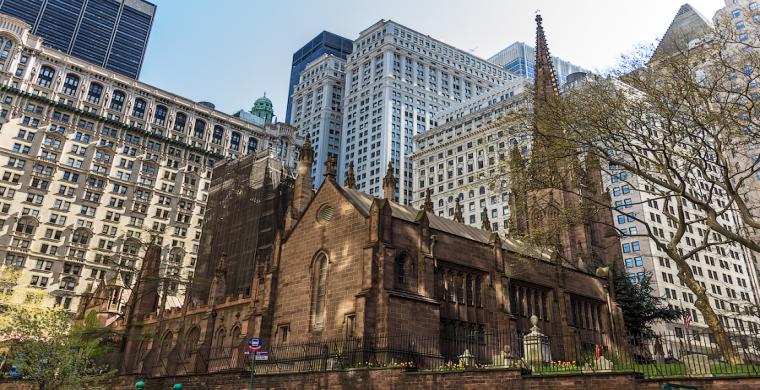
Cram’s work includes All Saints Chapel at Sewanee, The Cathedral of St. John the Divine in New York, and several of the buildings at Princeton University. Upjohn was the architect of Trinity Church in New York and, for those of you who have visited Nashotah House, St. John Chrysostom in Delafield, Wisconsin, along with many other church buildings. LaFarge is noted for his work with Stained glass windows.

We celebrate these three (and I think we should add one more to the list: R. R. Wright who was the architect of St. Matthew’s) because of their contributions to our houses of worship. Frank Lloyd Wright said, “A doctor can bury his mistakes, but an architect can only advise his clients to plant vines.” For these architects and artist, no vines were needed.

The architectural phrase, “form follows function,” is true. A building is most often designed to efficiently serve a particular need. That is true for the church as well, but the church is not designed to build material goods or serve as an office complex. A church is designed to draw you toward the transcendent. To help you enter into the presence of God. So with its high ceilings, stained glass, iconography, altars, and all the other accoutrements, the church building serves as a sanctuary in the midst of a chaotic world designed to draw us nearer to our God.

Those that we celebrate today, created some of our most notable sanctuaries. But even they, standing before their most glorious works, would understand King Solomon’s words that we read. It was at the dedication at the Temple he had built that Solomon prayed, “But will God indeed reside with mortals on earth? Even heaven and the highest heaven cannot contain you, how much less this house that I have built!”

Our sanctuaries are holy places of refuge in this world, but they cannot contain our God. Stephen, the first deacon and martyr declared, just before he was stoned to death, “The Most High does not dwell in houses made with human hands; as the prophet says,

‘Heaven is my throne,
and the earth is my footstool.’”

Our grandest cathedrals cannot house God and even an infinite universe is too small for his greatness, but what is so amazing is that the body of a believer can. You are his temple, so wrote St. Paul in his first letter to the Corinthians, “Do you not know that your body is a temple of the Holy Spirit within you, which you have from God, and that you are not your own?  For you were bought with a price; therefore glorify God in your body.”

The great Anglican poet, George Herbert, understood this and wrote of the altar of God that resides within the temple of us all: the heart.

A broken  Altar,  Lord,  thy servant  rears,
Made  of a heart,  and cemented with  tears,
Whose  parts are as  thy hand  did  frame;
No  workmans tool hath  touch’d the  same.
A    Heart     alone
Is   such  a  stone,
As    nothing    but
Thy pow’r  doth cut.
Wherefore  each part
Of   my  hard  heart
Meets in this frame,
To praise  thy name.
That   if  I  chance  to  hold  my  peace,
These stones to praise thee may not cease.
O   let  thy  blessed   Sacrifice  be   mine
And   sanctifie  this  Altar  to   be  thine.

We celebrate those who build our houses of worship, and along with them, we celebrate the One who builds our bodies into His most Holy Temple.

Sermon: Richard Baxter

When it comes to insurance, the cafeteria plan is one that allows a person to pick and choose what coverage they want. For example, someone with no children might choose dental, but not orthodontia. A cafeteria Christian functions in a similar manner. They are ones that choose to follow certain aspects of the faith, while leaving others pieces out. “I can get behind the ‘love your neighbor bit’, but ‘praying for my enemies’ is out of the question, unless of course you are asking me to pray that God will smite them.”

When it comes to Richard Baxter, you might say I’m a cafeteria Richard Baxter fan. There are parts of his writings and work that I think are quite remarkable, but other bits… not so much. Today, I’ll stick with what I agree with him on and let you decide for yourselves on the other, should you choose to read up on him.

On Sundays these past few weeks we have been looking at the four marks of the church: one holy catholic and apostolic, and have come to understand that we can not be one without the other. At the heart of these marks is is union with Christ and with one another. It is to this unity – or disunity – that Baxter partly spoke of in his work The Reformed Pastor, directed at other clergy. It was first published in 1656, but I wonder if you think he might have application for us today with regard to Christian unity.

Consider these words that he addressed to other pastors on the disunity of the Church as he saw it: “And it is not ourselves only that are scorched in this flame, but we have drawn our people into it, and cherished them in it, so that most of the godly in the nation are falling into parties, and have turned much of their ancient piety into vain opinions and disputes and envyings and animosities… they see so many parties, that they know not which to join; and think that it is as good to be none at all, as of any, since they are uncertain which is the right.”

Does any of that sound familiar to you? The latest Pew Research indicates that nearly 20% of Americans – and the fastest growing category – now classify their religious preference as “None,” and we can blame that on culture, but I believe that we can also blame it on the church.

In an attempt to turn the tide of his time, Baxter provided some guidance. Its guidance that was directed toward clergy, but as we all make up what St. Peter calls the Royal Priesthood, then it applies not just to the ordained, but everyone. Baxter writes, “Every time we look upon our congregations, let us believingly remember that they are the purchase of Christ’s blood, and therefore should be regarded by us with the deepest interest and the most tender affection.”

Each of you is “the purchase of Christ’s blood,” as is every member of the faith; therefore, we must all learn to set aside (in the words of Baxter) our, “vain opinions and disputes and envyings and animosities” and rediscover the unity that can be found only in Christ Jesus.

Baxter’s advice to accomplish this: “Take heed to yourselves” and “Take heed to all the flock.” Watch over your own life and assist others in their life with Christ. I may not agree with everything he wrote or said, but that is advice we should all be able to support.

Sermon: Sergius – Abbot of Holy Trinity, Moscow

In the year 1206 the great Mongolian Empire began under the rule of Genghis Khan. Over the next century and a half, the Mongol armies conquered much of Asia including most of what is now Russia. For years the Mongols oppressed the people, but there was certain resistance along the way. Before one battle, the Prince of Moscow, Dmitry Donskoy, came and sought the advice of Sergius, the Abbot of the Monastery of the Holy Trinity in Moscow. Sergius encouraged him. As the battle commenced, a great and miraculous sandstorm blew up in the face of the Mongols and gave Donskoy the opportunity to go onto achieve a great victory, which “laid the foundation of his people’s independent national life.”

Abbot Sergius’ support of the prince and his love of the Russian people led him to be highly revered and he is still known as “The Spiritual Father of Russia.” “The Modern historian Klutchévski declared that the entire Russian people owe their whole freedom and liberation to the moral education and spiritual influence of one man: Sergius of Moscow.”

Professor Klutchévski wrote, “There are historical names which escape the barriers of time and whose work profoundly influences subsequent generations, because the figure of a personality is transformed into an idea. Such is the case with St. Serguis.”

The figure of a personality being transformed into an idea. John F. Kennedy, perhaps another of those personalities transformed into an idea, said during a speech in 1963, “A man may die, nations may rise and fall, but an idea lives on. Ideas have endurance without death.” In such cases, the idea is not the light bulb over the head moment, but is instead the desired outcome where everything is laid on the line in order to achieve success. The life of St. Sergius may have transformed into such an idea, but he was working from an idea that had been put forth centuries before: “The kingdom of heaven is like a net that was thrown into the sea and caught fish of every kind; when it was full, they drew it ashore, sat down, and put the good into baskets but threw out the bad.”

Jesus planted this idea of being fishers of men in the minds of his disciples. That idea survived the death of the disciples and centuries later Sergius continued to put everything on the line, just as the disciples did, in order to achieve the desired outcome. He took that one idea and cast a net over the people of Russia and also became a fisher of men.

Following the example of St. Sergius, illuminated in the light of God, keep this idea that Christ established set firmly before you, and cast your net. Join the disciples, Sergius and so many others by becoming fishers of men. How? You don’t have to catch an entire nation, thousands, or even hundreds. “I tell you, there is rejoicing in the presence of the angels of God over one sinner who repents.” By simply sharing your story of God with one person or inviting one person to church, you are casting the net and doing the work of Christ.