On this feast of St. James the Apostle (Originally posted on July 25, 2019), I am delighted to launch this new item on the blog: In 2020 my cousin, Janie, and I plan to walk the Camino de Santiago, Camino Francés (The French Way), which begins in St. Jean Pied de Port, France, is roughly 500 miles across northern Spain, and leads to the Cathedral of Santiago de Compostela. In order to accomplish this pilgrimage we’re going to need to get started now. This page is to document the journey, from training (I weigh in at 243lbs and that just isn’t going to work… need to drop at least 50lbs) to shoes, from plane tickets to side trips, from a compostela to albergues, and hopefully learn a bit of Spanish in the process. Looking forward to taking you along the way.
At some point in 2001 (I was 36 and in my first year of seminary), the switch in my body that says, “You can eat all you want” was flipped to “You CANNOT eat all you want.” Ever since that point I’ve struggled maintaining even a healthy weight. Up and down. Up and down. Today the scale hit the number above (can’t bring myself to type it again).
What does this number mean? It means, unless absolutely necessary, I no longer wear shirts that tuck in. My suits don’t fit. My clericals are tight around my neck (19″). My knees hurt. I don’t sleep well. I can’t preach on gluttony. etc. etc. etc., but most importantly for this blog entry: I won’t be able to walk the Camino… and I’m GOING to walk the Camino, so I have to do something about that number. It starts today.
I won’t post everyday on this, but I’ll keep you up to date. For those around, when you see me back in my black suit, you’ll know I’ve made a bit of progress. When you see me in my gray suit… Yahtzee!
“HE WHO follows Me, walks not in darkness,” says the Lord. By these words of Christ we are advised to imitate His life and habits, if we wish to be truly enlightened and free from all blindness of heart. Let our chief effort, therefore, be to study the life of Jesus Christ.” Those words have been read by more people than any other words printed except those printed in the Holy Scriptures. They are the opening sentences of The Imitation of Christ by my 15th century friend, Thomas à Kempis. I would share with you my favorite passages of this great work, but then I would pretty much have to read the entire book to you.
Since it was first published in 1471, the year of Thomas’ death, there have been 6,000 different editions published. That’s one new edition, every month, for 500 years.
I’ve told you the story before: I’ve read all sorts of devotional / inspirational books. From Oswald Chambers to the more contemporary, but in every case, it took me less than about a month to become completely bored or frustrated with them. Oswald was probably the most compelling, but they seemed to all tell me what I wanted to hear, not what I needed to hear. They seemed more interested in giving the reader a warm fuzzy than in changing lives. Then one day, as I was walking through the library of Nashotah, I came to the shelves of free books. Ones that were dated or worn out and students could take what they wanted. It was there that I picked up this very book, and although I now have multiple editions, I’ve never set it down. Thomas is a true companion of my soul. And, clearly, I’m not the only one who feels this way.
St. Thérèse of Lisieux, who’s book, Story of a Soul, we just finished in book club writes, “If I open a book composed by a spiritual author (even the most beautiful, the most touching book), I feel my heart contract immediately and I read without understanding, so to speak. Or if I do understand, my mind comes to a standstill without the capacity of meditating. In this helplessness, Holy Scripture and the Imitation [of Christ] come to my aid; in them I discover a solid and very pure nourishment.”
If Thomas à Kempis and the Imitation have had such widespread and lasting effect on so many, then why is he still not SAINT Thomas à Kempis. There have been two attempts at his canonization, 1655 and 1911, but both failed. One theory for the failure states that Thomas was buried alive—when they exhumed his body as part of the examination process, they found scratch marks on the inside of the lid of his coffin, with splinters in his hands. Rules say that it cannot be known if he died in a state of grace, because—obviously—no one was present at his death, therefore he cannot be sainted. However, there is further evidence that suggests this is only a myth that developed over the years. The second theory is that the Imitation was not written solely by Thomas, but was a compilation of several authors and Thomas was the editor of the work. In either case or none of the above, the church has not elevated Thomas, but those who read him have.
He is one of the medals on my rosary, along with the Blessed Virgin Mary, St. Michael the Archangel, and St. Josemaría Escrivá. With these three, Thomas, and the Lord Jesus walking with me, I figure I’m in pretty good hands.
My former bishop would give me a hard time for reading the Imitation—“Too morbid, John.”—and I’ve had friends suggest that I pick up something more inspiring, so I know he is not for everyone, but if you’ve never picked up this little book, I recommend it to you, with this one warning: you may never put it down.
When Boudreaux and Clotilde were first married, Boudreaux laid down the law. “I’m the MAN of the house! Starting tomorrow, I want you to have a hot, delicious meal ready for me the minute I walk through that door. Then, while I’m watching ESPN and relaxing in my lazy boy, you’ll bring me my slippers and then run my bath. And when I’m done with my bath, guess who’s going to dress me and comb my hair?”
Said Clotilde, “The funeral director.”
From our Gospel reading, it would seem that Mary has taken a few plays from Boudreaux’s play book. Sit and chat while Martha does all the work, which leads Martha to complain to Jesus, “Lord, do you not care that my sister has left me to do all the work by myself? Tell her then to help me.” Yet, Jesus’ response indicates that he does not view Mary’s inaction as laziness: “Martha, Martha, you are worried and distracted by many things; there is need of only one thing. Mary has chosen the better part, which will not be taken away from her.”
Based on this response, we could say that Jesus is making a point about active and contemplative ministry. Martha, running around could point to the busy Christian, always taking part in various ministries, but never stopping to sit at the feet of Jesus, like Mary, who represents the contemplative Christian. That is one who sees the work of the Christian person residing in prayer and time with God. But, if we all sat around navel gazing, nothing would get done; and if we all ran about all the time, we would never really engage God in the work of the soul. So, if our Gospel is not about Mary being lazy or the debate over active and contemplative Christians, then what is it about?
Martha is complaining about Mary not helping, but the real problem—in the words of my granny—Mary is acting like a hussy. That girl is out of line. Make her get up and help with (Lord forgive and protect me for saying this out loud) make her get up and help with “women’s work.” The problem is that Mary is acting like a man. The only time a woman might sit at the feet of a man would be in the bedroom with her husband, but out in public… hussy. Mary has broken cultural and social barriers. And not only is she acting like a man, but she is also acting like a disciple. One who sits at the feet of the rabbi and learns. Yet, Jesus isn’t just a rabbi, he is the Son of God, so what has Mary done? Mary has boldly come before Jesus, knelt before him, and entered into the very presence of God, hence, she “has chosen the better part, which will not be taken away from her.”
Remember the Temple complex: the outer area was the Court of the Gentiles. This is the area that Jesus entered and demonstrated a little righteous indignation, flipping tables and throwing out money changers. Moving further in we come to the Court of the Women, then the Court of the Priests, where the sacrifices took place. Entering into the Temple itself you first come to the Holy Place and before you is a curtain. Behind the curtain is the Holiest of Holies where the Ark of the Covenant resides. With regard to the Holy Place and Holiest of Holies, Scripture says, “The priests go regularly into the first section, performing their ritual duties, but into the second only the high priest goes, and he but once a year, and not without taking blood, which he offers for himself and for the unintentional sins of the people.” Only once a year would someone enter into the presence of God, but when Jesus died: “There was darkness over the whole land until the ninth hour, while the sun’s light failed. And the curtain of the temple was torn in two.” Mary sat at the feet of Jesus, she sat in the presence of God, and through his death, Jesus opened that same access to all who call on his name. As Jesus said, “Very truly, I tell you, I am the gate for the sheep. All who came before me are thieves and bandits; but the sheep did not listen to them. I am the gate. Whoever enters by me will be saved, and will come in and go out and find pasture.”
Mary was not the one who broke the barriers by sitting at the feet of Jesus. Jesus broke the barriers through his Incarnation. Emmanuel—God with us. Therefore, like Mary, we too can be bold, we can come into the very presence of God and sit as his feet, speaking to him and learning from him. As Paul said in his letter to the Hebrews, “Let us then with confidence… with boldness draw near to the throne of grace, that we may receive mercy and find grace to help in time of need.”
As my favorite passage of the Bible reads: “You have not come to what may be touched, a blazing fire and darkness and gloom and a tempest and the sound of a trumpet and a voice whose words made the hearers beg that no further messages be spoken to them. For they could not endure the order that was given, “If even a beast touches the mountain, it shall be stoned.” Indeed, so terrifying was the sight that Moses said, “I tremble with fear.” But you have come to Mount Zion and to the city of the living God, the heavenly Jerusalem, and to innumerable angels in festal gathering, and to the assembly of the firstborn who are enrolled in heaven, and to God, the judge of all, and to the spirits of the righteous made perfect, and to Jesus, the mediator of a new covenant.”
We’ve been given this tremendous access to the Creator of the Heavens and the Earth, so how do we enter? The answer is prayer and our Gospel reading can also help us to understand the kind of prayer that is needed. It is easier to understand this by looking at different types of communication that we practice, specifically, the difference between a text message and a phone call.
What I’ve discovered is that if I’m asking for specific information or giving it, text messaging and emails work just fine. “Do this.” “I’ll take care of that.” “6:30 works great.” But when it comes to actually having a conversation with someone… Well, I eventually give up on trying to make a point and give the person a call. And that’s just it, there is more to communication than words. There are words, inflection, emotion, etc. There is engagement. Martha had a text messaging conversation with Jesus. “Hey, Jesus. Tell my sister to help me with the chores.” She gave instruction. Mary, on the other hand, “picked up the phone” and entered into the presence of God. She engaged.
St. Thérèse of Lisieux writes, “For me, prayer means launching out of the heart towards God; it means lifting up one’s eyes, quite simply, to Heaven, a cry of grateful love from the crest of joy or the trough of despair; it’s a vast, supernatural force which opens out my heart, and binds me close to Jesus.” Prayer is an engagement of her spirit with the Spirit of God and drawing close, entering into the mystical presence of God.
We enter into this presence of God through prayer, but so often, we are like Martha: Jesus, do this and that. Jesus says to ask for anything, so this type of interaction is OK, but when it comes time to truly speak to the Lord and to listen to his teachings, then we must be still and sit at his feet. We must become like a disciple. We must become like Mary.
Let us pray:
The light of God surrounds us,
The love of God enfolds us,
The power of God protects us,
The presence of God watches over us,
Wherever we are, God is,
And where God is, all is well.
Help us Lord to enter into your presence,
Where we might sit at your feet
And find nourishment for our souls.
Amen.
ABOVE all things and in all things, O my soul, rest always in God, for He is the everlasting rest of the saints.
Grant, most sweet and loving Jesus, that I may seek my repose in You above every creature; above all health and beauty; above every honor and glory; every power and dignity; above all knowledge and cleverness, all riches and arts, all joy and gladness; above all fame and praise, all sweetness and consolation; above every hope and promise, every merit and desire; above all the gifts and favors that You can give or pour down upon me; above all the joy and exultation that the mind can receive and feel; and finally, above the angels and archangels and all the heavenly host; above all things visible and invisible; and may I seek my repose in You above everything that is not You, my God.
For You, O Lord my God, are above all things the best. You alone are most high, You alone most powerful. You alone are most sufficient and most satisfying, You alone most sweet and consoling. You alone are most beautiful and loving, You alone most noble and glorious above all things. In You is every perfection that has been or ever will be. Therefore, whatever You give me besides Yourself, whatever You reveal to me concerning Yourself, and whatever You promise, is too small and insufficient when I do not see and fully enjoy You alone. For my heart cannot rest or be fully content until, rising above all gifts and every created thing, it rests in You.
Who, O most beloved Spouse, Jesus Christ, most pure Lover, Lord of all creation, who shall give me the wings of true liberty that I may fly to rest in You? When shall freedom be fully given me to see how sweet You are, O Lord, my God? When shall I recollect myself entirely in You, so that because of Your love I may feel, not myself, but You alone above all sense and measure, in a manner known to none? But now I often lament and grieve over my unhappiness, for many evils befall me in this vale of miseries, often disturbing me, making me sad and overshadowing me, often hindering and distracting me, alluring and entangling me so that I neither have free access to You nor enjoy the sweet embraces which are ever ready for blessed souls. Let my sighs and the manifold desolation here on earth move You.
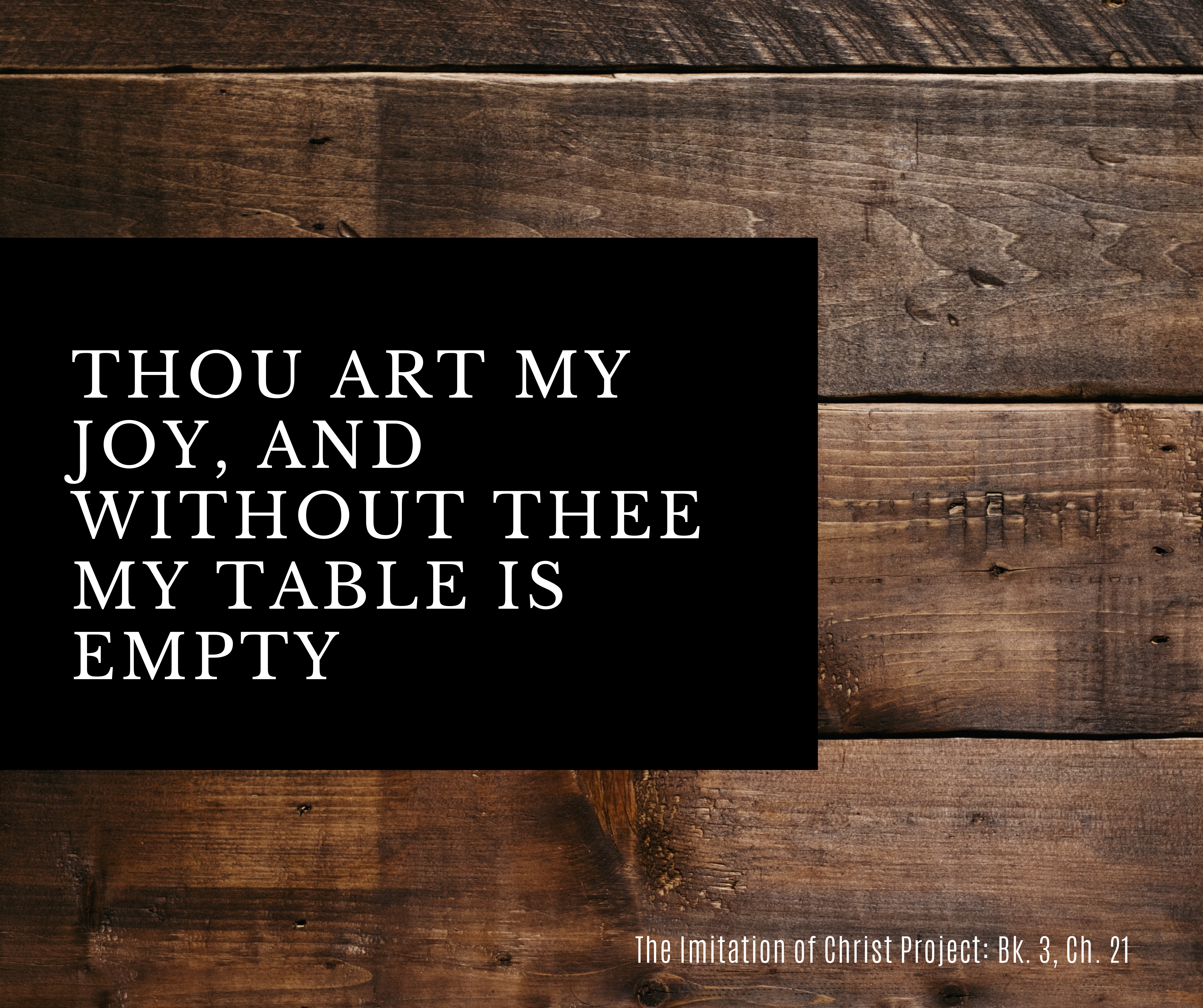
O Jesus, Splendor of eternal glory, Consolation of the pilgrim soul, with You my lips utter no sound and to You my silence speaks. How long will my Lord delay His coming? Let Him come to His poor servant and make him happy. Let Him put forth His hand and take this miserable creature from his anguish. Come, O come, for without You there will be no happy day or hour, because You are my happiness and without You my table is empty. I am wretched, as it were imprisoned and weighted down with fetters, until You fill me with the light of Your presence, restore me to liberty, and show me a friendly countenance. Let others seek instead of You whatever they will, but nothing pleases me or will please me but You, my God, my Hope, my everlasting Salvation. I will not be silent, I will not cease praying until Your grace returns to me and You speak inwardly to me, saying: “Behold, I am here. Lo, I have come to you because you have called Me. Your tears and the desire of your soul, your humility and contrition of heart have inclined Me and brought Me to you.”
Lord, I have called You, and have desired You, and have been ready to spurn all things for Your sake. For You first spurred me on to seek You. May You be blessed, therefore, O Lord, for having shown this goodness to Your servant according to the multitude of Your mercies.
What more is there for Your servant to say to You unless, with his iniquity and vileness always in mind, he humbles himself before You? Nothing among all the wonders of heaven and earth is like to You. Your works are exceedingly good, Your judgments true, and Your providence rules the whole universe. May You be praised and glorified, therefore, O Wisdom of the Father. Let my lips and my soul and all created things unite to praise and bless You.
I WILL bring witness against myself to my injustice, and to You, O Lord, I will confess my weakness.
Often it is a small thing that makes me downcast and sad. I propose to act bravely, but when even a small temptation comes I find myself in great straits. Sometimes it is the merest trifle which gives rise to grievous temptations. When I think myself somewhat safe and when I am not expecting it, I frequently find myself almost overcome by a slight wind. Look, therefore, Lord, at my lowliness and frailty which You know so well. Have mercy on me and snatch me out of the mire that I may not be caught in it and may not remain forever utterly despondent.
That I am so prone to fall and so weak in resisting my passions oppresses me frequently and confounds me in Your sight. While I do not fully consent to them, still their assault is very troublesome and grievous to me, and it wearies me exceedingly thus to live in daily strife. Yet from the fact that abominable fancies rush in upon me much more easily than they leave, my weakness becomes clear to me.
Oh that You, most mighty God of Israel, zealous Lover of faithful souls, would consider the labor and sorrow of Your servant, and assist him in all his undertakings! Strengthen me with heavenly courage lest the outer man, the miserable flesh, against which I shall be obliged to fight so long as I draw a breath in this wretched life and which is not yet subjected to the spirit, prevail and dominate me.
Alas! What sort of life is this, from which troubles and miseries are never absent, where all things are full of snares and enemies? For when one trouble or temptation leaves, another comes. Indeed, even while the first conflict is still raging, many others begin unexpectedly. How is it possible to love a life that has such great bitterness, that is subject to so many calamities and miseries? Indeed, how can it even be called life when it begets so many deaths and plagues? And yet, it is loved, and many seek their delight in it.
Many persons often blame the world for being false and vain, yet do not readily give it up because the desires of the flesh have such great power. Some things draw them to love the world, others make them despise it. The lust of the flesh, the desire of the eyes, and the pride of life lead to love, while the pains and miseries, which are the just consequences of those things, beget hatred and weariness of the world.
Vicious pleasure overcomes the soul that is given to the world. She thinks that there are delights beneath these thorns, because she has never seen or tasted the sweetness of God or the internal delight of virtue. They, on the other hand, who entirely despise the world and seek to live for God under the rule of holy discipline, are not ignorant of the divine sweetness promised to those who truly renounce the world. They see clearly how gravely the world errs, and in how many ways it deceives.
A few weeks ago I told you about Alexa, the virtual assistant from Amazon. She’s a bit like Siri on an Apple device. Ask a question, she’ll give an answer. Order something from Amazon and she’ll even let you know when it has arrived, but did you know that you can actually order from Amazon through Alexa? Just say, “Alexa, order such and such,” and she will have such and such shipped to you.
Well, Phil Brookman, the pastor at Memorial Road Church of Christ in Oklahoma City was talking to his 1,000 member congregation about this very feature and how you could order what ever they wanted. As an example, he said, “Alexa, order toilet paper.” And that’s where it gets even more fun.
Turns out that Memorial Road Church of Christ live streams their service through the Internet and on that day, one of their members was home with a sick child so she tuned into the broadcast. She reports, immediately after Pastor Brookman said, “Alexa, order toilet paper,” she heard her own Alexa unit respond: “OK. I’ve added it to your cart.” Pastor Brookman inadvertently ordered 60 rolls of toilet paper for his church member. But wait, there’s more: having heard about the incident between services, Pastor Brookman tweaked his illustration. Instead of saying, “Alexa, order toilet paper,” he said, “Alexa, donate $500 to the Memorial Road Church of Christ.” (Source)
To that, I can only add, for those of you listening to the podcast of this sermon: “Alexa, donate $500 to St. Matthew’s Episcopal Church, 518 W. Randolph Ave, Enid, Ok 73701.” I’ll keep you posted on how that works out.
Assistants: they come along in different forms. There are Alexa and Siri who do pretty good for what they are designed to do. They make life a bit easier. When we ask for assistance, the reasons probably vary: we don’t know how to do something, we want help to do even more, or there is so much to do, that we can’t get it all done ourselves. In the days of the Exodus from Egypt, Moses found himself in that last category. There was too much to do, the people were being unreasonable, and he was pulling his hair out. The Lord seeing this, provided him with assistants.
You’ll recall that as the Israelites were wandering in the desert, they began to grumble because they were hungry, so God gave them manna—bread from Heaven; however, they were not satisfied, so they started grumbling again because there was no meat for their pots. Upon hearing this and fed up with the grumbling, Moses looked up to God and said, “Why have you dealt ill with your servant? And why have I not found favor in your sight, that you lay the burden of all this people on me? Did I conceive all this people? Did I give them birth, that you should say to me, ‘Carry them in your bosom, as a nurse carries a nursing child.’” A few verses on: “I am not able to carry all this people alone; the burden is too heavy for me. If you will treat me like this, kill me at once.” Just kill me. I can’t deal with these whiny people anymore. But instead of killing him, the Lord gives him help. The Lord says, “Gather for me seventy men of the elders of Israel, whom you know to be the elders of the people and officers over them, and bring them to the tent of meeting, and let them take their stand there with you.” Because the burden was too great for Moses, the Lord gave him seventy assistants to lighten the load, and a part of the Spirit that was on Moses, was passed onto these seventy to help in performing the work and caring for the people.
Moses was given seventy assistants because the burden of carrying all of God’s people was too much for him. As we read in our Gospel, Jesus also called seventy to assist him. Was this because, like Moses, it was too much for him? Would he have been unable to accomplish the mission without them? The answer is, of course, No. Jesus alone accomplished the work he set out to do, and not just for a single tribe like the Israelites, but for all of humanity: “He is the propitiation for our sins, and not for ours only but also for the sins of the whole world.” Jesus alone carried the burden of us all on the Cross. Yet, for the work of God to continue, others had to be enlisted, so the seventy were enlisted to go before Jesus and perform the work. The seventy are not assistants as Moses needed them. The seventy are apprentices, learning how to continue the work. And what was the work?
From our Gospel, Jesus said: “Whatever house you enter, first say, `Peace to this house!’” And then, “Whenever you enter a town and its people welcome you, eat what is set before you; cure the sick who are there, and say to them, `The kingdom of God has come near to you.’” The work: proclaim peace—share with them that there is now peace between God and humankind. The old sin brought on by Adam and Eve’s disobedience is being forgiven. Demonstrate this peace to them by the healing of the sick and possessed. Tell them that the Kingdom of God is near. That just like God called to Adam and Eve as they hid in the garden, he now calls to us again. He calls us into a life of holiness and righteousness with Him, made possible through His One and Only Son.
The seventy took nothing extra with them. They were at the mercy of those they encountered. Where Jesus is the Lamb of God, these seventy are Jesus’ enlisted chosen, his lambs of which he is the Shepherd, and as he did battle in the wilderness during the forty days following his baptism, he sends the seventy out into the wilderness, amongst the wolves, not to be devoured, but to proclaim this message of peace, forgiveness, and restoration. As Jesus was successful, these seventy were also victorious. “Lord, in your name even the demons submit to us!”
If it was as easy as saying, “Alexa, preach the Gospel to the ends of the earth,” then this work would be done. But the Lord prefers a more personal touch. He wants for us to go out and proclaim his message. He wants us to have this passion for souls. A desire to see others, not only enter into a relationship with Him, but to participate in this work of reconciliation between God and his children.
In our Saints’ Book Club, this is one of the common threads that I’ve seen amongst all the Saints we’ve read about, this passion for souls. A driving unrelenting desire, even beyond death, to bring others into the fold, whether through works or prayer. The one we are currently reading, Thérèse of Lisieux says, “After my death, I will let fall a shower of roses. I will spend my heaven doing good upon earth. I will raise up a mighty host of little saints. My mission is to make God loved… I want to spend my Heaven in doing good on Earth.”
My friend St. Josemaría Escrivá writes, “We are children of God. Bearers of the only flame that can light up the paths of the earth for souls, of the only brightness which can never be darkened, dimmed or overshadowed. The Lord uses us as torches, to make that light shine out… It depends on us that many should not remain in darkness, but walk instead along paths that lead to eternal life.” (The Forge #1) You are children of God. You have been given a mission to bring light into darkness, to make God loved. You are the seventy.
Immediately following our Gospel reading today, Jesus prayed, giving thanks to the Father for making these things known to his disciples, then he said, “Blessed are the eyes that see what you see! For I tell you that many prophets and kings desired to see what you see, and did not see it, and to hear what you hear, and did not hear it.” You have seen and heard what prophets and kings spent lifetimes searching for. Jesus said, “The harvest is plentiful, but the laborers are few; therefore ask the Lord of the harvest to send out laborers into his harvest.” But, don’t just ask the Lord to make others the laborers, have such a passion for souls that you ask him to make you one as well.
Let us pray: Father, hear our prayers for the salvation of the world. Grant Mercy to all souls that turned away from You. Open their hearts and minds with Your light. Gather Your children from the east and the west, from the north and the south. Have mercy O God on those who do not know You. Bring them out of darkness into Your light. You are our saving God Who leads us in our salvation. Protect us from evil. We put the world in Your hands; fill us with Your love. Grant us peace through Christ, our Lord. Amen.
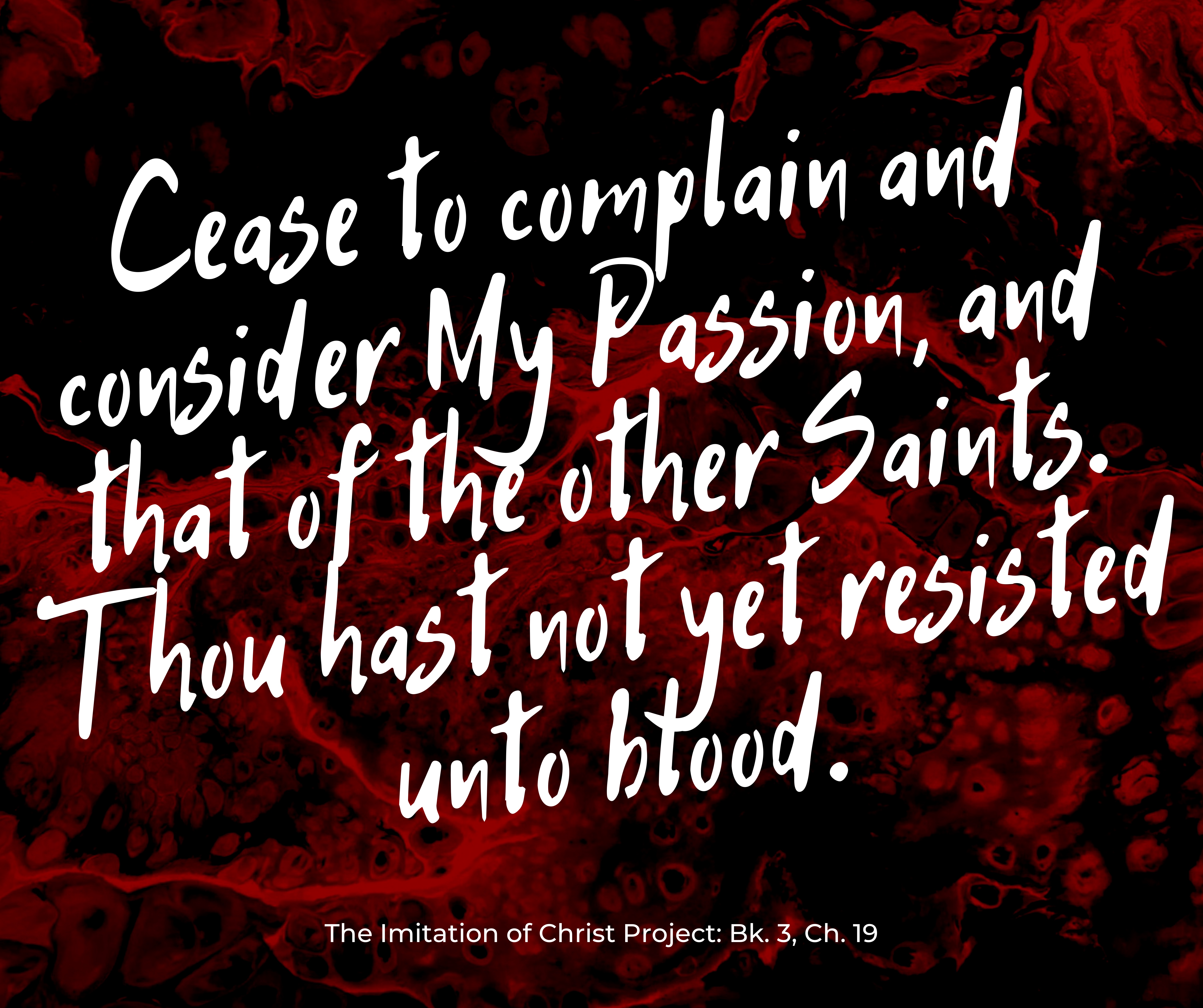
WHAT are you saying, My child? Think of My suffering and that of the saints, and cease complaining. You have not yet resisted to the shedding of blood. What you suffer is very little compared with the great things they suffered who were so strongly tempted, so severely troubled, so tried and tormented in many ways. Well may you remember, therefore, the very painful woes of others, that you may bear your own little ones the more easily. And if they do not seem so small to you, examine if perhaps your impatience is not the cause of their apparent greatness; and whether they are great or small, try to bear them all patiently. The better you dispose yourself to suffer, the more wisely you act and the greater is the reward promised you. Thus you will suffer more easily if your mind and habits are diligently trained to it.
Do not say: “I cannot bear this from such a man, nor should I suffer things of this kind, for he has done me a great wrong. He has accused me of many things of which I never thought. However, from someone else I will gladly suffer as much as I think I should.”
Such a thought is foolish, for it does not consider the virtue of patience or the One Who will reward it, but rather weighs the person and the offense committed. The man who will suffer only as much as seems good to him, who will accept suffering only from those from whom he is pleased to accept it, is not truly patient. For the truly patient man does not consider from whom the suffering comes, whether from a superior, an equal, or an inferior, whether from a good and holy person or from a perverse and unworthy one; but no matter how great an adversity befalls him, no matter how often it comes or from whom it comes, he accepts it gratefully from the hand of God, and counts it a great gain. For with God nothing that is suffered for His sake, no matter how small, can pass without reward. Be prepared for the fight, then, if you wish to gain the victory. Without struggle you cannot obtain the crown of patience, and if you refuse to suffer you are refusing the crown. But if you desire to be crowned, fight bravely and bear up patiently. Without labor there is no rest, and without fighting, no victory.
THE DISCIPLE
O Lord, let that which seems naturally impossible to me become possible through Your grace. You know that I can suffer very little, and that I am quickly discouraged when any small adversity arises. Let the torment of tribulation suffered for Your name be pleasant and desirable to me, since to suffer and be troubled for Your sake is very beneficial for my soul.
TEMPORAL SUFFERINGS SHOULD BE BORNE PATIENTLY, AFTER THE EXAMPLE OF CHRIST
THE VOICE OF CHRIST
MY CHILD, I came down from heaven for your salvation and took upon Myself your miseries, not out of necessity but out of love, that you might learn to be patient and bear the sufferings of this life without repining. From the moment of My birth to My death on the cross, suffering did not leave Me. I suffered great want of temporal goods. Often I heard many complaints against Me. Disgrace and reviling I bore with patience. For My blessings I received ingratitude, for My miracles blasphemies, and for My teaching scorn.
THE DISCIPLE
O Lord, because You were patient in life, especially in fulfilling the design of the Father, it is fitting that I, a most miserable sinner, should live patiently according to Your will, and, as long as You shall wish, bear the burden of this corruptible body for the welfare of my soul. For though this present life seems burdensome, yet by Your grace it becomes meritorious, and it is made brighter and more endurable for the weak by Your example and the pathways of the saints. But it has also more consolation than formerly under the old law when the gates of heaven were closed, when the way thereto seemed darker than now, and when so few cared to seek the eternal kingdom. The just, the elect, could not enter heaven before Your sufferings and sacred death had paid the debt.
Oh, what great thanks I owe You, Who have shown me and all the faithful the good and right way to Your everlasting kingdom! Your life is our way and in Your holy patience we come nearer to You Who are our crown. Had You not gone before and taught us, who would have cared to follow? Alas, how many would have remained far behind, had they not before their eyes Your holy example! Behold, even we who have heard of Your many miracles and teachings are still lukewarm; what would happen if we did not have such light by which to follow You?






 Candle in a Cave