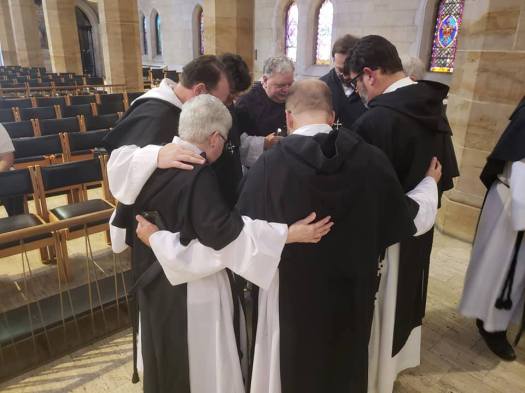
Discernment to the priesthood is not something that ends once you’re ordained, and for sometime, I’ve been discerning mine. My conclusion: I need to go deeper. I need to stop playing around and pretending. I need to further commit my life to the Gospel. With that in mind, after prayer and consultation with my Bishop, I have decided to ‘try’ and become a member of the Anglican Order of Preachers (a.k.a. Dominicans). No. I’ve no plans to leave my current church (unless they kick me out). In fact, this calling into the Dominicans seems to be drawing me even closer to them.
Who are the Anglican Dominicans? From their website:
The Anglican Order of Preachers is an apostolic religious community inspired by the spiritual tradition founded by Saint Dominic de Guzman in the thirteenth century. It was not until the last years of the twentieth century that an expression of Dominican spirituality and life could be found outside of the Roman Catholic Church. The Order is composed of men and women from around the world and various provinces of the Anglican Communion and her sister Churches.
The mission of the order is the proclamation of the Gospel of Jesus Christ, with a particular emphasis on proclamation ministries of evangelism and discipleship. The brothers and sisters surrender their entire lives to an apostolic lifestyle dedicated to God. This lifestyle, inspired by the lives of the first apostles and Saint Dominic, is lived out within the ordinary challenges of life, so that all people in all places can hear the Gospel.
The community is scattered, with brothers and sisters living across the world; by themselves, with their families or in small groups. They support themselves and the order by their work, either within the Church or the world. Brothers and sisters take vows of marriage or vows of celibacy. In everything members are encouraged to live out the words of Saint Dominic, “to speak with God or about God.” You can learn more here.
I’m currently only in the area of discernment, which is known as postulancy. Following this period of time, if accepted, I will become a novice and the novitiate will last for two years. If all goes well, I will make life vows and become a fully professed member.
The purpose of this new page, “Dominicans”, is to document the journey and post the writings that are required throughout this process and other info and pictures. I ask for your prayers.
O Lord Jesus Christ, you became poor for our sake, that we might be made rich through your poverty: Guide and sanctify, we pray, those whom you call to follow you under the vows of poverty, chastity, and obedience, that by their prayer and service they may enrich your Church, and by their life and worship may glorify your Name; for you reign with the Father and the Holy Spirit, one God, now and for ever. Amen.
Following morning prayers at the monastery, an older monk prostrates himself before the altar, and cries out, “O God. Before You, I am nothing!”
A second monk is so moved by this demonstration of piety that he immediately follows suit, throwing himself to the floor beside his brother and crying, “O God! Before you, I am nothing!”
In the ensuing silence, a shuffling is heard in the back of the chapel. A third monk jumps from his seat, prostrates himself in the isle and cries, “O God! Before You, I am nothing!”
Seeing this, the the first monk turned to the second and whispers, “So, look who thinks he’s nothing?”
Just when you thought you were being humble… you humiliate yourself.
Like all of Jesus’ teachings, today’s Gospel is like pitching a stone into a pond: the ever expanding ripples speak to more and more people, until we find ourselves caught up in the message.
At first glance, the parable of those jostling for the best seat appears to be about table etiquette and humility, but this is not a new teaching, especially to the religious leaders who were gathered around the table. Knowing the scriptures, they would have immediately recalled Proverbs 25:6-7:
Do not put yourself forward in the king’s presence
or stand in the place of the great,
for it is better to be told, “Come up here,”
than to be put lower in the presence of a noble.
Good advice and etiquette. Got it. And wouldn’t you hate to have been the guy that pushed his way to the front so that he could have the best seat at this particular dinner party. Jesus’ words might have stung that person a bit, but given the context and the audience, everyone would have felt a sting, because they all knew that just a short time before this gathering Jesus has said, “Woe to you Pharisees! For you love the best seat in the synagogues and greetings in the marketplaces.” (Luke 11:43) Not only were the religious leaders pushing themselves forward in the eyes of others, but they also pushed themselves forward in the eyes of God. As we learn in the Gospel lesson we hear on Ash Wednesday: the religious leaders like to sound the trumpets to make a show of their giving, they pray loudly in the synagogue and on the street corners, when they fast, they make a big show of their ‘misery.’ All of this to say, ‘Look at me world, look at me God, and see how special I am. I deserve a seat of honor at the table.’ But the sting of this teaching does not stop there. It takes in even more.
We know that following Jesus’ resurrection and ascension, Christianity began to spread, however, it was primarily a sect within Judaism, but in the Acts of the Apostles we see how it began to spread among the Gentiles. As more and more Gentiles became believers, the Jewish Christians began to ask themselves, ‘What are we going to do with them?’ There were many arguments over whether or not these Gentile converts needed to practice the Mosaic Law, be circumcised and so on. We know how it worked out in the end—Paul became the great Apostle to the Gentiles and even Peter came to understand that the faith was open to all, but initially, the Jewish Christians thought they were ‘better’ than the rest. After all, they were first. They were the Chosen People, therefore, they should have the seat of honor. So Paul would have to teach: “There is neither Jew nor Greek, there is neither slave nor free, there is no male and female, for you are all one in Christ Jesus.” (Galatians 3:23) There is no seat of honor, you are all honored because of Christ Jesus.
It is a good thing that we are not like this. We never see ourselves deserving of the seat of honor above others. How does it go? “The Church of England: Loving Jesus with a Slight Air of Superiority Since 597 a.d.” I’m pretty sure the same can be said of Episcopalians, just change the year to 1789.
We push to have ourselves ahead of others and to have the seat of honor, but, in all this, there was one question that kept coming up in my mind: what’s so bad about the lowest seat? That one that’s in the back of the banquet hall next to the bathroom door that squeaks every time someone goes in or out. No, perhaps it is not the best seat in the house, but why can’t we be happy with it?
Some of you will likely roll your eyes at the fact that I’ve never read or heard of this guy before: David Brooks. He is a commentator that writes for the New York Times. In 2014, he participated in a Christian forum, The Gathering, and gave a talk titled, “How to be Religious in the Public Square.” He says, “In 1950, the Gallup organization asked high school seniors, ‘Are you a very important person?’ And at that point 12 percent said yes. They asked the same question in 2005 and 80 percent said, ‘Yes, I am a very important person.’” He goes on to say that there is this “great desire for fame. Fame used to be low on a value. Now fame is the second-most desired thing in young people. They did a study, ‘Would you rather be president of Harvard or Justin Bieber’s personal assistant, a celebrity’s personal assistant?’ And of course by 3 to 1 people would rather be Justin Bieber’s personal assistant.” He adds, “Though to be fair I asked the president of Harvard, and she would rather be Justin Bieber’s personal assistant.” His conclusion, “This is an achievement culture. A culture of people striving and trying to win success.” A culture of people striving and trying to win the seat of honor.
Brooks then goes on to discuss the book Lonely Man of Faith, by Rabbi Joseph Soloveitchik, who talks about two opposing natures, referring to them as Adam One and Adam Two (not to be confused with Adam 12). The Rabbi states, “Adam One wants to conquer the world. Adam Two wants to obey a calling and serve the world. Adam One asks How things work. Adam Two asks why things exist and what we’re here for. Adam One wants to venture forth. Adam Two wants to return to roots. Adam One’s motto is ‘Success.’ Adam Two’s motto is ‘Charity. Love. Redemption.’” (Source) In the context of our Gospel reading, Adam One wants to sit at the head of the table, next to the guest of honor… No. That’s wrong. Adam One wants to be the guest of honor, to be famous and only if that fails, will Adam One be satisfied with being in near proximity of fame and perceived honor, i.e. Justin Bieber’s personal assistant. Adam Two doesn’t care much for Justin Bieber and will happily take a seat anywhere.
What is the difference between the two? The obvious answer (and a correct one) is humility. From the book of Proverbs:
The fear of the Lord is instruction in wisdom,
and humility comes before honor. (Proverbs 15:33)
Where does humility begin? With God. Humility is a grace from God that allows us to submit our lives to the Lord. Most pray for such a grace everyday, although we may not recognize it as such: “Thy will be done.” Humility begins by submitting your will to the will of God and saying with Jesus, “Not my will, but yours, be done.” (Luke 22:42) It comes, as humbling as it may sound, by recognizing that perhaps God’s will, at this stage in your life, is for you to be at the table next to the bathroom door.
Adam Two seeks only the will of God. Adam Two recognizes their place in the world—and understand this isn’t about societal status, money (or the lack there of), things of that nature, but is about being comfortable in your own skin—Adam Two finds happiness in who they are and where they are, whether being served in the seat of honor or in the kitchen, standing over the sink and eating leftovers. My friend Thomas à Kempis writes about this. Speaking to God the Father, he says, “Anyone who loves You … would be as peaceful and satisfied in the last place as in the first, and as willing to be despised, unknown and forgotten, as to be honored by others and to have more fame than they. He should prefer Your will and the love of Your honor to all else.” (Imitation of Christ, Bk. 3, Ch. 22) Put another way: Adam Two, doesn’t care where he sits, he’s just happy to have been invited and he’s delighted to see you, whether you’re sitting next to him or at the head table. The joy and happiness comes in recognizing that no matter what table you are sitting at, the Guest of Honor, Jesus, is sitting next to you.
Don’t worry about the seats of honor, instead, humble yourself so that you may seek, know, and follow the will of God. In God’s will is wisdom, peace, and the true happiness you are searching for.
Let us pray: Lord, if what we seek be according to your will, then let it come to pass and let success attend the outcome. But if not, let it not come to pass. Do not leave us to our own devices, for you know how unwise we can be. Keep us safe under your protection Lord, and in your own gentle way, guide us and rule us as you know best. Amen.
In the year 313 a.d., the Roman emperor, Constantine, issued the Edict of Milan. In it was stated, “The Christians and all others should have liberty to follow that mode of religion which to each of them appeared best; so that that God, who is seated in heaven, might be benign and propitious to us, and to every one under our government.” (source) From then on, Christians enjoyed a much easier time throughout the Roman Empire and Christianity would go on to be recognized as the official religion. Eventually the Empire would begin to crumble and in the year 410 a.d., the Visigoth’s, a Germanic tribe, would invade Italy and conquer Rome. Who did the people blame for the fall? Why the Christians of course. The complaint: if we had been able to keep the old gods, none of this would have happened.
Sixteen years later in 426 a.d., St. Augustine of Hippo published a response to the allegations: The City of God. “Two cities have been formed by two loves: the earthly by the love of self, even to the contempt of God; the heavenly by the love of God, even to the contempt of self. The former, in a word, glories in itself, the latter in the Lord. For the one seeks glory from men; but the greatest glory of the other is God, the witness of conscience. The one lifts up its head in its own glory; the other says to its God, ‘Thou art my glory, and the lifter up of mine head.’ In the one, the princes and the nations it subdues are ruled by the love of ruling; in the other, the princes and the subjects serve one another in love, the latter obeying, while the former take thought for all.” (source)
St. Augustine, who we celebrate today, wanted the people then to understand that the first city is the City of Man, where humankind rules and worships it own image and creations, and that the second city is the City of God, the city to come and the city of those who believe, helping Christians to understand that even though Rome has fallen, their future in the City of God is still assured and should be their greatest concern.
It would be nice to see how we’ve changed. That the vision of St. Augustine’s City of Man no longer exists and that we are ushering in the City of God, but we know that is not the case. This City of Man seems to be circling the drain more and more rapidly each day. With that being the case, we could become discouraged, wonder why we put up any effort or resistance at all, but, as with those in the time of Augustine, it’s not over. In the face of so much upheaval, remember the words of the Lord, “Be strong and courageous. Do not be frightened, and do not be dismayed, for the Lord your God is with you wherever you go.” (Joshua 1:9)
St. Augustine died on this day in the year 430 a.d. He was perhaps the greatest theologian to have ever lived and is responsible for much of what we believe and understand about our faith. In The City of God, he would have us know and understand that our hope is not in humankind, it is in God alone. “So,” as the Apostle Paul writes, “we do not lose heart. Though our outer self is wasting away, our inner self is being renewed day by day. For this light momentary affliction is preparing for us an eternal weight of glory beyond all comparison, as we look not to the things that are seen but to the things that are unseen. For the things that are seen are transient, but the things that are unseen… including the City of God… are eternal.” (2 Corinthians 4:16-18)
You all are very kind when it comes to comments about the sermon (at least the ones you say aloud!) However, that’s not always the case with every preacher. A parishioner came up to Jason Spears and said, “Coming from my other church and my former pastor to here listening to you is like going from filet mignon to ground beef hamburger meat.” Following the comment, he said, “Unfortunately, in my youthful insecurity, the next week I handed her a small bottle of A1 steak sauce and encouraged her to go back if she saw fit.”
Sometimes, preachers just aren’t sure as to how to take a comment: Jeff Chandler reports, “I was new to my first church and someone said: ‘You’re not like most pastors; when you say that you sin – we believe you.’” And Vince Torres said, “A guy in my church approached me after what must have been a personally convicting sermon and said, ‘Great teaching. But don’t you ever talk to me like that again.’” However, it was a comment made to Dan Donahue that got me to thinking. A parishioner told him, “I saw a documentary on Hell and thought of you.”
As I’ve shared with you in the past, I’ll go back and review sermons to see where we’ve been, so I took a look at these last few weeks, and although I’ll stick with the things I’ve said, there’s been a lot of talk about the “Son of Man coming as judge,” “Be prepared so that your not found lacking,” “The last day,” “Good soldier,” and so on. All true, but really just a round about way of telling you to get your act together or you’re going to Hell. Now, there are some of you that need to hear that on a regular basis (I’m not naming names, _____), but our Gospel reading today says that there is also a need for “the rest of the story.”
On the surface, we have a story of healing. Jesus sees a woman walking in the synagogue who has been crippled, bent over for the past eighteen years. So, Jesus, without being approached by anyone and asked to help, takes the initiative and says to her “Woman, you are set free from your ailment.” He then laid hands on her and she was healed, stood up straight and praised God. We are never told why she was bent over, but what happens next helps us to understand the larger point Jesus was making.
The president of the synagogue becomes angry with Jesus for healing the woman on a Sabbath, or put another way, he was angry with Jesus for working on a Sabbath which was against the Mosaic Law. Jesus responds to the accusation by saying to the president, “You as the religious leaders place huge burdens on the people. You weigh them down with all your rules and threats. You show more mercy to your animals than you do the children of God.” All you do is tell them that they’ve got it all wrong and they need to change or else they’re going to hell. You’ve weighed them down, bent them over, and you’ve forgotten to tell them the rest of the story. And what is the rest of the story? The same one that Jesus demonstrated to the woman and confirmed with his words: You have been shown mercy. “You are set free.”
Consider these passages of Scripture: Hosea 6:6 – “I desire mercy, not sacrifice, and acknowledgment of God rather than burnt offerings”; and James 2:13 – “Judgment without mercy will be shown to anyone who has not been merciful. Mercy triumphs over judgment.” The problem is that we can get so caught up in judgment and what to do in order to avoid hell, that our faith becomes about our actions instead of God’s actions; and God’s actions demonstrated and expressed by Jesus are all about mercy.
In The Name of God is Mercy, Pope Francis writes, “Pius XII, more than half a century ago, said that the tragedy of our age was that it had lost its sense of sin, the awareness of sin. Today we add further to the tragedy by considering our illness, our sins, to be incurable, things that cannot be healed or forgiven. We lack the actual concrete experience of mercy. The fragility of our era is this, too: we don’t believe that there is a chance for redemption: for a hand to raise you up; for an embrace to save you, forgive you, pick you up, flood you with infinite, patient, indulgent love; to put you back on your feet. We need mercy.” We need mercy because so much weighs us down that we live spiritually bent over lives, unable to stand up straight and give God glory. We become so bound up in our work to avoid hell that we no longer experience the freedom that comes through God’s mercy. Yes. We need mercy and the freedom that comes from it to live into the joy of the Lord. What is this freedom?
H&H is the short way of referring to the third oldest music society in the United States. It stands for Boston’s Handel and Haydn Society, founded in 1815. In May of this year, the Boston Symphony was performing the H&H season finale concert, which was being recorded. I’ve never been there, but looked at pictures and the symphony hall itself, built in 1900, is magnificent. On that particular day, there were approximately 2,500 in attendance. As part of the program, Mozart’s Masonic Funeral Music was played. It was a special day for everyone in attendance, but what made it even more so, was when that particular piece of music ended. In the silence between the last note and the time the audience begins to applaud, there was a very audible, “Wow!” It was clearly a child. The audience burst into laughter and applause. David Snead, President and CEO of H&H said, “It was one of the most wonderful moments I’ve experienced in the concert hall.” (Source) “The Handel and Haydn Society, America’s oldest performing arts organization, has been performing in Boston for 204 years and we can safely say that this was a first.” (Source)
The “Wow!” was such a sensation that the orchestra went in search of who the child was and eventually, through social media, discovered that it was nine year old Ronan Mattin, which makes the story even more fun. It turns out that Ronan is autistic. His mother says, “I can count on one hand the number of times that [he’s] spontaneously ever come out with some expression of how he’s feeling,” (Source)
What is this freedom that comes from mercy? It is the freedom to spiritually walk into one of the most prestigious symphony halls in the United States, during the recording of the season finale concert, put on by a 200 year old music society, listen to piece of music composed by a master, and in the silence that follows, say “Wow!”
The freedom that comes from mercy is to understand that you are a deeply loved child of God. A child who the Creator of Heaven and Earth desires to open to you all the joys of Heaven. Jesus tells us, “The Kingdom of God is now,” which means we don’t have to live hunched over, crippled in this life. Like the woman, we can stand straight and tall and give praise and glory.
Will there be a judgment day when the Son of Man returns unexpectedly? Yes. Yes there will be. Will we each of us be judged on that day? Yes we will be. Do we need to guard and care for our souls. Absolutely. But don’t get bogged down in Hell. You have been set free to live, to dance, to experience joy. You have been set free to say, “Wow!”
Let us pray: Lord, we believe in you: increase our faith. We trust in you: strengthen our trust. We love you: let us love you more and more. We are sorry for our sins: deepen our sorrow.
We worship you as our first beginning, We long for you as our last end, We praise you as our constant helper, And call on you as our loving protector.
Guide us by your wisdom, Correct us with your justice, Comfort us with your mercy, Protect us with your power. Amen
OPEN my heart, O Lord, to Your law and teach me to walk in the way of Your commandments. Let me understand Your will. Let me remember Your blessings — all of them and each single one of them — with great reverence and care so that henceforth I may return worthy thanks for them. I know that I am unable to give due thanks for even the least of Your gifts. I am unworthy of the benefits You have given me, and when I consider Your generosity my spirit faints away before its greatness. All that we have of soul and body, whatever we possess interiorly or exteriorly, by nature or by grace, are Your gifts and they proclaim Your goodness and mercy from which we have received all good things.
If one receives more and another less, yet all are Yours and without You nothing can be received. He who receives greater things cannot glory in his own merit or consider himself above others or behave insolently toward those who receive less. He who attributes less to himself and is the more humble and devout in returning thanks is indeed the greater and the better, while he who considers himself lower than all men and judges himself to be the least worthy, is the more fit to receive the greater blessing.
He, on the other hand, who has received fewer gifts should not be sad or impatient or envious of the richer man. Instead he should turn his mind to You and offer You the greatest praise because You give so bountifully, so freely and willingly, without regard to persons. All things come from You; therefore, You are to be praised in all things. You know what is good for each of us; and why one should receive less and another more is not for us to judge, but for You Who have marked every man’s merits.
Therefore, O Lord God, I consider it a great blessing not to have many things which human judgment holds praiseworthy and glorious, for one who realizes his own poverty and vileness should not be sad or downcast at it, but rather consoled and happy because You, O God, have chosen the poor, the humble, and the despised in this world to be Your friends and servants. The truth of this is witnessed by Your Apostles, whom You made princes over all the world. Yet they lived in this world without complaining, so humble and simple, so free from malice and deceit, that they were happy even to suffer reproach for Your name and to embrace with great affection that which the world abhors.
A man who loves You and recognizes Your benefits, therefore, should be gladdened by nothing so much as by Your will, by the good pleasure of Your eternal decree. With this he should be so contented and consoled that he would wish to be the least as others wish to be the greatest; that he would be as peaceful and satisfied in the last place as in the first, and as willing to be despised, unknown and forgotten, as to be honored by others and to have more fame than they. He should prefer Your will and the love of Your honor to all else, and it should comfort him more than all the benefits which have been, or will be, given him.
A German Shepherd, Doberman and a cat have died. All three are faced with God who wants to know what they believe in…. The German shepherd says: “I believe in discipline, training, and loyalty to my master.”… ”Good,” says God. “Then sit down on my right side. Doberman, what do you believe in?”… The Doberman answers: “I also believe in loyalty and the love, care, and protection of my master.”… Ah,” said God. “You may sit to my left.” Then he looks at the cat and asks, “And what do you believe in?”… The cat answers: “I believe you’re sitting in my chair.”
Dogs are always marked up as the loyal four legged companion, but even modern science contends that cats are also loyal, they just have a funny way of showing it. Whatever the case, whether it has to do with our four legged companions or the two legged ones, loyalty is a highly prized attribute.
Throughout Scripture, we hear much about faithfulness. There is God’s faithfulness to us: “Know therefore that the Lord your God is God, the faithful God who keeps covenant and steadfast love with those who love him and keep his commandments, to a thousand generations.” (Deuteronomy 7:9) “If we confess our sins, he is faithful and just to forgive us our sins and to cleanse us from all unrighteousness.” (1 John 1:9) There is also the call for us to be faithful to God: Jesus said to the Church in Smyrna found in John’s Revelation, “Be faithful until death, and I will give you the crown of life.” (Revelation 2:10) However, the idea of “faithfulness” encompasses many different aspects of God’s relationship to us and ours with God. Things such as obedience, perseverance, service, etc., so today, instead of trying to explore them all, I would like to look at one particular aspect of faithfulness and that is loyalty. Particularly, we know that Jesus is loyal to us—“even unto death on a cross”—but are we loyal to him?
We all have an idea what loyalty is, but to get us all with the same understanding: the Merriam-Webster Dictionary defines loyal as “unswerving in allegiance,” so loyalty is the act of unswerving allegiance. We can be loyal to more than one thing: brands/stores, sports teams, people, etc., and I would like to say that we only break our loyalty when trust is broken or we lose faith in the object of our allegiance, however… I’ll let you decide for yourself if this is a true statement: Niccolò Machiavelli, author of The Prince, wrote, “Of mankind we may say in general they are fickle, hypocritical, and greedy of gain.” I would like to say it is not true of me, but we all know that would be hypocritical. Therefore, when it comes to our relationship with God, I sincerely believe that we all desire to be loyal, but since the very beginning, we as the human race have struggled.
There was the issue of the apple, then the Cain and Abel incident, can’t forget the Tower of Babel or Sodom and Gomorra. The Golden Calf, Bathsheba, Baal worship, just to name a few, and that’s just the Old Testament. With Jesus there were the followers who couldn’t take the teaching, a matter of thirty pieces of silver, and something to do with a rooster crowing three times. Again, I sincerely believe that we desire to be loyal, but our allegiance does take a swerve or two, not because God has broken trust or faith with us, but because we have such a difficult time with… 90’s band, “The The” (that was their name) – lyrics from: True Happiness this Way Lies.
“Baby! (it is not a real song unless it says, “Baby”)
Baby… I’ve got my sight set on you
And someday… you’ll come my way.
But when you put your arms around me
I’ll be looking over your shoulder for something new.”
We want to be loyal to God, but there is always something new. Something shiny. Something distracting. So, what does it take to snap us back, to reaffirm our loyalty to God? Sometimes it is a moment of clarity: what the heck am I doing, I’ve drifted from my God; but in many cases, it takes a crisis, which brings us to our Gospel today.
Each Sunday for the past few weeks, we’ve had to have a review, because we’ve been in the middle of a single teaching from Jesus, and today is no different. What have we heard so far: Jesus, as the Son of Man, will act as our judge on the last day, so we must be vigilant in the care of our soul. We can’t just give it a quick dusting once a month and think all will be well. It needs our daily attention and nurturing. We are building a mansion for our King, so that when he returns he will find a home worthy of his glory. “Why?” is the question for today.
Some of you will remember the events of July 6, 1994 on Storm King Mountain in Colorado. It had been a hot dry summer and lightning strikes were causing all sorts of fires. When those fires pop up in remote areas, hot shots or smoke jumpers parachute in and fight them. This particular fire had been burning for a few days and had reached an area of twenty-nine acres. Not large, but big enough to do something about. Fifty firemen and women went in. Four hours later, fourteen of them were dead. At some point, the fire blew up and moved up the mountain at a pace of eighteen miles an hour. The flames reached 300 feet high and the temperature soared to 2,000 degrees. The blow up took less than twenty minutes to consume that side of the mountain and kill the fire fighters.
Jesus said, “I came to bring fire to the earth, and how I wish it were already kindled!” Sts. Ignatius, Origen, and Didymus all record a saying of Jesus that is not found in the Gospels. Whether he said it or not, if feels true: Jesus said, “He who is near me is near the fire.” Why are we to be vigilant in the care of our souls? Because there is a refining fire that is coming. A fire that purifies gold, a fire that purifies the people of God. A fire that is the saving message of the Gospel. A fire that will bring division, and when that dividing occurs, we must decide where our loyalties lie. If we have not been vigilant, alert, awake… remember: “If the owner of the house had known at what hour the thief was coming, he would not have let his house be broken into. You also must be ready, for the Son of Man is coming at an unexpected hour.” If we are not ready when that unexpected hour comes, if we have not been loyal to Jesus all along, then on that day, the day of judgment, our souls may be found lacking.
Consider what St. Paul says to Timothy: “Share in suffering as a good soldier of Christ Jesus. No soldier gets entangled in civilian pursuits, since his aim is to please the one who enlisted him.” (2 Timothy 2:3-4)
That great soldier, General George Patton stated, “It is a proud privilege to be a soldier – a good soldier … [with] discipline, self-respect, pride in his unit and his country, a high sense of duty and obligation to comrades and to his superiors, and a self confidence born of demonstrated ability.”
We are to be those soldiers of Christ Jesus. Sharing in his suffering and not getting entangled in civilian pursuits, that is, not confusing our loyalties, having an unswerving allegiance to our King so that we might please him and so that on the day of judgment he will say to us, “Well done, good and faithful servant.”
My friend, St. Josemaría Escrivá, writes, “The Lord, the teacher of Love, is a jealous lover who asks for all we possess, for all our love. He expects us to offer him whatever we have, and to follow the path he has marked out for each one of us.” (The Forge, #45) Therefore, be vigilant in guarding your soul, so that your loyalty to Jesus will remain unswerving.
Let us pray: Father in Heaven, ever-living source of all that is good, keep us faithful in serving You. Help us to drink of Christ’s Truth, and fill our hearts with His Love so that we may serve You in faith and love and reach eternal life. In the Sacrament of the Eucharist You give us the joy of sharing Your Life. Keep us in Your presence. Let us never be separated from You and help us to do Your Will. Amen.
A college professor had the mysterious habit of removing a tennis ball from his jacket pocket as he walked into the lecture hall each morning. He would set it on the corner of the podium. After giving the lecture for the day, he would once again pick up the tennis ball, place it into his jacket pocket and leave the room.
No one ever understood why he did this, until one day a student fell asleep during the lecture. The professor didn’t miss a word of his lecture while he walked over to the podium, picked up the tennis ball and threw it, hitting the sleeping student squarely on the top of the head.
The next day, the professor walked into the room, reached into his jacket, removed a baseball…
Today, we are still in the same conversation that Jesus was having with his disciples in last week’s Gospel as they make their way to Jerusalem.
As a refresher: last week we understood that Jesus, as the Son of Man, would act as judge on the last day, therefore, we need to care for our souls in the same way that we care for every other aspect of our lives. You spend time with your job, family, hobbies, etc., then spend time with your soul, caring for and nurturing it, so that on that last day… well, like they say, live your life in such a way that the preacher won’t have to lie at your funeral. Care for your soul in such a way, that on the day of judgment, you are prepared, which brings us to today: the need for vigilance in the caring for the soul. Of not being the one that gets hit square on the head with more than a baseball when we fall asleep or become complacent.
We’ve noted in the past that the authors of the Bible plagiarized a good bit of the Book of Common Prayer, which may explain why, when I went searching for a passage of Scripture, I couldn’t find it. You may recognize it: “Purify our conscience, Almighty God, by your daily visitation, that your Son Jesus Christ, at his coming, may find in us a mansion prepared for himself.” Well, come to find out, that’s one of the bits they didn’t plagiarize and it is only in the Book of Common Prayer. It is the collect for the Fourth Sunday of Advent. Put another way and in the language we’ve been using, “Assist us Lord in being in vigilant caring for our souls, so that on the day that Christ comes to judge, he may find in us a home worthy of a of King.”
Elsewhere in Scripture, Jesus says, “In my Father’s house are many rooms. If it were not so, would I have told you that I go to prepare a place for you?” (John 14:2) and again, “The King will say to those on his right, ‘Come, you who are blessed by my Father, inherit the kingdom prepared for you from the foundation of the world.’” (Matthew 25:34) We have these passages about Jesus going to prepare a place for us, so the Advent four collect and our Gospel reading gives it a bit of a twist: we’re the ones making ready and being prepared for Jesus, the master and judge’s return. We’re making sure that all is ready for him to take up residence within us. For Jesus says, “If anyone loves me, he will keep my word, and my Father will love him, and we will come to him and make our home with him.” (John 14:23) We understand that passage as the giving of the Holy Spirit, but there is also our responsibility in maintaining that home, for the one who sent the Spirit, Jesus, will come again.
Those of you who were here long before I came are fond of telling about the time this place needed a new roof. How bad was it? You could literally look up and see daylight. However, at the time, we couldn’t afford a new roof. So, in “church speak,” when a congregation can’t afford to care for the building or simply don’t care for the building, those kinds of jobs become what is known as “deferred maintenance.” Yeah, you have a problem, but because of circumstances or negligence, the problem is not resolved. The house the Holy Spirit and the one that Master, Jesus, will return to is the same way. We recognize a problem in the care of our souls, but we do nothing. Deferred maintenance. We don’t want to spend the time and effort to correct the problem or we just don’t really care, so we justify leaving it. “I know I spend too much time in front of the TV or the computer and neglect family time, but ‘Hey, I work hard all day and I deserve a break.’” Instead of addressing the issue, we push it off, but when the Master returns, he will not be pleased with what he finds.
Not only must we maintain this home of the Holy Spirit, but in preparation for the Master’s return, we must expand it. Consider the parable of the talents. The Master gave the the three servants one talent, five talents and ten talents respectively. The ones with the five and ten talents went out and doubled their money, but the one with only one talent did nothing and the master was displeased, calling him a “wicked and slothful servant!” (Matthew 25:26) The house we are given is only the beginning. We begin with the knowledge of our salvation, but then we are to take that knowledge, discern our gifts, engage the world in such a way that we make Christ known… we are to expand ourselves and the Kingdom of God, not just sit and hold what we’ve got.
C.S. Lewis, in Mere Christianity, describes this process of maintenance and growth like this: “Imagine yourself as a living house. God comes in to rebuild that house. At first, perhaps, you can understand what He is doing. He is getting the drains right and stopping the leaks in the roof and so on; you knew that those jobs needed doing and so you are not surprised. But presently He starts knocking the house about in a way that hurts abominably and does not seem to make any sense. What on earth is He up to? The explanation is that He is building quite a different house from the one you thought of – throwing out a new wing here, putting on an extra floor there, running up towers, making courtyards. You thought you were being made into a decent little cottage: but He is building a palace. He intends to come and live in it Himself.”
I’ve done my share of home maintenance. In the process, I was electrocuted—more than once—so covered in dirt and grime that I didn’t recognize myself, had paint in my hair that didn’t come out for a week, I’m not even going to talk about the sewer issues, etc. But in the end… the house of the soul requires the same work. Now, I willingly admit, if I have to remodel another house in this lifetime, it will be too soon. Not my idea of a good time, but the work on the maintenance and the expansion of the house of the soul is no burden. Far from it. It can be daunting, but it is intended to be a joy. You are working for a Master, a King who loves you. Who desires to live with you and in you.
Queen Victoria reigned over the United Kingdom for more than sixty-three years until her death in 1901. It is not true of many monarchs, but she was much loved and she made a practice of making unexpected calls on the farm folks who lived in cottages. Any day for these farming families might be a royal day, and the Scots had a chair prepared for her visit. Because any day might see a visit from the Queen, they kept their houses spotless. They were a clean and wholesome people, but her unannounced visits added to the joy of keeping their homes lovely. They had an expression for the joy they found in the work: “Perhaps today, she’ll come my way.” Perhaps today, the Queen will visit us… and perhaps today, our Master, our King will visit us.
“Blessed are those servants whom the master finds awake when he comes. Truly, I say to you, he will dress himself for service and have them recline at table, and he will come and serve them. If he comes in the second watch, or in the third, and finds them awake, blessed are those servants!”
Do not fall asleep. Maintain and expand the house that God has given you for your soul and prepare a mansion for Him, worthy of his Glory.
Let us pray: God of power and mercy, open our hearts in welcome. Remove the things that hinder us from receiving Christ with joy, so that we may share his wisdom and become one with him when he comes in glory, for he lives and reigns with you and the Holy Spirit, one God, for ever and ever. Amen.
Due to inherit a furniture factory when his sickly, widower father died, Clyde decided he needed a woman to enjoy it with.
Going to a cafe, he met a woman who was Scarlett Johansson good looking.
“I’m only an ordinary man,” he said, walking up to her, “But in just a week or two, my father will die and I’ll inherit a 20 million dollar business.”
The woman went home with Clyde, and the next day she became his stepmother.
At first glance, our Gospel reading appears to be about two different topics. First we have the young man asking Jesus to settle a dispute over an inheritance, and in the second we have a parable that speaks of greed, but it is underneath both topics that we find the point Jesus is conveying.
Just moments before our Gospel today, Jesus had been teaching the same crowd and had said to them: “I tell you, everyone who acknowledges me before men, the Son of Man also will acknowledge before the angels of God, but the one who denies me before men will be denied before the angels of God.” (Luke 12:8-9) Jesus does not state that he is the “Son of Man,” but it is implied, and in this roll, he acts as the judge who will either acknowledge you before the Father and the angels as one of his own or he will deny you as one of his own. From John’s Gospel: “The Father has given [Jesus] authority to execute judgment, because he is the Son of Man. Do not marvel at this, for an hour is coming when all who are in the tombs will hear his voice and come out, those who have done good to the resurrection of life, and those who have done evil to the resurrection of judgment.” (John 5:27-29) Jesus makes the eternal judgment with regard to the final outcome of our lives. It is then the person in the crowd asked, “Teacher, tell my brother to divide the family inheritance with me.” Jesus responded, “Friend, who set me to be a judge or arbitrator over you?”
I always read Jesus’ response as saying, “Not my department. I’ve got other fish to fry,” but a closer look shows that Jesus may have truly been looking for an answer. “When you ask me to be a judge over you with regard to the inheritance, your recognizing my authority over temporal things, but do you also recognize my authority, as the Son of Man, to judge eternal things? Specifically, your salvation.” Jesus was not denying his authority to judge, he simply wanted to know if the person asking about the inheritance was also accepting Jesus’ authority over his soul. It is with that understanding that the second part of the Gospel makes more sense.
We know that the farmer was already a wealthy man, because he obviously had enough land to produce a crop that would fill all his current store houses and he had the money to tear them down and build larger ones to store the bumper crop. When complete, he says to himself, “Soul, you have ample goods laid up for many years; relax, eat, drink, be merry.” With all that he has, the farmer believes himself to be set. “But God said to him, ‘You fool! This very night your life is being demanded of you. And the things you have prepared, whose will they be?’” God called the man a fool, not because he was rich or because he had stored up for the future. God called the farmer a fool because he wrongly believed that because his earthly needs were satisfied, he was set. His material needs were taken care of, so what more could he want? The author of Ecclesiastes asked, “What do mortals get from all the toil and strain with which they toil under the sun?” The answer: “Vanity of vanities! All is vanity.” Put another way, “Worthless of worthless! “All is worthless.” All the efforts the farmer put into storing up his crops were worthless, because, in the meantime, he forgot to care for his soul. He forgot to work as hard at storing up treasures in heaven as he did storing up treasures on earth. And when the Son of Man, the Judge, comes with all the authority of Heaven, the farmer’s final end: “You have been weighed in the balances and found wanting.”
“The Lord God formed the man of dust from the ground and breathed into his nostrils the breath of life, and the man became a living creature.” (Genesis 2:7) The man became a living soul. God breathed his breath into us. He breathed our souls, made in his image, into us, and this soul—realized or not—is our most precious possession, and we will be judged, based on the condition of that soul at the end of days. “For we must all appear before the judgment seat of Christ, so that each one may be recompensed for his deeds in the body, according to what he has done, whether good or bad.” (2 Corinthians 5:10)
Did you know that this coming Saturday, August 10th, is National Garage Sale Day (FYI: the following Saturday is National Thrift Shop Day—I promise I’m not making this up). Anyhow, not everything you purchase at a garage sale is worth the $0.25 you paid for it, but in 2007, a family in New York purchased a small bowl for $3.00. They put it on a shelf in the living room and more or less forgot about it until 2013. In 2013 a friend came by to visit and was astonished. That bowl was from the Northern Song Dynasty in China and was approximately 1,000 years old. The bowl was placed at Sotheby’s Auction House for sale. Original estimates had it going for $200,000. It didn’t. Someone in London purchased it for more than $2,000,000.
Why would someone sell a $2,000,000 bowl for $3 at a garage sale? Answer: they did not know what they had and therefore did not know what it was worth.
The same can be true of the soul. We put a $3 price tag on it and never give it a second look. We can become complacent, never thinking we will be judged; therefore, we spend great amounts of time building up and filling our store houses and very little time caring and working for our souls. However, God cares very little for our store houses and their contents. Instead, he looks at us and sees our souls, and in so doing, sees his own image and for that he cares greatly.
So, what are we to do? How do we go from viewing our souls as $3 trinkets to our greatest possession? St. Paul answered that for us in his letter to the Colossians that we read, “Set your minds on things above, not on earthly things. (Colossians 3:2)
What are we to do? The Trappist Monk, Thomas Merton, wrote in The Seven Storey Mountain, “The soul of man, left to its own natural level, is a potentially lucid crystal left in darkness. It is perfect in its own nature, but it lacks something that it can only receive from outside and above itself. But when the light shines in it, it becomes in a manner transformed into light and seems to lose its nature in the splendor of a higher nature, the nature of the light that is in it.”
What are we to do? We are to recognize that Jesus is the judge and that the soul deposited within us has the greatest value. Then we are to set our minds on the things above and let the Light in. In this, we receive, not an earthly inheritance, but an eternal inheritance. St. Peter writes, “Blessed be the God and Father of our Lord Jesus Christ! According to his great mercy, he has caused us to be born again to a living hope through the resurrection of Jesus Christ from the dead, to an inheritance that is imperishable, undefiled, and unfading, kept in heaven for you, who by God’s power are being guarded through faith for a salvation ready to be revealed in the last time.” (1 Peter 1:3-5)
As you apply yourself in the care of your family, job, hobbies, etc., apply yourself to the care of your soul, because on the last day… it’s all that matters.
Let us pray:
For Your mercies’ sake, O Lord my God,
tell me what You are to me.
Say to my soul: “I am your salvation.”
So speak that I may hear, O Lord;
my heart is listening;
open it that it may hear You,
and say to my soul: “I am your salvation.”
After hearing this word,
may I come in haste to take hold of you.
Hide not Your face from me.
Let me see Your face even if I die,
lest I die with longing to see it. (St. Augustine)
Amen.
For us, when a person—or any living creature for that matter—dies, we understand the necessity for burial or cremation. The process of “ashes to ashes, dust to dust” just isn’t that pleasant. During the time of Jesus, within Jewish culture, cremation was not practiced, so everyone would buried in the ground or in a tomb that had been hewn out of the rock, but did you know that—according to legend—burial in the ground goes all the way back to Adam and Eve and the murder of Abel? The legend states:
“Adam and [Eve] came and sat by the corpse [of their son Abel whom Cain had murdered], weeping and mourning for him – but they did not know what to do with Abel’s body. A raven whose companion had just died said: I will teach Adam what to do. The raven took his dead companion, dug the earth before the eyes of Adam and his mate, and buried him in it. Adam said: We will do as the raven.” And so the practice of burial began, based on the teachings of a Raven.
Within Holy Scripture, there appear to be many traditions and teachings with regard to the burial of the dead, but no specific laws dictating how it should be done, and most of these traditions were practiced in the burial of Jesus: the body anointed, wrapped, and then placed in a tomb. As we read today, the tomb that Jesus was buried in belonged to Joseph of Arimathaea, who had gone to Pilate and requested the body of Jesus so that it could be properly buried.
These are events which we are all familiar with. The crucifixion, death, and resurrection of Jesus. We talk about these things often. We also talk about how we will have eternal life through Jesus, and that there is a place prepared for us, but the one thing we will avoid talking about like we would avoid the plague—whether because of self preservation or simple denial—is the topic of our own death and burial. (And now you’re all depressed… sorry, but that’s not my intent.)
Ignatius of Loyola writes: To almost all the questions that might be asked about you the answer would be “perhaps.” Shall you have a large fortune, great talents, a long life? “Perhaps.” Will your last hour find you in the friendship of God? “Perhaps.” After this retreat, will you live long in a state of grace? “Perhaps.” Shall you be saved? “Perhaps.” But shall you die? “Yes. Certainly.”
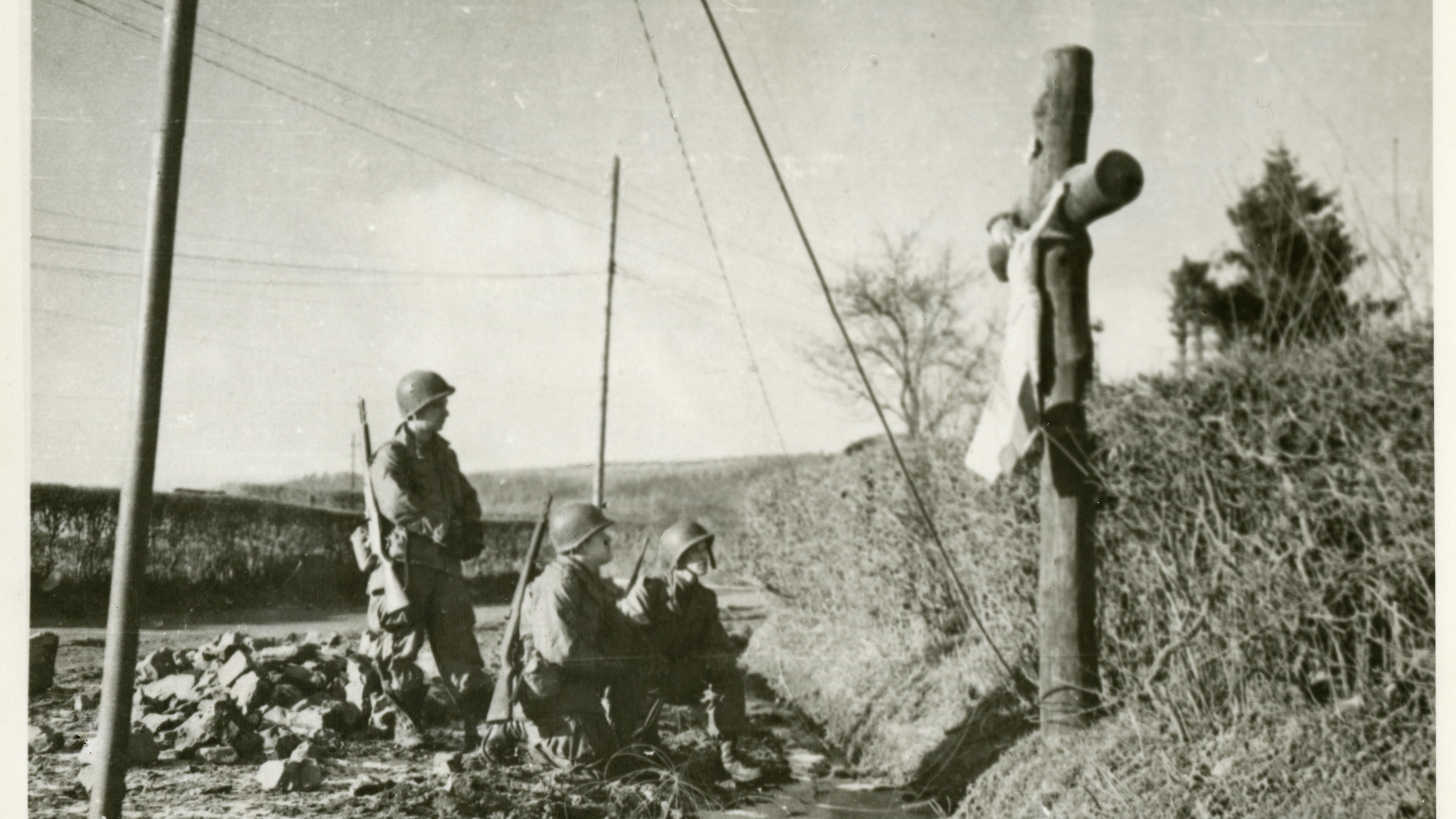
We shall all die and someone will place us in the ground or a mausoleum or a niche in a columbarium. Because of this fact, the Saints will ask us to keep this event of our own death always before us. St. Benedict wrote in his Rule, “Remember to keep death before your eyes daily.” Not to dwell morbidly upon it, but as a reminder to remain vigilant watch over your soul, so that when that time does come, you are not caught unprepared.
A story from the desert monks: “News spread that an elder father lay dying in the desert of Skete. The brothers came, stood around his deathbed, clothed him and began to cry. But he opened his eyes and laughed. And he laughed again, and then again. The surprised brothers asked him, ‘Tell us, Abba, why do you laugh while we cry?’ He spoke, ‘I laughed at first because you fear death. Then I laughed because you are not ready. A third time I laughed because I am going from hard work to enter my rest – and you are crying about that!’ He then closed his eyes and died.”
Don’t be afraid to think of the “last things,” keep them before you, not with a heavy heart, but the heart of one who is persevering until the end and one who will receive the reward of joy and peace.









 Candle in a Cave