Sermon: Lent 2 RCL A – Scourging at the Pillar

This is part two of a five part series on the Sorrowful Mysteries of the Rosary.


The Podcast is available here.


Second Sorrowful Mystery: Scourging at the Pillar

Pilate speaks: It is your custom that I release one prisoner to you on the Pasch. Whom shall I set free, Barabbas —a thief jailed with others for a murder —or Jesus? (Matt 27:17) —Put this man to death and release unto us Barabbas, cries the multitude, incited by their chief priests (Luke 23:18).

Pilate speaks again: What shall I do, then, with Jesus who is called Christ? (Matt 27:22) Crucify Him!

Pilate, for the third time, says to them: Why, what evil has He done? I find no fault in Him that deserves death (Luke 23:22).

The clamour of the mob grows louder: Crucify Him, crucify Him! (Mark 15:14)

And Pilate, wishing to please the populace, releases Barabbas to them and orders Jesus to be scourged.

Bound to the pillar. Covered with wounds.

The blows of the lash sound upon His torn flesh, upon His undefiled flesh, that suffers for your sinful flesh. —More blows. More fury. Still more… It is the last extreme of human cruelty.

Finally, exhausted, they unbind Jesus. —And the body of Christ yields to pain and falls limp, broken and half dead.

You and I are unable to speak. —Words are not needed. —Look at Him, look at Him… slowly. After this… can you ever fear penance?

(Source: Holy Rosary by St. Josemaría Escrivá)

Meditation:

In Matthew, Barabbas is described as a “notorious prisoner,” John has him as a “bandit,” Mark and Luke have him involved in a riot. However we refer to him, the crime he committed was punishable by death. As I meditated on this mystery, I began to see myself in his place and from there, I wondered…

When Pilate asked, “Who do you want me to release for you,” who’s name would I have wanted to hear them shout out? How would I feel if I understood that he was truly innocent and I had been set free? How would I have felt that those who had called for my release really didn’t care about me, they just wanted Jesus dead. And from there, how would I have felt when I realized that the only one who actually cared anything about me was to be scourged by the same soldiers who just set me free. I also wondered what it would have been like, as I was walking away from the guards to have caught Jesus eyes.

As I meditated on this mystery and wondered about these things, I also had answers. Who’s name would I want to hear the crowds calling out? Mine. How would I feel about walking away free, knowing he was the innocent one? I’m sorry for him, yes, but I suppose I would have thought, “Tough break.” Did I care that the crowd really didn’t care for me? No. Don’t much care for them either. What were my thoughts on realizing Jesus was the only one who really cared for me? Well, isn’t that the way it always is?

Yes. I have answers for all these questions, except the last. That last question really haunts me, because although I have an answer, I don’t like it. What would I have seen in Jesus eyes as I walked away free and he condemned? The answer, of course, is love. I would have seen love and gratitude. Grateful that he could even save my wretched life.

As my friend Thomas à Kempis wrote in On the Passion of the Christ, “Woe to me, unfortunate sinner, weighed down with the heavy burden of sin! Because of my evil deeds I deserve to be assigned to eternal punishment, but you, holy, just, and loving God, chose to be despised and detested to deliver me from the devil’s deceits and everlasting death.” (Source: On the Passion of Christ: According to the Four Evangelists, p. 47)

The very difficult truth is that we are all Barrabas. Like him, we have all sinned and the punishment for our sins is the same death sentence that he received for his. “For the wages of sin is death.” (Romans 6:23a) As we meditate on these events, we realize that we are the ones standing with Jesus and facing the crowd, waiting on the verdict from Pilate, and it is there that we understand, though we are guilty we are set free. Not because of anything that we have done or deserve, but because of God’s grace. Because God’s one and only son chose to love us, who are all Barrabas. But here’s the thing, being Barrabas isn’t necessarily bad.

The name Barrabas is made up of two words, Bar Abba. Bar, meaning son and Abba meaning Father, so the name Barrabas means “Son of the Father.” We are all Barrabas, but because of God’s grace, we are all set free, and in being set free, we become Bar Abba, children of the Father. But now, as those children, we must watch Jesus being led away and are witnesses to his scourging. Witnesses to the punishment that was rightfully ours.

Last week we talked about how we must be honest with ourselves and with sincere hearts and minds, confront our own failings, so that we can rightly confess and allow the Lamb of God to take those sins with him to the cross, that through his great love for us, we might be redeemed. Yet, the idea of being honest and confessing often causes us to be fearful. And so, even though it is not possible to hide from God, as the Psalmist says:

Where can I go from your Spirit?
Where can I flee from your presence?
If I say, “Surely the darkness will hide me
and the light become night around me,”
even the darkness will not be dark to you;
the night will shine like the day,
for darkness is as light to you.
(Psalm 139:7, 11-12)

Even though it is not possible to hide from God, we pretend as though we could. We are like Adam and Eve in the Garden, after they had eaten the fruit: “The man and his wife heard the sound of the Lord God as he was walking in the garden in the cool of the day, and they hid from the Lord God among the trees of the garden. But the Lord God called to the man, ‘Where are you?’ [The man] answered, ‘I heard you in the garden, and I was afraid.’” (Genesis 3:8-10) We are afraid to come before God, to confess, because we fear the punishment we so rightly deserve, but—and this is the Good News—the punishment has already been meted out. It is why Josemaría encouraged us to look at Jesus following the scourging: “Look at Him, look at Him… slowly. After this… can you ever fear penance?” Why would you fear to confess, to be penitent, “By his stripes, we are healed.” (Isaiah 53:5)

Consider again the words of The Exhortation: “Examine your lives and conduct by the rule of God’s commandments, that you may perceive wherein you have offended in what you have done or left undone, whether in thought, word, or deed. And acknowledge your sins before Almighty God, with full purpose of amendment of life, being ready to make restitution for all injuries and wrongs done by you to others; and also being ready to forgive those who have offended you, in order that you yourselves may be forgiven. And then, being reconciled with one another, come to the banquet of that most heavenly Food.” (Book of Common Prayer, p. 316)

There should be great fear in not confessing, but you are Bar Abba—you are God’s child and he endured the scourging that you might be with him. As the Lord said through the Prophet Isaiah:

‘You are my servant’;
I have chosen you and have not rejected you.
So do not fear, for I am with you;
do not be dismayed, for I am your God.
I will strengthen you and help you;
I will uphold you with my righteous right hand.
(Isaiah 41:9b-10)

Let us pray:
Father, Your Love never fails.
Keep us from danger
and provide for all our needs.
Teach us to be thankful for Your Gifts.
Confident in Your Love,
may we be holy by sharing Your Life,
and grant us forgiveness of our sins.
May Your unfailing Love turn us from sin
and keep us on the way that leads to you.
Help us to grow in Christian love.
Amen.

Sermon: Lent 1 RCL A – Agony in the Garden

This is part one of a five part series on the Sorrowful Mysteries of the Rosary.


The podcast is available here.


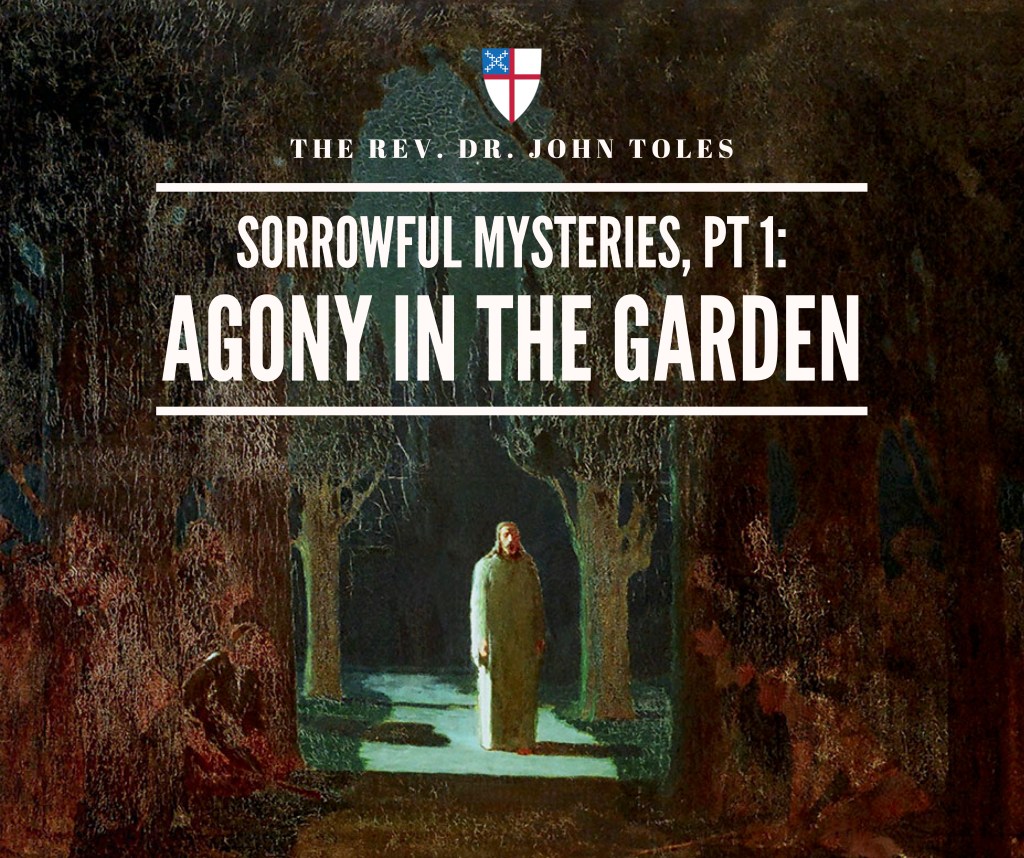
First Sorrowful Mystery: Agony in the Garden

“Pray that you may not enter into temptation”. —And Peter fell asleep. —And the other apostles. —And you, little friend, fell asleep…, and I too was another sleepy headed Peter.

Jesus, alone and sad, suffers and soaks the earth with His blood.

Kneeling on the hard ground, He perseveres in prayer… He weeps for you… and for me: the weight of the sins of men overwhelms Him.

Father, if Thou wilt, remove this chalice from me… Yet not my will, but Thine be done (Luke 22:42).

An Angel from Heaven comforts Him. —Jesus is in agony. —He continues, praying more intensely… —He approaches us, who are asleep: Arise, pray —He says again—, lest you enter into temptation (Luke 22:46).

Judas the traitor: a kiss. —Peter’s sword gleams in the night. —Jesus speaks: Are you come, as to a robber, to apprehend Me? (Mark 14:48)

We are cowards: we follow Him from afar, but awake and praying. —Prayer… Prayer…

(Source: Holy Rosary by St. Josemaría Escrivá)

Meditation:

On that night, following the Last Supper, the apostles went with Jesus to the Garden of Gethsemane. Most stayed further away, but Jesus took Peter, James and John a little deeper into the garden. Before going on alone even further into the darkness, Jesus said to these three, “Sit here while I go over there and pray. My soul is overwhelmed with sorrow to the point of death. Stay here and keep watch with me.” We know that after awhile, Jesus came back and found them sleeping. Waking them, he said, “Couldn’t you men keep watch with me for one hour? Watch and pray so that you will not fall into temptation. The spirit is willing, but the flesh is weak.” He went away a second time to pray then returned, only to find them again asleep. “Are you still sleeping and resting? Look, the hour has come, and the Son of Man is delivered into the hands of sinners. Rise! Let us go! Here comes my betrayer!” The betrayer was Judas, who had left the Last Supper early to find the soldiers who would arrest Jesus, because he had earlier betrayed Jesus to the religious leaders for thirty pieces of silver.

If I had been there, do you know who I would have been talking about before I fell asleep? Hint: not Jesus. Judas. Yes, Judas. It is the middle of night. I’m tired and a little scared. Jesus was talking about all sorts of things, including betrayal, none of which I fully understood. I’m not sure about what I’m supposed to be doing, because Jesus is over there somewhere and we are simply lost when he is not around. So instead of thinking about all that: “Hey, guys, can you believe Judas tonight? The man is always a bit flaky, but he was so dang nervous tonight he was starting to make me more nervous than I already was. And did you see his face when Jesus washed his feet? He went as white as Lazarus that day when Lazarus stepped out of the tomb after being dead for a couple of days.” Yeah. I would have been talking about Judas.

Do you know who I would have thought about when Jesus woke me up? Yep. Judas again. I mean, let’s be honest, we may have fallen asleep, but we’re here, aren’t we? Who knows where that thief is. Probably out there spending some of the purse. He doesn’t think we noticed that he was running around in new sandals, but we saw and they looked expensive, had those fancy camel knee soles on them. Yeah, we’re here. That’s what really counts.

As I was running through the garden after Jesus was arrested… Judas on my mind. Can you believe the nerve of him. Kissed him! Called him, Teacher! Betrayer! I’ll tell you what—I think I lost those guards who were chasing me, I can slow down some—I’ll tell you, when I get my hands on Judas, I’m going to string him up.

In all these events, Judas is my guy. He makes me look good and I don’t have to think about my own failings. My own betrayals. My own sins.

The Lord told Moses and Aaron how they were to go about making the annual sacrifice during Yom Kippur for the people’s sins, part of which involved two goats. The two goats would be brought before Aaron, he would cast lots and the one selected was sacrificed, but from the sounds of it, the one sacrificed may have been the lucky goat. With the second goat, Aaron would lay his hands on it, thereby transferring all the sins of the people onto the goat. The goat was then taken deep into the wilderness where it was set free to return to Azazel, a demon. A spirit of desolation and ruin. It was believed that the goat was returning all the sins of the people back to their source, Azazel, the demon. This is, of course, where we get the idea of scapegoat. Someone or thing that we can lay our hands upon, thereby transferring all the blame and ridicule for all that has gone wrong, leaving everyone else free of all culpability, blame.

Following the events in the Garden of Gethsemane, Judas is our second goat, our scapegoat. We can lay our hands on him and transfer all the sins to him and then set him loose in the wilderness to carry them away to Azazel. We never betrayed Jesus, we never fell asleep on Jesus, we never abandoned Jesus. We are innocent. So we think, but we are still in our sin. Therefore, we must be honest with ourselves and with sincere hearts and minds, confront our own failings, understanding that this is not an easy task. It is far easier to deny, to blame, to compare, than it is to admit we were wrong. And we are honest, not so that we can run around whipping ourselves, but so that we can rightly confess and allow the Lamb of God to take those sins with him to the cross, that through his great love for us, we might be redeemed.

The garden is the place where Jesus was left alone, betrayed, abandoned, not just by Judas, but by us all. And the garden is the place where Jesus made his final resolve to redeem all those failings: “Yet not my will, but Thine be done.” And it is God’s will that none of us should perish, but be redeemed and share in eternal life with him. “If we confess our sins, he is faithful and just to forgive us our sins and to cleanse us from all unrighteousness.”

Let us pray (based on Psalm 51:1-7):
Have mercy on us, O God,
according to your steadfast love;
according to your abundant mercy
blot out our transgressions.
Wash us thoroughly from our iniquity,
and cleanse us from our sin!
For we know our transgressions,
and our sin is ever before us.
Against you, you only, have we sinned
and done what is evil in your sight,
so that you may be justified in your words
and blameless in your judgment.
Behold, we were brought forth in iniquity,
and in sin were we conceived.
Behold, you delight in truth in the inward being,
and you teach us wisdom in our secret heart.
Purge us with hyssop, and we shall be clean;
wash us, and we shall be whiter than snow.
Amen.

Camino: Coming together…

When things begin to happen, they happen fast.

I’ve been nervous all along about purchasing the ticket. This airline or that. Start here and then book my domestic flights later. Well, the card I do business with said, “Book through us” so I gave them a shot. How did they do? Flying first class or business from OKC to Madrid for less than what I could book ‘comfort’ on my own. Guess how I’ll be booking all my future travels! Jack may never think a “true pilgrim” would travel first or business class, but this particular pilgrim is delighted, having never travelled either!

The Credencial del Peregrino also arrived this week. “The Credencial does not generate any rights to the pilgrim. It has two practical purposes: 1) access to hostels offered by the Christian hospitality of the Way, 2) serve as certification in applying for the “Compostela” at the Cathedral of Santiago, which certifies you have made the pilgrimage. The “Compostela” is only granted to those who make the pilgrimage with Christian sentiment: devotionis affectu, voti vel pietatis causa (motivated by devotion, vote or mercy). And it is only granted to those who make the pilgrimage to reach the Tomb of the Apostle, doing in full at least the last 100 kilometres on foot or horseback, or the last 200 km by bike or 100 nautical miles and last km on foot.” (Source) Although I received a Credencial from the American Pilgrims on the Camino, I may still stop in the office in St-Jean-Pied-de-Port and get one there.

And then there is the training: yesterday five miles and today six. It continues. Back on July 30, I weighed in at 247.2. Today… drum roll please… 217.5. I’m not sure that I’ll make the 200 I’m going for by departure date, but I’m guessing I can at least make 207.

If things go according to plan, which I’m not really counting on, I should arrive at the Cathedral in late June. After a day or so of resting, I’m planning the additional sixty miles to Muxia. From there… Rome, but that is a different thing all together.

Oh… and I’ve been using the app Duolingo to learn a little Spanish, because I’m guessing, “Casa de pepe” will not get me a restroom.

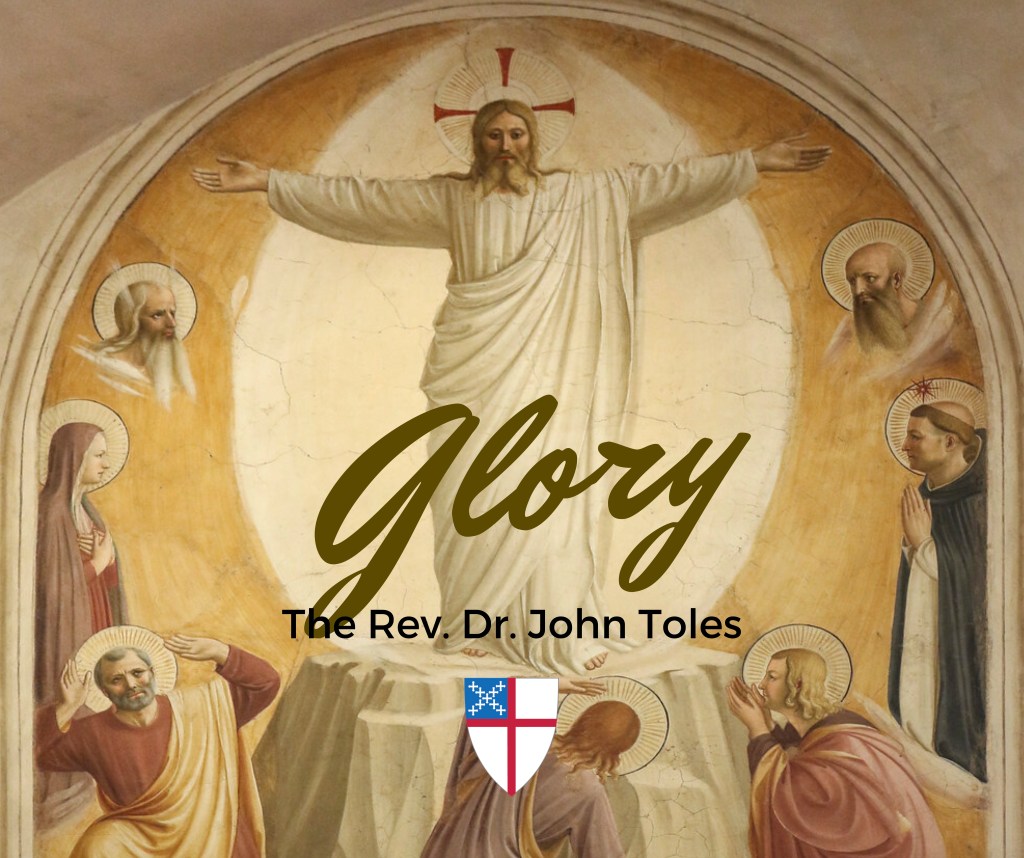
Sermon: Last Epiphany RCL A – Glory

The podcast is available here.


Visiting Ireland, Boudreaux walked into a bar in Dublin, ordered three pints of Guinness and sat in the back of the room, drinking a sip out of each one in turn. When he finished them, he came back to the bar and ordered three more.

The bartender said, “You know, Boudreaux, a pint goes flat after I pour it. Wouldn’t you rather I pour fresh pints for you, one at a time?” Boudreaux replied, “Well, you see sha, I have two brothers. One is now in Nova Scotia and the other in France, and me, mais, I’m from Louisiana. When we all left home, we promised we’d drink this way to remember the days when we drank together.” The bartender admitted that this was a nice custom and left it there.

Boudreaux became a regular in the bar and always drank the same way: He ordered three pints and drank them in turn. One day he came in and ordered two pints. All the regulars noticed and fell silent, speculating about what might have happened to one of the absent brothers.

When Boudreaux went back to the bar for a second round, the bartender said, “Hey, Boudreaux, I don’t want to intrude on your grief, but I wanted to offer my condolences on your great loss.”

Boudreaux looked confused for a moment and then a light dawned in his eye, and he laughed and said, “Oh, no, no, no, arrybody’s fine. I’ve just given up drinkin’ for Lent!”

The week before last I had the opportunity to go down to New Orleans and do a bit of Mardi Gras.

This past week I had influenza A also known as the flu which of course was my penance for going down to New Orleans and doing a bit of Mardi Gras. Fear not, I am medically cleared to once again be among the living.

If you think back to Christmas, you will recall that we heard the opening prologue of John’s Gospel: “In the beginning was the Word, and the Word was with God, and the Word was God. He was with God in the beginning.” A bit further, John writes, “The Word became flesh and made his dwelling among us. We have seen his glory, the glory of the one and only Son, who came from the Father, full of grace and truth.” Since Christmas, we have been hearing about how this “glory of the one and only Son” was further revealed, and it began with the Epiphany (it takes place on January 6th each year), which celebrates the visitation of the wisemen and the revealing of the glory of God to the Gentiles.

Following the Epiphany, we read about Jesus’ Presentation in the Temple, where the Prophet Simeon also declared Jesus glory:

“Lord, you now have set your servant free
To go in peace as you have promised;
For these eyes of mine have seen the savior,
Whom you have prepared for all the world to see:
A light to enlighten the nations,
And the glory of your people Israel.”

Then there was his baptism. The dove, the Holy Spirit descended and rested upon him and the Father declared Jesus’ glory to all who were present: “This is my Son, the Beloved, with whom I am well pleased.”

Jesus further revealed his glory in the calling of the disciples and in the great wisdom he showed through his teachings.

Think also about how Jesus said, “A city on a hill cannot be hid.” Ask yourself this, in saying that, could Jesus have been alluding to his own crucifixion and the glory to come? A city on a hill… a cross on a hill that all can see. A city built with Jesus as the cornerstone and the cross as the very foundation. A city which gives light, gives glory to all the world. And not only that, but a city of which you are a part, not only of the building, but of the glory itself, and like Jesus, you are called to “let your light shine before others, so that they may see your good works and give glory to your Father in heaven.”

You know how when you’re sitting out on a lake on a bright sunny day and there’s just enough of a breeze to cause a few small waves across the water. And on occasion, one of those small waves reflects the sunlight back to you perfectly and there is this sudden flash of light. It’s really all you can see. That’s what our readings have been like since Christmas. These sudden flashes of Jesus’ glory, but today: “Jesus took with him Peter and James and his brother John and led them up a high mountain, by themselves. And he was transfigured before them, and his face shone like the sun, and his clothes became dazzling white.” Not a quick flash of light, but a full revealing.

What can be confusing is that we are so close on Christmas, that we can mistakenly believe that the Transfiguration of Jesus took place early in his ministry, but in the life of Jesus, he has already turned toward Jerusalem. Not only is this day a day when the glory of Christ is fully revealed, it is also the beginning of the journey to the Cross: for Jesus, the disciples, and for us, so what significance would the Transfiguration have had on the disciples and how can it assist us as we begin?

The African Impala is one of those amazing creatures in God’ creation. A bit like a deer in build. They can get up to 40 miles per hour when in a flat out run. That’s a pretty good clip, except when you are in a foot race with a cheetah who can hit 75 miles per hour in short burst. Given the cheetah likes a little venison for supper, it would seem that the Impala wouldn’t have a chance, but the Impala has learned a couple of tricks. One, stop on a dime and make a sharp turn. Cheetah’s have breaks, but they’re not that good. Second trick of the Impala, the ability to jump up to ten feet in the air. I think they rely more on the quick turn when in a race for their life, but I can see where jumping ten feet in the air might come in handy. Either way, the “supper time” routine has played out between these two since the beginning. What’s interesting about the Impala is that placed in a zoo, even though they can jump ten feet high, they can be confined to an enclosure that has only a three foot wall. Why? They won’t jump anywhere if they can’t see where their feet will land. They are confined by what they can’t see.

At the time leading up to the Transfiguration, perhaps Jesus understood this same issue with the disciples. Perhaps he knew they would follow, but in order to do so, to get through the trials and suffering and sorrows that were to come, they would need to see where their feet would land, they would need to see the glory that was to be revealed… not just a flash, but the glory in all its fullness. Archbishop Michael Ramsey wrote, “The Transfiguration is the revelation of the potential spirituality of the earthly life in the highest outward form. Here the Lord, as Son of Man, gives the measure of the capacity of humanity, and shows that to which he leads all those who are united with him.” In the Transfiguration, Jesus makes known to us, not only his glory, but our glory that is to come, and it is in that glory that we find our hope. A hope that sees us through trials and a hope that walks with us as we go the way of the Cross. As St. Paul said to the Romans, “I consider that our present sufferings are not worth comparing with the glory that will be revealed in us.”

Since Christmas, we have been walking up the mountain and now Jesus has fully revealed himself and who we will become. Now… now we must begin the descent into the valley of the shadow of death. It is a place of great trials, so as you go, listen for the voice of the Shepherd, watch for signs of his glory, and keep his revealed glory ever before you, knowing that where he is, you will be also.

Let us pray: O God, who before the passion of your only begotten Son revealed his glory upon the holy mountain: Grant to us that we, beholding by faith the light of his countenance, may be strengthened to bear our cross, and be changed into his likeness from glory to glory; through Jesus Christ our Lord, who lives and reigns with you and the Holy Spirit, one God, for ever and ever. Amen.

Louise at Sixteen

I’m always early. Always have been. Not entirely sure why, but it comes with a couple of perks, especially when traveling through airports. The best seat at the gate, no rushing about, and an outlet should you need to charge a phone. It also gives you the opportunity to watch everyone else running about.

Today, I watched folks jockeying for positions in lines so that they could get through security faster, chatting up airline desk attendants attempting to score an upgrade, and the occasional grouch, who no matter the situation, is going to find that one thing. And then there was… well, I don’t know her name, but she looked like a Louise, so Louise it is.

Louise was at least seventy, she appeared to have difficulties with balance–her gait was almost a stumble at every step–hair gray, and a bit overweight, but who am I to talk about that one. I watched Louise and I watched all the other travelers around me. What struck me about Louise is that, unlike everyone else, Louise wasn’t catching a flight this morning. Louise was cleaning. Going behind all of us, wiping up our spills, picking up our trash, wiping our fingerprints off the windows, mopping floors that we had tracked up, etc. As I watched her, I wondered if anybody else actually saw her (the fact that I did does not make me special, it was just me doing the people watching thing). What I wondered about Louise: I wondered what she was like at sixteen.

I saw a young girl in a pastel dress, with white socks (a bit of lace around the top), and shiny black shoes. I saw a girl trying to be a woman with her hair pulled back, a bit of color on her cheeks, and a smile to break the boys’ hearts. I saw a future unfolding and then I wondered again: when she was sixteen, did she see herself at seventy cleaning up after me as I passed through some random airport? Don’t get me wrong, there is nothing wrong with a custodial job. Had one myself for three years before going off to seminary. It is honest “clean” work, but I just wondered about Louise at sixteen. Is this how she saw life working out for her? I doubt it. Would she like to be boarding one of the hundreds of planes she sees departing everyday? Taking some exotic trip? Getting away from it all if for only a few days? I’m certain of it.

I saw a young girl in a pastel dress. She pushed her cleaning cart through an “Employees Only” door and disappeared. That young girl disappeared. I wonder if she thinks the same thing.

Sermon: Epiphany 5 RCL A – Mind of Christ

The podcast is available here.


Photo by Joshua Eckstein on Unsplash

The local sheriff in Terrebonne Parish, Louisiana was looking for a deputy, so Boudreaux – who was not exactly the sharpest nail in the bucket went in to try out for the job.

“Okay,” the sheriff drawled, “Boudreaux, what is 1 and 1?”

“11,” he replied.

The sheriff thought to himself, “That’s not what I meant, but he’s right.”

“What two days of the week start with the letter ‘T’?”

“Today and tomorrow.”

He was again surprised that Boudreaux supplied a correct answer that he had never thought of himself.

“Now Boudreaux, listen carefully: Who killed Abraham Lincoln?”

Boudreaux looked a little surprised himself, then thought really hard for a minute and finally admitted, “I don’t know.”

“Well, why don’t you go home and work on that one for a while?”

So, Boudreaux wandered over to the pool hall where his pals were waiting to hear the results of the interview. Boudreaux was exultant.

“It went great! First day on the job and I’m already working on a murder case!”

The Intelligence Quotient (aka: IQ) can be defined as: “The whole of cognitive or intellectual abilities required to obtain knowledge, and to use that knowledge in a good way to solve problems that have a well described goal and structure.” (Source) Boudreaux I don’t know about, but the average person (68% of us) has an IQ between 85 and 115, and you have to be in the top 2% (IQ ~140 or above) to be admitted into Mensa—think Genius club.  Currently, the youngest member of Mensa is 3, with an IQ of 142.  Are you a genius?  Well, according to one genius, Albert Einstein, you are: “Everybody is a genius, but if you judge a fish by its ability to climb a tree, it will live its whole life believing it is stupid.” (Source)  

Even though a person has a high IQ, as much as genius level, they can still be an idiot.  High IQ means you can quickly take in large amounts of information and utilize it in the given setting, but wisdom (not being an idiot) is something completely different.  Charles Duhigg, author of The Power of Habit, says, “Typically people who can see beyond the information they’ve learned and apply it through analogies to other situations in their life or see other insights from it, those are the people we typically refer to as being exceptionally wise.” (Source)  So, not being an idiot isn’t dependent upon your IQ, it is dependent upon your wisdom.  

Why this talk of IQ, intelligence, and wisdom? St. Paul wrote in his First Epistle to the Corinthians that we read, “Among the mature we do speak wisdom, though it is not a wisdom of this age or of the rulers of this age… But we speak God’s wisdom, secret and hidden, which God decreed before the ages for our glory.”  What does that mean for us?

A few weeks ago we wrapped up our study of St. Paul’s Epistle to the Romans.  I had a number of folks say how confusing and difficult it was.  I went to seminary, have access to all these additional resources and even I had to stop and ask, “For the love of all things holy, what in the heck are you talking about?”  The ability to compare and contrast N.T. Wright’s to Gordon Fee’s views of Pauline Christology takes a higher IQ and intelligence than everyone I know, but to say that we are the body of Christ and Jesus is the head of the body, that is something most of us can get our heads around, and can understand, based on the information we have learned about our own bodies.  That is approaching wisdom, but we’re not quite there, because “God’s wisdom” that Paul referred to is our ability to take that and not only know it, but apply it—live it, because intelligence tells me that Jesus is the head, but wisdom directs me—the body—to submit to the mind of Christ instead of my own.  Which leads to one more question: where does that mind of Christ come from and how to we attain it?  St. Paul answers, “We have received not the spirit of the world, but the Spirit that is from God, so that we may understand the gifts bestowed on us by God.”  Through the Spirit of God, we have received the wisdom of God. As the author of Proverbs states, “For the Lord gives wisdom; from his mouth come knowledge and understanding.” (Proverbs 2:6)  We have the ability to understand what God expects of us, just as Jesus understood, because—and this is that mind blowing statement that we read—because “We have the mind of Christ.”  We can know what God expects of us, not because we have some high IQ and understand all things, but because we have the mind of Christ or put another way, we have the same Spirit of God within us that Jesus had in himself.  It is knowledge to be able to say it, but God’s wisdom to believe it, “We have the mind of Christ.”

When Jesus began to teach the things of God, what God expected of us, he spoke of the difference between intelligence in wisdom.  For example: Jesus said, “You have heard that it was said to those of old, ‘You shall not murder; and whoever murders will be liable to judgment.’  But I say to you that everyone who is angry with his brother will be liable to judgment.”  “You shall not murder” is intelligence.  It comes from the Book and can be learned, but to take it the next step and apply it to the attitude of the heart is wisdom.

Again, Jesus said, “You have heard that it was said, ‘You shall not commit adultery.’  But I say to you that everyone who looks at a woman with lustful intent has already committed adultery with her in his heart.”  To know, “You shall not commit adultery,” is intelligence.  To understand that lusting in your heart is also adultery, that is wisdom.  You’ve taken the information and applied it to your life.

The Israelites were to be the salt of the earth.  They were to ‘season’ this life with God.  God and his teachings were to permeate every aspect of their lives.  They were also supposed to be the light of the world.  They were to draw others to God so that this ‘seasoning’ of God would be a part of others’ lives as well.  Why did Jesus judge the religious leaders—those who were to teach about being salt and light—why did he judge them so harshly?  Because they only taught and practiced ‘intelligence.’  They cared about outward/external things, but not internal, things of the heart.  As Jesus will later say, “Now you Pharisees cleanse the outside of the cup and of the dish, but inside you are full of greed and wickedness.”  Therefore he goes onto say to them, “You fools! Did not he who made the outside make the inside also?”  He wants them to take what they know of God through all their studies and understanding and then apply it, not only to their bodies, but to their hearts and souls as well.  And that message is the same for us, because at the end our Gospel reading, Jesus said to those who were listening, “For I tell you, unless your righteousness—your wisdom—exceeds that of the scribes and Pharisees, you will never enter the kingdom of heaven.”  Just about anyone can appear to be a ‘good’ Christian, while at the same time have a heart shrouded in darkness.  My friend St. Josemaría Escrivá said that to be like this is not to have the mind of Christ, but the “mask of Christ.” (cf. The Furrow #595)

We have been grafted into the people of God, so we are now also to be the ones who are salt and light.  With the mind of Christ, we are to have wisdom that teaches and guides us, so that others may see our good works—so that others may see God and give glory to our Father in heaven.  To accomplish this, we don’t need a Mensa level IQ, we need the mind of Christ, the wisdom of Christ, which is given to us all through the Spirit of God, for as Paul said, “These things God has revealed to us through the Spirit.”  Pray that the mind of Christ, the Spirit of God may enter you more fully and fill you with God’s wisdom.

Let us pray: Loving Father, faith in Your Word is the way to wisdom. Help us to think about Your Divine Plan that we may grow in the truth. Open our eyes to Your deeds, our ears to the sound of Your call, so that our every act may help us share in the life of Jesus. Give us the grace to live the example of the love of Jesus, which we celebrate in the Eucharist and see in the Gospel. Form in us the likeness of Your Son and deepen His Life within us.  Amen.

Camino: Training Continues

In order to complete the Camino in the time allotted, I need to average 12.5 miles (20km) per day. Each day I become more confident in my ability to do that, but I’ve definitely been training for it by walking, walking, walking. For this, I utilize the trail system that was integrated into my neighborhood along with a few drainage routes to get around. The end result resembles a Beatles song. Keeping me company these days has been The Hanging Girl: A Department Q Novel (Book #6) by Jussi Adler-Olsen.