Sermon: Easter 3 RCL B – “Oneness”


Boudreaux was talking to his buddy, Thibodeaux, “I’ve been doing a lot of thinking recently and based on many years of marriage, I’ve come to a remarkable conclusion.”

“This I want to hear already,” says Thib. “So tell me about your wonderful conclusion.”

“I’ve discovered,” says Boudreaux, “that if I only slightly upset Clotile, it’s almost certain that she will shout at me. Fair enough! But if I really upset her, she won’t shout louder but instead will give me the silent treatment.”

Thibodeaux almost immediately starts nodding his head and says, “I understand. To get a little peace, it’s sometimes worth putting in a little extra effort.”

Boudreaux would define peace as Clotile not yelling at him, but if we were to go around the room, I’m sure we would find a variety of answers. Peace is the lack of noise. Peace is sitting on a beach. Peace is being in the arms of one you love. All of these answers are correct, but they are really only highlighting a certain aspect of peace.

Webster’s defines peace as tranquility, quiet, freedom from civil disturbance, harmony, and so forth. The biblical understanding of peace takes these things into account, but it brings them all under an overarching idea that I can best describe as “oneness.”

The Hebrew word for peace is shalom, and the Greek is eirene (ir-ray-nay). Eirene / peace is a noun, but the Greek word has at its root a verb: eiro. Eiro means “to join or bind together that which has been separated,” therefore, peace is not just the absence of Clotile yelling at Boudreaux or some other noise or trouble, but is instead a brining about of oneness that transcends the noise or trouble.

Jim Walton was a missionary and linguist in the jungles of Columbia and he took on the task of translating portions of the New Testament into the local language. In the process, he found that he lacked the native vocabulary to be able to translate the word peace.

At some point, Jim was scheduled to take a local chief to a village that was a three days walk or a twenty minute plane ride, however, because of an error, the chief missed the flight and he became very angry. Finding Jim, he launched off into angry rant and Jim noticed that the chief kept repeating the same phrase. He did not understand it at the time, but translating it later he discovered that when the chief was angry, he kept saying, “I don’t have one heart.” The chief did not have oneness in his heart, there was something broken—he didn’t have peace.

I know that I quite often come back to this passage of scripture, so bear with me… on the night before he was crucified, we hear the great priestly prayer of Jesus and what does he pray for? He prays that those who the Father has given him “may all be one.” He tells the Father, “The glory that you have given me I have given to them, that they may be one even as we are one, I in them and you in me, that they may become perfectly one, so that the world may know that you sent me and loved them even as you loved me.” He is praying that we have one heart with each other and one heart with the Father and he is praying that through him that one heart might be attained.

Now, do you remember the two disciples that were on the Road to Emmaus and the stranger (a.k.a. Jesus) joined them and how they were talking about all the things that happened with Jesus and the crucifixion and that when evening had come Jesus sat with them and broke bread and their eyes were opened and they recognized him? Well, at that point, Jesus vanished from their sight and those two disciples hightailed it back to Jerusalem to tell the others. At this point, Scripture tells us, “As they were talking about these things…”…as they were in the upper room, talking with the other disciples about what had happened—and this is where our Gospel reading picks up today—“Jesus himself stood among them, and said to them, ‘Peace to you!’”

In the times before Jesus, the Israelites had wandered in the desert, then they came to the land flowing with milk and honey, but before they crossed the Jordan River into this promised land, the Lord renewed the Covenant with them: “Choose you this day whom you will serve,” and the people chose God, so God promised that he would be with them if they kept his commandments, but just as they wandered in the desert, they wandered in their faith and went after other gods, breaking the One True God’s Laws and his Commandments; therefore, God did not break the Covenant with them—there would always be a remnant—but he did take from them the peace, the oneness, that had been established between them. Speaking through the Prophet Isaiah, the Lord said:

“I am the Lord your God,
    who teaches you to profit,
    who leads you in the way you should go.
Oh that you had paid attention to my commandments!
    Then your peace would have been like a river,
    and your righteousness like the waves of the sea;
your offspring would have been like the sand,
    and your descendants like its grains;
their name would never be cut off
    or destroyed from before me.”

All the things that could have been, but in their wickedness, they turned from God and they were left separated, broken from God and from one another as they were carried off into exile, and that brokenness remained until it was healed on the cross and proclaimed to the disciples and to us in the upper room when “Jesus himself stood among them, and said to them, ‘Peace to you!’” St. Paul teaches us, “Since we have been justified by faith, we have peace with God through our Lord Jesus Christ.” Through Christ Jesus, we again have oneness with God.

When you and I exchange The Peace, it is this hope, this oneness that we are extending to one another. That we might be of one heart with each other and with God, but it doesn’t end there. Jesus said, “Thus it is written, that the Messiah is to suffer and to rise from the dead on the third day, and that repentance and forgiveness of sins is to be proclaimed in his name to all nations, beginning from Jerusalem. You are witnesses of these things.” In saying “that repentance and forgiveness of sins is to be proclaimed,” Jesus is saying that peace—between God and man—is to be proclaimed and that we are the proclaimers, we are the witnesses of oneness with God, a oneness and peace that is made available to all.

He who is the Prince of Peace is sending us into the world to proclaim the restoration of our oneness with God. How do we do that? Perhaps St. Francis said it best in a prayer…

Lord, make me an instrument of your peace:
where there is hatred, let me sow love;
where there is injury, pardon;
where there is doubt, faith;
where there is despair, hope;
where there is darkness, light;
where there is sadness, joy.

O divine Master, grant that I may not so much seek
to be consoled as to console,
to be understood as to understand,
to be loved as to love.
For it is in giving that we receive,
it is in pardoning that we are pardoned,
and it is in dying that we are born to eternal life.
Amen.

Sermon: Easter Sunday RCL B


The priest was working in his office one day when the church secretary came scurrying through the door, out of breath.

“Father, Father, I have news!” she said, trying to regain her composure.

“Well, what’s the news?” asked the perplexed priest.

“Jesus is coming. He is back and he’s coming here right now. What should we do?”

The priest suddenly became flustered and wringing his hands, turned back to his computer and answered, “Look busy.”

St. Peter said to Cornelius and the other gentiles, “They put him to death by hanging him on a tree; but God raised him on the third day and allowed him to appear, not to all the people but to us who were chosen by God as witnesses, and who ate and drank with him after he rose from the dead.” Jesus died and rose again on the third day. That is the Easter proclamation: the resurrection, but why? Why did Jesus die and rise again? Answer: so that we would look busy. We must be busy little Christians or we’re not really Christians at all. Right?

I was reading a devotional by Bishop Robert Barron (he’s Roman Catholic, so don’t tell our friends across the street that I quoted him) and Bishop Barron was reflecting on the calling of St. Matthew. He pointed out something that I hadn’t noticed before: what is the first thing that Jesus and Matthew did after Matthew was called? Multiple choice quiz: A) heal a leper, B) feed the 5,000, or C) have a party? Jesus “saw a man named Matthew sitting at the tax collector’s booth. ‘Follow me,’ he told him, and Matthew got up and followed him. While Jesus was having dinner at Matthew’s house, many tax collectors and sinners came and ate with him and his disciples.” The answer is C). The first thing Jesus and Matthew did after the calling of Matthew: they had a party.

Skip ahead: the house of Mary and Martha. There is busy Martha scurrying about the house making all the preparations, while her sister Mary is sitting at Jesus feet enjoying his company. Busy Martha gets irritated with Lazy Mary and complains to Jesus: “Make her help me,” cries Busy Martha. Jesus says, Busy “‘Martha,’ the Lord answered, ‘you are worried and upset about many things, but few things are needed—or indeed only one. Mary has chosen what is better, and it will not be taken away from her.’”

Returning to today’s reading again: what did Jesus and the disciples do following the resurrection? Peter said, “They put him to death by hanging him on a tree; but God raised him on the third day and allowed him to appear, not to all the people but to us who were chosen by God as witnesses, and who ate and drank with him after he rose from the dead.”

Do you see a pattern? Party. Sitting at Jesus feet. Having a meal with friends.

In his reflection, Bishop Barron quoted from a book by a Trappist Monk, Fr. Simeon (I know, two Romans Catholics in one sermon, oy!). Fr. Simeon wrote, “The deepest meaning of Christian discipleship is not to work for Jesus but to be with Jesus.” I thought that was so simple, but brilliant, that I had to find the book and read more. Fr. Simeon, speaking to those whom Jesus calls, says, “Jesus is inviting those he chooses to forsake worldly concerns and busyness, a circular routine of habits and prejudices leading nowhere, in order to recline with him and his friends in the joy of breaking bread with the eternal Word…. All by itself, working for Jesus would be a call to a higher servility.” (Source: Fire of Mercy, Heart of the Word, Vol. 1 by Fr. Simeon, formerly Erasmo Leiva-Merikakis). We are chosen by Jesus, not to be busy Christians, but so that we might recline with him and break bread with him and his friends. Don’t get me wrong: I am not saying that there is no work for us to do—there is more than enough and there always will be, but… Jesus did not die on a cross and rise on the third day so that we would be busy. He died and rose so that we might be with him and have fellowship with him and one another and break bread together.

Have you been doing it wrong?

For me, the answer is: most likely. Why? Well, as nice as it sounds to simply be with Jesus, it is a whole lot easier to work for him, to be busy for him. You see, fellowship with Jesus and his friends isn’t like, “Party at JC’s Place!” with the BeeGees playing Saturday Night Fever in the background—You should be dancing…. (you can tell I don’t get out much). Fellowship with Jesus isn’t like that. Do you remember your first love: how you ached for them and when you saw them, you wanted every part of them. You couldn’t bear the thought of being separated from them. You would lay awake at night thinking of them, anxiously waiting to be with them again… my goodness, I can still smell her perfume! Anyhow, that is fellowship with Jesus, the thing is, that’s not how we always feel about him, but it is how he always feels about us; and to be loved so intently will either consume you, scare you away, or cause you to put up barriers—like being busy; and we put up those barriers so that we can hold onto something of ourselves, afraid that all will be lost if we don’t, never realizing that we have everything to gain.

Today, if you have been scared away, I invite you to come back, for our God is faithful and just, and if you confess your sins he will forgive you and cleanse you of all unrighteousness; but if you have put up a barrier of busyness or some other barrier, then I invite you to allow God to tear it down and then I invite you to be consumed by his love for you.

Jesus did not conquer death so that you could be busy for him. He conquered death so that you might be consumed by him and become one with him as he and the Father are one.

Let us pray:
Draw us forth, God of all creation.
Draw us forward and away from limited certainty
into the immense world of your love.
Give us the capacity to even for a moment
taste the richness of the feast you give us.
Give us the peace to live with uncertainty,
with questions,
with doubts.
Help us to experience the resurrection anew
with open wonder and an increasing ability
to see you in the people of Easter.
Amen.

Sermon: Great Vigil of Easter RCL B


Photo by Rinat Alshynbay on Unsplash

If you need 144 rolls of toilet paper for a month-long quarantine, you probably should’ve seen a doctor long before COVID-19.

What’s the difference between COVID-19 and Shakespeare’s Romeo and Juliet? One’s a coronavirus and the other is a Verona crisis.

The World Health Organization has announced that dogs cannot contract COVID-19. Dogs previously held in quarantine can now be released. To be clear, WHO let the dogs out.

There’s a new COVID-19 vaccine delivered via an audio interface as music. It is hoped that this will lead to heard immunity.

Ran out of toilet paper during the COVID-19 pandemic and had use lettuce leaves. Today was just the tip of the iceberg, tomorrow romaines to be seen.

Why stupid COVID-19 jokes? In a few minutes—because I will keep it brief this evening—we will renew our Baptismal Vows. Following the confirmation of the Creed, we are asked five “Will you” questions: “Will you continue… Will you persevere… Will you proclaim… Will you seek and serve… Will you strive…” For the past year, our response has been, “I sure would like to, but… COVID-19.” “I could help with that, but… yeah, COVID-19.” “I’d really like to come to church, but… COVID-19.” It’s a bit like me and The Queen (That’s the cat. Her real name is Rain, but I’m only allowed to call her by her proper title, thus… The Queen.) I’m out shopping and come across something I think would look nice in the house and then I say to myself, “I have a cat”—meaning it’ll last until The Queen decides to knock in on the floor. It’s the answer to so many things, “I have a cat.” The same has been true with COVID-19, it is the answer to everything, including why we haven’t been able to fully live into our Baptismal Vows. So, I want you to keep this in mind—because we’re not quite there yet, but we are very close—I want you to keep in mind that, pretty soon, COVID-19 is only going to be an excuse, not a reason. We’ve been safe and playing by the necessary rules, but now we’re all getting vaccinated and this pandemic will be over, therefore, very soon, it will be time to reinvest ourselves into our faith, and our church, and the fulfillment of our vows.

I am so very thankful for all of you who have come out tonight and have begun to return to church. I am also so very thankful for everyone watching and not watching on the internet, but we are nearing the time when we must once again be the Church in the fullest meaning of that word, so tonight, as many around the world are preparing for and being baptized, let us stand together and recommit ourselves to our own vows, so that when the day arrives, we can, without delay, reconvene the work of God and His Church. (p.292 of the BCP)

Sermon: Holy Saturday RCL B

Photo by Jongsun Lee on Unsplash

At the death of Jesus, we are told of many unnatural occurrences in the natural world, for even the earth and heavens rebelled and reacted to the death of Jesus: the sun went dark, the earth shook in a violent earthquake, and the curtain of the Temple was torn into. A great upheaval… then the murmuring of the people returned. The crowd dispersing, What to do with the bodies, finding a tomb, something to anoint Jesus with, but then… the silence came over it all and all of creation held its collective breath as Jesus lay in the tomb.

N.T. Wright wrote a poem about this day and that silence (The Seventh Day):

On the seventh day God rested
in the darkness of the tomb;
Having finished on the sixth day
all his work of joy and doom.

Now the word had fallen silent,
and the water had run dry,
The bread had all been scattered,
and the light had left the sky.

The flock had lost its shepherd,
and the seed was sadly sown,
The courtiers had betrayed their king,
and nailed him to his throne.

O Sabbath rest by Calvary,
O calm of tomb below;
Where the grave-clothes and the spices
cradle him we did not know!

Rest you well, beloved Jesus,
Caesar’s Lord and Israel’s King,
In the brooding of the Spirit,
in the darkness of the spring.

Source: N. T. Wright, The Challenge of Easter, pp. 33-34.

Jesus rested and we wait.

Sermon: Good Friday RCL B


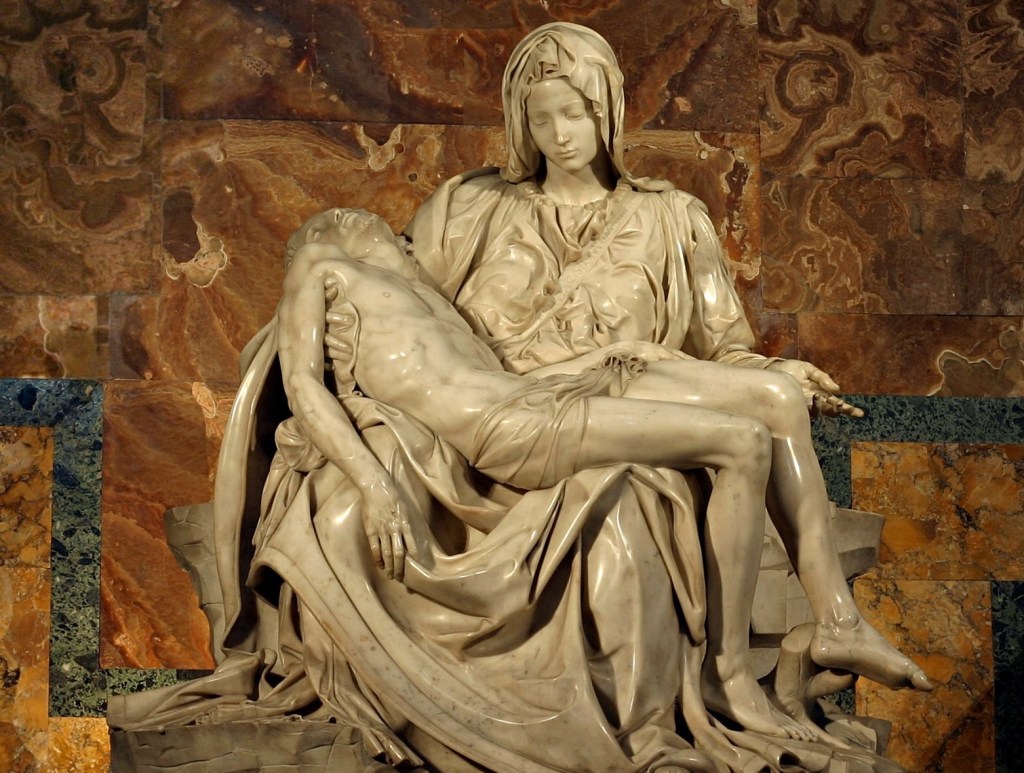
At the time of the crucifixion, standing near the Cross, was John, the beloved disciple and the three women: Mary “his mother, and his mother’s sister, Mary the wife of Clopas, and Mary Magdalene.” I believe it is safe to say that they did not leave him until he was placed in the tomb, so they were also present at the Descent from the Cross or the Deposition of Christ, that is, when Joseph of Arimathea and the others removed Jesus’ body from the cross. The scene is not described for us in Holy Scripture, but the imagination of many artists has captured it and perhaps the most moving of these is when the body of our Lord is held in the arms of his mother, Mary, which is most often referred to as the pietá. The word pietá means pity or compassion and is meant to describe the face of Mary as she gazes upon her son. Of all the pietás created, the most famous is the one by Michelangelo.

The statue was originally commissioned by a French Cardinal who wanted it to adorn his tomb, but when the magnificence of the creation was revealed, it was ‘acquired’ by the Vatican.

At Christmas, we always hear that wonderful passage from Isaiah that begins:

The people who walked in darkness
    have seen a great light;
those who dwelt in a land of deep darkness,
    on them has light shone.

A few verses later:

For to us a child is born,
    to us a son is given.

For us a child is born and for us a son is given. This great event is when God the Father gave his Son to the world and it will be later that the Son will give himself for us. He gave himself on the Cross, but he continues to give himself in the Eucharist, for we hear his words: “Take, eat: This is my Body, which is given for you. Do this for the remembrance of me.”

The Son of God: given to us for our salvation and the nourishment of our souls. The Son of God placed into our hands, just as he was placed into the hands of his mother when he was lowered from the Cross. In the receiving of the Bread of Heaven, the Body of Christ at the Eucharist, we become the Pietá. We become the ones who hold him in our hands and gaze upon his sacrifice. Not even Michelangelo could capture the beauty and love expressed to us by God in that moment.

We can not be indifferent when the bread is placed in our hands, for it is the Son… given for us.

Let us pray: O Holy Mother of God and Blessed Virgin, as you held the body of your Son, Our Lord, at his birth and at his death, may we be found worthy to draw near to you and hold him in our hands at the Eucharist. May the source of your sorrow, that pierced your soul like a sword, bring us a perfect end and life eternal. Pray for us, O holy Mother of God, that we may be made worthy of the promises of Christ. Amen.

Sermon: Maundy Thursday RCL B

Photo by Wim van ‘t Einde on Unsplash

In 1812, Lord Byron published the first two parts of his poem, Childe Harold Pilgrimage.  He thought nothing of it, but it gave meteoric rise to his career.  The reigning poet at the time was Sir Walter Scott, not too shabby of poet himself, however, after reading Childe Harold, Scott decided that he was no longer worthy to even write poetry and gave it up all together in favor of writing novels.  There is a story—I’ll call it story because I couldn’t find a copy of the actual review—a story that says that following the publication of Childe Harold an anonymous critic, writing in a London paper, praised the poetic genius of Lord Byron and stated that Sir Walter Scott could no longer be called the leading poet.  According to the story, it was later discovered that the author of that review was in fact Sir Walter Scott.

We have all been in some form of a competition and they are wide ranging.  The obvious are things like sports and games, but we also compete for jobs, status, and even people’s affections, but have you ever been competing and suddenly realized that other person is the better?  The more talented or suited for the job or the relationship and in realizing that, simply bowed out?  Or even further, like Sir Walter Scott, have you ever bowed out while singing your opponent’s praises?  There are some who might do that, but what if you were in fact the better person or match?  Would you bow out and sing their praises then?  I doubt any would do that.  That would be… well, that would be the greatest becoming the least and that’s just silly.  That said, I suspect God is OK with certain competitions (from what some of you say, He is an OSU fan), but what if we are talking about our opponent’s (a.k.a. our neighbor’s) standing before God?  Their value in God’s eyes?  Their value in our eyes?  Or, put another way, what if we’re talking about their glory and their place in God’s Kingdom?  Is it still a competition?  Do we have an obligation to them?  Or do we say, “As long as I get my mansion, I’m good.  You’re on your own.”  I’ve heard many different answers on this from Christians, but I like C.S. Lewis’ the best.  From his sermon, The Weight of Glory

“It may be possible for each to think too much of his own potential glory hereafter; it is hardly possible for him to think too often or too deeply about that of his neighbour…. It is with the awe and the circumspection proper to them, that we should conduct all our dealings with one another, all friendships, all loves, all play, all politics. There are no ordinary people. You have never met a mere mortal. Nations, cultures, arts, civilizations—these are mortal, and their life is to ours as the life of a gnat. But it is immortals whom we joke with, work with, marry, snub, and exploit. 

“Next to the Blessed Sacrament itself, your neighbour is the holiest object presented to your senses. If he is your Christian neighbour, he is holy in almost the same way, for in him also Christ vere latitat —the glorifier and the glorified, Glory Himself, is truly hidden.” 

Do you have an obligation for your neighbor’s glory?  C.S. Lewis says, “Yes,” because within your neighbor is the very glory of God and we do have an obligation to see that glory of God manifested in them even if we must sacrifice ourselves.  How do we do that?  Jesus “got up from the table, took off his outer robe, and tied a towel around himself. Then he poured water into a basin and began to wash the disciples’ feet and to wipe them with the towel that was tied around him.”  If that is how your Lord and Teacher chose to make manifest the glory of his disciples, how will you?  How will you do the same in your neighbor?

Palm Sunday RCL B


Today has so much happening without me being long winded, but I just wanted to share a thought with you. It comes back to that one line we read: “All of them deserted him and fled.”

It would be easy to criticize the Apostles for their actions on that night. They had been with Jesus for three years, witnessed the miracles, heard the teachings… just a few hours before they had shared the Passover meal with him, yet when things got difficult, “All of them deserted him and fled.”

We could criticize, because we want to say in our hearts that we would have never abandoned him. We would have been the one Apostle that died with him that day, if that’s what it came to, but… well, we know that’s just not true, because in big and small ways, we still desert him everyday. Every time we are disobedient to his commands we abandon him, just like the Apostles that night.

In the end, Jesus hangs alone on the cross. While walking the earth, he could hardly find a moment of peace: someone or some crowd was always looking for him and tracking him down, but when he entered his own suffering, he was left only with faith in his Father.

I would never suggest or even consider that someone could suffer as Jesus did, but in our own ways, we all do, whether it be through emotional, physical, or spiritual pain. We can try and share what we are feeling or experiencing with others, but we are often alone, even if we are surrounded by many, and crying to our Father as Jesus did: “Eloi, Eloi, lema sabachthani? …My God, my God, why have you forsaken me?”

Yet, as we discussed last week, Jesus took on our fear so that he might redeem it, he also takes on our suffering so that he might redeem it as well, but he also helps us through. My friend Thomas à Kempis explains how: “If you are infirm in body, or if you find that you are mentally weary and depressed, or if others despise you, or you lose the good graces of men because of your poverty or some inadequacy, do not give in to sadness or yield to anger. Rather, let this be your way of acting: choose this scene as your safe refuge and enter into conversation with Jesus, despised and hanging on his Cross and abandoned for a time by the Father, and reflect on what he meant when he uttered the words: “My God, my God, why have you forsaken me?” (On the Passion of the Christ: According to the Four Evangelists, p.121)

In that conversation with the crucified Lord, you will discover one who intimately aware of your pain and your sorrows, and one who will take you by the hand and walk with you through that valley of shadows. All may have abandoned him, but he will never abandon or forsake you. As the Lord says through the Prophet Isaiah:

“For I, the Lord your God,
    hold your right hand;
it is I who say to you, ‘Fear not,
    I am the one who helps you.’”

Let us pray: Heavenly Father, let your blessing be on us as we pass through these holy days in which we remember the sufferings and death of our dear Lord. Set his example before us, that we may follow him in willing obedience, learn his gracious humility, and be filled with his love and spirit of self-sacrifice, and learn the lessons of a life pleasing to you and helpful to our neighbors; through him who loved us and gave himself for us, Jesus Christ our Lord. Amen.

Sermon: Lent 5 RCL B – “Now My Soul is Troubled”

Photo by Myriam Zilles on Unsplash

Things kids wonder about God:

“Why does God stay in heaven and not come down to earth to visit?”

A woman reported that her four-year-old got a bit confused when she taught him that God watches over us. The young boy asked, “Wait, so God is Santa Claus?”

Closely related to that: “Is Santa God’s really rich brother?”

And not related at all: “Is Jesus a zombie?”

An interesting observation: “If God saw that it was not good for Adam to be alone… how come He never made himself a wife?”

A good question: “If Jesus doesn’t have a sister, why do I need to have one?”

I would also like to sign up for lessons: “Did Jesus practice walking on water first? How can I do it?”

Finally, a woman reports that her three-year-old found a baby bird in the yard that had fallen from its nest. When she went to check on it the next morning, it had died. She says she took the kids to school and then removed the bird and placed it in the garbage. However, when he got home, the boy asked, “Mama, what happened to that baby bird?” Trying to avoid the issue, she responded, “Oh, you don’t have to worry about that baby bird, he lives with Jesus now.” The boy was thoughtful for a moment and then asked, “Jesus lives in the garbage?”

As we get older, we like to pretend that we know more of God than these children, but in truth, we just have larger vocabulary. For example: Child — is God Santa Claus? Adult — is God omniscient / all knowing. Child — is God in Heaven and on Earth? Adult — is God omnipresent / everywhere. Child — did Jesus have to practice walking on the water. Adult — is God omnipotent / all powerful. Child — Is Jesus a zombie? Adult — is God infinite. Yes, we have the same questions, just a larger vocabulary. God is immutable, merciful, wise, faithful, and so on.

Holy Scripture also tells us about our God: God is a consuming fire, God is my crag and my stronghold, God is a mighty fortress, God is one, God is love.

Not only do these attributes apply to God the Father, but in our understanding of the Holy Trinity, we also believe that these attributes apply to God the Holy Spirit and to God the Son, Jesus. From the Creed of St. Athanasius found in the Book of Common Prayer: “And the Catholic Faith is this: That we worship one God in Trinity, and Trinity in Unity, neither confounding the Persons, nor dividing the Substance.” In understanding the Father, the Son and the Holy Spirit we have all these tremendous and powerful ways, as adults and children, of understanding our God, which brings me to my point (Yes, Fr. John, a point please!)…

In our Gospel reading today, the Triumphal Entry into Jerusalem that we celebrate on Palm Sunday has just occurred, so we know that Jesus is in Jerusalem, therefore, we also know that the festival about to be celebrated is the Passover. Jew and non-Jews have come to celebrate and among them are Greeks / Gentiles, and they say to Philip, “Sir, we would see Jesus.” The Gentiles coming in search for him must have been a sign to Jesus that everything was in order, for instead of going to see these foreigners, Jesus said, “The hour has come for the Son of Man to be glorified.”

Then God—Jesus—the omnipotent, omnipresent, the consuming fire, the fortress, the merciful… then Jesus says, “Now my soul is troubled.” I know that Jesus, when he humbled himself at the Incarnation and became one of us, I know that he “set aside” some of the attributes of God so that he might be truly man, but he was still God and inside God… is one… who was troubled. That’s almost scary if you think about it too long, and if you didn’t know who is Dad is, then it really would be.

Jesus has come to Jerusalem, the Gentiles are searching for him, so he knows that his time has arrived and he knows what that means: he just spoke about a grain of wheat dying and in doing so, he knows that he is speaking of his own death and all the pain and horror that is to come before it is finally accomplished. Jesus is troubled. God is afraid.

Now, I know that there are some of you sitting out there shaking your heads and thinking, “Fr. John, you’ve crossed a line this morning,” but let me ask you: is Jesus God? Did he say he was troubled? How do you define “troubled”? The Greek defines it as fear, dread, pain, sorrow, anxiety. Feel free to pick one or all, but what we can’t escape is the fact that our omni-everything God… was afraid, and in his being troubled and his fear, he gathered up the humanity of us all, that he might take it to the Cross. He had to experience our fear so that he could redeem it. And what is our fear? Our fear is that on the day of our judgment we will be found wanting and in being found wanting, we will die eternally—that is our fear. Jesus took up our judgment, our death, our fear, our humanity—he took it all within, within the Godhead itself—the Holy Trinity—and declared: “Behold, I am making all things new.”

John tells us in his first epistle: “Whoever confesses that Jesus is the Son of God, God abides in him, and he in God.  So we have come to know and to believe the love that God has for us. God is love, and whoever abides in love abides in God, and God abides in him….” …and here it is… “By this is love perfected with us, so that we may have confidence for the day of judgment, because as he is so also are we in this world.  There is no fear in love, but perfect love casts out fear. For fear has to do with punishment, and whoever fears has not been perfected in love.” We have not been perfected in our own love. No. Our love is as flawed as our understanding of God, but we have been perfected in Jesus and his perfect love for us casts out our own fears of judgment and punishment that we might rejoice.

Through the Prophet Isaiah, the Lord said:
“Fear not, for I am with you;
    be not dismayed, for I am your God;
I will strengthen you, I will help you,
    I will uphold you with my righteous right hand.”

We joined with the Psalmist this morning in crying out to God: “Have mercy on me… cleanse me… purge me… wash me… block out my offenses… renew me… give me joy.” In all of this, we cry to Father in the same words that Jesus cried, “Father, glorify your name.” Glorify your Son’s name in me. And as the Father spoke to Jesus in the thunder, so He speaks to us: through the perfect love of my Son, “I have glorified it, and I will glorify it again” in you. Se aside your fear and rejoice. The Lord has heard your cries for mercy and He has redeemed you.

This morning, in closing, I would like for us to say together the Song of Zechariah. It is Canticle 16 on page 92 of the Book of Common Prayer. Would you please stand….

Blessed be the Lord, the God of Israel; *
he has come to his people and set them free.
He has raised up for us a mighty savior, *
born of the house of his servant David.
Through his holy prophets he promised of old,
that he would save us from our enemies, *
from the hands of all who hate us.
He promised to show mercy to our fathers *
and to remember his holy covenant.
This was the oath he swore to our father Abraham, *
to set us free from the hands of our enemies,
Free to worship him without fear, *
holy and righteous in his sight
all the days of our life.
You, my child, shall be called the prophet of the Most High, *
for you will go before the Lord to prepare his way,
To give people knowledge of salvation *
by the forgiveness of their sins.
In the tender compassion of our God *
the dawn from on high shall break upon us,
To shine on those who dwell in darkness and the shadow of death, *
and to guide our feet into the way of peace.

Glory to the Father, and to the Son, and to the Holy Spirit: *
as it was in the beginning, is now, and will be for ever. Amen.