The Golden Fistula(new cover art coming soon) is available on Amazon and has had 1,000+ edits to correct the grammar. The Journey is also out there. All this is in preparation for the release of The Marble Finger (the second Father Anthony Savel Mystery). If you are interested in following, connect with one of these social media outlets (FYI: I don’t do much on Twitter) or follow this blog.
Weary of constantly picking clothes up from the floor of little Johnny’s room, his mother Rachel finally laid down the law: each item of clothing she had to pick up would cost Johnny 25 cents.
By the end of the week, Johnny owed his mother $1.50, and she placed the “bill” on his bed. Surprisingly, mom quickly received $2 along with a note: “Thanks, Mom. Keep up the good work, and keep the change!”
With all the technology available, you would think we would no longer need a pen and paper. We’ve got electronic calendars that will ding us and tell us when we’re supposed to be somewhere, apps and other electronics that provide notifications, and even my dentist now has an electronic service that will call me no less than four times to remind us of an appointment (a bit annoying actually, but I’m told that there are still plenty of folks that forget their appointment.) All that, yet even though I make use of them, I still sit down at night and write out the next day’s events and tasks. With the planner I have, The Monk Manual, in addition to a calendar and task list, some questions allow you to review the day: “Ways to improve tomorrow,” “When was I at my best,” and “When did I feel unrest.” There’s also a place for journaling and things I’m looking forward to. Finally, there’s a box where I list three things that I am grateful for, but why would a daily journal ask me to include things I’m grateful for? There’s actually science behind it.
An author for Psychology Today writes, “Gratitude, or an intentional focus on appreciating the `positive aspects of life, is strongly and causally related to both physical and psychological well-being. There’s also growing evidence that simple gratitude meditations done on a daily basis can improve our mental health, and that cultivating gratitude can even strengthen our immune functioning. As we shift our focus towards what is positive in our lives, or reframe painful experiences in ways that allow us to grow, gain wisdom and compassion, and deepen our empathy with others, we also dial down our stress response, lessening the flow of stress-related hormones through our bodies.” (Source)
The science says it is good for us to be grateful, and my daily planner allows three small spaces to list what I’m grateful for. There are a few days when the only thing I can come up with is “coffee,” but most days, I’m able to fill the box. However, I suppose the real question for me would be: why can’t I fill an entire journal with everything I should be grateful for in a single day? To answer that, I need a better definition of gratitude.
A secular answer comes from a Harvard Medical School journal (please note: I do not sit around reading psychology and medical journals. I Google and then search for good sources. Anyhow…)—the journal states, “The word gratitude is derived from the Latin word gratia, which means grace, graciousness, or gratefulness (depending on the context). In some ways, gratitude encompasses all of these meanings. Gratitude is a thankful appreciation for what an individual receives, tangible or intangible. With gratitude, people acknowledge the goodness in their lives. People usually recognize that the source of that goodness lies at least partially outside themselves.” (Source)
“The source of that goodness lies at least partially outside of themselves.” That source can be found in relationships, good fortune, opportunities given, and so on, but ultimately, the source is The Source—it is God. Today in our Gospel reading, I suspect all ten lepers recognized the source of their good fortune, but that is not all there is to gratitude. The journal stated, “With gratitude, people acknowledge the goodness in their lives.” Recognizing and acknowledging are two separate things. For these feelings of joy and happiness to be genuine gratitude, they must first be recognized and acknowledged.
Finally, there may be an innate sense of gratitude in us all, but for the most part, it is something that must be practiced and cultivated. If you walk around all day moping and complaining, then if you win the lottery, you might exhibit gratitude, but for the remainder of the time… you’ll just be moping and complaining. Gratitude must be practiced and cultivated—it must be intentional.
At this point, you may be saying, “Well, Father John, this is a nice talk for a psychology class, but what does it have to do with the Gospel of Jesus Christ?” The answer: everything.
1 Chronicles 16:34 — Oh give thanks to the Lord, for he is good; for his steadfast love endures forever!
1 Thessalonians 5:16-18 — Rejoice always, pray without ceasing, give thanks in all circumstances; for this is the will of God in Christ Jesus for you.
Colossians 3:15 — And let the peace of Christ rule in your hearts, to which indeed you were called in one body. And be thankful.
I do not know this for a fact, the scriptures do not say it, but it would not surprise me if the one leper who came back and gave thanks to Jesus was one who, whether intentionally or unintentionally, practiced gratitude. Even though it may not have appeared, there were reasons for him to be grateful. He was an outcast, but he had a community. He was sick, but he was still alive. He was required by the law to wear rags, but he still had something to cover his body with. He was required to cry out, “Unclean! Unclean!” anytime someone approached, but he still held in his heart the hope of one day being clean. He could have spent all his time moping and complaining about his misfortune, circumstances, the unfairness of it all, the people he was with, everything, but he could have also seen all the goodness in those difficulties.
Time and time again, the scriptures call upon us to be thankful. Why? The reasons are innumerable—even in the worst of circumstances—but if for no other reason, we are called to be grateful because we were once the lepers. We were the ones living outside the community of God. We were the ones who had to cry out, “Unclean! Unclean!” We were the ones who stared at death and decay all day long, but through Jesus, we have been redeemed and given new life. Like with the one leper that returned, Jesus has said to us, “Get up and go on your way; your faith has made you well.” That’s a simple enough phrase, but it is powerful because the words “get up” are also translated be resurrected. Even in the most difficult of situations, we are grateful because Jesus has said to us, “Get up, you are resurrected—given new and eternal life—so go on your way and be thankful; your faith has made you well.”
Practice your gratitude and cultivate it. Keep a small journal and daily write down those good things you recognize and acknowledge them. Take time in your prayers to not just lay out the laundry list for God but also allow time to give him thanks, even in the most difficult of times, for the goodness he has shown you. Go to the person who showed you the goodness of God and acknowledge them as a conduit from God to you, telling them how much you appreciate them in your life. Finally, spend a little time meditating on that most extraordinary gift of all: the salvation and eternal life you have received through Jesus, and realize how truly blessed you are. As the Psalmist declared:
Hallelujah! I will give thanks to the Lord with my whole heart, in the assembly of the upright, in the congregation.
And a few verses further:
He sent redemption to his people; he commanded his covenant for ever; * holy and awesome is his Name.
He sent redemption: let that be the beginning, then let your heart overflow in thanksgiving and gratitude for the goodness of our God.
As a concluding prayer, please turn to page 837 in your Book of Common Prayer.
Let us give thanks to God our Father for all his gifts so freely bestowed upon us.
For the beauty and wonder of your creation, in earth and sky and sea.
We thank you, Lord.
For all that is gracious in the lives of men and women, revealing the image of Christ,
We thank you, Lord.
For our daily food and drink, our homes and families, and our friends,
We thank you, Lord.
For minds to think, and hearts to love, and hands to serve,
We thank you, Lord.
For health and strength to work, and leisure to rest and play,
We thank you, Lord.
For the brave and courageous, who are patient in suffering and faithful in adversity,
We thank you, Lord.
For all valiant seekers after truth, liberty, and justice,
We thank you, Lord.
For the communion of saints, in all times and places,
We thank you, Lord.
Above all, we give you thanks for the great mercies and promises given to us in Christ Jesus our Lord;
To him be praise and glory, with you, O Father, and the Holy Spirit, now and for ever. Amen.
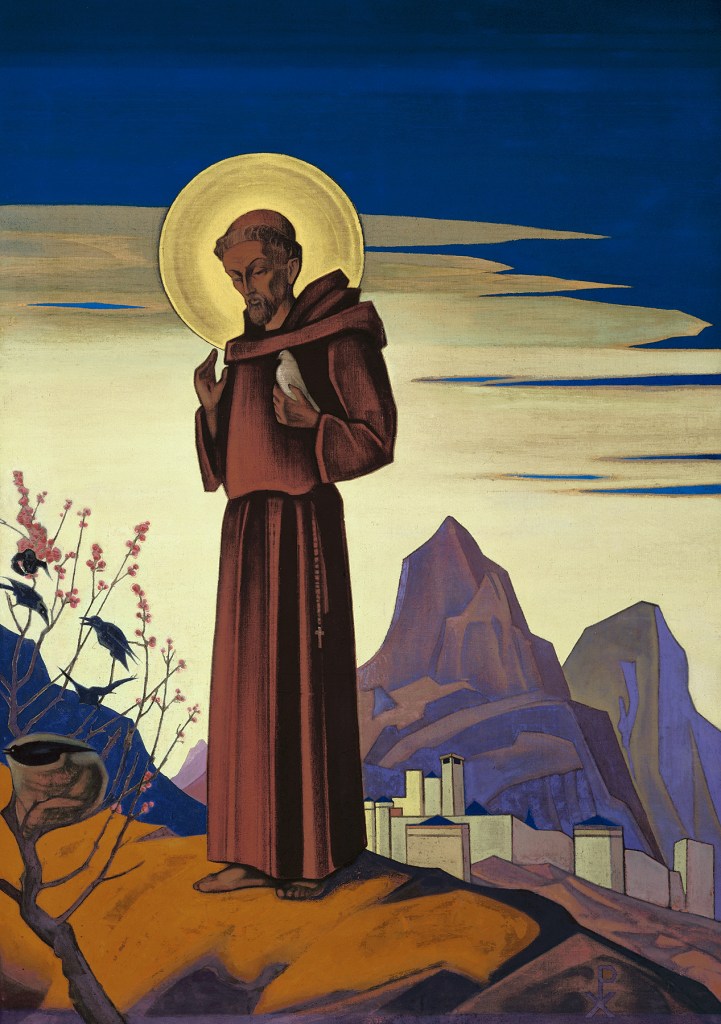
St. Francis by Nicholas Roerich. 1932. Tempera on canvas.
“In the beginning, God created the heavens and the earth,” and a bit further in the creation narrative, we are told: “So God created humankind in his image, in the image of God he created them; male and female he created them. God blessed them and said, ‘Be fruitful and increase in number; fill the earth and subdue it. Rule over the fish in the sea and the birds in the sky and over every living creature that moves on the ground.’”
God created all things, and we are to “fill the earth and subdue it.” He crowned us with glory and subjected all things to us. The Lord took all that he had made and handed it to us. Yet, in doing so, he did not make us owners or dictators over it. He made us stewards and supervisors of His creation, and how we care for His creation reflects how we care for one another.
When we think of St. Francis, we think of the stories of his interactions with the animals. However, a closer reading of those stories demonstrates to us how we are to care for one another; as St. Francis of Assisi said, “If you have men who will exclude any of God’s creatures from the shelter of compassion and pity, you will have men who will deal likewise with their fellow men.” Francis is saying that if you abuse an animal, you’ll abuse a person. If you pollute the earth, you’ll pollute a soul. If you see creation simply as a means to an end, then it is likely that you will see others simply as objects created to fulfill selfish desires.
How should we act towards creation and others? A Native American saying: “God Made the earth, the sky and the water, the moon and the sun. He made man and bird and beast. But He didn’t make the dog. He already had one.” Jesus said, “Be the kind of person your dog thinks you are.” I read that on Facebook, so it must be true. No. Jesus did not say that, but it has a good bit of truth and expresses how we should act toward creation. And you can change it up to be the kind of person your cat thinks you are, your iguana or turtle. They are all the same if you love and care for them—the point: be that kind of person to the people around you.
I do not know what Jesus would say about a cat, but the name I gave the cat that lives in my house is Rain. The name she has given herself is The Queen. As her loyal subject and obedient servant, she finds in me kindness, compassion, comfort, a scratch behind the ear, and treats. I pray that the world will discover those qualities in me (minus the scratch behind the ear). Why? Because Jesus said, “You are the light of the world. A town built on a hill cannot be hidden. Neither do people light a lamp and put it under a bowl. Instead, they put it on its stand, and it gives light to everyone in the house. In the same way, let your light shine before others, that they may see your good deeds and glorify your Father in heaven.”
Yes, be the kind of person your dog, cat, or iguana thinks you are. Be the kind of person who brings glory to the Father in your dealings with the earth and with the four, eight, or more legged creatures, and be one who brings glory to the Father in your dealings with the two-legged variety as well. Perhaps Francis expressed it best in the prayer that is attributed to him. Let us pray:
Lord, make us instruments of your peace: where there is hatred, let us sow love; where there is injury, pardon; where there is doubt, faith; where there is despair, hope; where there is darkness, light; where there is sadness, joy.
O divine Master, grant that we may not so much seek to be consoled as to console, to be understood as to understand, to be loved as to love. For it is in giving that we receive, it is in pardoning that we are pardoned, and it is in dying that we are born to eternal life. Amen.
Did you know that the longest fingernail (actually a thumbnail) is 6 feet 4 inches? Did you know that the loudest burp by a female is 107 decibels (the equivalent of being close up to a jackhammer)? Did you know that the longest kiss lasted over 58 hours? And did you know that the greatest distance to catch a thrown grape in the mouth is 354 feet? World’s records. If someone is willing to do something crazy, there’s bound to be someone around to measure it. There are also some remarkable human feats that have been accomplished.
A few weeks back, ten of us came together as a team—St. Matthew’s Saints—and walked the 5K at the Great Land Run. For those not proficient in the metric system (myself included), 5K (kilometers) is roughly 3.1 miles. You’ll be happy to know that as a team, we came in second place out of six. The only team to beat us was the EHS Cross Country runners. I’m OK coming in second behind them.
Not only do they keep track of teams, but they track by age groups. For the St. Matthew’s Saints, Frank Baker came in first in his age group, Mary Henneke came in third in hers, and Max Baker came in third for the shorter folks. I… well, I came in 172nd out of 195 runners, and I lived to tell about it. My time for walking 3.1 miles was 54 minutes and 7 seconds, an average of 17 minutes and 46 seconds per mile. There are some remarkable human feats… that was not one of them; however, at the Berlin Marathon held earlier this week, Eliud Kipchoge ran a full marathon (26.2 miles) and set a new world record: 2 hours 1 minute, and 9 seconds. I walked a mile in about 18 minutes. This man ran 26 miles at a pace of 4 minutes and 37 seconds per mile. That’s the difference between running a bit over three mph compared to 13 mph. Eliud set a world record. I did not.
This is only one of the amazing number of remarkable feats accomplished by humans. Still, in all that the human race had done, I’ve never come across a single person who has said to a mulberry tree, “Be uprooted and planted in the sea,” and had it obey them. Yet, when the apostles said to Jesus, “Increase our faith!” Jesus said if you had faith the size of a mustard seed—in other words—if your faith was the equivalent of my 18-minute mile—you could move that mulberry tree, so perhaps Jesus did not mean for us to understand this literally but was instead using a figure of speech to make a point.
This past week during our Wednesday night study, we discussed the use of a metaphor in Holy Scripture. A metaphor is a word that symbolically refers to another. For example, we see many times in scripture where God is referred to as a rock, but we know this doesn’t literally mean that God is a rock. To have faith the size of a mustard seed and be able to move a tree from one place to another is not a metaphor. Still, it is also a figure of speech: a rhetorical hyperbole—an over-the-top exaggeration, yet when Jesus uses it, he speaks of a greater truth.
In the nineteenth chapter of Matthew, we are told of Jesus’ encounter with the rich young man. The man came to Jesus and asked what he must do to inherit eternal life. Jesus says to him, “If you would enter life, keep the commandments.” The young man asks, “Which ones?” Jesus replied, “You shall not murder, You shall not commit adultery, You shall not steal, You shall not bear false witness, Honor your father and mother, and, You shall love your neighbor as yourself.” Hearing this, the young man becomes excited. He’s on his way, so he says to Jesus, “All these I have kept. What do I still lack?” Jesus tells him, “If you would be perfect, go, sell what you possess and give to the poor, and you will have treasure in heaven; and come, follow me.” Jesus said, “All you need to do is say to that mulberry tree, be uprooted and planted in the sea, and you will inherit eternal life.” And the young man went away sad because he could not do that.
If that were the end of it, then in all likelihood, we would all go away sad because there is a mulberry tree in all our lives that we can’t seem to move. Think about it. I can pick many mulberry trees in my life. Things that I’ve worked to change, sins that I’ve attempted to overcome, anger that I think I’ve set aside that keeps welling up… run through the list: pride, hypocrisy, gluttony—It’s all there. Spin the wheel and see which one pops up today. All of them are like that young man and his wealth; they are mulberry trees with roots into my soul that just won’t give an inch. If eternal life depended upon my ability to move them, I would catch up to that young man so that we could commiserate together because, in the end, we would both be damned. Fortunately for us, that is not the end of the story.
After the rich young man went his way, Jesus said to his disciples, “Truly, I say to you, only with difficulty will a rich person enter the kingdom of heaven. Again I tell you, it is easier for a camel to go through the eye of a needle than for a rich person to enter the kingdom of God.” Jesus said, “Truly I say to you, only with difficulty can someone who is unable to move the mulberry tree gain eternal life. It would be easier for Father John to squeeze into a pair of skinny jeans than for such a person to enter the Kingdom of God.” When the disciples heard this, they were greatly astonished, saying, “Who then can be saved?” But Jesus looked at them and said, “With man this is impossible, but with God… with a faith in God that is no larger than a mustard seed… all things are possible.” Moving the mulberry tree and gaining eternal life is not about what I can do. Instead, it is about my faith in what my God can do—and all things are possible through Him. As St. Paul says, “The sting of death is sin, and the power of sin is the law. But thanks be to God, who gives us the victory through our Lord Jesus Christ.” (1 Corinthians 15:56-57) And again, he says, “Wretched man that I am! Who will deliver me from this body of death?”—who will move this mulberry tree in my life?—“Thanks be to God through Jesus Christ our Lord!” (Romans 7:24-25a)
There are things in our lives that we strive to change and overcome, and so often, we fail. They are like trying to move mulberry trees into the sea. However, just because we fail does not permit us to stop trying and pushing forward, but those failures are not a reason to walk away sad and defeated. We must go at it again. Yet, we can rest in confidence that, in the end, Jesus has already moved the mulberry tree for us. As St. Paul said, the Lord Jesus gives us the victory.
One final note—a bit of an aside: I said that moving the mulberry tree and saying you could move it into the sea was a rhetorical hyperbole, an over-the-top exaggeration. Fine. However, I am not one to limit God, so I firmly believe that should God ever need such a remarkable feat accomplished, it will be done, for if he can raise a man from the dead, moving a tree, no matter how deeply rooted, will never be an issue.
Let us pray: Holy God, we come to you with humility, knowing that the answer to our challenges is not wholly within us. We come with steadfastness and faith, knowing that your love for us is everlasting. And we come with hope, knowing that all things are possible in you. We come to you and give you thanks for the victory you have won for us. Amen.
Tomorrow is the Feast of St. Michael and All Angels, and Sunday, October 2nd, is the traditional date for celebrating the Feast of the Guardian Angels. We’ll combine those two days today.
My friend, St. Josemaría Escrivá, had a special devotion to his guardian angel. He would say, “For years I’ve experienced the constant and immediate assistance of my guardian angel, even in the smallest material particulars.” For example, it was his habit to wake at 6 a.m. every morning, so when his alarm clock broke, he turned to his guardian angel and asked for assistance. That angel never failed him, waking him at the correct time every day. Escrivá would refer to him as, “My dear watchmaker.”
At another time, he and friends were playing bocce ball. When it was his turn, Escrivá threw particularly well but immediately declared, “That doesn’t count—I was helped by my guardian angel. I won’t do that anymore.” Later he would confess how ashamed he was for asking his guardian angel to help with such a trivial matter.
And one more: while in seminary, a professor told them how priests, in addition to their guardian angels, have a ministerial archangel that watches over them. This he took to heart. His friend and biographer, Alvaro del Portillo, writes that whenever “[Escrivá] was leaving the room, he would pause, almost imperceptibly, before going through the doorway” to allow his two angels to go before him. Alvaro said, “This was a tiny detail, unnoticed by the others, which showed how he lived in relationship with his guardian angel and ministerial archangel.”
Referring to angels, the Catholic catechism states, “The existence of the spiritual, non-corporeal beings that Sacred Scripture usually calls ‘angels’ is a truth of faith. The witness of Scripture is as clear as the unanimity of Tradition.” It further states, “From infancy to death human life is surrounded by their (the angels) watchful care and intercession. Beside each believer stands an angel as protector and shepherd leading him to life. Already here on earth the Christian life shares by faith in the blessed company of angels and men united to God,” and St. Thomas Aquinas writes, “The angels work together for the benefit of us all.”
Not only do they watch over and guard, but they are also God’s messengers. The word angel is derived from the Greek word angelos, meaning messenger. Perhaps the most important message being delivered by Gabriel to Mary announcing the Incarnation. Throughout scripture, we hear of their work: the angel that freed Peter from prison, the grand visions of them by Isaiah and John in his Revelation, and how they ministered to Jesus following the forty days in the wilderness.
Like Escrivá, you don’t have to go far to find or hear stories about angels. There are many, many books of accounts and encounters (some of which claim that angels are, in fact, space aliens, but we won’t go down that road.)
We do not worship them. Upon seeing one, John tells us, “I fell down to worship at the feet of the angel…but [the angel] said to me, ‘You must not do that! I am a fellow servant with you and your brothers the prophets, and with those who keep the words of this book. Worship God.’” We do not worship them, but we do honor and celebrate these ‘fellow servants’ of the Lord. We celebrate their unswerving obedience to God and the many kindnesses they show: watching over and protecting us, bringing us God’s messages, and saving our behinds when we do something especially stupid.
Remember that these guardians and messengers are with you, and give them pause to go before you and protect you.
Let us pray: Saint Michael the Archangel, defend us in battle. Be our protection against the wickedness and snares of the devil; May God rebuke him, we humbly pray; And do thou, O Prince of the Heavenly Host, by the power of God, thrust into hell Satan and all evil spirits who wander through the world for the ruin of souls. Amen.
A poor fella wants to attend church on a Sunday morning, but when he arrives, he sees that everyone is all nice and clean, but he’s a bit dirty. They’re wearing nice clothes, but his have holes and are patched. They’ve got nice shoes on, but his are so worn that his big toe sticks out on both shoes. So, when he tries to gain entry, he’s told he’ll need to clean up a bit first and put on some nice clothes. He’s told that he’ll need to be proper, and then the door is closed on him. As he sits on the front steps, listening to them sing songs about the love of Jesus, he complains to God about not being allowed in. Then he heard God say, “I know how you feel. They won’t let me in there either.”
From our Psalm this morning:
Praise the Lord, O my soul! I will praise the Lord as long as I live…
Who gives justice to those who are oppressed, and food to those who hunger.
The Lord sets the prisoners free; the Lord opens the eyes of the blind; * the Lord lifts up those who are bowed down;
The Lord loves the righteous; the Lord cares for the stranger; * he sustains the orphan and widow, but frustrates the way of the wicked.
Have you ever read passages of scripture like this and wondered what all those types of individuals think? I mean, the scriptures say God will give justice to the oppressed, but there are so many who are still oppressed. It says he’ll give food to the hungry, but there are still so many who hunger. I suppose those who don’t believe can’t complain, but what about the believers—those who call on the name of the Lord but who are still oppressed, blind, hungry, and so on? If I found myself in such a position, I might be one to say, “Excuse me, Lord, but would you fulfill some of those promises in my life?” I know you’ve done these kinds of things before.
I read about the crippled woman bent over (bowed down); you healed her. There was the blind man you restored sight to. You cared for plenty of strangers: the ten lepers, the guy whose friends lowered him through the roof, the crippled man in the temple. And you fed the hungry: feeding of the 5,000. Feeding of the 4,000. The miraculous catch of fish. Yes. You’ve done all these things before, so, yeah, I’ll take some of that, but… nothing.
At such a point, we can say, “To heck with all this God business,” or we can look more deeply and discover what is really being said. We can listen, not just to the parts we want to hear, but to all of what scripture says. And that understanding begins at the inauguration of Jesus’ work when he said,
“The Spirit of the Lord is upon me, because he has anointed me to proclaim good news to the poor. He has sent me to proclaim liberty to the captives and recovering of sight to the blind, to set at liberty those who are oppressed, to proclaim the year of the Lord’s favor.”
“He has anointed me to proclaim.” There’s also the time he got up early in the morning, after healing many the day before, and went away alone into the wilderness. Later, Simon finds him and reports that everyone is looking for him and Jesus said, “Let us go on to the next towns, that I may preach there also, for that is why I came out.” “The reason I came was to proclaim the Kingdom of God.”
As we’ve discussed before, the miracles were not the reason for Jesus’ coming. They were signs of his authority in proclaiming the forgiveness of sins. Remember when he healed the paralytic? Jesus said to the man, “Take heart, my son; your sins are forgiven,” but the scribes became angry, so Jesus, knowing their thoughts, said, “‘Why do you think evil in your hearts? For which is easier, to say, ‘Your sins are forgiven,’ or to say, ‘Rise and walk’? But that you may know that the Son of Man has authority on earth to forgive sins’—he then said to the paralytic—‘Rise, pick up your bed and go home.’”
The message—the proclamation of the gospel and the forgiveness of sins was his primary purpose, and even his death upon the cross announced it. This is part of what made Jesus so unpopular with religious leaders. He was proclaiming the Kingdom of God was available to everyone—tax collectors and sinners and all, but the religious leaders believed you would have to pay for your sins. You couldn’t be forgiven just because someone said you were, so when Jesus declared that all who repented were welcomed into the Kingdom… well, the religious leaders got their knickers in a twist. He pointed this out in the parable of the prodigal son.
You know the story: a father with two sons. The younger son asks for and receives his inheritance, then goes out and squanders it. When he hits bottom, he says, “Self, you should go home and work for your father; at least there, you’ll have something to eat.” So he returns home. Dad sees him coming and orders a party to celebrate the return of the lost sheep—his son. However, the older brother—and keep in mind the attitude of the religious leaders who object to Jesus—older brother throws a snit fit and refuses to go to the party. The father implores him, but the son replies, “Look, these many years I have served you, and I never disobeyed your command, yet you never gave me a young goat that I might celebrate with my friends. But when this son of yours came, who has devoured your property with prostitutes, you killed the fattened calf for him!”
The religious leaders complained to Jesus: we are the ones that are following God’s ways, yet you declare the forgiveness of sins to those who are furthermost from God. That’s not right, they said.
Now, come forward to our Gospel reading for today, which was told almost immediately following the parable of the prodigal son.
We can understand today’s parable in terms of a moral teaching, which it should be. We are called on to care for those in need and we will be partially judged by how we do, but there is more being said, and it relates to the prodigal son and the attitude of the religious leaders.
The poor man, Lazarus, begs at the city gates day and night, and the dogs are more compassionate toward him than the rich man. Eventually, they both die and receive justice: Lazarus to heaven and the rich man to Hades. Seeing Father Abraham, the rich man asks if Lazarus could bring him one tiny drop of water to cool his tongue, for he was in agony in flames. That, of course, is not possible. Hence, the rich man asks if Father Abraham would send someone to his brothers to proclaim the truth so that they might repent and not be punished as he was, but Father Abraham replies, “If they do not listen to Moses and the prophets, neither will they be convinced even if someone rises from the dead.”
This is a story about the proclamation of the Kingdom of God: the tax collectors and sinners were the ones, not at the city gates, but at the Temple gates, crying out daily for a single drop of cool water to cool their souls—some sign of hope, compassion, mercy from those who were supposed to be rich in God’s word, the religious leaders, but those religious leaders wouldn’t even look at the sinners, associate with them, or speak with them. Jesus is saying to the religious leaders, “Because, in this life, you refused to give the tax collectors and sinners a single drop of the Good News to cool their souls and help them gain the Kingdom of God, then you will receive punishment in the next.”
The parable is a morality story, but more importantly, it is a message for the church. We are the rich. Within us is not just a drop of cool water, but Jesus tells us, “Whoever believes in me, as the Scripture has said, ‘Out of his heart will flow rivers of living water.” When that poor man complained to God that they wouldn’t let him in church, God said to him, “I know how you feel. They won’t let me in there either.” You are not that kind of church, but let us always be on guard against it. Like Jesus, we want to be about the business of proclaiming the Kingdom of God. As the church, that is our job, so as His church, let us continue to be a place where all who are thirsty and in need of forgiveness and repentance can come and receive Jesus, the Savior of us all.
Let us pray: Everliving God, whose will it is that all should come to you through your Son Jesus Christ: Inspire our witness to him, that all may know the power of his forgiveness and the hope of his resurrection; who lives and reigns with you and the Holy Spirit, one God, now and for ever. Amen.
A farm boy got a white football for his birthday. He played with it a while and then accidentally kicked it over into the neighbor’s yard. The old rooster ran out, looked at it, and called the hens to see it.
“Now look here,” the rooster said, “I don’t want you girls to think I’m complaining, but I just want you to see what they are doing next door.”
If I were a chicken, I don’t know if that would motivate me or get me to cross the road and find a less demanding farm.
When it comes to cats, I don’t believe there is anything that motivates them. They do what they want, when they want, although The Queen is motivated to have a nip of scotch when I pour myself one. On the other hand, dogs can be motivated by all sorts of things: affection, play, food (I would make a good dog), and other games they enjoy. People also have motivators. Food, money, fame, power, love, and such, but we are also motivated by negatives: shame, societal expectations, fear, and more. Whether positive or negative, human or animal, a motivator is an external factor that stimulates a desired response and is something learned. In addition, if the motivator is removed—the reward is no longer given, the fear is no longer present—the person or animal may revert to who they were before. If a person is motivated by money and you cut their pay or their hours, then you’ll likely see their productivity decline. That great motivational speaker, Zig Ziglar, said, “Of course, motivation is not permanent. But then, neither is bathing; but it is something you should do on a regular basis.” Motivation is good.
What is similar to motivation is inspiration, but where motivation is an external force that pushes in hopes of attaining a specific response, inspiration is an internal awakening that draws us and pulls us to something greater. The reward or punishment is not present with inspiration. It is nice if there is a reward, but if you’re inspired, you’ll do whatever it is, regardless. Leonardo Davinci didn’t paint the Mona Lisa because someone offered him a cookie. It was an inspiration, something within him that needed to express itself.
Our life with God is the same. Some are positively motivated—they want the reward of heaven—and some are negatively motivated—they’re afraid of hell. That’s one way to do it. These external factors push us toward the desired response: I want to go to heaven, or I want to avoid hell, so I’ll behave in a certain way. However, to be inspired to follow God and his calling on your life is to be drawn in—not for the reward or avoidance of punishment—but by love, by desire, by passion, by relationship.
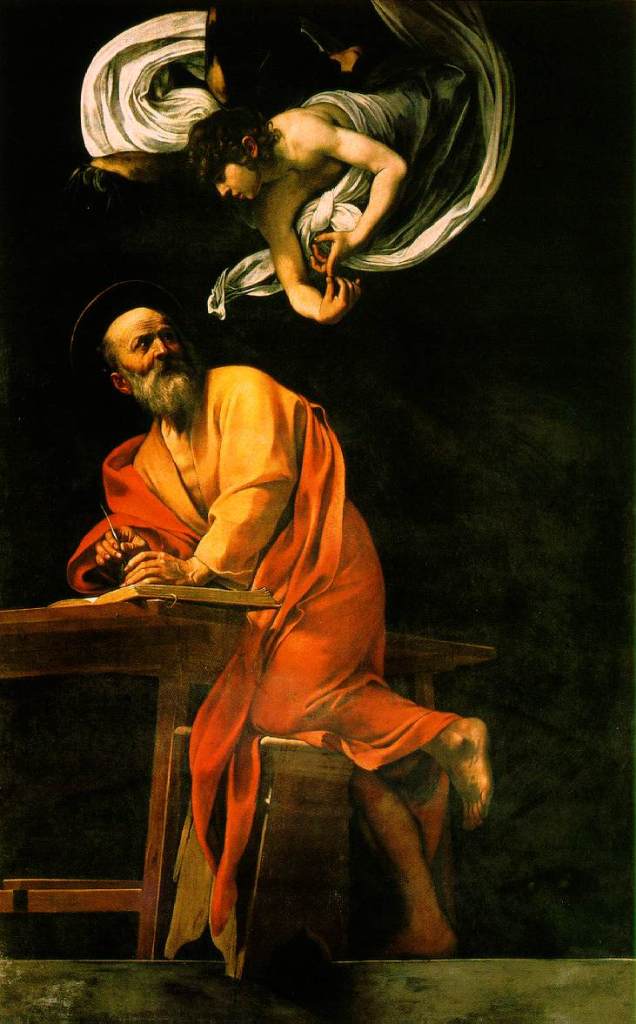
The image on the front of your booklet this morning is named, The Inspiration of St. Matthew and is located in the church of San Luigi dei Francesi in Rome. When we study it, we begin to see the inspiration of God at work.
The angel is making several points, ticking them off with his fingers, and Matthew is staring up at him. Although his pen and tablet are on the desk, Matthew only has eyes for the messenger of God. His focus is singular. Matthew is not concerned with himself—you can’t see it all, but he is standing at his desk with one knee propped up on the seat. The seat itself is tilted and about to fall over, yet Matthew is not concerned with his discomfort or the precariousness of his position. His hand is poised for action, ready to write. And notice the background of the painting—it is all black. Nothing else matters other than the angel and the message. Matthew is not motivated—he’s not looking for a reward or in fear of punishment—Matthew is inspired, and he wasn’t only inspired to write a Gospel. He was inspired from the very moment Jesus walked into that tax collection operation and said, “Follow me,” for we are told, “[Matthew] got up and followed him.” Jesus did not promise him heaven or threaten him with hell. Jesus’ words and presence filled Matthew with such a deep inspiration, a deep sense of call, that without hesitation or any concern for self, discomfort, possessions, danger, and everything else that accepting a call from the Savior can produce, he got up and followed Jesus with his entire self.
Question: why are we not inspired in such a way to follow Jesus so passionately? I can come up with a few answers but I think, for the most part… we simply won’t allow it. We want to follow Jesus with complete abandon, but we will not give ourselves permission to do so. We say, “Yes, Jesus, I will follow you, but… but I’ve got a family. But I’ve got a job. But I’ve got responsibilities. But I’m afraid of what people will think.” That’s a pretty big “but.” But! what we fail to understand is that Jesus is not asking us to abandon family or job or responsibilities, etc. Jesus is asking us to abandon our lives to him so that he can inspire our life with family, our life at work and with our colleagues, and in all those other areas of responsibility. The Lord does not want our day-to-day life to be separate from our life with Him. So often, in following Christ, we think we’ve got our life with him over here and our life in the world over here, with this nice barrier between them keeping them separate. To be inspired by Jesus as St. Matthew was is to remove that barrier and allow Jesus into every aspect of your life. In doing so, you will no longer feel as though there is this conflict between the two but will instead experience peace in knowing that your life is entirely under the kingship of Christ.
It is not in the prayers we have today, but in our Rite II service each Sunday, the last sentence of the Post-Communion prayer is, “Send us now into the world in peace, and grant us strength and courage to love and serve you with gladness and singleness of heart….” It is that peace, that gladness, and that singleness of heart—our daily lives—that enters us when we allow Jesus to inspire the entirety of our lives.
Jesus says, “Follow me.” Be inspired, be passionate in your walk with Jesus, and follow him in every aspect of your life.
Let us pray: We thank You, heavenly Father, for the witness of Your Apostle and evangelist Matthew to the Gospel of Your Son our Savior; and we pray that, inspired by his example, we may with ready wills and hearts obey the calling of our Lord to follow him; through Jesus Christ our Lord, who lives and reigns with you and the Holy Spirit, one God, now and forever, Amen.
The Rev. Nicky Gumbel, the creator of the Alpha Course, discusses how so many Christians wear crosses. Still, he asks a rather interesting question: what if Jesus had been executed during the French Revolution? Would we all wear small guillotines around our necks? Or we could ask: what if he were executed in the United States? Would we all be wearing reproductions of an electric chair? The point is that the cross was a means of execution, not glory, but with all things, God took that means of execution and redeemed it for his purposes, and where there was once shame and horror, there is now glory and love. So, we take this very special day, the Feast of the Holy Cross, and celebrate this great work of our God.
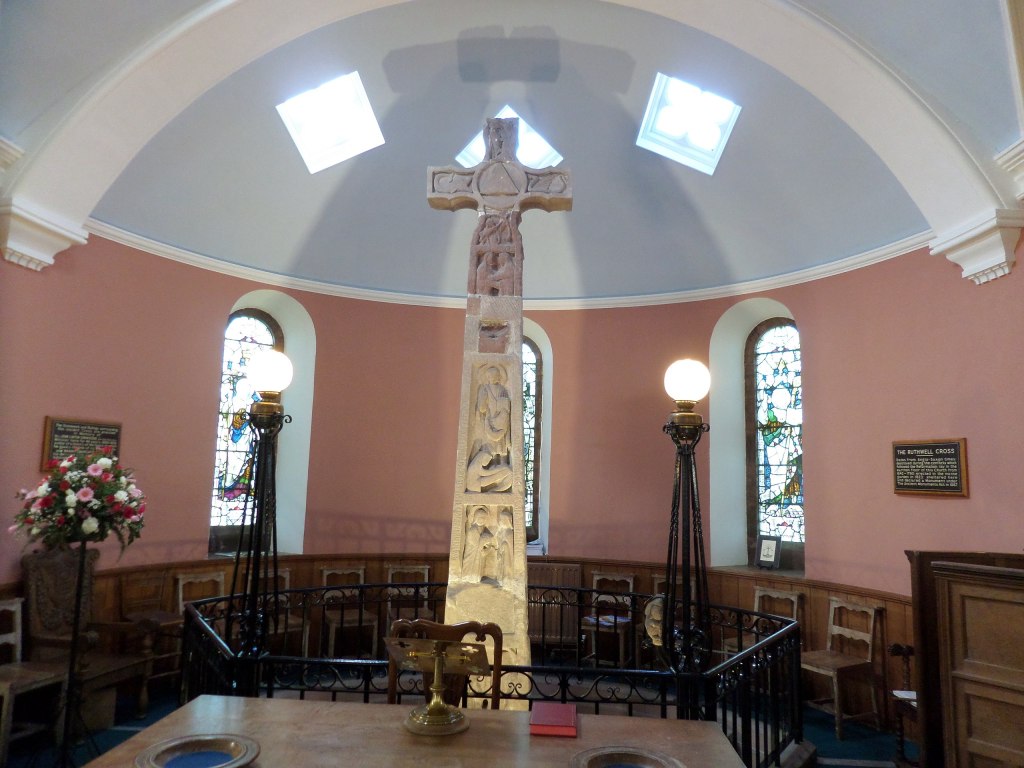
I’ve told you before about the preaching cross discovered in Ruthwell, Scotland, but it is such testimony to the cross of Christ that I’d like to share it with you again.
The cross in Ruthwell is eighteen feet tall and made of stone. It marks the place where an itinerant priest or monk would come to proclaim the word of God. Carved into this particular cross are scenes from the Bible, decorative vine work, and eighteen verses of an old English poem.
For centuries it was thought that the eighteen verses comprised the entire poem, but in 1822 a 10th-century book was found that contained the complete text. The poem is titled “The Dream of the Rood.”
In the poem, an unknown poet dreams of encountering a beautiful tree. It is the “rood” or cross on which Jesus was crucified. The cross is gloriously decorated with gold and gems, but the poet can still see ancient wounds inflicted upon it. The rood tells the poet how it had been forced to be the instrument of Christ’s death, describing how it, too, experienced the nails and thrusts of the spear.
The rood explains that the cross was once an instrument of torture and death but is now the dazzling sign of humanity’s redemption. Finally, the rood charges the poet to tell his vision to everyone so that all might be redeemed of sin.
Then the young hero – God Almighty – stripped himself. Firm and unflinching he mounted the high cross. brave in the sight of many, for he intended to redeem humanity. I trembled when the young hero clasped me, but dared not bow down to the earth No – I would not fall to the ground; I knew full well I must stand firm. As I, the cross, was raised up – I bore aloft the mighty king – the Lord of Heaven – I dared not stoop. They pierced me with dark nails – the wounds can still be seen in me – gaping gashes of malice. I dared do nothing to seal them up, for they mocked us both together. I was drenched with the blood shed from the man’s side after he had sent out his spirit. I endured many hard trials on the hill. I saw the God of hosts violently stretched out. Darkness with its clouds had covered the Lord’s corpse, the fair radiance, a shadow moved in, dark beneath the heavens. All creation wept – all lamented the King’s death. Christ was on the cross!
Christ and the cross endured the crucifixion, and you and I must endure our own spiritual crucifixion so that, as St. Paul, “If we have been united with him in a death like his, we shall certainly be united with him in a resurrection like his. We know that our old self was crucified with him in order that the body of sin might be brought to nothing, so that we would no longer be enslaved to sin. For one who has died has been set free from sin.” (Galatians 6:5-7)
Submit yourself to Christ; do not be afraid to take up the cross he offers and follow him.


















 Candle in a Cave