The Martyrs of Memphis iconwas painted (or “written”) in 1999 by Br. Tobias Stanislas Haller, BSG.
In 1873, the sisters of the Community of St. Mary in Peekskill, New York, were invited by the Bishop of Tennessee to establish a school for girls in Memphis. I couldn’t determine the exact reason; however, I suspect it had something to do with the Yankees’ arrival in the South shortly after the Civil War. Still, it is implied that the sisters’ presence was not appreciated. Undeterred, the sisters continued their work, but as soon as the school opened, the first of two Yellow Fever epidemics broke out. While most of the city was fleeing, the sisters remained and cared for the sick. A member of the community wrote about Constance:
“Sister Constance went out first to the sick. Before she reached the house to which she was going, she was met by a young girl weeping and in great distress. She said her sister was just taken with the fever, that they could get no doctor, and did not know what they ought to do for her. My Sister went immediately to the sick child, did for her all that could be done, and ministered to her wants daily till her recovery. My Sister always loved to speak of this little Louise as her first patient.”
During that first epidemic, 5,000 people became ill and 2,000 died.
Afterward, the school opened, and during four smooth years, Constance and another sister went back to New York for a retreat. However, they were gone only two weeks before news arrived that a second epidemic had started. They quickly returned to Memphis and once again began caring for the sick.
Over 5,000 died during this second wave of Yellow Fever, including Constance and most of her companions, known as the Martyrs of Memphis. Speaking of Constance’s death, one biographer wrote, “Few know what a wonderful life it was that ended, for this world, when Sister Constance died. It was one long and entire consecration to Christ and the Church; and the strength with which she met the fearful trials of those last days, directing, sustaining, and cheering her devoted companions, and working day and night to spare others, was a supernatural strength. She was but thirty-three years old when called away; a woman of exquisite grace, tenderness, and loveliness of character, very highly educated, and one who might have adorned the most brilliant social circle. All that she had she gave without reserve to her Lord, asking only Himself in return as her own.”
Constance’s final words, “Hosanna. Hosanna.”
Father Morgan Dix wrote: “Before the memorable year 1878, many spoke against these faithful and devoted women; but after that year, the tongue of calumny was silent, while men looked on with beating hearts and eyes dim with tears.”
Jesus said, “Very truly, I tell you, unless a grain of wheat falls into the earth and dies, it remains just a single grain; but if it dies, it bears much fruit. Those who love their life lose it, and those who hate their life in this world will keep it for eternal life. Whoever serves me must follow me, and where I am, there will my servant be also. Whoever serves me, the Father will honor.”
Constance and her companions were those who first died to self and, like single grains of wheat, fell to the ground, grew, and produced much fruit. They then sacrificed their lives again, just as their Savior did, by serving others.
The final petition of our collect (prayer) for Constance asks the Lord to “Inspire in us a like love and commitment to those in need, following the example of our Savior Jesus Christ.” We pray that God’s Church will be inspired by these Martyrs of Memphis and many others who give of themselves and produce such abundant good fruit.
I saw in my previous post that I provided a description, but failed to insert the picture. In case you were interested….
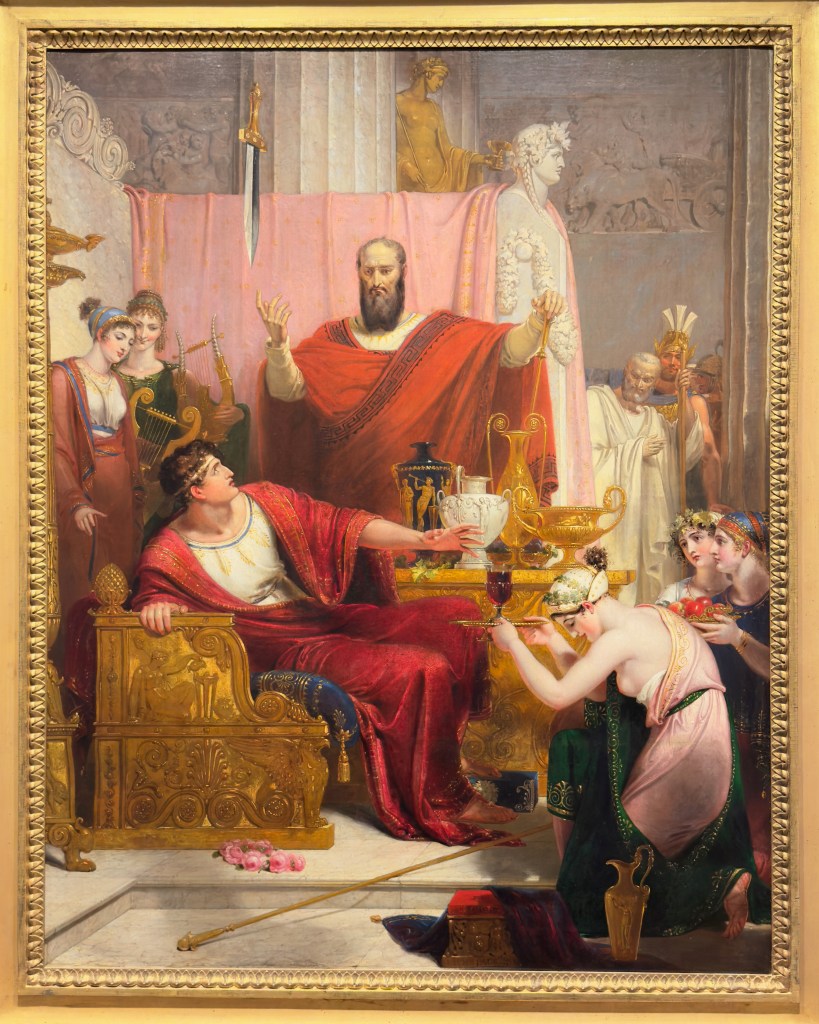
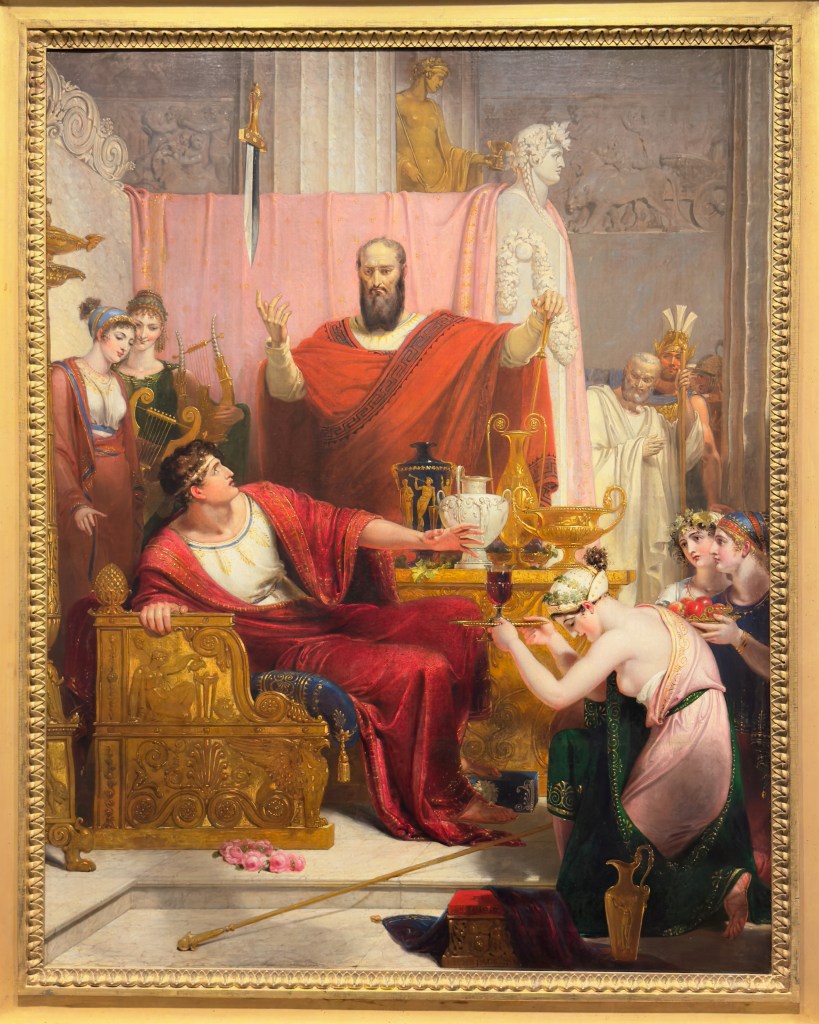
Richard Westall’s The Sword of Damocles. The story behind the painting:
The “sword of Damocles” refers to a situation where a person lives under the constant threat of an impending disaster or harm. The idiom comes from an ancient Greek anecdote where a sycophantic courtier named Damocles, who envied the powerful life of King Dionysius II, was offered to trade places with the king for a day. Damocles found himself in the king’s seat, enjoying the luxury, only to look up and see a sharp sword hanging precariously above his head by a single strand of horsehair, symbolizing the ever-present danger and anxiety that comes with power and fortune.
It all started out with The Queen giving me the stink eye, because she saw the suitcase and that always means trouble, in her pointy little head’s opinion. After the final treat, I headed to OKC and caught my first flight to Atlanta. I remember Drew always referring to it as “Hotlanta.” Somewhere I saw a sign… several years back… that said, Nobody calls it that. We did.
Spent an hour and a few dollars in the Braves Bar during the layover before taking off for RDU–The Raleigh/Durham airport.
That evening, my brother and I spent hours outside talking and drinking. He was hanging something fierce the following day (the whiskey was good but perhaps a tad too much), so we lay low and just hung out.
Truly a very nice evening. We haven’t talked like that since we were kids, and I suppose that is a good thing.
Hangover and a Papilio glaucus
We spent the day just resting and enjoying being outdoors in the beautiful weather. There are several very fat mosquitoes around his house. I had no idea they were feeding on me until the following day. Ate my ass up! After a bit, the brother felt well enough to move around long enough to go to the grocery store. I picked up the fixin’s for a nice chicken curry. When I started to put it together, we discovered that they had no curry powder; however, they had all the ingredients to make their own curry powder… very tasty.
The butterfly was beautiful.
Duke
On this day, we went to Duke University, where my brother received his PhD. A beautiful campus and very rich. I bought a flimsy t-shirt and thought it would cost about $20. Turns out… $56! Almost told the girl she could keep it, but came home with it anyhow. Glad I did.
At the top of my list was the University Chapel. Yeah, they call that a chapel. Truly stunning and I would like to have heard that organ play.
We went to lunch in the refectory at the School of Theology. Should have taken a picture, but had Zimbabwean Beef Stew, Fufu (a doughy African bread used for scooping food), and a curry cabbage dish. Everything was excellent. Afterward, we went over to one of the many libraries, where I saw an exhibit on Indigenous Peoples’ Graphic Novels/Comics.
Had to send several pictures to my friend, Faith. There were several pieces on The Missing and Murdered Indigenous Women (MMIW).
The interesting thing about the exhibit was to see the evolution of the portrayal of Indigenous People in the graphic novels/comics. From Scalphunter to Superhero…
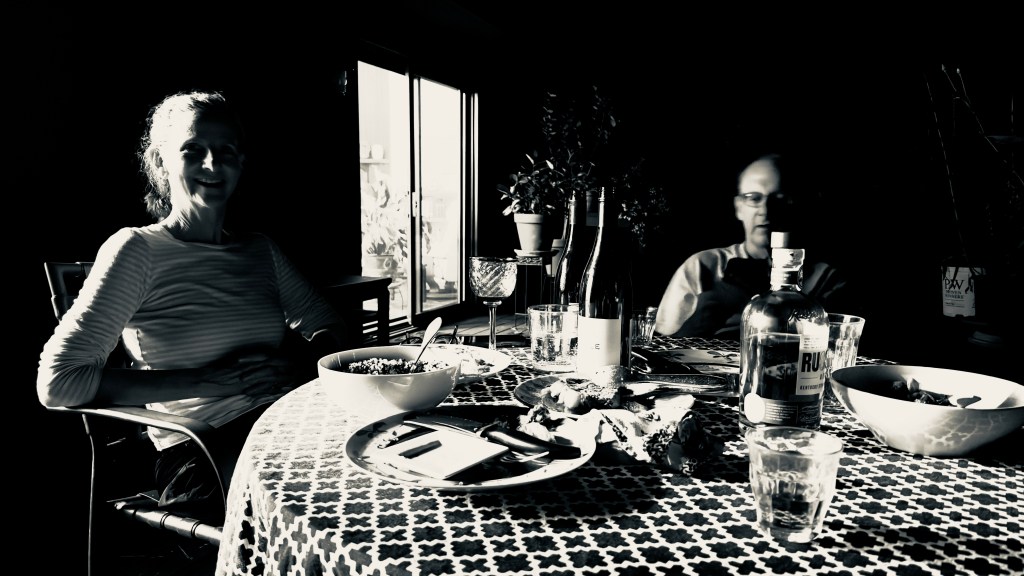
That evening, the brother fixed us all a steak dinner, and I had the opportunity to finally begin to know my sister-in-law, Tori. So great. The conversation was very wide-ranging, and before it was over, I had ordered a specific translation of Dante’s Inferno. Definitely looking forward to the read. I have shied away from it in the past because I did not understand all the historical references to persons and places. Tori says that it is not necessary. Seems it is a bit like Umberto Eco’s Foucault’s Pendulum–read and enjoy the larger story without getting too bogged down in the details.
Saturday with Mark and Tori
Tori had a meeting with their Quaker group, so Mark and I eased into the day. When we got moving, we headed to the University of North Carolina. Mark’s official title and position: MARK TOLES, PHD, RN, FAAN Professor; Beerstecher-Blackwell Distinguished Term Scholar & Senior Division Chair, Health Systems, Policy and Leadership Innovations. He’s pretty much got his act together.
We began the day at UNC’s botanical garden. Way too many pictures to post here, but it was beautiful, even though late in the season.
Bald CypressTithonia
Also in the garden was the cabin of Paul Green. I knew nothing about him, but I very much enjoyed seeing him. According to Wikipedia:
Paul Eliot Green (March 17, 1894 – May 4, 1981) was an American playwright whose work includes historical dramas of life in North Carolina during the first decades of the twentieth century. He received the Pulitzer Prize for Drama for his 1927 play, In Abraham’s Bosom, which was included in Burns Mantle’s The Best Plays of 1926-1927.
His play The Lost Colony has been regularly produced since 1937 near Manteo, North Carolina, and the historic colony of Roanoke. Its success has resulted in numerous other historical outdoor dramas being produced; his work is still the longest-running.
The plaque behind the desk reads:
WHAT IS THE SOUL OF MAN?
I WALK THROUGH THE WOODS, AND I WALK THROUGH THE HILLS, AND I ASK YOU TO TELL ME IF YOU CAN – YOU KNOW WHAT A TREE IS, YOU KNOW WHAT A ROCK IS, BUT WHAT IS THE SOUL OF MAN?
I SEARCHED THE BROAD EARTH, I BEGGED THE FAR SKY, I QUESTIONED THE RIVERS THAT RAN, BUT NEVER A WHISPER TO TELL THAT THEY KNEW AUGHT OF THE SOUL OF MAN.
I BOWED DOWN AT EVENING, I BOWED LOW AT MORN. I PRAYED FOR SOME SIGN OF LIFE’S PLAN, WHEN LO, THE GLAD ANSWER, THE WORD WITH ITS LIGHT — LOVE IS THE SOUL OF MAN.
FROM YOUR FRIENDS AT WILDERNESS ROAD
MARCH 17, 1979
It’ll probably show up in a sermon someday.
Mark also enjoys water painting. He is much better at it than I am.
We met Tori for lunch at Sutton’s Drug Store, but unless a tasty chili cheeseburger is a drug, then it is now only a restaurant…. but what a burger, and yes, I got the t-shirt.
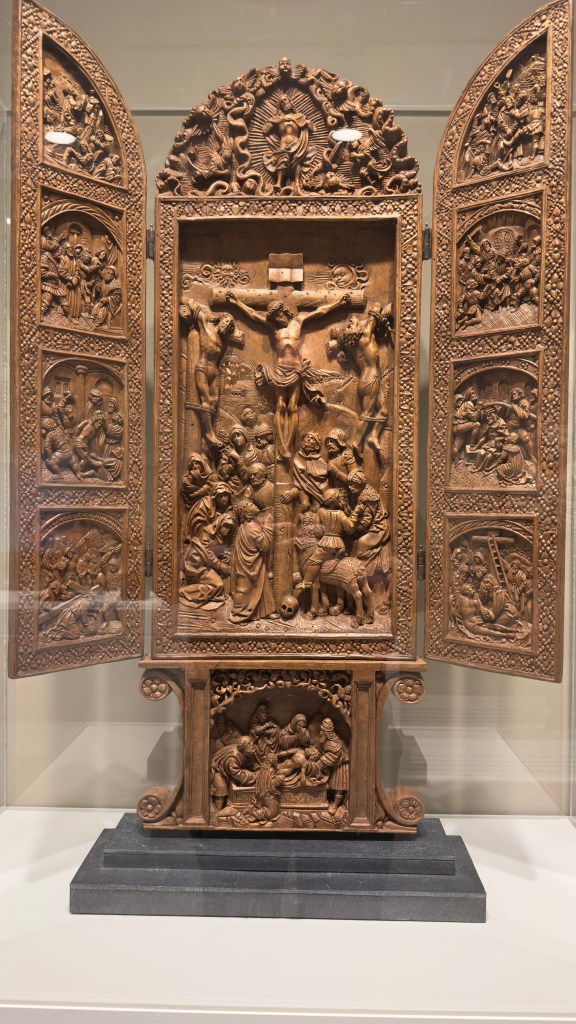
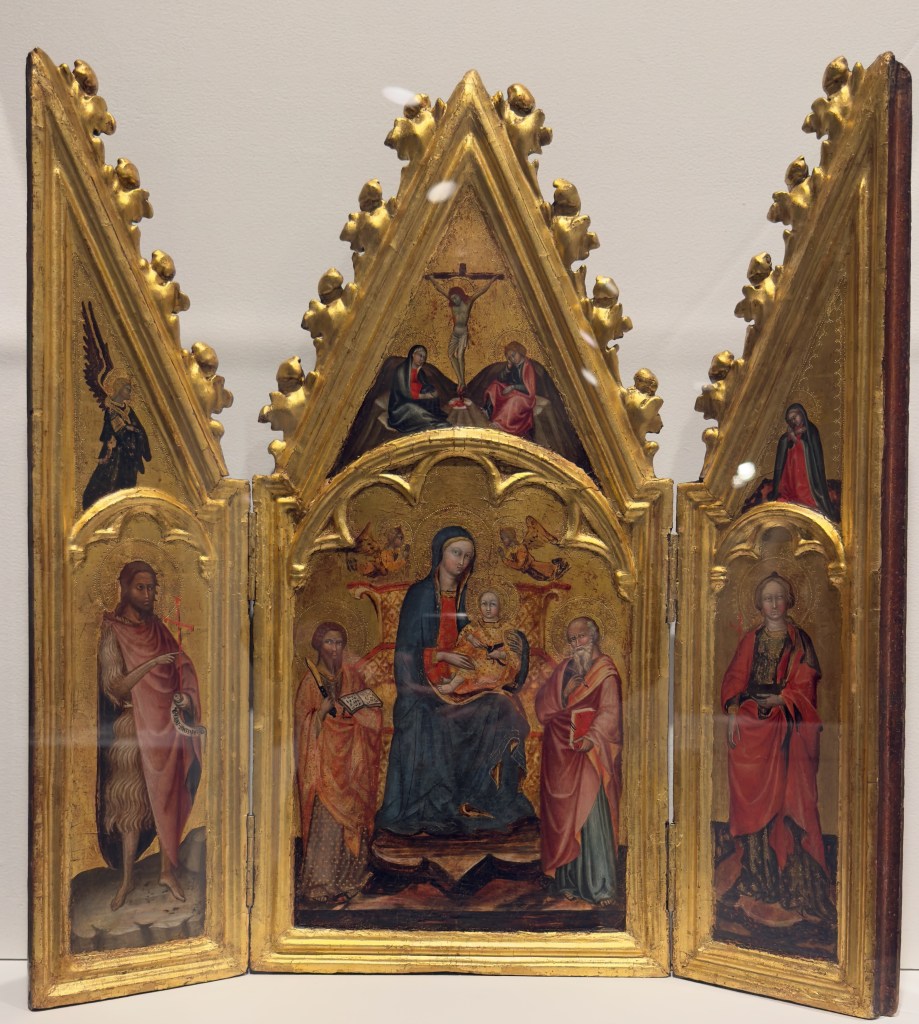
We continued touring the campus and saw a show at the planetarium (there may have been a nap involved during a portion of it) and then stopped at the Ackland Art Museum. We were all delighted with this visit, and it definitely made the day.
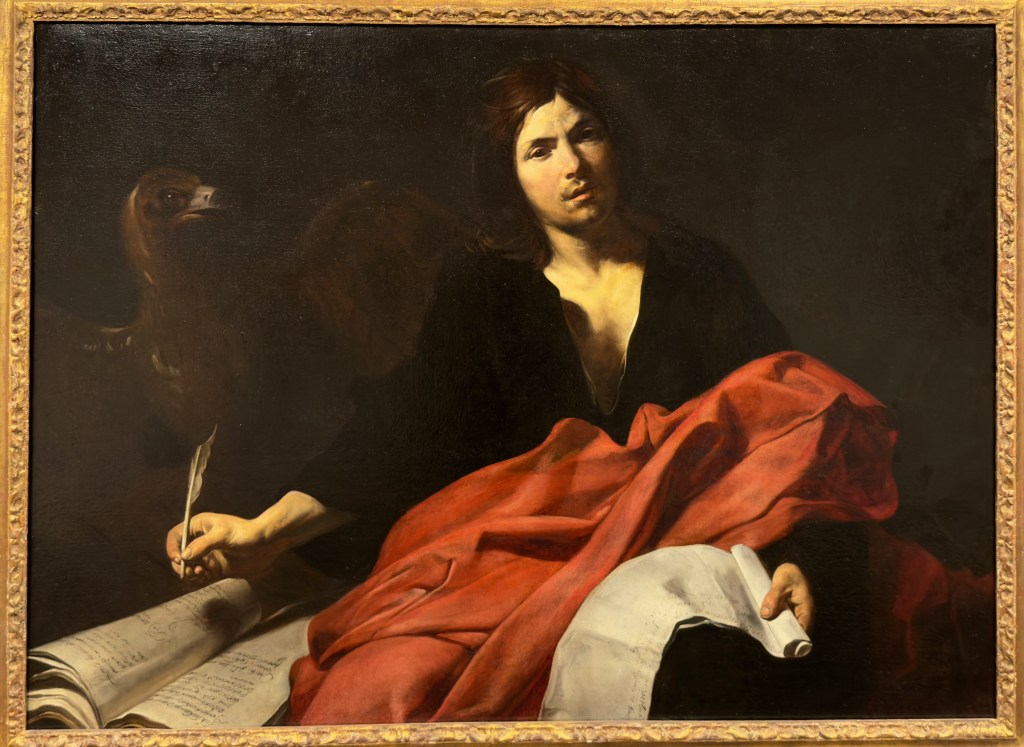
My favorite piece was Saint John the Evangelist by Valentin de Boulogne. He is listening so intently to the Spirit.
Richard Westall’s The Sword of Damocles. The story behind the painting:
The “sword of Damocles” refers to a situation where a person lives under the constant threat of an impending disaster or harm. The idiom comes from an ancient Greek anecdote where a sycophantic courtier named Damocles, who envied the powerful life of King Dionysius II, was offered to trade places with the king for a day. Damocles found himself in the king’s seat, enjoying the luxury, only to look up and see a sharp sword hanging precariously above his head by a single strand of horsehair, symbolizing the ever-present danger and anxiety that comes with power and fortune.
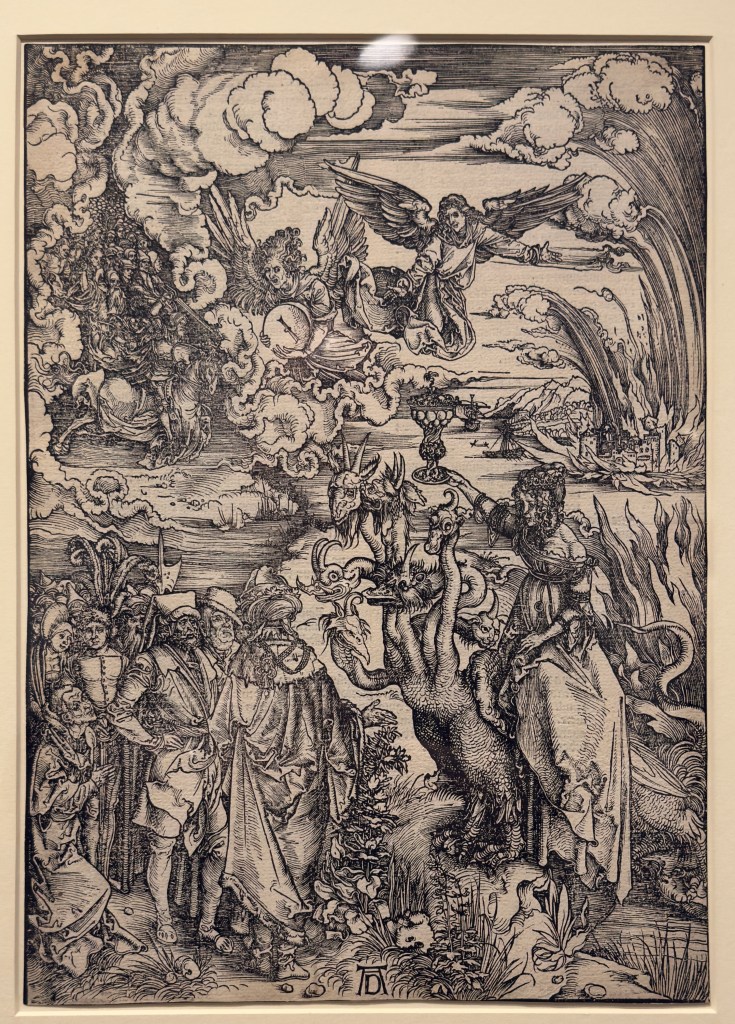
Finally, there was a fine etching by the German artist Albrecht Dürer titled The Babylonian Whore, a depiction of a scene from the Book of Revelation.
Saturday and Home
La Luna, è bellissima. A wonderful few days in North Carolina.
A father told his daughter, “You graduated with honors; here is a car I bought many years ago. It’s quite old now. But before I give it to you, take it to the used car lot downtown and tell them I want to sell it to see how much they’ll offer.” The daughter went to the used car lot, came back, and said, “They offered me $1,000 because it looks very worn out.” The father then said, “Take it to the pawnshop.” The daughter went to the pawnshop, returned, and said, “They offered $100 because it is a very old car.” The father then asked his daughter to show the car at a car club. The daughter took the car there, came back, and told her father, “Some people in the club offered $100,000 because it’s a Nissan Skyline R34, an iconic car that’s highly sought after.” The father said, “The right place values you the right way. If you are not valued, don’t be upset; it means you are in the wrong place. Those who recognize your worth are the ones who appreciate you. Never stay in a place where no one sees your value.”
While he was in Corinth, the Apostle Paul wrote a letter to the church in Rome—The Letter to the Romans. He had not yet visited the city, but news of the church there had reached him.
Broken down, Romans provides guidance on several topics, but overall, Paul’s main concern is the conflict between Jewish Christians and Gentile Christians. This was actually a common issue in the early Church.
We know that the Israelites are God’s chosen people. The word “chosen” is defined as “selected or marked for favor or special privilege.” That very much describes the Covenant God made with Abraham and explains why the Israelites were chosen. When making the Covenant, God said, “Go from your country and your kindred and your father’s house to the land that I will show you. And I will make of you a great nation, and I will bless you and make your name great, so that you will be a blessing. I will bless those who bless you, and him who dishonors you I will curse, and in you all the families of the earth shall be blessed.” (Genesis 12:2-3)
It is easy to see the “marked for favor or special privilege” in those words. And it is also easy to overlook why the Israelites were so marked, but it is right there in the middle—“And I will make of you a great nation, and I will bless you and make your name great, so that you will be a blessing.”
Yes, God says, I am setting you apart for blessing and honor, but I am doing so for a very specific purpose. I am blessing you so that you will be a blessing to the world. The Lord stated it clearly through the Prophet Isaiah.
“It is too light a thing that you should be my servant to raise up the tribes of Jacob”
(The “tribes of Jacob” is understood to be all the Jewish people—the Israelites.)
“It is too light a thing that you should be my servant to raise up the tribes of Jacob and to bring back the preserved of Israel; I will make you as a light for the nations, that my salvation may reach to the end of the earth.” (Isaiah 49:6)
God selected the Israelites to be His chosen people so they could bless others, and in return, He promised to bless them. However, somewhere along the way, it seems that the Israelites focused more on being blessed than on blessing others. They viewed their chosen-ness as a privilege and a right to look down on those around them.
Following the death and resurrection of Jesus, many Israelites became Christians and brought their Jewish practices with them. This wasn’t a problem as long as they didn’t impose these practices on the Gentiles. However, they also carried with them a false idea of being chosen and privileged. So, in his letter to the Romans, Paul asks, “What then? Are we Jews any better off? No, not at all. For we have already charged that all, both Jews and Greeks, are under sin.” (Romans 3:9) A few paragraphs later, he asks, “Is God the God of Jews only? Is he not the God of Gentiles also? Yes, of Gentiles also, since God is one—who will justify” both by faith. (Romans 3:29-30) In other words, no one has any special privileges except those who come to God in faith. Therefore, Paul says in chapter 12 of Romans, “Let love be genuine. Abhor what is evil; hold fast to what is good. Love one another with brotherly affection. Outdo one another in showing honor.” (Romans 12:9-10) and “Live in harmony with one another. Do not be haughty, but associate with the lowly.” (Romans 12:16a)
This theme recurs often in Paul’s letters. In his letter to the Philippians: “Do nothing from selfish ambition or conceit, but in humility count others more significant than yourselves. Let each of you look not only to his own interests, but also to the interests of others.” (Philippians 2:3-4) To the Ephesians, he says, “I… urge you to walk in a manner worthy of the calling to which you have been called, with all humility and gentleness, with patience, bearing with one another in love, eager to maintain the unity of the Spirit in the bond of peace.” (Ephesians 4:1-3)
This all connects back to and could have originated from the events in our Gospel reading today.
Jesus was invited to the home of a Pharisee to share a Sabbath meal. As we know, most Pharisees were not real fond of Jesus and were happy to let him know. Usually, when they had Him around, they looked for ways to trap Him. This time is no different.
The Pharisees closely resembled the Jewish Christians of Paul’s time. They, more than any other Israelites, were called to be the priests—if you will, the light of the lights of the world. Instead, they became a burden to the people and saw themselves as superior. In their eyes, they were the truly chosen. Remember the Pharisee and the tax collector praying in the Temple, and how the Pharisee prayed, “God, I thank you that I am not like other men, extortioners, unjust, adulterers, or even like this tax collector. I fast twice a week; I give tithes of all that I get.” (Luke 18:11-12)
And, in the time of Jesus, this one-upmanship wasn’t limited to the religious leaders. Remember when James’ and John’s momma got into the mix? “Say that these two sons of mine are to sit, one at your right hand and one at your left, in your kingdom.” (Matthew 20:21) Then there was the argument over who is the greatest. On and on and round and round. It all boils down to the same thing—they all wanted the best seat at the party or, at the very least, a place at the head table.
You’re probably thinking, I know where he’s going with this one. He’s going to tell us how we wrongfully assign value to others based on influence, income, status, and similar factors. That’s a sermon I’ve preached before, but today, I want you to focus on yourself. What value do you place on your own soul?
I know many people who believe their worth to the world doesn’t even reach 100 dollars—pocket change, if that. They think that not only are they unworthy of a good place at the table, but they shouldn’t even be invited to the banquet. Yet, Jesus the Good Shepherd would leave the ninety-nine to find you. No matter how you see yourself, Jesus looked at you and said, You are worth dying for. Each individual soul is of the utmost value to God. To paraphrase St. Augustine, “The whole universe, with all its good things, is not worth as much as the soul of one humble person.”
St. Paul said, “For none of us lives for ourselves alone, and none of us dies for ourselves alone. If we live, we live for the Lord; and if we die, we die for the Lord. So, whether we live or die, we are the Lord’s possession.” (Romans 14:7-8)
We are given the freedom to set aside concerns about which seat we hold at the table. Why? Because we are all the Lord’s possessions. He bought us with His very own blood. Therefore, our one and only concern should be whether or not we are living a life worthy of an invitation to the banquet. That is why Paul and Jesus both became upset about this argument. It was never about who was the greatest or who would sit at the head table. It has always been about who would be invited to the banquet—who would attain salvation.
Jesus’ life, every word and action, proclaims to you, You are worth more to me than life itself. I invite you to the banquet. I have a seat set aside just for you. Here, He says, is your invitation. All you need to do is accept.
Let us pray: O God, source of all life and goodness, you fashion human lives in your image and likeness, and through your love, give each human life dignity, sacredness, and priceless worth; awaken in every heart new reverence for the least of your children, and renew among your people a readiness to nurture and sustain your precious gift of human life at all stages, and in all conditions. Amen.
We have discussed before that not all saints are born as the holiest of holy people, and many start out as quite sinful individuals. One such Saint is Augustine of Hippo. He is the patron saint of beer brewers because of his past habits before his conversion. Yet, he is now considered one of the preeminent Doctors of the Church, and it would be hard to find anyone who has influenced Christianity more than him outside of the Holy Scriptures. So, how did he go from a bad boy to a saint? There were many factors, but if you asked Augustine, he would probably say, “Momma.” We know her as Monica. However, Monica was not always a saint either.
She grew up in a Christian home, but not all the virtues seemed to be present in her life, and one area of concern ultimately led her to a deeper faith. She was responsible for going into the cellar to get the wine for family meals. As a child, she didn’t partake, but one day out of curiosity, she took a sip. Later, that sip became a cup, and eventually, she drank as much as she could. She was eventually found out by a servant who called her a “wine-bibber,” meaning a drunk. The comment made Monica so ashamed that she never drank liquor again, but she must have passed that taste onto her son Augustine.
At first, she would raise a fuss with him and scold him, but he simply ignored her pleas. However, with the help of a priest, she realized that this approach would only breed frustration and create a rift between her and Augustine. So, the priest suggested she try a different approach, which involved intercessory prayer, fasting, and vigils for her son. Later, she had a dream in which she was weeping over her son’s downfall, when suddenly an angel appeared and said, “But your son is with you.” When she told Augustine about the dream, he laughed and told his mother that they could be together if she would give up her Christianity. She replied, “The angel did not say that I was with you, but that you were with me.” That gave her the hope she needed, and she continued to pray. It took several years, but eventually Augustine converted and became one of the greats.
There is an incident in Mark’s Gospel where a young boy is said to have a demon that throws him down and harms him. The boy’s father brought him to Jesus’ disciples and asked them to heal his son. They tried, but were unsuccessful, so the man brought his son to Jesus, who was able to heal him. Later, in private, the disciples asked Jesus, “Why could we not cast it out?” He answered, “This kind can come out only through prayer and fasting.”
It would be wonderful if every time we offered intercessory prayers for healing, the person was healed immediately—and that can happen!—but more often, healing (which can take many forms: physical, spiritual, emotional) takes time. That was a lesson that both the disciples and Monica had to learn, and it is one we also need to be taught. In faith, we must believe that—regardless of the perceived outcome or lack of result—God is working, hearing the prayers of his people, and fulfilling those prayers according to his purposes.
Monica did not become a saint because she performed great deeds or died violently as a martyr. Monica became a Saint because she prayed and she believed in God’s promises. That is a practice we can all follow.
I don’t consider myself a bona fide marriage counselor, so I depend on other sources to help me give good advice. For example, I’m particularly fond of a Home Economics book from the 1950s. I believe it gets to the heart of the matter.
The section heading is “How to be a Good Wife.”
HAVE DINNER READY: Plan ahead… Most men are hungry when they come home, and having a good meal prepared is part of the warm welcome they need.
PREPARE YOURSELF: Greet him with a smile.
CLEAR AWAY THE CLUTTER: Make one last walk through the main part of the house just before your husband arrives, gathering up children’s books and toys, papers, etc. Then run a dust cloth over the tables. Your husband will feel he’s reached a haven of rest and order, and—as a bonus—it will give you a lift too.
PREPARE THE CHILDREN.
MINIMIZE ALL NOISE.
SOME “DO NOT’S”: Don’t greet him with problems or complaints. Don’t complain if he’s late for dinner. Consider this a minor issue compared to what he might have gone through that day.
MAKE HIM COMFORTABLE: Have a cold or warm drink ready for him… Allow him to relax and unwind.
LISTEN TO HIM.
MAKE THE EVENING HIS: Never complain if he doesn’t take you to dinner or other entertainment. Instead, try to understand his world of stress and pressure, and his need to unwind and relax.
THE GOAL: TO MAKE YOUR HOME A PLACE OF PEACE AND ORDER WHERE YOUR HUSBAND CAN RELAX IN BODY AND SPIRIT.
Fellas, I’ll need some bodyguards following the service.
The truth is, we all need opportunities to rest and relax in body and spirit. In terms of our faith, such a rest is called a Sabbath.
As you know, keeping the Sabbath ranked in the top five of the top ten Laws of Moses—“Remember the Sabbath day, to keep it holy. Six days you shall labor, and do all your work, but the seventh day is a Sabbath to the Lord your God.…Therefore the Lord blessed the Sabbath day and made it holy.” (Exodus 20:8-9, 11b)
Philo of Alexandria was a Jewish philosopher who lived during the time of Jesus. Speaking of the Sabbath, he wrote, “On this day we are commanded to abstain from all work, not because the law inculcates slackness…. Its purpose is rather to give man relaxation from continuous and unending toil and by refreshing their bodies with a regularly calculated system of remissions to send them out renewed to their old activities. For a breathing spell enables not merely ordinary people but athletes also to collect their strength with a stronger force behind them to undertake promptly and patiently each of the tasks set before them.” (The Sabbath, p.14)
Rabbi Heschel tells us, “The Sabbath is not for the sake of the weekdays; the weekdays are for the sake of the Sabbath. It is not an interlude but the climax of living.” (Ibid.)
There is a great deal of writing on the Sabbath, so this is very much an oversimplification, but it is a gift—a gift from God. It is the opportunity for everyone to be renewed in body and spirit. We can see the Sabbath as just a Law, something that must be obeyed, but it’s so much more than that. It’s a Law that allows us to be with our God, but it’s also a Law because we need it. Our bodies need rest, as do our souls. A quote from St. Augustine I shared with you a few weeks back, “You have made us for yourself, O Lord, and our hearts are restless until they rest in you.” Not just at the end of our days, but each and every day.
From our Gospel reading: “Now Jesus was teaching in one of the synagogues on the sabbath. And just then there appeared a woman with a spirit that had crippled her for eighteen years. She was bent over and was quite unable to stand up straight.” I’m certain that this woman would have been thrilled with a weekly Sabbath free from her crippling pain. One day out of seven to rest and relax from it is better than none; however, what she truly needed was a daily Sabbath, a lifetime Sabbath from her burden, and she received it. “When Jesus saw her, he called her over and said, ‘Woman, you are set free from your ailment.’ When he laid his hands on her, immediately she stood up straight and began praising God.”
We also know that these signs and miracles of Jesus are multidimensional—they are healings, but they also point toward something even greater. Therefore, in this case, we could also say that the woman was burdened not with a physical malady but a spiritual one. We could say she was burdened with sin or the shame and guilt of sin or even the anger caused by another’s sin. We could say that she had been carrying this spiritual malady for so long that her soul was bent from the burden. Just like the physical issue, she would rejoice over one day of freedom, but what she truly needed was a lifetime Sabbath. Her entire life needed to find rest, and this, too, Jesus would give her. “Woman, you are set free from your ailment.”
Is that possible? Can a soul have a lifetime Sabbath from its burdens? St. Augustine tells us, “Our soul is weighed down by sin as by a burden. When it turns to You, Lord, it finds rest, for it finds forgiveness.” (Confessions, X.28) And St. Gregory of Nyssa writes, “True Sabbath is when the soul looks no longer at its own sins, nor is burdened with the memory of evil, but rejoices in the good alone.”
Yes, it is possible to have a lifetime Sabbath from those things that burden our souls, and our souls need it. Just as our bodies break down without rest, so do our souls.
A professor walks to the front of the class and holds up a glass of water. She asks, “How heavy is this glass of water I’m holding?”
The students begin shouting out answers.
After a few guesses, she says, “From my perspective, the absolute weight of this glass doesn’t matter. It all depends on how long I hold it. If I hold it for a minute or two, it’s fairly light. If I hold it for an hour straight, its weight might make my arm ache a little. If I hold it for a day straight, my arm will likely cramp up and feel completely numb and paralyzed, forcing me to drop the glass to the floor. In each case, the weight of the glass doesn’t change, but the longer I hold it, the heavier it feels to me.”
She continues, “Your stresses and worries in life are very much like this glass of water. Think about them for a while, and nothing happens. Think about them a bit longer, and you begin to ache a little. Think about them all day long, and you will feel completely numb and paralyzed—incapable of doing anything else until you drop them.” (Source)
Stresses and worries, carried for too long, can make you completely numb and paralyzed. Sin, the shame and guilt of sin, the anger at another’s sin, can do the exact same thing. It can burden and cripple your soul. The weight, carried for too long, is too much. You need a Sabbath rest from it, but not just for a day. You need to live a Sabbath life, resting in Jesus. How do we rest in Jesus? Peter says, “Humble yourselves, therefore, under the mighty hand of God so that at the proper time he may exalt you, casting all your anxieties on him, because he cares for you.” (1 Peter 5:6-7) We find rest in Jesus by coming before our Lord and, with gratitude in our hearts, placing our burdens—the sin, the pain, the evil—in His strong hands. In doing so, we will hear the words of Jesus, “You are set free from your ailment.”
Jesus said, “Come to me, all who labor and are heavy laden, and I will give you rest—I will give you a lifetime Sabbath. Take my yoke upon you, and learn from me, for I am gentle and lowly in heart, and you will find rest—Sabbath—for your souls. For my yoke is easy, and my burden is light.” (Matthew 11:28-30)
My marriage counseling might not be up to snuff, but this I know to be true:
“Cast your burden on the Lord, and he will sustain you; he will never permit the righteous to be moved.” (Psalm 55:22)
Jesus died on the Cross and rose again, not only so that on the last day you might have an eternal Sabbath in Him, and not only so that you might have a Sabbath rest one day a week. Jesus died and rose again so that you might have a Sabbath in Him all the days of your life. “Cast your burden on the Lord,” so that you “may have life and have it abundantly.” (John 10:10b)
Let us pray: Lord Jesus, in our weariness and burdens, we come to You. In Your gentle heart, we find rest. Teach us to walk in Your humility and to trust in Your love. Yoke our lives to Yours, that we may carry our trials with grace, knowing You are beside us. Calm our restless souls, and let Your peace dwell within us. In You alone is our refuge, our strength, and our home. Amen.
Born in 1090, Bernard of Clairvaux grew to become a force to be reckoned with. Not only did he establish a monastery at Clairvaux, but through his teachings, sixty other monasteries were founded and linked with Clairvaux. That alone was a great achievement, but he was also a poet and hymn writer, a preacher of the Crusades, a priest to the Knights Templar, and an advisor to popes and kings. “By 1140, his writings had made him one of the most influential figures in Christendom.”
In his writings, especially those addressed to Pope Eugenius III, Bernard emphasized moderation in all things. He wrote to the overburdened pope, “As the Lord says, ‘What does it profit you to gain the whole world, but lose yourself alone?’ Now since everyone posses you, make sure that you too are among the possessors.” Yes, Bernard is saying, dedicate yourself fully to the work the Lord has called you to, but don’t forget the Lord or yourself in the process. However, if there was one area where Bernard would not preach such moderation, it would be in “love,” for when it comes to love, Bernard knows no limits. For Bernard, this understanding of love partly stems from his meditations on our Gospel reading.
Jesus said, “If you abide in me, and my words abide in you, ask for whatever you wish, and it will be done for you.” Bernard understood “in me,” in God, to mean, in love with God. To be in God is to be in love with God. He believes we are called to be in love with God and were created for this purpose, writing, “God hath endowed us with the possibility of love.” When someone asked him, “Why should we love God?”, he answered, “You want me to tell you why God is to be loved and how much. I answer, the reason for loving God is God himself; and the measure of love due to him is immeasurable love.” He concludes by asking, “Is this plain?” A more modern way of saying “Is this plain?” could be something like, “Duh!”
Not only should our love extend to God, but also to one another. Perhaps one of his most famous quotes states, “Love me, love my dog.” If you are going to be in a relationship with someone, then you have to love everything about them, including the goofy dog with fleas, bad breath, and all the other unfortunate and annoying aspects of their character.
In living a life of moderation and love, Bernard fulfilled his own definition of a holy person: “seen to be good and charitable, holding nothing for himself, but using every gift for the common good.”
Centuries later, St. Josemaría Escrivá wrote, “Lord: may I have due measure in everything… except in Love.” Escrivá wasn’t speaking directly of Bernard, but those words clearly articulate the pattern of life that Bernard of Clairvaux would call us each to: a life of moderation and perpetual, unrestrained love.
One day, when Vice President Calvin Coolidge was presiding over the Senate, one senator angrily told another to go “straight to hell.” The offended senator complained to Coolidge, as presiding officer. Coolidge looked up from the book he had been leafing through while listening to the debate and wittily replied, “I’ve looked through the rule book. You don’t have to go.”
Another short reading for you this morning. This one is an excerpt from the Prophet Micah.
“The godly has perished from the earth, and there is no one upright among mankind; they all lie in wait for blood…
Their hands are on what is evil, to do it well; the prince and the judge ask for a bribe, and the great man utters the evil desire of his soul… Put no trust in a neighbor; have no confidence in a friend…
for the son treats the father with contempt, the daughter rises up against her mother, the daughter-in-law against her mother-in-law; a man’s enemies are the men of his own house.”
It’s a different translation, but that last section is what Jesus was quoting in our Gospel reading today.
Micah prophesied from 742 to 687 BC, and his main complaint—the Lord’s complaint—was directed against both the social and religious elites. His complaint was against the wealthy, who showed no regard for the poor, and the religious leaders who showed no regard for the poor in spirit. Therefore, Micah foresees a coming crisis.
The word crisis originally comes from the Greek and is a medical term. Merriam-Webster defines it as “the turning point for better or worse in an acute disease or fever.” In this case, the “better or worse” means you either live or you die.
In the case of Micah, the evil—the social and religious elite—will repent, or the evil will be destroyed. As for the latter, Micah speaks of the destruction of Jerusalem.
“Therefore because of you Zion shall be plowed as a field; Jerusalem shall become a heap of ruins, and the mountain of the house a wooded height.” (Micah 3:12)
An unfortunate consequence of the punishment of evil is that the innocent often become caught up in the destruction. Today, we rely on the non-emotive term, collateral damage, to describe the death of innocent people, so we don’t have to admit we killed them.
So, when the crisis—the pivotal moment for better or worse—arrives, A) the people will repent, return to the Lord, and live, or B) Jerusalem will fall, and the wicked, along with the collateral damage, will perish.
How did it all turn out? In 586 BC, Nebuchadnezzar and the Babylonian army sacked Jerusalem, destroyed the First Temple, and exiled the people.
Micah warned, “The path we are taking is leading to our destruction. We’re about to experience a certain hell on earth, but I’ve checked the rule book, and we don’t have to go.” The crisis arrived, and the people chose… wrongly.
By examining these events, we can find a pattern for any crisis.
A specific path is chosen, but there are early warning signs that it may be the wrong path.
A shrugging of shoulders, thinking it’ll be OK, or the status quo rules.
The early warning signs begin to turn into real problems. Sirens are sounding.
The symptoms are addressed, but not the root problem. It begins to fester.
A catalyst or trigger of some sort pushes it all over the edge. Hell on Earth follows.
The crisis—the turning point for better or worse—blossoms.
Options: Strong corrective measures are implemented to prevent a disaster or destruction.
In our Gospel, Jesus said, “You know how to interpret the appearance of earth and sky—a cloud rising in the west or a south wind blowing—but why do you not know how to interpret the present time?”
Jesus said, “You’ve chosen a certain path, but there are warning signs everywhere—your country is occupied, there is trouble within, the religious system is broken, and there is no fear of God. Yet, in your arrogance, you shrug your shoulders, thinking everything is A-OK. The prophets, like John the Baptist, have sounded the alarm. You believe the solution is to ratchet up the requirements of the Law, but you’re missing the point. It’s not the Law that’s the problem; it’s you! All you’re doing is oppressing the people and further angering the Father. You’ve created Hell on Earth, so you can either turn and repent, or all this will be destroyed. ‘Truly, I say to you, there will not be left here one stone upon another that will not be thrown down.’ (Matthew 24:2) But,” Jesus said, “I’ve looked through the rule book, and you don’t have to go that way.
How did everything turn out? In 70 AD, Titus and the Roman army sacked Jerusalem, destroyed the Second Temple, and enslaved or scattered the people. The exact same pattern and result of the crisis that occurred in the time of Micah.
Not only does this pattern of crisis occur on a large scale for nations, but it also applies to individuals.
I believe it has been at least a week since I last mentioned a Stephen King book, so…
In The Stand, one of the main characters, Larry Underwood, has been experiencing troubles in his life. As he reflects on it, he remembers another person who faced a time of trial—Jory Baker.
Jory was a guitarist, and a good one at that. He even played in a band that looked as though they were going to make it big, but then Jory was involved in an accident. This was followed by intensive rehab and a little drug called Demerol. Jory got hooked, and when he no longer had access to Demerol, he turned to heroin. He ended up on the streets, begging for change and his next fix. Hell on Earth. Crisis—the point where he could choose either life or destruction. Over eighteen months, Jory managed to get clean and stay clean. He chose life.
As he remembers this, Larry thinks, “No one can tell what goes on in between the person you were and the person you become. No one can chart that blue and lonely section of hell. There are no maps of the change. You just … come out the other side. Or you don’t.” (p.575)
We understand that all these crises—whether between nations, within individuals, or any type in between—are the direct result of the conflict between Heaven and Hell, with the prize being the soul of God’s people. In C.S. Lewis’ The Screwtape Letters, the demon writes, “We want cattle who can finally become food; He [God] wants servants who can finally become sons.” Therefore, in every situation, we must be those who can properly “interpret the present time.” And yes, we must be able to do this for the world and society around us, so we don’t blindly follow the masses to destruction, but equally important, we must learn to unemotionally and honestly “interpret the present time” of our own lives. How do we achieve this?
We must learn to take a step back from our lives and unflinchingly scrutinize them, as if from the outside. Are there warning signs that we may be headed in the wrong direction? If so, are we glossing them over or pretending that they’re really no big deal? In our arrogance, are we convincing ourselves that we’re right, even when evidence suggests otherwise? If we do recognize areas of concern, are we just treating the symptoms while ignoring the real problem? Is a crisis actually developing or already upon us—Hell on Earth? To be blunt, if it looks like you’re heading to hell, remember, there’s nothing in the rule book that says you’ve got to go. Ask yourself, “If in my analysis of the present time and path, will I come out the other side… or not?” If the answer is “Yes,” give thanks to the Lord your God. If the answer is “No,” then pray for wisdom and courage to change. After all, “What does it profit a man to gain the whole world and forfeit his soul?” (Mark 8:36)
The life of a Christian person is often and mistakenly solely measured by emotions. Do I feel the joy of the Lord? Am I at peace? Do I sense God’s presence in my life? If you answer “Yes” to these questions, then you feel like all is well. However, we can’t rely only on our emotions. As Christians, we must sometimes sit down, like an academic, and study our lives—properly interpreting the present times—and then be prepared to make the necessary course corrections. In doing so, with God’s help, we will safely come out the other side.
Let us pray: O Lord, mercifully receive the prayers of your people who call upon you, and grant that they may know and understand what things they ought to do, and also may have grace and power faithfully to accomplish them; through Jesus Christ our Lord, who lives and reigns with you and the Holy Spirit, one God, now and for ever. Amen.
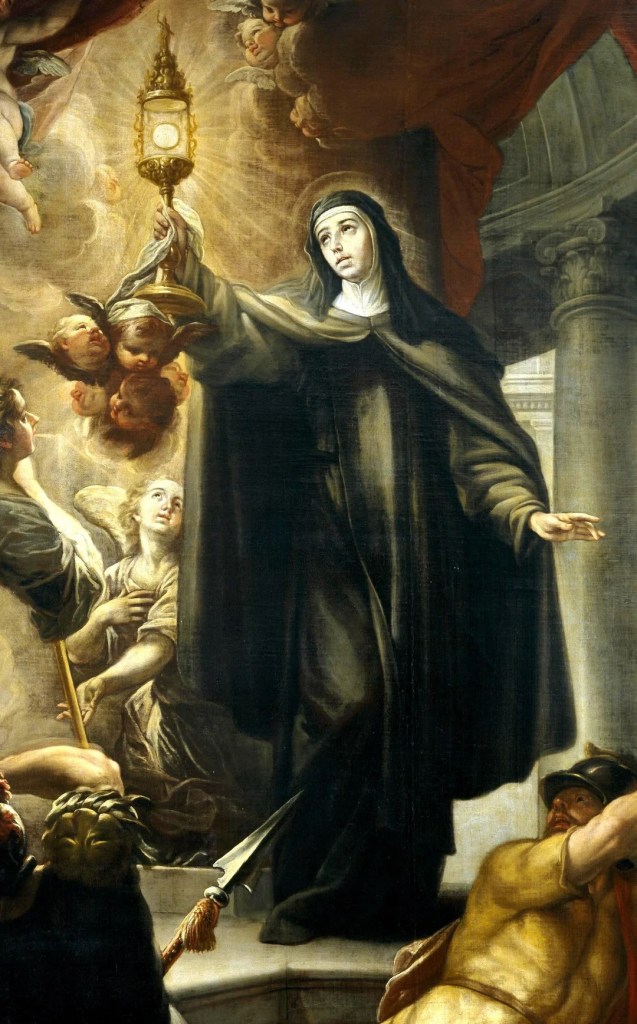
St. Clare of Assisi: We know very little about her childhood beyond being born into a wealthy family. However, at age eighteen, she had the opportunity to hear St. Francis of Assisi preach and decided to leave everything behind.
Sneaking away from her family, who would have prevented her, she went to Francis and expressed her desire to follow in the way of his teachings. She exchanged her fine clothes for a dress of rough fabric. She cut her long, beautiful hair and replaced it with a veil. At one point, her family tried to pull her back, but she ultimately prevailed, and later her sister Agnes and her mother, when widowed, joined her in the convent.
How did she live? She was barefoot all year, spoke only when necessary, prayed for hours daily, had no source of income, so begged for alms, ate no meat, fasted on bread and water, and slept on a hard floor. Eventually, the Bishop and Francis ordered her to sleep on a mattress for health reasons. You might think such a life would be so unappealing that no one would follow in her footsteps, but that was not the case. When she died, “there were forty-seven convents in Spain alone, with many others in Italy, Bohemia, and France. And not long after Clare’s death, four convents of Poor Clares—as they became known—were founded in England.”
She was considered so pure and righteous in faith that bishops, cardinals, and even Popes sought her advice. Pope Innocent IV, who heard her last confession. Following that confession, he said, “I would to God I had so little need of absolution myself.”
On August 11, 1253, the day she died, she was heard to say, “Go forth in peace, for you have followed the good road. Go without fear, for he who created you has sanctified you, has always protected you, and loves you as a mother. Blessed are you, O God, for having created me.”
Could such a movement continue today? Currently, there are 20,000 Poor Clares spread across the world, living cloistered lives dedicated to prayer—praying for the needs of the church and the world.
In a letter to Agnes, the daughter of the King of Bohemia, who also became a Poor Clare, Clare wrote,
When You have loved [Him], You shall be chaste; when You have touched [Him], You shall become pure; when You have accepted [Him], You shall be a virgin. Whose power is stronger, Whose generosity is more abundant, Whose appearance more beautiful, Whose love more tender, Whose courtesy more gracious. In Whose embrace You are already caught up; Who has adorned Your breast with precious stones And has placed priceless pearls in Your ears and has surrounded You with sparkling gems as though blossoms of springtime and placed on Your head a golden crown as a sign [to all] of Your holiness.
There is no doubt that St. Clare of Assisi has received the golden crown from the One she loved above all others—Jesus.






























 Candle in a Cave