Sermon: Easter 2 RCL C – “God Ain’t Dead”

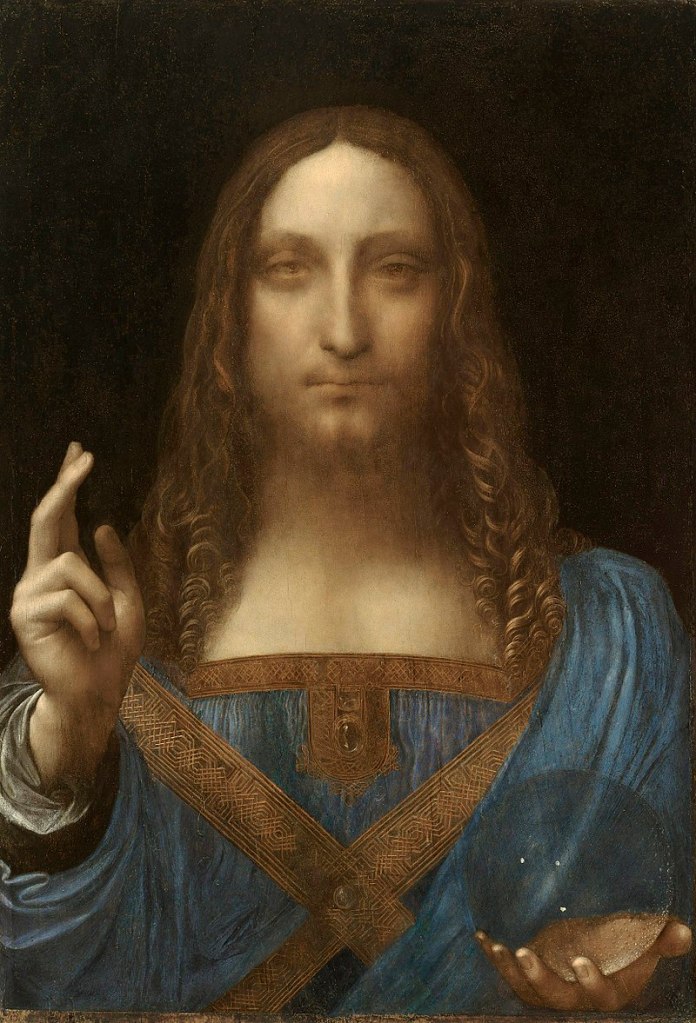
Leonardo da Vinci, Salvator Mundi, c.1500

There is a painting that shows the charred debris of what had been a family’s sole possession. In front of this destroyed home, standing in deep snow, stood an old grandfather dressed only in his underclothes with a small boy who is clutching a pair of patched overalls. It was evident that the child was crying. Given the way they were dressed and the fact that nobody else was around you could tell they didn’t have anyone else or anything else except the clothes that were on their back and each other. No Red Cross person was going to drive up and offer them food, clothing, and shelter. Now, if you were the grandfather, what would you say to the weeping child to comfort him? All is lost. We’re done for. We’ll never make it. Or would you just start crying yourself?

The artist of this particular picture wasn’t much on despair, because beneath the picture were the words which the artist felt the old man was speaking to the boy. They were simple words, yet they presented a profound theology and philosophy of life that exhibited true hope. The grandfather said, “Hush child, God ain’t dead!”

From our Gospel, Jesus had appeared to the disciples, but Thomas wasn’t there. When the others tell him that they have seen the Lord, Thomas becomes upset and agitated, “I won’t believe the Lord is risen unless I see him myself and place my hand in his side.” Did he doubt the power of God? Did he not believe Jesus when he had said, “I will rise again?”

No. I don’t believe that was the way Thomas was looking at these events. Instead, I think Thomas had looked upon the blood-stained cross, he had seen or at least heard of the gaping wounds that had pierced Jesus’ body, he had placed all his hope in Jesus, and now without question, he knew Jesus was dead. All was lost. We’re done for. I can’t possibly believe that he is raised from the dead unless I see him myself, because I can’t get my hopes up again. I can’t be hurt like that again. Someone needed to lovingly turn to Thomas and say, “Hush child. God ain’t dead.”

In 1972, NASA launched the exploratory space probe Pioneer 10. According to Leon Jaroff in Time, the satellite’s primary mission was to reach Jupiter, photograph the planet and its moons, and beam data to earth about Jupiter’s magnetic field, radiation belts, and atmosphere. cScientists regarded this as a bold plan, for at that time no earth satellite had ever gone beyond Mars, and they feared the asteroid belt would destroy the satellite before it could reach its target.

But Pioneer 10 accomplished its mission and much, much more. Swinging past the giant planet in November 1973, Jupiter’s immense gravity hurled Pioneer 10 at a higher rate of speed toward the edge of the solar system. At one billion miles from the sun, Pioneer 10 passed Saturn. At some two billion miles, it hurtled past Uranus; Neptune at nearly three billion miles; Pluto at almost four billion miles. By 1997, twenty-five years after its launch, Pioneer 10 was more than six billion miles from the sun.

And despite that immense distance, Pioneer 10 continued to beam back radio signals to scientists on Earth. “Perhaps most remarkable,” writes Jaroff, “those signals emanate from an 8-watt transmitter, which radiates about as much power as a bedroom night light, and takes more than nine hours to reach Earth.”

The Little Satellite That Could was not qualified to do what it did. Engineers designed Pioneer 10 with a useful life of just three years. But it kept going and going. By simple longevity, its tiny 8-watt transmitter radio accomplished more than anyone thought possible. After more than 30 years, the venerable Pioneer 10 spacecraft sent its last signal to Earth on Jan. 23, 2003, having traveled 7.6 billion miles.

So it is when we offer ourselves to serve the Lord. God can work even through someone with 8-watt abilities. However, God cannot work through someone who quits.

That is not saying that there are no times when the wise decision is to quit. There are our bad habits. There are times when we realize that we are in the wrong. Sometimes it just makes sense not to continue in a direction and at other times it is a matter of coming to peace with a situation. There are all sorts of legitimate reasons for quitting a particular activity; however, fear, despair, disappointment, level of difficulty, and so on are not. Why? Because “God ain’t dead” and if God ain’t dead, then there is always hope.

Imagine, after trying something once, we say, “I’ll never do that again!” What about falling in love? What would happen after the first time you fall in love and had your heart broken you said, “I’ll never do that again.” What would you miss out on? How lonely would you be?

What if the first time you said a prayer and God answered by saying, “No.” How would things work out if you were to say, “I’ll never do that again?”

What if the Lord had not appeared before the disciples again and Thomas had remained in his denial? “I’ll never do that again. I’ll never believe unless I see him.”

In truth, we can find ourselves in similar situations all the time. It happens to us personally. It happens to us in our jobs. It can even happen in the church. Along with Thomas, we say, “All is lost. We are finished. I’ll never do this again. I quit.” But God responds, “Hush child. I’m not dead!” In other words, there is hope.
What do we mean when we say, we have hope?

Václav Havel, the first president of Czechoslovakia following the fall of communism, wrote

“Either we have hope within us or we don’t. It is a dimension of the soul, and it is not particularly dependent upon some observation of the world. It is an orientation of the spirit, and of the heart. It transcends the world that is immediately experienced and is anchored somewhere beyond horizons. Hope is a deep and powerful sense and it is not the same as joy that things are going well or the willingness to invest in opportunities which are obviously headed for success. But rather, it is an ability to work for something because you believe in it. Hope is definitely not the same thing as optimism. It is not the conviction that something will turn out well, but the certainty that it makes sense regardless of results. It is hope, above all, which gives us the strength to live and to continually try new things.”

That is what we mean by hope. It is the kind of hope that declares, no matter the situation, “God’s not dead.” When I find myself in a position of losing hope, I recall a certain incident with Jesus. There was a father whose child was very sick. The father brought the child to Jesus’ disciples, but they could not heal the boy. Finally, Jesus arrives on the scene and the father says, “If you can do anything, take pity on us and help us.” Jesus responds, “‘If you can?’ Everything is possible for him who believes.” In other words, “Hush child. God ain’t dead.” Immediately the boy’s father exclaimed, “I do believe; help me overcome my unbelief!”

When you find yourself in times of losing hope then let that be your prayer, “‘I do believe. Help me overcome my unbelief.’ Help me to regain or to hold onto my hope that is in Christ Jesus the Risen Lord.” In the midst of that prayer remember—God ain’t dead!

Let us pray: O God, in whose image we all are made, give us hope that through the work of our hands, and with Jesus as our model, we may glorify you now and always. Amen.

Sermon: Easter Sunday – “Listen”

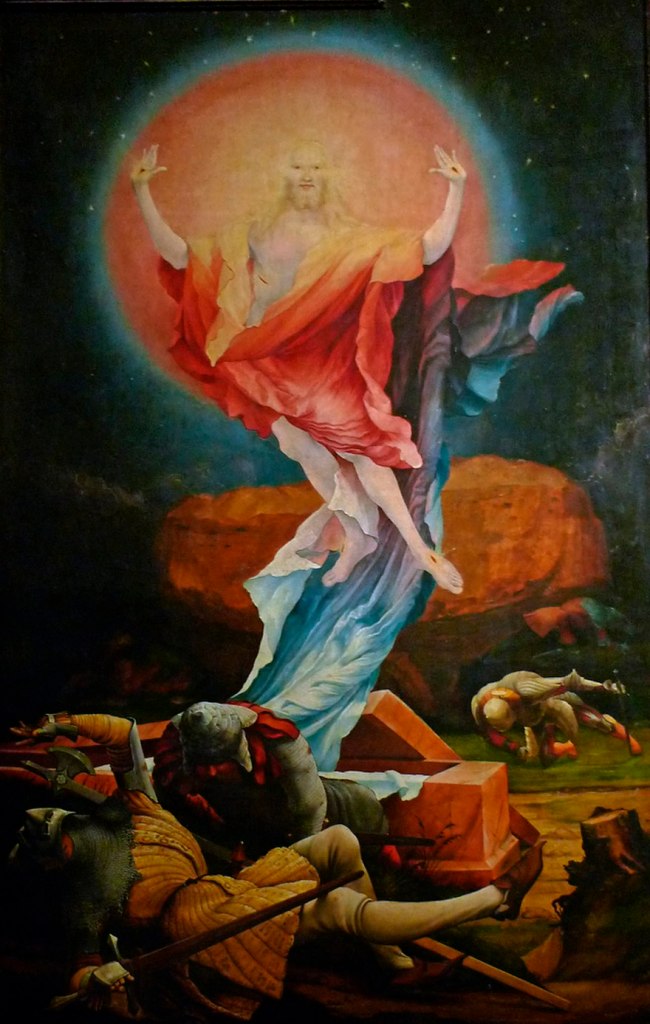
The Isenheim Altarpiece (1512–1516) by Matthias Grünewald (c. 1470 – 1528)

Mark Twain wrote, “No sinner is ever saved after the first twenty minutes of a sermon.”  Today we’re here to put that theory to the test.  No.  Not really.  If I hit the twenty-minute mark, you can tell me to shut up and sit down, but this is the Super Bowl and the World Series and the Stanley cup and the Master’s Golf Tournament of sermons all rolled into one.  It’s the one I’m supposed to knock out at the park and wow everybody with.  No pressure.  None whatsoever.  

In fretting over that, I’ve also thought about all the pessimism and skepticism in the world today and wondered how a few words of mine could make a difference. What can I say to you that will change anything?  Not just that, but in order to be heard above the clamor of everything else, I’m going to need something to grab your attention.  What could it be?  

Well, if I just wanted to get a lot of attention, then I could stand up here and tell you that as a priest and as a church we really don’t believe that Jesus rose from the dead.  That would get some attention.  That would even get my bishop’s attention!  The Facebook post would go off the charts and I’d probably even get a few “love letters” from people threatening to send me to meet Jesus.  Yes.  I could say that Jesus never rose from the dead and everyone would be up in arms, but if I say, “Jesus rose from the dead,” no one really gets excited.  There are no angry posts on Facebook, the Bishop is not called, we can all go back home to our lives, and nothing and no one is actually changed.  So the question is this: what would it take for this message—the Gospel of Jesus Christ, the love of God, and the resurrection to eternal life—what would it take for this message to actually change your life?  Today’s Gospel reading helps us in the right direction.  

Mary Magdalene went to the tomb. The stone was rolled away, so she runs and tells Peter and John who then get into a foot race to the tomb (John wins).  They look inside and see that the tomb is empty and the cloth that Jesus had been wrapped in was set to one side.  They saw all this, but they didn’t know what it meant, so what did they do?  Our Gospel reading tells us, “Then the disciples returned to their homes.”  They were probably confused more so than they ever had been. They were probably wondering who stole the body.  They were also wondering how they could continue after the death of Jesus and wondering where do we go now?  He’s dead.  He’s gone.  We’re here and everybody either hates us or thinks we’re freaks.  The best thing we can do is just to go home.  Go back to what we’re doing before we even knew the tomb was empty or even before we ever met him.  For the most part that’s you and I.  We hear this message, we know it intellectually, we read it every year.  I would wager that most everyone is very well aware of this basic Christian message: “Christ has died.  Christ has risen.  Christ will come again.”  It’s a very simple proclamation but so many hear it and then they just go back home.  The message hasn’t changed their lives, but then we have the second part of our Gospel reading today.

Mary Magdalene has experienced the exact same thing as the disciples.  She had witnessed the miracles and the teachings.  She had been there for the trial, the crucifixion, the death, and the burial, but the one difference between the disciples and Mary is that on that morning, Mary heard Jesus call her name.  She had a very real and personal encounter with the Risen Lord.  And now everyone says, “Oh, Father John, you’re just preaching like an evangelical minister this morning!  Going to tell me I need a personal relationship with Jesus Christ.  Yes, you do.  It’s true.  But if that’s all I tell you then you’re just gonna go back home, not changed, so what is it you need to hear in order to believe this message of the Gospel so that you don’t just go back home unchanged? 

If I was one of those really great passionate charismatic orators I might be able to tell you a story, give you an example, share my testimony about how God has changed my life or the life of so many others.  I might even for a minute or for a day or season convince you to follow Jesus, but after doing this for almost twenty years I know that there isn’t anything I can preach that will ultimately turn a person’s heart.  That was true even for Jesus.  Judas heard every one of Jesus’ sermons and those sermons didn’t do him a lick of good.  So what we do here on days like today is provide opportunities for souls to encounter God in hope that those souls won’t simply go home, but will instead stop and listen for God to speak their name just as he did with Mary.

When you decided to come to church this morning this is not what you were expecting to hear. You were probably expecting to hear Jesus Christ is risen today.  Hallelujah.  You would hear it then maybe go out to brunch, an Easter egg hunt, take a nap, but in the end, you would just go home.  Would your life be changed?  Would you stop everything to follow Jesus?  I don’t know.  But today, I don’t believe I can convince you, so instead of trying, I’m going to ask you to do something.  I know, the preacher asking us to do something probably wants us to give money.  Give Jesus $100 today and make a downpayment on that heavenly mansion.  No.  It’s nothing like that.  Instead, I’m just asking that you go home and listen.  Close yourself off in your room and sit quietly by yourself and say, “Speak Lord, for your servant is listening.”  And then, listen.  Listen for the voice of God.  At first, you’ll probably think you’re crazy, but then somewhere in that silence, you will hear God speak your name and you will know that on the third day Jesus Christ rose from the dead and that all who call on his name will be saved to eternal life.  You will know and you will be changed eternally.

Let us pray:
For Your mercies’ sake, O Lord our God,
tell us what You are to us.
Say to our soul: “I am your salvation.”
So speak that we may hear, O Lord;
our hearts are listening;
open our hearts that we may hear You,
and say to our soul: “I am your salvation.”
After hearing this word,
may we come in haste to take hold of you.
Amen.

Sermon: Great Vigil of Easter – “This is the Night”

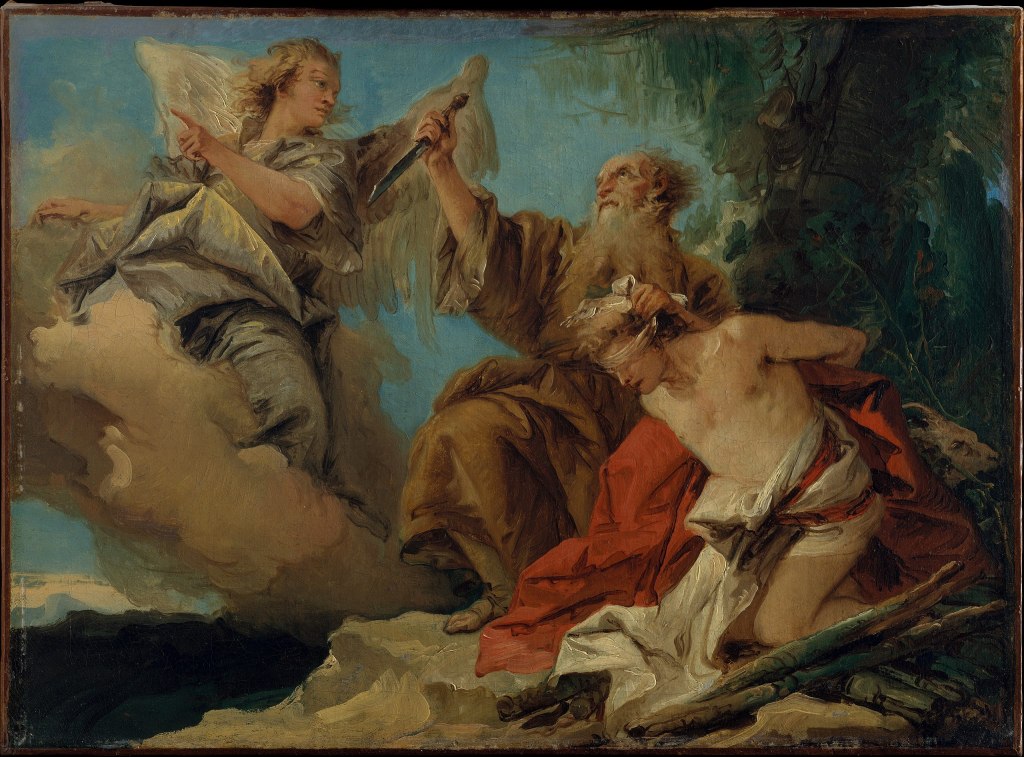
The Sacrifice of Isaac (mid-1750s) by Giovanni Domenico Tiepolo (1727 – 1804)

In her book, When God is Silent, author and Episcopal priest, Barbara Brown Taylor speaks to clergy about preaching.  At one point she addresses how we should go about preaching on some of the more difficult passages, such as the one we read: the sacrifice of Isaac.  Barbara says, that the Bible is full “of such raw and powerful stories.  Maybe we should preach more of them and where they are obscure, troubling, or incomplete, perhaps we should leave them that way.  Who are we, after all, to defend God?… The discord—like the silence—is God’s problem, not ours.  When we try to solve it, we are no longer being courteous.” (p.115-116)

When it comes to her advice and that passage of scripture of Abraham and Isaac, very few have taken Barbara’s advice.  They launch into long explanations of how this is only a myth and not an actual event or attempt to break down Abraham’s thought process or the psychology of Isaac or anything else so as to avoid or distract us from what the story tells us.  I’m guilty of all of the above because when taken at face value, all that remains is God telling Abraham, “Take your son, your only son Isaac, whom you love, and go to the land of Moriah, and offer him there as a burnt offering on one of the mountains that I shall show you.”  Abraham did not argue or weep or bargain.  He was obedient.  In the end, because of his obedience, Isaac was saved.  In his letter to the Hebrews, Paul summarizes what took place and how it was viewed, “By faith Abraham, when he was tested, offered up Isaac, and he who had received the promises was in the act of offering up his only son.”

We can finagle, whitewash, and analyze the incident all we want to make it easier to swallow, but the Scripture itself is clear: God tested Abraham by asking him to deliver his son up as a burnt offering so that God could determine whether or not Abraham was faithful.  

I do not believe that there is a parent in the room who would even consider it.  In fact, I believe that every single one of us—parent or not—would fail that test.  We would unapologetically tell God, likely in some rather colorful language, “No!  What you ask is impossible.”  If that were the end of it, we would all be lost, but Jesus refuses to lose us.  

Jesus says, “What is impossible with man is possible with God.”  

Jesus says, “Father, if you are willing, remove this cup from me. Nevertheless, not my will, but yours, be done.”  

Jesus says, “Father, into your hands I commit my spirit!”  

Jesus says, “It is finished.”

“This is the night, when Christ broke the bonds of death and hell, and rose victorious from the grave.” 

In order to prove our faith, we will never be called upon to sacrifice anyone or anything, for this is the night that the sacrifice that was made once and for all restores us to God. 

Alleluia.  Christ is Risen.

The Lord is risen indeed.  Alleluia.

Sermon: Holy Saturday – “The Ancient Homily”


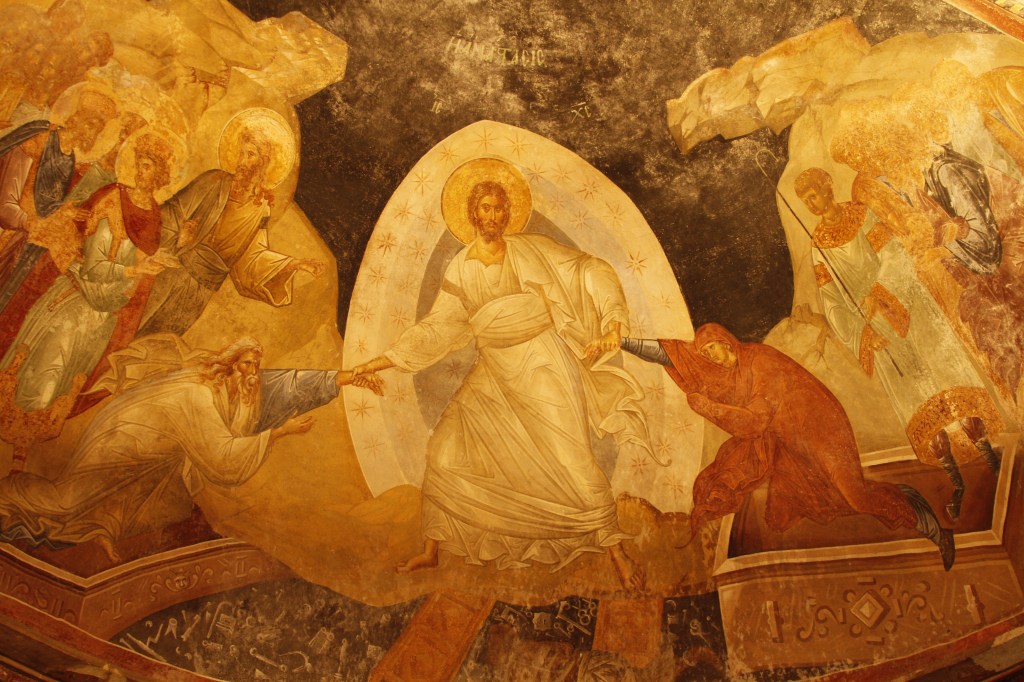
In some places, the author is listed as unknown, but in others, it is attributed to St. Epiphanius, Bishop of Cyprus (403 A.D.).  Whatever the case, it is an ancient sermon and speaks of the Harrowing of Hell, when Jesus descended into the dead following his death and prior to his resurrection.  It is of Jesus speaking to Adam, the first human.

Something strange is happening – there is a great silence on earth today, a great silence and stillness. The whole earth keeps silence because the King is asleep. The earth trembled and is still because God has fallen asleep in the flesh and He has raised up all who have slept ever since the world began. God has died in the flesh and Hell trembles with fear.

He has gone to search for our first parent, as for a lost sheep. Greatly desiring to visit those who live in darkness and in the shadow of death, He has gone to free from sorrow the captives Adam and Eve, He who is both God and the Son of Eve. The Lord approached them bearing the Cross, the weapon that had won Him the victory. At the sight of Him Adam, the first man He had created, struck his breast in terror and cried out to everyone, “My Lord be with you all.” 

Christ answered him, “And with your spirit.” He took him by the hand and raised him up, saying, “Awake, O sleeper, and rise from the dead, and Christ will give you light.

“I am your God, who for your sake have become your son. Out of love for you and for your descendants I now by My own authority command all who are held in bondage to come forth, all who are in darkness to be enlightened, all who are sleeping to arise. I order you, O sleeper, to awake. I did not create you to be held a prisoner in Hell. Rise from the dead, for I am the Life of the dead. Rise up, work of My hands, you who were created in My image. Rise, let us leave this place, for you are in Me and I am in you; together we form only one person and we cannot be separated.

“For your sake I, your God, became your son; I, the Lord, took the form of a slave; I, whose home is above the heavens, descended to the earth and beneath the earth. For your sake, for the sake of man, I became like a man without help, free among the dead. For the sake of you, who left a garden, I was betrayed to the Jews in a garden, and I was crucified in a garden.

“See on my face the spittle I received in order to restore to you the life I once breathed into you. See there the marks of the blows I received in order to refashion your warped nature in My image. On My back see the marks of the scourging I endured to remove the burden of sin that weighs upon your back. See My hands, nailed firmly to a tree, for you who once wickedly stretched out your hand to a tree.

“I slept on the Cross and a sword pierced My side for you who slept in Paradise and brought forth Eve from your side. My side has healed the pain in yours. My sleep will rouse you from your sleep in Hell. The sword that pierced Me has sheathed the sword that was turned against you.

“Rise, let us leave this place. The enemy led you out of the earthly Paradise. I will not restore you to that Paradise, but I will enthrone you in Heaven. I forbade you the tree that was only a symbol of life, but see, I who am Life itself am now one with you. I appointed cherubim to guard you as slaves are guarded, but now I make them worship you as God. The throne formed by cherubim awaits you, its bearers swift and eager. The Bridal Chamber is adorned, the banquet is ready, the eternal dwelling places are prepared, the treasure houses of all good things lie open. The Kingdom of Heaven has been prepared for you from all eternity.”

Sermon: Good Friday – “Thief”

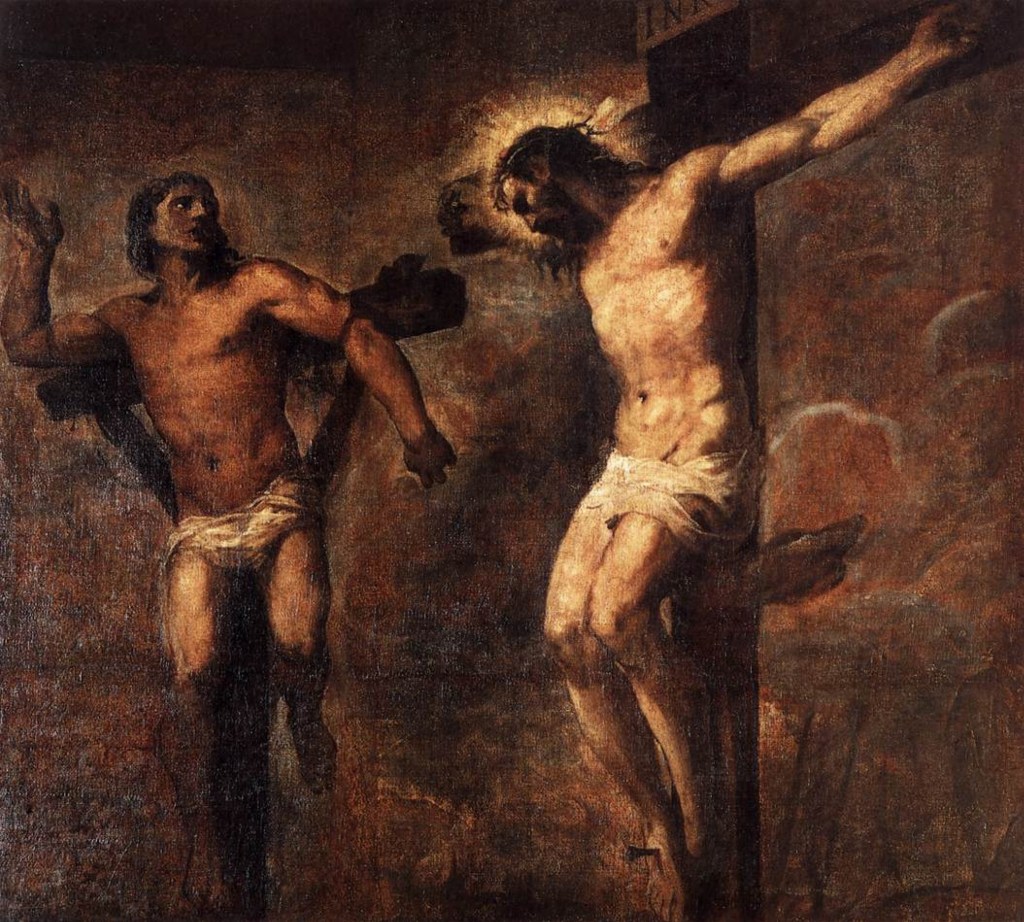
Christ and the Good Thief (c. 1566) by Tiziano Vecellio (Titian) (c. 1490-1576)

According to legend, his name is Dismas.  He and his family lived in the barren land between Israel and Egypt and at a very young age he contracted leprosy.  One day, a man and a woman with a baby boy were fleeing Israel and passed through that region.  They were tired and hungry and in need of shelter and it was Dismas’ mother who took them in.  She fed them and even provided water to bathe the baby.  After the bath, Dismas also took a bath in the same water and by doing so, was cured of his leprosy.

Another legend, taking place in that same barren land between Egypt and Israel tells of how a mother and father with their young baby were fleeing Israel and encountered two thieves, Dismas and Gestas.  At first, they both were determined to rob the family, but something turned in Dismas’ heart and he instead bribed Gestas not to rob them.

Either or possibly even both these events (or none of the above) had an effect on Dismas, but not enough of an effect for him to change his ways, so in the end, he and Gestas found themselves crucified on a hill outside of Jerusalem alongside a man whom many believed to be the Messiah, Jesus.  Perhaps it was because of one of those earlier encounters with Jesus that caused Dismas’ heart to turn once more toward Jesus.  Perhaps something in him, since he was a boy, had also been longing for a Messiah, whatever the case, at that moment, like so many others before him, Dismas understood that this Jesus was the only one who could save him, so he asked Jesus to remember him: “Jesus, remember me when You come into Your kingdom!”

At the time, to be remembered was the best most could hope for.  They had not heard about the Kingdom of God.  They did not understand the resurrection.  The only way to experience eternal life was to be remembered by others following your death, but who was going to remember a thief.  No one.  A thief was no more worth remembering than yesterday’s garbage.  Yet this thief with his death imminent, wanted just one person to remember him: “Jesus, remember me when You come into Your kingdom!”  But Jesus is not in the business of simply remembering people.  Jesus redeems, atones, and makes all things new.  Jesus gives eternal life to those who call on him, even if the time is 11:59 p.m., so Jesus said to Dismas, “Truly, I say to you, today you will be with me in paradise.”  Archbishop Fulton J. Sheen commented, Dismas “was a thief to the end and he even stole heaven!”

St. Paul tells us in his letter to the Hebrews, “Since then we have a great high priest who has passed through the heavens, Jesus, the Son of God, let us hold fast our confession.  For we do not have a high priest who is unable to sympathize with our weaknesses, but one who in every respect has been tempted as we are, yet without sin.  Let us then with confidence draw near to the throne of grace, that we may receive mercy and find grace to help in time of need.” (Hebrews 4:14-16)

Jesus’ throne on this earth was his cross, therefore, like Dismas, let us come boldly before that throne, but instead of asking Jesus to remember us, let us ask him to grant us entry into his paradise that we might have eternal life with him.  Whether you are a saint or sinner, if you believe and call on him, he will not deny you entry.

Sermon: Maundy Thursday – “Two Gardens”

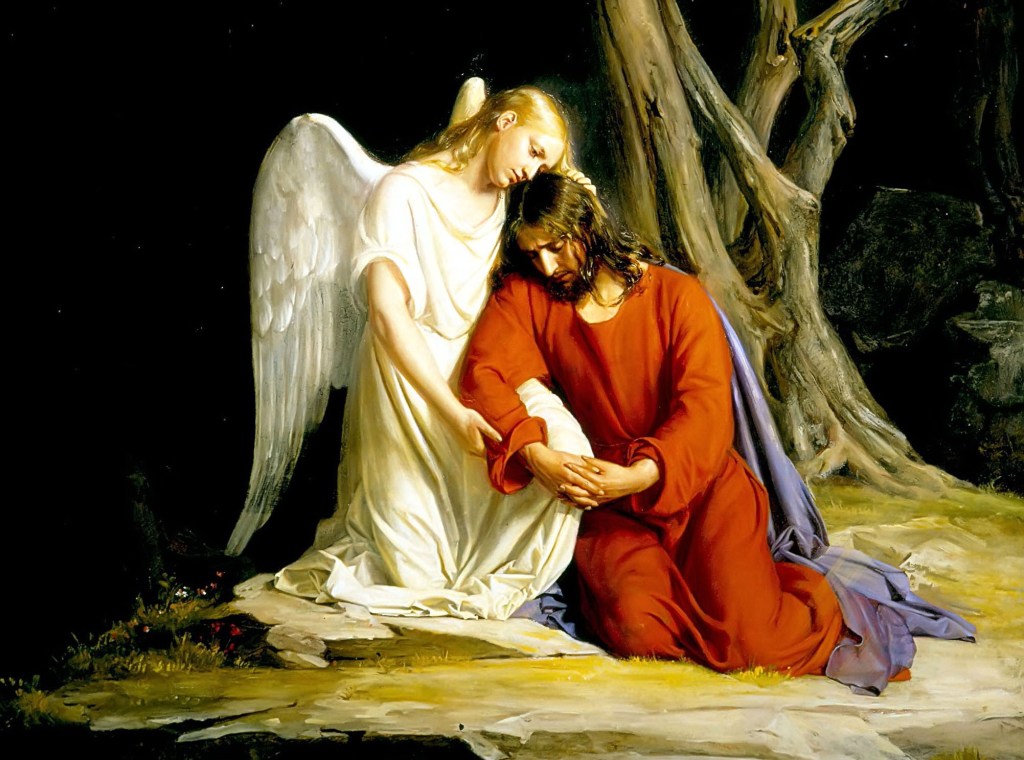
Kristus i Getsemane (1873) by Carl Heinrich Bloch (1834–1890)

Tonight is the night of the foot washing and the institution of the Holy Eucharist.  It is also the night of the Garden of Gethsemane.  When we think of this garden, it should remind us of another: “The Lord God planted a garden in Eden, in the east, and there he put the man whom he had formed.  And out of the ground the Lord God made to spring up every tree that is pleasant to the sight and good for food. The tree of life was in the midst of the garden, and the tree of the knowledge of good and evil.” (Genesis 2:8-9)  But we know how that all worked out: a snake, a lie, a piece of fruit, followed by exile.  God “drove out the man, and at the east of the garden of Eden he placed the cherubim and a flaming sword that turned every way to guard the way to the tree of life.” (Genesis 3:24)

Tonight, following the foot washing and breaking of bread, Jesus taught and prayed for his disciples and for us, and then afterward, “When Jesus had spoken these words, he went out with his disciples across the brook Kidron, where there was a garden, which he and his disciples entered.” (John 18:1)

The Garden of Eden and the Garden of Gethsemane: I’m not suggesting that the two are one and the same, but we are connected to them both.  Archbishop Fulton Sheen also demonstrated that link when we wrote, “As Adam lost the heritage of union with God in a garden, so now Our Blessed Lord ushered in its restoration in a garden. Eden and Gethsemane were the two gardens around which revolved the fate of humanity.” (Source)  

In that first garden, we became burdened by the sin of Adam and Eve’s rebellion and in that second garden, Jesus took that burden upon himself.  In that first garden, we were sent into exile, an angel with a flaming sword preventing our reentry into Paradise, but in that second garden, Jesus accepted the cup of God’s wrath on our behalf and by doing so, the angels rejoice at our return. (cf. Luke 15:10)  In that first garden, there was no atonement for our sin yet in the second garden, there was, Jesus, and he submitted to the Father’s will.

In this world, there are many questions, choices, and options, but the most important question we are asked is which of these two gardens we will choose.  Will we constantly fight against that angel’s flaming sword, seeking to enter a paradise of our creation by the fulfillment of our own will and desires, or will we, like Jesus, come to the other and kneel before the Father and seek his will and desires?  My buddy, Stephen King simplifies the issue, he writes, “There’s really no question.  It always comes down to just two choices. Get busy living, or get busy dying.” (Different Seasons, p.129)  

Enter the Garden with Jesus and get busy living.

Let us pray: “Father… not my will, but yours, be done.”  Amen.

Sermon: Wednesday in Holy Week – “Cognitive Dissonance”

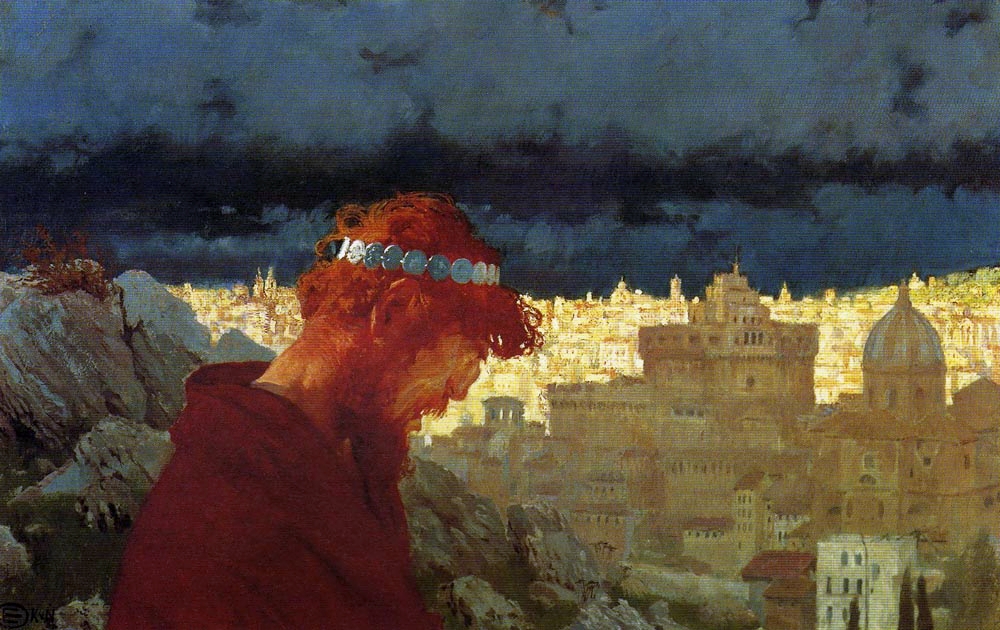
Judas by Edward Okuń

Psychology Today defines cognitive dissonance as “the state of discomfort felt when two or more modes of thought contradict each other. The clashing cognitions may include ideas, beliefs, or the knowledge that one has behaved in a certain way.” (Source)  So, you believe A to be true but then through study or enlightenment, you come to believe the exact opposite, Z, to be true.  However, you’ve invested so much time and energy into A that regardless of how much you believe Z to be true, you won’t give in, so you now have this tension/guilt between the two or maybe a deep sense of confusion.  That said it seems I tell you this story during Holy Week at least every other year.  It involves Bishop Jack Nicholls, the Bishop of Sheffield, who once asked a sixth-grade girl where she thought Jesus was between Good Friday and Easter. 

As a church, we understand the answer to be related to the Harrowing of Hell.  The Harrowing of Hell is understood from two passages of scripture: 1) Ephesians 4:7-9 — “But each of us was given grace according to the measure of Christ’s gift.  Therefore it is said, ‘When he ascended on high he made captivity itself a captive; he gave gifts to his people.’ (When it says, ‘He ascended,’ what does it mean but that he had also descended into the lower parts of the earth?” and 2)  1 Peter 4:6 — “For the gospel has for this purpose been preached even to those who are dead, that though they are judged in the flesh as people, they may live in the spirit according to the will of God.”  Combined, we understand the Harrowing of Hell as Jesus descending into hell and proclaiming the Good News to those who had died before his first coming giving them the option to also accept him as Lord and Savior.  Those who do are allowed to rise in glory.  The iconography shows Jesus pulling people up out of the depths.

When Bishop Nicholls asked the child what Jesus was doing between his death and resurrection, the answer he was looking for was likely associated with this Harrowing of Hell, but instead of answering the question in general terms, the little girl answered it in very specific terms.  After she had thought a little, she replied, “I think he was in deepest hell looking for his friend Judas.”

For me, this is where the cognitive dissonance kicks in.  We are told, “Satan entered Judas, the one called Iscariot.” (Luke 22:3)  In speaking to the Father about the twelve and referring to Judas, Jesus says, “I guarded them, and not one of them perished except the son of destruction.” (John 17:12)  He was a thief, traitor, betrayer, and more.  Yes, he did try and return the silver, but by then it was too late.  So, could the little girl have been right?  Would Jesus have gone looking for his “friend” Judas?  Answer: No!  Absolutely not!  Let him burn.  Answer: Yes!  “God is love.” (1 John 4:8)  God “desires all people to be saved and to come to the knowledge of the truth.” (1 Timothy 2:4)  Jesus said, “What man among you, if he has a hundred sheep and has lost one of them, does not leave the other ninety-nine in the open pasture and go after the one that is lost, until he finds it?” (Luke 15:4)

Dante placed Judas in the lowest level of hell and I think that is where he belongs, but… I also want Jesus to go looking for him and maybe even find him.  Why?  Because I want Jesus to come looking for and find me.  

Cognitive dissonance.

Sermon: Palm Sunday RCL C – “Darkness”

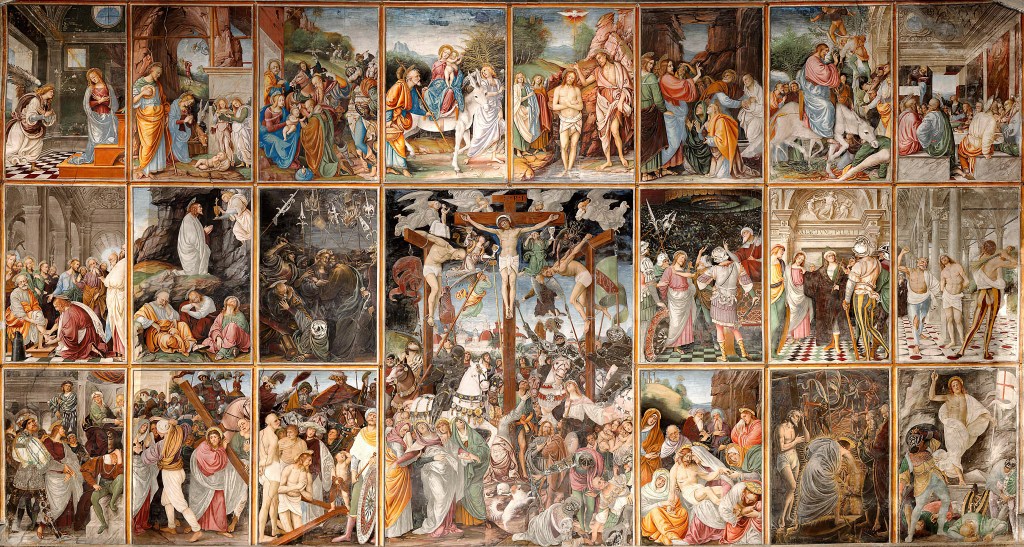
Gaudenzio Ferrari (1475–1546), Stories of The Life and Passion of Christ (1513),
Church of Santa Maria delle Grazie, Varallo Sesia (VC), Italy.

The Gospels are not time-stamped so it is somewhat difficult to calculate the length of Jesus’ public ministry, but given the clues and festivals mentioned, it is estimated to have been three to three and a half years.  With that understanding, we can say that the forty days Jesus spent in the wilderness and the temptation he experienced there took place about three years prior to the events we are reading today.

At the end of those forty days we are told, “When the devil had ended every temptation, he departed from him until an opportune time.”  Following this, Scripture tells us, “Jesus returned in the power of the Spirit to Galilee, and a report about him went out through all the surrounding country. And he taught in their synagogues, being glorified by all.”  The public ministry begins.

Throughout that ministry, we know that there were many encounters with religious leaders, demons that he exorcised, teachings, feedings, miracles, and more.  For three years Jesus poured out his life for the sake of the mission, fighting every battle that came along, so when he arrived in the Garden of Gethsemane on the night before he was crucified—knowing full well what was about to happen—not only was he exhausted, he was also highly stressed.  He sweated drops of blood.  Hematidrosis.  An exceptionally rare medical condition brought on by stress and anxiety that causes a person to sweat blood.  Because of its rarity, the doctors aren’t entirely certain as to what brings it on, but it is postulated that it is related to the fight and/or flight response: “Father, if you are willing, remove this cup from me; yet, not my will but yours be done.”  And then they came to arrest him, Jesus said, “Have you come out with swords and clubs as if I were a bandit? When I was with you day after day in the temple, you did not lay hands on me. But this is your hour, and the power of darkness!”

“But this is your hour, and the power of darkness!”  The word ‘power’ (exousia) in that sentence can be translated in several different ways: power, right, liberty, strength, jurisdiction, authority.

Following the forty days, the devil left Jesus “until an opportune time”.  That opportune time arrived on the night of Jesus’ arrest when he was experiencing the greatest anxiety.  That hour and the hours to come were handed over to the power of darkness… to the jurisdiction / authority of darkness.  This handing over to the darkness was not because Jesus had been defeated, instead, it occurred so that Jesus might be glorified.  The darkness believed it had finally conquered God, but in being given authority for a short while, it was defeated.

What you and I experience of the darkness of this life is nothing more than the death throes of death itself.

“In the beginning was the Word, and the Word was with God, and the Word was God.  He was in the beginning with God.  All things were made through him, and without him was not any thing made that was made.  In him was life, and the life was the light of men.  The light shines in the darkness, and the darkness has not overcome it.”

As we walk with Jesus during this Holy Week, darkness may seem to have conquered, but do not be afraid, it is only the hour before sunrise.