Sermon: Lent 5 RCL B – “Camino Sunday”


In a conversation with C.S. Lewis, J.R.R. Tolkien said, โ€œWe have come from God, and inevitably the myths woven by us, though they contain error, will also reflect a splintered fragment of the true light, the eternal truth that is with God.โ€ Within our legends and myths, there is a certain amount of truth. The same is true with what I would like to share todayโ€”a combination of facts, myths, and legends, and it all begins in the year 43 B.C. We can read about it in the Acts of the Apostles.

โ€œHerod the king laid violent hands on some who belonged to the church. He killed James the brother of John with the sword, and when he saw that it pleased the Jews, he proceeded to arrest Peter also.โ€ (Acts 12:1-3a) The Apostle James, brother of John and son of Zebedee, was martyred by beheading. It is from there that our legend begins.

Following his death, his followers, wanting to provide a proper burial for him but also wanting his body to be kept safe, took it to the coast, where they boarded a stone boat. The boat had no rudder or sail but was guided by an angel, which took it on a long journey across the Mediterranean, through the Strait of Gibraltar, and up to the northwest corner of Spain.

At this same time, a father was throwing a huge wedding party for his son. There was food, drinks, dancing, and games. One of the games played was abofardarโ€”the men, riding horses, would take a spear and hurl it into the air as high and far as they could, then, charging forward, they would attempt to catch the spear before it hit the groundโ€”very safe. The groomโ€™s turn came, and he gave the spear a mighty throw. However, he was so focused on the spear that he paid little attention to where his horse was going, and he plummeted into the sea and disappeared. There was high tension as the crowd watched and waited for him to surface. Finally, he did. A way out from shore, the groom and horse popped up. Fortunately for them, there was a boat directly beside them. It was the stone boat carrying the body of the Apostle James. 

After rescuing the groom and the horse, it was discovered that they were both covered in scallop shells. The followers of James on the boat saw this as a miracle, so the scallop shell became a symbol of all who were saved by coming to St. James. 

Following these events, the body of St. James was secretly buried and essentially lost for almost 800 years until a hermit, Pelayo, noticed strange lights in the sky. Following the lights, Pelayo came to a field where he discovered the hidden tomb. He informed his Bishop, who, with several others, went to investigate and were able to determine that it was, in fact, the remains of the Apostle. A church was built over the tomb, and later a cathedral. The city that grew up around it that supported the pilgrims who came to venerate the saint was named Santiago de Compostella. Santiago is translated as St. James, and Compostella means โ€œfield of lights.โ€ For the last 1,200 years, saints and sinners, lay people and clerics, rich and poor, popes and kings, have made the pilgrimage to pray before the remains of St. James the Greatโ€”one who was so very close and dear to Jesus.

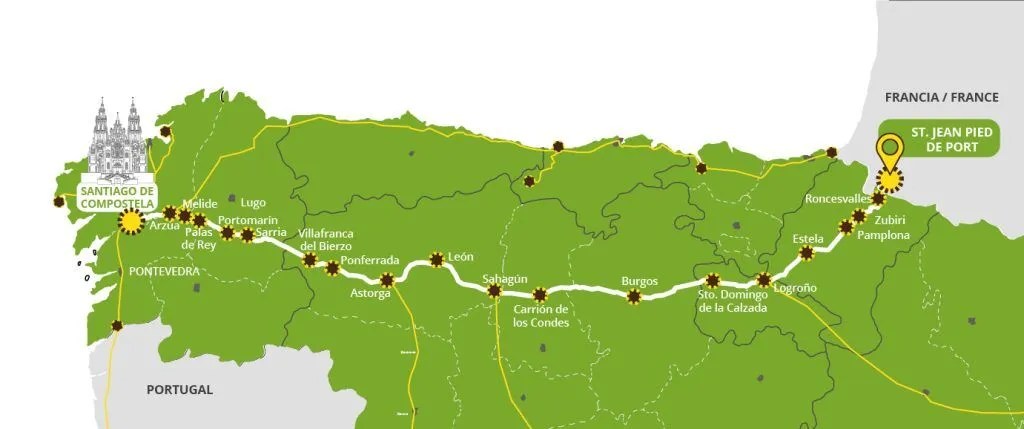
The pilgrimage is called the Camino de Santiago, the Way of St. James, and the starting point for many is Saint-Jean-Pied-de-Port, which means St. John at the Foot of the Passโ€”the pass is the one that takes you over the Pyrenees Mountains, from France into Spain. On April 10th of this year, I will rename this town Jean-Pied-de-Portโ€”John at the Foot of the Pass (unless, of course, Iโ€™m sainted in the next month, then Iโ€™ll keep it the same.) The French Way, the route I will be taking, is the most popular and the one pilgrims have walked for 1,200 years.

Iโ€™ll take more time and make more stops, but there are traditionally 31 stops along the way, and early on, pilgrims would make the journey there and back, so with the Cathedral counting as their destination, you would have 63 stops. As they did not have the benefit of GPS and a well-marked trail, early pilgrims relied on various maps, one of which was created by the Templars. That early map has evolved into a game still played today (and one our kids will have the opportunity to play while Iโ€™m away)โ€”The Royal Game of the Goose. Thus enter Albert the Goose. Why a goose?

It was the Templars who were charged with protecting pilgrims as they made the pilgrimage, and so it was the Templars who made the original map. Looking at our game board, you will see many of the squares have symbols in them. The meaning of most of the symbols is lost. Still, the labyrinth could represent physical and spiritual growth, a well might represent a lousy day, and a bridgeโ€”although it may be a specific bridgeโ€”can also represent a spiritual crossing. And then there is the goose. For the Templars, the goose represented wisdom, and throughout the Camino, if you keep your eyes open, you will see a goose carved in the base of a statue or a distinctive goose track in various locations. There are also towns with โ€œGooseโ€ in their names: Villafranca de Montes de Oca, Castrojeriz (city of geese), El Ganso, Ocรณn, Puerto de Oca, Manjarรญn (man of geese). (Source) While Iโ€™m away, Albert will also be traveling, and you may find him at your front door looking for a place to rest.

In the very early days of the Camino, there were tens of thousands of pilgrims, but the numbers waned due to wars and other issues. Eventually, it nearly fell out of use, and in 1979, only twelve people completed the walk. However, popularity has increased dramatically. Last year, which was considered a holy year, over 442,000 individuals walked a Camino.

To officially walk a Camino, you must walk at least 100km (62 miles). From St-Jean, where Iโ€™ll start, it is 800km (500 miles), and last year, of the 442,000, about 23,000 made that distance. For each, regardless of the distance, the shellโ€”like the one attached to the groom and his horseโ€”has become the symbol of the Camino de Santiago. It is what designates a pilgrimโ€”they attach one to their pack or hatโ€”and it is what marks The Way, with signposts, wayfaring markers, and various marks in the road.

Finally, the Camino de Santiago is a physical exerciseโ€”putting one foot in front of the other for 500 milesโ€”but more than that, it is a spiritual exercise. It is a journey of the soul. It is a way of letting go of all except the most necessary and, hopefully, along The Way, discovering that all you truly need is God and a few items you can carry on your back. As I walk, I hope to declutter my mind and my soul, and just as I might leave some gear that I donโ€™t use along the way, I hope to leave the clutter and discover that life is far simpler than we make it.

I will be on the Camino for 60 days, and Iโ€™ll be out for fourteen weeks. I will be very out of touch, but I will pray for you every day. As Iโ€™ve told several people, St. Matthewโ€™s was around for 125 years before I got here, so I know youโ€™ll be just fine and in very capable hands. I encourage you to participate in the events and activities that have been planned. In the process, you might just discover the spirit of the Camino and find The Way opening up before you.

Let us pray (this is the traditional pilgrimโ€™s prayer that was written in the 12th century):

O God, who brought your servant Abraham
out of the land of the Chaldeans,
protecting him in his wanderings,
who guided the Hebrew people across the desert,
we ask that you watch over us, your servants,
as we walk in the love of your name.

Be for us our companion on the walk,
Our guide at the crossroads,
Our breath in our weariness,
Our protection in danger,
Our refuge on the Camino,
Our shade in the heat,
Our light in the darkness,
Our consolation in our discouragements,
And our strength in our intentions.

So that with your guidance we may arrive safe and sound
at the end of the Road
and enriched with grace and virtue
we return safely to our homes filled with joy.
In the name of Jesus Christ our Lord, Amen.

St. James the Greater, pray for us.
Holy Mary, Mother of God, pray for us.

Buen Camino!
Sermon: “Now”


A few years back, The Netherlandish Proverbs, a painting by Pieter Brueghel, sold for $9M at Christieโ€™s Auction House in London. Painted in 1559, it depicts seventy-six proverbs, many of which we still say today, or at least a version. A man with his hand over his face, peering through his fingers, is โ€œTo look through oneโ€™s fingersโ€ or to turn a blind eye. Another, โ€œWhen the gate is open, the pigs run through the wheat,โ€ is for us; when the cat is away, the mice will play. Some are far more obscure, and one of these caught my attention. 

A woman is carrying a bucket of water in her left hand and a set of tongs with a hot coal in the other. The proverb: โ€œShe carries fire in one hand and water in the otherโ€ means to be two-faced and stir up trouble. It also means to hold two contradictory views. That is not a good thing, and it is a claim that many make about Holy Scripture. It was that issue that I was confronted with this week as I read through the last two verses of our Gospel lessonโ€”โ€œDo not be astonished at this; for the hour is coming when all who are in their graves will hear his voice and will come outโ€”those who have done good, to the resurrection of life, and those who have done evil, to the resurrection of condemnation.โ€ (John 5:28-29) What is the problem?

The last word, โ€œcondemnation,โ€ immediately brought to mind our Gospel reading from Sunday. It begins with that most famous of verses, John 3:16, โ€œFor God so loved the world that he gave his only Son, so that everyone who believes in him may not perish but may have eternal life.โ€ So far, so good. Jesus continued, โ€œIndeed, God did not send the Son into the world to condemn the world, but in order that the world might be saved through him.โ€ Even more good news, good news that St. Paul will confirm in his letter to the Romans when he writes, โ€œThere is therefore now no condemnation for those who are in Christ Jesus.โ€ (Romans 8:1) Everything is coming up roses until you arrive at those verses from today, how some will experience the โ€œresurrection of condemnation.โ€ 

I thought Jesus said we were past all that condemnation bit. Is this a contradiction in Holy Scripture? Not at all. It only requires that we read the passage from John 5 more closely. It is easy to miss, but before speaking of condemnation, Jesus said, โ€œThe hour is coming.โ€ Coming. Not yet. John 3 is speaking of Jesusโ€™ first coming. John 5 is speaking of Jesusโ€™ second coming. No contradiction. 

We are now living in the time when โ€œeveryone who believes in [Jesus] may not perish but have eternal life.โ€ However, there is an end dateโ€”a time when judgment will come, and for those who do not believe, it is a judgment of condemnation; therefore, the time to choose is not then but now.

In the first verse of our reading from Isaiah, the Lord said, โ€œIn a favorable time I listened to you, and in a day of salvation I have helped you.โ€ St. Paul quotes this verse in his second letter to the Corinthians: โ€œIn a favorable time I listened to you, and in a day of salvation I have helped you.โ€ Then Paul adds, โ€œBehold, now is the favorable time; behold, now is the day of salvation.โ€

There is no confusion or contradiction; now is the time to come to God. Now is the day. For all of you sitting here, I believe you have, but who do you know that has not? How might you guide them and share your faith with them so that on the last day, they too will be judged and receive the resurrection of lifeโ€”life eternal with our God?

We are “The Capitol”

I’m a firm believer in Israel’s right to defend. If what happened to them happened to us, we would have dusted off the nukes. I know that we will send billions to help rebuild when it is over. I know that this is not the only aid that will be sent. I know… I know… I know… but…

The tug boat is towing a barge of food to Gaza, which I also firmly believe we should be doing. However, I could only imagine those on the Virgin cruise looking down on it and thinking, “Aren’t we good people for helping out.”

I can’t help but think that this is how we support the world when we could do so much more. We live in The Hunger Games, and we are The Capitol.

This from the hypocrite who is going to Spain to take a walk.

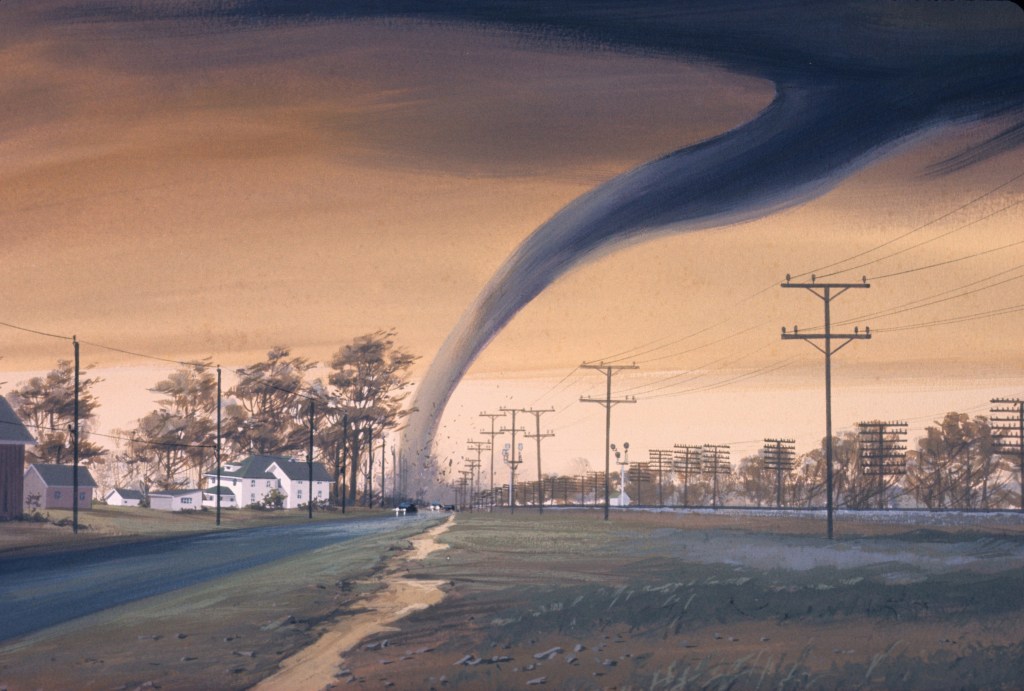
Prompt: You are under a tornado warning

Enid Writers Club Roll Call (150 word limit)

Photo byย NOAAย onย Unsplash

The wind was sucking on Danโ€™s shirt tails as he dove into the tornado shelter. Quickly, he slammed the door shut and spun the wheel to lock it in place.

Climbing down the ladder, he fumbled for the light switch. Nothing. He had forgotten to charge the batteries.

โ€œWonโ€™t be but a few minutes,โ€ he said to the pitch and settled in, his back against the wall.

He listened, but it wasnโ€™t the sound of the storm that caught his attention. Instead, it was a slurping squelch as something else moved in the dark. 

Cautiously, he felt around until his hand fell upon a short metal pipe. He waited. Moments later, something grabbed him, and Dan started beating away with the pipe. He quit when he felt the skull of the intruder give way under a heavy blow. 

โ€œDamn zombies,โ€ he said and went back to listening to the storm.

Sermon: Lent 4 RCL B – “Into the Light”

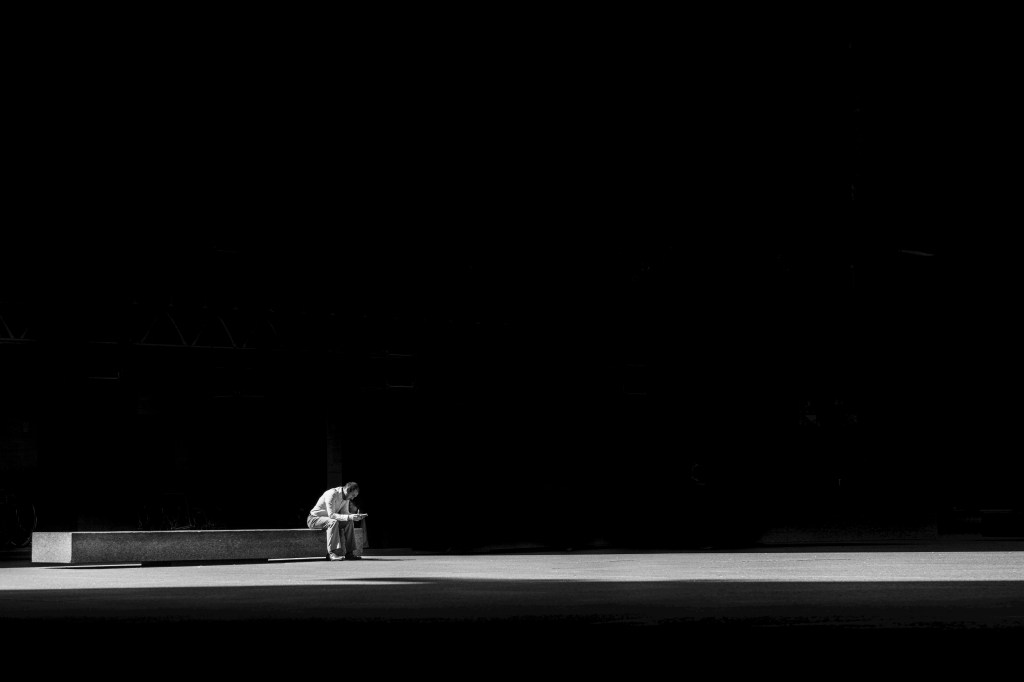
Photo by Matthew Henry on Unsplash

Olโ€™ Boudreaux had been out carousing all night, so he decided it might be best to go to confession before going home to Clotile. It had been many years since his last confession, so he was a bit surprised when he stepped into the confessional. On one wall was a fully stocked bar with Guinness on tap. A dazzling array of the finest cigars and chocolates was on the other wall. Boudreaux hereโ€™s the priest come in on the other side and says, โ€œFather, forgive me, for itโ€™s been a very long time since Iโ€™ve been to confession, but I must admit that the confessional box is much more inviting than it used to be.โ€

The priest responds, โ€œGet out! Youโ€™re on my side.โ€

The Israelites had been set free from their bondage in Egypt, and they passed through the parted waters of the Red Sea, but through their sin, they ended up wandering around for forty years. At one point, they came to Mount Hor, about forty miles south of the Dead Sea. As it was difficult in the land, they again complained against the Lord, so the Lord sent the serpents to punish them. Many died from being bitten by the poisonous snakes. When the people came to their senses, they confessed to Mosesโ€”โ€œWe have sinned by speaking against the Lord and against you; pray to the Lord to take away the serpents from us.โ€ The Lord heard their cries for mercy, so He said to Moses, โ€œโ€˜Make a poisonous serpent, and set it on a pole; and everyone who is bitten shall look at it and live.โ€™โ€ So Moses made a serpent of bronze, and put it upon a pole; and whenever a serpent bit someone, that person would look at the serpent of bronze and live.โ€ They named the bronze snake Nehushtan, and later in Israelโ€™s history, theyโ€™ll turn it into a god and worship it, but thatโ€™s for another day. In todayโ€™s lesson, the people sinned, and death entered in the form of the serpents. When the people confessed their sins, the Lord provided a way for them to liveโ€”look upon the serpent that has been raised up, and you will live.

In our Gospel reading this morning, Jesus said, โ€œJust as Moses lifted up the serpent in the wilderness, so must the Son of Man be lifted up, that whoever believes in him may have eternal life.โ€

In the time of Moses, the people sinned, and death came upon them. So they confessed their sin, and if they looked up at the bronze snake, they would live.

Today, we know that โ€œall have sinned and fall short of the glory of Godโ€ (Romans 3:23) and that โ€œthe wages of sin is death.โ€ (Romans 6:23) However, we also know that โ€œIf we confess our sins, [God] is faithful and just to forgive us our sins and to cleanse us from all unrighteousness.โ€ (1 John 1:9) In confessing and repenting, we are not looking up at a bronze snake, but within our souls, we are looking up to our crucified Lord, and by doing so, by believing in the sacrifice He made on our behalf, we have eternal life.

Within the teachings of the Old Testament and the New, we know that there is sin and death, as well as forgiveness and life. However, between those two paths lies confession. 

There is the general/private confession we make almost every time we gather, and there is auricular confession. Auricular relates to the ear, meaning to be heard, so it is our confession to a priest.

Is the general/private confession just as good as auricular confession? Yes, in that forgiveness of sin is assured. No, in that sometimes, you need to confront and speak a sinโ€”you need to make it realโ€”not for Godโ€™s sake, but for yours, so that, as we say in The Exhortation, โ€œyou may receive the benefit of absolution, and spiritual counsel and advice; to the removal of scruple and doubt, the assurance of pardon, and the strengthening of your faith.โ€ And thereโ€™s one more reason to speak your sins to another that the Prayer Book will not mentionโ€”it is humbling, and there are times when we need to be humbled. It is not a pleasant experience, far from it, but it is a cleansing one. 

Think of what Jesus said, โ€œAll who do evil hate the light and do not come to the light, so that their deeds may not be exposed. But those who do what is true come to the light, so that it may be clearly seen that their deeds have been done in God.โ€ The confession of sin is the hauling out into the light those things we would prefer to keep hidden. It is the recognition that as much as we would like to think otherwise, we are not always good little boys and girls. In my heart, I can speak to God about my unrighteousness, and God says, โ€œYeah, I know.โ€ However, when I speak to the image of Christ in another person, when I make my sin real, then I also genuinely know of my fallenness. No longer can I deceive myself into thinking that Iโ€™ve confessed when I come before another. In Life Together, Dietrich Bonhoeffer writes, โ€œOur brother breaks the circle of self-deception. A man who confesses his sins in the presence of a brother knows that he is no longer alone with himself; he experiences the presence of God in the reality of the other person.โ€ (p. 116) When we confess, we come into the light with all that is dark within us and allow God’s Light to reveal and cleanse us of that darkness.

I know that we always have fun when the topic of confession comes up, but I do believe in its ability to heal, so, all fun aside, I want you to know about it. Do I expect there to be a line on Wednesday for those of you seeking to make confession? Nope. But I do ask you to consider it, and if nothing else, the next time you make a general confession, donโ€™t just say the words. Instead, bring the burden of your sins before God, and seek to make amendment of life, not just with words, but in actions as well. And thenโ€”and this is the other half and perhaps the more difficult aspect of confessionโ€”receive the absolution. Know in your soul, without hesitation or doubt, that you have been forgiven. You donโ€™t have to carry the weight of your sins. As St. John tells us, โ€œIf we walk in the light, as he is in the light, we have fellowship with one another, and the blood of Jesus his Son cleanses us from all sin.โ€ (1 John 1:7) Jesus was lifted up on the cross that you might receive forgiveness of sin. Receive that forgiveness and know that you have been made acceptable to God. From the Book of the Prophet Isaiah,

โ€œCome now, let us reason together, says the Lord:
though your sins are like scarlet,
    they shall be as white as snow;
though they are red like crimson,
    they shall become like wool.โ€

(Isaiah 1:18)

Today, Iโ€™ll close with a portion of Psalm 32,

Blessed is the one whose transgression is forgiven,
whose sin is covered.
Blessed is the man against whom the Lord counts no iniquity, and in
whose spirit there is no deceit.
For when I kept silent, my bones wasted away
through my groaning all day long.
For day and night your hand was heavy upon me;
my strength was dried up as by the heat of summer.
I acknowledged my sin to you,
and I did not cover my iniquity;
I said, โ€œI will confess my transgressions to the Lord,โ€
and you forgave the iniquity of my sin. (Psalm 32:1-5)

The Word of the Lord.

Thanks be to God.

Sermon: “Salt Farmers”


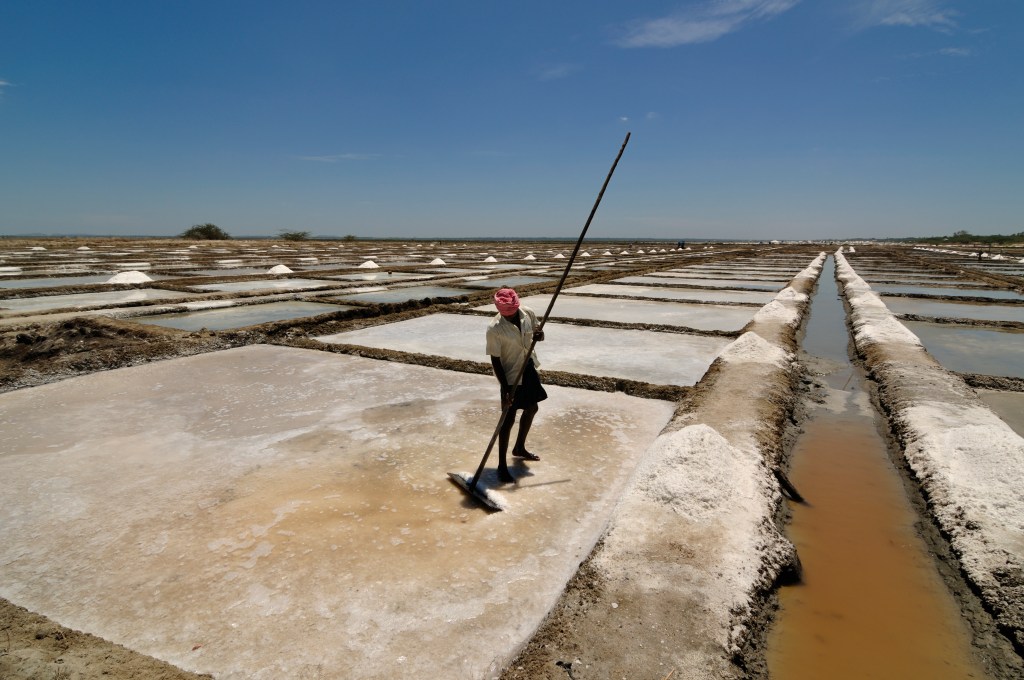
In the far west of India, near the coast of the Arabian Sea, is the Rann of Kutch. For a few months out of the year, it is a marsh submerged underwater, but for the most part, it is a barren wasteland. Even so, some 40,000 families migrate out into this wasteland every year for seven to ten months and call it home. They are the Agariya people, and they have been farming this land for centuries. Not for wheat, corn, or some other crop we typically think of, but for salt, harvesting 76% of the salt produced in India.

I recently watched a documentary on these families, My Name is Salt. It was fascinating. The conditions are harsh. Temperatures can range from 40ยฐ to 104ยฐ, and the people suffer from various illnesses due to the salt. The average lifespan is only 60. It is a fantastic story, and even more so is how the salt is farmed.

It is a fairly extensive process, but they form โ€œbedsโ€ where groundwater is pumped up. Through evaporation, the salt is rendered from these โ€œbeds.โ€ To initiate the crystalization process, they lay small branches on the surface of the beds, and the salt begins to form crystals along the branches. When those crystals are large enough, they come along and beat them off the branches, and they continue to growโ€”youโ€™ll have to watch the documentary to seeโ€”but in the end, they have mountains of beautifully white salt.

Todayโ€™s Gospel reading from Matthew is a part of the Sermon on the Mount, and what we heard follows closely after the Beatitudes. In the three verses between the Beatitudes and our verses today, Jesus said, โ€œYou are the salt of the earth. But if the salt loses its saltiness, how can it be made salty again? It is no longer good for anything, except to be thrown out and trampled underfoot.โ€ Jesus then speaks of light in a similar way, and then then our verses for today.

Taken out of context, the verses we heard seem to indicate that we are in error by not following the Law as prescribed by Moses. But in the context of the Beatitudes and with this idea of being the โ€œsalt of the earth,โ€ we begin to understand that Jesus had something else in mind, which is why I thought of those salt farmers.

God gave the Law to Moses. We know the top ten, but there are 613 laws in the Law of Moses. Everything from โ€œThou shall not murderโ€ to โ€œdonโ€™t eat bacon.โ€ There are so many laws, and they are so intricate, that only a very few could remember it all, and none could follow. To remedy this, God sent His one and only Son, Jesus, to โ€œharvestโ€ the Lawโ€”to reduce it down to its purest nature, which Jesus did: โ€œTeacher, which is the greatest commandment in the Law?โ€ Jesus replied [with what we know as the Summary of the Law]: โ€œโ€˜Love the Lord your God with all your heart and with all your soul and with all your mind.โ€™ This is the first and greatest commandment. And the second is like it: โ€˜Love your neighbor as yourself.โ€™ All the Law and the Prophets hang on these two commandments.โ€

Jesus โ€œharvestedโ€ the Law and reduced all there was down to those few statements, and ultimately to one wordโ€”loveโ€”and โ€œnot one letter, not one stroke of a letter, will pass from the law until all is accomplished.โ€

Like Jesus, we are called upon today to harvest this salt of Godโ€™s love. We are to take this beautifully white โ€œsaltโ€ of Godโ€™s love and season everything we touch with it and then share it. There will be days filled with joy and days when the conditions are harsh, but we are โ€œsalt farmers,โ€ and sharing Godโ€™s love is what we do.

Sermon: Lent 3 RCL B – “Filled”

Photo by Yasin ArฤฑbuฤŸa on Unsplash

The Marble Faun was written by Nathaniel Hawthorne and published in 1860. The setting is Rome, and Hawthorne did such a remarkable job of describing locations in the city that it became somewhat of a travel guide. One of those settings is the catacombs below the city, where we hear of the legend of Memmius.

Hawthorne writes, โ€œThis man, or demon, or man-demon, was a spy during the persecutions of the early Christians, probably under the Emperor Diocletian, and penetrated into the catacomb of St. Calixtus, with the malignant purpose of tracing out the hiding-places of the refugees. But, while he stole craftily through those dark corridors, he chanced to come upon a little chapel, where tapers were burning before an altar and a crucifix, and a priest was in the performance of his sacred office. By divine indulgence, there was a single momentโ€™s grace allowed to Memmius, during which, had he been capable of Christian faith and love, he might have knelt before the cross, and received the holy light into his soul, and so have been blest forever. But he resisted the sacred impulse. As soon, therefore, as that one moment had glided by, the light of the consecrated tapers, which represent all truth, bewildered the wretched man with everlasting error, and the blessed cross itself was stamped as a seal upon his heart, so that it should never open to receive conviction.

โ€œThenceforth, this heathen Memmius has haunted the wide and dreary precincts of the catacomb, seeking, as some say, to beguile new victims into his own miseryโ€ or, even better, seeks to find someone to take him by the hand and lead him from the darkness into the light, knowing that he will eventually turn on them and bring new kinds of misery on the world.

Jesus said, โ€œWhen an impure spirit comes out of a person, it goes through arid places seeking rest and does not find it.  Then it says, โ€˜I will return to the house I left.โ€™ When it arrives, it finds the house unoccupied, swept clean and put in order.  Then it goes and takes with it seven other spirits more wicked than itself, and they go in and live there. And the final condition of that person is worse than the first.โ€ (Matthew 12:43-45)

Memmius had within him a spirit of persecution. When he saw the light of the candles and the celebration of the Holy Mass, that spirit was driven from him, and he was given the opportunity to repent and believe.  However, instead of believing, he hardened his heart, and that spirit of persecution returned more powerful than before and forever sealed Memmiusโ€™ fate.

It is true what the Prophet Isaiah says, โ€œYet you, LORD, are our Father.  We are the clay, you are the potter; we are all the work of your hand.โ€  God forms us as a potter forms a pot from a lump of clay. He forms us each to His likings to serve His purpose, and like any pot that a potter forms, there is within us an empty place that is to be filled.  That place within you is the Temple of the Lord. You are the Temple of the Lord.

Consider our Gospel reading. Jesus went to the temple in Jerusalem with his disciples, where he encountered the money changers and sellers of sacrifices. Emanating from them was this overwhelming physical and spiritual stench that sent Jesus into a holy riot, so he drove them all out with the whip he made. Seeing this, the Jews became incensed and asked, โ€œWhat sign can you show us for doing this?โ€ They were asking, by whose authority are you doing these things? Why would they care? Because money changing and the selling of sacrifices is big business. I donโ€™t know if it is still true or not, but they used to say that movie theaters didnโ€™t make their money on showing movies; instead, they made their money on all the concessions sold. The same principle is applied here. The religious leaders made some money on folks coming to the Temple, but the shekels rolled in when it came to changing money and selling sacrifices. So they asked, by whose authority are you disrupting our business?  Give us a sign that you are allowed. Jesus answered them, โ€œDestroy this temple, and in three days I will raise it up.โ€ The religious leaders, thinking He was speaking of the building, said, โ€œThis temple has been under construction for forty-six years, and will you raise it up in three days?โ€ But we know that Jesus was talking about the Temple of His body.

Remember what St. Paul said in his letter to the Corinthians,  โ€œDo you not know that your bodies are temples of the Holy Spirit, who is in you, whom you have received from God? You are not your own; you were bought at a price. Therefore honor God with your bodies.โ€ (1 Corinthians 6:19-20)

There is within us this place, this temple, that must be filled. However, there is a gift that God has given to us allโ€”free will. Free will means you are free to choose how and with what to fill that temple that is within you. You may choose, like Memmius, to fill it with those things that are in opposition or contrary to God, or you may choose to fill it with the things of God. The choice is yours, and so are the consequences.

Will this filling happen all at once? No. For good or ill, it is a process.  There will be days of success and days of failure, but the hope is we will keep moving forward. Blessed Teresa of Calcutta said, โ€œGod has not called me to be successful. He called me to be faithful.โ€ We may not always be successful in our attempts at filling this temple of ours with the holy, but we must be faithful and persevere, returning time and time again to the Throne of God, repenting and seeking His grace and mercy.

One day, speaking to a large audience, the great preacher D.L. Moody held up a glass and asked, โ€œHow can I get the air out of this glass?โ€ One man shouted, โ€œSuck it out with a pump!โ€ Moody replied, โ€œThat would create a vacuum and shatter the glass.โ€ After numerous other suggestions, Moody smiled, picked up a pitcher of water, and filled the glass. โ€œThere,โ€ he said, โ€œall the air is now removed.โ€ He then went on to explain that victory in the Christian life is not accomplished by โ€œsucking out a sin here and there,โ€ but by being filled with the Holy Spirit, and each day, we can be filled a little more.  

My friend, St. Josemarรญa Escrivรก, writes, โ€œGet to know the Holy Spirit, the Great Unknown, the one who has to sanctify you. Donโ€™t forget that you are a temple of God. The Paracleteโ€”the Holy Spiritโ€”is in the center of your soul: listen to him, and follow his inspirations with docility.โ€

When Jesus was led into the wilderness after his baptism, we are told that he fasted for forty days, then the devil came to him and said, โ€œIf you are the Son of God, tell these stones to become bread,โ€ but Jesus answered, โ€œIt is written: โ€˜Man shall not live on bread alone, but on every word that comes from the mouth of God.โ€™โ€ Our bodies need food, but the Temple of God within us needs spiritual food; it needs the filling of the Holy Spirit and the Blessed Sacrament of the altar. 

Give no room to those spirits like Memmius who seek to fill you and drive you from God. Instead, persevere in your strides towards holiness and fill the temple that is you with the Holy Spirit; be filled with God. 

Let us pray: (this is a prayer written by St. Augustine of Hippo) Breathe into us, Holy Spirit, that our thoughts may all be holy. Move in us, Holy Spirit, that our work, too, may be holy. Attract our hearts, Holy Spirit, that we may love only what is holy. Strengthen us, Holy Spirit, that we may defend all that is holy. Protect us, Holy Spirit, that we may always be holy. Amen.

Sermon: “Spiritual Disciplines”


How easy is it for you to maintain your focus on any given thought or practice? For most of us, our minds wander. We get sidetracked by the demands of the world, by our ever-dinging and chiming devices, and by the random thoughts that ceaselessly stream through our minds. It is true for our life in the world, and it is true for our life with God. Because of this, learning to clearly focus on a single task is a practiced skill. If youโ€™ve ever tried to sit down and pray, you know how this works. You are attempting to focus on God, then, without even the awareness of it occurring, you’re thinking about having curly fries for lunch.

My all-time favorite novel is The Stand by Stephen King. The publishers said it was too long, so they made him cut 150,000 words (500 pages) to make it more manageable. It would later be printed in its entirety, which made me a thrilled reader. It is now a hefty doorstop with 1,440 pages. How does someone write so much? 

In his own words, Sai King says, โ€œI used to tell interviewers that I wrote every day except for Christmas, the Fourth of July, and my birthday. That was a lie. I told them that because if you agree to an interview you have to say something, and it plays better if it’s something at least half-clever. Also, I didn’t want to sound like a workaholic dweeb (just a workaholic, I guess). The truth is that when I’m writing, I write every day, workaholic dweeb or not. That includes Christmas, the Fourth, and my birthday (at my age you try to ignore your โ€ฆ birthday anyway). And when I’m not working, I’m not working at all, although during those periods of full stop I usually feel at loose ends with myself and have trouble sleeping. For me, not working is the real work. When I’m writing, it’s all the playground, and the worst three hours I ever spent there were still prettyโ€ฆ good.โ€ (On Writing, p.153)

King has learned the art of focusโ€”approaching the task with unwavering attention and has become one of the most prolific writers ever. Can I focus like that? Nope. Iโ€™ve thought about whatโ€™s for lunch at least twice since weโ€™ve been here. Whatโ€™s this got to do with today?

โ€œWhile Jesus was going up to Jerusalem, he took the twelve disciples aside by themselves and said to them on the way, โ€˜See, we are going up to Jerusalem, and the Son of Man will be handed over to the chief priests and scribes, and they will condemn him to death; then they will hand him over to the Gentiles to be mocked and flogged and crucified; and on the third day he will be raised.โ€™โ€ This is followed by James and John jockeying for positions.

Jesus said, โ€œWe are headed to Jerusalem, where I will be brutally murdered.โ€ The disciples said, โ€œCool. Can we have a pony?โ€ Like us, their minds could not focus on what Jesus was saying. It wandered here and there with all sorts of concerns.

The Season of Lent is marked by certain practicesโ€”โ€œself-examination and repentance; by prayer, fasting, and self-denial; and by reading and meditating on Godโ€™s holy Word.โ€ (BCP 265) Although we should, these are not always things that we practice, so itโ€™s likely that weโ€™re not very good at it. When we should be reading Godโ€™s holy Word, we get distracted by the latest Stephen King novel to come out or whatever. Therefore, we must be very intentional in our time with God. Disciplining our minds to focus on spiritual practices. At first, it is easy to become frustratedโ€”โ€œI just canโ€™t seem to sit with Jesus for an hour!โ€โ€”but over time, we will learn, and we will then say, โ€œI just canโ€™t seem to not sit with Jesus.โ€ 

โ€œFor everything there is a season, and a time for every matter under heaven.โ€ That is true when it comes to thinking about getting a pony, and it is true when it is about spending time with God.

Sermon: “Sign of Jonah”

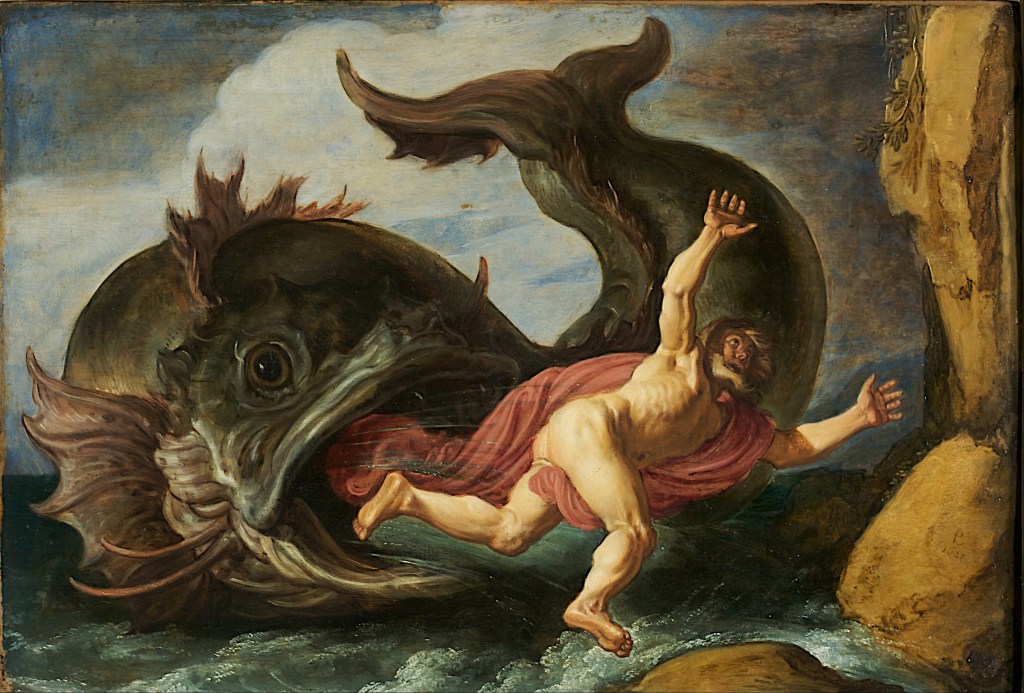
Jonah and the Whale (ca. 1603-1607) by Pieter Lastman

From the Book of Jonah 1:1, โ€œNow the word of the Lord came to Jonah the son of Amittai, saying, โ€˜Arise, go to Nineveh, that great city, and call out against it, for their evil has come up before me.โ€™โ€ From there, most grade school children can tell you what happened next.

Jonah said, โ€œNo.โ€ He believed that if he went to Nineveh and preached, the people would repent and be saved. He did not want that. He wanted them to pay for their wickedness, so he fled instead of doing as God asked. Going to the coast, he boarded a ship and set sail. While Jonah slept below deck, a great storm blew in. The sailors began praying to their various gods, to no avail. Finally, the captain found Jonah sleeping and demanded to know why Jonah wasnโ€™t also praying. When Jonah realized that it was his fault that everyone was about to die, he said, โ€œPick me up and hurl me into the sea; then the sea will quiet down for you, for I know it is because of me that this great tempest has come upon you.โ€

At first, the other men hesitated, but when the storm only worsened, they picked up Jonah and pitched him into the sea. From there, we are told, โ€œAnd the Lord appointed a great fish to swallow up Jonah. And Jonah was in the belly of the fish three days and three nights.โ€ Then Jonah prayed. In the words of his prayer, you might also hear words Jesus may have prayed as he slept in the belly of the earth for three days.

โ€œI called out to the Lord, out of my distress,
    and he answered me;
out of the belly of Sheol I cried,
    and you heard my voice.

For you cast me into the deep,
    into the heart of the seas,
    and the flood surrounded me;
all your waves and your billows
    passed over me.

Then I said, โ€˜I am driven away
    from your sight;
yet I shall again look
    upon your holy temple.โ€™

The waters closed in over me to take my life;
    the deep surrounded me;
weeds were wrapped about my head

    at the roots of the mountains.
I went down to the land
    whose bars closed upon me forever;
yet you brought up my life from the pit,
    O Lord my God.

When my life was fainting away,
    I remembered the Lord,
and my prayer came to you,
    into your holy temple.

Those who pay regard to vain idols
    forsake their hope of steadfast love.

But I with the voice of thanksgiving
    will sacrifice to you;
what I have vowed I will pay.
    Salvation belongs to the Lord!โ€

After Jonahโ€™s prayer, on the third day, โ€œThe Lord spoke to the fish, and it vomited Jonah out upon the dry land.โ€ And we know that, on the third day, Jesus rose from the earth, the tomb.

Jesus said, โ€œThis generation is an evil generation; it asks for a sign, but no sign will be given to it except the sign of Jonah.โ€

The sign of Jonah is the descending into the waters and the belly of the beast. It is entering into sin, chaos, and death, but it is also rising from chaos and death to new life. Therefore, the sign of Jonah is also our life with God, for as St. Paul tells us in his letter to the Ephesians, โ€œYou were dead in the trespasses and sinsโ€ฆ But God, being rich in mercy, because of the great love with which he loved us, even when we were dead in our trespasses, made us alive together with Christ.โ€

Jonah prayed in the belly of the whale, and I feel that his words were near to the heart of Jesus as he lay in the belly of the earth. On those days of great trial, you can also make these words yours, knowing as they both did, โ€œSalvation belongs to the Lord!โ€