The Book of Judith can be found in the Apocrypha, which means, according to Article 6 of the 39 Articles, “The Church doth read for example of life and instruction of manners; but yet doth it not apply them to establish any doctrine.”
The book begins, “It was the twelfth year of Nebuchadnezzar who reigned over the Assyrians in the great city of Nineveh,” which rabbinical scholars state is equivalent to saying, “A long time ago in a galaxy far, far away….” In other words, it is historical fiction but a great read.
Israel is under attack from the Assyrians in the north. On their way to Jerusalem, the Assyrians conquer everyone in their path, finally coming up against the Jewish city of Bethulia.
The general of the Assyrian army, Holofernes, is all for immediately marching in and conquering it. Still, the Edomites, who are with him, convince him to lay siege instead by cutting off the water supply. They do, and they wait.
After thirty-five days, the people of Bethulia are ready to surrender, but the mayor convinces them to wait five more days, saying that if God did not rescue them after 40 days, he would surrender.
It is then that Judith goes into action. She plans to save her people by whatever means necessary, and the plan requires her to get safely into the Assyrian camp. She will need to lie to do this, so she prays that she can lie well. We heard part of it today, including the words, “King of all your creation, hear my prayer! Make my deceitful words bring wound and bruise on those who have planned cruel things against your covenant.”
She is very beautiful, so to accentuate that beauty, she dresses seductively. Then, leaving the city with her maidservant, she allows herself to be taken captive. Because of her beauty, they do not harm her, and when she lies, saying she has information on how to defeat the Israelites, she is taken to Holofernes. Beautiful woman encounters lustful general. Care to guess what the general is thinking? Yahtzee!
Judith’s plan works, but she keeps the general’s desire at bay for several days. Eventually, she declares that she will give in to his wishes. He is so excited by the prospect that he celebrates. In fact, he celebrates so much with liquor that he passes out. Scripture picks up: “With that, she went up to the bedpost by Holofernes’ head and took down his scimitar; coming closer to the bed, she caught him by the hair and said, ‘Make me strong today, Lord God of Israel!’ Twice she struck at his neck with all her might and cut off his head.” Then, after escaping through the enemy camps, she returned to the city. She said to the people, “Praise God! Praise him! Praise the God who has not withdrawn his mercy from the House of Israel but has shattered our enemies by my hand tonight!” She then had them place the head of the general on the city gate, which struck fear into the hearts of the Assyrians, which led to great chaos. The Israelites used the chaos, attacked, and drove the Assyrians from their land. I think Judith would have made a good Marine.
Interestingly, this story is tied to the feast of St. Mary Magdalene, which we celebrate today. Why? Because they are both declaring a victory. Judith says, “Praise God! Praise him! Praise the God who has not withdrawn his mercy from the House of Israel but has shattered our enemies.” She is declaring salvation from an earthly enemy. Mary Magdalene says, “I have seen the Lord.” She declares salvation for us all—our salvation over sin and death. In essence, Mary is saying, “Praise God! Praise Him! Praise the God who I have seen, who has conquered death, once and for all, and brought salvation to all God’s children.”
With her, we say, “Praise God for our salvation through Christ Jesus.”
Little Johnny got himself a drum for his birthday. It was one like the drummer boy in the infantry might have carried into battle, and Johnny loved his drum. He banged on the drum at home, and even worse; he would go up and down the neighborhood streets making all kinds of racket. No amount of coaxing would get him to stop, and it was for lack of trying.
One person told Johnny that he would if he continued to make so much noise, perforate his eardrums. This reasoning was too advanced for Johnny, who was neither a scientist nor a scholar.
A second person told Johnny that playing the drum was a special activity and should be carried out only on rare occasions. A third person offered the neighbors earplugs; a fourth gave Johnny a book; a fifth gave him meditation exercises to make him placid and docile. Nothing worked. Johnny banged away on his drum.
One day, Johnny’s grandpa came to town and wondered what all of the ruckus was about. He surveyed the situation, then went out to the garage. When he came back, he had a hammer and a chisel. He set them on the table in front of Johnny. As he turned to walk away, he said, “I wonder what’s on the inside of that drum?”
Grandpa was nominated for the Nobel Peace Prize.
You are familiar with the story of Elijah, but for a refresher… Elijah showed the strength of the Lord and put to shame the 450 priests of Baal. When the people saw this, they had those priests put to death. When Jezebel, the wife of King Ahab, heard this, she became furious and sent word to Elijah, essentially saying, “I’m coming for you.” Fearing for his life, Elijah ran. Scripture says he “went a day’s journey into the wilderness and came and sat down under a broom tree. And he asked that he might die, saying, ‘It is enough; now, O Lord, take away my life, for I am no better than my fathers.’” (1 Kings 19:4)
Elijah worked tirelessly to convince and convert the people and the king to cease their worship of Baal and follow God. He had performed miracles. He had preached. For his efforts, he received a death sentence. He had done all that he knew to do and was tired, so he said to God, “I’m done. I don’t care anymore. Kill me and let me rest.”
The drum of Elijah’s life had been pounding and pounding. He had no peace, which drove him to the point of not caring. Not caring for his own life and not really caring anymore about what God had called him to.
We are told that when Elijah reached this point, he had just quit, lay down under a tree, and gone to sleep. After a while, an angel of the Lord came to him, woke him up, and gave him something to eat. Then Elijah slept a bit more. And after another while, the angel of the Lord came to him again, fixed a meal, and woke Elijah, saying, “Arise and eat, for the journey is too great for you.” Elijah did and then continued on his journey to Mt. Horeb, where he would encounter God in the still, small voice. There’s a funny meme that’s made its way around the internet. It reads, “This is your gentle reminder that one time in the Bible, Elijah was like, ‘God, I’m so mad! I want to die!’ So God said, ‘Here’s some food. Why don’t you have a nap?’ So Elijah slept, ate, and decided things weren’t so bad.” The conclusion, “Never underestimate the spiritual power of a nap and a snack.”
The angel of the Lord said to Elijah, “Arise and eat, for the journey is too great for you.” Through the angel, the messenger, the Lord said, “All that you’ve been through really is too much. I understand that, but I need you to continue in this work, so for a time, quiet the drum of your life and rest for a minute.”
Last week, we spoke about desiring God above all things and how God makes Himself available to us when we do. The Lord says, “You will seek me and find me when you seek me with all your heart.” (Jeremiah 29:13) The Psalmist writes, “The Lord is near to all who call on him, to all who call on him in truth.” (Psalm 145:18) However, there are times in our lives when the drum is beating so quickly and so loudly that we say, “I desire you Lord, but I don’t have the time to seek you. The banging of the drum of my life is so “loud” that I can’t shout above all the racket to call on You.” Like Elijah, the journey is too much for us, and we may reach a point where we love God, but we just can’t find the energy to care.
Thomas Merton writes, “We live in a state of constant semi-attention to the sound of voices, music, traffic, or the generalized noise of what goes on all the time around us. This keeps us immersed in a flood of racket and words… Resigned and indifferent, we share semiconsciously in the mindless mind of Muzak and radio commercial which pass for ‘reality.’”
The beat of the drum becomes so loud that it drives out everything else and makes us indifferent to many things, including God. This is the “demon of acedia, [defined as] the restless spiritual boredom and disgust with existence that would lure one from prayer into ultimately dissatisfying distractions… and eventually away from God.” (The New Ressourcement, “Thomas Aquinas, the ‘Nones,’ and the ‘Dones’”)
When the beat of the drum, the Muzak, life, the journey becomes too much, the acedia sets in, and we shut down and may even shut off our connection to God. When it happened to Elijah, God said, “Here, have a cookie. Take a nap. Find some silence and rest for a bit. You’ll feel better and then be able to continue.” He did, and it worked. Jesus did the same thing with His disciples after they had been going strong.
We do not know how long they were gone, but prior to our Gospel reading today, we know that Jesus sent the disciples out, two-by-two, and “they went out and proclaimed that people should repent. And they cast out many demons and anointed with oil many who were sick and healed them.” (Mark 6:12-13) Today’s Gospel begins with their return from this mission trip, and Jesus says to them, “‘Come away to a deserted place all by yourselves and rest a while.’ For many were coming and going, and they had no leisure even to eat. And they went away in the boat to a deserted place by themselves.”
The Lord knew how loudly the drum had been beating in the disciples’ ears. He knew they were exhausted, so instead of allowing them to reach the used-up condition of Elijah, He said to them, “Come away to a quiet place with me. Let’s have a cookie, maybe take a nap, and ‘hang out’ for a while.” As with Elijah, who encountered God in the stillness of the mountain, the disciples were also able to have an encounter with Jesus in the stillness of that place. Sure, the crowds eventually find them, and they all have to go back to work, but for a time, like in the beginning, they were allowed to walk with God in the Garden—to be with one another and enjoy each other’s company and fellowship. In doing so, God was able to heal their weary bodies and souls.
When was the last time you just ‘hung out’ with God? When was the last time you went away to a quiet place and rested in Him? Jesus says, “Come to me, all who labor and are heavy laden, and I will give you rest.” (Matthew 11:28) This rest is a gift offered to us today—the gift of healing, renewal, and refreshment. Give yourself permission to stop. Grab a hammer and a chisel and go to work on that drum. Have a cookie, lie down in the green pasture beside the still waters, take a nap, and spend time being with God. By doing so, He will revive your soul. Like Elijah and the disciples, you can be renewed and then continue with the work He has set before you.
Edwina Gateley is a speaker and spiritual writer. She wrote the poem, Let Your God Love You. It makes for a beautiful prayer.
Let us pray:
Be silent. Be still. Alone. Empty Before your God. Say nothing. Ask nothing. Be silent. Be still. Let your God look upon you. That is all. God knows. God understands. God loves you With an enormous love, And only wants To look upon you With that love. Quiet. Still. Be.
The first Holy Communion of the Church of England was held in 1607 in Jamestown, Virginia. It was a slow start, but the church began to take hold and was quite successful; however, because of its ties to England, that changed following America’s independence. According to Powell Mills Dawley in Our Christian Heritage, “the American Revolution left the Anglican parishes shattered, stripped of most of their financial support, weakened by the flight of many clergy and thousands of members, with a number of buildings destroyed and property lost.”
Not only did the citizens of the new United States abandon the church, but in a very real sense, the Church of England did as well. The primary issue was that we had no American Bishops. As you know, a Bishop is required to Confirm, ordain clergy, and it takes three Bishops to consecrate a new Bishop. Therefore, if a person wanted to be ordained a priest, they had to make the long and perilous trip to England.
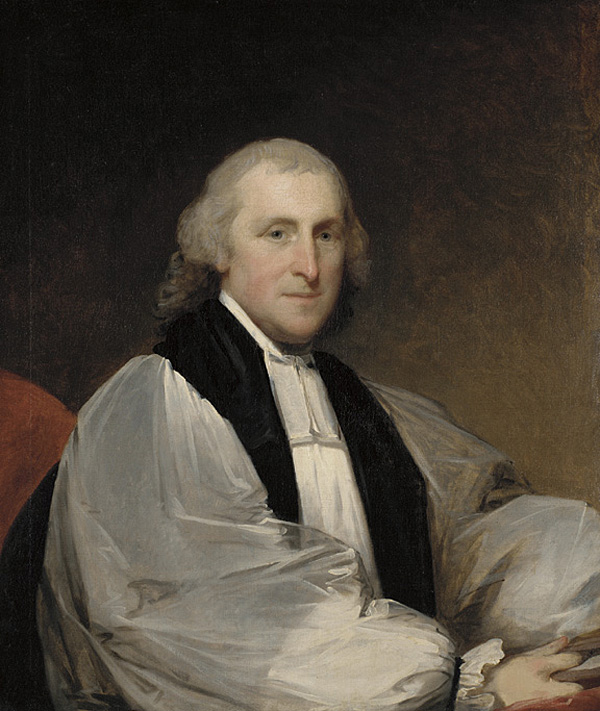
To remedy the situation, a few devoted men took up the cause. Among them were Samuel Seabury, Samuel Provoost, the person we celebrate today, William White, and James Madison – all four of which made the journey to England to be consecrated. Then, having enough American Bishops, Thomas Clagget was consecrated Bishop in New York, and the Church in America could function separately from the Church of England. In 1789 – the first General Convention – under these men’s leadership, specifically William White, the American Episcopal Church was fully organized.
William White served as our first and fourth presiding Bishop in 1789 and from 1795 to 1836. In addition, he served for 57 years as the rector of St. Peter and Christ Church in Philadelphia. He died in 1836.
A lengthy obituary devoted to Bishop White appeared in the National Gazette and Literary Register. In part, it described his character, “…[T]he duties of the several important relations in which he stood to society were performed with undeviating correctness and suavity; he possessed the rare merit of winning the respect and love of an entire community to which he was an ornament and a blessing. His piety was deep and unfeigned; his walking humble yet dignified; his acquirements profound; in his mind the welfare of the Christian church was always the prominent consideration…He was one of those examples of steady virtue sent upon earth by Divine Providence, as if to prove how near the great pattern of perfection it is permitted to approach.”
In our Gospel reading today, Jesus asked St. Peter, “Simon, son of John, do you love me more than these?” He said to him, “Yes, Lord; you know that I love you.” Jesus said to him, “Feed my lambs.” This was the restoration of St. Peter after he denied Jesus three times the night before Jesus was crucified. It is also a command given to all who would be followers of Jesus – “Feed my sheep.” In those three words, God calls us all, lay and ordained, to care for those we encounter. To care for them in both their physical and spiritual needs. For us in the Episcopal Church, William White is an exemplary role model for us to emulate. When you consider what it means to be true and faithful to the Church, you need only consider him to find the “great pattern of perfection” that leads to becoming a faithful servant to God and His One Holy Catholic and Apostolic Church.
There was a frog that absolutely knew his destiny was to turn into a handsome young prince. But for confirmation, he decided to visit a fortuneteller. The fortuneteller brought the frog in and gazed into her crystal ball. She said, “Oh, I see something. You are going to meet a beautiful young woman.”
The frog gets very antsy, “Yes, I knew it. I’m going to become a prince.”
The fortuneteller continues, “From the moment she sets eyes on you, she will have an insatiable desire to know all about you. She will be compelled to get close to you—you’ll fascinate her.”
The frog is very excited. It is everything he has ever desired. He asks, “Where am I? At a party? A restaurant? A palace?”
The fortuneteller gazes even deeper into her crystal ball, then, looking up, answers, “No, Biology class.”
The things we desire. Author Jackson Brown, Jr. said, “I’ve learned that if you give a pig and a boy everything they want, you’ll get a good pig and a bad boy.” (Live and Learn and Pass it On) There’s a good bit of wisdom in that. Wisdom that Herod could have benefited from.
Today’s Gospel reading is one of the few in our lectionary that does not include the words of Jesus. Instead, we have an incident from the life of Herod and his dealings with John the Baptist.
John the Baptist had condemned Herod for marrying his brother’s wife, Herodias. Was John correct in this condemnation? Yes. From the Law of Moses, “If a man takes his brother’s wife, it is impurity.” Herod may not have minded so much, but Herodias, his wife, took it personally and held a grudge against John. So, when the opportunity arose, it was probably she who convinced Herod to arrest John.
One day, while John is in prison, Herod throws himself a great birthday party and invites all his little minions to tell him how great he is. To impress them, we are told that he asked his “daughter Herodias” to come in and dance. This is a case of Daryl, his brother Daryl, and their brother Daryl. Herod’s wife is Herodias, and his stepdaughter is Princess Herodias, also known as Salome. Salome comes in and dances. Herod is so impressed with the dance that he makes an outlandish offer to the girl, “Ask me for whatever you wish, and I will give it. Whatever you ask me, I will give you, even half of my kingdom.” Salome is a child and has no idea what to ask for, so she runs to Momma and asks her. Having her grudge against John the Baptist, Momma asked for John’s head, probably because she feared her husband would eventually release John because he liked him. Having made the outlandish offer to the girl in front of all those guests, Herod had to make good on his promise to give her whatever she asked or lose face. Bottom line: John was beheaded.
There’s much we can learn from this, but one of my questions was, why did Herod promise up to half his kingdom to Salome? The answer, or at least part of it, is desire. The girl was young and beautiful, and the dance was provocative. Herod saw something he desired, and that desire drove him to lust for the girl, make outlandish promises, experience pride in his unwillingness to reverse course, go against his conscience, and ultimately to even greater sin in ordering the death of John. All of that because of desire.
There is a healthy desire for something. Such a desire leads to motivation, imagination, hope, and more. But so often, the things we desire are either of no consequence in the larger picture or, like with Herod, sinful.
Think of something you desire or want that falls outside the healthy category. Sometimes, the object of our desire is so elusive or outside the realm of possibility we know we will never be able to obtain it—perfect example: Scarlett Johansson. Never going to happen. You know it, and I know it, and if she knew I even existed, she would know it, but what if I didn’t? What if I became one of those weird, obsessive stalkers? What would that lead to other than a lengthy prison sentence? I would covet what others could have, and in that, I would become disappointed, angry, and frustrated. My actions would probably resemble something of Herod’s or the frog pinned down in a biology class.
At other times, we have the means to obtain those things we desire. Lucky you. However, how many times have you desired something in an unhealthy way, actually ended up getting it, but then being less than 100% happy with it, even disappointed? Sometimes, that’s a bit like reading a good book and hearing they’re making a movie out of the book. You get all excited, await the release date, watch the previews with anticipation, and then… eh. In other cases, when you finally obtain the object of your desire, you ask, “Now what?” “What is there to look forward to?” “What am I supposed to do?” “Is this all there is?” In those cases, instead of being happy, we start wanting something else, and the cycle repeats itself time and time again.
In all of these cases, what did it cost you? Time? Energy? Money? Joy? Peace? Happiness? What did it cost the people around you? Did you even consider them? Was it worth it? In seeking it out, how did you sin? Who did you hurt or neglect? How many blessings did you overlook or ignore because you were so singularly focused on this one desire? At that stage, perhaps we didn’t order anyone’s death, but we are no better than Herod, who desired a dancing girl.
So, again, think of something you desire, even those healthy desires, and replace it. Replace it with God. What if your desire for God was as great as your desire for things of this world? What if you were one of those weird obsessive stalkers, but the object of your obsession, of your desire, is God? Is that an unreasonable or unobtainable desire? No. The Lord says, “You will seek me and find me when you seek me with all your heart.” (Jeremiah 29:13) The Psalmist writes, “The Lord is near to all who call on him, to all who call on him in truth.” (Psalm 145:18) Once you have come into the presence of God will you say, “Now what? Is this all there is?” No.
“‘Oh, the depth of the riches and wisdom and knowledge of God! How unsearchable are his judgments and how inscrutable his ways!
‘For who has known the mind of the Lord, or who has been his counselor?’
‘Or who has given a gift to him that he might be repaid?’
For from him and through him and to him are all things.’” (Romans 11:33-36)
The knowledge, wisdom, love, and person of God and His Son Jesus Christ are inexhaustible. You will never delve the depths of God. There is always more, but unlike desiring more of this world, when you desire God, it never gets old or frustrating or boring. It only becomes richer and more exciting.
St. Augustine wrote his autobiography, Confessions, around the year 400. In the first chapter, he states, “Thou hast formed us for Thyself, and our hearts are restless till they find rest in Thee.” Then he asks, “Oh! how shall I find rest in Thee? Who will send Thee into my heart to inebriate it, so that I may forget my woes, and embrace Thee my only good?”
Like the things of this world, desiring God will cost you time and energy, but as Augustine says, God is the only one—the only desire—that will give you rest, where peace and joy are in such measure that the cup of your soul is overflowing. It might mean that I don’t end up on a date with Scarlett Johansson, but hopefully, I won’t end up splayed out with my hands and feet pinned down in some biology class, either.
King David wrote, “Whom have I in heaven but you? And there is nothing on earth that I desire besides you.” (Psalm 73:25) What of all the rest? Allow God to work these things out according to His good purposes, for as Jesus tells us, “Seek first—desire first—the kingdom of God and his righteousness, and all these things will be added to you.” (Matthew 6:33)
Let us pray: Father in heaven, our hearts desire the warmth of your love, and our minds are searching for the light of your Word. Increase our longing for Christ our Savior and give us the strength to grow in love, that the dawn of his coming may find us rejoicing in his presence and welcoming the light of his truth. We ask this in the name of Jesus the Lord. Amen.
When I think of CEOs—Chief Executive Officers—of major corporations, I often think of men and women with a single focus, which all boils down to dollars. Perhaps that is why they are in the positions they hold, because it only takes one or two bad quarters, and the CEO is looking for another job that may or may not come with an office on the top floor. My guess is that many CEOs are singularly focused, but I suspect the really successful ones have found a balance in their lives.
Currently, Coca-Cola Enterprises is a company worth about $271 billion. Who knew a little red can was worth so much, but they are involved in far more than fizzy sodas. From 1986-1991, Brian Dyson was the CEO. Although not worth as much then as today, it was still a powerhouse. In 1996, Brian was invited to Georgia Tech to deliver the commencement address. Perhaps they were expecting him to speak on that singular drive for the golden ring, but instead, they got a lesson in leading a balanced life. Brian said:
“Imagine life as a game in which you are juggling some five balls in the air. You name them – work, family, health, friends, and spirit – and you are keeping all of these in the air. You will soon understand that work is a rubber ball. If you drop it, it will bounce back. But the other four balls – family, health, friends, and spirit – are made of glass. If you drop one of these, they will be irrevocably scuffed, marked, nicked, damaged, or even shattered. They will never be the same. You must understand that and strive for balance in your life.”
Benedict of Nursia wrote his rule, what we now know as the Rule of St. Benedict, in the 6th century. Towards the end of the prologue, Benedict writes:
Brothers and sisters, we have asked the Lord who is to dwell in His tent, and we have heard His commands to anyone who would dwell there; it remains for us to fulfill those duties. Therefore we must prepare our hearts and our bodies to do battle under the holy obedience of His commands; and let us ask God that He be pleased to give us the help of His grace for anything which our nature finds hardly possible. And if we want to escape the pains of hell and attain life everlasting, then, while there is still time, while we are still in the body and are able to fulfill all these things by the light of this life, we must hasten to do now what will profit us for eternity. And so we are going to establish a school for the service of the Lord.
To accomplish this life, the religious who lived within the walls of the school or monastery were to work toward a life of balance between prayer, work, study, and renewal or rest. Whether aware of it or not, this is the type of life that Brian Davis was trying to describe to that graduating class—a life of balance.
Considering our own lives, I suspect the rubber ball—that which we can occasionally allow to “drop”—is different for each of us. Unfortunately, whatever it may be, that aspect of our life is likely something that we view as one of our most dear “possessions,” for a possession is not only understood as a thing but also something we can control, like a job or even a hobby. This is why Jesus said, “None of you can become my disciple if you do not give up all your possessions”? Those things we possess—things we have or control—often end up possessing us. And, like the demons that possessed the sick, these possessions drive us from God and the other aspects of our lives. Therefore, if some part of your life possesses you, find ways to let it go for a time so that different parts of your life are not neglected.
On Sunday, June 2nd, I was sitting at home in my comfy clothes with a tasty cup of coffee, and watching the service here at St. Matthew’s on Facebook live. Father Jim preached a fine sermon. As is our way, this was then followed by the Creed, the prayers, the confession, and the seventh-inning stretch—also known as the peace.
I watched and smiled as I saw you all greeting one another, imagining the pew hopping and all. Then, at the bottom right corner of the screen, in rolled Andrew, sitting in his wheelchair. He was all smiles. Elizabeth greeted him, then there was this steady stream of you all coming up and giving Andrew the Peace. Afterward, he rolled back out of view from the camera. The whole time I watched, it never once crossed my mind that this would be the last time I would see him. I suspect, for those who saw him that day, you never thought it would be the last time you would see him, either.
Today, we heard the words of the Psalmist, as he speaks to the Lord,
“My frame was not hidden from you when I was made in the secret place, when I was woven together in the depths of the earth.
Your eyes saw my unformed body; all the days ordained for me were written in your book before one of them came to be.”
All the days ordained for me were written in your book, including the very last.
Just as we did not consider that it might be the last day for Andrew, we also do our very best not to consider our own last day. It is something we fight desperately against. However, Andrew was in a rather unique position. Like Job, who spent days considering the ways of God, Andrew also—in his trials—had the opportunity to consider the ways of God. Like any of us, he did not come to fully understand, but he did give it a great deal of thought. At some point, he sat down and put some of those thoughts to verse in a poem—A Word to the Lord.
Master of beauty, craftsman of the snowflake, inimitable contriver, endower of the Earth so gorgeous and different from the boring Moon, thank you for such as it is my gift.
I have made up a poem to you containing with deep feeling everything that most matters now. “According to thy will,” the thing begins. It took me off and on nearly a week. It does not aim at eloquence.
You have come to my rescue again and again in my impassable, sometimes despairing years. You have allowed my brilliant and beautiful friends to destroy themselves, and I am still here, severely damaged, but functioning.
Unknowable, as I am unknown to a guinea pig, how can I “love” you? I only as far as gratitude and awe confidently and absolutely go.
I have no idea whether we live again. It doesn’t seem likely from either a scientific or philosophical point of view, but certainly, all things are possible to you, and I believe in the resurrection-appearances to Peter and to Paul as I believe I sit here in this green-blue chair. Only that may have been a special case to establish their initiatory faith.
Whatever end you may have for me, accept my amazement. May I stand until death forever at attention for your least instruction or enlightenment. I even feel sure you will assist me again, Master of insight and beauty.
Yes. Andrew had considered his last day. In the end, he knew that he would not be able to understand it all, so instead of entrusting his life to his own means and understanding, he handed all things over to God. With Jesus, Andrew said, “Father, into your hands I commit my spirit!”
Perhaps we never will consider our own last day, but as long as we do the same—as long as we commit our spirit and our bodies to the loving hands of Jesus—then on our last day, Jesus will bring us into our Father’s house, into that place that has been prepared for us.
Today, we mourn the loss of Andrew. Today, we also rejoice for Andrew, for he has been resurrected to eternal life. A life that is available to all who commit their bodies and souls to Jesus.
A beautiful day for walking around the city. It started off in an12th century church, made a deviation into some level of hell, and came out the other side with a delicious espresso.
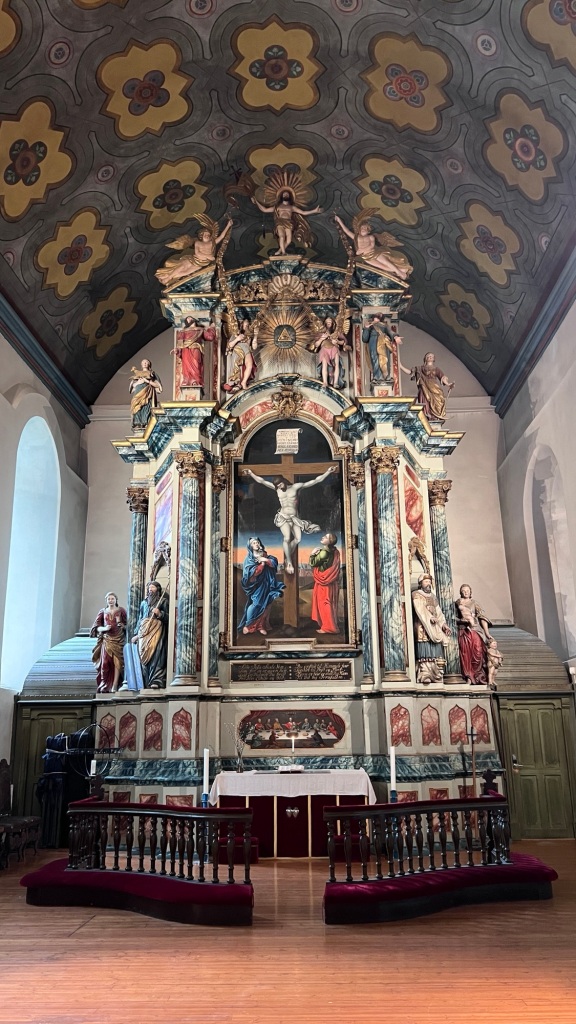
Vår Frue Kirke (The Church of Our Lady) is only a block from the hotel and is one of the oldest buildings in Trondheim, with parts of the building dating back to the 12th century. It now functions as a church, but also community outreach center for the poor. It is sponsored by the Cathedral.
I saw some pictures of the next stop, about a half mile further, and decided it might be interesting.
Oh.
My.
Goodness!
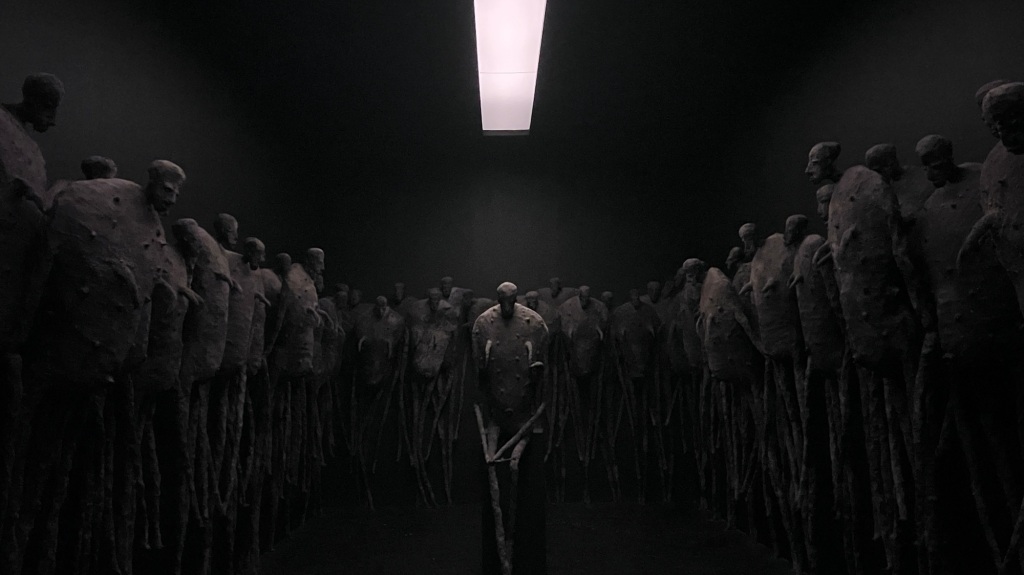
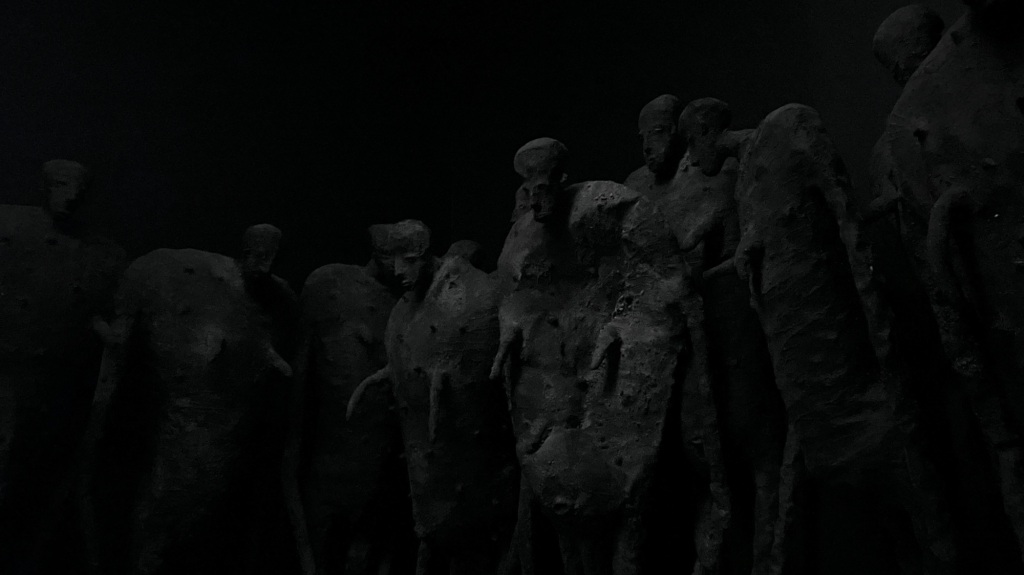
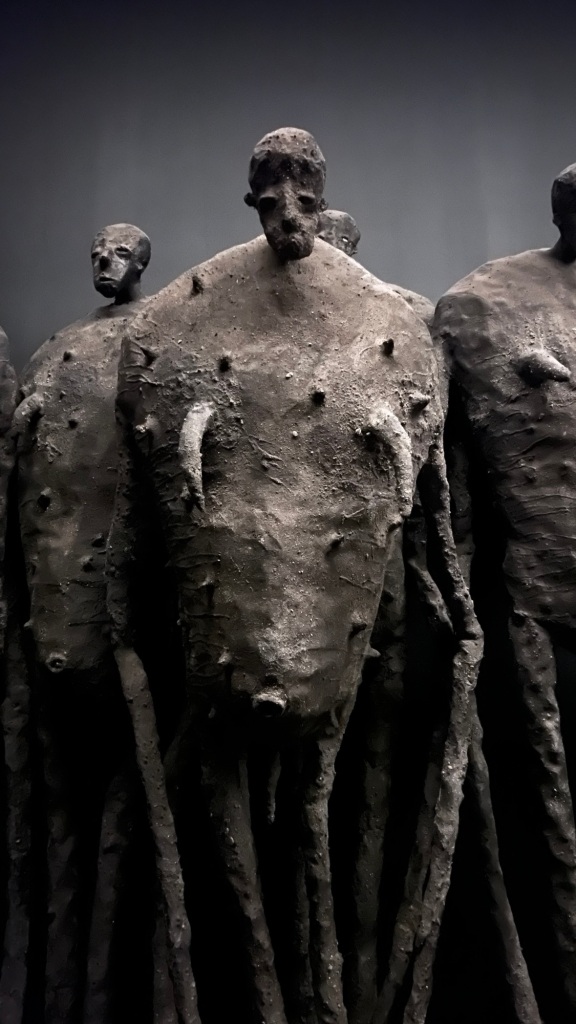
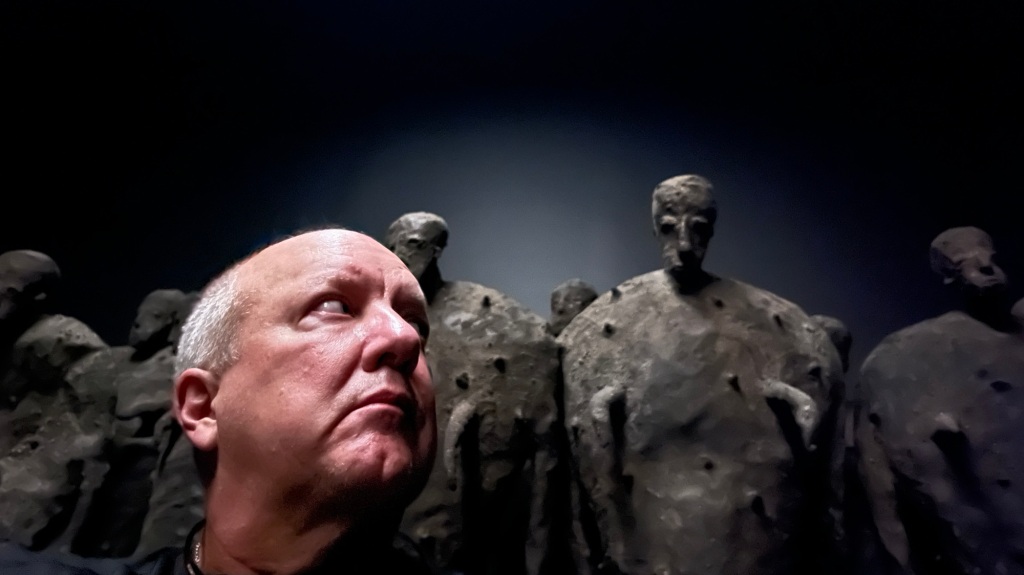
It was worth the trip to Trondheim. The Salamandernatten (The Salamander Night).
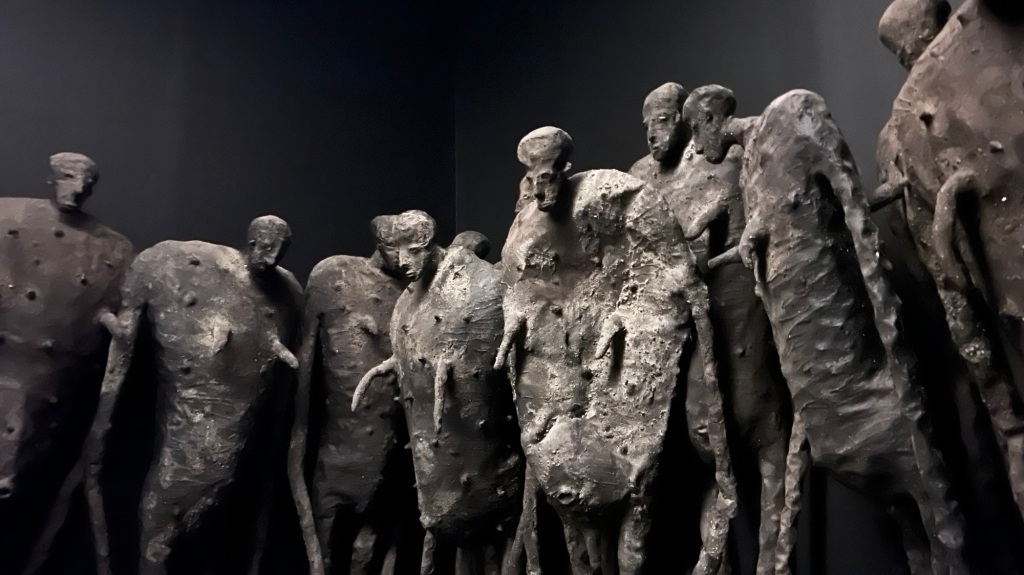
The Salamander Night is an art installation made by Trondheim artist Kjell Erik Killi Olsen for Sao Paulo’s biennial anniversary in Brazil in 1989. The installation is comprised of 72 sculptures, all of which are more than 3 metres high (about 10 feet). The Salamander Night was presented as a gift to Trondheim municipality by the artist in 2007. This wonderful piece of art may be seen in the premises of the bank “Sparebank1 Midt-Norge” in Sendre gate.
The light is quite low, so those pictures that are bright are adjusted or I used a flash so that you could see the sculptures.
Made a short video for your viewing pleasure. The sounds are from the cafe above, but they do add a bit of ambiance.
Fortunately, there were other exhibits in the same location that weren’t as freaky (sarcasm alert).
The 12th century church ruins are the remains of a Romanesque stone church. The church had an underground crypt, a very rare element in Nordic churches. Such crypts have normally had a cultic function in connection with saint worship and functioned as a place of pilgrimage.
As luck would have it, they kept the “saint” around.
And they gave him/her a few companions.
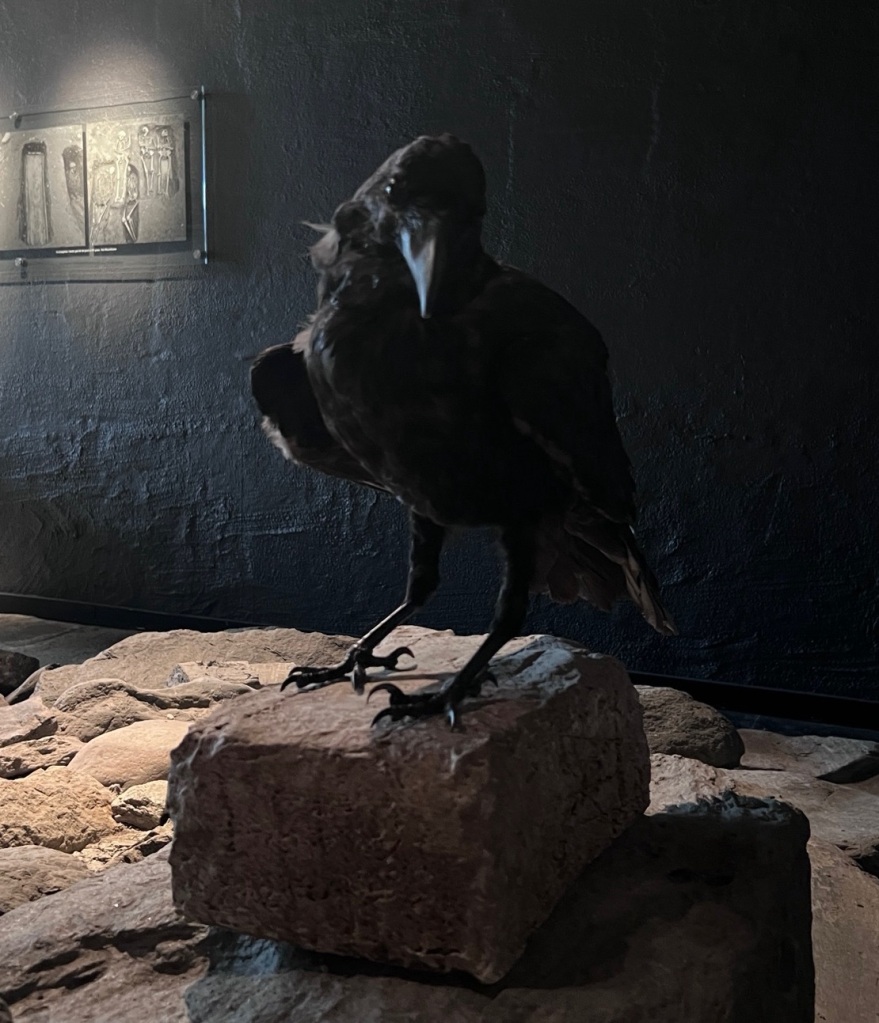
Nevermore… moving on to a happier little bird in another exhibit. I loved the shadows. It is part of the series Twelve Stories by Nils Aas.
After all that, I moved outdoors and crossed the Blomsterbrua (Flower Bridge) and entered Solsiden (The Sunny Side), the trendy happening section of town that is next to the harbor.
It was quiet this morning, and after a bit I stopped for an espresso (perhaps the best I’ve ever had, and that’s saying something because I’ve had plenty.) A little place called Dromedar Kaffebar.
I bought some beans to bring home and hope to find out how to order more.
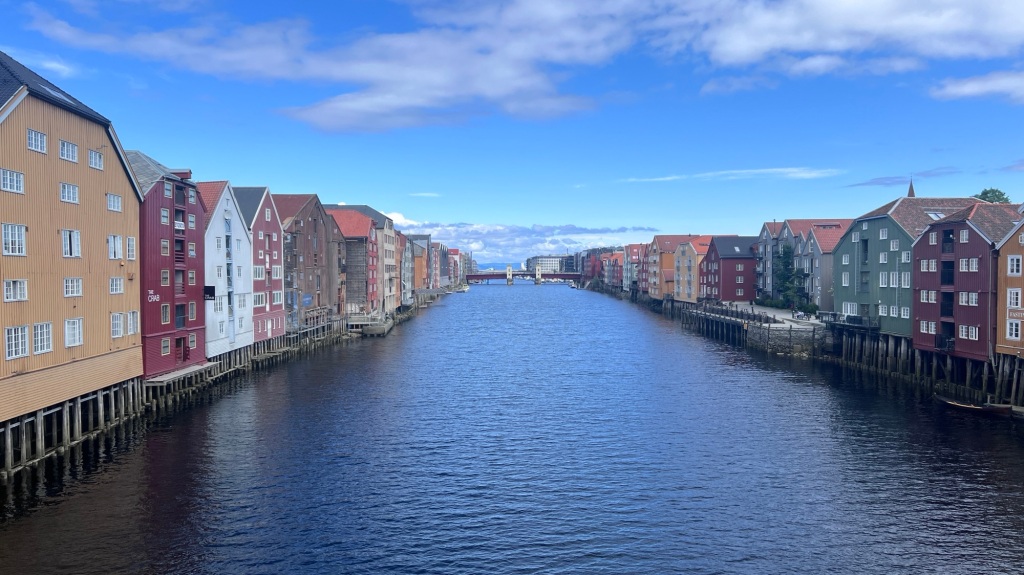
On the way back to the hotel, I found the second bridge that I was looking for (had no idea I was interested in bridges.)
Gamle Bybro (The Old Town Bridge) was first built on this site in 1681, at the same time as Kristiansten Fortress was constructed. A sentry and excise house stood at either end of the bridge. The excise house on the western side is still standing and is used as a kindergarten. The bridge and gates as they now stand were built in 1861.
From the center of the bridge is the quintessential Norwegian photo op.
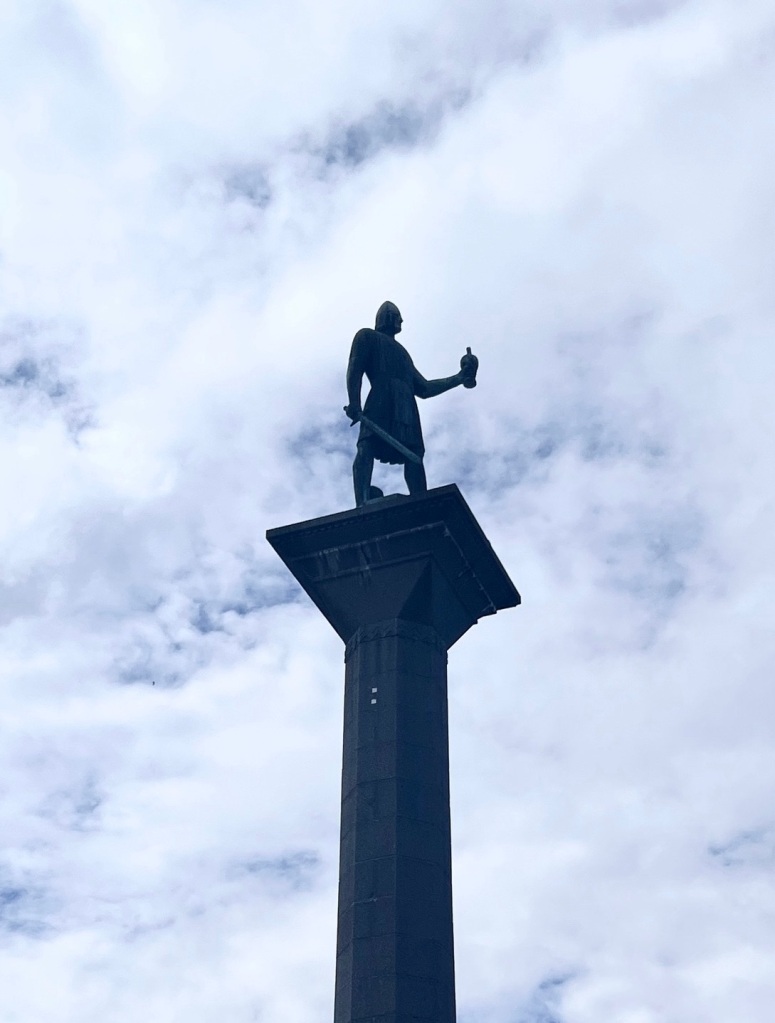
On the way back, I passed through the square and said, “Hello,” to Olaf. He holds up the dove (peace), but also carries a sword. I suppose he is saying, “It’s your call.”
This is likely my last travel post for a while. I’ve got some other writing that I want to work on… I had started a dystopian novel, but Miss Avery (I hope she lives through this one) insisted that I write of Dean Anthony’s most recent adventure. Will there be a murder? Where? Who done it? Working title: The Forty-Seventh Wife. It’ll probably stick.
And, for the record, I’ll be looking over my shoulder for a while.
Please comment below. When I return, we’ll combine some of your journal entries with mine and produce a printed journal of our adventure.
WEEK EIGHT PROMPT
St. Irenaeus writes, “For the glory of God is a living man; and the life of man consists in beholding God.” The glory you have isGod and is of God. Without Him, you are……. nothing. You may claim worldly glory, but that is less than dirty rags. (cf. Isaiah 64.6) How will you reflect God’s glory.
Some days you go to church, other days are something of a conversion experience. Today was the latter. My seat for the Mass (although they don’t call it that here.)
There were two stations to receive Communion. One on the floor, standing, and you intincted. The other was at the high altar… each person receives a small silver chalice. You go and kneel at the altar, the priest places the host in your hands, you eat, then, the deacon comes and pours a small amount of white wine in your personal chalice. If you have to guess as to which way I went, you don’t know me very well. The choir—about 40 members—were singing something, I was receiving, and… they got it right. Beautiful. Again, all in Norwegian and I didn’t understand a word, but I did know the flow. In addition, the entire service was printed in the bulletin, so I could follow along. Lovely. The choir—I’m guessing paid—was amazing.
Following the service, I went for a coffee and a cookie, then began looking around. The first is a view from the back, the second, a view from the front.
Yes. It is startling in every aspect. A few more views from different angles throughout.
Baptismal font.The high altar.Looking up at the crossing.Rose window and organ pipes.
I then went up. 172 steps up a very narrow, claustrophobia inducing spiral staircase and you reach the top. Spectacular. I forgot to take a picture of the staircase, so stole one from the internet. The views were amazing.
This is “perhaps” the tomb of St. Olaf. During the reformation, much was removed, so there is no certainty as to which tomb is his. Silly Lutherans. Historians will tell us that Olaf was no real saint, but don’t say that too loudly amongst these people.
A chapel in the undercroft.
I’ve just begun reading The Kingsbridge Series (Pillars of the Earth is book 3.) I thought of it when I came across this series of models, showing the evolution of the cathedral.
I also had the opportunity to see the crown jewels of Norway. You are not allowed to take pictures, so I borrowed these from the web. What I was able to see were the real thing.
There is just entirely too much to show here. I spent about six hours in the cathedral and museums and didn’t even begin to touch on it all. I hope to show more pictures later.
My attempt at artistic photography.
Now we see in a mirror dimly. There is only one who is seen clearly. One who is True. One who is Life.















 Candle in a Cave