
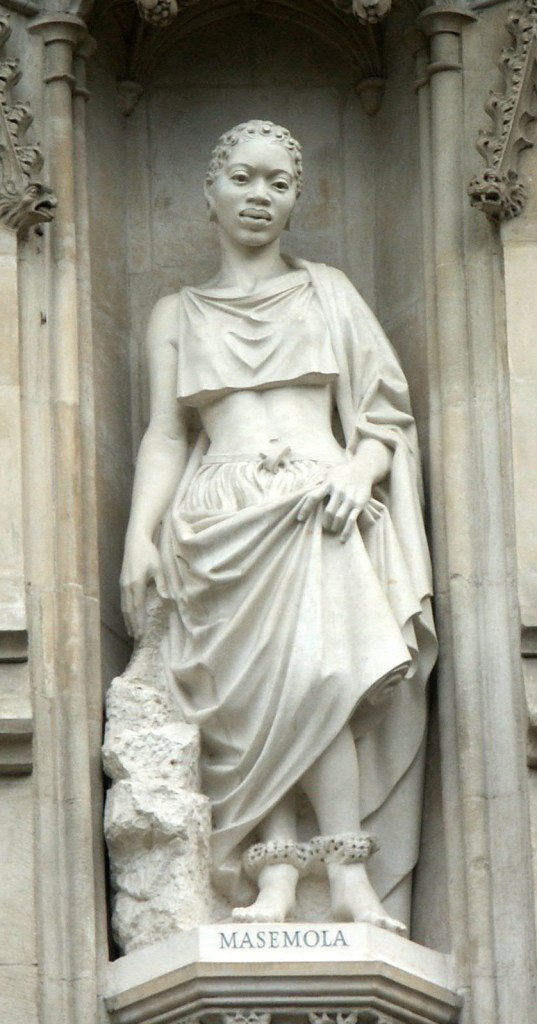
Today, Thursday, and Friday, we celebrate three martyrs. Today, we remember Manche Masemola, an Anglican woman from South Africa who, in 1928, was put to death by her parents at age 15 for converting to Christianity and refusing to renounce her faith. She was unbaptized, but she declared she would be baptized in her own blood. Tomorrow is the Feast Day of St. Agatha, who, in 251 AD, was put to death at age 19 for refusing to renounce her faith and marry a Roman prefect. Shortly before her death, she prayed, “You Lord, who have created and guarded me from my childhood, and made me to act with manly strength, have taken from me the love of the passing world, who kept my body from contamination, who made me overcome the torments of the executioner, the iron, the fire, and the chains, who gave me in torment the virtue of patience! Please accept my spirit now, for it is already time that I should leave this world by your command and reach your mercy.” She is the patron saint of breast cancer patients, which points to some of the torture she endured. And, finally, Friday is the Feast Day of St. Paul Miki and his companions, who were missionaries in Japan in the 1500s and were put to death for proclaiming the Good News. Before he died, he said, “The only reason for my being killed is that I have taught the doctrine of Christ. I certainly did teach the doctrine of Christ. I thank God it is for this reason I die.”
Those are three of the estimated 70 million Christian martyrs since the time of Christ. Even today, 5,000 to 10,000 people are estimated to be martyred each year—people who died for the same cause as Manche, Agatha, and Paul Miki.
On her feast day, Saint Methodius of Sicily spoke of Agatha. The words he shared are true for Agatha and for all who have stood upon the solid rock of their faith in Christ Jesus. Methodius writes, “The woman who invites us to this banquet is both a wife and virgin. To use the analogy of Paul, she is the bride who has been betrothed to one husband, Christ. A true virgin, she wore the glow of pure conscience and the crimson of the Lamb’s blood for her cosmetics. Again and again she meditated on the death of her eager lover. For her, Christ’s death was recent, his blood was still moist. Her robe is the mark of her faithful witness to Christ. It bears the indelible marks of his crimson blood and the shining threads of her eloquence. She offers to all who come after her these treasures of her eloquent confession.
“Agatha, the name of our saint, means “good.” She was truly good, for she lived as a child of God. She was also given as the gift of God, the source of all goodness to her bridegroom, Christ, and to us. For she grants us a share in her goodness.
“Agatha, her goodness coincides with her name and way of life. She won a good name by her noble deeds, and by her name she points to the nobility of those deeds. Agatha, her mere name wins all men over to her company. She teaches them by her example to hasten with her to the true Good. God alone.”
My prayer is that none of us ever has to experience what these and so many others have gone through. My prayer is that if we do, we can stand as firmly in our faith as they did. My prayer is that we can look to their lives and their deaths and find the courage to live our faith in the smallest of details. As St. Josemaría Escrivá tells us, “‘Great’ holiness consists in carrying out the ‘little duties’ of each moment.” (The Way, #817)
 Candle in a Cave