
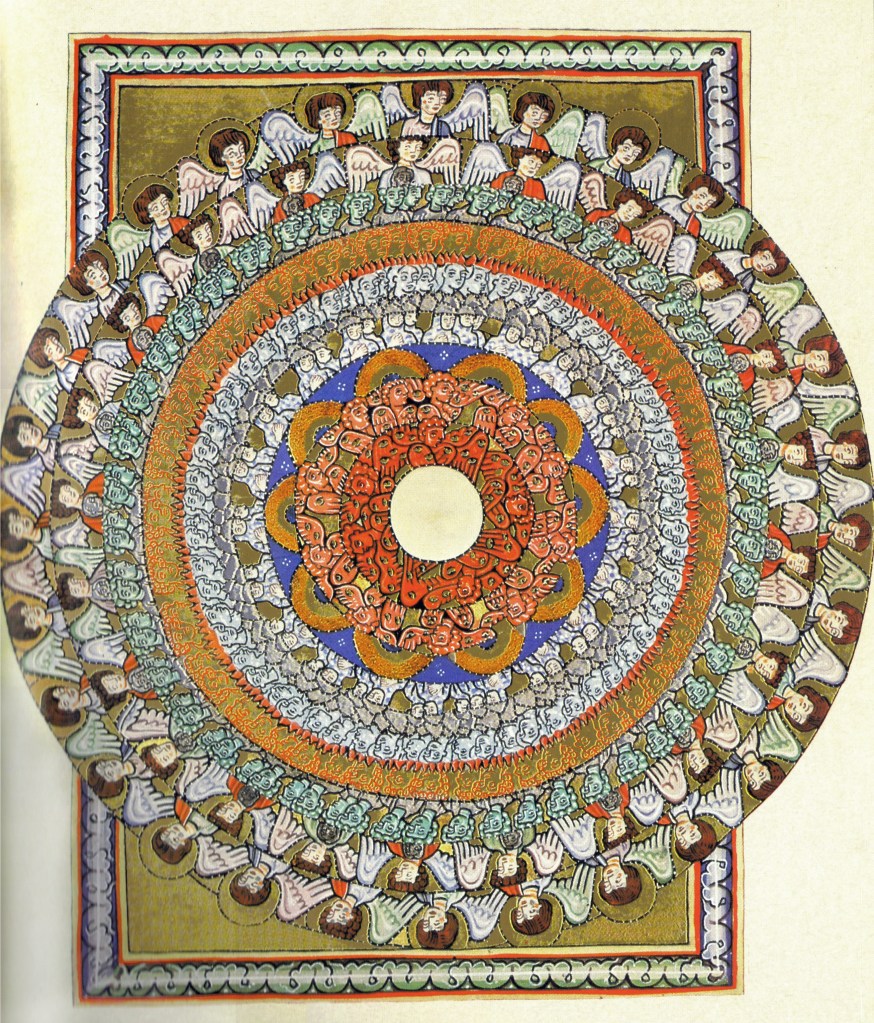
Today, we celebrate Hildegard of Bingen, born in 1098. She was highly sought after for her advice and corresponded with kings, queens, abbots, abbesses, archbishops, and popes. She undertook four preaching tours across northern Europe, practiced medicine, authored treatises on science and philosophy, composed remarkable music and liturgical dramas, and was quite the artist. What makes this even more impressive is that in the 12th century, these roles were typically reserved only for men.
Along with her many achievements, she was also someone who had visions, which started to appear to her when she was just three years old. She would later describe them as “The Shade of the Living Light.” She wrote, “These visions which I saw—I beheld them neither in sleep nor dreaming nor in madness nor with my bodily eyes or ears, nor in hidden places; but I saw them in full view and according to God’s will, when I was wakeful and alert, with the eyes of the spirit and the inward ears.”
Here is an example of her writing:
It is easier to gaze into the Sun than into the face of
the mystery of God.
Such is its beauty and its radiance.
God says:
I am the supreme fire; not deadly, but rather,
enkindling every spark of life.
I am the reflection of providence for all.
I am the resounding WORD; the It-Shall-Be
that I intone with mighty power
from which all the world proceeds.
Through animate eyes I divide the seasons of time.
I am aware of what they are.
I am aware of their potential.
With my mouth I kiss my own chosen creation.
I uniquely, lovingly embrace every image I have
made out of the earth’s clay.
With a fiery spirit I transform it into a body to serve
all the world.
To me, she shows a genuine understanding of God’s love. Not as we might view God from a theologian’s point of view, but from a human perspective (not that theologians aren’t human).
In our Gospel reading today, John wrote those beautiful words, “For God so loved the world that he gave his only Son, so that everyone who believes in him may not perish but may have eternal life.” In Hildegard’s poem, it seems she was expressing that same idea: God is saying, I am aware of who they are, their potential. I lovingly embrace them, transform them, and give them my Son to show them this great love I have for them so that they may be where We are.
Hildegard was one who intimately knew of this transforming love of God and was able to express it through music, preaching, poetry, and art, surpassing the boundaries of her time. Perhaps such intimacy with God is not something everyone can achieve, but it is something everyone should strive for. In doing so, we can also become living testimonies, breaking through our own limits.
There is an exceptional German movie about her life, “Vision,” and I recommend it if you don’t mind subtitles (or speak German).
In 2010, Pope Benedict XVI said, “Let us always invoke the Holy Spirit, so that he may inspire in the Church holy and courageous women like Saint Hildegard of Bingen who, developing the gifts they have received from God, make their own special and valuable contribution to the spiritual development of our communities and of the Church in our time.” In 2012, Benedict named her a Doctor of the Church, among thirty-three at the time, with only three being women.
 Candle in a Cave