
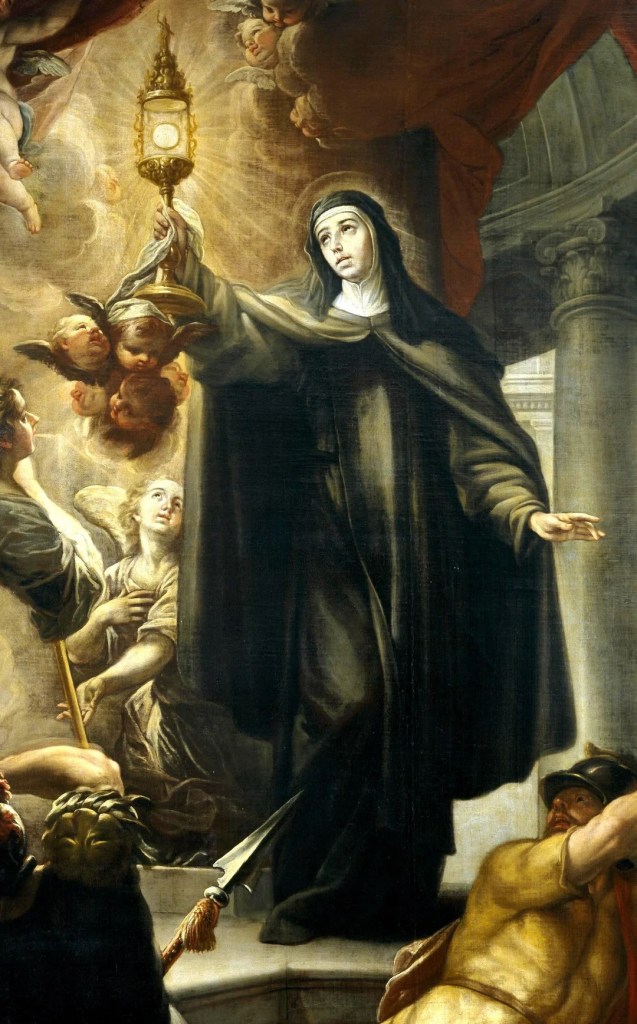
St. Clare of Assisi: We know very little about her childhood beyond being born into a wealthy family. However, at age eighteen, she had the opportunity to hear St. Francis of Assisi preach and decided to leave everything behind.
Sneaking away from her family, who would have prevented her, she went to Francis and expressed her desire to follow in the way of his teachings. She exchanged her fine clothes for a dress of rough fabric. She cut her long, beautiful hair and replaced it with a veil. At one point, her family tried to pull her back, but she ultimately prevailed, and later her sister Agnes and her mother, when widowed, joined her in the convent.
How did she live? She was barefoot all year, spoke only when necessary, prayed for hours daily, had no source of income, so begged for alms, ate no meat, fasted on bread and water, and slept on a hard floor. Eventually, the Bishop and Francis ordered her to sleep on a mattress for health reasons. You might think such a life would be so unappealing that no one would follow in her footsteps, but that was not the case. When she died, “there were forty-seven convents in Spain alone, with many others in Italy, Bohemia, and France. And not long after Clare’s death, four convents of Poor Clares—as they became known—were founded in England.”
She was considered so pure and righteous in faith that bishops, cardinals, and even Popes sought her advice. Pope Innocent IV, who heard her last confession. Following that confession, he said, “I would to God I had so little need of absolution myself.”
On August 11, 1253, the day she died, she was heard to say, “Go forth in peace, for you have followed the good road. Go without fear, for he who created you has sanctified you, has always protected you, and loves you as a mother. Blessed are you, O God, for having created me.”
Could such a movement continue today? Currently, there are 20,000 Poor Clares spread across the world, living cloistered lives dedicated to prayer—praying for the needs of the church and the world.
In a letter to Agnes, the daughter of the King of Bohemia, who also became a Poor Clare, Clare wrote,
When You have loved [Him], You shall be chaste;
when You have touched [Him], You shall become pure;
when You have accepted [Him], You shall be a virgin.
Whose power is stronger,
Whose generosity is more abundant,
Whose appearance more beautiful,
Whose love more tender,
Whose courtesy more gracious.
In Whose embrace You are already caught up;
Who has adorned Your breast with precious stones
And has placed priceless pearls in Your ears
and has surrounded You with sparkling gems
as though blossoms of springtime
and placed on Your head a golden crown
as a sign [to all] of Your holiness.
There is no doubt that St. Clare of Assisi has received the golden crown from the One she loved above all others—Jesus.
 Candle in a Cave