
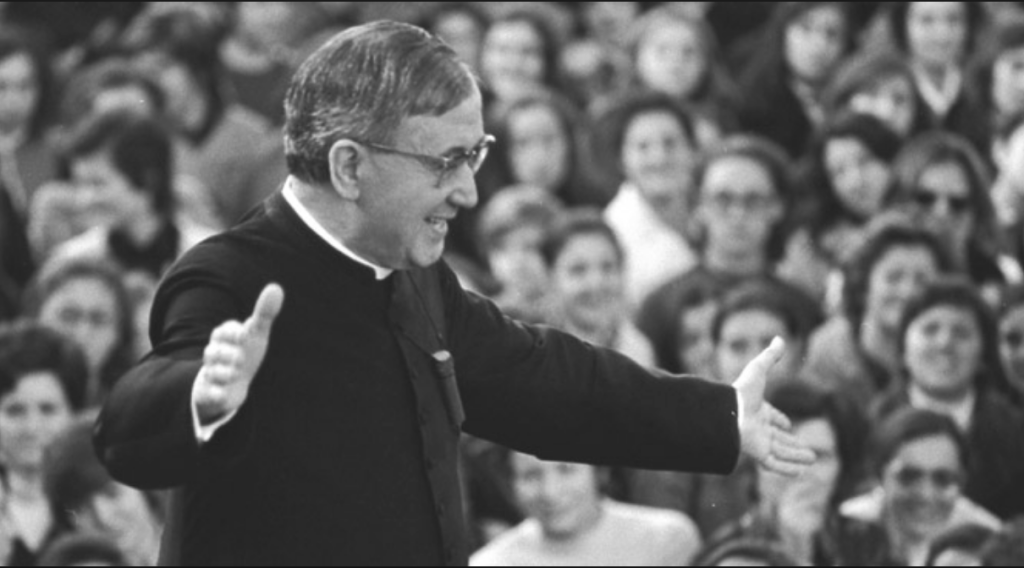
On October 6, 2002, one of the largest crowds ever to gather at the Vatican (with estimates reaching as high as 500,000) came to witness the canonization of one of my friends, Josemaría Escrivá. He is listed in our calendar of saints, but he is mine. His official feast day is tomorrow, June 26.
Pope John Paul II conducted the service and spoke fondly of the Saint and his close friend.
“Outstanding in the founder of Opus Dei was his love for the will of God. There is a sure criterion of holiness: faithfulness in fulfilling the divine will to its ultimate consequences. The Lord has a plan for each one of us; he entrusts each one with a mission on earth. The saint cannot even think of himself outside of God’s plan: he lives only to fulfill it.
“St. Josemaría was chosen by the Lord to proclaim the universal call to holiness and to indicate that everyday life, ordinary activities, are the way of sanctification. It might be said that he was the saint of the ordinary.
“In fact, he was convinced that for anyone who lives from the perspective of faith everything offers an opportunity for encounter with God, everything becomes a stimulus for prayer. From this point of view, daily life reveals an unsuspected grandeur. Holiness appears truly within the reach of all.”
“St. Josemaría was profoundly convinced that the Christian life entails a mission and an apostolate: We are in the world to save it with Christ.
“He loved the world passionately, with a redemptive love. Precisely for this reason his teachings have helped so many ordinary members of the faithful to discover the redemptive power of faith, its capacity to transform the earth.
“This is a message that has abundant and fruitful implications for the evangelizing mission of the Church. It fosters the Christianization of the world ‘from within,’ showing that there can be no conflict between the divine law and the demands of genuine human progress.
“This saintly priest taught that Christ must be the apex of all human activity. His message impels the Christian to act in places where the future of society is being shaped.
“From the laity’s active presence in all the professions and at the most advanced frontiers of development there can only come a positive contribution to the strengthening of that harmony between faith and culture, which is one of the greatest needs of our time.”
I’ve read what many consider his most popular book, The Way, a collection of 999 sayings, multiple times. Also, through the internet, I’ve heard him speak at various events. What stands out to me is the difference between the two. When he speaks to others, he is compassionate and supportive, but many of the sayings in The Way can be quite harsh at times. Regarding charity, he writes, “Your charity is presumptuous. From afar, you attract; you have light. From nearby, you repel; you lack warmth. What a pity!” (#459)
Many others are similar, and all the writings are clear and bold, which makes me think that The Way (and I have no way of proving this) was originally a collection of sayings to himself. Words he spoke to himself to bring correction to his own life in areas he thought necessary, and it is that type of self-examination/self-evaluation that would make a Saint. Ever seeking to improve in the eyes of God. Such honesty with oneself can sometimes be quite painful, but as the Proverbs tell us, “Iron sharpens iron” (27:17), and we can all use honesty in our own self-examination and evaluation so that we too become the saints God has called us all to be.
 Candle in a Cave