
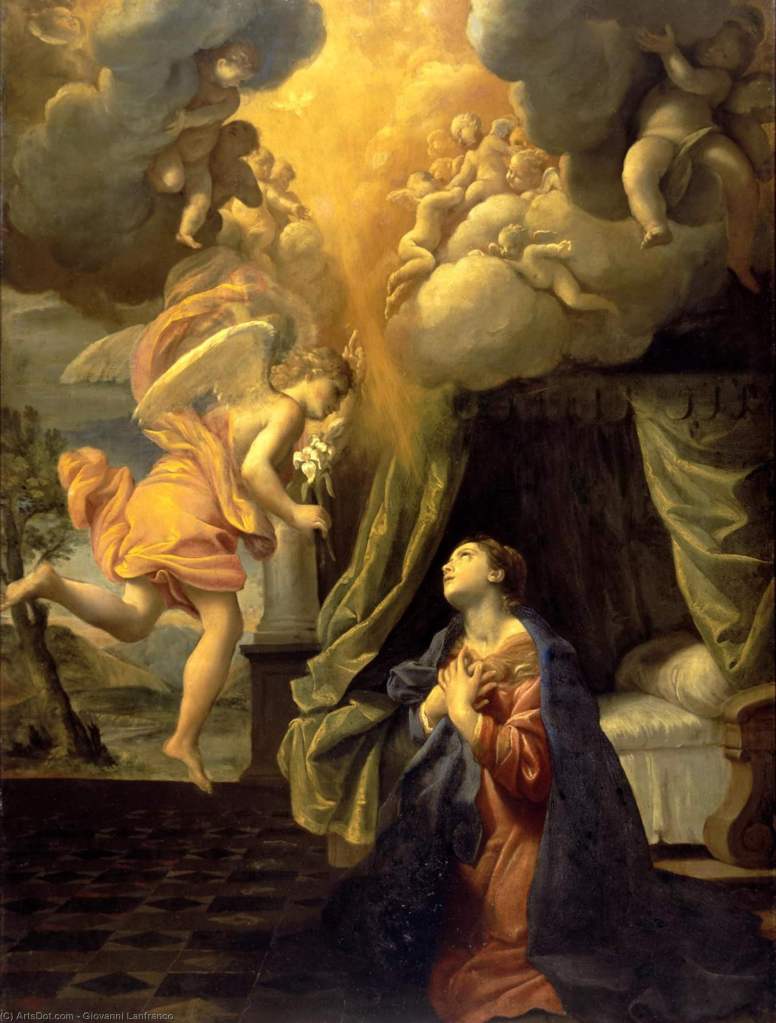
During the Season of Lent, there are only two significant feast days on our church calendar. One was last Wednesday, the Feast of St. Joseph; the other was yesterday, The Annunciation. Both of these days are fixed, meaning we cannot transfer them from one date to another. St. Joseph’s Day must be celebrated on March 19, and the Annunciation must be celebrated on March 25. Today is March 26, so today we are celebrating the day after the Annunciation when Mary was only a little bit pregnant.
Why must the Annunciation be celebrated on March 26? Math and biology. It is, after all, only 274 days until Christmas—that would be nine months—when we celebrate the birth of Jesus. Therefore, even though we are only days away from Jesus’ death on a cross outside of Jerusalem, we pause to remember the day that the angel of the Lord came to the Blessed Virgin Mary and told her she would conceive in her womb the very Son of God.
The feast of The Annunciation is a pivotal event in God’s plan of salvation for His people.
For centuries, the prophets had been speaking of the coming of a Savior. Perhaps the prophet whose voice we are most familiar with regarding the Savior’s birth is Isaiah.
The people walking in darkness
have seen a great light;
on those living in the land of deep darkness
a light has dawned….
For to us a child is born,
to us a son is given,
and the government will be on his shoulders.
And he will be called
Wonderful Counselor, Mighty God,
Everlasting Father, Prince of Peace.
The world looked for this child, this Savior, because as St. Paul wrote in his letter to the Romans: “The creation was subjected to frustration, not by its own choice, but by the will of the one who subjected it, in hope that the creation itself will be liberated from its bondage to decay and brought into the freedom and glory of the children of God. We know that the whole creation has been groaning as in the pains of childbirth right up to the present time.”
The world is groaning under bondage and decay, but for the child to be born, Jesus can save it. However, all of this depends on the response of a young teenage girl.
The angel tells Mary, “You will conceive in your womb and bear a son, and you will name him Jesus.” He goes on to tell her about her cousin Elizabeth and then waits for Mary’s response. In the moment before Mary spoke, a deacon observed, “It was the moment when all creation held its collective breath.” (Source) St. Bernard of Clairvaux also wrote in his homily for this day, “You have heard, O Virgin, that you will conceive and bear a son; you have heard that it will not be by man but by the Holy Spirit. The angel awaits an answer; it is time for him to return to God who sent him. We too are waiting, O Lady, for your word of compassion.” (Source)
We know her response, but had we been present, we would also have held our breath. Will she say “Yes” or “No?” Will we be saved, or are we condemned forever?
Mary speaks. ”Here am I, the servant of the Lord; let it be with me according to your word.” And all creation wept for joy.
How does that short prayer begin: “Hail Mary, full of grace. The Lord is with thee. Blessed art thou among women…”
Our Mother Mary is truly blessed. Her “Yes” to God allowed the birth of our salvation.
I wonder, what would your “yes” to God accomplish?
 Candle in a Cave